
外交部翻译的笔记符号
笔记 口译常用缩写
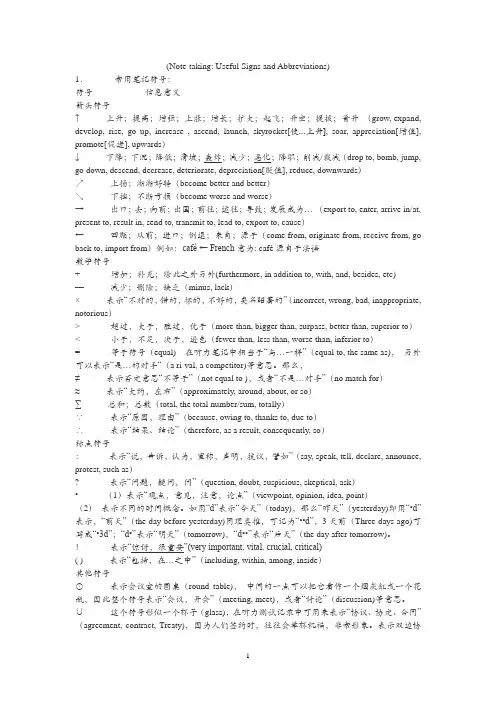
(Note-taking: Useful Signs and Abbreviations)1.常用笔记符号:符号信息意义箭头符号↑上升;提高;增强;上涨;增长;扩大;起飞;升空;提拔;晋升(grow, expand, develop, rise, go up, increase , ascend, launch, skyrocket[使...上升], soar, appreciation[增值], promote[促进], upwards)↓下降;下沉;降低;滑坡;轰炸;减少;恶化;降职;削减/裁减(drop to, bomb, jump, go down, descend, decrease, deteriorate, depreciation[贬值], reduce, downwards)↗上扬;渐渐好转(become better and better)↘下挫;不断亏损(become worse and worse)→出口;去;向前;出国;前往;运往;导致;发展成为… (export to, enter, arrive in/at, present to, result in, send to, transmit to, lead to, export to, cause)←回顾;从前;进口;倒退;来自;源于(come from, originate from, receive from, go back to, import from)例如:café ← French意为: café源自于法语数学符号+ 增加;补充;除此之外另外(furthermore, in addition to, with, and, besides, etc)—减少;删除;缺乏(minus, lack)×表示“不对的,错的,坏的,不好的,臭名昭著的”(incorrect, wrong, bad, inappropriate, notorious)> 超过,大于,胜过,优于(more than, bigger than, surpass, better than, superior to)< 小于,不足,次于,逊色(fewer than, less than, worse than, inferior to)= 等于符号(equal) 在听力笔记中相当于“与…一样”(equal to, the same as),另外可以表示“是…的对手“(a ri-val, a competitor)等意思。
翻译的笔记符号
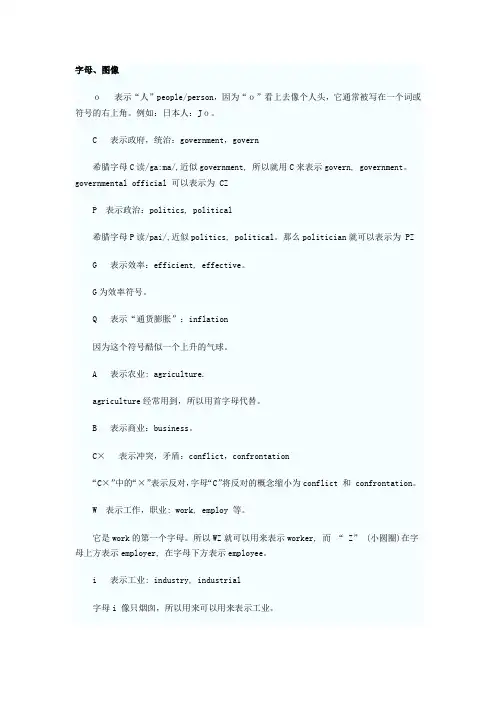
字母、图像o表示“人”people/person,因为“o”看上去像个人头,它通常被写在一个词或符号的右上角。
例如:日本人:Jo。
C 表示政府,统治:government,govern希腊字母C读/ga:ma/,近似government, 所以就用C来表示govern, government。
governmental official 可以表示为 CZP 表示政治:politics, political希腊字母P读/pai/,近似politics, political。
那么politician就可以表示为 PZG 表示效率:efficient, effective。
G为效率符号。
Q 表示“通货膨胀”:inflation因为这个符号酷似一个上升的气球。
A 表示农业: agriculture.agriculture经常用到,所以用首字母代替。
B 表示商业:business。
C×表示冲突,矛盾:conflict,confrontation“C×”中的“×”表示反对,字母“C”将反对的概念缩小为conflict 和 confrontation。
W 表示工作,职业: work, employ 等。
它是work的第一个字母。
所以WZ就可以用来表示worker, 而“ Z” (小圆圈)在字母上方表示employer, 在字母下方表示employee。
i 表示工业: industry, industrial字母i 像只烟囱,所以用来可以用来表示工业。
U U 看酷似一个酒杯,在笔记中表示合同、协议(treaty, agreement)一般只有在谈判成功、协议成交后才会表示“举杯祝贺”。
如果在U内填入2,就可以表示为bilateral(双边的), 填入3表示为trilateral (三边的)。
填入在U中填入1表示: Unilateralism(单边主义),填入m (multiple) 表示多边主义。
口译笔记的符号和缩略语
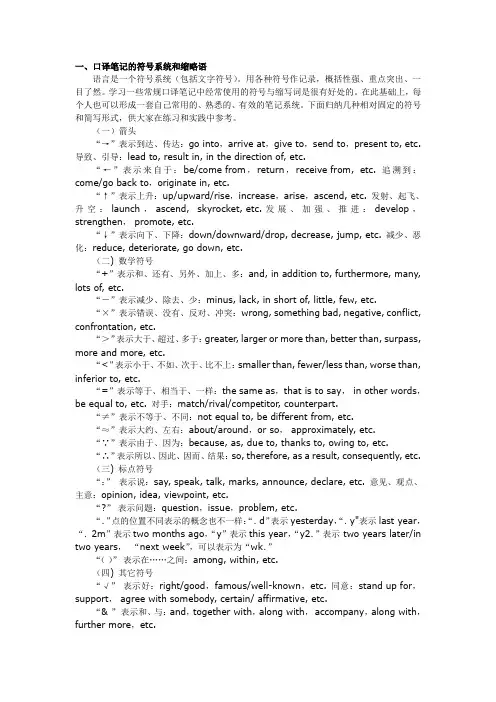
一、口译笔记的符号系统和缩略语语言是一个符号系统(包括文字符号)。
用各种符号作记录,概括性强、重点突出、一目了然。
学习一些常规口译笔记中经常使用的符号与缩写词是很有好处的。
在此基础上,每个人也可以形成一套自己常用的、熟悉的、有效的笔记系统。
下面归纳几种相对固定的符号和简写形式,供大家在练习和实践中参考。
(一)箭头“→”表示到达、传达:go into,arrive at,give to,send to,present to, etc. 导致、引导:lead to, result in, in the direction of, etc.“←”表示来自于:be/come from,return,receive from, etc. 追溯到:come/go back to,originate in, etc.“↑”表示上升:up/upward/rise,increase,arise,ascend, etc. 发射、起飞、升空:launch,ascend, skyrocket, etc.发展、加强、推进:develop,strengthen, promote, etc.“↓”表示向下、下降:down/downward/drop, decrease, jump, etc. 减少、恶化:reduce, deteriorate, go down, etc.(二) 数学符号“+”表示和、还有、另外、加上、多:and, in addition to, furthermore, many, lots of, etc.“-”表示减少、除去、少:minus, lack, in short of, little, few, etc.“×”表示错误、没有、反对、冲突:wrong, something bad, negative, conflict, confrontation, etc.“>”表示大于、超过、多于:greater, larger or more than, better than, surpass, more and more, etc.“<”表示小于、不如、次于、比不上:smaller than, fewer/less than, worse than, inferior to, etc.“=”表示等于、相当于、一样:the same as,that is to say, in other words,be equal to, etc. 对手:match/rival/competitor, counterpart.“≠”表示不等于、不同:not equal to, be different from, etc.“≈”表示大约、左右:about/around,or so, approximately, etc.“∵”表示由于、因为:because, as, due to, thanks to, owing to, etc.“∴”表示所以、因此、因而、结果:so, therefore, as a result, consequently, etc.(三) 标点符号“:”表示说:say, speak, talk, marks, announce, declare, etc. 意见、观点、主意:opinion, idea, viewpoint, etc.“?”表示问题:question,issue,problem, etc.“.”点的位置不同表示的概念也不一样:“.d”表示yesterday,“.y"表示last year,“.2m”表示two months ago,“y”表示this year,“y2.”表示 two years later/in two years,“next week”,可以表示为“wk.”“()”表示在……之间:among, within, etc.(四) 其它符号“√”表示好:right/good,famous/well-known,etc. 同意:stand up for,support, agree with somebody, certain/ affirmative, etc.“& ”表示和、与:and,together with,along with, accompany,along with,further more,etc.“☆”表示重要的、杰出的、优秀的、榜样:important, best,outstanding,brilliant,model, etc.“∥”表示结束:end,stop,halt,bring something to a standstill/stop, etc.“°”表示人、者:person, people, 如经济学家可以表示为“经°”,中国人可以表示为“中°”,etc.“⊙”表示会议、讨论、谈判:meeting, seminar, discussion, negotiation, etc.“♂”表示男人:man, male, boy, etc.“♀”表示女人:woman, female, girl, etc.“□”表示国家:country, state, nation, etc.“△”表示代表:represent, on behalf of, etc.“∽”表示交流、交换、替代、相互:exchange, mutual, each other, communication, replace, etc.(五) 缩略词英语缩写词的写法一般有以下几种:●拿掉所有元音。
口译人员常会用到的笔记符号及缩写
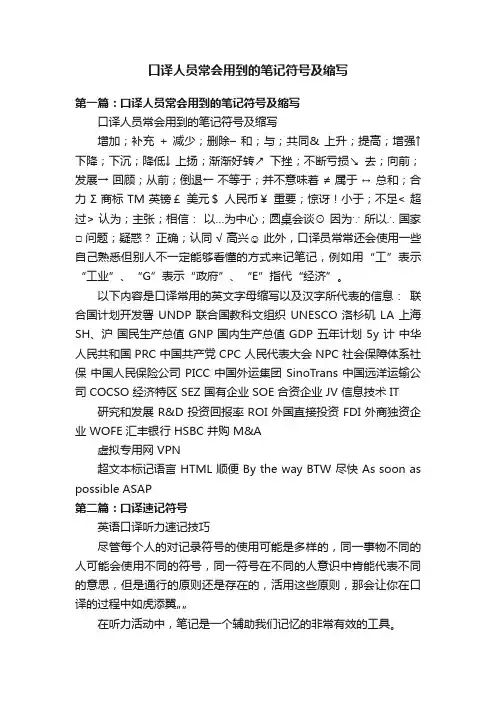
口译人员常会用到的笔记符号及缩写第一篇:口译人员常会用到的笔记符号及缩写口译人员常会用到的笔记符号及缩写增加;补充+ 减少;删除–和;与;共同& 上升;提高;增强↑ 下降;下沉;降低↓ 上扬;渐渐好转↗ 下挫;不断亏损↘ 去;向前;发展→ 回顾;从前;倒退← 不等于;并不意味着≠ 属于↔总和;合力Σ 商标 TM 英镑£美元$人民币¥重要;惊讶!小于;不足< 超过> 认为;主张;相信:以…为中心;圆桌会谈⊙ 因为∵ 所以∴ 国家□ 问题;疑惑?正确;认同√ 高兴☺此外,口译员常常还会使用一些自己熟悉但别人不一定能够看懂的方式来记笔记,例如用“工”表示“工业”、“G”表示“政府”、“E”指代“经济”。
以下内容是口译常用的英文字母缩写以及汉字所代表的信息:联合国计划开发署 UNDP 联合国教科文组织 UNESCO 洛杉矶 LA 上海SH、沪国民生产总值 GNP 国内生产总值 GDP 五年计划 5y 计中华人民共和国 PRC 中国共产党 CPC 人民代表大会 NPC 社会保障体系社保中国人民保险公司 PICC 中国外运集团 SinoTrans 中国远洋运输公司 COCSO 经济特区 SEZ 国有企业 SOE 合资企业 JV 信息技术 IT 研究和发展 R&D 投资回报率 ROI 外国直接投资 FDI 外商独资企业 WOFE 汇丰银行 HSBC 并购 M&A虚拟专用网 VPN超文本标记语言 HTML 顺便 By the way BTW 尽快 As soon as possible ASAP第二篇:口译速记符号英语口译听力速记技巧尽管每个人的对记录符号的使用可能是多样的,同一事物不同的人可能会使用不同的符号,同一符号在不同的人意识中肯能代表不同的意思,但是通行的原则还是存在的,活用这些原则,那会让你在口译的过程中如虎添翼……在听力活动中,笔记是一个辅助我们记忆的非常有效的工具。
口译笔记符号汇总及注意事项

现场口译笔记符号汇总一、口译记录符号分类1、像形、会意符号:汉字属于象形文字,具有很强的表意功能,口译记录可以借用单个的汉字或它们的某些偏旁部首,然后再混合其它符号来表达一些概念。
e.g. 水水(上加一横表示干旱,下加一横表示洪灾)“口”表示“国家”、“民族”,在“口”的上面加上一个人头样的小圆圈“o”,这时“口”又可以用来表示"x国人"了2、像声符号:e.g: “U”与单词“you”希腊字母“γ”(gamma) 读作[ga:ma:]其发音近似英语单词“government”的读音,所以“γ”也常被用在口译记录中表示“government”(政府)或“governmental”(政府的)之意。
3、公共场所和行业标识:e.g: “P”,它表示的是“停车场”、“停放”之类的意思,口译记录,我们除了借用这一符号指代上述意义外,还可以将它们稍加引申来表达“中止”、“中断”、“停顿”、“停火”等意思。
再如:作口译记录时我们还可以用“十”来代表“医院”、“门诊部”等。
4、标点符号:e.g: “?”常被用来表示“问题”、“难题”等概念,因此口译过程中若涉及到“台湾问题”时,译员只记作“TW?”即可。
“:”可以表示与“说”有关的概念,如:“告诉”、“演讲”、“宣称”、“声明”、“认为”、“赞成”、“报怨”、“抗议”等;“……”表示“剩余”、“遗留问题”;“( )”则表示“包括”、“在……范围之内”、“封闭”、“闭关自守”、“禁闭”等意思。
、印刷符号:e.g: “∧”则表示“插入”、“干涉”、“介入”、“侵略”,而“/”则用来表示“删(剔)除”、“取消”6、数学符号:加号“+”可以表示“增加”、“补充”;“减号”“-”则表示“扣除”“减少”,而“≈”便用来表示“大约”、“几乎”;“∵”则可以表示“由于”“因为”等概念7、箭头符号:箭头符号直观、明了,使用得更多、更广泛 . e.g:右指箭头“→”常用来表示“派谴”、出国、“运往”、“前往”、“出口”、“向……传达”、“导致”等概念。
同传-3-口译笔记符号

1. 特点,特色,特征 mark, feature, character, symbol, sign, characteristic, speciality peculiarity, attribute
2. 代表 represent, symbolize, typify, stand for, on behalf of
愿意接受 accept with pleasure
1. 卖 sell 2. 获利 make a profit
1. 去,到 go 2. 引起,导致 result in, lead to
1. 买 buy 2. 投资 invest
↑
增加;上升;完善;繁荣
increase, heighten, enhance, grow, lift
3. 揭示,显示 show, suggest, indicate, reveal, discover, reflect
←
1. 来 come
2. 收到 receive
3. 需要,缺少 need, require,
want, be short of,
4. 邀请,应邀 invite, on invitation
常用笔记符号
思考
为什么要记笔记? 笔记记多少? 如何记笔记?
笔记的要点
少些多划 少字多意 少横多竖 快速书写 明确结束
常见笔记符号类型
1. 图形符号 2. 人体行为符号 3. 标点符号 4. 数学符号 5. 中文 6. 英文 7. 谐音 8. 化学符号 9. 地图标识 10. 货币符号 11. 其它符号 12. 关联词
3. 主要 main, chief, primary, major, dominant, overwhelming
国外口译笔记符号图例
国外口译笔记符号图例consequences development relations agriculture agreement environment role energy success trade problem politics repression democracy impact work country money meeting inflation industrydeficit surpluslook forwardtochange want to need know continue decide join propose listen/hear lead to, cause say promise attack agree thankson the one hand always(toujours in French)...on the otherhanduntilon behalf of from that time onas opposed to beforerecently more than/less thanall anynowsimilar endstartOrganic symbolsWhen we talk about ORGANIC SYMBOLS we mean simply that one symbol is taken as the root for several related symbols.The most obvious example is the underlining...You can underline any symbol to add emphasisbig (i)You can also double underline, draw a squiggly line or a dotted line underneath a symbol or word denote differing degrees of emphasis or certainty....There is a system for noting verbs that ties in with this idea.......verb tenses work work g work | | work | w魊kworking worked will work would work Here are some more examples of one symbol giving rise to several more...al national (adjective)ally Nationallyze to nationalizetn nationalisationo national (noun), citizen⏹♋☐♦✍return, come back, reverse, regress⏹♋☐♦✍rise, increase, grow, climb etc.↘fall, decline, slide, slip, drop, shrink,exchange, relations,→lead to, consequence of, therefore☠continue,?o:p>☺pleased.☹annoyed, unhappy, unimpressed, etc.☹very unhappy, disgusted, etcÕ to thinkŌ to know, (for me, the straight line denotes certainty, in comparison to the squiggly line for 搕o think?)The circle can also be used to denote a person who is associated with that symbol's meaning. This can be done by adding a raised circle to another symbol.o citizenal national(adjective)econ Economy econ o economistE Energy E o energy expert,supplier,πPolicy πo politician∩ that, which ∩o whoWhere to find symbolsYou can get your symbols from anywhere that suits you...as long as you stick to some basic RULES.. Here are a few ideas.Only use these symbols if they click in your mind, don't just use them because you've seen them here. You don't have to use the meanings assigned them here either. Symbols should be instantly associated FOR YOU with the meaning you give them.Maths= + > < % /E ?nbsp; tScience(and more I can't do in html!)Music#Text messages L8R R U OK? 2 etc.Keyboard% & @ ? ?/h5>Punctuation marks? ! ( ) " :D DA UK CH FVehicle registrations(beware of mixing up China & Switzerland, or Poland and Portugal)Short words in otherso hi ta ok / bo ale juz / deja / ergo etc / pero / languagesCurrencies$ Y L €Periodic table Fe Na Po Ag CO2 CO NO2 H3SO4What to note - Lederer/Seleskovitch1. The ideas. The essence. A single symbol or word can represent an entire idea.2. Fulcra. Causality, consequence, links etc. and the relation of the ideas to one another in time.3. Transcodable terms. Words than must be repeated rather than deverbalised and interpreted.4.Numbers. Note the numbers immediately, interrupting whatever you are noting to note the number as they cannot be remembered from context and noted later as ideas can.5. Proper names. If you don't know a name, note it phonetically and see if you can work out how to say it properly in your target language later. If you can't then substitute a generic like "the UK delegate" rather than mangling the name.6. Technical terms. Specific to the context of the speech.7.Lists. Lists of words which are not integral parts of the sentences in which they are held overload the memory. So note them.8. The first sentence of each new idea should be noted with particular care. This does not mean verbatim but with care.9. LAST sentence of the speech should be noted with particular care.10. Striking usage. If the speaker uses a word or expression that stands out he has probably used it deliberately and will want it to appear in the interpretation.What to note - Taylor-BouladonMost beginners tend to write down too much but with experience you will see that your memory is better than you think and a few clear notes are infinitely preferable to a whole page of notes written so fast you can't read them back.As to what you should note, W. Keiser suggests the following:l.Always ideas, arguments, never just words. But write down all proper names, figures, titles, quotes.2. Who speaks and about whom or what.3. Tense of the action, i.e. present, past or future.4. Whether the statement is negative, positive, interrogative or exclamatory.5. Connections between ideas and arguments.6. Emphasis and stress.Notes should arranged vertically on the page, with indentations such as for new paragraphs to indicate new thoughts and a system of arrows and connecting signs.What to note - JonesThe first thing to be noted should be the main ideas, first because they are the most significant elements of a speech, and secondly because they are the pillars of its structure.It is also important to systematically note the links between the different ideas as well to divide them very clearly. Another element which has to be clear is the point of view being expressed: the audience must immediately realize who is speaking.As far as verbs are concerned, there are two basic things which must appear in the notes: verb tenses, with special attention to conditional forms, and modal verbs, whose semantic role in the sentence is always of paramount importance.Other fundamental data are numbers, dates and proper names, which must be noted accurately, being preferable in a good interpretation to miss some elements of another sentence than to get names or statistics wrong.These are some of the basic needs in consecutive interpreting as regards note-taking. Of course, interpreters have their own styles, and they could note down almost everything, or just the main elements, if they trust their short-term memory. Anyway, noting down everything, without paying the proper attention to active listening, must be avoided at all costs.Exercises for note-taking in consecutiveWhat and how to note should be part of any interpreting course and may differ greatly from one place to the next, however, the techniques for which I suggest practice exercises below are widely used.Each of these elements of note-taking can be practised in isolation and without the time pressure associated with live note-taking. By practising elements regularly and in isolation they become automatic more quickly, thus when we interpret we can concentrate on the many issues that are more important than note-taking. i.e. listening, Comprehension, analysis and reformulation!(Weber)Noting less5.1 Listening to the news. Note one word per news item and then try to reproduce each item afterwards.5.2 Reading newspaper articles. Note one word per paragraph and then try to recreate it afterwards.?Annex 1.15.3 One student prepares a short speech containing say 5 clear ideas ?listeners agree to note only five words while listening to the speech and interpret on the basis of those notes.Students must listen and analyse in order to decide which 5 words best represent the core ideas of the speech5.5 Read newspaper articles. Take notes from an article using diagonal/ vertical note-taking techniques - read article back from notes. ?also Annex 1.4 and IV 5 揈fficient Preparation?5.6 While still unfamiliar with the technique practice notetaking from slow, short speeches.Using margins (e.g. for link words) many interpreters swear by the use of margins at the left-hand side of the page (i.e. to highlight link words (conjunctions)/ structural pointers (numbering and paragraph markers) / and viewpoints see Jones). Here are some exercises to accustom ourselves to using margins to note link words. Similar exercises can be created for different uses of margin.5.7 Read articles highlighting the link words. ?Annex 1.3.5.8 Practice notetaking from articles, noting only the link words in the margin (or only link words plus one word per paragraph). Reproduce as speech. ?Annex 1.2. ?Annex 1.3.Other?/b>5.9 After a speech rewrite your notes in "fair copy". Concentrate on aspects of note-taking technique that you have been taught but perhaps ignored under the pressure of the moment. Try toarrive at a set of 搃deal?notes (- ideal according to your own style of note-taking or that which you are using). ?5.11 (Rozan)5.10 Speeches prepared for lessons and practice sessions should be noted/written in consecutive note style.These notes will not correspond exactly to what might have been noted from a spoken speech (inter alia the role of memory will be different if we prepare hours/days in advance) however for the reasons explained below it can still be a very useful exercise.In preparation we practise note-taking techniques (i.e. brevity and clarity of our notes, familiarizng ourselves with the use of symbols or margins for example. ?Consecutive notetaking V 5.10 and V 5.11) without the time pressure associated with note-taking from live speeches. Also when giving the speech to colleagues students practise note reading and delivery. By giving speeches for fellow students you have not, therefore, sacrificed your own practice time but rather practised different, but equally important, skills.?Annex 1.4.5.11 Practise taking notes while sitting at a desk or table, with the pad on your lap while sitting and while standing.Depending on the market you end up working on or the meetings you attend you may have to be proficient at note-taking in all three positions. Practising taking notes whilst sitting back in your chair with your legs crossed and the pad on your lap can also help you to relax while note-taking as the posture is naturally less tense than being hunched over a desk or table.Practising Note-takingIf you have good technique, and there are many pages on this site which describe elements of note-taking technique, and if that technique is ingrained through hours and hours of practice, then when the pressure is on...when you have to take a test or actually work....it will not let you down.Is making notes from a written text a good idea? Don't take it from us.....the following is taken from the new translation of Rozan's classic "Note-taking in Consecutive Interpreting".a) Compare your notes from the previous few pages with the model below. Note the points where you have not analysed the text well.b) Make a page of written comments on this model. Try to simplify it, by 則elescoping?or deleting everything that is not absolutely essential.c) Take notes again on the [same] text above, keeping in mind the corrections you made to youroriginal notes. Correct this new set of notes (for lay-out, verticality etc.) until your are sure that you cannot improve on them.d) Read your notes through several times until you can read them back with total fluency. Change the vocabulary you use each time, particularly for the link words, without changing the meaning or the text.。
口译笔记符号
1 常见笔记符号全球,世界,国际,global, international, world≰会议,研讨会,大会,conference, seminar, symposium, meeting(市)中心,中心的,downtown, center, central○空洞,无效,空白,invalid, ineffective, empty, blank, vacant, vacancy∞接触,联系,关系contact, link, touch,association, relationship∞合作,cooperation, work together, collaborate☺高兴,happy, pleased, delighted, pleasure, delight, joy不高兴,sad, unhappy, displeased✠不许,禁止,停止,stop, end, forbid+ 医院,医疗,hospital, medical@关于,就,位于,通过,为了,as regard to, concerning, about, be located in, be situated in, through, for﹡(基本)点(basic) points/删除,消除,delete, cross out, eliminate, remove, clear up, omit∕∕与……相比而言,compared with, compared to·∕·双边,bilateral·∕一方面,on one hand∕·另一方面,on the other hand// 但是,可是,然而,but, however, nevertheless, although&和,与,此外,而且,and, together with, with№第(几),number°人,people, -ist, -cian, -er,-or△代表represent, on behalf, stand for△°代表,representative, agent☆优秀的,重要的,important, excellent, outstanding, fantastic, distinguished ☆°优秀人物,excellent people主持,preside, host, chair主持人,主席,总统,president, chairman, host□国,国家,state, country, nation▪国内,national, domestic∙国外,foreign, abroad, overseas□/□国与国之间,between countries出口,出国,export, go abroad□进口,到国内,import, come into our countryγ统治,政府,政府的,govern, government, governmentalγ°政府领导人,政府官员,government officials#结束,结尾,end, finish, conclude, wind up, close, be over↑上升,增加,出现,建立,发展,加强,改善,提高,go up, increase, come into being, appear, emerge, develop, enhance, strengthen, promote,improve↓下降,减少,着陆,go down, decrease, lessen, reduce, abate, diminish, subside, landing←来自,起源,原因,由……造成,come from, origin, originate from, result from→造成,导致,到达,给,方向,结论是,lead to, result in, go to, arrive at, give,in the direction of, conclude, conclusion∽替换成为,be replaced as, substitute,交流,双向,对话,相互(的),共有的,exchange, two-way, dialogue, mutual, one another, each other≈大约,约等于,大概,差不多,approximate, around, about, approach, close, near, roughly≠不等于,不平等,not equal to, inequality≠分歧,不同点,disagreement, discord, difference=等于,相当于,意味着,be equivalent to, which means><对立,冲突,conflict, clash, opposition↓压力,印象,印象深刻的,pressure, impression, impressed<小于,少于,劣于,回顾,smaller than, less than, worse than, inferior to, look back on, in retrospect, review>大于,多于,好于,展望,larger than, more than, better than, superior than, look into the future, look forward to, prospect≮不小于,不少于,不劣于,not smaller than, no less than, no worse than, not inferior to≯不大于,不多于,不好于,not larger than, no more than, no better than, not superior to+和,加,正面的,多,and, add, addition, plus, positive, a lot, many, quitea few++(比较级) 更,更多,更加,more,+++(最高级) 最多(的),最大(的),最高程度(的),the most-减,负面的,少,subtract, subtraction, minus, negative, few, little--(比较级) 更少(的),更小(的),less---(最高级) 最少(的),最小(的),the least×错误,不好,mistakes, errors, not good√正确,好,correct, good, okayi 工业(的),industry∨胜利,成功(的),victory, success, successful∑总和,合计,total, total amount, total value, add up to, amount to∪(像酒杯) 协议,合约,合同,agreement, treaty, contract∩转换,改变,transform, transition, switch↔属于,belong to∵因为,由于,because, as, for, since∴因此,所以,hence, therefore, so, so that?问题,什么,疑问,question, what, issue, doubt!重要,需引起注意,危险,当心,important, worth attention, danger, caution!!关心,重视,care, emphasize, pay attention to, attach importance to︰说,表明,是,speak, say, shows, demonstrate, be( ) 包括,包含,including, contain, cover, comprise£英镑,pounds$美元,dollars¥人民币,元,金钱,yuan, RMB, moneyY 同意,Y es, approve, agreed 今天,today.d 昨天,yesterdayd. 明天,tomorroww 本周,this week.w 上周,last weekw. 下周,next weeky 今年,this year.2y 两年前,two years ago10y. 十年后,ten years later以上是一些最常见的笔记符号。
外交部常用口译笔记符号
外交部常用口译笔记符号嘿,你有没有想过,在那些高大上的外交场合,口译员们是怎么迅速又准确地把信息传达出来的呢?这里面可有个小秘密,那就是口译笔记符号。
这就好比是口译员们的“秘密武器”呢!比如说,上升这个概念,我就可以简单地用一个向上的箭头↑来表示。
就像我们看股票走势,如果股票上涨,我们是不是脑海里第一反应就是这个向上的箭头呀?在外交场合中,如果在谈论一个国家的经济增长趋势是上升的,那我就可以迅速地在本子上画个↑,简单又明了。
那下降呢,当然就是一个向下的箭头↓啦。
想象一下,你在和朋友讨论气温的变化,要是说气温降低了,你是不是很自然地就会想到这个向下的箭头?要是在外交谈判里提到某个地区的冲突事件数量在减少,↓这个符号就可以派上用场啦。
还有啊,等于号=。
这在口译笔记里也超级实用。
假如是在说两个国家的贸易额相等或者达成了某种平等的协议,那这个=就像一个小天平一样,准确地记录下这个概念。
这就像我们在分蛋糕的时候,说每个人分到的蛋糕一样多,这个时候等于号就特别能表达这种“相同”的感觉。
大于号>和小于号<也不陌生吧。
在外交事务中,要是提到一个国家的军事力量比另一个国家强大,或者某个国家的资源储量比另一个国家少,这两个符号就能快速记录下这种对比关系。
就好像在一场比赛里,一方得分比另一方多,我们很容易就会想到大于号。
有时候,还会用到一些简单的字母缩写。
像“UN”代表联合国。
这就像我们给好朋友起的昵称一样,简单好记。
在一场国际会议上,如果频繁提到联合国的事务,直接写“UN”可比写“联合国”三个字快多了。
这就像是我们平时聊天的时候,用简称来称呼一些常见的事物,方便又高效。
那像“&”这个符号呢,它可以表示“和”“与”的意思。
比如说在提到中美关系的时候,就可以写成“中&美关系”。
这就好比是把两个好朋友的名字用一个小符号连起来,表示他们之间的联系一样。
这些口译笔记符号啊,就像是一群小小的精灵,在口译员的本子上跳跃着,帮助他们快速地记录下各种复杂的信息。
口译笔记符号大汇总(超全整理版)
5
submit to
↓ 屈服
exchange/mutual
n 交流
a match /rival /competitor/ VS 对手
counterpart/against
many/lots of/a great deal of/a + 多/加之/加上/补
good many of/plus
充
more
PZ Q 通货膨胀 T 领导人 B 商业 W 工作/职业 U 合同/协议 U 内填入 3 U 内填入 m □ 国家/民族/领土
Import 进口 chair/ host/preside over contact, exchanges:
gO Z 主持/主办 ∞ 联系
head of government/ company CT
from
↗ 发射/投放市 develop/strengthen/promote/
场/发行
boost,/improve/enhance
↑ 发展/加强/推进
up/upward/rise/increase/ arise/ascend
h↑ 上升
ups and downs/twists and << 波折
turns/roller coaster
U
Your
UR
Will
WL
Week
WK
Weight
WT
六.较长单词的处理办法
词尾
缩写
原词
速记符号
-ism
m
-tion
n
socialism
Sm
standardization (标准化) stdn
-cian
o
-ing