
七年级英语上册unit 3教案1
Go for it! Book I Unit 3 This is my sister.
单元目标与要求
1、学会表述家人的称谓, 区分家人的称谓..
2、学会介绍家人.
3、学会用疑问句来询问家人的称谓.
4、学会向别人询问、介绍家庭成员
5、求熟练运用以下句式: This/That is…… Is/this/that…?
These are … Yes, she/he is. No, he/she isn’t.
He/She is … .
单元课时安排
The 1st period:Section A 1a-1c, 2b-2d
The 2nd period:Section A 2a, 3a---3c
The 3rd period:Section B 1---2c
The 4th period Section B 3a—4b
The 5th period Section B Self--check
The first period
Teaching Contents and Analysis(教学内容与分析)
Teaching materials(教学内容):Section A 1a-1c, 2b-2d
Teaching aims (教学目标)
1、会表述家人的称谓, 区分家人的称谓..
2、学会介绍家人.
3、学会用疑问句来询问家人的称谓.
language points(语言点)
1.要求掌握以下句式: (1) ------This is my …
------ These are my …
------ This is his / her …
------ These are his / her …
------Is this your…?
------ Are these your…?
------ Is this his / her …?
------ Are those his / her…?
2.要求掌握以下词汇: (1) 名词: sister, mother, father, parent, brother,
grandmother, grandfather, friend, grandparent
(2) 代词: these those
Analysis of key items and difficulties of teaching(教学重点、难点分析):
1、Important Points(重点):着重掌握家庭成员的词汇。
2、Difficult Points (难点):本课的难点是学生要区分和掌握家人的称谓, 而学生在初次接触
的时候, 要分清楚各个称谓会有一定难度。
学生学习用一般疑
问句来询问并回答家庭成员的关系也有一定的难度。
The second period
Teaching Contents and Analysis(教学内容与分析)
Teaching materials(教学内容):Section A 2a, 3a---3c
Teaching aims (教学目标)
1. 学会说家庭成员的称谓
(继续学习含有be的动词的基本句型的陈述句和一般疑问句。
)
2. 学会向别人询问、介绍家庭成员
Language points (语言点)
1.要求学会以下句式:(1) That’s… …
(2) ---Is he/she… …
---Yes, he/she is.(No, he/she isn’t.)
2.要求掌握以下词汇:she, he
3. 要求掌握以下缩写:he’s=he is, she’s=she is
(上述句式、词汇和缩写应在第二课中出现过,在本课中作为重点可渗透到课堂各个活动中,加深学生对所学知识的印象,使之能被更灵活地运用。
)
Analysis of key items and difficulties of teaching(教学重点、难点分析):
1、Important Points(重点):人称代词的用法。
2、Difficult Points (难点):学习含有be动词的一般疑问句的句式及其回答。
The third period
Teaching Contents and Analysis(教学内容与分析)
Teaching materials(教学内容):Section B 1---2c
Teaching aims (教学目标)
.1、学会说家庭成员的称谓(继续学习含有be的动词的基本句型的陈述句)
2.、学会谈论家庭成员
Language points ( 语言点)
要求熟练运用以下句式:(1) These are…
(2) This/ That is… …
(3) He/She is…
要求掌握以下词汇:son, cousin, daughter, uncle, aunt
(上述句式在前几课中已学过,在本课中要将这些单词和句型渗透到综合性活动中,加深学生对所学知识的印象,使之能被更灵活地运用。
)
Analysis of key items and difficulties of teaching(教学重点、难点分析):
3.1、Important Points(重点):熟练运用以下句式1) These are…
2) This/ That is… …
3) He/She is…
2、Difficult Points (难点):在介绍或谈论家庭成员时,注意学生口语中的单复数运
用。
Teaching steps
The fourth period
Teaching Contents and Analysis(教学内容与分析)
Teaching materials(教学内容):Section B 3a—4b
Teaching aims (教学目标)
1、学会介绍家庭成员。
2 、学会写简单的书信。
Language points ( 语言点)
要求熟练运用以下句式: This/That is……Is/this/that…?
These are …Yes, she/he is. No, he/she isn’t
(以上句式在前几课中已有出现,在本课中要把这些句式运用到照
片的介绍中,记加深学生对所学知识的印象,使之能更灵活地运用
到实际生活中.)
要求掌握以下句式: Thanks for…
要求掌握以下词汇: thanks for, dear, great, photo, here
要求掌握简单的书信格式。
Analysis of key items and difficulties of teaching(教学重点、难点分析):1、Important Points(重点):介绍家庭成员。
2、Difficult Points (难点): 本课难点是学会简单地写信
The fifth period
Teaching Contents and Analysis(教学内容与分析)
Teaching materials(教学内容):Section B Self--check
Teaching aims (教学目标)
学会介绍家庭成员
Language points ( 语言点)
要求熟练运用以下句式: This/That is…… Is/this/that…?
These are … Yes, she/he is. No, he/she isn’t.
He/She is … .
(以上句式在前几课已有出现,在本课中要把这些句式运用各个任务中去,加深
学生对所学知识的印象,使之能更灵活地运用到实际生活中.)
要求熟练掌握并运用本单元的单词
Analysis of key items and difficulties of teaching(教学重点、难点分析):1、Important Points(重点):能学会介绍自己的家庭成员或朋友的家庭成员。
2、Difficult Points (难点): 能以书面的形式来介绍家庭成员。
Teaching steps。
仁爱版英语七年级上册Unit3Topic1SectionA教学设计

2.培养学生尊重他人、关爱家人的价值观,让他们学会珍惜亲情、友情。
3.培养学生的团队协作精神,使他们学会与人沟通、交流,共同解决问题。
4.培养学生具有全球意识,了解不同国家文化背景,拓展国际视野。
5.引导学生树立正确的价值观,关注社会现象,提高社会责任感。
三、教学重难点和教学设想
(一)教学重难点
1.重点:本节课的核心词汇和句型,如:friend, family, mother, father, brother, sister等,以及一般现在时的用法。
难点:在实际对话中正确运用所学的词汇和句型,进行流畅的口语表达。
2.重点:学会使用一般疑问句和特殊疑问句进行家庭成员信息的询问。
2.教师提问:“Can you introduce your family members and their jobs?”,让学生尝试用英语介绍自己的家庭成员及其职业,为新课的学习做好铺垫。
3.教师播放一段关于家庭成员的英语歌曲,让学生在欣赏歌曲的同时,感受英语学习的乐趣,进而导入新课。
(二)讲授新知
1.教师呈现本节课的核心词汇,如:friend, family, mother, father, brother, sister等,并通过例句、图片等形式帮助学生理解和记忆。
2.教师讲解一般现在时的用法,结合家庭成员及其职业的例子,让学生学会用一般现在时描述家人及其特点。
3.教师教授一般疑问句和特殊疑问句的构成,如:“Is your father a doctor?”、“What does your mother do?”等,并引导学生进行实际操作,巩固所学知识。
4.关注学生个体差异,实施分层教学,满足不同学生的学习需求。
2024年秋人教七年级英语上册Unit 3 My School(教案)
Unit 3My School1.Talk about places in school.Period 4Section B(1a-2b)本单元教材以“我的学校”为中心话题,围绕着“你的学校是什么样的?”以及“你在学校做过哪些有趣的事情?”进行学习和运用相关知识。
Section A主要学习用there be句型以及方位介词介绍学校。
掌握介词(短语)in front of,behind,next to,between,across from等。
Section B的重点是要求学生读懂Peter回复Flora关于介绍自己学校的邮件,并完成所安排的读写任务,教师在教学中应合理利用课本上的知识进行教学。
第一课时Section A(1a-1d)—Pronunciation(1-2)Teaching Objects【教学目标】1.Talk about places in school.2.Describe locations using there be structure and prepositions of position.3.Pronounce /ɔː/,/ɒ/,/uː/ and /ʊ/ correctly,and remember the letters and letter combinations that represent them.4.Know the location of word stress.Teaching Aids【教学工具】an English book,a tape recorder and CAITeaching Steps【教学步骤】Listening and speaking★Step 1Leading in【情景导入】1.Ask the Ss to look at the photo of a school on Page 35,and then share:(1)What is this place in the photo?(2)What are the people doing on the sports field?(3)What do you like to do at school?2.Let some students share their answers with the class.★Step 2Pretask【准备任务】Page 36,1a1.Ask the Ss to look at the words in the box and translate them into Chinese.And then summarise the prepositions of position.2.Ask the Ss to look at the picture.Then talk about the positions of the places with the words in the box.3.Show them a sample.4.Ask them to work in groups and talk about the places.5.Choose a group to make a short conversation.★Step 3Whiletask【过程任务】Page 36,1b1.Ask the Ss to listen to the conversations and number the places in the order they hear them.2.Check the answers with the class.Page 36,1c1.Listen again and complete the sentences.2.Ask some Ss to share their answers.The T could show the right answers.★Step 4Posttask【后续任务】Page 36,1d1.Ask the Ss to talk about the places in the picture in 1a.2.Give the Ss some prompts.Ask them to roleplay the conversations using the following structures.—Is there...in this school?—Yes,there is.—Where is it?—It's...Pronunciation★Step 5Pretask【准备任务】Page 37,11.Ask the Ss to read the words.Then ask them to answer the question:Which pronunciationdoes each group of words contain?2.Lead the Ss to learn the phonetic symbols of words.★Step 6Whiletask【过程任务】Page 37,11.Play the recording,and then ask the Ss to repeat it.2.Explain the key points of pronunciation about /ɔː/,/ɒ/,/uː/ and /ʊ/,show the pronunciation of them to the Ss,and then ask them to repeat again.3.Let the Ss read the words together.Page 37,21.Ask the Ss to read the words in Pronunciation 2 freely.2.Play the recording,and then ask the Ss to notice the stressed syllables.3.Ask the Ss to repeat them.4.Then ask them to tell the difference of the words in stressed syllables in two groups.5.Ask the Ss to read the words again.★Step 7Posttask【后续任务】If possible,the T can provide more target language materials for students to practise.★Step 8Summary【课堂小结】Ask the Ss to use the students' selfassessment form to check what they have learned in this★Step 9Homework【家庭作业】1.Review the words,phrases and sentences.2.Do the exercises in students' book.Board Design【板书设计】Unit 3My SchoolPeriod 1Section A(1a-1d)—Pronunciation(1-2)1.V ocabulary:hall,dining,building,across,field,gym,office2.Target words:in front of,behind,next to,between...and...,across fromTeaching reflection【教学反思】In the learning process,we should use listening practice to improve the students' listening ability.At the same time,we must ask the students to practise the conversations they make to improve their speaking skills.From the simple to the complex,the content of this lesson is gradually introduced,which is easy for students to understand.And the teaching effect is good.第二课时Section A(2a-2f)Teaching Objects【教学目标】1.Get detailed information about Peter's new classroom through the conversation.pare your classroom with Peter's.Teaching Aids【教学工具】an English book,a tape recorder and CAITeaching Steps【教学步骤】★Step 1Leading in【情景导入】1.Ask the Ss to answer the question freely:What's your classroom like?2.Let the Ss share the answers,and let other students add some information.★Step 2Pretask【准备任务】Page 37,2aShow the photo on Page 37 to the Ss,and ask them to answer the following questions:(1)Where's it in the picture?(2)What can you see in the classroom?★Step 3Whiletask【过程任务】Page 37,2a1.Let the Ss listen to the conversation and fill in the blanks.2.Ask some students to share their answers,and then show the right answers to them.3.Translate the right answers into Chinese to the Ss.Page 38,2b1.Ask the Ss to look through the questions in 2b first,and then let them read the conversation and match the questions with the answers.2.Check the answers with the class.Page 38,2c1.Let the Ss look through the sentences in 2c and read them.Then let them circle T for true orF for false.2.Ask the Ss to share the answers,and explain the reason why it is true or false.★Step 4Posttask【后续任务】Page 38,2d1.Ask the Ss to listen to the conversation again and roleplay it.2.Choose a pair to roleplay the conversation in the front of the classroom.Page 38,2e1.Show the words in the box to the Ss,and ask them whether the things are in their classroom.2.Let the Ss list the things in Peter's classroom and the students' classroom.Page 38,2f1.Ask the Ss to work in pairs to compare Peter's classroom with theirs.2.Show a sample to the Ss.Then ask them to talk about their classroom as the sample.★Step 5Language points【语言要点】1.special的用法作形容词,意为“特别的;特殊的”,如:a special gift 一份特别的礼物。
七年级英语上册(人教版)Unit3单元整体教学设计
一、教学目标
(一)知识与技能
在本章节的学习中,学生将掌握以下知识与技能:
1.词汇:学生能够熟练掌握并运用Unit 3中的重点词汇,如family, parent, brother, sister, doctor, teacher等,以及与家庭职业相关的词汇。
4.任务型教学:学生通过完成各种任务,如听力、阅读、写作等,巩固所学知识,提高综合语言运用能力。
5.激励性评价:教师给予学生积极的评价,激发学生的学习兴趣和自信心,培养良好的学习习惯。
(三)情感态度与价值观
在本章节的学习中,学生将培养以下情感态度与价值观:
1.积极参与:学生积极参与课堂活动,主动与同学交流,展示自己的学习成果。
3.学习习惯:七年级学生正处于学习习惯养成的关键时期,需要教师在教学中注重培养学生的学习策略、自主学习能力和合作精神。
4.情感态度:学生在学习英语过程中,可能存在一定的焦虑和恐惧心理。教师应以鼓励、关爱为主,营造轻松、愉快的课堂氛围,帮助学生树立自信心,激发学习兴趣。
5.家庭背景:学生来自不同的家庭背景,对家庭、职业等方面的认知存在差异。教学中应充分挖掘学生的生活经验,将所学知识与学生实际相结合,提高教学效果。
-例如,展示一个家庭的日常生活场景,引导学生用一般现在时描述家庭成员的活动。
2.互动教学:采用问答、角色扮演、小组讨论等形式,增加课堂互动,提高学生的参与度。
-教师提问:“What does your mother do?”,引导学生用一般现在时回答。
3.分层教学:针对学生的不同水平,设计不同难度的教学活动,确保每个学生都能在课堂上得到有效提升。
二、学情分析
针对七年级学生的年龄特点和英语学习水平,进行以下学情分析:
七年级英语上册Unit3-Is-this-your-pencil教案
Unit3 Is this your pencil? 教案Period1 Section A 1a-1cⅠ.教学准备1.教师:录音机和录音磁带,多媒体课件,图片图片和物品实物。
2.学生:学习用品实物。
Ⅱ.教学目标1.调动学生学英语和说英语的积极性。
2.使学生了解并掌握一些学习用品的英语表达。
3.学习本课的知识点。
(1)词汇:pencil, book, eraser, box, pencil box, schoolbag, dictionary, his, mine, hers(2)句型:–Is this/ that your pencil?– Yes, it is. It’s mine.No, it isn’t. It’s his/ hers.4. 训练学生在听录音时听懂简单英语词汇的能力。
Ⅲ.教学重点1.词汇:pencil, book, eraser, box, pencil box, schoolbag, dictionary,his, mine, hers2.句型:–Is this/ that your pencil?– Yes, it is. It’s mine.No, it isn’t. It’s his/ hers.Ⅳ.教学难点让学生运用所学句型“Is this/ that your pencil? Yes, it is. It’s mine. / No, it isn’t. It’s his/ hers.”等内容对物品的所属进行问答,能辨认物品的所有者。
Ⅴ.教学步骤Step1: Greetings and talking1.教师向学生表示问候,并复习之前所学的问候语。
2.师生问答:教师向学生询问一些已经学过的信息。
For example:T: What’s this in English?Ss: It’s a pen.T: What color is it?Ss: It’s blue.…Step2: Lead-in & Presentation利用实物直接导入,通过师生问答学习新单词:pencil, book, eraser, schoolbag, dictionary, pencil box, mine, his, hers。
七年级上册英语Unit 3(Section A 2a-2d)教案
七年级上册英语Unit 3 Is this your pencil?(Section A 2a-2d)教案一、教材内容分析本课时仍然围绕“识别物品的所属”,使学生学会询问物品的主人的基本句型“Is this your /her/his pencil? Yes, it is. It’s mine. No, it isn’t. It’s hers/his “Are these/those your/her/his books? Yes, they are. No, they aren’t. They’re hers /his”.体会一般疑问句的用法。
在反复操练中,加强对this, that的学习过渡到these, those 的学习,由指示一个人、一个物过渡到指示到多个人、物,使学生学会区分远近单复数。
同时学习和巩固名词性物主代词的用法。
二、教学目标1. Language Objects:单词:复习前一课时所学单词,学习本课时新单词功能:辨认物品的所有者以及英语中对应的表达法语言结构:指示代词:this that those these形容词性、名词性物主代词Yes /No 问句以及其回答2. Ability Objects询问物品的归属,以及英语中对应的表达法3. Emotional Objects:通过参加本单元的任务型活动,激发学生学习英语的兴趣和热情。
三、教学重点、难点Teaching key and difficulty1.Key words and phrases:Excuse me , yours, thank , teacher,about, for, help, welcome2.Key sentences:Excuse me.Is thi s /that his green pen? Yes, it is. It’s mine. /No, it isn’t. It’s hersAre these your pencils? No, they are Bob’s.What about...........Thank you for.......You’re welcome.四、教具Text book and ppt.五、教学过程Step 1 Revision and lead-in1. Greet and introduce myself2. let them look at two pictures of a schoolbag and some pencils. And ask themquestions like:(1) A: What’s this /that? B: It’s a /an.......A: How do you spell it? B: ..........A: What color is it? B: It’s ........A: Is this your...? B: Yes, it is. It’s mine./No, it isn’t. It’s his/hers.(2) A: What’re these /those? B: They’re.......A: How do you spell it? B: ..........A: What color are they? B: They’re........A: Are these/those your......?B: Yes, they are. They are mine. /No, they aren’t. They’re his/hers3. Then give students a few minutes to make the similar conversations, and choose two or three pairs to act them out.Step 2 Listen1. Ask the names of the things in 2a like: what’s this/that? Or what’re these/those? Then play the radio, let them finish 2a and check the answers.2. Before listening, let them to pay attention to erasers and books, guess where they may be. Then listen 、finish and check the answers.3. Teach students to read the conversation, and explain the new phrase ---Excuse me4. Give students enough time to practice the conversation and make the similar conversations5.Invite some pairs to act their own conversations out.Step3 Task-reading 2d1.Give students some questions before reading 2d(1) 找出对话中形容词性物主代词、名词性物主代词和名词所有格。
人教版初中英语七年级上册unit 3 (1a--2d) 教案
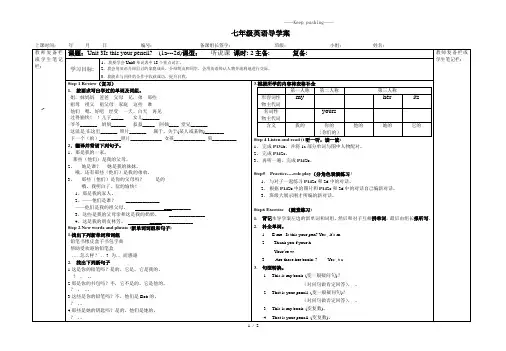
1.找出下列新单词和词组
铅笔书橡皮盒子书包字典
帮助受欢迎的铅笔盒
……怎么样?…..?为…..而感谢
2.找出下列新句子
1.这是你的铅笔吗?是的,它是。它是我的。
?,。。
2.那是你的书包吗?不,它不是的。它是他的。
?,。。
3.这些是你的铅笔吗?不,他们是Bob的。
3、我能在与同伴的合作中收获成功,提升自我。
Step 1 Review(复习)
1.按要求写出学过的单词及词组。
姐,妹妈妈爸爸父母兄,弟那些
祖母祖父祖父母家庭这些谁
他们嗯,好吧经受一天,白天再见
过得愉快!!儿子_____女儿_______
爷爷_______奶奶______叔叔_____阿姨____堂兄_______
1.背记本导学案左边的新单词和词组,然后和对子互相拼单词,最后由组长报听写。
2.补全单词。
1.----E me . Is this your pen? Yes , it’s m .
2.-----Thank you f your h .
------Your’re w .
3.------Are these her books ?------ Yes , t a .
?,。
4.那些是她的钥匙吗?是的,他们是她的。
?,。
3.根据所学的内将表格补全
第一人称
第二人称
第三人称
形容词性
物主代词
my
her
its
名词性
物主代词
yours
含义
我的
你的
(你们的)
他的
她的
2024年新版人教版七年级上册英语Unit 3(第4课时 Section B 1a-2b)(教案
Part 2:
学习理解Байду номын сангаас
(10min)
1.Tshowsthe text of 1b and asks Ss to think about the question--Whatis the text?
学生根据1b小短文,在教师的引导下,思考并总结如何写一篇介绍一个地方的回复邮件。
学生按照教师的要求,根据学校的实际情况和所给的句式,明确写作任务,根据老师所给的评价量规,规范自己的写作,介绍自己的学校,完成一封邮件。学生以小组结对的形式在组内进行联系,进而在班级前进行分享和展示。
引导学生梳理、学习和内化关键句型与重点语言,引导学生综合运用本课所学,写出作文。引导学生通过体验、参与、自主发现、合作探究等方式,最终图例解决问题,体现了学生是学习的主体,学生基于自己的写作题纲和提炼的语言表达方式完成作文。
学生在教师的指导下,小组合作,探讨四个问题,这些问题需要学生和小组内的成员进行讨论、推测,进行运用准确的语言分享答案。
指导学生观察和归纳文章体裁,考察学生对于文章大体的把控。
锻炼学生运用扫读策略的能力。
学生通过快速阅读、抓取关键词的方式获取信息,准确、快速地完成任务。
学生通过活动总结归纳做题步骤,养成勾画关键词的习惯。
2.T guides Ssto find who send this email?Who receive this email?
3.Tasks Ss to finish 1b --Skim Peter’s reply to Flora’s email. Choose the question Flora probably asked in her last email.After that, check the answers together.
七年级英语上册人教版StarterUnit3Welcome教学设计
1.设计各种练习题,如填空、选择、匹配等,让学生巩固所学词汇和句型。
2.安排角色扮演活动,让学生在模拟真实场景中进行问候和自我介绍,提高口语表达能力。
3.针对学生的练习情况,教师给予及时反馈,纠正错误,指导学生改进发音、语调等。
4.鼓励学生大胆开口,积极参与练习,培养他们的自信心和合作精神。
7.课后拓展,巩固知识:布置富有挑战性的课后任务,如制作英语问候视频、编写英语小故事等,让学生在课后继续巩固所学知识,提高综合语言运用能力。
四、教学内容与过程
(一)导入新课,500字
1.教师以热情பைடு நூலகம்问候语“Hello, everyone! Nice to meet you!”与学生打招呼,引导学生模仿并回应。
5.阅读理解:阅读一篇关于问候和自我介绍的短文,回答相关问题。旨在提高学生的阅读理解能力,并加深对所学知识点的理解。
6.拓展任务:请学生收集不同国家的问候礼仪,以图片、文字或小报告的形式呈现。通过这一任务,培养学生了解多元文化的意识,拓宽国际视野。
7.反思与总结:请学生撰写一篇学习心得,反思在本节课中的收获和不足,并提出改进措施。要求真实、具体,体现学生的自主学习能力。
2.难点:学生在实际情境中灵活运用所学句型和词汇进行自然、流畅的交流,以及正确使用一般现在时来描述自己和他人。
(二)教学设想
1.创设情境,激发兴趣:通过设置真实的交流场景,如学校新生报到、朋友聚会等,让学生在情境中自然地学习和运用所学知识,提高他们的学习兴趣。
2.分层教学,关注个体差异:针对学生的英语水平,设计不同难度的教学活动,使每个学生都能在原有基础上得到提高。对于基础薄弱的学生,重点辅导词汇和基本句型;对于基础较好的学生,引导他们进行更复杂的交流练习。
Unit 3 英语教案2022-2023学年人教版七年级英语上册
Unit 3 Is this your pencil教学目标:学生能够掌握单词pencil, book, ruler, eraser, sharpener的发音、拼写及意义。
学生能够掌握句型“Is this your…”“Yes, it is./No, it isn’t.”进行简单的交际。
提高学生的听说读写能力,培养学生的语感和交际能力。
教学重点:学生能够掌握单词pencil, book, ruler, eraser, sharpener的发音、拼写及意义。
学生能够掌握句型“Is this your…”“Yes, it is./No, it isn’t.”进行简单的交际。
教学难点:学生能否正确运用句型“Is this your…”“Yes, it is./No, it isn’t.”进行简单的交际。
学生能否熟练掌握单词pencil, book, ruler, eraser, sharpener的发音、拼写及意义。
教学准备:单词卡片,图片等教具。
录音机,磁带等教学用品。
教学过程:Step 1: Warming-upReview the vocabulary learned in the previous lesson.Show some objects, such as a pencil, a book, a ruler, an eraser, and a sharpener, and ask the students to say the names of the objects.Step 2: PresentationIntroduce the new words by showing pictures or real objects, and ask the students to repeat after the teacher. Write the words on the board and explain the meaning.Use flashcards to practice the vocabulary. The teacher can show the flashcards to the students and ask them to say the word or make a sentence with it.Step 3: Listening and SpeakingPlay the recording of Section A, and ask the students to listen and repeat after the recording. Play the recording again, and ask the students to answer the questions in the textbook.Ask the students to practice using the new sentence structures, such as “Is this your pencil?”“Yes, it is.”“No, it isn’t.”Pair up the students and have them practice the dialogue using the new vocabulary and sentence structures.Step 4: Reading and WritingAsk the students to read the dialogue in Section A and try to understand the meaning.Ask the students to write a short paragraph about the objects they have in their school bags using the new vocabulary and sentence structures they have learned.Step 5: Review and AssessmentReview the new vocabulary and sentence structures with the students by asking them to say the words and make sentences with them.Assess the students’understanding of the new vocabulary and sentence structures by asking them to complete some exercises in their textbook or workbook.Step 6: HomeworkAssign some homework exercises that reinforce the new vocabulary and sentence structures, such as writing a short paragraph about the objects they have in their school bags or doing some fill-in-the-blank exercises.。
人教版七年级英语上册教案(RJ) Unit 3 Is this your pencil
Unit 3Is this your pencil?第一课时Section A(1a-1c)1.重点单词:pencil,book,eraser,box,schoolbag,dictionary,his,mine,hers 2.重点短语:your pencil,your schoolbag,your books,pencil box3.重点句式:—Is that your schoolbag?—No,it isn't.It's his.—Are these your books?—No,they aren't.They're hers.1.含有be动词的一般疑问句2.名词性物主代词的用法1.含有be动词的一般疑问句2.名词性物主代词的用法一、预习课本P13新单词并背诵,完成下面的汉译英。
1.铅笔____________ 2.书____________3.橡皮____________ 4.盒子____________5.书包____________ 6.字典____________7.他的____________ 8.我的____________9.她的____________二、认真预习1a,1b,1c,找出下列短语和句型。
1.你的铅笔________________2.你的书包________________3.你的尺子________________4.你的书________________5.铅笔盒________________6.—那是你的书包吗?—不,不是。
它是他的。
________________________________________________________________________ 7.—这些是你的书吗?—不,不是。
它们是她的。
________________________________________________________________________Step 1情景导入Teacher:We have some school things at school.The things are very important to our study.Do you know how to say them in English?If you can't,please don't worry about it,you can know them after this class.Then show some pictures of the school things to let the students learn.环节说明:通过与学生日常学习生活紧密相关的话题——学习用品,导入新课,能引起学生的学习兴趣。