
超越概念听力2 课件 (3)[79页]
Part III News New 1 New 2 New 3 Part IV Dictation Part V Video clip
approximately equal to nine point four.
U3-B2 Social Issue
Part I Dialogue 1 Vocabulary
1. precinct ['pri:siŋkt]n. the office of a police department in a particular area
U3-B2 Social Issue
Part I Dialogue 1
Listen to the dialogue once to get the main idea. Listen again and choose the best answer to each of the following questions.
Listen to the sentences and write down what you have heard.
You hear: Seven times six equals forty-two.
You write: 7×6=42
❖ 1. 24 × 3 = 72
❖6. (13 × 6) + 30 = 108
one equals two. 4. Seven thousand six hundred forty minus fourteen
hundred equals six thousand two hundred and forty. 5. What’s four point three minus three point two three? 6. Thirteen times six plus thirty is one hundred and eight. 7. Fourteen, divided by three fourths minus two fifths equals
4. What happened next to the man?( C ) A. He walked to a flying saucer. B. He followed the animal to a plane. C. He was carried to a spaceship.
2. What time did the man report the incident to the police?( C ) A. About 12:00 a.m. B. About 3:00 a.m. C. About 5:00 a.m.
U3-B2 Social Issue
3. What jumped out in front of the man’s car?( C) A. A giant deer. B. A strange man. C. A hairy alien.
1. Where was the man coming from when he first saw the UFO?( A ) A. He was returning home from a party. B. He just got off work when he saw the UFO. C. He was driving home from a restaurant.
2. bizarre [bi'zɑ:] a. strange or unusual 3. unidentified ['ʌnai'dentifaid]a. unknown or
impossible to determine the origin 4. out of this world unbelievable, incredible 5. approaching [ə'prəutʃiŋ] a. coming closer
❖ 2. 117 + 70 = 187
❖7. 14÷(3/4 – 2/5) = 40
❖ 3. 682÷341 = 2
❖8. (11 – 0) × 5 = 55
❖ 4. 7640 – 1400 =6240
❖9. 14 × (3 – 22) = –266 ❖10. 16÷(4 – 2.3) ≈ 9.4
❖ 5. 4.3 – 3.23 = ?
forty. 8. Eleven minus zero, times five is fifty-five. 9. Fourteen, times three minus twenty-two equals negative
two hundred and sixty-six. 10. Sixteen, divided by four minus two point three is
Ⅲ Listening for Fun Ⅳ Supplementary Listening Ⅴ Story Series
2 U3-B2 Social Issue
Part I Definition
The Language of Math
U3-B2 Social ation
Beyond Concept
Listening Comprehension 2
中国人民大学出版社
U3-B2 Social Issue
Unit 3 Social Issues
Ⅰ Listening Strategies
Part I Definition Part II Consolidation
Ⅱ Listening Comprehension
U3-B2 Social Issue
Text
1. Twenty-four times three equals seventy-two. 2. One hundred seventeen plus seventy equals one
hundred eighty-seven. 3. Six hundred eighty-two divided by three hundred forty-
2003版超越概念高级英语Unit_Eight(修改版)[33页]
![2003版超越概念高级英语Unit_Eight(修改版)[33页]](https://360docs-1393072327.cos.ap-beijing.myqcloud.com/5adedead168884868662d699.webp)
Language Change: Progress or Decay?
Ⅰ. Further Information about the Text Ⅱ. New Words, Phrases and Expressions Ⅲ. Content of The Text Ⅳ. Understanding the Text Ⅴ. Language Exercises
1. The way you speak your language may not be the same as the way your parents speak it. What are the differences and which version do you think is better? What do you think are the causes for the shift?
超越概念听力第二单元

PASSAGE1A study reported that life expectancy has fallen or is no longer increasing in some parts of the United States. The situation is worst among poor people in the southern states, and especially women. Public health researchers say it is largely the result of increases in obesity, smoking and high blood pressure. They also blame differences in health services around the country.In 2006, a study found that only 4% of elementary schools provided daily physical education all year for all grades.This was true of 8% of middle schools and 2% of high schools. The study also found that 22% of all schools did not require students to take any P.E.Charlene Burgeson is the executive director of the National Association for Sport and Physical Education. She says one problem for P.E. teachers is that schools are under pressure to put more time into academic subjects.Also, parents may agree that children need exercise in school. Yet many parents today still have bad memories of being chosen last for teams because teachers favored the good athletes in class.But experts say P.E. classes have changed. They say the goal has moved away from competition and toward personal performance, as a way to build a lifetime of activity. These days, teachers often lead activities like weight training and yoga.Some parents like the idea of avoiding competitive sports in P.E. class. Yet others surely dislike that idea. In the end, schools may find themselves in a no-win situation.参考译文:2006年,一项调查发现只有4%的小学全年给所有年级的学生安排了每日活动时间。
超越概念听力

Unit 2 Fitness and HealthSection 1 Listening StrategiesPart II ConsolidationListen and identify the difference between two words ineach pair and circle the word you hearA. / s / vs. / θ/1. thing2. tense3. think4. path5. sick6. sankB. /ɪ/ vs. / i:/1. he’s2. each3. sit4. lead5. it6. live7. seek8. a pill9. bit10.teenC. /æ/ vs. /ɑ/ or /ɒ/1. hat2. ad3. box4. racket5. mop6. pat7.sock8. cot9. blackSection II Listening ComprehensionPart I DialoguesDialogue 1Listening to a financial trader talking about the stress of his job and how he handles stress.Listen to the dialogue and answer the following questions.1. Stress is generally driven by the feelingof being out of control of a situation and the feeling of a situation controlling you.2. The feeling of uncertainty, being out of control.3. Cooking a meal.4. Watching some TV before going to bed.5. At least once a week.Dialogue 21. Yes. Because of stress-related factors.2.It can lead to a change in direction, success, and stimulate you to do something new.3. It keeps him on his toes and makes him concentrated and focused.4. Trading.5. No. It remains constant.Dialogue 3A. Listen to the dialogue once and jot down the key words relating to the main idea.obesity, diet, less active, more food, lose weight, fad dietsB. Listen again and decide whether each of the followingstatements is true [T] or false [F].1.T2. F3. T4. F5. TPart II PassagesPassage 11. F (A study found that only four percent of elementary schools provideddaily physical education all year for all grades. )2. T3. T4. F (Yet many parents today still have bad memories of being chosen lastfor teams because teachers favored the good athletes in class. )5. T6. F (Some parents like the idea of avoiding competitive sports in P.E. class. Yet others surely dislike that idea.) Passage 2Our first word is “diet”. It has four l etters and four sounds: D-I-E-T. Diet. Diet can be a noun or a verb. There are some important (1) differences in meaning.Firstly “diet” as a noun. This mean s the food and drink (2) taken by a person or group of people.—Footballers have to eat a good diet in order tostay healthy.—The Japanese diet is (3) said to be very healthy. People live to an old age.People often use an adjective before diet. For example you may hear the expression “ a (4) balanced diet”. It means eating a (5) range of all the food types necessary to keep healthy.Secondly, we can use diet as a (6) countable noun—a diet. It means when someone eats less of certain foods so they can lose weight. It’s used in (7) combination with the words “to go on” or “to be on” a diet.A: I’m getting really fat. I can’t (8) fit into my trousers! B: You should go on a diet.Thirdly, we can use it as a verb—to diet. This is another, less (9) common way of saying “to go on a diet”. It means to eat (10) less in order to lose weight.—So many people diet these days. I’m not really sure if it’s good for them.Passage 31. Martina e2. Rachel c3. Romeshb4. Mark a5. John dPart III NewsNews 1Listen to the recording once to get the main ideas. Listen again and take notes to answer the following questions.1. More than four hundred fifty.2. The study looked at changes in genes that govern an important cell-signaling pathway.3. The animals do not grow as big as others of their kind but they live longer.4. Ashkenazi Jews are more genetically similar than most other groups, so any differences are easier to find.5. No one had the mutations.News 2Listen to the news about vitamin D once to get the main ideas. Listen again and answer the following questions briefly.1. From sunlight.2. They worry about getting skin cancer or skin damage.3. No. They produce more.4. Oily fish such as salmon, tuna and mackerel, and fish liver oils.5. Six hundred international units.News 3Listen to the news about obesity. Decide whether each of the following statements is true [T] or false [F]1. T2. F (At present, according to Professor Philip James, an expert on nutrition, obese children outnumber the malnourished by two to one.)3. T4. F (According to Professor James, there is no point in blaming individuals for being overweight.)5. T6. TPart IV DictationA. SentencesYou will hear each sentences three times. First, listen and try to understand the meaning of the whole sentence. Second, listen and write. Third, listen and check.1. It sounds like we’re both trying to raise our finalgrades in this class.2. You should see if there are any openings so you can enroll in it.3. The new school year that begins this fall will cost fifty-two thousand dollars for undergraduates.4. Students may also need to take SAT subject tests in areas like history.5. Three million three hundred thirty thousand students are expected to graduate.B. ParagraphYou will hear a paragraph three times. First, listen and try to understand the meaning of the whole paragraph. Second, listen and write. Third, listen and check.Research in the last several years has shown that low levels of vitamin D may increase the risk of heart attacks in men and deaths from some cancers. Other studies have shown that people with rheumatic diseases often have low levels of Vitamin D. More doctors are now having their patients tested for their vitamin D levels. But as research continues, some experts worry that if people take too much vitamin D, it might act as a poison.Part V Video ClipWatch and write down the three idioms mentioned in the video and explain each of them.Number Idioms Meanings1 He’s a bad egg.Someone is bad or dishonest.2 Don’t put all your eggs in one basket.You should never rely on only one plan—in case it goes wrong.3 He got egg on his face.Someone makes a mistake which makes him look stupid. Section IVSupplementary ListeningListen to each sentence and write down the words which contain phonemic sound /s/, /θ/, /ɪ/, /i:/, /æ/, /ɑ/ or /ɒ/.1. think, if, watch2. it, is, really, see3. what, departure4. me, family5.topic, is, not, money, handle, that, have Section V Story SeriesListen to Chapter 2 of Robinson Crusoe and answer thefollowing questions.1. At first, he felt seasick because of the rain and the wind, and he thought it was the punishment form God. But later the storm ended and he slept deeply at night.2. The second storm made the first storm look like a gentle wind. For days the storm went on with the terrible waves, lightening and thunders. Others agreed that they had never seen storms like this.3. The captain lighted a firework and a boat came and rescued them.。
2003版超越概念高级英语Unit_two(修改版)
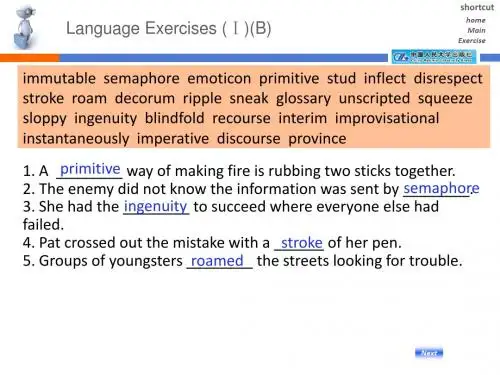
primitive way of making fire is rubbing two sticks together. 1. A ________ semaphore 2. The enemy did not know the information was sent by ________. ingenuity to succeed where everyone else had 3. She had the ________ failed. stroke of her pen. 4. Pat crossed out the mistake with a ______ 5. Groups of youngsters ________ roamed the streets looking for trouble.
Next
shortcut
Language Exercises (Ⅰ)(B)
home Main Exercise
immutable semaphore emoticon primitive stud inflect disrespect stroke roam decorum ripple sneak glossary unscripted squeeze sloppy ingenuity blindfold recourse interim improvisational instantaneously imperative discourse province unscripted item in his speech. 6. The President inserted one __________ ripples across the 7. I dropped the pebble in the water, sending _______ pond. 8. He _______ sneaked a look at her as she was passing by. instantaneously in the 9. The witness recognized the suspect _______________ crowd and motioned the police to make the arrest . immutable , but are likely to 10. Values and attitudes are not __________ change.
2025届高考英语二轮复习之感知读后续写课件(共36张PPT)

准确,可能有些许错误,但不影
响意义表达。
— 比较有效地使用了语句间的连接 成分,使所续写短文结构紧凑。
档次
描述
— 与所给短文关系较为密切,与所 提供各段落开头语有一定程度的
衔接。
第三档 — 写出了若干有关内容。 (11—15) — 应用的语法结构和词汇能满足任
Then Jeff noticed steam shooting out of the pot and the lid starting to shake. The next minute, the porridge boiled over and put out the fire. Jenna panicked. Thankfully, Jeff stayed calm and turned off the gas quickly. But the stove was a mess now. Jenna told Jeff to clean it up so they could continue to cook the rest of the porridge. But Jeff’s hand touched the hot burner and he gave a cry of pain. Jenna made him put his hand in cold water. Then she caught the smell of burning. Oh dear! The piece of bread in the pan had turned black as well.
普通高等学校招生全国统一考试英语科 考试试题
阅读下面短文,根据所给情节进行续写, 使之构 成一个完整的故事。续写的词数应为150左右。
超越概念听力2 课件 (13)[89页]
![超越概念听力2 课件 (13)[89页]](https://360docs-1393072327.cos.ap-beijing.myqcloud.com/eff80cb19b6648d7c1c746f8.webp)
330 320 Hellenistic
U13-B2 Films and Movie Stars
Text
Now, when you think about the art of ancient Greece, what comes to mind? Most people think of the Parthenon. There’s a nice shot of it in your book. The Parthenon was built between the years 490 and 432B.C.E., that is, Before the Common Era. It was dedicated to the goddess Athena Parthenos. That is P-A-R-T-H-E-N-O-S. Did everybody get that? Sorry, let me put that up here [writes on board], P-A-R-T-H-E-N-O-S. It stands on the Acropolis, which is basically a rocky hill in Athens and the most important site in the city. Now, Greek art began about 500 years before the Parthenon was built and lasted approximately 400 more years.
(施心远)听力教程第二册 ppt Unit2
Section One Tactics for Listening
Part I Phonetics--Stress, Intonation and Accent Directions: The word in a sentence on which the fall or (or fall-rise) begins is called the tonic word. Sometimes the tonic word is also the prominent word in the sentence. Listen to some sentences. Which dialogue does each one best fit? Write the letter in the space provided.
Section Two Listening comprehension
Part 1 Dialogues
Dialogue 1 Give Them Time to Get to Know You
T ____ T ____ F ____ T ____
Ex. Directions: Listen to the dialogue and decide whether the following statements are true or false.
Ex. A: Listen to some sentences and fill in the blanks with the missing words. 1. Ralph Nader is a man of few possessions. 2. He is paying back to America his debt as a citizen. 3. He said new laws were needed to make cars safer. 4. A law was passed to ensure that products like sausages and hamburgers contained the right amount of meat. 5. Ralph Nader has set a wonderful example of what determined men and women can do to improve the quality of life in their country.
新教材高中英语UNITBRIGINGULTURES突破语法大冲关课件新人教版选择性必修第二册
These two areas are similar in that they both have high rainfall in summer.
这两个地区相似,因为在夏天降水都很多。
I'm not certain whether the train will arrive on time. 我不确信火车是否将会按时到达。
1.that 引导主语从句,在从句中不充当任何成分,仅起连接作 用,但不可省略。
That you will win the medal seems unlikely. 你想获得奖牌看起来是不可能的。
2.whether 引导的主语从句既可放在句首也可放在句尾,但 if 引导的主语从句只能放在句尾,前面需要用 it 作形式主语。
[名师点津] 同位语从句和定语从句的区别
同位语从句
定语从句
功能
与先行词是修饰与被修饰的关系,起
对名词加以补充说明
不同
连接作用
不作成分,只起连接作 作主语或宾语,起连接作用;并且作
that 用,不可省略
从句的宾语时可省略
起连接作用,其中 whether whether/ 不作成分,而 how 和 what how/what
作成分
不引导定语从句
作成分;起连接作用;没有自 其他 wh-作成分;起连接作用;有自
2.if 和 whether 引导宾语从句的区别: ①在动词不定式之前只能用 whether。 ②在 whether...or not 的固定搭配中,只用 whether。 ③在介词后,只能用 whether。 ④作 discuss 的宾语时,只能用 whether。 ⑤宾语从句放在句首表示强调时,只能用 whether。
概念英语第二册课件l
Integration of cultural background knowledge to enhance students' understanding of English language use in different contexts
02 Vocabulary learning
Vocabulary classification
carry out lifeboat drill
• Summary: Carrying out a lifeboat drill is a safety procedure that ensures everyone on board a boat knows how to react in case of an emergency situation.
01 Course Introduction
Course objectives
Develop students' English listening and speaking skills
Enhance students' ability to understand and use English in different contexts
超越概念第三册unit2学生用书
超越概念第三册unit2学生用书Unit 1Jobs and OccupationsDiscussion·How would you categorize jobs by occupation (for example, jobs in accounting, engineering, information technology, to name a few)?·How would globalization affect the job market? What challenges does a job applicant face and what qualification is an applicant require to have in order to compete in the global job market?·What do you think of “home office”or working at home?Sect ion ⅠListening StrategiesListening for the Main Ideas (Part Ⅰ)Part ⅠDefinitionEfficient listeners listen to acquire the main ideas from the message. You should, therefore, concentrate primarily on the main points rather than small details. If your goal is to understand what the listening text is mainly about and to recall, at a later time, no more than 25 percent of what you have listened to today, you should strive to concentrate on the key concepts rather all the details.There are several ways you can become in identifying the main ideas. First, understand clearly the purpose and direction of your listening task. For the current purpose, you will strive to get the main idea of the entire message and understand the main concepts in the text. Second, you can get familiar with the positions where most main ideas would occur. For example, it may occur in the title, or shortly afterthe introduction of the topic, or it may even be repeated throughout the speech since the speaker would often repeat main points. The main points may be stated again in the summary of the speech. It is also possible that the main ideas are subtly implied and suggested, so you should listen to the whole text and guess the meaning from the context.Part ⅡConsolidationListen to the passage and write down the main idea.Section ⅡListening ComprehensionPart ⅠDialoguesDialogue 1A PrelisteningDiscussion1.Why would you think enthusiasm is very important for a job?2.Why would you think interpersonal skills are necessary fora particular job? Vocabulary1.antagonistic [?n?t?ɡ??n?st?k] adj. showing opposition2.strike up: to cause to start a conversation, singing, playing, etc.B ListeningMain IdeaListening to the dialogue and take notes to answer the following questions.1.Do you think this is a naturally—occuring conversation ora conversation in amovie? How can you tell?2.Where do you think this conversation most probably takes place? Who are thetwo female speakers? What is the first speaker’s name?What is the second spea ker’s name? What is this conversation all about?3.What do Ruth and Barbara feel about their own jobs respectively?4.What do you think Barbara’s problem with her job?5.What is the narrator’s comment on Ruth and Barbara respectively?Details and InferencesNow listen to the dialogue again and decide whether each of the following statements is true [T] or false [F].1.[T] [F] Barbara is unhappy with her job because of her boss.2.[T] [F] Barbara’s unhappiness with her job has nothing to do with her company.3.[T] [F] For Ruth, it is tiresome and unpleasant to meet the public because of herhostile attitude.4.[T] [F] Ruth had the same feeling with her job as Barbara at the beginning.5.[T] [F] Ruth has made up her mind and she is going to look for another job. Dialogue 2A PrelisteningDiscussion1.What do you think of working at home?2.What are the advantages and disadvantages of working at home? Vocabulary1.fusion [?fju:??n] n. the process or result of joining two or more things togetherto form one2.seep [si:p] v. to flow slowly and in small quantities through sth. or into sth.3.leak [li:k] v. to allow liquid or gas to get in or out through a small hole or crack.4.threshold [?θre?h?uld] n. the floor or ground at the bottom of a doorway,considered as the entrance to a building or room.5.Sci-fi n. science fiction6.gadget [?g?d??t] n. a small tool or device that does sth. usefulB ListeningMain IdeaListen to an interview and take notes to answer the following questions.1.The first speaker’s name is Liane Hansen, the host and interviewer. How doesLiane Hansen feel about working at home?2.What is the second speaker’s name? What is the title of her book? What is herviewpoint towards working at home?Details and InferencesⅠ.Listen to the intervie w again and continue to take notes to complete the following exercise.1.Describe Jackson’s own experience working at home.2.How does Olivier Marc’s quotation, “Home allows us to create an area of peace,clam and security, for once we have crossed the threshold and shut the door behind us, we can be at one with ourselves,”support Maggie Jackson’s viewpoint towards the subject?Ⅱ. Listen to the interview again and circle the best answer to each question.1.How does the interview’s personal experience illust rate the theme of blurredboundaries between work and home?A.Her daughter moved out of her mother’s home to a studio apartment.B.The interview with Maggie Jackson’s was conduct in the interview’s home.C.Her technician came to her home to help her conduct an interview with MaggieJackson in New York.2.How many times do you think Maggie Jackson hurried her kids to bed so shecould get back to work?A.Only once.B.Several times.C.Every night.3.What does Liane Hansen think about the boundaries of her new home office?A.They have been set physically.B.They have been set psychologically.C.They have been set both physically and psychologically.4.What does Olivier Marc’s quotation mean?A.The architecture of the home is still important.B.Home is a place of comfort and protection.C.We are in danger of our work and home life becoming blurred.Part ⅠPassagesPassage 1A PrelisteningDiscussion1.What do you think of job-hunting situations in China?2.Do you think there is job growth every year in China? Why?Vocabulary1.recession [ri?se??n] n. an extend decline in general business activity2.sluggish [?sl?g??] adj. slow-moving3.paradigm [?p?r??da?m] n. a pattern or model4.temp [temp] n.a person, esp. a typist or an office worker, employed on atemporary basis5.shrink [?ri?k] v. to become or cause to become smaller in size6.cautious [?k?:??s] adj. showing or having caution; wary; prudentB ListeningMain IdeaListen to the passage to understand the main idea. Take notes and write down the main idea briefly.Details and InferencesNow listen again and fill in the blanks with the exact words you have just heard. There’s little dispute that U.S. job growth has been well below normal since the last recession ended in November 2001. But rather than strengthening anytime soon, the labor market may not pick up much, or at all, at least for the (1) , a growing number of labor market experts and Wall Street economists are saying. “I do think we’re in a new era now in which job growth will(2) for quite some time,”form er Labor Secretary Robert Reich said ina comment e-mailed to CNN/Money. The economy creatednearly (3) jobs last year, an improvement from the 2002—2003 period, when there was a net loss of jobs. But that’s still well below the average of any recovery tha t’s lasted this long since World War Ⅱ, according to Anthony Chan at JPMorgan Fleming Asset Management. “We’re basically missing (4)jobs at this stage of the expansion. You could even call it the case of the missingjobs,”Chan said, nothing the job market’s now in a “ .”Jared Bernstein of the left-leaning Economic Policy Institute estimated that the number was closer to 3 million. With 132.6 million Americans working, according to the Labor Department, and another 7.7 million unemployed, the labor market in the United States is obviously (6). Among the factors hurting job growth in the current expansion: companies facing (7) from overseas, especially from China and Latin America; productivity growing at better than double the historical average; (8) ; the growing use of temp workers; (9) . “I can’t see the state of job creation changing for the better anytime soon,”said Richard Yamarone, chief economic at Argus Research in New York. He noted that (10) , on top of health care costs growing well above the pace of inflation.Passage 2A PrelisteningDiscussion1.Are you pessimistic or optimistic about the job market nowadays? Why?2.What do you expect to do as your future job?Vocabulary1.household [?haush?uld]n.a domestic unit consisting of the members of afamily who live together along with nonrelatives such as servants2.edge up: to push one’s way into (a space)3.Hispanic [his?p?nik] n. a Spanish-speaking person4.reentrant [ri?'entr?nt] adj. reentering; pointing inward n. the people who reenter5.civilian [si?vilj?n] adj. of or relating to civilians or civil life; nonmilitary6.cut back: to discharge from a group or number7.marginal [?mɑ:d?in?l] adj. of, relating to, located at, or constituting a margin, aborder, or an edge8.prior [?prai?] adj. preceding in time or orderB ListeningMain IdeaⅠ. Listen to the passage once and understand the main idea. Take notes and write down the main idea briefly.Details and InferencesⅡ. Now listen again and decide whether the following statements are true [T] or false [F]. Use your notes to help you and discuss your answer in a small group.1.[T] [F] The number of long-term unemployed (those jobless for 27 weeks andover) continued to trend up over the month, reaching 6.7 million.2.[T] [F] Among the unemployed, the number of reentrants to the labor force roseby 805,000 over the month.3.[T] [F] In April, the civilian labor force participation rate decreased by 0.3percentage point to 65.2 percent.4.[T] [F] About 2.4 million persons were marginally attached to the labor force inApril, who were not counted as unemployed because they had not searched for work in the 4 weeks preceding the survey.5.[T] [F] Discouraged workers are persons not currently looking for work becauseof school attendance or family responsibilities.Passage 3A PrelisteningDiscussion1.Can you give some suggestion that can help the government ease the tensionof people’s job-hunting efforts?2.Could you give some advice to the university students on how to become morecompetitive in job-hunting?Vocabulary1.patchy [?p?t?i:] adj. irregular in quality, occurrence, intensity, etc.2.redundancy [r??d?nd?nsi:] n. the state or condition of being redundant orsuperfluous, esp. superfluous in one’s job3.unblock [??n?bl?k] v. to remove a blockage from (a pipe, etc.)4.GCSE:General Certificate of Secondanry Education in the British educationsystemB ListeningMain IdeaListen to the passage once and understand the main idea. Take notes and write down the main idea briefly.Details and InferencesⅠ.Now listen again and answer the following questions. Then work with a partner to discuss the answers.1.According to the passage, what will the AACS offer? What does AACS stand for?2.How many areas will the AACS be piloted prior to the national launch in 2010?3.According to the Department for Innovation, Universities and Skills, what kindof people mainly faced barriers which held them back in life?4.What did the educational or organization Edge and the Skills commission findin March?5.According to your understanding, what is the whole passage mainly about?Ⅱ. Now listen to the passage again and decide whether each statement below is true [T] or false [F]. If a statement is false, change it into a true stamen. Discuss your answers in a small group.1.[T] [F] A small fee will be charged for those who attend the “one-stop-shop”service, but the service will be freely available to those most in need from 2010.2.[T] [F] After the national in 2010,the AACS will be piloted in ten areas.3.[T] [F] According to the Department for Innovation, Universities and Skills, manypeople, particularly mothers, the low-paid and theunemployed, faced barriers which held them back in life.4.[T] [F] Research by the department found that adults who gained a vocationalqualification at GCSE level were more likely to go to further learning, leading in turn to higher wages.5.[T] [F] A study by the educational organization Edge and the Skills Commissionfound government-backed careers advice for youngsters and adults was successful.Part ⅢNewsNews 1Vocabulary1.seminary [?sem??neri:] n. a college where priests, ministers are trained. Listen to the news for the main idea first. Listen again and answer the following questions.1.What is the shooting called by the authorities?2.How many people were killed in the shooting?3.What is the exact place of the shooting?4.What killed nine people inside the Middle Eastern country in 2006?News 2Listen to the news and get the main idea first. Listen again and decide whether each of the following statements is true [T] or false [F].1.[T] [F] Clean-up crews are working overtime in Ohio, aftera winter stormslammed the state over the weekend.2.[T] [F] About 20 inches of snow fell on both Cleveland and Cincinnati.3.[T] [F] The Midwest was struck by heavy snow.4.[T] [F] All the vehicles were prohibited from hitting the road.Part ⅣDictationYou will hear a short passage three times. First, listen and try to understand the meaning of the whole passage. Second, listen and write. Third, listen to the passage again at a normal speed and check your work. Finally, you will have 2 minutes to complete your work.Part ⅤVideo ClipWatch the video “Leadership Trainer Builds International Youth Activist Movement”and take notes. Then discuss the important of student exchange among countries in today’s global village.Section ⅢListening for FunYou are going to hear several people give their opinions on whether employers should monitor their employees while at work. Listen to the four viewpoints on workplace monitoring. Listen again, and share your notes and reactions in small groups.Section ⅣSupplementary ListeningListen to the passage and write down the main idea.Section ⅤStory SeriesA Listen to Chapter 1 of The Adventures of Tom Sawyer and answer the followingquestions.1.What is the main purpose of this book, according to the author?2.How is St. Petersburg portrayed?3.What kind of person is Aunt Polly, as introduced in Chapter 1?B Listen to Chapter 2 of The Adventures of Tom Sawyer and answer the following questions.1.What narrative mode is used in the novel?2.Why did Tom try again and again to attract other kids paint the fence?3.What kind of law of human action did Tom discover, according to the story? Notes:Unit 2Artistic IssuesDiscussion·How much do you know about art history?·How much do you know about the categories of art?·What do you like best the art?Section ⅠListening StrategiesListening for the Main Ideas (Part Ⅰ)Part ⅠDefinitionYou can learn to identify transitions that the speaker uses to introduce or discuss the main idea. These transition devices could be sentences, phrase or words. The following are some examples.The list of sentences includes:“I want to make one impression on you, and that is…”“Today, we are going to discuss…”“Simply stated, the issue is…”“Let us today examine why…”“Today, we will be covering…”“There are three methods that we…”“Our subject this evening is…”“And so we can conclude that…”“In conclusion then, I want you to understand that…”“To summarize…”“In summing up, we must remember that…”“As can be seen…”“Following this step is…”“A somewhat similar method is…”The list of phrases of words includes:“first”“along with”“not only…but also…”“finally”“next in important”“in addition to this”“on the other hand”“also”“above all”“of even more importance”“in connection with this”“equally important”“together with this”Part ⅡConsolidationListen to the following passage and try to identify transitions that the speaker uses to introduce the main idea.。