
仁爱版英语七年级上册Unit3复习学案
Unit 3 Topic 1Ⅰ:人称代词—宾格①(单数)我me 你you 他him 她her 它it(复数)我们us 你们you 他/她/它们them②动词与介词后的人称当宾语时用宾格He often helps _________(我) with my English.I help _________(他) study Chinese.Ⅱ: 几个动词的用法1)come from = be from 来自She _________(来自) Japan. = She _________(来自)Japan.2)know about 了解Jane .(Jane对中国了解一些) 3) help sb with sth = help sb do sth (do要用具体的动词代入)帮助某人做某事Jane often _____________________(帮助我学习) my English.Jane often _____________________(帮助我学习) my English.4) live in +地点:居住在某地live with +对象:与…一起住Does he _________(居住在) Beijing? Yes, he does.My grandparents _________(与我们一起住).5)want to do sth: 想要做某事like to do sth: 喜欢做某事We _________ (想要参观) Shanghai tomorrow.He _________ (喜欢帮助) his classmates.Ⅲ: 程度副词的应用very much = a lot: 十分,非常 a little: 有一点not…at all:一点也不以上的程度副词应该放在句末I _________ Chinese food _________. 我十分喜欢中国食物。
I_________ English _________. 我有点喜欢英语。
She _________ black _________. 她一点也不喜欢黑色。
Ⅳ:一般现在时态的各种句型(实意动词当谓语时)①肯定句:当主语是非单三时,谓语动词用原形;We _________(来自) China.I_________(喜欢) English very much.主语是单三时,谓语动词用单三形式,一般情况在动词后+s/es.She often _________(帮助) me with my Chinese.Michael _________(想要) to visit China.②否定句:当主语是非单三时,在谓语动词前加don’t;They _________(不认识) me.I _________(没有) big eyes.当主语是单三时,在谓语动词前加doesn’t,并还原动词原形.He _________(不喜欢) English at all.Jane _________(没住在) in Beijing.③一般疑问句:当主语是非单三时,句首用Do;_________you _________ long hair? 你有长发吗?_________ they _________ Japanese? 他们讲日语吗?当主语是单三时,句首用Does,并还原动词原形._________she _________ the USA? 她来自美国吗?_________ he _________ his sister? 他找到他妹妹吗?Ⅴ:问与答句子一:表喜欢或不喜欢程度的句子:1.Do you like English? —— Yes, I like it very much/a lot.(非常)Yes, I like it a little.(一点点)No, I don’t like it at all.(一点也不)2. Does she/he like English? ——Yes, she/he likes it very much/a lot.Yes, she/he likes it a little.No, she/he doesn’t like it at all.二:“某人做某事吗?”的句型?Do /does + 主语+ 动词原形+...?Yes, 人称代词+ do/does. No, 人称代词+ don’t/doesn’t句子延伸:你有一件红色的短裙吗?_______you _____ a red skirt?是,我有。
Yes,_______ _____ .Jane喜欢英语吗?_______Jane _____ English?不,她不喜欢。
No, _______ _____ .Unit 3 Topic 2Ⅰ:名词所有格ofa photo of my family我家的照片 a map of China 中国地图Ⅱ: 后置定语介词短语可以充当后置定语,位于所修饰名词的后面Who’s the young woman in yellow? 穿黄色衣服的那位年轻妇女是谁?Is the man on the sofa your uncle? 在沙发上的那个男人是你的叔叔吗?. 在我旁边的那个男孩是我的弟弟。
留长发的那个女孩是我的同班同学。
work→_______工人teach→_______教师farm→_______农民drive→_______司机act→_______演员cook→_______厨师父亲母亲叔叔婶婶父母亲祖父母兄弟姐妹女儿堂兄弟,表姐妹Ⅳ.在餐馆在医院在办公室在学校在农场知识应用:1.我哥哥在学校学习,他是一名学生。
My in a school, he is a .2.我的父母在办公室工作,他们是办公人员。
My in an office, they are .3.我的叔叔和婶婶是农民,他们在农场工作。
My and are ,they work .4.我的父亲在餐馆煮饭,他是一名厨师。
My in a restaurant, he is a .5.Tom的姐姐在医院工作,她是一名护士。
works , she is aWhat do/does+主语+do? 主语+be+工作(询问工作的句型)1.What do you do? —— I am a student.2.What do your parents do? —— They are office workers.3.What does the man do? —— He is a cook.Where do/does+主语+work? 主语+work(s)+地点(询问工作地点的句型)4.Where does he work? —— He works in a hospital.5.Where do they work? —— They work on a farm.句子延伸:你姐姐是干什么的?_______ _____ your sister _____?她是一位英语老师。
She is_______ _____ _____ .Tom是做什么的?_______ _____ Tom _____?他是一位白领。
He is _______ _____ _____ .她在哪里工作?_______ _____ she _____?她在学校教语文。
She _______ Chinese_____ _____ _____ .你叔叔在哪里工作?_______ _____ your uncle _____?他在北京开车。
He _______ a car _____ _____ .你哥哥在福州工作吗?_______your brother _____ in Fuzhou?是的,他是。
Yes, _____ _____ .Unit 3 Topic3Ⅰ:可数与不可数名词(食物类)可数:苹果_______ 香蕉_______ 桔子_______ 鸡蛋_______ 汉堡_______ 蔬菜_______ 蛋糕_______不可数:鱼_______ 鸡肉_______ 面包_______ 米饭_______ 水_______ 牛奶_______果汁_______ 饮料_______Ⅱ:掌握以下短语(背)请随便吃(喝)help yourself(to) 吃早餐/午餐/晚餐have/breakfast/lunch/dinner 下馆子eat out 点菜take your order …something to eat/drink:一些吃/喝的东西怎么样what/how about为什么不why not 好主意good idea对...友好be kind to知识应用:Please_______ _____ to some fish,Jane. (Jane,请随便吃鱼)Please_______ _____ to some fish,kids. (孩子们,请随便吃鱼)Mary usually_______ _____ at 6:00. (Mary经常在六点吃早饭)I would like_______ _____ _____ with my friends.(我想要与我的朋友下馆子)My parents_______ _____ _____ _____ . (我的父母对我好)Ⅲ: 掌握would like各种句型1.某人想要某物:主语+ would like + 物体。
(肯定句)例:I would like an apple.2.某人想要吃/喝某东西:主语+ would like to eat/drink + 物体。
(肯定句)例:I would like to eat an apple.3.你想要某物吗?:Would you like + 物体?(一般疑问句)Yes, please. / No, thanks.例:Would you like some fish? Yes, please.4.你想要吃/喝某东西吗?:Would you like + to eat/drink物体?(一般疑问句)Yes, please. / No, thanks.例:Would you like to drink some juice? No, thanks.5. 你想要吃/喝什么?What would + you+ like to eat/drink? (特殊疑问句)句子延伸:你想要一些汉堡吗?_______ you_____ _____ _____?好的。
_______ , _____ .你想要一些鸡肉吗?_______ you_____ _____ _____?不,谢谢。
七年级英语仁爱版上册Unit3_Topic2_SectionD_教学设计

Unit3 Topic2 SectionD 教学设计I. Material analysis本课是话题二的最后一个课时,主要活动是Grammar和Functions。
引导学生复习构词法、实义动词一般现在时的特殊疑问句及其回答,以及通过对话、听力训练、阅读训练、综合探究等活动复习和巩固Sections A~C学习的打招呼、询问职业、家庭成员、工作场所等信息的表达方式。
另外,学生将在学完本话题后,学会自行总结和归纳构词法的规律以及实义动词一般现在时的特殊疑问句及其回答,学会在实际的句子中发现语法错误并改正错误,同时还将锻炼他们听并判断、听再填空、读前猜测、读后总结的能力,提高他们用所学的词汇、句型、功能、话题进行综合探究活动的能力。
此外,在project的综合探究活动中,借助全家福,让学生以实践体验等方式来综合运用本话题所学知识,学会用英语做事情。
II. Teaching aims1. Knowledge aims能根据已学语音、音标及发音规则,正确朗读下列词汇并在实际的对话操练中加以应用:cute, play, its, love能根据本话题已学知识,自行总结和归纳构词法、实义动词一般现在时的特殊疑问句及其回答:teach—teach er, act—act or在教师的帮助与指引下,通过对话操练、听力训练、阅读训练、综合探究等活动复习和巩固有关打招呼、询问职业、家庭成员、工作场所等信息的表达方式,如:(1)—Glad to meet you.—Glad to meet you, too.(2)—What does your father do?—He is a doctor.(3)—Where does he work?—He works in a hospital.(4)—Who is the man in yellow?—He is my uncle.2. Skill aims能听懂有关询问职业、家庭成员等简单对话或叙述并完成相应的任务;能根据图文就职业、工作场所、家庭成员等基本情况的话题进行交流;能够在图片的帮助下进行阅读,理解大意、细节等,并按要求进行语言活动;能根据提示书面介绍自己或同伴的家庭成员的工作情况。
仁爱英语七年级上Unit3 单元复习学案(含答案)
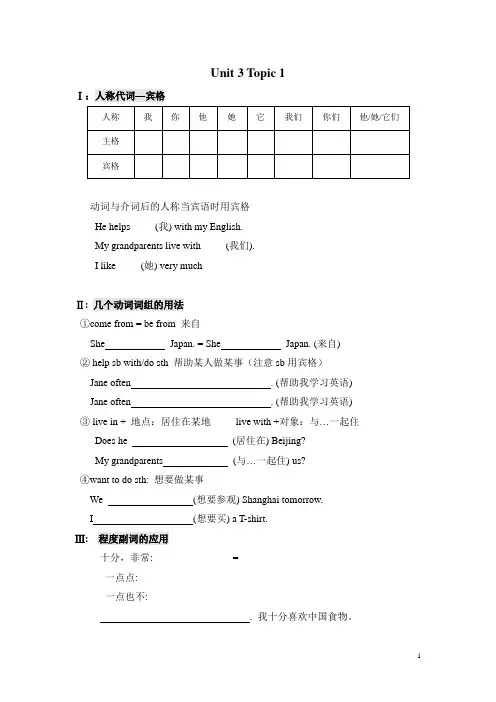
Unit 3 Topic 1Ⅰ:人称代词—宾格动词与介词后的人称当宾语时用宾格He helps ____ (我) with my English.My grandparents live with ____ (我们).I like ____ (她) very muchⅡ: 几个动词词组的用法①come from = be from 来自She Japan. = She Japan. (来自)② help sb with/do sth 帮助某人做某事(注意sb用宾格)Jane often . (帮助我学习英语) Jane often . (帮助我学习英语) ③ live in + 地点:居住在某地live with +对象:与…一起住Does he (居住在) Beijing?My grandparents (与…一起住) us?④want to do sth: 想要做某事We (想要参观) Shanghai tomorrow.I (想要买) a T-shirt.Ⅲ: 程度副词的应用十分,非常: _______________ = _______________一点点: _______________一点也不: _______________. 我十分喜欢中国食物。
. 我喜欢英语一点点。
. 她一点也不喜欢黑色。
Ⅳ:一般现在时态的各种句型(行为动词当谓语时)①肯定句:当主语是非单三时,谓语动词用;We (come) from China.I (like) English very much.主语是单三时,谓语动词用形式,一般情况在动词后+s/es.She often (help) me with my Chinese.Michael (teach) English in China.②否定句:当主语是非单三时,在谓语动词前加;They (not know) me.I (not have) big eyes.当主语是单三时,在谓语动词前加,并还原动词原形.He (not like) English at all.Jane (not live) in Beijing.③一般疑问句:当主语是非单三时,句首用;(do) you have long hair?(do) they speak Japanese?当主语是单三时,句首用,并还原动词原形.(do) she (come) from the USA?(do) he (find) his sister?Topic 1 重点句子综合应用请以My Pen Pal为题写一篇50词左右的短文。
仁爱版英语七上Unit 3 Topic 2复习

show work hospital restaurant on farm teach act drive
v.给…看,出示;表明n.演出;展示 v.工作;运转n.工作,劳动 n.医院 n.餐馆 perp.在…上;关于 n.农场 v.教 v.扮演,表演 v.驾驶,开车
show work hospital restaurant on farm teach act drive
例:— What's his job? 他是干什么的? — He is a driver. 他是司 机。
— What is Jane's job? 简是做什么的? — She is a student.她是一 个学生。
4.Where does she work ? She works in a hospital. 她在哪工作?她在医院工作。. 由where引导的特殊疑问句是用来询问地点的,这一句型的结 构为: where + do/ does +主语+行为动词。 例:—Where do you study ? 你在哪里学习。 —I study in No.1 High School. 我在第一中学上学。 —Where does your mother work? 你妈妈在哪里工作。 —She works in a school. 她在一所学校工作。
v.给…看,出示;表明n.演出;展示 v.工作;运转n.工作,劳动 n.医院 n.餐馆 perp.在…上;关于 n.农场 v.教 v.扮演,表演 v.驾驶,开车
aunt uncle brother sofa grandparent cousin daughter
n. 婶母,伯母,姨母,舅母,姑母 n.叔,伯,舅,叔父,姑父,姨父 n.兄,弟 n.沙发 n.祖父(母),外祖父(母) n.堂(表)姐妹;堂(表)兄弟 n.女儿
Unit+3+模块复习题2024-2025学年仁爱版英语七年级上册

U3 Our Colorful School Life 复习(P38-P42)一、短语1.在4:30上一节生物课2.在10:45上一节英语课3.地理课在3点钟开始4.以一个照片开始5.以一个游戏结束6.她最喜爱的科目7.在周二下午上一节美术课8.没有地铁站9.经常坐公交去学校(两种)10.总是步行回家(两种)11.通常坐飞机去天津(两种)12.有时坐火车去武汉(两种)13.停止和同学交谈14.离公交车站远15.喜欢在电脑上工作二、重点句子练习(填空或对提示词翻译)时间表达:1.---? ---It’s (1:58). It’s time class.3.---? ---The Chinese class begins at (8 :00).4. ---? ---The politics class is over ten past three.5. ---? ---It’s Friday, it’s time go home this afternoon.学科表达:1.---?---My favorite subject is PE because we can (做不同的活动)。
2.--- ?---I like history best because we can (了解很多关于过去(的东西))。
3.--- ? They have English class, it’s interesting!4. A: ---I like the art class very much. B: --- ?A: ---Because I can (做一些手工制品)。
--?B: --- Me, too.5. --- ? ---She teaches Japanese in a school.交通方式及频率副词1. ---? --- He usually goes to work by car.2. A: ---? B: --- I go to the park on Saturdays/every Saturday. A: ---? B: --- I like (在这儿遛狗).3. ---?---Yes, it is. My home is far from the library. So I (很少去那儿).4. ---? No, there aren’t. There aren’t any bus stops near my home.三、完形填空Tom comes from America. He 1.______ in a middle school in Zhengzhou. Every morning he takes the school bus to school. He has four classes in the morning 2.______ two in the afternoon.He speaks English very 3. ______. He often helps his Chinese friends 4. ______English. He 5.______ like history. He thinks it's boring. His favorite subject is music. He thinks it's 6. ______. His teacher 7. ______ very strict with him. His last 8.______ ends at 4:20 every day. So in the 9.______ he can 10.______ all kinds of clubs.Tom wants to know more about Chinese culture. 11.______ Monday to Wednesday he often does Chinese kung fu. On Thursday he often plays Chinese chess for 12.______ hour. On Friday he comes to the 13.______ club. He likes 14.______ the guzheng and erhu. Every afternoon he gets home at about six o'clock. How busy 15.______ day is!1.()A. study B. studying C. studies D. studied2.()A. or B. but C. and D. so3.()A. good B. well C. better D. best4.()A. to B. of C. for D. with5.()A. does B. isn't C. don't D. doesn't6.()A. interest B. interested C. interesting D. interests7.()A. is B. am C. are D. be8.()A. class B. term C. subject D. sport9.()A. morning B. afternoon C. evening D. night10.()A. play B. plays C. join D. joins11.()A. From B. For C. On D. At12.()A. a B. an C. the D. /13.()A. art B. drama C. dance D. music14.()A. play B. playing C. plays D. to plays15.()A. he B. him C. his D. himself四、语篇填空be good and to sister help she very class interesting My name is Mike. I'm from England. I am in Xi'an with my parents 1. my sister now. My sister is eleven and I am twelve. We 2. in the same school. We go to school from Monday 3. Friday. We have four 4. in the morning and two in the afternoon. We can't speak Chinese very 5. , so we want to learn it. We think Chinese is very 6. . My favorite subject at school is math and science is my 7. favorite. I like sports. I like playing soccer and basketball8. much. But I don't have much time to play them on weekdays. I help my sister with9. math on Monday. I practice((练习)Chinese on Friday afternoon. My Chinese friend Li Feialways 10. me. On weekends, I can play sports, watch TV and play computer games. They're relaxing for me.1. 2. 3. 4. 5.6. 7. 8. 9. 10.五、阅读理解(I)1.How many lessons does Lin Tao have every day?()A. 5.B. 6.C. 7.D. 8.2. How many English lessons does he have every week?()A. 5.B. 7.C. 9.D. 6.3.What time do morning classes begin?()A. 7:20.B. 14:30.C. 9:00.D. 8:00.4.What time is school over in the afternoon?()A. 17:00.B. 18:00.C. 16:10.D. 11:40.5.How often does he have a PE lesson?()A. Every day.B. Three times a week.C. Once a week.D. Twice a week.六、阅读理解(II)In junior high school or middle school in America, 1. such as English writing, maths, science, biology, music, art and PE. There are six classes every day. The students go to school from Monday to Friday. In the morning, they go to school by school bus. At 12 o'clock, the students eat lunch at school. 2. But they like hot dogs and hamburgers best. American children like sugar (糖), and after the meal they can have a small piece of cake. 3. They begin classes at 3 o'clock.4. And then students return home. Parents let their kids play or watch TV until supper at 6:00 p.m.5. Sometimes children and their parents have a family together activity after dinner.A. Students sleep for a short time after lunch.B. They have classes for six hours every day.C. They usually do their homework after supper.D. They have meat, vegetables, fruit, bread and a drink.E. students must study many subjects every week.1. 2. 3. 4. 5.。
仁爱版英语七年级上册Unit3Topic3SectionB教学设计

三、教学重难点和教学设想
(一)教学重难点
1.重点:本节课的重点在于让学生掌握描述家庭成员职责和家庭日常活动的词汇及句型,如:clean the room, make the bed等,并能运用一般现在时描述家庭成员的日常行为。
2.能够运用一般现在时描述日常生活中的习惯性行为,并能够运用频率副词always, usually, often, sometimes等。
3.能够理解并运用本节课所学的日常对话,进行真实情境下的角色扮演和交流。
4.能够通过观察、模仿和实践,掌握正确的发音和语调,提高英语口语表达能力。
(二)过程与方法
3.通过提问方式,让学生回顾已学的频率副词(always, usually, often, sometimes),为新课中描述家庭成员行为习惯做好词汇准备。
4.结合图片和学生的回答,自然导入新课主题:描述家庭成员的职责和日常活动。
(二)讲授新知
在这一环节中,我将按照以下步骤为学生讲解新课内容:
1.呈现本节课的主要词汇和句型,如:clean the room, make the bed, do the dishes, sweep the floor等,让学生跟读、模仿,并注意纠正发音。
在本章节的学习过程中,学生将通过以下方法提升自己的英语能力:
1.通过小组合作,讨论家庭成员的分工,培养学生合作学习的能力。
2.通过听力训练,提高学生获取信息、理解对话的能力,培养学生良好的听力习惯。
3.通过角色扮演,让学生在实际语境中运用所学知识,提高学生的口语表达能力。
Unit 3 Topic 1 复习课件仁爱版英语七年级上册

know about sb./sth. 了解某人/物 我了解这个故事。 I know about the story。 know a lot about sb./sth非常了解某 人/物(about介词+宾格) 他非常了解我。
so还可当副词,意为“如此,这么” Its hands is so small.它的手如此小。 She is so beautiful.她如此美丽。
Language points
(1)and意为“和;又;并”,表示并列关系,用来连接语法作用相同的 词、短语或句子。如: I'm from Beijing and she is from Shanghai.我来自北京,她来自上海。
learn English.
他们帮助我学习中文。
They help me with my Chinese. = They help me (to) learn Chinese.
2. 表达请求及其答语:—Could you please+动词原形? “你能……吗?”,用于礼貌地请求别人做某事, 肯定回答:—Sure. / No problem. 当然/没问题。 否定回答:Sorry.
E.g. Please tell me about your school. (2)tell sb. to do sth.告诉某人做某事
E.g. Miss Liu tells you to read books.
4. speak+某种语言,表示“讲某种语言”。
仁爱版七年级上册英语优秀教学案例:Unit3Topic3SectionA
1.分组合作学习:将学生分成若干小组,组织他们进行合作学习,培养他们的团队协作能力和沟通能力。
2.小组讨论:设计各种讨论话题,让学生在小组内进行讨论,促进他们之间的思想交流和共享。
3.小组展示:组织小组进行展示,让他们有机会展示自己的学习成果,提高他们的表达能力和自信心。
(四)反思与评价
仁爱版七年级上册英语优秀教学案例:Unit3Topic3SectionA
一、案例背景
本案例背景以仁爱版七年级上册英语Unit3Topic3SectionA为例,本节课主要围绕“询问时间和日期”展开教学,通过本节课的学习,让学生能够掌握询问和表达日常时间和日期的词汇和句型,如“What time is it?”“It’s 1:30.”“What day is it today?”“Today is Tuesday.”等。同时,让学生能够运用所学知识进行简单的日常交流,提高他们的实际应用能力。
3.对话教学:通过展示和模仿对话,让学生熟悉和理解日常时间和日期的表达方式,培养他们的口语交流能力。
(三)学生小组讨论
1.分组讨论:将学生分成若干小组,让他们围绕本节课的主题进行讨论,鼓励他们提出问题、分享观点和交流思想。
2.任务设计:设计一些与时间和日期相关的任务,让学生在小组内进行合作完成,如制作一个简单的日程表、编写一个关于时间的短剧等。
1.学生自我反思:鼓励学生在课后进行自我反思,总结自己在课堂上的学习情况和收获,找出自己的不足之处,制定改进措施。
2.同伴评价:组织学生进行同伴评价,让他们互相评价对方的学习表现和进步,促进彼此之间的学习和成长。
3.教师评价:教师对学生的学习情况进行全面评价,关注他们的知识掌握程度、技能运用能力和情感态度,及时给予反馈和鼓励。
英语仁爱版七年级上unit3-4学案(英语)
Unit 3 Getting togetherTopic 1 Does he speak Chinese ?Section A学习目标:1.知识1)学习关于请求和喜好的功能用语。
2)继续学习一般现在时。
2.方法:问答法3.情感:教育学生要互相帮助学习重点:掌握表示请求及喜好的功能用语。
学习难点及突破策略:学习难点:新单词could 和problem 的用法突破策略:比较法学习流程【阅读质疑,自主探究】一.走入新课1.播放flash动画part4 Let’s chant2.与学生做类似的互动练习:T:Do you have a good friend?S1:Yes,Ido.T: Do you have a pen pal ? S1:Yes,Ido.T:Could you tell me his name? S1:No problem.Ask and answer in pairs with the drill.----Could you please…? ----No problem/sure.二.阅读提示11.阅读教材55—56页的内容找出下列词汇.could ,tell , sure, pen pal ,speak, some , with , help sb with sth , problem , well , often 2.找出你不懂的其他词汇.____________________________________________________________________________________________________________________________________三.阅读提示2:1.读对话1a,回答下面的问题。
1)Where does Jane come from?2)Whose Chinese is not very good?2.读对话1a 找出下面的重要句型并找出你不懂的其他问题。
仁爱英语七年级上册Unit3-topic1复习
• 但是我只是有点喜欢。
• but I like it a little.
•
我们是好朋友,我们互相帮助。
• We are good friends and we help each other.
• she wants to visit Beijing. • She lives in England. • He works in a hospital. • She teaches in a high school. • She likes to play with Kitty.
• 了解很多关于 know a lot about
• 住在英国
live in England
词组
• 我们班的许多学生 many students in our class
• 一点点喜欢
like ... a little
• 一点也不喜欢 not like ... at all
• 不是很好
not very good
A. very
B. much
C. at all
D. little
8.I like the little cat a lot but she likes
it ____. B
A. a lot
B. a little
C. lot
D. much
9.Sally often helps me study English. And
可以这样说
My pen pel speaks English, but he knows a lot
about China.
. 10. 你想询问对方的国籍是不是美国,你可以这样问: Are you from America_? 11.当别人问你可不可以帮他做一件事情的时候 你可以这样
仁爱版英语七年级上册Unit3 topic2复习 教案
七年级上册unit3 topic2重点词组in a school在学校in a hospita在医院in an office在办公室in a shop / store 在商店on a farm 在农场be home到家make oneself at home 请随意,别拘束。
have a seat.= sit down= take a seat.请坐.a photo of my family一张我家的相片the young woman in yellow穿黄衣服的年轻女士on the sofa 在沙发上a happy family 幸福的家a student in Grade Seven一名七年级的学生live in…居住在live with…和……住在一起look after…照顾……; 保管……重点句型⒈提问职业:⑴.What do you do? I am a doctor.⑵.What does he "she do? He "She is a doctor.⒉提问工作场所:⑴. Where do you work?I work in a hospital"school⑵.Where does he "she work ?He"She works in an office"on a farm.重点语言点1.I’m home 我到家了be at home=be in在家go home 回家2.句型:一般现在时含有助动词do/does的特殊疑问句(询问职业)What do/does +主语+do? = What +be+主语?=Whats ones job?答语:人称代词主格+be+职业3.构词法:某些动词或名词之后+er则变成从事这一工作的人work—worker farm--farmer (注意:cook 厨师cooker厨具) 练习:Work farm teach Michael1. His father works in a school,he is a _________.2.This is ________mother.3.A ________works on a farm.5.May's brother is a __________ in a factory4.在医院,学校,办公室用介词in,在农场则用介词onin a school/a hospital/an office on a farm5.句型:一般现在时含有助动词do/does的特殊疑问句,询问职业及工作场所What do/does …do? Where do/does …work?练习1.Where does your mother work?--In a h______,she is a nurse.2.My mother works in a school .She is a _____3.—What do they do? They are farmers and work on a f______.4.Office workers often w______ in the office5.---What does her p_______ do?---Oh,her father is a cook,her mother is a worker.6.辨析:in the hospital, in hospitalin the hospital 表示“在医院”,指地点概念。