
外研社英语必修2 Module3 教案
课题名称:Module 3 Music外研社第二册(必修2)(高一)课型:阅读课第4课时时间:45 分钟I. Teaching Objectives1. Language Objectives(1)Important words: choir, orchestra, director, classical, composer, symphony, ballad,catchy, complex, record, solo, Austria.(2)Phrases: be impressed with, split up, make a note of, as well as, the rest of.(3)Difficult structures:a)Having worked there for 30 years, Haydn moved to London, where he was verysuccessful.b)By the time he was 14, Mozart had composed many pieces for the harpsichord,piano and violin, as well as for orchestrasc)As he grew older, he began to go deaf.2. Ability Objectives(1) Reading: understanding general topics and main idea.(2)Listening: taking note.(3)writing: Helping the students write an essay about he/her favorite musician.(4)speaking: Helping the students learn how to talk about some famous composers in the world3. Moral Objectives1)Get the students know some composers.2)Encourage students to talk about composers who they are like or dislike.4. Learning Strategies(1) Individual work(2) Group work5. Cultural Awareness(1)Help students to learn some famous composers.(2)Let students know some instruments.II. Important Points(1).To be able to talk about some famous composers in the world.(2).To be able to talk about some musicians who they’re like.III. Difficult Points(1).Background of the three famous composers.IV. Teaching Methods(1).Teaching Methods: Communicative Approach and Task-based Teaching Method.(2).Teaching Aids: a projector , a computer and PPT .V. Teaching ProceduresStep I Lead-in ( 3 minutes)T: Hello, everybody.Ss: Hello, Miss Guo.(All the students’ answers are predicted answers.)T: Ok. Before begin our class, I want to play pieces of music for all of you.Step II Pre-reading( 6 minutes)Play pieces of music named Ninth Symphony.After the music.T: Do you like the music?Ss: Yes.T: Do you know what composer refers to?Ss: No.T: Well, I’ll give you a hint. A composer is a musician who writes pieces of beautiful music for others to sing or to play. Clear?Ss: Yes.T: Do you know who is the composer of the music?Ss: Beethoven.T: Brilliant! So, how much do you know about him? Uh, I will give you 3 minutes to discuss with your partner. Ok?Ss: Ok.After 3 minutesT: Ok, time is up. Any volunteers?S1: He is famous all over the world.T: yes. He is famous. And else?S2: he is deaf, but he is a genius.T: Yes. Is there anyone know more about him?S3: he created many beautiful songs.T: Yes. He is creative in music. He is a great composer, isn’t it?Ss: Yeah.T: Do you want to know more about him.\Ss: Yes.T: As we know, there are various kinds of music around the world. They all have their own obvious characteristic. And also there were famous composers such as Joseph Haydn, Mozart, and Beethoven. Today we will learn of their life from the text.Step III while-reading( 28 minutes)T: Now, please open your book and turn to page on 22. There are three pictures, who are they?Ss: Haydn, Mozart and Beethoven.T: Good! And this passage is about the three persons. Now, I will give you 6 minutes to skimming this passage. During this time, you should complete the 2 questions that is presented in the ppt. (the questions are:1.W hat’s the main idea of the passage?2.How many parts do you divide this passage, and why ?) Let’s begin.After 6 minutes.T: Time is up. Have you finished the work?Ss: Yes.T: Good. L et’s check together. W hat’s the main idea of the passage? Any volunteers? Ok, Zhang yue, please.S1:T his passage’s main idea is about three famous composers’ background and experience.T: Yes, good job! This passage tells us three great composers’ background and experience. Generally, we can find the main idea from the first sentence or the last sentence of a paragraph, but sometimes we need to find out the key words and use them to summarize the main idea, clear? By the way, how many parts do you dividethis passage?S1: Three parts. First part is 1-2, this part is about H aydn’s background and experience. Second part is 3-5, which is about M ozart’s experience. Last part is 6-8, which is about B eethoven’s.T: Good, you do a good job! Is there anyone have different opinions?Ss: No.T: Ok. I t’s quite easy to divide the part s, isn’t it?Ss: Yes.T: Ok, now, turn to page on 23 and look at activity 3. T here’re 8 questions. (the questions are:1.Which of the composers were born in Austria? 2. Who was born in Germany? 3. Who had a good singing voice? 4. Who died before his fortieth birthday?5. Who became deaf?6. Who met each other?7. Who had fathers who were musicians?8. W ho had a father who wasn’t a musician?)I’ll give you 10 minutes to scanning this passage in this period, you should complete activity 3 on the page 23, clear?T: Great! Go ahead.After 10 minutesT: All right, time is up. Please look at ppt, the answer is here. Correct your answer quickly please.After 2 minutesT: Ok, let’s move on. Now, work in pairs, answer these questions in activity 4. (the questions are:1. How did Haydn change the form of symphonies? 2. How long did he work in eastern Austria? 3. How many pieces of music did Mozart compose? 4. How old was he when he played for the Empress of Austria? 5. How long were Mozart and Haydn friends? 6. Who taught Beethoven how to play the piano? 7. Did he stop composing when he became deaf?) Because you have scanned the passage, it’s quite easy. 7 minutes for you now, it’s your time.After 7 minutesT: Guys, time is up. Any volunteers want to answer the questions 1-2? Ok, Li fang please. How did Haydn change the form of symphonies?S1: He changed the symphony into a long piece for a large orchestra.T: Good, how long did he work in eastern Austria?S1: 30 years.T: Good, sit down please. Any volunteers want to answer the questions 3-4? Oh, Zheng liang please. How many pieces of music did Mozart compose?S2: More than 600 pieces of music.T: Great! How old was he when he played for the Empress of Austria?S2: When he was 6, he played the harpsichord in a concert for the Empress of Austria. T: Excellent! questions 5-7, any volunteers? Ok, Sheng xiao please. How long were Mozart and Haydn friends?S3:10 years.T: Good. Who taught Beethoven how to play the piano?S3: His father.T: Did he stop composing when he became deaf?S3: No, he continued composing.T: Good job!Step IV Post-listening( 6 minutes)T: Now, I’ll give you some key words and phrases. Work in groups to retell the main points of the lives of the three great composers. Ok?Ss: Ok.T:The keys words and phrases are in the ppt.( The keys words and phrases are: choir, orchestra, director, classical, composer, symphony, showed musical talent, be known as, be impressed with/by/at, be popular with, have a gift / genius / talent for (doing) something, By the time of…) because of the matter of time, you can retell one of them, ok? 4 minutes for you now.After 4 minutesT: Time is up. Anyone want to try? Yes, Zhao ye please.S1: Beethoven showed musical talent when he was a child, Mozart met Beethoven and was impressed by him. Beethoven is very popular in the Austrian capital. But as he grew older, he began to go deaf.T: Oh, good! Other students can retell like this after class, ok?Ss: Ok.Step V Summary(1 minutes)This lesson introduces to students three world-famous composers: Beethoven, Mozart and Haydn, include their family background and masterpiece. From their different experiences, we learned that no pains, no gains.Step VI Homework Assignment (2 minutes)Talking about your favorite musician with your partner. VI. Blackboard Design附:阅读原文Module3 MusicJoseph Haydn (1732 - 1809) was an Austrian composer and is known as "the father of the symphony". Other composers had written symphonies before Haydn, but he changed the symphony into a long piece for a large orchestra.He was born in a village in Austria, the son of a peasant. He had a beautiful singing voice. After studying music in Vienna, Haydn went to work at the court of a prince in eastern Austria, where he became director of music. Having worked there for 30 years, Haydn moved to London, where he was very successful.Wolfgang Amadeus Mozart (1756 - 1791) was a composer, possibly the greatest musical genius of all time. He only lived 35 years and he composed more than 600 pieces of music.Mozart was born in Salzburg, Austria. His father Leopold was a musician and orchestra conductor. Wolfgang had musical talent from a very early age. He learned to play the harpsichord when he was four, he started composing music when he was five, and when he was six, he played the harpsichord in a concert for the Empress of Austria.By the time he was 14, Mozart had composed many pieces for the harpsichord, piano and violin, as well as for orchestras. While he was still a teenager, Mozart was already a big star and toured Europe giving concerts. Haydn met Mozart in 1781 and was very impressed with him. "He is the greatest composer the world has known," he said the two were friends until Mozart's death in 1791.Ludwig van Beethoven (1770 - 1827) was born in Bonn, Germany(1770-1827)He showed musical talent when he was very young, and learned to play the violin and piano from his father, who was a singer. Mozart met Beethoven and was impressed by him. "He will give something wonderful to the world," he said.Beethoven met Haydn in 1791, but was not impressed by the older man. After they had known each other for many years, Beethoven said, "He is a good composer, but he has taught me nothing." However, it was Haydn who encouraged Beethoven to move to Vienna.Beethoven became very popular in the Austrian capital and stayed there for the rest of his life. As he grew older, he began to go deaf. He became completely deaf during the last years of his life, but he continued composing.。
外研版高中英语必修2Module3 Music (listening and speaking) 公开课教学设计
Studentswatch a video clip
设计意图:通过播放关于披头士MV,让学生对听力中提到的乐队产生好奇心;通过了解相关背景知识,为听力活动做好准备。
Words checking
设计意图:通过词汇小测,解决生词,为接下介绍听力预测技巧做好词汇准备。
Teacher guides students to be aware of listening skills
教学设计
课文标题
外研社Book2 Module3Music (listening and speaking)
单元名称
Book2Module3
教材版本
外研社Leabharlann 授课年级高一授课教师
杜宇
一、整体设计思路
授课内容是关于music的听说课。在本课中,学生通过多样化练习,做好听、说词汇铺垫。在听力中,通过强调听力技巧,让学生提高听力效率。在说的环节,通过创造“乐队出道发布会”的新颖情境,激发学生说的欲望,学会谈论乐队,谈论关于音乐的喜好。
Teacher guides students to make a summary.
VI.Homework
Students write an introduction about new band.
(instruments, style, team members…)
Reflection
设计意图:介绍听力技巧,授之以渔。
III. While-listening
Students listen and choose the correct answer.
Students listen again and choose theright notes.
高中英语新课标外研版必修2教案(Module 3 Music the 1st Period)

Module 3 MusicPeriod 1 Introduction; Reading and Vocabulary整体设计教材分析This period includes Introduction as well as Reading and Vocabulary. Introduction can serve as a warming up of the reading passage. To make students fully prepared for the study of the passage, the teacher may first lead the students to some new words concerning the topic in this module. And in this way the teacher can stimulate the students’ interest in the study of the new module. Then the teacher can let them complete the two activities individually and check their answers through pair work. If the class is good enough, other options can be provided for reference. In the reading and vocabulary part you can first lead the students to learn some new words which will appear in the reading passage. This may decrease the difficulty they come across in the reading process. Then require the students to read the passage fast, getting its main idea. After this, instruct the students to read the passage again, completing the third and fourth activities. Next, ask the students to read through the passage once again and learnsome useful language points. Finally, require the students to discuss the questions in the last activity. If the class is of high level, refer to other given options. l5DWdhE5wK 三维目标1. 知识与技能1>Train the students’ speaking skills.2>Develop the students’ reading ability.3>Words: audience, choir, classical, composer, conductor, jazz, musician, orchestra, saxophone, court, director, genius, lose, musical, peasant, symphony, talent, Austria, prince, compose, tourl5DWdhE5wKPhrases: listen to, be known as, change into, of all time, as well as, give concerts, be impressed by, the rest of, go deafl5DWdhE5wKSentence patterns:having done作状语; 强调句; however引起的句式2. 过程与方法1>Train the st udents’ speaking ability through individual, pair work and group work.l5DWdhE5wK2>Train the students’ reading skills by dealing with some reading activities.l5DWdhE5wK3>Explanations to make the students master some language points.l5DWdhE5wK4>Fast reading to make the students get the main idea of the passage.l5DWdhE5wK3. 情感与价值1>Try to raise the students’ cooperative awareness in their study by pair work or group work.l5DWdhE5wK2>Request the students to love music and enrich their emotion. l5DWdhE5wK教学重点1. Encourage the students to talk about music as well as music instruments.l5DWdhE5wK2. Help the students make sense of the passage.3. Help the students to improve their reading ability. l5DWdhE5wK教学难点1. Lead the students to talking in class actively.2. Deal with some difficult language points.教学过程→Step 1 Lead-in and Introduction1. Ask the students the following questions and lead in the new class.l5DWdhE5wKDo you enjoy music?Which kind of music do you like most?What do you know about music?2. Option 1Ask the students to read through the listed words individually. Make sure they understand what they mean. If they come across any trouble in understanding any of them, give some explanations in English or just give their Chinese meanings. Then the students complete the following exercise by themselves. After this, put the students into pairs to compare their answers. Finally, show the answers on the screen for the whole class to refer to.l5DWdhE5wK Option 2A volunteer reads out the listed words and other students repeat them after him or her. Put the students into pairs or groups of four to discuss the words and understand their meanings. If they have any difficulty in their understanding, they can look them up in the dictionary. Then answer the questions and compare their answers. Finally, call back the answers from the class.l5DWdhE5wKOption 3Read through the words in the first activity one by one as the students follow you. Make sure they understand what these words mean. Then have the students work in pairs and complete the first activity. After this, compare their answers with other pairs. Next, volunteers speak out their answers and other students check if they are correct. At last, show the correct answers on the screen for the whole class to refer to.l5DWdhE5wKSuggested answers:1 composer2 choir3 drums, guitar, piano, saxophone4 drums, piano, violin, saxophone5 drums, piano, saxophone, violin6 erhu, drums3. The teacher reads out the listed questions and make sure the students understand what they all mean. If not, give some necessary explanations. Then the teacher asks the students to have a discussion in groups of four. Next, ask some representative groups to report their discussion results. Finally, call back answers from the whole class.l5DWdhE5wKSuggested answers:The pictures show(from left to right: violin, classical guitar, drums, saxophone, erhu, piano>1-3 Students’ own answers.→Step 2 Pre-reading1. Background knowledge of the three composersOption 1First put the students into groups of four and ask the students to discuss how much they know about the Haydn, Mozart as well as Beethoven and tell as much as they know about them. Then some volunteers report their discussion results to the whole class.l5DWdhE5wKOption 2The teacher shows the following chart on the screen. Ask the students to work in pairs, first having a discussion and then fill in the chart to see how much they know about the three world famous composers.l5DWdhE5wKBirth place About hisfatherAbout hisachievementsRelationshipwith theother twoHaydnMozartBeethoven2. Show the following words on the screen. Have the students read them after you and make sure they know what they mean. If they can’t understand any of them, they ca n turn to you for help or look them up in the reference book, for example, a dictionary.l5DWdhE5wK(Show the following on the screen. >court director genius harpsichord impressed lose musical peasant piece(of music>singer successful symphony talent teenager→Step 3 While-reading1. SkimmingThe teacher first reads out the listed three titles to the whole class and make sure they can understand them clearly. Then the teacher has the students look through the passage quickly to catch the main idea. Next, the students complete the second activity and choose the best title. Finally, the teacher calls back the answers from the class.l5DWdhE5wKSuggested answers:Three Great Composers of the Eighteenth Century.2. ScanningOption 1First ask the students to look through the four questions in activity three on P23 quickly and try to understand them. Then have the students read the passage and find out the answers. Next, put the students into pairs and compare their answers. Finally, call back the answers from the class.l5DWdhE5wKSuggested answers:1>Haydn, Mozart2>Beethoven3>Haydn4>Mozart 5>Beethoven6>They all met each other. 7>Beethoven, Mozart 8>HaydnOption 2Ask the students to reread the passage and make the chart shown in Step 2 perfect.l5DWdhE5wK3. Careful readingOption 1The students are required to look through the seven questions in activity four on P23 before reading the passage one more time. Work in pairs to ask and answer them. One reads the listed questions, and the other gives his/her answers. Then exchange their roles and repeat this once again. Finally, check their answers according to what is shown on the screen.l5DWdhE5wKSuggested answers:1>He made them longer and for a larger orchestra.2>He worked in eastern Austria for 30 years.3>He composed over 600 pieces of music.4>He was six years old.5>They were friends for ten years.6>His father taught him.7>No, he continued composing when he became deaf.Option 2(Show the following on the screen. >1>Mozart is famous as “the father o f the symphony”.l5DWdhE5wK2>Beethoven spent his last years of life in the Austria capital.l5DWdhE5wK3>Mozart helped Beethoven move to Vienna.4>Haydn thought highly of Mozart.5>Among the three composers, Haydn was the oldest while Mozart the youngest.l5DWdhE5wKFirst, ask the students to read through the sentences above quickly and try to understand them.l5DWdhE5wK Then have the students read the passage again and decide if these sentences are true(T>or false(F>. Next, put the students into pairs and compare their answers. Finally, call back the answers from the class.l5DWdhE5wKSuggested answers:1>F 2>T 3>F 4>T 5>F4. ConsolidationOption 1First ask the students to review the table dealt with in Step 2. And then put the students into groups of four and discuss how to retell the passage using related information in it. Give them some time to make fullpreparations. When the time is up, let some group representatives retell the whole passage. (You can also lead the whole class to doing this together as a sample. >l5DWdhE5wKOption 2First the students are requested to read the questions listed in the fifth activity quickly and make sure they understand what they mean. Put the students into groups of four to have a discussion about these questions. When they finish their discussion, some groups can be ordered to report their discussion results.l5DWdhE5wKOption 3The teacher invites three students, respectively playing the roles of the three great composers. Other students can ask them questions about their life and they need to answer the questions which must be based on the passage. l5DWdhE5wK→Step 4 Related Language Points in This PeriodWords and phrases:1. Is the Chinese instrument different from the other instruments? Describe the difference, if there is one. 中国的乐器与其他的乐器不同吗? 如果有,描述不同点。
英语:module3 speaking and writing教案(外研版必修2)
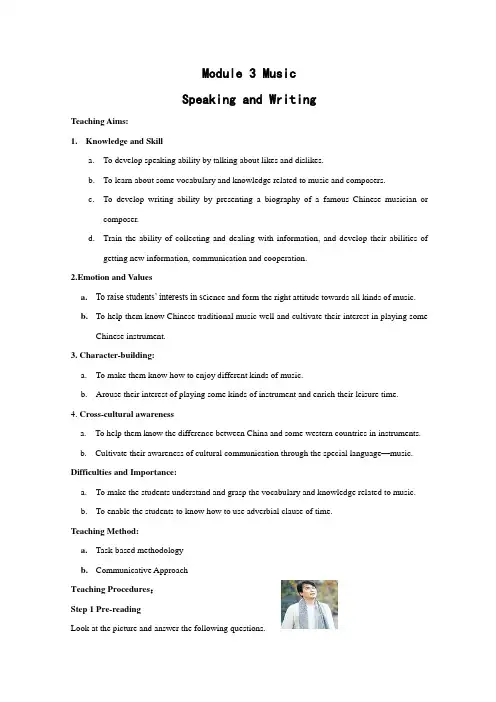
Module 3 MusicSpeaking and WritingTeaching Aims:1.Knowledge and Skilla.To develop speaking ability by talking about likes and dislikes.b.To learn about some vocabulary and knowledge related to music and composers.c.To develop writing ability by presenting a biography of a famous Chinese musician orcomposer.d.Train the ability of collecting and dealing with information, and develop their abilities ofgetting new information, communication and cooperation.2.Emotion and Valuesa.To raise students’ interests in sc ience and form the right attitude towards all kinds of music.b.To help them know Chinese traditional music well and cultivate their interest in playing someChinese instrument.3. Character-building:a.To make them know how to enjoy different kinds of music.b.Arouse their interest of playing some kinds of instrument and enrich their leisure time.4. Cross-cultural awarenessa.To help them know the difference between China and some western countries in instruments.b.Cultivate their awareness of cultural communication through the special language—music. Difficulties and Importance:a.To make the students understand and grasp the vocabulary and knowledge related to music.b.To enable the students to know how to use adverbial clause of time.Teaching Method:a.Task-based methodologymunicative ApproachTeaching Procedures:Step 1 Pre-readingLook at the picture and answer the following questions.1.Who is he?2.Have you ever know something about him?Step 2 While-readinga. SkimmingRead the passage quickly, and make a note of some basic information about Ye xiaogang.Suggested answers:b. Detailed readingRead the passage carefully and fill in the blanks with proper words. Find what Ye Xiaogang did or what happened to him in the following years:Suggested answers:Step 3. Post-readingDiscussion.1.Are there any similarities between Ye Xiaogang and the European composers you have readabout in this module?2.Do you think it is a good idea to mix Chinese and western music?Step 4 Everyday Englisha. Listen to two people talking about the way they listen to music and answer the questions.1.How do they listen to it?2.Are they happy with the way they listen to music?3.What does Anna offer to do for Tom?b. work in pairs. Discuss your favourite music and how you listen to it.Step 4 Guided writingWrite a short passage of a famous singer in China—Han Hong.The following words may help you:1. sing well successful song writer2.born in1971 in Tibet(西藏)3. young watch her mother sing and dance4. at the age of nine professional(专业的) training in Beijing.5. in 1985 her first national prize6. write songs in 19937. song Hometown number one in ChinaHomework:1.Finish writing the biography of Han Hong—a famous Chinese singer.2.Finish other exercises in this module.。
高中英语外研版高中必修2Module3Music-Module3教案
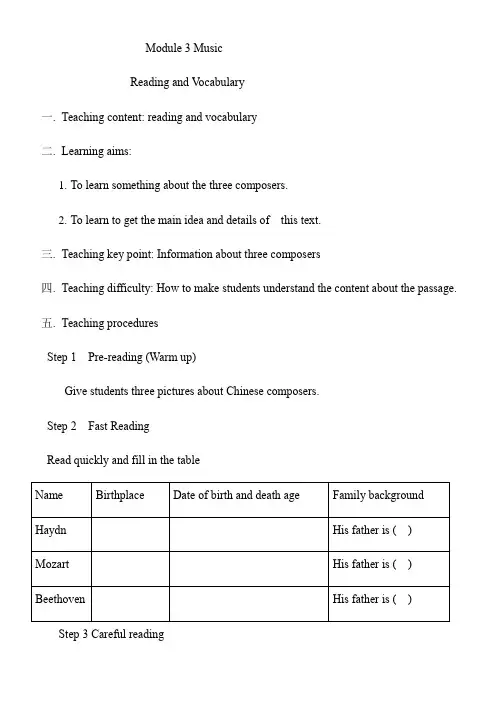
Module 3 MusicReading and V ocabulary一.Teaching content: reading and vocabulary二.Learning aims:1.To learn something about the three composers.2.To learn to get the main idea and details of this text.三.Teaching key point: Information about three composers四.Teaching difficulty: How to make students understand the content about the passage.五.Teaching proceduresStep 1 Pre-reading (Warm up)Give students three pictures about Chinese composers.Step 2 Fast ReadingRead quickly and fill in the tableStep 3 Careful reading(1)Read P1-P2, and answer the following questions.①what is Haydn known as?①How did Haydn change the form of symphonies?①How long did he work in eastern Austria?(2)Listen P3-P5 and answer questions.①How many pieces of music did Mozart compose?①How old was he when he learned to play the harpsichord?①How old was he when he stared composing music?①How old was he when he played for the Empress of Austria?①How long were Mozart and Haydn friends?(3)Read P6-P7 and fill in the blank.Beethoven was born in Bonn, Germany. He showed musical ___ when he was very young ,and learned to play the ___ and ___from his father.Then Mozart met Beethoven and was ___ by him. It was____ who encouraged Beethoven to move to Vienna. Beethoven became very ____ in the Austria. As he grew older, he began to go ___ . He became completely deaf during the last years of his life, but he ____.Step4 Post Reading(T or F)(1). Haydn and Mozart were born in Austria.(2). Mozart had a good singing voice.(3). Haydn died before his fortieth birthday.(4). Beethoven became deaf when he grew older.(5). Haydn and Mozart had fathers who were musicianStep 5 Interview(Which composers do you like best and tell us the reason) Step6 Homework: Reading the passage again after class.。
外研版高中英语必修二模块三教案
Book2Module 3 Music(教案)I. 教学内容分析本模块以Music 为话题,通过本模块的学习使学生对古今中外的音乐家有所了解,增强他们的音乐欣赏能力,并培养他们的评价和鉴赏能力。
从而丰富学生的音乐知识,提高学生的艺术修养。
Introduction 该部分通过设计两个活动来复习和学习常见的乐器的名称,激发学生对本模块话题的兴趣。
培养了学生的审美能力。
Reading and V ocabulary 该部分向同学们介绍了音乐家海顿、莫扎特和贝多芬以及他们的伟大成就。
让同学们在阅读的过程中感受到名人的魅力,树立正确的人生观和价值观。
通过相关的活动训练学生的综合技巧。
Grammar (1) 学习并巩固时间状语从句。
Function通过回答问题和完成句子练习让学生懂得如何表达喜好和厌恶,从而初步培养学生的鉴赏能力。
Listening and V ocabulary 通过听力活动来了解和学习有关英国The Beatles 乐队的知识,然后联系实际体验来谈谈自己对于不同音乐的感受以及音乐和生活的关系。
Grammar (2) 复习过去完成时态。
通过练习帮助学生巩固过去完成时态的基本用法。
Pronunciation 学会如何在日常交际中使用升调和降调。
Writing 要求学生阅读一封外国朋友的电子邮件,并根据问题写一封回信。
Everyday English 要求学生掌握表达喜好的一些用语和有关音乐器材的名称。
Culture Corner 学习一篇有关著名音乐家的叶小刚的文章。
了解他的音乐经历和音乐成就。
树立学生的民族尊严。
Task 训练学生仿写一篇介绍著名音乐家生平和作品的文章。
Module File 对整个模块的学习内容进行小结,巩固本模块的知识。
II. 教学重点和难点1. 教学重点(1) 本单元的有关音乐的生词和短语。
(2) 弄清楚时间状语从句和过去完成时态的用法。
(3) 谈论有关音乐的话题。
2. 教学难点(1) 学会谈论对音乐的喜好。
外研版高中英语必修2Module3__Period1__精品教案
Module3 Period 1精品教案The First Period SpeakingTeaching goals 教学目标1. Target language目标语言a. 重点词汇和短语audience, choir, classical, composer, conductor, jazz, musician, orchestra, saxophone, guitar, classical music, traditional Chinese musicb. 重点句式By the time we arrived ..., the band had ... P27... happened after the fans had left ... P27Before he made ..., he had recorded ... P27I love ... / I really like ... P25... is great! P25... is wonderful! P25I hate ... / I can’t stand ... P25... is awful!/ ... is dreadful! P252. Ability goals 能力目标Enable the Ss to talk about music and instruments.Enable the Ss to express likes and dislikes.3. Learning ability goals 学能目标Help the Ss learn how to talk about music and instruments.Help the Ss learn how to express likes and dislikes.Teaching important points教学重点Talk about likes and dislikes.Teaching difficult points教学难点Full discussion about music.Teaching methods教学方法Asking-and-answering activity; pair or group work.Teaching aids教具准备A recorder, a computer and a projector.Teaching procedures & ways教学过程与方式Step I Lead-inBring a recording with a few short sections of different types of music and play them to the Ss. Then ask some questions about music.T: Morning,boys and girls, what do you like doing in your spare time?S1: I like playing football, because it can make me relaxed.S2: I like reading. It can enlarge my knowledge in a lot of aspects.S3: When I am tired, I like listening to music to relax myself.T: Then what kind of music do you often listen to?S3: I often listen to pop music.T: Well. How many kinds of music do you know?S3: Pop music, classical music and country music.S4: Traditional Chinese music....T: Good. Now I’ll play several pieces of music for you. Please tell me their styles.Play the recording.S5: Is the first piece classical music?S6: No, I think it’s traditional Chinese music.T: You are right. It’s traditional Chinese music. What about the second one?S7: Is it rock and roll?T: Correct. It’s just rock and roll. And what about the last one?S8: It sounds like classical music.T: Excellent! You did a good job.T: Could you tell me which instruments are used in the three pieces of music?Ss: Saxophone, drum, guitar, violin, jazz, etc.T: Which pieces do you like best and why?S9: In my opinion, rock and roll is the best, because it is fashionable and encouraging.S10: I prefer traditional Chinese music, because it is beautiful and reflects our culture. T: How about classical music?S11: To tell the truth, I’m not really interested in it. It’s too difficult to understand.T: Good! Trying to express your ideas is a good way to learn English. In this module, weare going to learn something about music. Now let’s come to the Introduction.Step II IntroductionTask 1T: Please open your books and turn to Page 21. The words in the box are all related to music more or less. Please read them, and at the same time, speak out their Chinese meanings.T: S1, could you read the first two words!S1: OK, audience(听众), choir(唱诗班,合唱队).T: S2, please read the next two.S2: Classical(古典音乐), composer(作曲家).T: S3, please go on.S3: Conductor(指挥), drum(鼓).T: S4, Next two?...T: Good. Since you have known their meanings, please do the following exercise. Which word means someone who writes music?S: Composer.T: Which word means a group of people who sing together?S: Choir.T: Which instruments are used in pop and rock music?S: Drum, guitar, piano and saxophone.T: Which instruments are used in classical music?S: Drum, piano, violin and saxophone.T: Which instruments are used in jazz?S: Drum, violin, piano and saxophone.T: Which instruments are used in traditional Chinese music?S: Erhu and drum.Task 2Divide the class into groups of four to discuss different kinds of instruments.T: In our daily life, we all like to listen to music. Now I’ll give you a chance to talk about your favorite instruments. Please work with your partners.A sample version:S1: Which of the instruments do you like listening to?S2: I prefer erhu.S3: I think I’d like to enjoy piano.S4: I like listening to saxophone.S1: When we mention erhu, whom should we think of?S2: Let me think, oh, I know, Abing.S1: What’s his masterpiece?S3: Erquanyingyue. Do you know who plays the piano best in China?S4: I don’t know. Who?S3: Kongxiangdong. He is a world-class player.Step III FunctionLet the Ss read through the questionnaire in FUNCTION on Page 25. Make sure they understand what they have to do. Then put the Ss into pairs to ask and answer the questions of the questionnaire.T: Now turn to Page 25. Please work in pairs to complete the questionnaire. While you are practicing, you must use the useful sentence structures on the screen.Show the structures on the screen.I love ... I really like...... is great! ... is wonderful!I hate ... I can’t understand...... is awful! ... is dreadful!Sample versions:S1: I love rock music. Among the rock stars, I think Britney Spears is great. I like her because she has a beautiful voice. As for the band, I really like the Rolling Stones. By the time the Rolling Stones called themselves the greatest Rock and Roll band in the world, they had already become stars.S2: I can’t understand why Dao Lang is so popular this year. The words of his songs are awful. At the same time, his style is so simple that I am not interested in him indeed. Step IV PronunciationThe aim of this part is to let the Ss read sentences using the correct intonation. Play thetape for the Ss to listen to and follow.T: As we all know, reading English aloud is an important part in our English learning. If you want to read English sentences correctly, one thing that you must remember is the intonation. Now please look at the sentences on the screen. I will play its tape, for the first time, just listen carefully and pay attention to the speaker’s intonation.Show some sentences on the screen.1. Unfortunately, he arrived at the show after I had left.2. By the time we arrived at the stadium, the band had begun playing.3. Fortunately, the power cut happened after the fans had left the stadium.4. Before he made his latest album, he had recorded some songs with Paul McCartney. Play the tape.T: Let’s listen to the tape again, at the same time you must mark↗when the speaker’s voice rises and↘when it falls.Listen again and mark.T: We’ll listen to the tape a third time, and check your answers while you are listening. Listen and check.T: Now let’s listen for the last time. Please read after the tape....Step V Homework1. Finish exercises about vocabulary in the WORKBOOK on Page 80.2. Prepare for the reading task on Page 22.。
高中英语外研版必修2【教学设计】Module 3
Module 3 Music本模块的话题是music, 旨在通过模块教学使学生通过讨论古今中外的音乐家,增强他们的音乐欣赏能力, 并培养他们的评价能力。
在此基础上表达自己的好恶。
INTRODUCTION通过对乐器知识的了解, 激发学生对本模块中心话题的兴趣;同时也使本模块的授课更具有针对性, 从而培养学生的音乐审美能力。
READING AND VOCABULARY 介绍了国外的三位音乐家及他们的伟大成就, 让学生在阅读中学习音乐知识, 树立正确的评价观、人生观, 为日后走向社会作铺垫。
课文重点讲解了三位音乐家的生平经历, 以及他们对音乐所做的巨大的贡献。
通过阅读, 学生学习了新的词汇和句型, 提高了阅读水平,并能学习音乐家们坚持不懈的精神。
GRAMMAR 1 && GRAMMAR 2学习并灵活运用由when, while, as等引导的时间状语从句, 然后对比过去时和过去完成时。
FUNCTION通过问答形式表达对音乐的喜好, 培养学生的评价能力。
LISTENING AND VOCABULARY让学生通过听一段关于介绍英国历史上的披头士的文章来练习学生的听力能力, 并且完成相关的练习题, 然后介绍自己对音乐的感受及音乐在生活中的意义。
VERYDAY ENGLISH 要求学生掌握如何表达自己最喜爱的音乐及如何听音乐的一些用语。
PRONUNCIATION 听并跟读语法材料中出现的句子, 注意语调的起伏。
CULTURAL CORNER 了解著名音乐家叶小刚的生平经历及音乐成就。
他为中国音乐的发展做出了巨大贡献, 了解他,引导学生向他学习, 学习他勤奋钻研, 不断追求完善的精神, 更要学习他时刻不忘祖国, 为国争光的爱国情怀。
WRITING要求学生阅读一封来自Sandra的电子邮件,并根据一些问题写一封回信。
TASK 训练学生写一篇关于中国著名音乐家的生平介绍及作品简介的文章。
【知识目标】1.重点词汇与短语Austria, Vienna, Germany, symphony, compose, composer, completely,Deaf, from an early age。
外研社英语必修2-Module3-教案
外研社英语必修2-Module3-教案课题名称:Module 3 Music外研社第二册(必修2)(高一)课型:阅读课第4课时时间:45 分钟I. Teaching Objectives1. Language Objectives(1)Important words: choir, orchestra, director, classical, composer, symphony,ballad, catchy, complex, record, solo, Austria.(2)Phrases: be impressed with, split up, make a note of, as well as, the rest of.(3)Difficult structures:a)Having worked there for 30 years, Haydn moved to London, where he wasvery successful.b)By the time he was 14, Mozart had composed many pieces for theharpsichord, piano and violin, as well as for orchestrasc)As he grew older, he began to go deaf.2. Ability Objectives(1) Reading: understanding general topics and main idea.(2)Listening: taking note.(3)writing: Helping the students write an essay about he/her favorite musician.(4)speaking: Helping the students learn how to talk about some famouscomposers in the world3. Moral Objectives1)Get the students know some composers.2)Encourage students to talk about composers who they are like or dislike.4. Learning Strategies(1) Individual work(2) Group work5. Cultural Awareness(1)Help students to learn some famous composers.(2)Let students know some instruments.II. Important Points(1).To be able to talk about some famous composers in the world.(2).To be able to talk about some musicians who they’re like.III. Difficult Points(1).Background of the three famous composers.IV. Teaching Methods(1).Teaching Methods: Communicative Approach and Task-based TeachingMethod.(2).Teaching Aids: a projector , a computer and PPT .V. Teaching ProceduresStep I Lead-in ( 3 minutes)T: Hello, everybody.Ss: Hello, Miss Guo.(All the students’ answers are predicted answers.)T: Ok. Before begin our class, I want to play pieces of music for all of you.Step II Pre-reading( 6 minutes)Play pieces of music named Ninth Symphony.After the music.T: Do you like the music?Ss: Yes.T: Do you know what composer refers to?Ss: No.T: Well, I’ll give you a hint. A composer is a musician who writes pieces ofbeautiful music for others to sing or to play. Clear?Ss: Yes.T: Do you know who is the composer of the music?Ss: Beethoven.T: Brilliant! So, how much do you know about him? Uh, I will give you 3 minutes to discuss with your partner. Ok?Ss: Ok.After 3 minutesT: Ok, time is up. Any volunteers?S1: He is famous all over the world.T: yes. He is famous. And else?S2: he is deaf, but he is a genius.T: Yes. Is there anyone know more about him?S3: he created many beautiful songs.T: Yes. He is creative in music. He is a great composer, isn’t it?Ss: Yeah.T: Do you want to know more about him.\Ss: Yes.T: As we know, there are various kinds of music around the world. They all have their own obvious characteristic. And also there were famous composers such as Joseph Haydn, Mozart, and Beethoven. Today we will learn of their life from the text.Step III while-reading( 28 minutes)T: Now, please open your book and turn to page on 22. There are three pictures, who are they?Ss: Haydn, Mozart and Beethoven.T: Good! And this passage is about the three persons. Now, I will give you 6 minutes to skimming this passage. During this time, you should complete the 2 questions that is presented in the ppt. (the questions are:1.W hat’s the main idea of the passage?2.How many parts do you divide this passage, and why ?) Let’s begin.After 6 minutes.T: Time is up. Have you finished the work?Ss: Yes.T: Good. L et’s check together. W hat’s the main idea of the passage? Any volunteers? Ok, Zhang yue, please.S1:T his passage’s main idea is about three famous composers’ background and experience.T: Yes, good job! This passage tells us three great composers’ background and experience. Generally, we can find the main idea from the first sentence or the last sentence of a paragraph, but sometimes we need to find out the key words and use them to summarize the main idea, clear? By the way, how many parts do you divide this passage?S1: Three parts. First part is 1-2, this part is about H aydn’s background and experience. Second part is 3-5, which is about M ozart’s experience. Last part is 6-8, which is about B eethoven’s.T: Good, you do a good job! Is there anyone have different opinions?Ss: No.T: Ok. I t’s quite easy to divide the part s, isn’t it?Ss: Yes.T: Ok, now, turn to page on 23 and look at activity 3. T here’re 8 questions. (the questions are:1.Which of the composers were born in Austria? 2. Who was born in Germany? 3. Who had a good singing voice? 4. Who died before his fortieth birthday? 5. Who became deaf? 6. Who met each other? 7. Who had fathers who were musicians? 8. W ho had a father who wasn’t a musician?)I’ll give you 10 minutes to scanning this passage in this period, you should complete activity 3 on the page 23, clear?T: Great! Go ahead.After 10 minutesT: All right, time is up. Please look at ppt, the answer is here. Correct your answer quickly please.After 2 minutesT: Ok, let’s move on. Now, work in pairs, answer these questions in activity 4. (the questions are:1. How did Haydn change the form of symphonies? 2. How long did he work in eastern Austria? 3. How many pieces of music did Mozart compose? 4. How old was he when he played for the Empress of Austria? 5. How long were Mozart and Haydn friends? 6. Who taught Beethoven how to play the piano? 7. Did he stop composing when he became deaf?) Because you have scanned the passage, it’s quite easy. 7 minutes for you now, it’s your time.After 7 minutesT: Guys, time is up. Any volunteers want to answer the questions 1-2? Ok, Li fangplease. How did Haydn change the form of symphonies?S1: He changed the symphony into a long piece for a large orchestra.T: Good, how long did he work in eastern Austria?S1: 30 years.T: Good, sit down please. Any volunteers want to answer the questions 3-4? Oh, Zheng liang please. How many pieces of music did Mozart compose?S2: More than 600 pieces of music.T: Great! How old was he when he played for the Empress of Austria?S2: When he was 6, he played the harpsichord in a concert for the Empress of Austria.T: Excellent! questions 5-7, any volunteers? Ok, Sheng xiao please. How long were Mozart and Haydn friends?S3:10 years.T: Good. Who taught Beethoven how to play the piano?S3: His father.T: Did he stop composing when he became deaf?S3: No, he continued composing.T: Good job!Step IV Post-listening( 6 minutes)T: Now, I’ll give you some key words and phrases. Work in groups to retell the main points of the lives of the three great composers. Ok?Ss: Ok.T:The keys words and phrases are in the ppt.( The keys words and phrases are: choir, orchestra, director, classical, composer, symphony, showed musical talent, be known as, be impressed with/by/at, be popular with, have a gift / genius / talent for (doing) something, By the time of…) because of the matter of time, you can retell one of them, ok? 4 minutes for you now.After 4 minutesT: Time is up. Anyone want to try? Yes, Zhao ye please.S1: Beethoven showed musical talent when he was a child, Mozart met Beethoven and was impressed by him. Beethoven is very popular in the Austrian capital. But as he grew older, he began to go deaf.T: Oh, good! Other students can retell like this after class, ok?附:阅读原文Module3 MusicJoseph Haydn (1732 - 1809) was an Austrian composer and is known as "the father of the symphony". Other composers had written symphonies before Haydn, but he changed the symphony into a long piece for a large orchestra.He was born in a village in Austria, the son of a peasant. He had a beautiful singing voice. After studying music in Vienna, Haydn went to work at the court of a prince in eastern Austria, where he became director of music. Having worked there for 30 years, Haydn moved to London, where he was very successful.Wolfgang Amadeus Mozart (1756 - 1791) was a composer, possibly the greatest musical genius of all time. He only lived 35 years and he composed more than 600 pieces of music.Mozart was born in Salzburg, Austria. His father Leopold was a musician and orchestra conductor. Wolfgang had musical talent from a very early age. He learned to play the harpsichord when he was four, he started composing music when he was five, and when he was six, he played the harpsichord in a concert for the Empress of Austria.By the time he was 14, Mozart had composed many pieces for the harpsichord, piano and violin, as well as for orchestras. While he was still a teenager, Mozart was already a big star and toured Europe giving concerts. Haydn met Mozart in 1781 and was very impressed with him. "He is the greatest composer the world has known," he said the two were friends until Mozart's death in 1791.Ludwig van Beethoven (1770 - 1827) was born in Bonn, Germany (1770-1827)He showed musical talent when he was very young, and learned to play the violin and piano from his father, who was a singer. Mozart met Beethoven and was impressed by him. "He will give something wonderful to the world," he said.Beethoven met Haydn in 1791, but was not impressed by the older man. After they had known each other for many years, Beethoven said, "He is a good composer, but he has taught me nothing." However, it was Haydn who encouraged Beethoven to move to Vienna.Beethoven became very popular in the Austrian capital and stayed there for the rest of his life. As he grew older, he began to go deaf. He became completely deaf during the last years of his life, but he continued composing.。
高中英语新课标外研版必修2教案(Module3Musicthe3rdPeriod)
Period 3 Listening and Vocabulary; Pronunciation整体设计教材分析In this period two parts will be dealt with. In Listening and Vocabulary part, first arouse the students to brainstorm some background knowledge about the Beatles. Then the teacher leads the students to learn some words which will appear in the interview in the way of answering the questions. Make sure the students know what they mean. And then ask the students to listen to the tape and complete the third activity. Furthermore, in order to help them know more details about the Beatles, let them listen once more and make some notes about songs as well as albums the band produced. If the students have any difficulty in understanding the interview, they can listen more times. Finally, have the students work in pairs or groups asking and answering questions to get rid of the difficult points they met during the course of listening.The second part is Pronunciation, which is an extension of the listening part and the vocabulary part and helps the students improve their listening ability. First ask the students to listen to the answers to Grammar 2 activity 4 carefully, paying attention to the intonation. Then listen to the tape again and check if they are correct. Next, do more practice by reading the sentences aloud with the correct intonation.三维目标1. 知识与技能1>Train the students'listening ability.2>Develop the students'speaking ability.3>Words: album ballad catchy complex influence lyrics solo artist tune4>Phrases: hear of split up be influenced by in the history of consist of stop doing sth. finish doing sth. break up2. 过程与方法1>Make the students know how to grasp important information through listening activities.2>Make the students catch some details of the listening material.3>Make the students master the correct intonation while reading.4>Individual work, pair work as well as group work to get every student to participate in class.3. 情感与价值1>Make it fun to grasp knowledge by listening.2>Have the students enjoy knowing more about the Beatles.3>Try to raise the students'cooperative awareness in their study by pair work or group work.教学重点1. Learn to research by cooperation.2. Learn to catch necessary information when listening.教学难点1. Lead the stude nts to take an active part in class.2. Learn to make use of correct intonations while reading and speaki ng.3. How to make the stude nts master some liste ning skills.教学过程—Step 1 Review and Lead-i nCheck the stude nts homework by ask ing them to work in pairs and compare their an swers. The n show the correct an swers on the scree n for the stude nts to refer to. If n ecessary, give some expla nati ons to help make them much clearer about some difficult poin ts.—Step 2 Liste ning1. Backgro und kno wledge(Show the followi ng questi ons on the scree n. >1>Do you know the word “ band” ?2>Does the word “ band” mean one person or more than one?3>Ca n you n ame some of the famous ban ds?4>What is your favourite band? Say why?The teacher puts the whole class into groups of four to discuss the above questi ons and work out the an swers. The n compare their an swers with other groups. Next, the stude nts refer to the correct an swers show n onthe scree n. Later, the teacher asks the whole class to look through and observe the above pictures. Fin ally, have the stude nts brain storm as much information about this world-famous musical band as possible with the help of the questions listed in the first activity on P26.2. VocabularyOptio n 1Ask the students to read the listed words as well as questions in activity two on P26 individually and try to understand what they all mean. Then ask some students to read them out and others check if they are correct. Next, let them an swer the questi ons by themselves. If they come across any problems in their understanding, they can turn to the teacher, other students or a dictionary for help. Finally, have the students refer to the correct an swers show n on the scree n after they compare their an swers in pairs.Optio n 2Hold a competition. The teacher writes any word in the table on the blackboard or shows them on the screen for the students to read. The competiti on rules are as follows:Whe n a word is give n, the stude nts who know it raise their han ds.The one that does this first reads the word and give its Chinese meaning or explains it in English. If he or she is correct, he or she will get five grades. Otherwise, he/she gets zero and another one can read and explain it again. Each student has only one chance to read the same word. The guy who gets the most grades will be the final winner.After they know what the words mean, the teacher reads the questions one by one while the whole class give the answers.Option 3Read the listed words out and let the students follow you. Meanwhile, make them pay attention to the stress of them. Put the students into pairs to practice reading them. One reads them through, while the other checks if the words are read and stressed correctly. Then exchange their roles to repeat this.Suggested answers:1>They remember it. 4>More than one.2>The words.5>They like them.3>Difficult. 6>No, they don't.3. While-listening1>Option 1The teacher asks the students to listen carefully for the first time and try to catch the main idea of the record. Then, let them look through the sen tencesi n the third activity quickly and un dersta nd their meanings completely. Later the stude nts liste n a sec ond time to decide whether the senten cesthey just read are true or false. Fin ally, in order to make the stude nts con firm their an swers are correct, you can let them liste n once more.Suggested an swers:(1>T (2>F (3>T (4>T (5>TOptio n 2(Show the following questions on the screen. >The Beatles were born in Liverpool in the north of England. During the early 1960s, the Beatles were 1> by America n rock sin gers. They had their first hit in 1962 with a 2> so ng called Love Me Do. Dur ing the mid-1960s, the Beatles gave rock music a new directi on. Mea nwhile, they sang some serious son gs, 3> as well as 4> s on gs. By thelate 1960s, the 5> ____ a nd the 6> had become more in teresti ng.After they had fini shed record ing Let It Be, they 7> . After the group had broken up, all the Beatles performed as 8> artists or started other ba nds.First the students predict what the record is mainly about. Then ask them to liste n to the tape carefully to get the main idea of the record and check if their prediction is correct. Exchange their main ideas with others. Next, play the tape one more time and the students listen carefully tocatch some details. Meanwhile, they need to fill in the blanks. Later the stude nts work in pairs to compare their an swers. At last the teacher shows the correct answers on the screen for the students to refer to or just call back an swers from the class.Suggested an swers:1>in flue need 2>catchy 3>ballads 4>complex 5>t unes 6>lyrics 7>split up 8>soloOptio n 3(Show the followi ng questi ons on the scree n. >1>Who wrote most of the son gs?2>When did they have their first hit?3>When did they tour the Un ited States?4>What was their last album?5>What did they do after the group had broke n up?6>Whe n and where did Joh n Lennon and George Harris on separately die?The stude nts are required to read them through and un dersta nd them. The n let them liste n to the tape and find out the an swers to the questi ons. Ask some stude nts to report their an swers to the class. Fi nally, check their an swers accord ing to the correct on es.Suggested an swers:1>Le nnon and McCart ney.2>In 1962.3>I n 1964 after they had become stars in their own coun try.4>Let It Be.5>After the group had broke n up, all the Beatles performed as solo artists or started other ban ds.6>Joh n Lennon died in New York in 1980 while George Harris on died in 2001.2>First, the teacher puts the stude nts into four big groups. Each one isrequired to make no tes about one special songs or album men ti oned in the fourth activity. The n the teacher plays the tape through one more time while the stude nt liste n carefully to catch as many details about these songsand albums as they can. Next, each group has a discussi on and collects the n ecessary in formatio n that members got, orga nising them in order. Fin ally, the teacher asks represe ntativesof each group to report their results to the whole class. You might as well en courage them to give differe nt opinions.Suggested an swers:Nowhere Man: seriousYesterday: balladStrawberry Fields Forever: complexLet It Be: last album.Tapescript:The Beatles were the most successful band in the history of popular music. The band consisted of John Lennon, Paul McCartney, George Harris on and Ringo Start. Starr played drums, the other three played guitar. Lennon and McCartney wrote most of the songs all the Beatles were born in Liverpool in the north of England.During the early 1960s, the Beatles were influenced by American rock singers, such as Chuck Berry and Elvis Presley. They had their first hit in 1962 with a catchy song called Love Me Do(1962>. In 1964, after they had become stars in their own country, the Beatles toured the United States andwere a huge success.During the mid-1960s, the Beatles were one of the bands which gave rock music a new direction. Some of their songs were quite serious, such as Nowhere Man; there were ballads such as Yesterday and more complex songs such as Strawberry Fields Forever.By the late 1960s, their music had changed completely. They had stopped writing simple songs with catchy tunes. The tunes and the lyrics had become more interesting and they had begun to use new instruments, too. For example, after visiting India, they started using Indian instruments.Some of their albums changed pop music completely. Their last album was Let It Be in 1970.After they had finished recording Let It Be, they split up. By the time they stopped working together, they had sold more albums than any other band in history. After the group had broken up, all the Beatles performed as solo artists or started other bands.Joh n Lennon died in New York in 1980, George Harris on died in 2001.—Step 3 Pronun ciati onFirst let the stude nts work in pairs and read through the sen ten ces in Grammar 2 activity 4. Meanwhile, mark ' when they think the voice should rise and 亠when it should fall. Then the students listen to the tape and check whether their marks are correct. If not, correct them .In order to consolidate what they just learnt, ask the students to read the sentences once aga in andpay special atte nti on to the inton ati on. Or you can choose some other senten ces and have the stude nts read them and marlas well as * where n ecessary.Suggested an swers:1>Unfortunately 呻,he arrived at the show呻after I had left * .2>By the time we arrived at the stadium ”, the band had begun playi ng3>Fortunately刀,the power cut happened • after the fans had left the stadium *.4>Before he made his latest album , he had recorded some songs with Paul McCartney *.—Step 4 Relative Language Points in This Period1. complex adj.合成的,复杂的,综合的,难解的n.复杂,合成物a complex sentence复合句a complex nu mber数> 复数a complex situati on错综复杂的形势a complex argument/problem/subjec复杂难懂的论证/问题/科目alaboratory complex 综合实验室a sports complex综合体育馆have a complex about sth对 .. 过分敏感或担忧a complex of...很多复杂的.....There is a complex n etwork of roads round the city.城市周围有复杂的公路网。
外研版高中英语必修二模块三教案
Book2Module 3 Music (教案)I.教学内容分析本模块以Music为话题,通过本模块的学习使学生对古今中外的音乐家有所了解,增强他们的音乐欣赏能力,并培养他们的评价和鉴赏能力。
从而丰富学生的音乐知识,提高学生的艺术修养。
Introduction该部分通过设计两个活动来复习和学习常见的乐器的名称,激发学生对本模块话题的兴趣。
培养了学生的审美能力。
Reading and Vocabulary该部分向同学们介绍了音乐家海顿、莫扎特和贝多芬以及他们的伟大成就。
让同学们在阅读的过程中感受到名人的魅力,树立正确的人生观和价值观。
通过相关的活动训练学生的综合技巧。
Grammar (1)学习并巩固时间状语从句。
Function通过回答问题和完成句子练习让学生懂得如何表达喜好和厌恶,从而初步培养学生的鉴赏能力。
Listening and Vocabulary通过听力活动来了解和学习有关英国The Beatles乐队的知识,然后联系实际体验来谈谈自己对于不同音乐的感受以及音乐和生活的关系。
Grammar (2)复习过去完成时态。
通过练习帮助学生巩固过去完成时态的基本用法。
Pronunciation学会如何在日常交际中使用升调和降调。
Writing要求学生阅读一封外国朋友的电子邮件,并根据问题写一封回信。
Everyday English要求学生掌握表达喜好的一些用语和有关音乐器材的名称。
Culture Corner学习一篇有关著名音乐家的叶小刚的文章。
了解他的音乐经历和音乐成就。
树立学生的民族尊严。
Task训练学生仿写一篇介绍著名音乐家生平和作品的文章。
Module File对整个模块的学习内容进行小结,巩固本模块的知识。
II.教学重点和难点1.教学重点(1)本单元的有关音乐的生词和短语。
(2)弄清楚时间状语从句和过去完成时态的用法。
(3)谈论有关音乐的话题。
2. 教学难点(1)学会谈论对音乐的喜好。