
新时代英语传统文化翻译
英语翻译
Unit 1Book 3. 中国传统节日以中国的农历为依据。农历年的岁首称为春节,俗称“过年”,有祈年等多种习俗,是中国人民最隆重的传统节日,象征团结兴旺。其他主要的节日有元宵节、清明节、端午节、七夕节、中秋节、重阳节、冬至节、腊八节等等。各个节日都有其来源讲究和风俗习惯。农历节日与农历中的二十四节气不同。农历节日是中华民族凝聚力和生命力的体现
Traditional Chinese festivals are usually fixed to the Lunar calendar. January 1st on the lunar calendar has been designated as the Spring Festival (generally referred to as guonian). There are several customs during the Spring Festival, such as praying for a good harvest, etc. The Spring Festival is the most ceremonious traditional festival in China and symbolizes unity and prosperity. Some other significant Chinese festivals include the Lantern Festival, the Pure Bright Festival, the Dragon Boat Festival. the Double-Seventh Festival, the Mid-Autumn Festival, the Double-Ninth Festival, the Winter Solstice, and the Eight Day of the Twelfth Lunar Month, etc. Each festival has its own unique origin and custom. These Chinese festivals that follow the Lunar calendar are different from the 24 Solar Terms in the
Lunar calendar. They embody China's cohesion and vitality.
Unit 3Book3. 中国古代四大艺术“琴棋书画” 的画特指国画。其绘画形式是用毛笔蘸水、墨、颜料作画于绢、帛、宣纸之上,古代称之为水墨丹青。为区别于西方的油画而称之为“中国画”,简称“国画”。其题材有人物、山水、花鸟等。技法可分为工笔和写意。国画的艺术特质在于“笔墨”,强调以形写神,画尽意在。国画在艺术创作上反映了中化民族的审美意识和情趣。
The four art forms in ancient China are guqin, chess, penmanship, and painting. And painting particularly refers to traditional Chinese painting. Traditional Chinese painting is done with a brush dipped into black or colored ink and is painted on silk or xuan paper. In ancient China, it was called “ink-painting.” In order to distinguish it from Western oil-paintings, the Chinese people term their works “traditional Chinese painting” (abbreviated to “Chinese painting”.) The
subject matters of Chinese paintings are typically figures, landscapes, birds and flowers. The drawing skills and techniques
employed by the Chinese painters can be divided into two forms: fine brushwork and
free-hand brushwork. The artistic characteristics lie in “the writing brush and ink.”
Chinese painting emphasizes using the shape to convey the feelings of the painter. Even though a painting is a finished product, it endlessly conveys a meaning. In terms of the artistic creation, traditional Chinese painting is a reflection of the aesthetic consciousness and artistic sentiment of the Chinese people.
5. 中国石窟
中国石窟组要反映的是佛教文化艺术。敦煌莫高窟、大同云冈石窟、洛阳龙门石窟、天水麦积山石窟,号称中国四大石窟艺术景观。佛教石窟随山雕凿、彩绘,形象生动自然,将崇尚美与世俗情融为一体,把天然造化与人工创造有机结合,是由建筑、绘画、雕塑等组成的博大精深、绚丽夺目的综合艺术殿堂。其艺术成就为世界瞩目,已成为重要的世界文化遗产。
Chinese Grottoes
Chinese grottoes mainly reflect the art of Buddhist culture. In China, there are four major art landscape of grottoes:the Mogao Grottoes at Dunhuang, the Yungang
Grottoes at Datong, the Longmen Grottoes at Luoyang, and the Maijishan Grottoes at
Tianshui. Carved and painted on mountains, the Buddhist grottoes mingle both
sublimity and secular feelings together, presenting us a vivid and natural appearance.
They embody the systematic combination of both the exceptional artistry of great
nature and the extremely fine craftsmanship of mankind. The Chinese Buddhist
Grottoes are regarded as a profound and stunning general art gallery, which are
composed of architecture, painting, sculptures, etc. The artistic achievements of
Chinese grottoes have attracted the attention of the world, and have become important
international cultural heritage.
Unit 7Book3 .中药主要由植物药(根、茎、叶、果)、动物药(内脏、皮、骨、器官)和矿物药组成。因以植物药为主,故也称中草药。中药的应用理论独特,认为中药有四气五味。“四气”指药性的“寒热温凉”,“五味”指“辛酸甘苦咸”。中国人探索中草药已有几千年的历史,如今中医药及其诊疗方法已传播到世界各地。
Traditional Chinese medicine mainly consists of plant medicine (roots, stems, leaves,
fruits), animal medicine (viscera, skins, bones, organs), and mineral medicine. Chinese herbal medicine is based on plant medicine. According to the unique application
theory of traditional Chinese medicine, it is believed that it contains “ four natures and five flavors.” “Four Natures” refers to the properties of “coldness, heat, mildness, and coolness,” while “five flavors” refers to the properties of being
“pungent, sour, sweet, bitter, and salty.” It is said that Chinese people have been conducting research into herbal medicine for thousands of years. Nowadays, traditional
Chinese medicine and its therapeutic methods have extensively been spread to the far
corners of the globe. Unit 1 Book 4 剪纸
剪纸又叫刻纸,窗花或剪画。剪纸在纸的发明之前就已经流行,当时人们运用金箔,绢帛,皮革等片状材料,通过镂空雕刻的技法制成工艺品。汉代(前206-公元220),纸张的发明促使了剪纸的发展与普及。民间剪纸的题材多来源于现实生活,充满纳福迎祥的主题,表达对美好生活的向往。
Paper cutting (otherwise known as jianzhi) is also called kezhi, chuanghua or jianhua.
Paper cutting was popular even before paper was invented. When there was no paper,
120个中国传统文化名词及其英译
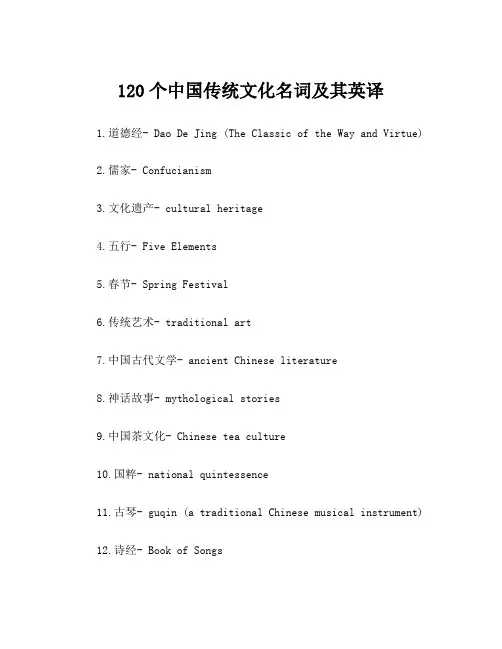
120个中国传统文化名词及其英译
1.道德经- Dao De Jing (The Classic of the Way and Virtue)
2.儒家- Confucianism
3.文化遗产- cultural heritage
4.五行- Five Elements
5.春节- Spring Festival
6.传统艺术- traditional art
7.中国古代文学- ancient Chinese literature
8.神话故事- mythological stories
9.中国茶文化- Chinese tea culture
10.国粹- national quintessence
11.古琴- guqin (a traditional Chinese musical instrument)
12.诗经- Book of Songs 13.行书- running script (a style of Chinese calligraphy)
14.红楼梦- Dream of the Red Chamber
15.京剧- Beijing Opera
16.四书五经- Four Books and Five Classics (Confucian
classical texts)
17.中医- Traditional Chinese Medicine (TCM)
18.书法- calligraphy
19.文房四宝- Four Treasures of the Study (brush, ink
stick, inkstone, and paper)
20.传统节日- traditional festivals
21.工艺品- handicrafts
22.长城- Great Wall
23.农历- lunar calendar
24.中国画- Chinese painting
中国传统文化英语版
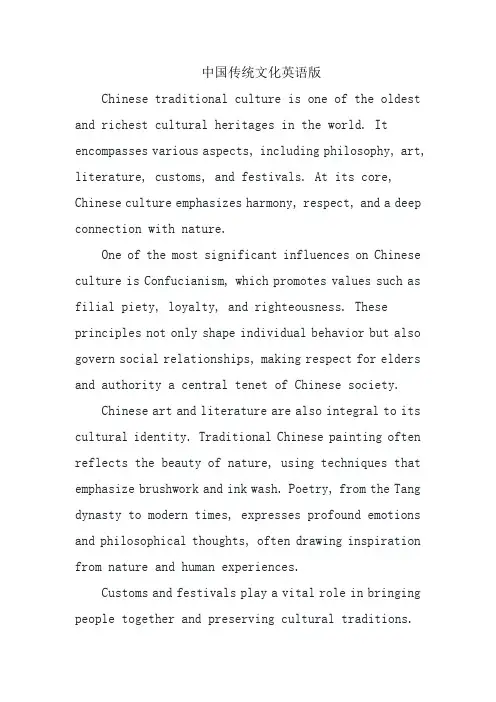
中国传统文化英语版
Chinese traditional culture is one of the oldest
and richest cultural heritages in the world. It
encompasses various aspects, including philosophy,
art,
literature, customs, and festivals. At its core,
Chinese culture emphasizes harmony, respect, and a deep
connection with nature.
One of the most significant influences on Chinese
culture is Confucianism, which promotes values such as
filial piety, loyalty, and righteousness. These
principles not only shape individual behavior but also
govern social relationships, making respect for elders
and authority a central tenet of Chinese society.
Chinese art and literature are also integral to its
cultural identity. Traditional Chinese painting often
reflects the beauty of nature, using techniques that
emphasize brushwork and ink wash. Poetry, from the Tang
中国传统文化英语表达

1. 元宵节: Lantern Festival
2. 刺绣:embroidery
3. 重阳节:Double-Ninth Festival
4. 清明节:Tomb sweeping day
5. 剪纸:Paper Cutting
6. 书法:Calligraphy
7. 对联:(Spring Festival) Couplets
8. 象形文字:Pictograms/Pictographic Characters
9. 人才流动:Brain Drain/Brain Flow
10. 四合院:Siheyuan/Quadrangle
11. 战国:Warring States
12. 风水:Fengshui/Geomantic Omen
13. 铁饭碗:Iron Bowl
14. 函授部:The Correspondence Department
15. 集体舞:Group Dance
16. 黄土高原:Loess Plateau
17. 红白喜事:Weddings and Funerals
18. 中秋节:Mid-Autumn Day
19. 结婚证:Marriage Certificate
20. 儒家文化:Confucian Culture
21. 附属学校:Affiliated school
22. 古装片:Costume Drama
23. 武打片:Chinese Swordplay Movie
24. 元宵:Tangyuan/Sweet Rice Dumpling (Soup)
25. 一国两制:One Country, Two Systems
26. 火锅:Hot Pot
27. 四人帮:Gang of Four
28. 《诗经》:The Book of Songs
中国传统文化翻译

中国传统文化翻译
中国传统文化是中国文化的一个重要组成部分,涵盖了许多方面,包括历史、哲学、艺术、文学、音乐、美术等。以下是中国传统文化翻译的相关参考内容:
1. Confucianism (儒家思想)
Confucianism is a philosophy developed by Confucius in ancient
China, emphasizing the importance of personal and governmental
morality, the correctness of social relationships, justice, and
sincerity.
2. Taoism (道家思想)
Taoism is a philosophical and religious tradition that emphasizes
living in harmony with the Tao (the Way), encompassing ideas like
simplicity, naturalness, and spontaneous action.
3. Chinese Calligraphy (中国书法)
Chinese calligraphy is a form of visual art that seeks to express
artistic beauty using characters as a medium. It is often regarded as
one of the highest forms of Chinese cultural expression.
4. Chinese Poetry (中国诗歌)
Chinese poetry has a rich history dating back to ancient times, with
中国传统文化常见词的英文翻译

中国传统文化常见词的英文翻译
中国传统文化常见词的英文翻译
样板戏—— model opera
地雷战 ——The Mine Warfare
贵妃醉酒 ——Drunkened Concubine
霸王别姬 ——Farewell to My Concubine
荒山泪 ——Tears of Huangshan
群英会 ——Gathering of Heroes
借东风 ——East Wind
将相和 ——General and Premier Make Up
杨门女将 ——Women General of Yang Family
凤阳花鼓—— Flower Drum Dance
大海啊,故乡—— Home in the Sea
我的中国心—— My Chinese Heart
军港之夜 ——Night at the Naval Port
冬天里的一把火—— Winter Fire
十面埋伏(古曲)—— Ambush from All Sides
天仙配—— Goddess Marriage
牡丹亭—— Peony Pavilion
春江花月夜—— Moon and Flower in the Spring River
琵琶记 ——The Story of Pipa
醒世恒言—— Lasting Words to Awaken the World
梁祝(小提琴协奏曲)—— Butterfly Love
警世通言—— Ordinary Words to Warn the World
喻世明言—— Clear Words to Illustrate the World
拍案惊奇—— Surprise Stories to Make One Slap the Desk
红楼梦—— A Dream of Red Mansion/Chamber
水浒—— Water Margin
西游记 ——Journey to the West 三国演义 ——Romance of the Three Kingdoms
100个中国传统文化词汇的英文翻译翻译
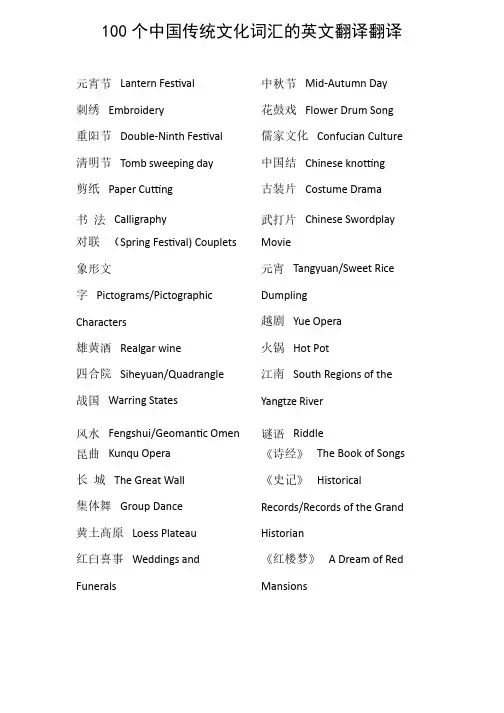
100个中国传统文化词汇的英文翻译翻译
元宵节元宵节 Lantern Fesval
刺绣刺绣 Embroidery
重阳节重阳节 Double-Ninth Fesval
清明节清明节 Tomb sweeping day
剪纸剪纸 Paper Cung
书 法 Calligraphy 对联对联 (Spring Fesval) Couplets
象形文
字 Pictograms/Pictographic Characters
雄黄酒雄黄酒 Realgar wine
四合院四合院 Siheyuan/Quadrangle
战国战国 Warring States
风水风水 Fengshui/Geomanc Omen 昆曲昆曲 Kunqu Opera
长 城 The Great Wall
集体舞集体舞 Group Dance
黄土高原黄土高原 Loess Plateau
红臼喜事红臼喜事 Weddings and Funerals 中秋节中秋节 Mid-Autumn Day
花鼓戏花鼓戏 Flower Drum Song
儒家文化儒家文化 Confucian Culture
中国结中国结 Chinese knong
古装片古装片 Costume Drama
武打片武打片 Chinese Swordplay Movie
元宵元宵 Tangyuan/Sweet Rice Dumpling
越剧越剧 Yue Opera
火锅火锅 Hot Pot
江南江南 South Regions of the Yangtze River
谜语谜语 Riddle 《诗经》《诗经》 The Book of Songs
《史记》《史记》 Historical Records/Records of the Grand
Historian
《红楼梦》《红楼梦》 A Dream of Red Mansions
《西游记》《西游记》 The Journey to the West
120个中国传统文化名词及其英译 2
1 120个中国传统文化名词及其英译
以下是120个中国传统文化名词及其英译:
1. 春节 (Spring Festival)
2. 元宵节 (Lantern Festival)
3. 清明节 (Tomb-Sweeping Day)
4. 端午节 (Dragon Boat Festival)
5. 中秋节 (Mid-Autumn Festival)
6. 重阳节 (Double Ninth Festival)
7. 除夕 (New Year's Eve)
8. 书法 (Calligraphy)
9. 国画 (Traditional Chinese Painting)
10. 剪纸 (Paper Cutting)
11. 对联 (Spring Festival Couplets)
12. 风筝 (Kite)
13. 中国结 (Chinese Knotting)
14. 灯笼 (Lantern)
15. 灯谜 (Lantern Riddles)
16. 茶文化 (Tea Culture)
17. 热闹 (Noise and Excitement)
18. 团圆 (Reunion)
19. 红包 (Red Envelope)
20. 长寿 (Longevity) 2 21. 福字 (Fu Character)
22. 禅宗 (Zen Buddhism)
23. 道教 (Taoism)
24. 佛教 (Buddhism)
25. 儒家 (Confucianism)
26. 旗袍 (Qipao)
27. 长衫 (Long Shirt)
28. 唱戏 (Opera)
29. 京剧 (Peking Opera)
30. 象棋 (Chinese Chess)
31. 麻将 (Mahjong)
32. 瓜子 (Sunflower Seeds)
33. 腊八节 (Laba Festival)
34. 元宵 (Tangyuan)
大学英语六级翻译传统文化词汇:喜庆节日
大学英语六级翻译传统文化词汇:喜庆节日
导读:本文大学英语六级翻译传统文化词汇:喜庆节日,仅供参考,如果觉得很不错,欢迎点评和分享。
中华民族的喜庆节日(Chinese Festivial)
国庆节 National Day
中秋节 Mid-Autumn Day/Festival
春节 Spring Festival
元宵节 Lantern Festival
儿童节 Children’s Day
端午节 Dragon Boat Festival
妇女节 Women’s Day
泼水节 Water-Splashing Day
教师节 Teachers’ Day
五四青年节 Youth Day
中国传统文化 词汇表英文
中国传统文化词汇表英文
【释义】Chinesetraditionalculture
中国传统文化:指中国历史上形成并流传至今的文化体系,包括但不
限于文学、艺术、哲学、宗教、礼仪、习俗等方面的内容。
【短语】1中国传统文化专题
TopicsonChineseTraditionalCulture
2中国传统文化概论
introductiontochinesetraditionalculture;TheTraditionalCultureof
China
3中国传统文化1
TraditionalCultureofChina
4中国传统文化与新文学
ChineseTraditionalCulture&;NewLiterature;chinesetraditional
culture
5中国传统文化研究协会
CTWH
6以中国传统文化
traditionalcultureofChellona
7中国传统文化精髓
Chinesetraditionculturemarrow8国际中国传统文化学院
TCCII
9中国传统文化艺术
Chinesetraditionalcultureart
【例句】1虽然他是一个外国人,但他热爱中国传统文化。
Althoughheisaforeigner,helovesChinesetraditionalculture.
2既然你喜欢中国传统文化,我认为参观剪纸展览是个好选择。
SinceyouarefondoftraditionalChineseculture,Ithinkvisitingthe
paper-cuttingexhibitionisagoodchoice.
3应该鼓励青少年学习和传播中国传统文化。
TeenagersshouldbeencouragedtolearnandspreadChinesetraditional
culture.
4优秀的中国传统文化是我们的宝贵财富。
ThegoodtraditionalChinesecultureisourgreattreasure.
关于传统文化的英语翻译词汇、短语
➢ 压岁钱 gift money lucky money
➢ 放鞭炮 setting off firecrackers
➢ 拜年paying New Year calls
➢ 逛庙会 visiting temple fairs
➢ 贴春联 pasting Festival Couples
➢ 春运 spring festival travel season
➢ 年夜饭 Spring Festival reunion dinner
➢ 祝福短信 blessing message
➢ 发红包 Hand out red envelopes
➢ 春节晚会 Spring Festival Gala
➢ 元宵节 the Lantern Festival
➢ 灯谜 lantern riddles
➢ 清明节 Tomb-Sweeping Day
➢ 祭拜祖先honor the ancestors
➢ 踏青 family outing
➢ 端午节 Dragon Boat Festival
➢ 赛龙舟 Dragon Boat Racing
➢ 粽子 rice dumplings wrapped in leaves
➢ 屈原 patriotic poet and senior minister of
the Chu State
➢ 七夕 Double Seventh Festival (Qixi, or
Qiqiao) ➢ 牛郎 Cowherd
➢ 织女 Weaver Maid
➢ 中秋节 Mid-Autumn Festival
➢ 重阳节
Double Ninth Festival
➢ 前人,前辈 predecessors
➢ 后代,后辈 descendants
➢ 历史记载 historical record
➢ 历史故事 historical stories
➢ 历史人物 historic figure