
七年级英语牛津7BUnit6教案解读
第 1 页 2022-4-26 课题 Unit 6 Outdoor fun ---Welcome to the unit 课时 第一课时 执教时间 复备人 教学目标 1. 知识目标: Know different kinds of English names about outdoor fun. 2. 技能目标:. Talk about your favourite outdoor fun in English. 教学重点 Know different kinds of English names about outdoor fun.
教学难点 Talk about your favourite outdoor fun in English. 教学媒体 录影机,多媒体,实物等
教学过程
Step1:预习指导与检测 Step2:展示目标 Step3:课堂导学与互动 任务一:Lead-in Different kinds of outdoor activities: 任务二:Listen and answer Daniel and Amy are talking about outdoor activities. Listen to their conversation and find out : 1. What are their favourite outdoor activities? 2. Why do they like the two activities? 任务三:Work in groups and talk about what activities to do this weekend. E.g. A: What outdoor activity would you like to try? B: I would like to go jogging. A: Why? B: Because I want to keep healthy and fit. What about you? A:I would like to… B: What do you like about camping? A: I think… 任务四:Language points: 任务五:Eddie and Hobo are also doing an outdoor activity. Listen and answer: 1. What are they doing? 再备 第 2 页 2022-4-26
2. Does Eddie like it? What about Hobo? Step4:总结提升 Pratice Step5:当堂反馈 Step6:课后拓展 Step7:布置作业 1.Copy new words and phrases. 2.Recite the dialogue 第 3 页 2022-4-26
课题 Unit 6 Outdoor fun ---Reading 1
课时 第二课时 执教时间 复备人 教学目标 1. 知识目标: 1. Master the new words and phrases. 2. Learn something about the story by using different kinds of reading skills. 3. Pay attention to the order of narrating a story. 2. 技能目标:Learn about the simple past tense. 教学重点 Learn something about the story by using different kinds of reading skills.
教学难点 Pay attention to the order of narrating a story. 教学媒体 录影机,多媒体,实物等
教学 过程
Step1:预习指导与检测 Step2:展示目标 Step3:课堂导学与互动 任务一:Lead-in 1. Do you read this book or watch the movie? 2. Show some pictures one by one. Talk about the story. 任务二:Listen and answer What did Alice do one sunny day? 2. Who did Alice run after? 3. What could Alice see on the other side when the small door opened? 4. Did Alice go through the small door? 任务三:Complete Part B1,B2 on Page 71 and B3 on Page 72. 任务四:Watch a video and Retell the story between Alice and the rabbit. 任务五:Complete Part B4 on Page 72. Fill in the passage about the story. Step4:总结提升归纳重点短语和句型 Step5:当堂反馈 Step6:课后拓展 Step7:布置作业 1.Copy new words and phrases. 2.Recite the dialogue 再备 第 4 页 2022-4-26
课题 Unit 6 Outdoor fun ---Reading 2
课时 第三课时 执教时间 复备人 教学目标 1. 知识目标: 1. Master the new words and phrases. 2. Learn something about the story by using different kinds of reading skills. 3. Pay attention to the order of narrating a story. 2. 技能目标:Learn about the simple past tense. 教学重点 Learn something about the story by using different kinds of reading skills.
教学难点 Pay attention to the order of narrating a story. 教学媒体 录影机,多媒体,实物等 教学过程 Step1:预习指导与检测 Step2:展示目标 Step3:课堂导学与互动 任务一:复习课文Talk about the story between Alice and a rabbit 任务二:Work with your group members and try to answer these questions: 1. What did Alice see? 2. What surprised Alice? 3. Where did Alice find herself? 4. Was it a key for any of the doors? 5. Why Alice did not go through the door? 任务三:Interview Have students prepare some questions in groups first, then each group can suggest one to be the interviewer and interview other students 任务四:Language points 任务五:practice Step4:总结提升 _____________________________________________________ Step5:当堂反馈 Step6:课后拓展 Step7:布置作业 1.Copy new words and phrases. 2.Recite the dialogue 再备 第 5 页 2022-4-26
课题 Unit 6 Outdoor fun ---Grammar
课时 第四课时 执教时间 复备人 教学目标 1. 知识目标:1. Master the new words and phrases. 2. Learn to use the simple past tense. 2. 技能目标:Learn to use the simple past tense correctly. 3. 情感目标:Learn to use the simple past tense to describe what happened to us in the past.. 教学重点 Learn to use the simple past tense.
教学难点 Learn to use the simple past tense. 教学媒体 录影机,多媒体,实物等
教学过程
Step1:预习指导与检测 Step2:展示目标 Step3:课堂导学与互动 任务一: Lead-in Show the students a picture and ask the students to work out the rule of the simple past tense. 动词过去式的构成 任务二:Practice 见课件 1. We always (go) to Shanghai when I was a child. 2. They (not go) to school last Wednesday, they (have) a match. 3. Mike (drive) to Nanjing three days ago, he (not, take) a train there. 4. She seldom (arrive) home late after work, but she (come) back at 10p.m. yesterday. 任务三:Finish Page 74 Part A,B. Step4:总结提升 Step5:当堂反馈 Step6:课后拓展 Step7:布置作业 1.Copy new words and phrases. 2.Recite the dialogue 再备
7B Unit 6 Outdoor fun Integrated Skills 课件 (牛津版七年级下)

Whose kites are they?
Millie
Simon
Amy
Daniel
Task 3
Learn the history of kites
Now flying kites is a very popular activity around the world. Do you want to know the history of kites? Who made the first kite?
I need to take a mobile phone.
Amy and Shirley are going for a picnic. They are very excited.
Listen and answer
What can they do when they have a picnic?
1. 2000 2. Mozi 4. Lu Ban 7. Marco Polo 10. kites 5. Cai Lun 8. West
3. wood 6. 13th
9. outdoor
Ask and answer:
• When did Chinese people begin to make kites?
• When did people begin to use paper to make kites?
After Cai Lun found a new way to make paper He told people in the West all about kites.
• Which city in China is famous for making kites now? Weifang in Shandong province.
牛津译林版英语七年级下册7B Unit6 知识点梳理及考点归纳

7B Unit 6 Outdoor funⅠ概况7BU6的主要考点为以下几点:1.much,many,few和little的辨析2. alone=by oneself或on one’s own(属于初一略微提及,初二上学期全面学习的词组。
初一升初二衔接知识点)3.反身代词herself(属于初一略微提及,初二上U3重点讲解的语法。
初一升初二衔接知识点)4. put up的用法,表示搭建的意思。
考察与put out,.put on,和put away的辨析5.too … to …表示太而不能的意思,考句型...考单选...6. reach,在本句中做动词,意思是够得到。
考察动词词义辨析Ⅱ详细讲解一、重点词组二、重要句型1、Hurry up, Eddie. 快点,埃迪!hurry up意为“快点”。
如:Hurry up, or you will be late. 快些,不然要迟到了。
(1)hurry to +地点意为“赶往某地”,如:Betty hurried to the garden. 贝蒂急忙奔向花园。
(2)(be)in a hurry意为“匆忙地;仓促地”,翻译:你为什么这么匆忙?(3)hurry to do sth. 急忙做某事翻译:我正急着去赶火车。
2、Hobo, carry it for me. 霍波,帮我拿包吧。
[辩异]bring, carry 和takebring表示“拿来”(从远到近)take表示“拿走”(从近到远)carry表示“搬、运”1.____________ me my food here, please.2.You can read the book here but you can’t ______ it home.3.Trains _______ more things than trucks.答案:1.bring 2.take 3.carry3、You complain too much. 你抱怨太多了。
7B Unit6知识点梳理及拓展

牛津英语7B Unit6知识点梳理及拓展1. outdoor fun户外趣事(1).同义词为outside(外部的) 反义词indoor室内的[拓展]outdoor常构成固定短语:outdoor activities 室外活动outdoor life 野外生活outdoor exercises 户外运动(2).fun 的短语:have fun doing sth. tell funny jokes2. Hurry up, Eddie.赶快,埃迪。
考点:掌握hurry作名词与动词在句中的转换。
hurry 此处用作不及物动词,意为“匆忙;急忙”。
其过去式为hurried。
(1)"hurry to+地点”意为“急忙去某地”,(2)hurry to do sth.=do sth in a hurry意为“匆忙做某事”[拓展] hurry也可用作名词,意为“匆忙;急忙”in a hurry匆忙,急忙;in no hurry 不用着急,慢点3. complain too much 抱怨太多[拓展]complain 的用法complain about sth. 抱怨某事;complain about doing sth. 抱怨做某事complain to sb. of/ about sth.向某人抱怨某事练习:他经常跟我抱怨。
He often _______________ me.他对这家餐厅的食物不满。
He ____________ the food in the restaurant.[拓展]too much用法(1)后+ 不可数名词,译为“太多”;(2)修饰动词,放在被修饰词后面区别:much too太……修饰adj/adv 放在被修饰词的前面too many太多……修饰可数名词复数,放在被修饰词的前面助记too much, much too与too many ,too much, much too,用法区别看后头。
牛津译林版7B Unit6 outdoor fun Reading课件(共24张PPT)
the white rabbit
The Cheshire Cat(柴郡猫)
The March Hare (三月兔)
The Caterpillar (毛毛虫)
The dodo bird (渡渡鸟)
The Hatter (帽匠)
The queen of hearts(红心女王)
Fill in the blanks according to Paras.4-5
Did Alice get out of the hall and get into the lovely garden?
There were doors all they were all locked. around, it did not fit any of Alice saw a small key on BUT the doors. a table, Alice saw a lovely garden she was too big. on the other side, and tried to go through the door,
Fast reading
Task 1
Match each part with paragraphs.
Para 1
Part 1 Before jumping down the hole.
(outside the hole)
Para 2 Para 3 Para 4 Para 5
Part 2 After jumping down the hole.
e ___
c ___
a ___
d ___
b ___
What did the rabbit do outside the hole?
牛津英语 7B Unit6 Task课件p

2. what to do 特殊疑问词后接动词不定式
how to do sth., when to do, where to go 我爷爷以前不知道怎样使用电脑。现在他 知道怎样发电邮了。 My grandfather didn’t know h__o_w_t_o__u_s_e a computer. But now he knows h__o_w_t_o__se_n_d_ e-mails. 我们都不知道何时出发。
tree. • He is not tall enough to reach the apple on the tree.
14. climb up 向上爬 每个人都想登上长城。 Everyone wants to _c_li_m_b__u_p_ the Great Wall.
13. fail 失败 考试失败 fail in the exam fail to do sth. 做不到,未能做 如果你做不到努力学习,要得到好成 绩是不可能的。
problem.
10. decide to do sth. 决定做…… 我决定周末陪父亲去钓鱼。 I decide _to__g_o_ fishing with my father this weekend.
11. forget about sth. 忘记…… 我怎么可能忘了你? How could I _fo_r_g_e_t_a_b_o_u__t you?
5. taste sweet taste + adj. taste 是系动词,后接形容词,形成 系表结构,我们学过的系动词还有:
be/become/look/smell/sound/keep/ get/feel 等等。
6. drink some more 表示数量意义的词+ more + 名词,表 示 “再一些,更多一些”。 我想再吃一个苹果。
牛津7Bunit6 reading课件(共14张PPT)
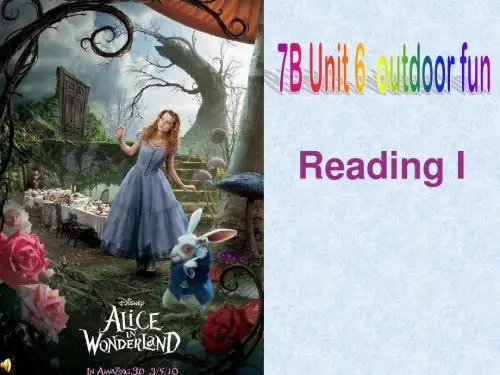
Alice in Wonderland 爱丽丝梦游仙境
2.What are the main characters(主要人物) in the video ?
Alice & a rabbit
Listen and answer:
1.Where did Alice sit with her sister ? Alice sat by a river with her sister.
htseoallaopootrkaoodbskkaysaeeweaddsdaorauitbuvctpynehrd the time
Task2 (In the field)
Read Para3 and answer: 1.Where did the rabbit go?
It jumped down a big hole.
Alice is clever, brave and careful, so
csahreefcualn
find
her
wonderland
friendly
in the
story. I think if y…ou…a.re clever, brave
and careful like Alice , you can also
2.What did Alice do then, and why?
She jumped down the big hole too, because she didn’t want to let the rabbit get away.
Task3 (In the hall)
Read Para4-5 and finish the table:
七年级英语7B Unit6 Vocabulary1课件牛津版
my parrot
a
wing
b
feather
c
tail
my cat
tail a
paw b
Fish use this part to control
their directions.
tail
b
It’s very important for
fin
fish, because fish use it
Group work
Work in groups of four. Each group chooses one of the animals above and say something about it from its appearance (parts of the body), personality and activities.
❖ When she wants some food, what does she do? She miaows when she wants some food.
Passage 2 My _p_ar_r_o_t_ is a very special friend. His blue-and-green feather look so
likes to c_h_a_s_e_ birds. When she gets tired,
she _sl_e_e_p_s in the armchair. She _m__ia_o_w__s
when she wants some food. She
always_h_i_d_e_s herself in the cupboard.
Passage 1
牛津7B Unit6 Outdoor fun Grammar课件(32张ppt)
Fill in the blanks with the given verbs using the corrcet forms:
1.Alice was (be) outside one sunny day. 2.Mary was (be) at home yesterday. 3.We were (be) in Beijing last week. 4.Alice jumped (jump) down a hole after the rabbit got in. 5.We always went (go) to Shanghai when I was a child. 6.She came (come)back at 10 p.m. yesterday.
一般过去时的否定句 (1)be动词的否定句
I/He/She/It You/We/They
was
were was not were not at home yesterday.
I/He/She/It
You/We/They
at home yesterday.
一般过去时的否定句
(1)be动词的否定句
1.Alice was outside one sunny day. Alice wasn't outside one sunny day. 2.Mary was at home yesterday. Mary wasn't at home yesterday. 3.We were in Beijing last week. We weren't in Beijing last week.
一般过去时的否定句
(2)行为动词的否定句 I/You/We/They/ He/She/It
牛津译林版7B Unit6 Outdoor fun Grammar课件(共23张PPT)
wasn’t
______________________+was (not)
______________________+were (n he she it
my uncle
we they
Lucy
you
I
his family his family
Was your father at home in May Day holiday? Yes, he was. No, he wasn’t.
Sanya
……
By plane ……
felt/was excited/ happy/ interesting
Yes, they did. didn’t.
No, they
Work out the rule
一般疑问句: 行为动词
Did+主语+动词原形+其他? Yes,主语+did. No,主语+ didn’t.
Pair wok
A: What did you do...? B: I went shopping. A: Did you go hiking? B: Yes, I did. No, I didn’t.
Guessing game
yesterday
Did she...? Yes, she did.
No, she
last Sunday
Did he...?
Yes, he did. didn’t.
No, he
in 2004
Did she...?
Yes, she did. didn’t.
No, she
Welcome
Unit 6 Outdoor fun!
深圳牛津英语 7B unit 6 Grammar(情态动词)
◆拓展 (can与 be able to 的区别)
can —用于一般现在(can)、 一般过去时态(could)。 be able to —用于一般现在(am able to)、 一般过去时态(was/were able to)、 一般将来时态 (will be able to)。
• Homework: • 完成Book B Grammar P96----98 的 练习。
a. A man is going to see his boss. He is standing at the doorway.
May I come in?
b. A student is going to ask the teacher a question.
Maymmar Modal verbs
can and cannot may and may not must and must not
Modal verbs 情态动词 • 情态动词本身有一定的词义,但需要与动词原 形一起使用,给谓语动词增添情态色彩,表示 说话人对有关行为或事物的态度和看法,认为 其可能、应该或必要等。 • 情态动词后面通常加动词原形。本单元我们要 具体学习的是can,may 和 must 这三个情态动 词。
①must be ——“肯定推测” e.g. --- What is Tom? --- He must be a student. ② “否定推测” ——can’t be e.g. --- Where is Tom? --- He can’t be in the library.
◆ 拓展 (推测,可能) ·He is in the classroom. 100% ·must ﹥99% (must表推测,用于肯定句)