
英语人教版六年级下册Unit3 PartB Read and Write
Unit6PartB Readandwrite教学设计三磨后

课 题 2014版PEP小学六年级英语上册Unit 6 How do you feel?
Part B Read and write. 执教教师 白泽湖乡中心小学:王飞
教材简析 本课是2014新版PEP小学英语六年级上册第六单元PartB Read and
write部分,讲述了机器人Robin与一只小蚂蚁之间的对话,教育学生从小要做一个关爱他人,待人友善的人。
学情分析 经过三年多的英语学习,学生们基本具备了独立的阅读、思考并解决问题的能力。在这节阅读教学课中,教师应放手让学生自读自悟,学习文中作者给我们所传达的信息,体会文中所表达的待人友善的情感!
教学目标 知识与能力 1.引导学生在初读短文时找出文中的重点词汇: won't ,sit, hears,
little, says, stuck, mud, worried, strong, pull.
2.学生能够听懂,会读,会复述 read and write 的内容,并能在创设的情境中运用所学语言进行交流和运用,激发学生英语的学习兴趣。
3.运用所学语音知识,正确、流利,有感情地读出短文。
过程与方法 Step 1 Warming up English songs:If you’re happy,clap your hands lead in.
Step 2 Presentation CAI Show out the text “Robin and the Ant”.
Step 3. Consolidation The students’ Book Show.
Step 4. Homework Retell the story to your parents.
情感态度
与价值观 通过“Robin and the Ant ”故事的学习,培养学生在生活中乐于助人,关爱他人,待人友善的良好品质。 教学重点 学生能够根据真实的情境描述自己和他人的情感,通过本节阅读课教给他们一些阅读方法与技巧,形成一定的自主阅读技能。
人教PEP版六年级上册英语 Unit 3 PartRead and write 教案
经典文档
资料来源于网络 仅供免费交流使用 Unit 3《My weekend plan》教案
第五课时
(Part B Read and write)
教学目标:
词汇:Mid-Autumn Festival, together, get together, mooncake, poem,
moon.
句型: Tomorrow is Mid-Autumn.
My aunt is going to make a mooncake.
My grandma will tell a story about Chang’e.
教学重点:
1. 能准确的读出和写出新的单词和短语。
2.能用 be going to/ will进行问答练习。
教学难点:
be going to句型
教学工具
PPT,单词卡片
教学过程
Step1. Let’s sing
1. 学生与老师一起唱I’m going to…, 初步掌握be going to句式。
[设计意图] 通过游戏方式调动学生的学习积极性,以达到复习单词的目的。
2. 师生互相问好,教学新单词。 经典文档
资料来源于网络 仅供免费交流使用 A: Good morning!
B: Good morning!
3. Review
What are you going to do next Sunday?
I am going to wash my clothes.
利用图片进行对话练习.
教学新单词: Christmas Day, International Labour Day, Mid-Autumn
Festival, mooncake, National Day, New Year’s Day, poem教师利用图片反复练习,使学生便于掌握。
注意: 国家重大节日首字母大写.
Step2. Let’s try
1. T出示图片,然后领读Tomorrow is Mid- Autumn Festival.教师解释句意。教师逐句讲解这篇日记的内容。讲解be going to+动词原形,和will可以互换,使学生掌握一般将来时。
六年级下册英语一课一练Unit4 PartB Read and write_人教PEP人教PEP
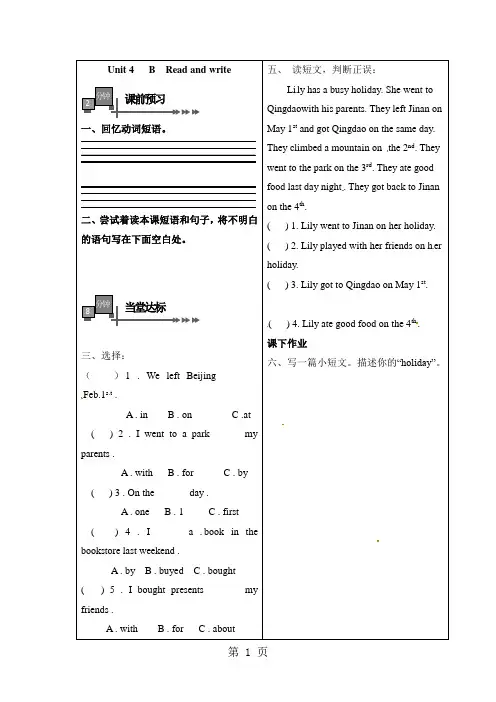
第 1 页 Unit 4 B Read and write
一、回忆动词短语。
二、尝试着读本课短语和句子,将不明白的语句写在下面空白处。
三、选择:
( )1 . We left Beijing _______
Feb.1st .
A . in B . on C .at
( ) 2 . I went to a park _____ my
parents .
A . with B . for C . by
( ) 3 . On the ______ day .
A . one B . 1 C . first
( ) 4 . I _____ a book in the
bookstore last weekend .
A . by B . buyed C . bought[
( ) 5 . I bought presents ______ my
friends .
A . with B . for C . about 五、 读短文,判断正误:
Lily has a busy holiday. She went to
Qingdaowith his parents. They left Jinan on
May 1st and got Qingdao on the same day.
They climbed a mountain on the 2nd. They
went to the park on the 3rd. They ate good
food last day night. They got back to Jinan
on the 4th.
( ) 1. Lily went to Jinan on her holiday.
六年级下册英语教案-Unit 3 B Read and write人教PEP版
PEP6 Unit3 Read and write
《Wu Yifan’s dairy ---A day in the countryside》
教学设计
PEP6 Unit3 B Where did you go?
Title: Wu Yifan’s dairy— A day in the countryside
Teaching
Aims nguage knowledge
To enable students to
1) Read and understand the diary correctly .
2) Know some new words and phrases such as dressed up ,played the part of … made a
funny play by reading this dairy .
2. Language skills
To enable students to
1) Develop abilities of reading skills(skimming,scanning,prediction ) and writing skills
by using past tense
2) know the form of a dairy by reading two dairies. .
3)know how to write a diary.
3. The emotion education
To enable students to
1) Improve their cooperation awareness by learning in groups or in pairs.
2) be a caring person. Establish optimistic way to solve the bad things in your life
人教版小学六年级英语下册Unit 3 B Read and write 教案
教学设计
课题 B read and write 单元 Unit3 Where did you go? 学科 English 年级 六
学习
目标 1.能听、说、认读单词:basket,part,licked,laugh。
2.能听懂、会说句子:Max sat in a basket on the front of the bike. We dressed up and
made a funny play. It was a bad day but also a good day!
3.完成Let’s check and Let’s wrap it up.
重点 bought gifts, ate delicious food, basket, took pictures, part, licked以及laughed
难点 能理解It was a bad day but also a good day!的意思。
教学过程
教学环节 教师活动 学生活动 设计意图
导入新课 1.Sing the song :Tell me about your holiday.
2.Sharp eyes:
rode a bike, rode a horse, went camping...
3.Let’s say:
What did you do on Qing Ming holiday?
边唱边做
抢读单词 Chant活跃气氛,同时复习学过的内容。
讲授新课 1. Fast reading.
T: What about Wu Yifan’s holiday? He wrote a
diary about his someday. Let’s read fast and
answer:
How was Wu Yifan’s day?
Ss read and circle.
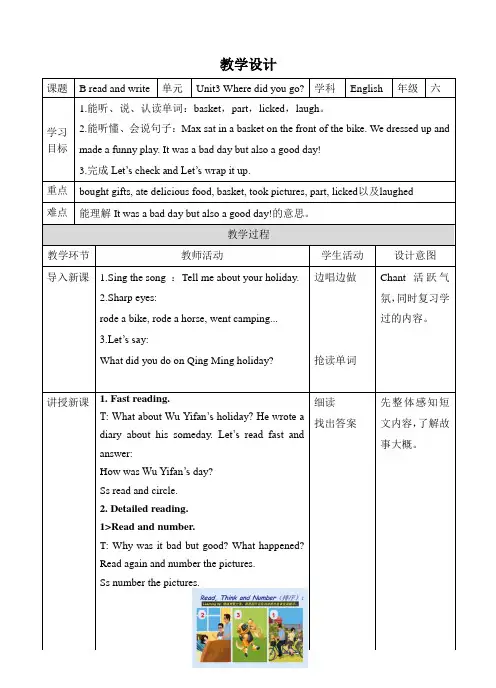
2. Detailed reading.
人教PEP版四年级下册Unit 6 Part B read and write教案
人教PEP版四年级下册Unit 6 Part B read
and write教案
人教PEP版四年级下册Unit 6 Part B read and write教案
一、设计思路
1、指导思想
《小学英语新课程标准》倡导学生通过感知、体验、实践、参与和合作等方式,实现任务目标,感受成功。针对四年级学生年龄特征,上课集中注意力时间短,并且好奇心、好胜心以及求知欲强的特点,教授新知时我采用多种教学方法,提高学生的积极性和主动性。让学生对单词和句子进行听、说、认、读,达到熟练认知的目的;并且根据提示,能写出简短的语句。
教育存在于生活当中的各个方面,所以在英语教学中我们要让学生学会在真实的生活情境中熟练的运用所学语言。我们应该让更多的学生在学习的过程中收获知识、体验快乐,真正做到在“以生为本”的教育理念的指引下,让学生英语的语言能力、思维品质、文化品格、学习能力得到更好的培养。
2、教学目标
知识目标:能够理解read and write部分的内容,能熟练地听、说、认、读有关服装和生活用品的单词以及用来修饰服饰和生活用品的形容词和颜色词。能听、说、读、写重点句型:They’re very expensive. They’all.
能够了解并熟练运用句型:They are all five yuan.
They’re very cheap. We have many colouu.
过程与方法:通过任务型教学法,交际法和视听法等教学活动,抓住关键词,掌握核心句型,并且尝试复述课文和创编新短文,从而提高学生的语言和学习能力。
情感态度与价值观:让学生树立正确的金钱观,教育学生在平时生活中要节约用钱,不要乱花钱,要体谅父母挣钱的辛苦和不易。
3、教学重、难点:
教学重点:听、说、认、读有关服装类单词以及重点句型:They’re very
expensive. 和They'all.
四年级英语下册Unit 3 Part B (Read and Write) 教学反思
四年级英语下册Unit 3 Part B (Read and Write) 教学反思
四年级下册Unit 3 Part B (Read and Write) 教学反思
本课选自人教版PEP教材四年级下册第三单元read and write。本单元学习的主题是天气,本课是一节阅读写作训练课。
在授课时,我采用top-down 的教学模式让学生险整体感知教学内容,然后通过pre-reading, while-reading ,post-reading这三个阅读步骤主次进行教学。为了帮助学生突破本课的难点,重点,根据小学生好奇。毫升,好动,模仿力强,表现欲旺盛的胜利和心理特点,在教课的过程中我主要采取了情境教学法,以活动、合作为主线,让学生在教师的指导下,通过感知、体验、实践、参与和合作,游戏感悟等多种方法并用的方式组织教学。在任务设置的时候,我设置学习有效任务帮助学生进行学习。Reading
for listening, reading for writing , reading for speaking, 学生在学习文章的过程中,听、说、读、写四个方面均进行了操练。
课堂任务的布置和小组活动的设计是本课的亮点,孩子们在小组活动中积极参与其中。在小组合作中进行了听说读写的综合性的学习。整烫课注重发挥了学生的主体性,提高了教学效率。
小学英语_人教版六年级下册 Unit3 PartB Let's talk教学设计学情分析教材分析课后反思
教学材料:新人教版六年级下册
Unit3 Where did you go? Part B Let’s talk
教学设计
课文标题:Part B Let’s talk
单元名称:Unit3 Where did you go?
教材版本:人教版
授课年级:小学六年级
教学目标:
语言能力目标:1.通过课件,图片等,学生在语境中感知,并能认读下列动词过去式:go-went, take-took;
2.通过课件,教师引导,以及听,找,读,练等活动,学生学习本课对话,理解对话大意,并回答问题。
3.通过本课学习,学生能在情景中恰当的运用用what,how,where引导的一般过去式特殊疑问句描述曾经参加过的假期活动并展开讨论。
语言知识目标:
1.能够听,说,认读单词go-went, take-took, beach;
2.能够听,说,读写下列句子: Where did you go over the winter holiday?/How did you go
there?/What did you do there?
3.通过对课文的学习和理解,能够在情景中恰当的运用句型并回答别人在过去的时间里去了哪里,乘坐什么交通工具。
情感态度及文化意识:
1.通过对旅行的描述,培养学生热爱祖国,热爱家乡的情怀;
2.增强学生学习英语的兴趣与自信心,体验学习成就感,能通过学习和模仿,将学到的英语知识应用于生活。
3.了解一些名胜古迹、著名景观、特色食品及风土人情。
学习重点难点:
重点:1.掌握及应用几个过去式不规则变化的动词:go-went,
take-took;
2.能够听,说,读写下列句子:
Where did you go over the winter holiday?
How did you go there?
What did you do there?
难点:通过本课学习,学生能在情景中恰当的运用用what,how,where引导的一般过去式特殊疑问句描述曾经参加过的假期活动并展开讨论。
英语人教版六年级下册Unit3 PartB Read and Write
教师姓名 单位 上课年级 课题名称
张弛 桐庐县圆通小学 六年级
下册 Unit3 Where did you go?
B. Read and write
教材分析
This read and write can be divided into two parts:
Part1:
Ask students to finish the pre-reading, to discuss the beginning
of the story and predict the story. Then read the passage and
number the pictures, to get the information of three good news
and two bad news.
Part2:
Write about students’ a bad but good day.
教学目标 During or after the lesson, the students will be able to
1. To predict the beginning and development of the story. (By
reading the pictures)
2. To get the different kinds of information and improve the
ability of thinking. (By finishing the exercise of the
After-reading.)
3. To use the important sentence pattern to describe daily life
and write a short passage.
4. To understand life is full of good news and bad news.
人教PEP版六年级下册英语教案--Unit 3 B Read and write1
Unit 3 Where did you go?
B Read and write
教学目标
1.能听、说、认读basket, part, licked, laughed等单词。
2.理解Read and write的内容并完成后面的练习。
3.能够通过看图讨论预测日记中故事的开端和发展,回忆相关话题的背景知识和话题词汇。能够在日记中捕捉不同类型的信息。
4.能够根据提示从日记中获取关键信息;能够利用上述信息仿照教材中的日记,并根据所提供的内容补全短文,描述自己一天的生活。
教学重点
1.能听懂、会说本课时教学的重点句子。
2.理解课本中日记的内容。
教学难点
从日记中获取关键信息,理解课文内容。
教学准备
1.单词卡片
2.录音机及录音带或教学光盘
3.多媒体课件
教学过程
Step 1:Warm-up
1.师生相互问候。
2.开展活动复习词组和重点句子。
(1)Which is missing?规则:教师在课件上出示本课单词图片(可以重复出现),教师让学生先认真观察,然后让其中一张图片快速消失,问学生哪一个单词不见了。最先回答出来的学生所在的小组获胜。
(2)活动:最佳拍档。规则:教师请两名学生上讲台,一名学生根据教师的纸条表演动作,另一名学生猜:You went fishing.此游戏也可以分小组进行对
抗赛,看哪一组在规定时间内猜对的句子最多。
(3)小小配音员。教师播放课文Let’s talk的动画,学生跟读一遍,然后分角色给动画配音。
3.Free talk.
T:How was your last Sunday?
S:It was fine.
T:Where did you go?
S:I went to …
T:What did you do there?
S:I rode a bike./…
T:What did Wu Yifan and his family do on April 23rd?Where did they