
2014秋人教版九年级英语unit2 section B 2a-2d
人教版九年级上册英语Unit 3 Section B (2a-2d)解析版

Unit 3 Section B (2a-2d)
Ⅰ. 根据句意及汉语提示完成单词
1. We can't use the direct ________(请求) when we ask our teacher for help.
2. Do you think his answer is ________(正确的)?
3. I don't know how to get to his home because I have forgotten his ________(地址).
4. There is a big ________(地下的) supermarket near here and you can buy some food in it.
5. We all like the children who are ________(有礼貌的).
Ⅱ. 从方框中选词并用其正确形式填空
wonder, park, trouble, order, lend, lead, direct
1. This is a busy street. Cars aren't allowed ________ here.
2. You can choose this plane. It's a(n) ________ flight.
3. The ________ has come and we have to finish the work in three hours.
4. Many of us ________ if he could come to the party.
5. Mr. Wang needs to spend some time ________ into a question.
6. I don't want to ________ you with such a small problem.
人教版八年级英语上册 Unit9 Section B (2a-2d) 教案
Unit 9 Can you come to my party? 教学设计
一、基本信息
课名 Unit 9 Can you come to my party?
学科(版本) 人教版 Go for it! 章节 SectionB(2a-2e)
学时 第三课时 年级 八年级上册
一 、教学背景分析
基础教育阶段英语课程的总体目标是培养学生的综合语言运用能力,综合语言运用能力的形成,建立在学生语言技能、语言知识、感情态度、学习策略和文化意识等素养整体发展的基础上。教学设计和教学过程,应充分发挥学生的主体地位、教师的主导作用。本节课要求学生学习如何做出聚会邀请,能够学会回复邀请函,对提出的邀请表示接受或者进行谢绝。采取了阅读形式,让学生在语言环境中运用语言,感受到英语学习的乐趣。这一课时围绕着如何提出邀请及如何回复(包括接受与拒绝)来展开。课程内容并不是太复杂,学生同时在section A已经有多接受过这样的学习,能较完整的进行初步的句子描述。鉴于以上原因,我尝试开展阅读技巧训练,利用思维导图进行阅读文章的总结,并将思维导图运用于输出环节,作为简单的写作提纲。
二 、教学目标:
1. 知识目标:
a. 能够识记并运用下列词汇熟练掌握以下词汇和短语 : invitation,
turn down, reply, forward, delete print, sad, goodbye, take a trip, glad,
help out, preparation, glue, without, surprised, look forward to, hear
from, housewarming
b. 能够运用以下句型:
(1) She helped me to improve my English so much.
(2) I already have a great idea about how to do that..
人教版英语九年级全册Unit3 SectionB(2a-2e)优质课教案
309教育资源库
309教育资源库 Unit3 SectionB(2a-2e)优质课教案
学习内容 Could you please tell me where the
restrooms are? SectionB (2a-2d) 科目 英语
教学对象 九年级学生 课时 1课时 执教者
一、教材内容分析
本节课是人教版九年级第三单元第四课时,Unit3 Could you please tell me where
the restrooms are? SectionB (2a-2d)部分。这是一节阅读课,围绕“不同文化下不同的询问技巧”这一话题展开,使学生学会在不同的环境下,使用合适的语言来礼貌地询问和准确地回答。
二、教学目标
根据新课程标准的要求,结合教材的具体内容,我确立教学目标为:
1.学生在语境中感知、理解以下词汇:request, polite, direct。
2.学生通过阅读谈论礼貌用语的文章,进一步感知、理解含有where, when, how引导的宾语从句。
3.学生运用思维导图理解语篇结构,在语境中体会不同的询问技巧,学会在不同的环境下,使用合适的语言来礼貌地询问和准确地回答。
4.学生学会礼貌待人,学会询问,创建和谐的人际关系。
三、学情分析
1.九年级的学生对Could you please…?句型有了一定的认识和理解(八年级下册Unit3),为进一步学习奠定了基础;对that/whether/if 引导的宾语从句有了一定的认识和理解(九上Unit2),本单元前三课时对wh-引导的宾语从句进行了认识。为本课时进一步巩固wh-引导的宾语从句奠定了基础。
2.九年级的学生已经具备了根据关键信息(关键词,关键句型)理解文章的能力。本课继续巩固根据关键词理解句子的能力,根据上下文关键句型进行猜词、推理的能力。
3.九年级的学生对于礼貌礼仪有了一定的了解,但不太深入,对于不同文化下不同的礼貌用语了解不多。本课继续学习在不同文化下不同的询问技巧,学会不同的环境下,使用合适的语言来礼貌地询问和准确地回答。
人教版九年级英语第二单元第一课时Section A 2a-2d练习题及答案
Unit 2 I think that mooncakes are delicious!
第一课时 Section A(2a~2d)
01 基础过关
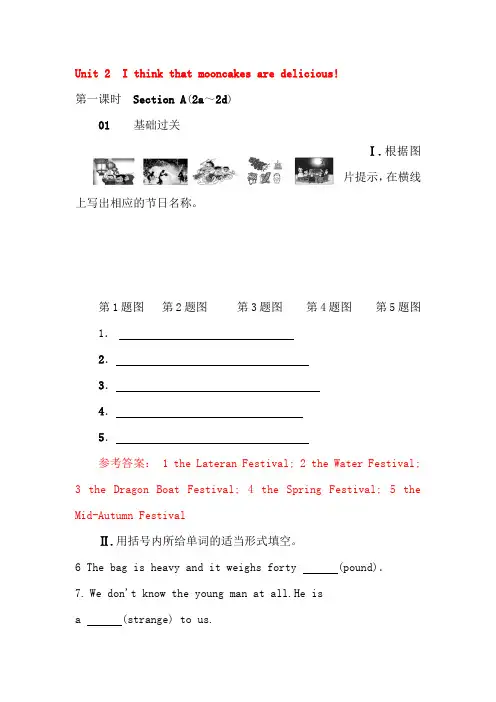
Ⅰ.根据图片提示,在横线上写出相应的节日名称。
第1题图 第2题图 第3题图 第4题图 第5题图
1.
2.
3.
4.
5.
参考答案: 1 the Lateran Festival; 2 the Water Festival;
3 the Dragon Boat Festival; 4 the Spring Festival; 5 the
Mid-Autumn Festival
Ⅱ.用括号内所给单词的适当形式填空。
6 The bag is heavy and it weighs forty (pound).
7. We don't know the young man at all.He is
a (strange) to us. 8.Does Mr.Brown have (relative) in this city?
9.In China people often eat (mooncake) that day.
10.How many (lantern) does the boy have?
参考答案:6 pounds;7 stranger; 8 relatives; 9mooncakes; 10
lanterns
Ⅲ.按要求完成下列句子,每空一词。
11.This idea sounds so amazing.(改为感叹句)
人教版九年级英语Unit3 Section B(2a~2d)教案

第1页 共1页 第五课时 Section B (2a~2d)
【学习目标】
1.教会学生掌握礼貌地提出要求和寻求帮助的表达法。
2.指导学生通过开展小组学习活动,培养协作意识,并能学会在不同的场合使用不同的语言,礼貌待人。
【学习重点】
重点单词:politely,direction,underground,correct,polite,direct,impolite,address,request
【学习难点】
通过交流表达和阅读训练,在不同的场合使用不同的语言。
☞学习提示
This period we will learn a passage,first ask a few students to answer my questions about the passage.
Task 1
☞学习提示
Learn the passage by oneself,students read the passage in 2b silently and rapidly,and mark the new words,phrases
and sentences.
【学法指导】
►less polite
“less+形容词或副词”构成降级比较形式,相当于中文“不那么;稍许不……”之意。
►spend/pay/cost/take
①spend主语是人,其常用结构有:sb.spend time/money on/(in doing) sth.
②pay主语是人,其常用结构有:sb.pay money for sth.
③cost主语是物,其常用结构有:sth.cost sb.time/money.
④take主语常常是it,其常用结构有:It takes/took sb.+时间+to do sth.
情景导入 生成问题
T:Do you often have problems in your life?
英语人教版八年级下册Unit9 Section B 2a-2d
Unit 9 Have you ever been to a museum(第4课时)
Section B 2a-2c导学案
一、学习目标:
能力目标: 学会用所学的知识解决问题。
重点词语: a couple of,theme,ride...
重点句子::Have you ever…?
When did you start studying English?
How long have you been studying English?
难 点:现在完成时。
二、预习导学
1.以小组为单位复习Unit9 Section A 中的新单词。
2.复习Section A
3.独立完成Section B 1a.
4.听录音完成1b;1c.
三、自学检测 填空题
四、合作探究
1.结对练习1c ,2c 的对话
2.一般过去时,现在完成进行时和现在完成时的区别
一般过去时只表示_______________,和___________不发生联系。现在完成时是用_____________说明现在的情况。
He lived in Beijing in 2000. 只说明他2000年住在北京,他目前住在哪里并不清楚。
He has lived in Beijing since 2000. 说明他自从2000年就住在北京,他目前还住在北京。 现在完成时和现在完成进行时都可以表示“从过去开始一直持续到现在”这一概念,有时两者可以互相代用,但前者多用于口语。在含义上如着重表示动作的结果时,多用_______________ 时;如着重表示动作一直在进行,即动作的延续性或者动作仍然继续下去时,则多用____________________________时。如:
a. I have written six letters since breakfast. 从吃早饭到现在我写了六封信。
人教版九年级英语Unit1 Section B(2a~2e)教案
精品 Word 可修改 欢迎下载
第五课时 Section B (2a~2e)
【学习目标】
1.学生读懂有关描述“如何成为成功学习者”的文章。
2.学生根据所学内容,形成好的学习习惯及学习策略。
3.学生通过开展小组学习活动,培养协作意识;并能学会通过各种方式克服学习过程中遇到的困难并找到适合自己的学习方法,树立自信心。
【学习重点】
重点单词:born,ability,create,brain,active,attention,connect,review,knowledge,wisely
【学习难点】
通过交流表达和阅读训练,了解好的英语学习习惯和学习策略。
☞学习提示
We will read the passage this lesson.Teacher can ask a few questions that are related to the
passage then ask some students to answer them.
精品 Word 可修改 欢迎下载
Task 1
☞学习提示
Learn and research the text before class:students read the passage quickly in silence in
2b.Mark the new words,key phrases and sentences.
【学法指导】
►even if
even if意为“即使”,引导让步状语从句,相当于even though。
►be (not) afraid of doing sth.
意为“(不)害怕做某事”,表示内心不情愿做某事,担心某事可能会发生。
be afraid to do sth.意为“害怕做某事”,强调因心里畏惧而不敢去做某事。
Task 2
☞学习提示
1.Fast reading
(1)Students read the passage quickly to know the main idea and finish the tasks in 2b.情景导入
人教版英语八年级上册 Unit9 Section B 2a-2d 教案
人教版英语八年级上册 Unit9 Section B 2a-2d 教案
1 / 4 Unit 9 Can you come to my party?
Section B 2a-2d
I. The teaching objects:
Knowledge objects:
1. Words and phrases: invitation, make an invitation, accept an invitation, turn down
an invitation, preparation, sad, surprised, look forward to, hear from, take a trip…
2. Sentences:
Bring Ms. Steen to the party without telling her so that she can be surprised.
I look forward to hearing from you all.
3. Ss will be able to learn some reading strategies.
Ability objects:
1. Ss can use reading strategies to comprehend the passage.
2. Ss can learn to write an invitation and accept or turn down it.
Emotional objects:
1. Ss will be able to be polite to others when they turn down their invitations.
2. Ss will be able to form the habit of holding parties for various purpose and enjoy