
中考英语新题型摘录要点
中考英语新题型摘录要点集团标准化工作小组 #Q8QGGQT-GX8G08Q8-GNQGJ8-MHHGN#中考文章摘录要点专题讲解一、考题要求:第二节摘录要点( 5小题,计10分)阅读下面的材料,然后在表格中完成内容摘要,每空不超过三个单词。
二、样题研究:2014长沙摘录要点样题是一篇150个词的文章,它由两部分组成,一是所需阅读的文章一篇,二是根据该文章所设计的图表,其题材为说明文,图表是文章的结构图,它反映了文章本身的逻辑思路,也是反映命题人的设题思路。
图表共5个空格,其答题信息均可直接从原文中找到。
三、对考生要求:尽管样题的答题信息均可从原文中直接找到,但为了使考生万无一失,以不变应万变,我们还是对考生相关能力提出了更高要求。
1.阅读理解能力。
对文章的整体把握,领略大意。
对文章的结构和层次把握,弄清局部和整体的关系。
对文章局部的透彻理解,提取有用信息。
2.对图表的识读能力。
考生要迅速把握图表的结构分布层次,命题人的出题角度,哪个空是考察细节,哪个空考察结论,哪个空考察标题。
3.分析、概括、推断能力。
图表试题中有的可以直接从原文中提取到,有的则需要对原文信息进行再加工处理,得到原文相一致的文外词汇。
4.正确书写能力。
这就需要考生具有一定的词汇储备,而且能够认识句子结构和句子成分,根据句子结构和成分来判断所填词的词性。
当然,考生也应该具有构词法的知识。
例如,词性转换,形容词、副词的比较级、最高级,名词的复数形式等。
此外,还有提炼出文章主旨或者重要信息的能力,也就是在语篇结构解读基础上的信息转换能力。
四、解题步骤:第一步,浏览图表。
划分板块,标题块、结论块、主题块、细节块。
标题块和结论块里的空放在最后做,然后按主题块次序先做细节空,再做主题空。
第二步,快速略读全文,把主题块和相应的段落对应起来。
第三步,在图表中领任务,第一主题块对应的细节中的空,带上任务精读相应的段落细节,提取信息,填空完成试题。
然后完成主题块,最后完成标题块。
五、题目的设置类型及答题策略1.信息捕捉题(文中原词)要求学生能快速在文章中查找相关细节,锁定信息来源,并用文章中的词来填空。
例如:样题中第58题可从原文第一句It lies in Taoyuan County and is 23 km away from Changde.直接得出。
样题中第59题可从第一段最后一句The tour area today is made up of four parts-the Taohua Mountain, the Taohualing Hill, the Taoyuan Mountain and the Qinren Village.直接得出。
2.同义转换题灵活考查学生在知识重组基础上,运用多中表达方式表意的能力,突显遣词造句能力的考查。
比如,用意义相同或相反的词完成句子的能力。
同时,在限定不超过3个词的要求下,更需要考生有逆向思维的能力。
这种类型的题目一般不能直接在文章中找到题目给出的句子,需要考生在捕捉到相关信息之后,将捕捉到的信息进行加工转换。
2014长沙中考样题56题所给答案(56. Places of interest / Scenic spots / Scenic area / Attractive places…)就充分的体现了这一点。
3.信息综合题(综合概括题)要求考生能够准确无误地概括出文章的主题或行(栏)的标题,考查学生概括与推断的能力,归纳、抽象并提炼出文章主旨或者重要信息的能力,也就是在语篇结构解读基础上的信息转换能力。
例如样题的第57. Changde Poem Wall常见英语摘录要点概括性词汇:标题title 主题topic 原因cause/reason结果result措施/步骤measure/step 方法solution/way/manner/method态度attitude 趋势tendency 结论conclusion建议suggestion/tip/advice 要求requirement/demand 问题problem 观点opinion/view/idea 意义significance目的/目标 purpose/aim/goal 影响effect/influence定义definition 来源source 数量quantity质量quality 优劣advantage/disadvantage 特色.特征feature 人物/角色character. 类型type/kind/sort 情节plot 内容content 行为behavior重要性importance 必要性necessity/must 情感feeling/emotion异同difference/similarity 外表appearance 信息information 人口population 贡献contribution 想象力imagination 创造力creativity 概括、总结summary 要点、提纲outline 其它time/place/situation/condition六、专题训练第一组(1)阅读下面的材料,然后在表格中完成内容摘要,每空不超过三个单词。
It lies in Taoyuan County and is 23 km away from Changde. The temples here were built in the 10th century. During the reign (统治) of Guangxu (1875-1908) of the Qing Dynasty, a scenic spot (景点) appeared according to the article“On the Land of Peach(桃)Flowers”written by Tao Yuanming, a famous writer of the Jin Dynasty. The tour area today is made up of four parts-the Taohua Mountain, the Taohualing Hill, the Taoyuan Mountain and the Qinren Village.Changde Poem WallChangde Poem Wall is a 3-kilometer-long riverbank alongside the Yuanjiang River, which is engraved(雕刻) with poems, handwriting and painting and it is listed as the longest wall with engraved arts in Guinness Record.(2)A recent report from Zhuzhou Daily says about 18% of Zhuzhou teenagers can haveproblems with their minds(内心,精神). Some students become worried because they have to study very hard. Others have trouble getting on well with people like their parents and classmates. Zhang Qiang, a Junior 2 student from Zhuzhou , could not understand his teachers in class and was doing badly in his lessons. He was afraid of exams. When he looked at the exam paper, he couldn’t think of anything to write. Another student, a 15-year-old girl called Wu Yan often argued with her classmates even her parents because of some different ideas. She became so annoyed about them that she started to cut her finger with a knife. However, many students who have problems won’t go for advice or h elp. Some think they will lookstupid(愚蠢的)if they go to see a doctor. Others don’t want to talk about their secrets. In(3)In most Chinese tea villages, March is the time of year in which locals start to pick and process tea. The usually quiet villages suddenly become crowded centers of activity, as people take out special tools and prepare for tea processing. In some villages, local residents hold traditional ceremonies, thanking heaven for its blessing. The price of tea picked in March is extremely high because it is fresh, tender and contains multiple trace elements.China has been famous for tea production since ancient times. Of the goods transported and traded along the Old Silk Road linking China to the Middle East and Europe, the importance of tea was matched only by silk. China produces Oolong, black, green, white, yellow and dark tea. The Oolong, green and black varieties are most famous for their high quality.Most of China's tea villages are found in remote mountainous areas in the country's south and southwest, where the beautiful scenery is often hidden under clouds.第二组(1)Some birthday customs are quite similar in many parts of the world---- birthday candles(蜡烛), birthday games,and birthday cakes. But some customs are more specific to certain countries. Here are some children talking about their customs.Linda---I am fourteen. I come from Aruba. In our country,Children take something special to school for their classmates and all teachers. Each teacher gives the birthday child a small gift like a pencil, an eraser or a postcard. The birthday child is also allowed to wear special clothes instead of the school uniform.Lucy---I am one year older than Linda. Denmark is my country. A flag is flown outside a window to show that someone who lives in that house is having a birthday. Presents are placed around the child's bed while they are sleeping so they will see them at once when they wake up.Tom---I am as old as Linda. I am from Brazil. The birthday child receives a pull on the earlobe(耳垂) for each year in my country. The birthday person also gives the first slice of(2)3)Last Tuesday, a little girl died after eating some fried chicken. Her father bought the chicken for her from a street seller in Fenzhuang Village, Fengtai,Beijing. After testing the girl, the doctor said she was poisoned (中毒) by nitrites (亚硝酸盐). Some experts suggest that we should buy foods with QS signs. They are safer.After hearing about the accident, many people feel more worried about the food safety because there have been many food safety problems in our country these years. For example, poisonous(有毒的) rice, oil, milk and so on have been found out recently. People feel quite afraid because these poisonous foods are rather bad for their health and even kill them. They want the government to do something to stop such poisonous foods and drinks appearing again so that they can have safe and healthy foods and drinks.Many kinds of birds live in the United States, but the number of the birds is becoming smaller every year. One of the leading reasons is the growing number of pet cats. By keeping your pet cats in your home, you can help give birds a better possible chance to live.Of the 90 million pet cats in this country, about two—thirds are allowed to go outside. It is said that these cats kill hundreds of millions of birds each year, as well as billions of small animals such as rabbits and field mice.They can also bring illness to the animals that live in people's yard(院子), further weakening the health of the natural populations.Allowing pet cats to go outside is not just bad for birds and wildlife, it's also bad for the cats themselves. Outdoor cats can get sick very easily. They are in danger from traffic and attacks (攻击) from other animals. In fact, outdoor cats usually don't live past the age of five, while indoor cats often live to be 17 or older.The idea of Mother’s Day is a very old idea. It was started by the ancient Egyptians (埃及人),who celebrated(庆祝) a day to honour (向……表示敬意) Isis, the mother of the pharaohs. The early Christians(基督教徒) celebrated a day to honour Mary, the mother of Jesus.Later, English Christians celebrated to honour all mothers. This English holiday was called “Mothering Sunday”.When the English came to America, they did not have time for Mothering Sunday, so the holiday was not celebrated in America. In 1914,the passed a law which designated(规定) the second Sunday in May as Mother’s Day to honour the mothers who hadlost sons in war.Today, Mother’s Day is celebrated in many other countries for all mothers. In Canada, Australia, New Zealand, Mother’s Day is celebrated on the same day as in the United States—the second Sunday in May. Children give their mothers cards, gifts, and flowers. Schools plan Mother’s Day’s special activities.In China, the holiday is celebrated to show the respect(尊重) the Chinese have for the oldpeople, and the love they have for their parents. Ten top mothers are chosen by the government. People all over the country try different ways to help mothers who are poor.(6)An American named Crum invented potato chips in 1853, although that was not his intention(意图). He was a chef at a beautiful restaurant in Saratoga Springs, New York. A regular dish on the menu was fried(油炸的) potatoes, which was an idea that had started in France. At that time, French fried potatoes were cut into thick slices(片).One day, a dinner guest at the restaurant sent back his fried potatoes to the chef because he did not like them so thick. So Mr Crum cut the potatoes a little thinner and fried them. Theguest did not like those either. That made Mr Crum angry, so he thought he would just show the man. He sliced the potatoes paper-thin and fried them, thinking that the man would say nothing about it. However, to his surprise, the man loved the thin potatoes very much. Other guests tried them and also liked them. So, Mr Crum’s potato chips were added to the menu. They called Saratoga Chips.Finally, Mr Crum opened his own restaurant to sell his famous chips. Now potato chips are packaged (包装)and sold in stores.New Energy in the Twenty-first CenturyEnergy from the windWind is a kind of clean energy, and there is lots of it, But, if there's no wind, there is no wind energy.Energy from the waterWhen water moves from a high place to a lower place, it can make electricity(电)without pollution. However, people have to build dams(水坝) to use this energy, and building dams is very expensive.Energy from the earthThere is heat in the rocks under the earth. Scientists use the heat to make geothermal(地热的)energy. This kind of energy is cheap, but it is only possible in a few places in the world. Energy from the sunSolar panels (太阳电池板) on the roofs of houses can turn energy from the sun into electricity. Solar power is clean and plentiful(丰富的).but when the weather is bad, It doesn't work.(8)请阅读下面有关希望工程帮助失学儿童的报道,根据所提供的信息,完成信息卡。
2023中考英语重点知识归纳笔记
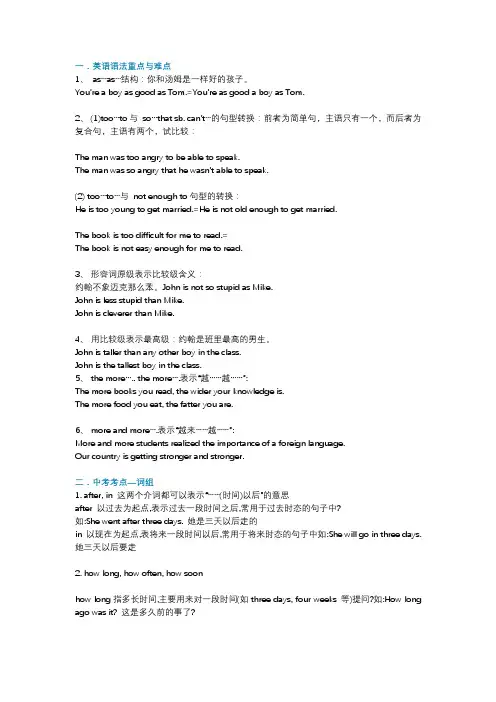
一.英语语法重点与难点1、as…as…结构:你和汤姆是一样好的孩子。
You’re a boy as good as Tom.=You’re as good a boy as Tom.2、(1)too…to与so…that sb. can’t…的句型转换:前者为简单句,主语只有一个,而后者为复合句,主语有两个,试比较:The man was too angry to be able to speak.The man was so angry that he wasn’t able to speak.(2) too…to…与not enough to句型的转换:He is too young to get married.=He is not old enough to get married.The book is too difficult for me to read.=The book is not easy enough for me to read.3、形容词原级表示比较级含义:约翰不象迈克那么苯。
John is not so stupid as Mike.John is less stupid than Mike.John is cleverer than Mike.4、用比较级表示最高级:约翰是班里最高的男生。
John is taller than any other boy in the class.John is the tallest boy in the class.5、the more….. the more….表示“越……越……”:The more books you read, the wider your knowledge is.The more food you eat, the fatter you are.6、more and more….表示“越来……越……”:More and more students realized the importance of a foreign language.Our country is getting stronger and stronger.二.中考考点—词组1. after, in 这两个介词都可以表示“……(时间)以后”的意思after 以过去为起点,表示过去一段时间之后,常用于过去时态的句子中?如:She went after three days. 她是三天以后走的in 以现在为起点,表将来一段时间以后,常用于将来时态的句子中如:She will go in three days. 她三天以后要走2. how long, how often, how soonhow long指多长时间,主要用来对一段时间(如three days, four weeks 等)提问?如:How long ago was it? 这是多久前的事了?how often指每隔多久,主要用来对频率副词或状语(如once a week等)提问?如:—How often does he come here? —Once a month. 他(每隔)多久来一次?每月一次。
2025中考英语新题型解析

2025中考英语新题型解析关键信息项:1、新题型的具体类型和形式2、新题型的考查重点和能力要求3、应对新题型的学习策略和方法4、新题型的分值分布和评分标准1、新题型介绍11 听力部分111 增加了对话的长度和复杂度,涉及更多实际场景,如学术讨论、社会热点等。
112 引入了听短文填空的形式,要求考生在听完一篇短文后填写关键信息。
12 阅读部分121 新增了图表解读题型,考生需要根据图表中的数据和信息回答相关问题。
122 阅读理解文章的题材更加广泛,包括科技、文化、环保等领域,且篇幅有所增加。
13 写作部分131 出现了看图写作,考生需要根据给定的图片内容构思并完成一篇短文。
132 增加了书信写作的类型,如申请信、建议信等。
2、考查重点和能力要求21 听力211 考查考生对不同口音和语速的适应能力,以及对细节信息的捕捉和理解能力。
212 要求考生能够在复杂的语境中快速理解对话的主旨和意图。
22 阅读221 重点考察考生的信息提取和归纳能力,以及对文章逻辑结构的把握。
222 要求考生具备一定的词汇量和阅读速度,能够理解较难的长句和复杂的语法结构。
23 写作231 注重考查考生的观察力、想象力和语言组织能力,能够清晰、准确地表达图片中的内容。
232 检验考生对不同文体的格式和语言特点的掌握,以及能否根据给定的情境合理表达观点和建议。
3、应对新题型的学习策略和方法31 听力311 平时多听各种英语材料,如英语广播、电影、电视剧等,提高对不同口音和语速的熟悉度。
312 进行针对性的听力训练,例如听短文填空练习,培养捕捉关键信息的能力。
32 阅读321 广泛阅读不同题材的英语文章,积累词汇和背景知识。
322 学习阅读技巧,如快速浏览、定位关键词、推理判断等。
33 写作331 多观察生活中的场景和图片,进行看图写作的练习。
332 背诵优秀的范文,模仿其结构和语言表达方式。
4、新题型的分值分布和评分标准41 分值分布411 听力部分占总分的X%。
初中英语语法新题型必胜宝典

初中英语语法新题型必胜宝典摘要:一、前言二、初中英语语法新题型概述1.题型变化2.考查重点三、初中英语语法新题型解题技巧1.听力理解2.词汇运用3.语法填空4.完形填空5.阅读理解四、初中英语语法新题型备考策略1.扎实掌握语法基础知识2.提高阅读速度和理解能力3.增强词汇运用能力4.多做练习,总结规律五、结论正文:【前言】随着教育改革的不断深入,初中英语语法新题型已经成为英语教学的重要内容。
为了帮助广大初中生更好地应对新题型,本文将对初中英语语法新题型进行详细解析,并提供一些实用的解题技巧和备考策略。
【初中英语语法新题型概述】近年来,初中英语语法新题型在各地的初中升学考试中逐渐推广。
新题型不仅考查学生对语法知识的掌握程度,还考查学生的阅读理解能力、词汇运用能力等。
学生需要掌握一定的解题技巧,才能在考试中取得好成绩。
【初中英语语法新题型解题技巧】针对不同的新题型,我们可以采取不同的解题策略。
例如,在听力理解部分,学生需要提高自己的听力水平,并学会抓住关键词;在词汇运用部分,学生需要掌握一定的词汇技巧,如词义辨析、固定搭配等;在语法填空部分,学生需要熟练掌握各种语法结构和句型;在完形填空部分,学生需要理解文章的大意,并注意前后文的联系;在阅读理解部分,学生需要提高阅读速度,准确理解文章内容。
【初中英语语法新题型备考策略】要想在新题型中取得好成绩,学生需要从以下几个方面进行准备:首先,扎实掌握语法基础知识,形成自己的知识体系;其次,提高阅读速度和理解能力,增强对文章的整体把握;再次,增强词汇运用能力,熟练掌握各种词汇技巧;最后,多做练习,总结规律,形成自己的解题方法。
【结论】总的来说,初中英语语法新题型对学生提出了更高的要求。
学生需要在掌握语法基础知识的同时,提高自己的阅读理解能力、词汇运用能力等。
初中英语中考必考知识点
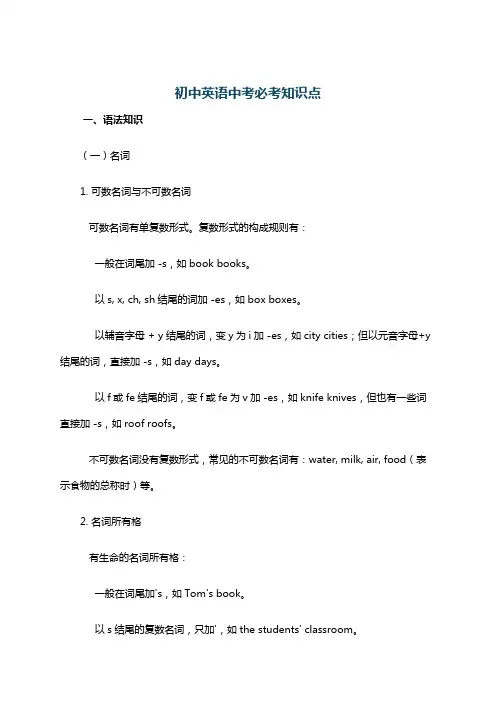
初中英语中考必考知识点一、语法知识(一)名词1. 可数名词与不可数名词可数名词有单复数形式。
复数形式的构成规则有:一般在词尾加 -s,如book books。
以s, x, ch, sh结尾的词加 -es,如box boxes。
以辅音字母 + y结尾的词,变y为i加 -es,如city cities;但以元音字母+y 结尾的词,直接加 -s,如day days。
以f或fe结尾的词,变f或fe为v加 -es,如knife knives,但也有一些词直接加 -s,如roof roofs。
不可数名词没有复数形式,常见的不可数名词有:water, milk, air, food(表示食物的总称时)等。
2. 名词所有格有生命的名词所有格:一般在词尾加's,如Tom's book。
以s结尾的复数名词,只加',如the students' classroom。
表示两者或两者以上共同拥有时,只在最后一个名词后加's;表示各自拥有时,每个名词后都加's。
例如:Lucy and Lily's mother(她们共同的妈妈);Lucy's and Lily's rooms(她们各自的房间)。
无生命的名词所有格常用“of + 名词”结构,如the window of the room。
(二)代词1. 人称代词主格:I, you, he, she, it, we, you, they,在句中作主语。
例如:I like English.宾格:me, you, him, her, it, us, you, them,在句中作宾语。
例如:He helps me.2. 物主代词形容词性物主代词:my, your, his, her, its, our, your, their,后面要接名词。
例如:This is my book.名词性物主代词:mine, yours, his, hers, its, ours, yours, theirs,相当于“形容词性物主代词+名词”。
中考英语新题型摘录要点

中考文章摘录要点专题讲解一、考题要求:第二节摘录要点( 5小题,计10分)阅读下面的材料,然后在表格中完成内容摘要,每空不超过三个单词。
二、样题研究:2014长沙摘录要点样题是一篇150个词的文章,它由两部分组成,一是所需阅读的文章一篇,二是根据该文章所设计的图表,其题材为说明文,图表是文章的结构图,它反映了文章本身的逻辑思路,也是反映命题人的设题思路。
图表共5个空格,其答题信息均可直接从原文中找到。
三、对考生要求:尽管样题的答题信息均可从原文中直接找到,但为了使考生万无一失,以不变应万变,我们还是对考生相关能力提出了更高要求。
1.阅读理解能力。
对文章的整体把握,领略大意。
对文章的结构和层次把握,弄清局部和整体的关系。
对文章局部的透彻理解,提取有用信息。
2.对图表的识读能力。
考生要迅速把握图表的结构分布层次,命题人的出题角度,哪个空是考察细节,哪个空考察结论,哪个空考察标题。
3.分析、概括、推断能力。
图表试题中有的可以直接从原文中提取到,有的则需要对原文信息进行再加工处理,得到原文相一致的文外词汇。
4.正确书写能力。
这就需要考生具有一定的词汇储备,而且能够认识句子结构和句子成分,根据句子结构和成分来判断所填词的词性。
当然,考生也应该具有构词法的知识。
例如,词性转换,形容词、副词的比较级、最高级,名词的复数形式等。
此外,还有提炼出文章主旨或者重要信息的能力,也就是在语篇结构解读基础上的信息转换能力。
四、解题步骤:第一步,浏览图表。
划分板块,标题块、结论块、主题块、细节块。
标题块和结论块里的空放在最后做,然后按主题块次序先做细节空,再做主题空。
第二步,快速略读全文,把主题块和相应的段落对应起来。
第三步,在图表中领任务,第一主题块对应的细节中的空,带上任务精读相应的段落细节,提取信息,填空完成试题。
然后完成主题块,最后完成标题块。
五、题目的设置类型及答题策略1.信息捕捉题(文中原词)要求学生能快速在文章中查找相关细节,锁定信息来源,并用文章中的词来填空。
最新中考英语语法必考知识点归纳
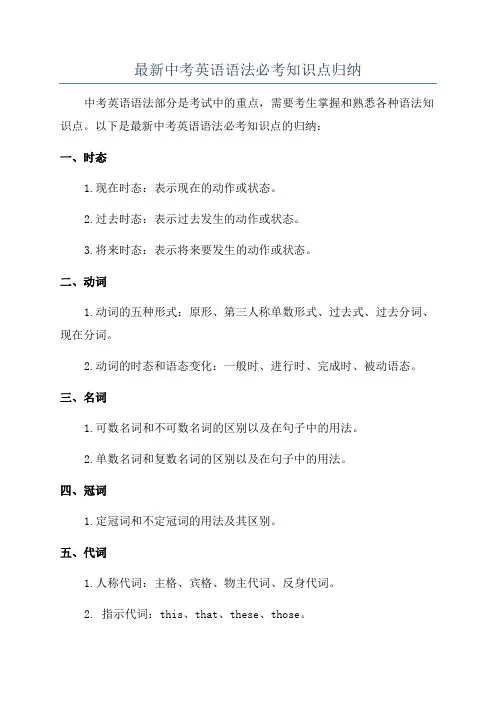
最新中考英语语法必考知识点归纳中考英语语法部分是考试中的重点,需要考生掌握和熟悉各种语法知识点。
以下是最新中考英语语法必考知识点的归纳:一、时态1.现在时态:表示现在的动作或状态。
2.过去时态:表示过去发生的动作或状态。
3.将来时态:表示将来要发生的动作或状态。
二、动词1.动词的五种形式:原形、第三人称单数形式、过去式、过去分词、现在分词。
2.动词的时态和语态变化:一般时、进行时、完成时、被动语态。
三、名词1.可数名词和不可数名词的区别以及在句子中的用法。
2.单数名词和复数名词的区别以及在句子中的用法。
四、冠词1.定冠词和不定冠词的用法及其区别。
五、代词1.人称代词:主格、宾格、物主代词、反身代词。
2. 指示代词:this、that、these、those。
3. 不定代词:some、any、no、every、each等。
六、形容词和副词1.形容词的用法及其在句子中的位置。
2.形容词的比较级和最高级的构成及用法。
3.副词的用法及其在句子中的位置。
七、介词1.常见的介词及其用法。
2.介词短语在句子中的作用。
八、连词1.并列连词及其连接的句子。
2.从属连词及其连接的句子。
九、虚拟语气1.虚拟语气的用法及其在条件句中的表示。
十、直接引语和间接引语1.直接引语和间接引语的区别及其在句子中的用法。
十一、固定搭配和常见短语1.固定搭配和常见短语的用法及其在句子中的位置。
以上是最新中考英语语法必考知识点的归纳,考生需要通过学习和积累这些知识点,提升自己的语法水平,从而在考试中取得好成绩。
中考英语新题型摘录要点
中考文章摘录要点专题讲解一、考题要求:第二节摘录要点( 5小题,计10分)阅读下面的材料,然后在表格中完成内容摘要,每空不超过三个单词。
二、样题研究:2014长沙摘录要点样题是一篇150个词的文章,它由两部分组成,一是所需阅读的文章一篇,二是根据该文章所设计的图表,其题材为说明文,图表是文章的结构图,它反映了文章本身的逻辑思路,也是反映命题人的设题思路。
图表共5个空格,其答题信息均可直接从原文中找到。
三、对考生要求:尽管样题的答题信息均可从原文中直接找到,但为了使考生万无一失,以不变应万变,我们还是对考生相关能力提出了更高要求。
1.阅读理解能力。
对文章的整体把握,领略大意。
对文章的结构和层次把握,弄清局部和整体的关系。
对文章局部的透彻理解,提取有用信息。
2.对图表的识读能力。
考生要迅速把握图表的结构分布层次,命题人的出题角度,哪个空是考察细节,哪个空考察结论,哪个空考察标题。
3.分析、概括、推断能力。
图表试题中有的可以直接从原文中提取到,有的则需要对原文信息进行再加工处理,得到原文相一致的文外词汇。
4.正确书写能力。
这就需要考生具有一定的词汇储备,而且能够认识句子结构和句子成分,根据句子结构和成分来判断所填词的词性。
当然,考生也应该具有构词法的知识。
例如,词性转换,形容词、副词的比较级、最高级,名词的复数形式等。
此外,还有提炼出文章主旨或者重要信息的能力,也就是在语篇结构解读基础上的信息转换能力。
四、解题步骤:第一步,浏览图表。
划分板块,标题块、结论块、主题块、细节块。
标题块和结论块里的空放在最后做,然后按主题块次序先做细节空,再做主题空。
第二步,快速略读全文,把主题块和相应的段落对应起来。
第三步,在图表中领任务,第一主题块对应的细节中的空,带上任务精读相应的段落细节,提取信息,填空完成试题。
然后完成主题块,最后完成标题块。
五、题目的设置类型及答题策略1.信息捕捉题(文中原词)要求学生能快速在文章中查找相关细节,锁定信息来源,并用文章中的词来填空。
2024年中考英语-考纲重点语法必背
考纲重点语法必背一、考纲重点语法总结(一)一.词类(Parts of Speech)名词英文名称The Noun(缩写为n.)表示人或事物的名称例词boy,clock,book等冠词英文名称The Article(缩写为art.)用在名词前帮助说明名词所指的人和或事物。
例词a(an),the代词英文名称The Pronoun(缩写为pron)用来代替名词、形容词或是数词例词we,that,his,what形容词英文名称The Adjective(缩写为adj.)用以修饰名词,表示人或事物的特征例词old,red,fine,good.数词英文名称The Numeral(缩写为num.)表示数量或是顺序。
例词one,thirteen first动词英文名称The Verb(缩写为v.)表示动作或状态。
例词sit,go,be(am,is,are)副词英文名称The Adverb(缩写为adv.)修饰动词、形容词或其他副词。
例词not too,here,very介词英文单词The Preposition(缩写为prep.)表示名词、代词等和句中其他词的关系。
例词in,on,of,to,under.连词英文单词The Conjunction(缩写为conj.)用来连接词与词、短语与短语或句与句。
例词and,or,but.感叹词英文单词The Interjection(缩写为interj.)表示说话时的喜悦、惊讶等情感。
例词oh,hello,hi,er.二.名词(Nouns)1.总的说来,名词分专有名词和普通名词两类。
专有名词:表示具体的人,事物,地点或机构的专有名称。
Lucy China中国Asia亚洲Beijing北京。
专有名词的第一个字母要大写。
普通名词:表示某些人,某类事物,某种物质或抽象概念的名称。
例如:teacher老师tea茶reform改革普通名词又可进一步分为四类1)个体名称:表示单个的人和事物。
中考英语语法题60个考点
中考英语语法题60个考点以下是中考英语语法题中常考的60 个考点:1.名词:名词的单复数、所有格、可数与不可数名词等。
2.代词:人称代词、物主代词、指示代词、反身代词等。
3.数词:基数词和序数词的用法。
4.冠词:定冠词和不定冠词的用法。
5.形容词和副词:比较级和最高级的构成和用法。
6.介词:常用介词的用法和固定搭配。
7.动词:时态、语态、情态动词、非谓语动词等。
8.句子种类:陈述句、疑问句、祈使句、感叹句等。
9.复合句:宾语从句、状语从句、定语从句等。
10.主谓一致:语法一致、意义一致、就近原则等。
11.倒装句:部分倒装和完全倒装。
12.虚拟语气:条件句中的虚拟语气和名词性从句中的虚拟语气。
13.直接引语和间接引语。
14.被动语态。
15.不定式。
16.动名词。
17.现在分词。
18.过去分词。
19.形容词和副词的比较级和最高级。
20.冠词的用法。
21.介词的用法。
22.数词的用法。
23.代词的用法。
24.连词的用法。
25.感叹句的用法。
26.疑问句的用法。
27.祈使句的用法。
28.时态的用法。
29.语态的用法。
30.非谓语动词的用法。
31.主谓一致的用法。
32.宾语从句的用法。
33.状语从句的用法。
34.定语从句的用法。
35.虚拟语气的用法。
36.直接引语和间接引语的转换。
37.形容词和副词的用法比较。
38.名词的用法。
39.动词的用法。
40.介词短语的用法。
41.固定搭配的用法。
42.同义词和反义词的用法。
43.情景交际用语的用法。
44.阅读理解中的语法知识。
45.写作中的语法知识。
46.听力理解中的语法知识。
47.口语表达中的语法知识。
48.词汇扩展和词汇运用。
49.语法错误的纠正。
50.句子结构的分析。
51.语法规则的记忆和应用。
52.语法学习的方法和技巧。
53.语法练习的方法和技巧。
54.语法考试的应对策略。
55.英语语法的历史和发展。
56.英语语法和其他语言的比较。
57.英语语法在实际生活中的应用。
中考英语常考七大题型及答题技巧总结
中考英语常考七大题型及答题技巧总结中考英语主要考查七类题型,分别是听力、单项选择、句子翻译、完型填空、补全对话、阅读理解、句意填词、改写句子、作文。
英语要想取得较高的分数,除了掌握英语的基础知识:单词、语法之外,还要掌握每种题型的答题技巧。
题型一:听力听力主要就是一些选择题,需要考生通过听录音里面的对话、短文、然后回答相应的问题。
听力题重在了解题目的问题,然后才是听录音里的内容。
答题技巧:1、勾划题重点,关键词,特别是一般疑问句的答语。
2、做好笔记,学会记下数字,比如时间,数字,年份等,因为很多时候关于数字需要进行计算,而不是简单的答案。
3、听短文时,特别注意题目的关键词,以及选项的关键词,带着问题有目的地听短文,没听到的及时看下一题,等下一遍的时候再做之前没做的。
题型二:单项选择属于考查各项基础知识的传统题型,此题内容涉及语法、词汇、惯用法、句型、口语功能等方面。
此题灵活,覆盖面广,但多数题目源于课本或化于课本。
答题技巧:1、题目有语境,吃透语境,把握题干的全部信息,并从词法、语法、惯用法、词的搭配等多方面考虑。
2、对话构成题干,更生活化,更灵活,要根据实际情况来断定答案。
3、注意综合性的知识,切记“语不离句,句不离文,语法不离语境”。
用排除法选出答案。
题型三:句子翻译它要求考生有较精准的语言素养,考查考生对词义的理解、词汇的拼写、词性的选择和运用,以及固定搭配、句子的类型结构、句子的时态等方面的能力。
答题技巧:1、联系课文中所学到的动词、固定搭配词组,学会仿写。
2、从简单句的基本句型出发,写完之后默读一遍检查自己的句子是否符合。
题型四:完型填空完型填空的考查比较综合,往往是一篇文章中有10个空,要求考生去填。
通常会考查到动词固定搭配、单词含义、语感、上下文联系等。
完型是相对较难的题目,需要考生反复去推敲答案。
答题技巧:1、第一遍要通读全文,掌握大意,不用急着做题。
2、抓住结构、语意及逻辑三条线索,推断和预测选项。