
功能对等理论视角下的旅游景点名称翻译技巧探析
功能对等理论视角下的旅游景点名称翻译技巧探析
作者:郭新华
来源:《科教导刊·电子版》2014年第09期
摘要本文以功能对等理论为理论依据与评判标准,研究旅游景点名称的翻译技巧,总结了当下中国旅游景点翻译中存在的问题并且分析了当前常用的各种技巧的利弊,希望对目前国内的旅游景点名称翻译有所助益。
关键词功能对等景点名称翻译技巧
中图分类号:H315.9 文献标识码:A
1功能对等理论与旅游景点翻译特点
首先,旅游景点名称具有丰富的历史文化内涵。
每个名称背后都可能有相关的历史故事,或者出处,如果能在翻译时将这个因素考虑在内,必将旅游景点锦上添花。
如故宫三大殿,即太和殿、中和殿、保和殿,其名称太和、中和、保和源自《中庸》:“中也者,天卜之大本业,和也者,天卜之达道也。
致中和,天地位焉,万物育焉。
”其中太和殿的翻译“Hall of Supreme Harmony”可以较好的体现出原语想要表现的气势磅礴。
而中和殿翻译为“Hall of Middle Harmony”仅仅用一个表示方位“中间”的一个“Middle”无法体现原语的深意。
因此,旅游景点翻译中的直译应用的并不十分广泛。
其次,旅游景点名称有着一定的商业色彩。
从位置来看,无论是景点名称还是景点之内的各个建筑或者雕塑的名称,都一定是在最明显的位置。
其目的不外乎是让前来参观的游客了解该建筑物或景点的由来、特点、相关历史事件等,最终是希望通过短暂的介绍,激发游客的参观兴趣。
最后,旅游景点名称对字数以及篇幅有着严格的要求。
景观介绍不可以宣兵夺主,虽然景点介绍很重要,但是,景区的重点毫无疑问是景点内的建筑群,介绍受到这个环境要素的制约,通常既精炼又具体,让游客在最短时间内了解相应的信息,方便游览参观。
2旅游景点常用翻译手法与存在问题
2.1音译法
所谓的音译法,指的是把一种语言的语音用另一种语言中跟它发音相同或相近的语音表示。
可是我国的很多景点名称,在英语中很难找到发音相对应的表达,因此,在我国的景点特别设计地名的翻译中,很多采取的是汉语拼音方案来进行标注。
例如:“雁塔路”:“Yan Ta
Lu”。
这种方法虽然常见,可是在外国游客心里得不到任何的共鸣,根据功能对等理论,以目的语读者的反映来判断,这样的翻译其实是不成功的。
2.2意译法
所谓意译通常指从意义出发,只要求将原文大意表达出来,不注重细节,译文自然流畅即可。
(陈安定,2004)。
在旅游景点翻译中,意译的优势较之音译变得十分突出,意译既可以更为准确的传递景点名称的文化信息,还可以让外国游客有认同感。
在此基础上,更有可能激发他们深入游览的兴趣。
相比起音译,或者不顾文化的直译来说,意译却是有很多优势。
再如:“万春亭’直译译文为“Pavilion of Ten Thousand Spring”。
这个翻译虽然翻译忠实原文,但是无论从形式还是内容都既臃肿又有局限性,进行意译为“Pavilion of Everlasting Spring”,既不失原来的美感又没有直译的呆板。
2.3音意结合法
顾名思义,音意结合法指的是在翻译过程中将汉语拼音与英文意译结合使用的方法。
由于旅游景点名称中由于历史原因,常常涉及人名跟地名,此时,拼音是一个必不可少的要素,但是如果完全用拼音,如:“YanTa Lu”,外国游客则无法明白其中的含义,但是如果改成“YanTa Road”,至少他们还知道这是一条“路”的标示而不是别的什么。
从这个意义上说,音意结合法既弥补了完全音译法不能表明意思的缺点,还能传达出原文的主要信息,起到了一定的交流效果。
因此成为常见的译法之一。
2.4补充解释法
此方法是在前面几种方法的基础之上出现的,为了弥补上述各种方法特别是音译法的缺陷而生。
如:“永寿宫”:Yong Shou Gong (Palace of Eternal Life):“慕才亭”Mucai Ting ( the Pavilion for Admiring the Talented)。
这个方法既保留了原文的发音又解释了其内在的含义,如果符合篇幅要求的话,不失为一个好的选择。
值得注意的是,运用解释法时,如果几个词语就可以将景点名称解释清楚,无需太大篇幅,那么解释性翻译直接跟在音译的后而即可。
但是如果景点名称文化内涵必须要用很长的文字才能解释清楚,这时受到篇幅的限制,解释法则无法使用。
3结论
依据功能对等理论,无论哪种方法,翻译成功与否的标准都是外国游客的感受,他们能否了解景点的文化内涵,在此基础之上能否产生兴趣游览,同时还能尽可能保持原文的风貌。
因此,对于语言学习者与研究者而言,研究旅游景点翻译,绝不是简单的语言学习的范畴,应该充分考虑到旅游景点翻译的特性,深入领会原语与目的语的文化内涵,这样才能在原语与目的语之间找到最佳的平衡点。
基金项目:2013年度陕西省教育厅科学研究项目“西安旅游景点及城市标识语翻译的现状、问题和对策研究”(项目编号:2013JK0355)。
参考文献
[1] 陈安定.翻译精要[M].北京:中国青年出版社,2004.
[2] 方梦之.应用翻译教程[M].上海外语教育出版社,2006.
[3] 丁海秀.故宫(The Forbidden city)[M].沈一梅,译.北京:旅游教育出版社,2002.。
功能对等翻译理论下的旅游景区公示语英译探析
2019年第07期学术专业人文茶趣基金项目:2019年度广西高校中青年教师科研基础能力提升项目———一带一路下北部湾地区旅游景区英语翻译规范化调查研究的研究成果之一,项目编号:2019KY1650作者简介:谢新贤(1984-),女,广西玉林人,硕士研究生,讲师,研究方向:英语课程与教学论。
收稿日期:2019年3月10日。
基于广西政府2013年颁布的文件《加快旅游业跨越式发展的若干政策》,计划以“一心两轴三圈四组团”的模式构建广西旅游发展格局,着力打造桂林国际旅游胜地、北部湾国际旅游度假区、巴马长寿养生国际旅游区三大国际旅游目的地,并依托“一带一路”建设,积极对接东盟国家入境旅游市场,着重吸引到访东盟国家的欧美游客,旨在把我区打造成全国一流、世界知名的区域性国际旅游目的地和集散地。
在大力发展国际化旅游的背景下,如何提升外国游客的旅游体验,遍布景区的公示语就是第一张名片。
公示语所传递出的信息就是外国游客最先接收到的信息。
规范化的,标准化的公示语对于提升外国游客的旅游好感有着至关重要的作用。
因此,旅游景点公示语的英语翻译规范化更加凸显其重要性。
1公示语的应用功能和语言特点1.1公示语的应用功能旅游景区公示语是公示语的重要组织部分,应用范围非常广泛,具有指示性、提示性、限制性和强制性四种突出的应用功能。
1.1.1具有指示性功能公示语指示性公示语(Instructive Guiding Notice ),一般指向旅游者提供相关旅游信息的服务,涉及到食、宿、行、娱、购各个方面。
如咨询服务台Information Center ,售票处Ticket Office ,行李提取处Baggage Claim 。
1.1.2具有提示性功能的公示语提示性公示语(Informational Notice ),该类公示语所提示的信息主要是告知公众,在公共场合下应该怎么做或是如何去做,不具有强制性。
这种标识语的功能一目了然,具有委婉性。
基于功能对等理论北京市旅游景点公示语的翻译探讨

基于功能对等理论北京市旅游景点公示语的翻译探讨随着旅游业的快速发展,旅游景点公示语的翻译成为了一个备受关注的话题。
在北京这样一个拥有悠久历史和丰富文化遗产的城市,旅游景点的公示语翻译显得尤为重要。
在本文中,我们将运用功能对等理论,探讨北京市旅游景点公示语的翻译问题,并分析其中的挑战和解决方法。
让我们简单介绍一下功能对等理论。
功能对等理论是由美国翻译学者尼达·纽马克(Nida)和查尔斯·特兰斯珀(Taber)在20世纪60年代提出的一种翻译理论。
该理论认为,在进行跨语言翻译时,最重要的是要传达原文的功能,而不是逐字逐句地翻译。
这意味着翻译应该根据目标语言和受众的文化和语言习惯,来重新表达原文的意思,以达到相同的功能目的。
在旅游景点公示语的翻译中,功能对等理论可以帮助我们更好地传达景点信息,吸引游客的注意,让他们更好地理解和体验景点文化。
我们来分析北京市旅游景点公示语的挑战。
北京作为中国的首都和一个有着悠久历史的文化古城,拥有丰富的旅游资源和景点。
由于文化的差异和语言的障碍,北京市旅游景点的公示语往往面临着翻译不准确、表达不到位的问题。
一些景点的标语可能在翻译过程中失去了原文的意境和情感,使得游客无法真正理解和感受景点的魅力。
一些景点的公示语可能存在使用生硬、官方化语言的问题,与游客的语言习惯和文化背景不符,难以引起游客的共鸣。
那么,我们应该如何解决北京市旅游景点公示语的翻译问题呢?基于功能对等理论,我们可以采取以下几种方法来改进景点公示语的翻译质量。
我们应该更多地考虑目标语言和受众的文化和语言特点,选择更贴近受众口语的表达方式,以便更好地传达景点信息。
我们可以借鉴当地的文化和历史背景,运用类比、隐喻等手法,来丰富景点公示语的表达方式,从而激发游客的兴趣和好奇心。
我们也可以通过加入一些当地特色的元素,比如俗语、谚语等,来使景点公示语更具吸引力和可读性。
我们还可以通过与当地导游、翻译专家等合作,对景点公示语进行审校和修改,以确保翻译的准确性和流畅性。
功能对等理论在旅游翻译中的指导与应用
功能平等理论在旅行翻译中的指导与应用在英语和汉语系统中,旅行文本存在巨大的差异,如何做好该文体的翻译,有很多问题需要解决。
本文在尤金奈达功能平等理论的指导下,以《库车县旅行概略》为例,剖析了如何利用增译、省译、改写等编译方法来做到对旅行文本的等值翻译,进而进一步总结出该类文本在翻译中广泛存在的问题,以及解决的方法。
当前我国旅行资料的翻译质量却存在很多问题,特别是一些少量民族聚居的地域,旅行资源丰富,但对其旅行景点的翻译却存在更多灾以解决的问题。
以《库车县旅行概略》汉译英为例,不单是一篇典型的中式旅行景点介绍,还存在很多少量民族专有词汇翻译的问题,要做好这项翻译,第一要对照中英旅行文本的差异,追求让译文切近目标读者的方法。
一、旅行文本的中英差异(一)汉英旅行文本的词汇其一,汉语旅行指南大批使用四字构造而英文多用词浅易。
英文旅行景点介绍多以行文简短、读者易于接受见长,在有限的篇幅内将供给的服务和旅行项目交代清楚。
比如本文的第一段就大批使用了汉语的四字构造如“广博精湛”、“气概恢宏” 、“得天独厚”等成语,在翻译成英文时就要注意,有些词汇能否负担,语义能否重复,需要全译仍是编译,仍是干脆省译?其二,汉英之间文化对应词少。
汉语旅行指南文本中与特定文化有关的词特别多,但这些词在译入语英语中多无对应词,即出现所谓的词汇空白现象。
在例文中,“七个打破,成立八个基地和一其中心” 、“十五时期” 、“ 六大体素协调配套体制”这样中国特点显然的表达,以及“古龟兹文化” 、“ 克孜尔千佛洞” 、“ 库木吐拉千佛洞” “ 克孜尔尕哈战火台”等拥有新疆民族特点的专有词汇,都是亟待解决的问题。
(二)汉英旅行文本的修辞差异中文旅行指南常常采纳华美的修辞而英文则多客观描绘。
大批的英语旅行文本显示出一个共同特点:重视于客观的描绘,给读者以充分的信息。
原文中的诗学语言许多,这就需要译者来进行选择和弃取,绝不可以全译。
二、功能平等理论指导旅行翻译旅行文本主要有两个功能:一是传达信息,二是引诱行动。
功能翻译理论视角下旅游景点翻译研究
- 240-校园英语 / 翻译研究功能翻译理论视角下旅游景点翻译研究黔南民族职业技术学院/莫才义 黔南民族幼儿师范高等专科学校/金学佳【摘要】随着经济全球化的不断发展,国家之间的联系愈发密切,跨国旅游已经成为了一种重要的旅游方式。
对旅游景点的介绍上,由于要注重翻译景点的文化底蕴和艺术特征,其翻译模式与普通英语有很大的差别。
功能翻译理论作为一种注重对核心信息和思想进行翻译的翻译理论,对于旅游景点的翻译具有重要的作用。
本文通过对功能翻译理论和旅游景点的特征进行分析,浅谈功能翻译理论与旅游景点翻译的结合途径。
【关键词】功能翻译 旅游景点 翻译一、功能翻译理论概述功能翻译理论由美国语言学家尤金·奈达提出的一种翻译概念,在动态对等和形式对等两个方面,对翻译工作提出了要求。
动态对等,也就是指无论是在语义、词汇、结构还是文体上,都要用目的语中的自然对等语,来对原文中所要表达的信息进行完整的还原。
而形式对等,则是指目的语中所表达出的信息与景点中的不同成分,要最大限度的保持一致。
旅游翻译中的功能翻译理论,最核心的思想是重视游客的反应。
传统的翻译工作领域主要有意译、直译、归化翻译和异化翻译四种,这四种翻译的争论在翻译工作领域持续已久,其中最核心的论点就是译文与原文的关系方面。
功能翻译理论是一种突破了译文和景点之间关系的新标准,但由于这是一种理论性的概念,在实际运用中,往往不可能将使景点和原文能够完全对等,因此,功能翻译理论也只是相对对等,在实际运用当中,要根据不同语言之间的差别,进行灵活的调整,不但要关注景点本身的形式,更要关注对景点所包含的文化信息和精神内容的传递,减少因为翻译方法过于注重景点具体信息而导致影响游客游览兴趣现象的产生。
二、功能翻译理论视角下旅游景点翻译策略1.景点文化底蕴的功能翻译。
商务合作双方的信息对等,是双方合作的基础。
只有让双方都对信息有完整并正确的了解,才能保证双方的合作能够有效的进行。
功能对等理论 旅游文本 翻译策略论文
功能对等理论论文:功能对等理论视角下旅游文本的英译【中文摘要】随着世界各国经济合作的日益密切和文化交流的渗透,旅游作为一种文化资源在各国经济和文化交流中起的作用也越来越大。
中国是个有着五千年历史的泱泱大国,旅游资源丰富,为了进一步弘扬中华文化,促进我国经济发展,从事旅游翻译的学者也越来越多。
但是,由于种种原因的限制,旅游翻译还处于不断的探索与发展之中。
本文旨在从功能对等的角度阐述旅游翻译,借旅游文本进行相关的研究,期待对旅游翻译的提高贡献自己的绵薄之力。
作为实用文体的旅游翻译,功能对等理论对其具有较强的指导作用和实践意义。
该理论强调翻译的,即满足语为对方语的读者。
在汉语旅游文本的英译中,该则表现为语为英语的游客,实现跨语言文化交际,吸引更多的国外游客,将中国的文化发扬光大。
这种翻译的,决定了旅游文本的英译原则是以实现译文预期功能为重点,以传播中国文化为取向。
因此,译者需要选择恰当的翻译方法,进行恰当的文化信息处理,体现不同的语言文化差异,从而符合旅游文化功能的需要。
针对目前的旅游翻译发展现状,本文尝试运用尤金·奈达的功能对等理论作为理论指导,从中西方思维方式、表达方式及其它方面的差异带来的语言表达上的差异着手,努力做到旅游文本翻译过程...【英文摘要】With the intermingling of international economy and culture, tourism culture has played a more and more important role in the cultural exchanges. China is a big countrywith five thousand years of history and rich tourism recourses. In order to promote the Chinese culture and its economy, tourism translation has become vitally important. However, tourism translation is still in constant exploration due to various reasons. This thesis is devoted to making some contribution to the tourism translation through ...【关键词】功能对等理论旅游文本翻译策略【英文关键词】Functional Theory tourism texts translation method【目录】功能对等理论视角下旅游文本的英译摘要4-5Abstract5-6Table of Contents7-9Chapter OneIntroduction9-131.1 Background of Research9-111.2 Aim of the Reasearch111.3 Data Collection111.4 The Structure of the Thesis11-13Chapter Two Literature Review13-242.1 EugeneA.Nida’s Translation Theory13-182.1.1 A.Brief Introduction of Nida13-142.1.2 Nida’s Dynamic/Functional Equivalence TheOry14-162.1.3 View on Translation Equivalence from Western Scholars16-182.2 Feasilility of Applying Nida’s Theory to Guide the Translation of Chinese-English Tourism Texts18-192.3 A Brief Review of Research on Functional Equivalence19-222.3.1 Domestic Research on Functional Equivalence19-212.3.2 Overseas Research on Functional Equivalence21-222.4 A BriefReview of Research on Tourism Text22-242.4.1 Tourism Text Studies abroad22-232.4.2 Tourism Text Studies inChina23-24Chapter Three Study of Tourism Texts24-313.1 Definition of Tourism Texts243.2 Function of TourismTexts24-263.3 Characteristics of Tourism Texts263.4 Characteristics of Chinese Tourism Texts26-283.4.1 Use of Four-character Expressions26-273.4.2 Use of Purple Patches Descriptions27-283.4.3 Use of Quotation and Poetic Lines or Legends283.5 Characteristics of English TourismTexts28-313.5.1 Conciseness and Readablity28-293.5.2 Vividness and appealing29-303.5.3 Figurative use of language30-31Chapter Four Practical Application of Funcitional Equivalence to Tourism Texts’sTranslation31-484.1 Translation of the name of the scenic spots31-344.2 Translation of historical events34-374.3 Translation of cultural elements in tourism texts37-484.3.1 Difficulty in translating cultural elements in tourismtexts37-404.3.2 Strategies to cultural gap between source language readers and target language readers40-48Chapter Five Conclusion48-50Bibliography50-52Acknowledgements52-53攻读硕士学位期间取得的科研成果53。
功能对等理论视角下的旅游广告标语翻译研究
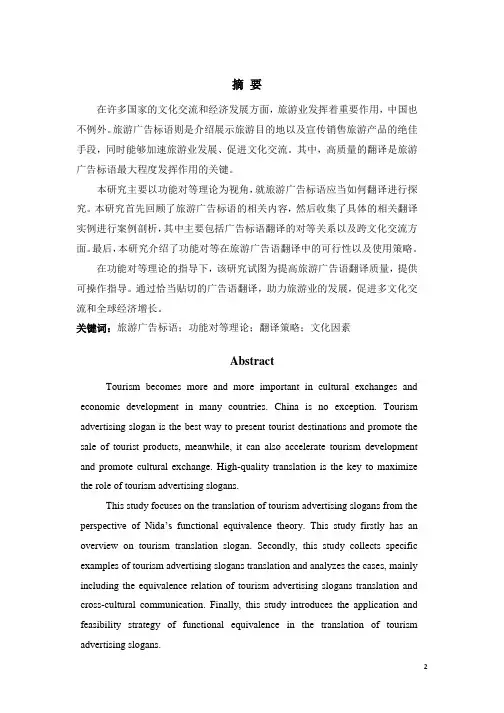
摘要在许多国家的文化交流和经济发展方面,旅游业发挥着重要作用,中国也不例外。
旅游广告标语则是介绍展示旅游目的地以及宣传销售旅游产品的绝佳手段,同时能够加速旅游业发展、促进文化交流。
其中,高质量的翻译是旅游广告标语最大程度发挥作用的关键。
本研究主要以功能对等理论为视角,就旅游广告标语应当如何翻译进行探究。
本研究首先回顾了旅游广告标语的相关内容,然后收集了具体的相关翻译实例进行案例剖析,其中主要包括广告标语翻译的对等关系以及跨文化交流方面。
最后,本研究介绍了功能对等在旅游广告语翻译中的可行性以及使用策略。
在功能对等理论的指导下,该研究试图为提高旅游广告语翻译质量,提供可操作指导。
通过恰当贴切的广告语翻译,助力旅游业的发展,促进多文化交流和全球经济增长。
关键词:旅游广告标语;功能对等理论;翻译策略;文化因素AbstractTourism becomes more and more important in cultural exchanges and economic development in many countries. China is no exception. Tourism advertising slogan is the best way to present tourist destinations and promote the sale of tourist products, meanwhile, it can also accelerate tourism development and promote cultural exchange. High-quality translation is the key to maximize the role of tourism advertising slogans.This study focuses on the translation of tourism advertising slogans from the perspective of Nida’s functional equivalence theory. This study firstly has an overview on tourism translation slogan. Secondly, this study collects specific examples of tourism advertising slogans translation and analyzes the cases, mainly including the equivalence relation of tourism advertising slogans translation and cross-cultural communication. Finally, this study introduces the application and feasibility strategy of functional equivalence in the translation of tourism advertising slogans.Under the guidance of the theory of functional equivalence, the study attempts to provide practical guidance for improving the quality of translation of tourism advertising slogans. This study hopes to accelerate tourism development as well as cross-cultural communication and global economic growth through appropriate and high-quality translation.Key words:tourism advertising slogans; functional equivalence theory; translation strategies; cultural factorsOutlineI. IntroductionA. Research Background and SignificanceB. Research Questions and MethodologyC. Research OrganizationII. Tourism Advertising SloganA. Definition of Tourism AdvertisementB. Principles and Language Features of TAS1. Principles of TAS2. Language Features of TASC. Intercultural Factors in TAS Translation1. Cultural Factors2. Psychological Factors3. Values in Different CountriesD. Function of TAS TranslationIII. Theoretical FrameworkA. Previous Studies on Tourism TranslationB. Background a nd Contents of Nida’s Equivalence TheoryC. The Advantages of the Functional Equivalence TheoryIV. Translation Strategies for TASs from the Perspective of Functional Equivalence TheoryA. Feasibility of Applying Functional Equivalence Theory in TAS Translation1. Equivalence in Passage and Style2. Meaning is More Important than Form3. Social and Cultural EquivalenceB. Strategies to TAS Translation1. Direct Transfer2. Partial Adaptation3. Total AdaptationV. ConclusionA. A General SummaryB. Limitations of the Present StudyC. Recommendations for Further StudiesA Study on Tourism Advertising Slogan Translation from thePerspective of Functional Equivalence TheoryI. IntroductionA. Research Background and SignificanceTAS translation is an emerging industry in China. With globalization and increasing cultural exchanges, tourism has become a powerful means to promote mutual understanding between countries around the world. With China entering WTO, translation develops quickly in China. However, translators did not pay much attention on TAS translation, literary translation and business translation are still the mainstream. Many translators are devoted to these fields of research, while ignoring the TAS translation.As time goes on, the TAS translation has attracted more attention from different fields’ translators, and the study of TAS translation has far-reaching significance. The TAS translation is not only linked to the profits, but also accelerates cultural and economic exchanges among countries. At the same time, the TAS translation still needs to be improved, so it needs more translators to paymore attention.Nowadays, people’s living standard has improved a lot, outbound tourism is popular and going to be a trendy. We humans becomes closer and closer, at this time, the study of TAS translation tends to be more and more important. This thesis tries to conclude some principles to guide TAS translation.Nida’s functional equivalence theory is often used by translators, and has been applied to kinds of translations. In this thesis, Nida’s functional equivalence theory is taken to find solutions and adopted as principles in TAS translation. Good translation can increase the promotion and sales of tourism products, and it is also a good way to increase the source country’s cultural influence.B. Research Questions and MethodologyThree questions mainly discussed in this thesis. Based on functional equivalence theory, the author hopes to offer some practical translation strategies.Q1: what is the definition of TAS and what’s the meaning to study TAS translation?Q2: why does the theory can offer strategies for TAS translation?Q3: what strategies does the theory can offer for TAS translation?This study is conducted mainly through qualitative research methods including inductive research method, descriptive research method and comparative research method.C. Research OrganizationThis thesis consists of five chapters. Chapter one is a brief introduction that states the research background and significance, research questions and methodology, as well as the research organization.Chapter two is an overview of tourism advertising slogan including definition, principles, language features, intercultural factors in TAS translation andfunctions of TAS translation.Chapter three gives an overview that provides a summary of previous studies on tourism translation and presents the theoretical framework which contains Nida’s equivalence theory and advantages of th e functional equivalence theory.Chapter four is mainly the translation strategies for TAS from the perspective of the functional equivalence theory.Chapter five is conclusion which summarizes the major findings, limitations and suggestions for further studies.II. Tourism Advertising SloganIn this chapter, the author shows an overview of tourism advertising slogan. Advertising is an important part of market means. The meaning of advertising is to pass all kinds of product information to readers or consumers by some artistic techniques. And the advertising language refers to the language specific to advertising, which should contain all kinds of language information in the slogan, such as pronunciation, words, sentences including lyrics, characters including pinyin letters, punctuation and text graphics consisting of words, graphics and objects (Lin, 1992: 42).The purpose of TAS translation is to help the target readers (the tourists) have a barrier-free and accurate comprehension of the information the TASs convey. Translators are a key part in meeting this goal. Translators should take translation strategies to build a bridge between source language and readers. This chapter summarizes the major previous studies and concludes the most frequently adopted strategies and theories.A. Definition of Tourism AdvertisementTourism advertisements are mainly organized, comprehensive, persuasive,non-personnel information dissemination activities related to tourism products, tourism services and tourism information through various media, belonging to narrowly defined advertisements (Baike 2016). Wu (2000) believes that travel advertising is “to produce and publish tourism information through the advertising company, in order to expand the influence of tourism destinations, and then attract tourists to consume.”In modern tourism advertising activities, there are many types of common tourism advertisements. There are different categories according to different classification criteria: 1) static tourism advertisement and dynamic tourism advertisement can be divided according to the form of tourism advertisement; 2) TV advertising, newspaper advertising, radio advertising, Internet advertising, shop advertising and new media advertising are classified by tourism advertising media;3) according to the category of tourism enterprises, tourism advertisements include tourist hotel advertisements, tourist traffic advertisements, travel agency advertisements, scenic spots advertisements, exhibition advertisements, etc.Tourism advertisement plays an important role in promoting the sales of tourism products, improving the popularity and reputation of scenic spots, and enhancing the core competitiveness of tourism enterprises. Good tourism advertisements can spread travel information so as to attract tourists well. The diversity of advertising media in modern society and the efficiency of information dissemination facilitate the access of tourists to information. Not only do tourists benefit from diversity of choices, but also tourism enterprises benefit from it, thus promoting the sustainable development of tourism. Tourism advertisements can also spread social culture and enrich cultural life. While promoting tourism products, tourism advertisements also promote the historical, national and artistic knowledge. While promoting products, they also play a role in spreading culture and improving aesthetic taste.B. Principles and Language Features of TASThe slogan translation cannot be equated with literary translation, and the slogan has its own characteristics. In general, TAS’s language strives to achieve the expected results by using simple language. The source language is certainly easy to understand and very attractive, and at the same time, it can show the characteristics of pre-sold goods. And the translated slogan should meet the above points, and local cultural differences are taken into account as well as the economic conditions. The slogan translation should be fluent in language, persuasive, and the use of rhetorical means should be special and attracting, which are making people feel wisdom in humor (Li, 2002: 67). Zhang (2003) mentioned in his book that the advertising language is also very distinctive in form, or it is well-organized, rhyming, refreshing, and can be intrigued and long-lasting effect. In a word, the slogan should be easy to understand and left a deep impression. At the same time, slogans should be persuasive, creative, attractive and influential. Only when these conditions are met can a successful slogan be created.1. Principles of TAS1.1 PersuasivenessAdvertising is designed to make influence on readers or consumers’ thinking patterns and purchasing behavior. As a communication with the mass media, slogans are persuasive and informative (Zhao, 2009: 43). And the TAS is also a kind of advertising slogan. The purpose of TAS is to change the concept of tourists and attract tourists to buy scenic products in order to make money. Therefore, the primary feature of a tourism slogan is that it must be persuasive, that is, to allow tourists to generate a desire to buy after seeing the slogan. Successful slogans are extremely persuasive, and can express the characteristics of the goods in simple and short language. The following examples can better reflect this feature: ST: We are good, not fancy. –New Century HotelTT:卓而不俗。
功能对等理论视角下的旅游景点名称翻译技巧探析
郭新 华
( 西安 外事 学院 外 国语 学 院 陕 西 ・西安
摘 要
7 1 0 0 7 7 )
本文以功能对等理论为理论依据与评判标准 , 研 究旅游景 点名称的翻译技巧 , 总结 了当下 中国旅游景点翻译
功 能对等 景点名称 翻译技巧
值 得注 意 的是 , 运 用 解释 法 时 , 如 果 几 个 词语 就 可 以将 景 点名称解释清楚 , 无需太大篇幅 , 那么解释性翻译直接跟在音 译 的后 而 即可 。但 是 如 果 景 点名 称 文 化 内涵 必 须要 用 很 长 的 文 字才 能 解释 清 楚 , 这 时受 到篇 幅 的 限制 , 解释 法 则 无法 使用 。
点特别设计地名的翻 译中,很多采取的是汉语拼音方案来进 行标注 。例如: “ 雁塔 路” : “ Y a n T a L u ” 。这种方法虽然常见 , 可是 在 外 国游 客 心里 得 不 到任 何 的共 鸣 , 根 据 功 能对 等 理 论 , 以 目的语 读 者 的反 映 来判 断 , 这 样 的翻 译 其 实 是 不 成 功 的 。
2 . 2意译 法
因此 , 对 于语 言学 习者与研究者而 言, 研 究旅游景点翻译, 绝 不是简单的语言学习的范畴 ,应该充分考虑到旅游景点翻译 的特 性 , 深 入 领 会 原 语与 目的语 的 文化 内涵 , 这 样 才 能在 原语 与 目的语 之 间找 到 最佳 的平 衡 点 。 ★基金项目: 2 0 1 3 年度陕西省教育厅科学研 究项 目“ 西安 旅 游景 点及 城 市 标 识 语翻 译 的现 状 、问题 和 对策 研 究”( 项目 编号: 2 0 1 3 J Ko 3 5 5 ) 。 参考文献
从功能对等理论视角下探讨云南省旅游景区英译中存在的问题及解决对策
从功能对等理论视角下探讨云南省旅游景区英译中存在的问题及解决对策作者:张羽来源:《新教育时代·教师版》2016年第12期摘要:本文在尤金.奈达功能对等的理论指导下,以云南省最著名的昆明、大理、丽江三个旅游城市为研究对象,通过分析这三个城市景区英译中出现的失误及问题,提出读者能接受的英文译文,并指出提升景区翻译质量的对策。
关键词:功能对等;旅游景区;存在问题;解决对策一、功能对等理论尤金·奈达是美国著名的语言学家和翻译家,是公认的翻译论奠基人。
奈达在翻译理论方面做出了很多重要的贡献,其中最核心的是功能对等理论。
奈达认为“翻译即是交际,这个过程要看人们在听、读译文时所获得的是什么”,即奈达认为翻译就是交际活动,作为交际活动的翻译主要是译意,在翻译中读者或言语的接收者是评判译文质量的关键,翻译时不考虑读者的反应,就可能产生对牛弹琴的译文。
翻译不仅是词汇意义上的对等,还包括语义、风格和文体的对等,翻译传达的信息既有表层词汇信息,也有深层的文化信息。
“动态对等”中的对等包括四个方面:(1)词汇对等;(2)句法对等;(3)篇章对等;(4)文体对等。
在这四个方面中,奈达认为,“意义是最重要的,形式其次”。
为了对等译文必须达到四个条件:(1)传达信息,译文有意义;(2)传达原文的精神风貌;(3)表达自然流畅;(4)读者反映类似。
二、功能对等视角下云南景区文本英译错误及规范(一)翻译信息传达不全面例1.赛典赤.詹思丁,西北回回人,随成吉思汗西征。
A Muslims from Northwest China, Sadianchi Zhansiding joined the expeditionary army of the First Yuan emperor Genghis Khan.例1.英译文对成吉思汗的加注使得译文与原文意思不符,译文加注 the First Yuan emperor Genghis Khan,是想让读者更加了解成吉思汗,但是此处的加注属于画蛇添足,成吉思汗统一蒙古各部落,元世祖忽必烈灭南宋,一统天下,建立元朝,所以忽必烈是元朝开国皇帝而不是成吉思汗。
功能对等理论视角下的旅游文本翻译研究——以齐云山风景区景点英译为例
功能对等理论视角下的旅游文本翻译研究——以齐云山风景区景点英译为例易晋宇,黎晓容(贵州大学外国语学院,贵州贵阳550025)摘要:随着国际交流的加深,我国的旅游业也不断发展壮大,来华旅游的海外游客呈逐年增多的趋势,因此对旅游胜地景点资料的翻译成为了海外游客了解中华文化的一项重要途径。
而我国旅游资料的翻译水平良莠不齐,这在一定程度上阻碍了海外游客真正了解中华文化。
该文以齐云山景区景点的英译材料为例,运用功能对等理论从译文与原文兼具形合与意合、译文不拘泥原文的形式以及对原文进行重创三个方面对部分译文进行评析,提出了自己的见解,以资参考借鉴。
关键词:功能对等;景点英译;中华文化中图分类号:H059文献标识码:A文章编号:1009-5039(2019)11-0175-021概述习近平在2013年提出的“新丝绸之路经济带”和“21世纪海上丝绸之路”(简称“一带一路”战略),“一带一路”战略是中国以“走出去”为主要特征的国际区域经济合作新模式,是统筹中国各领域全面对外开放的国家战略[1],同时也将对中国第三产业尤其是旅游业产生巨大的推动作用,而旅游业的发展也将进一步促进中华文化走向世界。
有着“天下无双胜境,江南第一名山”之称,中国四大道教名山之首的齐云山就是旅游的必去之处。
然而,要想让国际上更多的人了解齐云山文化并参与其中,就要对其加强外宣力度,这就对景区景点介绍的翻译提出了更高的要求。
近年来,随着慕名而来的海外游客日益增多,齐云山所在的安徽省黄山市的相关部门也陆续编译出版了旅游外宣刊物和手册,也对园区内各景点的介绍重新进行了编译。
根据对收集到的相关资料的研究,笔者发现部分英译文本仍存在着一些问题,这些问题主要归总为用词欠妥、对原文理解存在偏差等。
在此,笔者拟运用功能对等理论,以上述部分景点的英译材料为例进行评析,并提出自己的见解,以资参考借鉴。
2功能对等理论20世纪80年代,尤金·A.奈达在《从一种语言到另一种语言》即From One Language to Another一书中,用“功能对等”这一术语替换了“动态对等”[2]。
目的论指导下的旅游景点介绍文本翻译策略
尊宫女宦官分立左右两旁 , 排列有序 , 职责有别 , 仪 表各异 。
译文 : T h e m a i n s t a t u e , T h e Ho l y Mo t h e r , Y i J i a n g
特 的语言 风格 , 符合 译 人语读 者 的审美 观 。
( 二) 连 贯原 则
我 国丰 富 的旅 游 资 源 、 悠 久 的历 史 、 璀 璨 的 文 化、 迷人 的风 光 , 吸引 着越 来越 多 的外 国游 客 。英语
是世界上使用范 围最广 的语言 , 英译旅游景点介绍 文 本 承 载 着 对 外 传 递 旅 游 信 息 和 吸 引潜 在 外 国 游 客的重要责任 , 在旅游业发展 中扮演着越来越重要 的角色。好的译文不仅能宣传 和推广旅游景点, 而
s i t s i n t h e c e n t e r , d r e s s e d i n g o l de n i mp e r i a l r o be ,d i g — ni f i e d a n d ma g n i ic f e n t , wi t h 42 s e r v a n t s wa i t i n g o n b o t h s i d e s o r de r l y .T h e i r d r e s s e s ,p o s t u r e s a nd d ut i e s re a a l l di fe r e n t .
因此 有 些 中 国文化 内容 , 对 中 国读 者 来 说很 容 易 接 受, 而 对西方 读者却 费解难懂 。 这会造 成译 文读者 理