
译林牛津英语六年级上册Unit5教案
牛津小学英语六上Unit5 Signs教学设计总34--40 课时
1 Title: Signs Grade 6 Teacher’s Name: Zhou Ting Period 1 Date:
Teaching Points By the end of this lesson, the students should grasp the following points:
1、Master different public signs:No eating or drinking No eatingNo parking,No smoking,Danger,Wet floor
2、Master the dills:What does it mean? It means …. No littering/parking/smoking/…You can /can’t….
3、Master the new words:litter, go in, take …into, restaurant, someone, smoke, smell,sign, shopping centre,
careful, mean, floor
4、By learning this unit ,the students should be able to master some knowledge about the public signs
Main Lesson Aims
& Difficult Points Drills:What does it mean? It means ….
No littering/parking/smoking/…
You can /can’t….
Key words:sign, shopping centre, mean。
Teaching Aids PPT , some flash cards, some pictures about the public signs
STAGE PROCEDURE
(What will the teacher do) TASKS
(What will the
students do) INTERACTION AIMS
Warming-up Step 1 Warming up
Guessing game
T: Good morning, boys and girls. Do you like
watching TV at weekends? Can you guess what does
Miss Zhou like doing at weekends?
S: She
likes … .( one by
one)
PPT: She likes
reading books,
doing housework
and going
shopping.
1.T-Ss
2.S1-Sn 牛津小学英语六上Unit5 Signs教学设计总34--40 课时
2
Presentation
T:I like going shopping at weekends. If I want to
buy some beautiful dresses and skirts, I can go to the
shop. If I want to buy some food, I can go to the
supermarket. If I want to buy some books, I can go
to the bookshop. I can buy some fresh fruit at the
fruit shop. I like eating bread very much. So I often
go to the bakeshop. If I want to have a big lunch
with my family, we can go to the restaurant.
Listen and think
T-Sn
PPT依次出现图片:shop,supermarket,shopping centre,bookshop,fruit shop,bakeshop,restaurant。
T—S: shopping centre,
bookshop (渗透单词fruit
shop,bakeshop,restaurant)
(依次讨论4个选择题,并追问如何得出答案,.
3、Listen and answer:
T: Where are they? Please listen to the tape, then
answer my question.
Ss: They are in the …
T—S: juice shop, restaurant
4、Read and choose
T: Now please read the story quickly, than finish the
exercises on page 8 “Read and choose.”
Listen and answer
the questions
T-S1
牛津小学英语六上Unit5 Signs教学设计总34--40 课时
3
Practise
Presentation&
Practise T: Number 1, Where are Mike, Helen and Tim? How
do you know?
5、Look and answer
T: What does it mean? (Show the sign“Wet floor”)
S:It means the floor is wet.
T—S: It means ‘Wet floor’. It means the floor is
wet.
The same way to teach the following points:
What does it mean?
It means ‘No littering’ / ‘No eating or drinking’ / ‘No
smoking’.
It means you can’t litter / eat or drink / smoke here.
6、Listen and repeat
T: Now let’s listen to the tape, repeat the sentences.
1、Read and act.
T: Now it’s your turn to read the story. Then you can
act in your groups.
2、Look and write. (P8)
3、Work in groups.
T—S: What does it mean?
It means ‘No parking’ / ‘Danger’.
It means you can’t park here. / It means you must
stay away from it.
Find the answers:
It means the floor
is wet.
Follow the tape
T-Ss
1
T-S1
T-Sn
让学生说说依据)。
牛津小学英语六上Unit5 Signs教学设计总34--40 课时
4 Homework 1. Read the text after the tape.
2. Try to find more public signs.
Blackboard Design
What does it mean? It means ‘ ’. It means you can’t … .
Who: Mike, Helen and Tim
When: Maybe at the weekend
Where: shopping centre, juice shop, bookshop, restaurant
Wet floor No littering No eating or drinking No smoking
Title: Signs Grade 6 Teacher’s Name: Zhou Ting Period 2 Date
Teaching Points By the end of this lesson, the students should grasp the following points:
1.Master the drills:What does it mean? It means …. No littering/parking/smoking/…You can /can’t….
2. Key words:sign, shopping centre, careful, mean, floor。
3. They are able to talk about the public signs .
4.They can use the structure, ”No +doing”
Main Lesson Aims
& Difficult Points Drills:What does it mean? It means ….
No littering/parking/smoking/…
You can /can’t….
Key words:sign, shopping centre, mean。
Teaching Aids PPT , some flash cards, some pictures about the public signs
STAGE PROCEDURE
(What will the teacher do) TASKS
(What will the students
do) INTERACTION AIMS
牛津译林版初中英语七年级英语上册Unit5学案及习题
韩老师
第 1 页 共 13 页 1 牛津译林版初中英语七年级英语上册
Unit 5 Let’s celebrate!
短语:
1.dress up as… 装扮成……
2.Monkey King 美猴王(孙悟空)
3.Chinese New Year = Spring Festival 春节
4.Dragon Boat Festival 端午节
5.Mid-Autumn Festival 中秋节
6.Thansgiving Day 感恩节
7.eat mooncakes 吃月饼
8.tell sb. about sth. 告诉某人关于某事
9.in the USA = in America 在美国
10.celebrate Halloween 庆祝万圣节
11. have a special party 举办一个特别的聚会
12.on October 31st 在十月31日
13.on the evening of October 31st在十月31日的晚上
14.play a game called … 玩一个叫……的游戏
15.tick or treat 不招待就使坏
16.knock on one’s door 敲某人的门
17.give sb. sth. as a treat = give sb. a treat of
sth.
给某人某物作为招待
18.play a trick on sb. 捉弄某人
19.at Halloween 在万圣节
20.wear special costumes with masks 穿有面具的特殊服装
21.paint one’s face 给某人的脸涂色
22.cut out 剪出,切出,刻出
23.the sharp teeth 尖利的牙齿
24.have hot drink 喝热饮料
25.eat lot of nice, hot food 吃许多美味的热的食物
沪教版英语六年级上册《Unit5Animalsindanger》教案
沪教版英语六年级上册《Unit5Animalsindanger》教案
一、教学目标
1. 掌握词汇:leopard, polar bear, kangaroo,
monkey, elephant, panda, koala, dolphin
2. 能听懂、会说、会读、会写句型:What animals
are in danger? They are ____. What can we do? We
can ____.
3. 了解几种濒危动物的情况及其保护。
4. 培养学生的环保意识。
二、教学重难点
1. 词汇的掌握及运用。
2. 句型的理解及运用。
3. 学生对濒危动物的保护意识的培养。
三、教学准备
1. PPT。
2. 海报。
3. 相关课件材料。
4. 牛津英语教材。
四、教学流程
1. 导入(5分钟)
通过展示一幅画面或视频,激起学生对动物的兴趣,引发学生对保护动物的思考,举出保护动物的缘由。 2. 学习新知(25分钟)
2.1. 新词汇的学习
1. 出示图片,让学生辨认,大声跟读,理解词义。
2. 再次出示图片,让学生用单词描述图片。
3. 回答问题:What animals are in danger?(用图片答题)
4. 手抄单词,翻译。
2.2 句型的学习
1. 通过PPT呈现英语句子,再一遍遍地读出来,让学生理解句子组成结构。
2. 提问:What animals are in danger?(学生回答)What can we do?(学生回答)
3. 操练(15分钟)
1. 听录音,模仿、理解语音语调和语速。
2. 进行小组讨论,让学生用学过的单词,进行组句并合理表述。(练习时,老师可以参与其中,引导学生)
4. 巩固(10分钟)
1. 以小组为单位,让学生在四幅海报上(分别是熊猫、考拉、海豚、豹),描述关于保护这四种动物的方式,并贴在黑板上。
2. 列举保护濒危动物的方法,学生一起回答并发表自己的个人见解。
小学英语译林牛津版六年级上册《then and now》教案
Do one thing at a time, and do well.
- 1 - 小学英语译林牛津版六年级上册
《Then and now》教案
课 题 Unit4 Then and now 课 型 新授 课 时
备课时间 授课时间
教学目标 1.听说读单词then and now ,e-book, mobile phone, newspaper, radio,
telephone, e-friend, anywhere, could,并能运用于语句中。
2.掌握动词过去式的发音及用法,会说…years ago,…could/ could
not…Now,…
重点难点 1.能正确地理解并朗读对话内容,在教师的引导和帮助下尝试复述课文内容。
2.通过过去和现在的对比,感受个人的成长和社会的进步。
教具准备 光盘单词卡片,课文图片,PPT
教 学 过 程 二次备课
Step 1. Warming up
1.T: Do you know the song?
S: Where is time going?
T: Yes, time flies quickly. We are growing up, and the things around us are
changing. We know, the world is changing.
2. T: Then what is changing? Do you have your idea?
Step2. New learning
A. 1. T: Perfect. I like your ideas. Now I’ll show you a family. Do you
know them? Who is he/ she? ( Mike, Mr Brown, Mrs Brown, Mike’s
grandpa)
2. Then, how about this boy? Yes, this is Mike six years/ Mr Brown twenty
《Unit5 A party》公开课教案
牛津译林版英语六年级下第一课时教学设计
课题 A party 单元 Unit 5 学科 英语 年级 六年级下
学习
目标 1.能理解并会朗读故事。
2.能初步听懂、会读词汇balloons, drinks, fruit, snacks,toys,clown,
appear, put on, begin, Children’s Day.
3. 学会介绍人物的计划。
重点 1.能初步听懂、会读词汇balloons, drinks, fruit, snacks,toys,clown,
appear, put on, begin, Children’s Day.
2.学会介绍人物的计划。
难点 学会介绍人物的计划。
教学过程
教学环节 教师活动 学生活动 设计意图
导入新课 1. play a game
一颗颗的苹果落下的同时,说出苹果上的单词。
2.Look and say
老师出示六一节的图片,图片上有不少人物等信息,教师提出问题:Who are they?
What can you find? 然后让学生观察图片后思考然后回答是谁,学生回答是小朋友们。教师引导学生继续说说发现了什么?发现了六一,从而引出儿童节是Children’s Day。
3.let’s sing
唱首歌,活跃气氛,为六一儿童节的到来热身。
观察图片,思考,回答问题。 游戏热身,复习旧知识。
六一图片的出示,激发学生的好奇心,学生喜欢六一儿童节,他们的学习兴趣会更加浓厚,加上歌曲热身,很自然引出新课。
讲授新课 1. Look and say
教师说明六一儿童节就要来临,让学生观察图片,说说六一是什么时候的?学生很快能回答是六月一日。然
观察图片,思考,回答问题。
导入前准备
后教师可以借助这个回答,进一步追问学生在儿童节会做些什么事情呢?教师慢慢引导学生说出六一的其中一种活动是举行聚会。为接下来的故事做好过度的衔接。
牛津六年级英语上册教案全套

可编辑
精品 牛津版小学六年级英语上册教案
牛津英语6A教案 Unit 1 Public signs
第一课时
教学目标:
1. 能听懂、会说、会读和会拼写单词:mean, danger, should, shouldn’t, litter, park, cycle.
2. 能听懂、会说和会读单词和词组:public, a sign, grass, quiet, touch, keep off.
3. 能听懂、会说、会读和会写句型:What does it meam? It means you shouldn’t …
教学重点:
1. 能正确听说读会写句型:What does it meam? It means you shouldn’t …
2. 能正确能听说读写单词:mean, danger, should, shouldn’t, litter, park, cycle.
教学过程:
一. Everyday English:
How are you?
Pass the ball to …
Give the pen to …
Where’s …
What’s the score?
二.Presentation and practise:
1. T: Let’s go the the park.(多媒体展示公园情景,出现许多公共标志牌)
T: What’s this? It’s a public sign.
Learn : public sign.
T: Let’s look at some public signs on the Internet.多媒体展示九个标志。
T: Can you read them?
学生能朗读其中的八个:No parking. No eating and drinking. Keep quiet. Do not touch.
通过复习帮助学生巩固以上四句话。
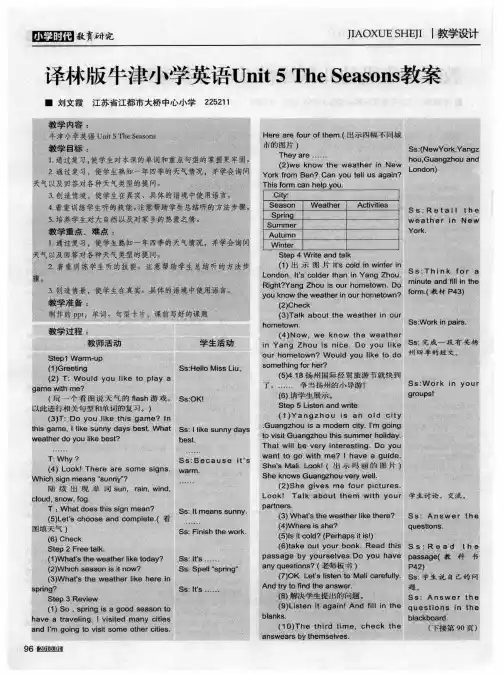
译林版牛津小学英语Unit 5 The Seasons教案
DEYU YU XINYU l德育与I 育 渐使孩子养成了自私自利、任性乃至放荡不羁的性格,更谈不上 具备爱心了。如果连对父母、对家庭都没有基本的爱心,何以谈 到对社会有博爱之心。因此,教师要利用好教材,及时地渗透孝 亲敬长的教育。 例如,一年级下册《陈毅探母》,讲的是五十多岁的陈毅将 军为母亲洗脚的事。这时候问学生:你们从哪些地方觉得陈毅非 常孝敬自己的母亲?反复朗读体会。接着话题一变:你们想到一 则广告了吗?立刻孩子们热情沸腾,说“洗脚”的公益广告。广 告中的妈妈和孩子为什么都要给自己的母亲洗脚呢?你怎样表达 你对父母的爱呢?让学生去实践,用行动表达对父母的关心、感 激,回报父母的爱。有些父母第二天就激动地反映孩子的情况, 幸福溢满了小家。又如四年级下册中的《第一次抱母亲》,讲了 作者抱病床上的母亲的事。在作者的心中总认为母亲很重,因为 她总是背很重的东西,用柔弱的肩膀支撑着整个家,而实际上母 亲一直只有八十几斤。作者用平实而感人的笔调使学生深受感动, 感受到了母亲胸怀的无畏、博大,加深对母亲的崇敬和爱戴之情。 随着孩子的年龄的增大,特别是青春期的孩子,与父母的 隔阂越来越大,对于“爱”似乎也越来越敏感。在六年级上册中 有一篇习作“向父母说出自己的爱”,说一声“我爱你”。简单的 三个字,使孩子与父母问产生了巨大的力量!例如一个孩子写道: “爸爸看到我写的纸条,呵呵笑了起来,然后拿出皮夹,把它珍 藏在皮夹里。顿时,我从心里升起了一股暖流,一些镜头浮现在 眼前:爸爸弯下腰,而我乐颠颠地爬上了他的背;从爸爸粗糙的 手中接过买肯德基的钱;我拿起剪刀,为爸爸剪一根根白发…… 我真想大声地对爸爸说:“爸爸,我爱你!” 在语文教学中,要适时地培养学生如何看待自己的家庭、自 己的父母,以增进子女与长辈的亲情沟通,养成孩子替父母分忧, 为长辈考虑的良好品性,弘扬中华传统美德,进而把孩子爱父母、 爱家庭的感情提升到爱社会、爱祖国乃至爱全人类的崇高境界。 四 利用教材,培养崇高的奉献精神 语文教学的德育渗透是多层次的全方位的有机体。语文老 师必须结合本学科的特点,充分发挥语文的思想性作用,寓德育 于智育之中,因文悟道,使学生深刻体会范文情感,获得最真切 的感受,从作品中吸取营养,引导学生分析欣赏文学作品中的人 物形象,在潜移默化中熏陶和塑造学生的心灵。 例如,一年级下册《大禹治水》.大禹为什么要治水?治水 过程中经历了哪些磨难?你佩服他什么呢?使学生了解到大禹为 百姓历尽苦难,不求回报的伟大精神,这是一种大无畏的崇高的 精神。四年级的《开天辟地》,描述了盘古为全人类奉献自己一 切的神话故事;五年级的《杂交水稻之父》,讲述了中国科学家 袁隆平研制杂交水道的艰难的过程,可他却不申请专利,毫无保 留的奉献给了全世界;六年级下册《钱学森》,写了我国的“导 弹之父”钱学森放弃国外优越的待遇,冲破万难回国的事,赞扬 了他时刻不忘祖国的崇高情操……类似这样的文章贯穿了整个小 学教学,激发学生为国、为民无私奉献的崇高精神。 五 利用教材。树立正确的价值观和人生观 培养学生崇高的道德情操和健康的审美情趣,形成正确的 价值观和积极的人生态度,是语文教学的重要内容。 90翻明幽 例如,一年级上册《怀素写字》,这篇课文写的是怀素从小 认真写字,后来成为一代书法家的故事,激发学生认真写字,认 真学习的热情。又如五年级上册《装满昆虫的口袋》,写了法布 尔从小就善于观察,热爱昆虫,即便遭到父母的责骂也没有放弃, 成为昆虫学家的故事,引导学生从小要仔细观察,善于观察,热 爱科学。五年级下册中的《海伦・凯勒》、六年级上册中的《轮 椅上的霍金》描写的是身残志不残的伟人,凭着坚韧不拔的毅力 和一颗感恩的心,成为沙漠中傲放的仙人掌花。 一篇篇,一则则,都在启发人、感化人、鼓舞人……在学生 的读后感中写道:“当女记者问霍金是否失去太多的时候,霍金 却觉得他拥有了很多很多:能动的三个手指,能思考的大脑,有 终身追求的理想,有爱他和他爱的人,有一颗感恩的心……我读 到这儿也震颤了,在我眼里,他是个多么可怜的人,他终身禁锢 在轮椅上,没有人生自由;他失去了说话的功能,只能靠语音合 成器发音;他身体已完全变形,连笑都成了龇牙咧嘴。可是他却 如此乐观,感谢上苍给他那么多东西!他那么坚强,化病痛的折 磨为力量,创造了一个个奇迹,被誉为‘宇宙之王’!而我们手 脚健全,却一直抱怨这抱怨那,总认为上苍对我们不公。”“我要 像他一样,当困难来临时,用微笑去面对一切艰难险阻”…… “把思想、语言、文字三项一贯训练,是国文之责。”是的, 语文不仅仅是进行语言文字的训练,更应发挥他的独特功能—— 思想性。只有这样,“国文之责”才算“尽责”了。而选入语文 教材的文学作品,虽然都有其闪光的思想和精神,但侧重各有不 同,有的是爱国主义,有的是集体观念,有的是自强不息,有的 是舍己为公……当我们教完一篇课文时,完全可以把课文中高尚 情操和闪光思想联系起来,综合在一起,让学生们进行一些热烈 的讨论,甚至是争议,最后让他们作出选择。尽管选择各有不同, 但无意中却让学生们进行了思想交流,互相取长补短。这种方式, 对德育渗透来说,是极其自然地突出了重点,有机地统一了课文 的文学性和思想性,最终达到作品与学生心灵产生共鸣的效果。 这样也更合理、更准确地处理和把握好语文教学与德育教育的关 系,更好地进行语文教学中的德育教育。 t 接箦 页’} 蠢≯ 、c 激. . S s:R e a d h e 1 2)Read the passage together.1earning tips. l《尊蠹 Step 6 Prolongation(语 阚谖、 Ss:Read it loudly. )Is Guangzhou your favorite city? 。| _ My favorite city is London ̄My friend 。| Lily is living in London now,she gives S s:Rea d and --me a letter about London. Qu\d you cho ose. l liketo readit? | (2)Check.。|慧 || Step8:迭你一匐话: 。 * 繁 At last.rl\l give you one sentence: tI| | 警 "Apr showers bring May flowers 0四Ss :Read. ≮毫 雨靠采五只花 、 j | .. Step9Homework| 1 鏊 . ReadthetextofUnit5twice.|lt曩 2 Write a short passage about l鼍 the weather in Yang Zhou.| 。 蔫l。jj
牛津译林版小学六年级英语上册 Unit5 单元知识 总结
牛津译林版小学六年级英语上册 Unit5 单元知识 总结
一.四会单词
1.标识sign 2.当心的,小心的 careful(形) 3.购物中心 shopping centre
...思是 mean 5.地面 floor 6. 在...周围around (介)
二.四会词组
1.在购物中心 at the shopping centre 2.当心be careful =look out
......take...into...去want to go in 4.带...进入...take...into... 5.吃一些面条eat some noodles
6.标识(开头大写):禁止饮食 No eating or drinking 禁止扔垃圾 No littering
禁止停车 No parking 禁止吸烟 No smoking 危险 Danger
小心地滑 Wet floor 注意孩子 School 禁止游泳 No swimming
禁止钓鱼 No fishing 禁止携带宠物 No pets
7.想要些果汁want some juice=would like some juice想要喝些果汁want to drink some juice 8.在饭店里in a restaurant 9.对某人说 say to sb 对我说say to me
10 地铁(metro) in the UK :underground;In the US: subway 11.继续走路walk on
12. 在远足 be on an outing 去远足 go on an outing 13.感到又累又饿 feel tired and hungry 14.寻找 look for 15.给某人某物 give sb sth= give sth to sb
牛津译林版六年级英语上册第一单元6A Unit5词汇和句型知识点
6A Unit 5 Signs
一、词组
1. at a shopping centre在一个购物中心 2. be careful小心
3. a juice shop一家果汁店 4. want some juice想要一些果汁
5. eat some noodles 吃些面条 6. take your juice into the shop把你的果汁带进店里
7.in a restaurant 在餐馆 8.can’t eat or drink there不能在那儿吃或喝
9.see that sign看见那个标志 10.can’t smoke here不能在这儿抽烟
11. say to the little bird对小鸟说 12.say to us/him/ them对我们/他/他们说
13.in the US 在美国 14.call the metro ‘subway’ 把地铁称为“subway”
15. be on an outing 在郊游 16. in the forest 在森林里
17. time for lunch 该吃午饭 18. feel tired and hungry 感觉又累又饿
19. look for 寻找 20. bring some for lunch 带了些作为午饭
21. want one 想要一个 22. walk on 继续走路
23. on a tree 在树上 24. find a sign 发现一个标志
25. eat bananas here 在这儿吃香蕉 26. see a lot of monkeys 看见许多猴子
27. around them 在他们周围 28. look at them 看着他们
牛津译林版-英语-六下-Unit 5 A party 全单元教案
英语-教学辅助资料-打印版
Unit 5 A party
第一课时
【教学目标】
1. 能听懂、会说、会读和会拼写单词: clown, appear, put on, begin
2. 能听懂、会说、会读和会拼写句型:What are you going to bring to the party? I’m going to
bring some toys. Are we going to eat or play with the toys first?
教师导学案 二次备课
【活动过程】
Step 1 Warming up
1. Sing a song: Will you join me?
2. Play a game: 天天连萌
读出闪烁的单词,以最快速度找到它的同伴,并大声读出来
(复习节日单词,并引出Children’s Day)
3. Free talk
T: What are you going to do on Children’s Day?
S: I’m going to …
Step 2 Presentation (Story time)
T: What are the children going to do on Children’s Day?
S: They are going to have a party.
1. Watch and fill the form
A party
When
Where
Who Wang Bing
What toys Before the party
T:
英语-教学辅助资料-打印版
What is XXX going to bring to the party?
S: XXX is going to bring … to the party.
(T-S S-S)
2. 教授clown, balloons
T: What is Liu Tao going to bring to the party?
2020年牛津译林版英语六年级上册6A全册教案
精品资料
Unit 1 The King’s new clothes (The 1st period)
【教学目标】
(一)知识目标
(1)学习故事中的单词rich, clever, foolish, soft, light, wear
(2)通过不同阅读方法和策略,理解故事的内容。
(3)初步培养学生复述故事的能力。
(二)能力目标
(1)在阅读过程中,培养学生快速阅读,查找答案的能力和做批注的习惯。
(2)通过小组讨论,同桌交流,汇报展示等方式,引导学生共同学习,培养合作习惯。
(3)通过一系列读的活动,让学生逐步了解故事内容,顺利完成相应的任务,并尝试复述故事。
(三)情感目标
(1)通过趣味阅读增强学习的兴趣。
(2)学会表达对事物的客观评价。
【教学重点】
(1)故事内容的理解。
(2)阅读策略的学习。
(3)根据对原故事的理解,能完成相应的练习。
(4)学生在了解故事的基础上,复述故事。
【教学难点】
(1)故事中大量动词过去式的理解、运用和发音。
(2)学生在了解故事的基础上,复述故事。
【教学准备】
图片,录音机等。
【课前先学】
1. Learn the new words and phrases by yourselves.
long long ago 很久以前 king 国王 one day 某一天 magic clothes
魔法衣
clever people 聪明人 foolish people 愚蠢的人 through 穿过
shout 大喊 point at 指向 wear 穿着
【教学过程】
Step 1. Preparation
1. Teach “king”.
Teacher draws a picture about the king.
Step 2. Presentation & Practice