
英语口语天天练-入门级别语法练习题3
He is standing .
Exercise D
1. Write the correct answer in the blank.
crossing
going to
running around sitting on
looking at
looking out
walking through walking up
Example:
1.
He is
bench.
He is coming from the door. a 2.
She is the window.
3.
He is
some stairs.
4.
He’s
the door.
5.
They are
6.
a track.
They are a street.
7.
He is
They are the door.
Exercise E
Fill in the blanks with the correct letter.
Ii J j
Kk
Ll
Example:
This is an apple.
1.
These are eys.
2.
ondon is n England.
3.
This man is a udge. 4.
1. The pencil is inside / in line the circle. 2. The apple is between / inside the books. 3. They are standing in / at line. 4. The window is below / on the clock.
4.
This is the umber ineteen.
n orth America.
5
She has a ong eck. 6
xygen is a gas.
7.
This door is pen.
8.
This an is a ilot.
9.
This is an range.
10.
aris is a city in France.
Exercise G
Write in the names of the numbers 0~100:
books. English at a high school.
in a dormitory. with his family. in New York. to school in New York. for a newspaper.
2. Circle the correct word. Example: Helen’s husband drives / works a police car.
2.
The ball is
the table.
The book is
the table.
4.
The pencil is
the circle.
5.
The ball is
6.
The book is
the computer.
the table.
7.
The pencil is
8.
the pen.
2. Circle the correct word. Example: The red book is inside / under the table .
Exercise A
1. Fill in the following chart:
Ex
Ana
1.
She
2.
She
3. Her father
4.
He
5. Her mother
6.
Tony
7.
He
8.
They
9. His sisters
10. His father
comes from
Mexico. two languages. in Mexico City. in a bookstore.
1. Helen teach / teaches science. 2. Helen is a good (a) teach / teacher and her students (b) like / likes her. 3. Ana and Tony (a) are / is both students. They both (b) go / live to school. 4. They are different / the same age. 5. They live in different / the same cities.
taly is a European country.
5
apan is an Asian
6.
country.
7.
This is a itchen.
8.
ndia is a country n Asia. People study n ibraries.
9.
We have two idneys. 10.
Exercise C
1. Write in correct answer.
above inside
behind next to
in front of on
in line under
Example:
The window is below the clock.
1.
The ball is
the computer.
8.
a clock.
2. Circle the correct word. Example: He is walking up / walking through the stairs.
1. She is coming out / come out of a room. 2. He is looking at / looking out a clock. 3. She is running around / running in a track. 4. He is coming from / going into the door. 5. He is sitting on / sitting under a bench.
Turn eft!
Exercise F
Fill in the blanks with the correct letter.
Ii Jj Kk Ll Mm Nn Oo Pp
Example:
This is an apple.
1.
He ikes usic.
2.
The ight is ff.
3.
exico is a country
口语天天练

河 南 王 秀 云
也是个很好 的话题 ,但是如果你们支持 的 是不同的球 队 , 就容易引起争论 。
避 免酌 话 题
尽管这取决于你的文化背景 ,总体来
说你还是应该避免敏感话题 , 例如政治 、 宗 有机 会练 习 , 却不知道该怎么说吗? 当与人
教、 年龄和婚姻状态等。 以下这些话题是应 用英 语交谈 时 ,让交谈继续下去是有技 巧 该避而不谈 的。 的。 无论你是在派对上还是商务会谈 中, 运 6 . H o w o l d a r e y o u ? 年龄是一个 敏感 的 用这些小贴 士 , 你 一定能成为谈话高手 !
“ I ’ mf r o m Da l l a s ”o
喜欢谈论 自己的收入状 况 , 如果 你询问 , 他
们会觉得尴尬。
谈话 小 贴 士
你 可 以用 这些 小 贴 士来 提 高交 流技
巧:
2 . I s t h i s y o u r f i r s t t r i p t o … ? 这是 当对方 是访客 的时候常 问的问题 。
良好 酌 开 始
话题, 尤其是男士询 问女士的年龄 。 7 . H a v e y o u p u t o n w e i g h t ?你应 该避 免 关于外表 的评论 。你可 能觉得你在赞 美别
ቤተ መጻሕፍቲ ባይዱ
当你开始谈话 的时候 ,最好 要选择常 见 的话题 , 比如天气 、 工作 、 体育 、 爱好和兴
g r e a t ! ” 或者 “ ha T t ’ s t o o b a d ” 等。
_
wa s , i t a b o u t ? ”。
l 0 .使用合适 的 回答来表 示你正在聆
英语基础口语练习题及答案

英语基础口语练习题及答案Section 1: Greetings and Introductions1. Q: How do you greet someone in English?A: In English, you can greet someone by saying "Hello" or "Hi".2. Q: How do you introduce yourself to someone?A: When introducing yourself, you can start by saying "My name is [your name]".3. Q: How do you ask someone about their name?A: To ask someone about their name, you can say "What's your name?" or "May I know your name?".4. Q: How do you respond when someone asks about your name?A: You can respond by saying "I'm [your name]" or "Nice to meet you, my name is [your name]".Section 2: Personal Information1. Q: How do you ask for someone's nationality?A: You can ask "Where are you from?" or "What is your nationality?".2. Q: How do you respond when someone asks about your nationality?A: You can say "I'm from [your country]" or "I'm [your nationality]".3. Q: How do you ask about someone's age?A: To ask about someone's age, you can say "How old are you?".4. Q: How do you respond when someone asks about your age?A: You can simply state your age, for example, "I'm 25 years old".Section 3: Daily Activities1. Q: How do you ask someone about their hobbies?A: You can ask "What are your hobbies?" or "What do you like to do in your free time?".2. Q: How do you respond when someone asks about your hobbies?A: You can share your hobbies by saying "I enjoy reading, cooking, and playing sports".3. Q: How do you ask someone about their daily routine?A: You can ask "What is your daily routine like?" or "What do you usually do during the day?".4. Q: How do you express your daily routine to someone?A: You can describe your daily routine using phrases like "I wake up early, have breakfast, go to work, etc."Section 4: Family and Friends1. Q: How do you ask someone about their family?A: You can ask "Do you have any siblings?" or "Tell me about your family".2. Q: How do you respond when someone asks about your family?A: You can share information about your family members, such as "I have one brother and two sisters".3. Q: How do you ask someone about their best friend?A: You can ask "Who is your best friend?" or "Tell me about your closest friend".4. Q: How do you describe your best friend to someone?A: You can describe your best friend's characteristics, hobbies, and what you like about them.Section 5: Asking for Directions1. Q: How do you ask for directions when you are lost?A: You can say "Excuse me, can you help me? I'm lost. How can I get to [place]?".2. Q: How do you give directions to someone who is lost?A: You can use phrases like "Go straight, turn left/right, and it will be on your left/right".3. Q: How do you ask for the nearest bus/train station?A: You can ask "Where is the nearest bus/train station?" or "How can I get to the bus/train station?".4. Q: How do you respond when someone gives you directions?A: You can say "Thank you so much for your help. I really appreciate it".Note: The above questions and answers are examples to help you practice basic English conversation skills. Feel free to create more questions and answers based on your specific needs and interests.。
英语每日口语天天练

英语每日口语天天练英语是一门广泛使用的语言,掌握好英语口语对于我们来说非常重要。
每日练习口语可以帮助我们更加流利地表达自己,提高交流能力,也是学习英语的有效方法之一。
下面将介绍一些英语口语练习的方法和技巧,希望对大家有所帮助。
口语练习方法1. 每日一句每天选择一个句子或短语,对其进行模仿、朗读,并尝试在实际生活中运用,这样可以帮助我们更好地记忆和掌握口语表达方式。
2. 角色扮演找一个练习英语口语的伙伴,或者自己假装和某个角色对话,模拟真实对话情境,这样可以让我们更有表达欲望和动力。
3. 听力练习通过听英文歌曲、影视剧或者英语播客等方式进行听力练习,模仿他们的口音和语调,可以帮助我们更好地提高口语水平。
4. 背诵口语材料选择一些常用口语材料,比如对话、口语短文等,进行反复背诵和朗读,可以帮助我们更好地掌握表达方式和语法结构。
口语练习技巧1. 多练多听口语练习需要不断地练习和听力,只有经常练习才能提高口语水平,所以要坚持每天进行口语练习,保持耐心和毅力。
2. 注重语音和语调在练习口语的过程中,要特别注重语音准确性和语调的表达,这样可以让我们的口语更加地自然和流利。
3. 积累常用口语表达要多积累一些常用口语表达,比如问候语、约会用语等,这样可以让我们更好地和人交流,提高口语表达的有效性。
口语练习的重要性掌握好口语是英语学习的重要组成部分,通过每日口语练习,我们可以更好地提高英语口语水平,增强和外国友人交流的自信心,也可以帮助我们更好地理解和融入外国文化。
总的来说,每日口语练习是提高英语口语的有效方法,希望大家能够坚持练习,不断提高口语水平,让英语口语成为我们的优势!。
英语三级语法练习题

英语三级语法练习题### English Grammar Practice for Level 3#### Exercise 1: TensesFill in the blanks with the correct form of the verb in parentheses.1. I have finished (finish) my homework before you arrived.2. She was reading (read) a book when the phone rang.3. They are planning (plan) a surprise party for their friend.4. The sun rises (rise) in the east and sets in the west.5. He has been studying (study) English for three years.#### Exercise 2: ArticlesChoose the correct article to fill in the blanks.1. There is a cat and the dog in the garden.2. I will go to the library to borrow a book.3. She is an engineer and works for a multinational company.4. He is the only one who knows the answer.5. I saw a UFO last night.#### Exercise 3: PrepositionsFill in the blanks with the correct preposition.1. The book is on the table.2. She is waiting for the bus.3. They are talking about the weather.4. He is interested in music.5. The children are playing with their toys.#### Exercise 4: Adjectives and AdverbsChoose the correct form to complete the sentences.1. She speaks English fluently.2. He is quickly running to catch the train.3. The beautiful sunset made us speechless.4. She sings beautifully.5. The most interesting part of the book is the last chapter.#### Exercise 5: ConjunctionsJoin the two clauses in each sentence using the correct conjunction.1. I wanted to go out, but it started raining.2. She is not only but also a talented singer and a great dancer.3. He will call you if he has time.4. Although it was late, they decided to watch a movie.5. Because she was tired, she went to bed early.#### Exercise 6: Modal VerbsChoose the correct modal verb to fill in the blanks.1. You must be quiet in the library.2. She might be at home, but I'm not sure.3. We could go to the beach if the weather is nice.4. He should study harder to pass the exam.5. They can speak several languages.#### Exercise 7: Passive VoiceChange the sentences into passive voice.1. The teacher will give the students a test tomorrow.- A test will be given to the students by the teacher tomorrow.2. Someone has stolen my wallet.- My wallet has been stolen.3. They will build a new bridge over the river.- A new bridge will be built over the river.4. She is making a cake for the party.- A cake is being made for the party by her.5. We will repair the car next week.- The car will be repaired next week.#### Exercise 8: Direct and Indirect SpeechChange the direct speech into indirect speech.1. "I am going to the store," she said.- She said that she was going to the store.2. "We saw a movie last night," they told me.- They told me that they had seen a movie the night before.3. "He will be late," I thought.- I thought that he would be late.4. "She is not feeling well," my friend informed me.- My friend informed me that she was not feeling well.5. "They are having a party tonight," she mentioned.- She mentioned that they were having a party that night. This set of exercises is designed to help you practice andimprove your English grammar skills at an intermediate level. Good luck with your studies!。
口语天天练

• 1. What day is it today? • 今天星期几? • It’s Saturday today.
• 1.God works. 上帝的安排。 2. Not so bad. 不错。 3. No way! 不可能! 4.Don‘t flatter me. 过奖了。 5. Hope so. 希望如此。 • 6.I‘m not going. 我不去了 • 7. I don't care. 我不在乎。 8. It doesn't work. 不管用。
• • • • • • •
1.forget 2.get 3.give 4.go 5.grow 6.have 7.know
forgot got gave went grew had knew
forgotten忘记 got 获得 given 给 gone 去 grown 生长 had 有 known 知道
1. What is your favourite food? My favourite food is …. 2. What’s your favourite sport? My favourite sport is …. 3. What is your lucky number • My lucky number is…. 4. Who is your best friend? My best friend is ….
• 1. Which one do you like better, the banana or the orange? • I like ….. better. • 2. How many people are there in your family? • There are …. people in my family. • 3 How many students are there in your class? • There are….students in my class.
英语口语天天练
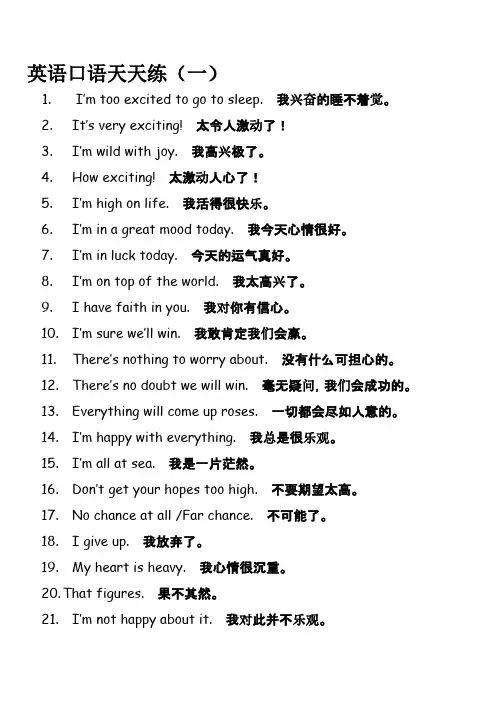
英语口语天天练(一)1.I’m too excited to go to sleep. 我兴奋的睡不着觉。
2.It’s very exciting! 太令人激动了!3.I’m wild with joy. 我高兴极了。
4.How exciting! 太激动人心了!5.I’m high on life. 我活得很快乐。
6.I’m in a great mood today. 我今天心情很好。
7.I’m in luck today. 今天的运气真好。
8.I’m on top of the world. 我太高兴了。
9.I have faith in you. 我对你有信心。
10. I’m sure we’ll win. 我敢肯定我们会赢。
11.There’s nothing to worry about. 没有什么可担心的。
12. There’s no doubt we will win. 毫无疑问,我们会成功的。
13. Everything will come up roses. 一切都会尽如人意的。
14. I’m happy with everything. 我总是很乐观。
15. I’m all at sea. 我是一片茫然。
16. Don’t get your hopes too high.不要期望太高。
17. No chance at all /Far chance. 不可能了。
18. I give up. 我放弃了。
19. My heart is heavy. 我心情很沉重。
20.That figures. 果不其然。
21. I’m not happy about it. 我对此并不乐观。
22.No way. It’s hopeless. 不可以,没希望了。
23.It’s the end of the world for me. 对我来说这简直是世界末日。
24.It’s fate. 这是命中注定的。
Oral English 英语口语天天练
Oral English英语口语天天练The first week1. Please do me a favor. 请帮我一个忙。
2. You can eat whatever you like. 你随便吃。
3. We should do our best to help her. 我们应该尽力帮助它。
4. How nice to see you! 见到你真高兴!5. Be kind to animals. 要爱护动物。
6. Don't worry. Everything will be all right. 别着急,一切都会好的。
7. Use your brain. 动动脑筋。
8. Let's have a break. 我们休息一下吧。
9. We should be polite to everyone. 我们应该礼貌待人。
10. Don't be rude to your parents. 对父母要有礼貌。
The second week1. What time is it? It's seven thirty. 几点了?七点半。
2. What day is it today? Today is Tuesday. 今天星期几?星期二。
3. What's the date today? It's March 6. 今天几号?三月六日。
4. When do you go to bed? At nine o'clock. 你什么时候睡觉?九点。
5. I usually get up at six thirty in the morning. 我通常六点半起床。
6. He has breakfast at seven. 他七点吃早饭。
7. Excuse me. 请原谅。
(用于打扰别人之前)8. I'm sorry. 对不起。
9. Never mind. 没关系。
小学六年级英语口语天天练
小学六年级英语口语天天练不要以为你的努力可以一劳永逸,权当做你始终一无全部”,将原“杯”中的残留倒掉,以一种空杯的心态接收新的事物,思想观念总是须要不断更新的。
英语口语练习起来吧。
下面就是我为大家梳理归纳的内容,盼望能够协助到大家。
小学六年级英语口语每天练●从起床到出门早晨好!Good morning.Good morning, John. (早晨好,约翰。
)Good morning, mom. (早晨好,妈妈。
)闹钟响了吗?Did the alarm clock go off? go off是闹钟“响”的意思。
Did the alarm clock buzz?Did the alarm clock ring?该起床了!Its time to get up!Its time to get up! (该起床了!)I dont wanna get up. (我真不想起。
)Its time to wake up!Its time to get out of bed.Its time to get ready.快点儿起床!Get up soon.Get up soon. (快点儿起床!)I dont want to. (我真不想起。
)你醒了吗?Are you awake? get up是动词,表示“起床”、“起”的动作。
awake是形容词,表示“醒了”、“没睡”的状态。
Are you awake? (你醒了吗?)I am now. (我刚醒。
)你不安适吗?Are you feeling sick?Are you feeling sick? (你不安适吗?)No, Im just tired. (没有,只是有点儿累。
)睡得好吗?Did you sleep well?Did you sleep well? (睡得好吗?)Yes, I slept very well. (嗯,睡得挺好。
)Did you sleep well? (睡得好吗?)No, I couldnt fall asleep. (哪儿啊,几乎没睡着。
英语口语天天练-入门级别Icebreaker
Lesson 3
=
How’s the weather today?
What’s the weather like today?
like v. 喜欢 prep. 像
• It’s _su_n_n_y____ .
What can you do?
• I can ________.
I/You/He/She/It/We/You/
英语口语天天练
入门级别 Icebreaker
Lesson 1
What’s your name?
My name is Ginger.
your his her
I you he/she/it we you they
my his her
my your his/her/its our your their
ride a bicycle fly a kite
Where’s the ball?
• It’s ________ the box.
in
on
under
- Where’re the balls? - They’re ______ the box.
by
verb + prep
Adjectives
moho’s he/she? B: He/She’s my ______.
grandfather and grandmother
He/She is ________. He/She is ____ and ___.
father and mother
Me
brother
sister
clean up
do homework
go to sleep wake up
语言口语模拟训练题库
语言口语模拟训练题库第一节:自我介绍(Introduction)1. 你能向我们简单介绍一下自己吗?请包括你的姓名、年龄、国籍以及你的兴趣爱好。
2. 我们来做一个有趣的游戏,你可以用三个单词来描述你自己吗?为什么选择这些单词?3. 你最喜欢的一本书或电影是什么?请分享一下你为什么喜欢它。
第二节:日常生活(Daily Life)1. 描述一下你通常的一天,包括你的日常作息时间以及你做的一些常规活动。
2. 你最喜欢的一餐是什么?请详细描述这顿饭的菜品和你为什么喜欢它。
3. 如果有一个星期的假期,你会选择去哪里旅行?为什么选择这个目的地?第三节:社交场合(Socializing)1. 描述一次你参加的特别的社交活动,比如一个派对,你是如何准备的,以及你在活动中的感受。
2. 和你的一个好朋友聊聊天,你通常会聊些什么话题?为什么你认为这些话题是你们之间的共同兴趣?3. 假设你在参加一个陌生人聚会,但你不太熟悉其他人,你会如何与陌生人建立对话?第四节:娱乐活动(Entertainment)1. 如果你有一天的假期,你会选择做什么娱乐活动?为什么?2. 描述一部你最喜欢的电影或电视节目,包括你的理由以及这部作品对你的影响。
3. 假设你参加了一个音乐会,你最喜欢的歌手或乐队将会表演,你期待这场音乐会的原因是什么?第五节:学习与发展(Learning and Development)1. 请分享你最难忘的学习经历,包括你遇到的困难以及你如何克服它们。
2. 如果你可以选择学习任何一门新的技能,你会选择学什么?为什么?3. 描述一次你参加的培训或研讨会,并谈谈你从中学到了什么。
第六节:决策与挑战(Decision Making and Challenges)1. 描述一个你曾经面临的困难抉择,并解释你是如何权衡利弊并做出决策的。
2. 分享一次你面对挑战的经历,这个挑战对你的成长和发展有何影响?3. 假设你成为了一家公司的CEO,你将如何处理竞争激烈的商业环境?第七节:旅行与文化(Travel and Culture)1. 描述一座你曾经去过的城市或国家,包括你喜欢的文化特色和你最难忘的经历。