
大学英语修辞学第十三章
Metonymy is the substitution of the name of one thing for that of another. In metonymy, the name of a referent (or thing referred to) is substituted by the name of an attribute, or entity related in some semantic way, or by spatial proximity, or another kind of link.
4. The species for the genus, or the genus for the species.
1) Did you see that cutthroat ? 2) Alas, that spring should vanish with the rose. 3) He hurled the barbed weapon (harpoon) at the
How to tell synecdoche from metonymy? Synecdoche—the relationship between the two things involved is part-and-whole: that is, one thing is a part of the other. Metonymy—the two things involved are completely different. They are not of the same kind but are juxtaposed and closely correlated. Her heart ruled her head. He paid the workers $5 per head.
6. Trade mark as a name for products. 1) Joanne burned Player after Player in her nervousness at his father‟s eccentric and preoccupied driving. (John Updike) (a brand of cigarettes) 2) He was driving a Ford. (a Ford car) 格力,劳斯莱斯 7. Location as a name for some government, institutions or enterprises. E. g.: Wall Street --- U. S. financial center; Hollywood --- American film-making industry; 北京,中南海,中关村
沉舟侧畔千帆过,病树前头万木春。 朱门酒肉臭,路有冻死骨。
When we make the part-for-whole synecdoche, we should take care to choose the most important and the most obvious feature or part to represent the whole.
In metonymy, the two unlike things do not have common quality but are closely associated: When we speak of one, the other will come up to our mind. Therefore, we can use one to substitute the other. bottle—alcoholic drinks; sword—war and destruction; the press—newspapers, reporters The Caribbean and Pacific islands form an empire on which the dollar never sets. 星条旗永不落。
whale.
of the material for the thing made.
1) He walked the boards for a living. 2) He is in irons.
3) Have you any coppers?
Synecdoche is common in our life. We think, talk and act synecdochically everyday: When someone asks you to show a picture of your friend, you show him a picture of his face. a tree for a forest; a tent a whole battlefield; a row of houses a city President, chairman, group leader, monitor
Tell the difference between metaphor and metonymy: Metaphor: All the world is a stage. She is a peacock. Metonymy: The kettle is boiling. He likes to read Hemingway. Metonymy cannot be converted into simile. In metonymy, the two unlike things involved have no common quality at all but are closely connected. When we speak of one, the other will come up to our mind.
He was left without a roof.
2. The whole for the part.
1) She cut hersef in the kitchen.
2) My TV is out of order. 3) Italy beat Spain in the soccer match.
2. Name of a person as a name for his/ her work or style. 1) Will you play me some Chopin? 2) Have you ever read Jack London? 慨当以慷,忧思难忘。何以解忧?惟有杜康。 (曹操《短歌行》) 3. Name of a clear sign of an object or a person as a name for the object or the person. 1) The thirteen colonies got together to fight the red lobsters. 2) Those big noses, blue eyes and yellow hair taught them English. 纨绔不饿死,儒冠多误身。(杜甫《赠韦左丞》
Metonymy helps to express an idea briefly and effectively by compressing much into a single word or a short noun phrase. The pen is mightier than the sword. By the sweat of thy brow thou shall eat thy bread. He was too fond of the bottle.
3. The abstract for the concrete, or the concrete for the abstract.
1) All the wit and learning of the world were
assembled there. 2) The authorities were greeted. 3) I had the muscle and they made money out of it.
10.4 Synecdoche提喻
Synecdoche is from Greek, meaning „take up with something else.‟ It is a figure of speech in which a part is substituted for the whole, or the whole for the part. strings can mean „stringed instruments‟ (part for whole); England can mean a sports team (whole for part). Sharp words may occasionally be spoken by unguarded or ignorant tongues.
The basic “strategy” in metonymy is the corporeal or tangible for the incorporeal or intangible. “the heart” for “the emotions.” tongue—eloquence; brain—knowledge, wisdom or reason; from the cradle to the grave—from birth to death Farewell to Arms
Sources of metonymy
1. Body part as a name for the sense, behavior or ability. 1) He has a good ear for music. 2) He has a sharp tongue. 3) To jaw-jaw is always better than to war-war. 吵 吵总比打打好。(丘吉尔) 鲁迅的骨头是最硬的。 让我们来谈谈心吧!
英语修辞学课件
w w w w w w w w w w w w w
As firm as a rock As mute as a fish As strong as a horse As brave as a lion As obstinate as a cow As white as snow As black as ink / pitch As changeable as the weather As wet as a drowned rat As blind as a bat As fat as a pig As proud as a peacock As fresh as a rose
Type One: like
w Living without an aim is like sailing without a compass. w Marriage is like a beleaguered fortress: those who are without want to get in, and those within want to get out.
Metaphor
A figure of speech containing an implied comparison, in which a word or phrase ordinarily and primarily used of one thing is applied to another. (Webster‘s New World Dictionary)
All the world‘s a stage, And all men and women merely players; They have their exits and entrances, And one man in his time plays many parts, His acts being seven ages… (Shakespeare, As you Like it ) The first clause sets up the basic comparison. The tenor and vehicle invoked by the first line are elaborated in the lines that follow. The metaphor makes possible for the literary writer to explain things vividly in great detail.
现代大学英语第五册修辞总结

高级英语第五册修辞方法(Rhetorical Device)1. Simile:L1-17: It is something like… behind bars.L1-25: Let us be dissatisfied until from every city hall… a mighty stream.(justice will roll down like waters and righteousness like a mighty stream)L5-5: Same age, same background, but dumb as an ox. (dumb as an ox)L5-50: First he looked at the coat with the expression of a waif at a bakery window. (comparing his longing for the raccoon coat with the expression of a hungry homeless child looking longingly at the bread at a bakery window.)L5-123: It was like digging a tunnel. (comparing his teaching to the hard work of digging a tunnel.)L5-147: I leaped to my feet, bellowing like a bull. (comparing his angry shouts to the bellowing ofa bull)L7-2: …united with others of our country in everything…like the fingers of the hand.(comparing the relationship between black and white to fingers of the hand)L7-10: Yet even then I had been going over my speech...as bright as flame. (comparing each word of his speech to bright flame)L7-16: For in those days I was what they called ginger—colored...like a crisp ginger cookie.(comparing the narrator to a cookie)L7-20: My saliva became like hot bitter glue.L7-21: The boys groped about like blind, cautious crabs... hypersensitive snails. (comparing the black boys to animals)L7-27: A blow to my head as I danced about sent my right eye popping... my dilemma.L7-45: I roiled away as a fumbled football rolls off the receiver’s fingertips...L7-46: 1 was limp as a dish rag.2. Metaphor:L1-5: Psychological freedom. . . physical slavery. (the long night of physical slavery)L1-5: The Negro. . . his own emancipation proclamation. (“signs with the pen and ink of assertive manhood his own emancipation proclamation”)L1-14: … when the unjust… is eliminated. (measurement, a scale of dollars)L1-20: He who hates… ultimate reality. (owning a key to open a door)L1-25: the battering rams of the forces of justice;the junk heaps of historyLet us be dissatisfied until the tragic walls… the forces of justice. (“the tragic walls” and “the battering rams”)L1-27: When our days…into bright tomorrow. (low-hovering clouds of despair; gigantic mountains of evil)L4-3: Killing the Angel in the HouseL4-5: The image of a fishermanL4-7: A room of one’s ownL5-1: There follows an informal essay that ventures even beyond Lamb’s frontier. (comparing the limitation set by Lamb to a frontier)L5-20: My brain, that precision instrument, slipped into high gear. (Mixed metaphor, comparing at the same time the narrator’s brain to a precision instrument and also to a machine that has gears.)L5-34: In other words, if you were out of the picture, the field would be open. (comparing the competing for friendship to an athletic event)L5-98: Maybe somehow I could fan them into flame. Maybe somewhere in the extinct crater of her mind, a few embers still smoldered. (comparing Polly’s mind to the extinct crater of a volcano)L5-115: Poisoning the well: (comparing “the personal attack on a person holding some thesis” to “poisoning the well”)L5-151: The rat. (comparing Petey to a rat)L6-41: I’ve never met anyone… the second time around. (The metaphor of record player is used.)3. Allusion:L1-25: Let us be dissatisfied until that day… none shall be afraid. (a biblical allusion: the 1ion and the lamb shall lie down together; every man will sit under his own vine and fig tree and none shall be afraid)L5-64: We went to the Knoll, the campus trysting place, and we sat down under an old oak… (An implied allusion to Robin Hood, whose trysting place was under a huge oak tree in Sherwood Forest.)L5-138: I was not Pygmalion; I was Frankenstein, and my monster had me by the throat.L10-8: Overnight… surreal episodes…(a sword of Damocles)4. Parody:L10-25: Is our democracy… of liberty? (This is a parody of a line in Patrick Henry’s speech: “Is life so dear or peace so sweet, as to be purchased at the price of chains and slavery?”)5. Metonymy:L4-1: No demand was made upon the family purse. (“purse” stands for money)L4-2: But to show you how little I deserve to be called a professional woman…with my neighbors. (Butcher’s bills stand for meat bought from a butcher. )L5-23: She was, to be sure, a girl who excited the emotions. But 1 was not one to let my heart rule my head. (to let my heart rule my head: Metonymy. “Heart”stands for “feelings and emotions” and “head” for “reason and good sense”.)L5-105: …surgeons have X-rays to guide them during an operation. (X-rays stand for X-rays photographs)L10-2: Anthrax panic… chambers (“Congress” stands for its members)6. Synecdoche:L1-25: Let us be dissatisfied until from every city hall… a mighty stream.city hall (the naming of a part to mean the whole. Here, the naming of the building for the government)L4-2: But to show you how little I deserve to be called a professional woman…with my neighbors. (bread and butter: This set phrase means food and the most important and basic things. )7. Transferred epithet:L1-25: Let us be dissatisfied until the tragic walls… the forces of justice. (the tragic walls)L5-40: I said with a mysterious wink… (the wink was not mysterious)L7-6: our bare upper bodies touching and shining with anticipatory sweat (In “anticipatory sweat”, the adjective “anticipatory “ is a transferred epithet.)L7-25: He kept coming, bringing the rank sharp violence of stale sweat. (the rank sharp violence: Logically rank and sharp modify “stale sweat”, not “violence”.)8. Oxymoron:9. Hyperbole:L5-5: It is not often that one so young has such a giant intellect. (exaggerating for effect)L5-50: … he just stood and stared with mad lust at the coat. (It’s an exaggeration to describe his longing for the coat as “mad lust”)L5-135: You are the whole world to me, and the moon and the stars and the constellations of outer space.L5-135: I will wander the face of the earth, a shambling, hollow-eyed hulk.10. Understatement or litotes:L5-61: This loomed as a project of no small dimensions, and at first 1 was tempted to give her back to Petey. (no small dimensions)11. Contrast:L3-22: A contrast is made between old Shanghai and Shanghai in the 1990s.L8-3: While Oppenheimer was interrupting…. had invented the subject. (an implied contrast)L10-25: How do we… poise? (paranoia vs. poise)12. Antithesis:L1-5: As long as. . . can never be free. (mind vs. body, enslaved vs. free)L1-5: Psychological freedom. . . physical slavery. (psychological freedom vs. physical slavery)L1-7: …love is identified… denial of love (1ove vs. power, a resignation of power vs. denial of love)L1-19: For through violence… but you can’t murder hate. (You may murder a murderer but you can’t murder murder.)L1-25: outer city of wealth and comfort vs. inner city of poverty and despair;wealth vs. poverty (economic);comfort vs. despair(mood, psychology)dark yesterdays vs. bright tomorrows;segregated schools vs. integrated educationon the basis of the content of their character vs. on the basis of the color of their skincontent(substance) vs. color (superficial)character(fundamental) vs. skin (outward appearance)L1-27: When our days…into bright tomorrow.dark yesterday VS. bright tomorrowL5-27: It is, after all, easier to make a beautiful dumb girl smart than to make an ugly smart girl beautiful.beautiful dumb vs. ugly smartL5-50: Back and forth his head swiveled, desire waxing, resolution waning.Desire waxing vs. resolution waningL5-153: Look at me—a brilliant student, a tremendous intellectual, a man with an assured future.Look at Petey—a knot-head, a jitterbug, a guy who’ll never know where his next meal is coming from.Brilliant, intellectual and assured vs. knot-head, jitterbug and never know where his next meal is coming from”13. Parallelism:L1-6: … confrontation of the forces… the status quo.forces of power demanding change(present participle)forces of power dedicated to the preserving of the(past participle) status quoL1-8: What is needed… and anemic.power without love is reckless and abusivelove without power is sentimental and anemicL1-8: Power at its best… against love.power at its best love implementing demands of justicejustice at its best power correcting against loveL1-10: And, in the thinking of that day…moral fiber.the absence of vs. a want ofworldly goods vs. (qualities)L1-19: For through violence… but you can’t murder hate.Three sentences “T hrough violence you may murder… but you can’t murder…”L1-20: And I have seen too much hate…. too great a burden to bear.I have seen too much hateI’ve seen too much hate onI’ve seen hate on…too many Klansmen…L1-25: There are 11 sentences beginning with “let us be dissatisfied until” and two short sentences of “let us be dissatisfied”.L12-5: The armies of… The legions of…The armies of… are marshaled against it.The legions of… will march against it.L12-16: A novelist’s characters… celebrity.a novelist’s characters hope for immortalitya profile journalist’s for celebrityL12-24: It is the disrespect… to preserve.(disrespect) for powerorthodoxiesparty linesideologies…;that I would like to celebratethat I urge all to preserve14. Epigram:L1-20: He who hates… ultimate reality.15. Paradox:L1-18: Without recognizing this…that don’t explain.paralleled paradoxes: solutions that don’t solveanswers that don’t answerexplanations that don’t explainL1-27: When our days…into bright tomorrow. (to make a way out of no way)16. Chiasmus:L1-9: It is precisely this collision… of our times. (immoral power vs. powerless morality)L6-6: Absence of evidence is not evidence of absence.17. Anaphora:L1-25: let us be dissatisfied…18. Alliteration:L1-25: Let us be dissatisfied until that day… none shall be afraid. ( lion, lamb, lie)L7-2: Live with your head in the lion’s mouth...or bust wide open. (death and destruction)L7-9: Some of the others tried to stop them…slipping and sliding over the polished floor.(slipping and sliding)19. Onomatopoeia:L3-14: clickRhetorical Devices一、明喻(simile)是以两种具有相同特征的事物和现象进行对比,表明本体和喻体之间的相似关系,两者都在对比中出现。
大学英语修辞整理及例子
l.Alliteration 头韵heart,home2.Assonance 元韵late,make“The rain in spain falls mainly in the plain.”The kind guide said aside he would chop the way for us.好心的导游在一旁说他将替我们开路。
3.Consonance 辅韵They left half a loaf in the safe.4.Onomatopoeia 拟声The stream murmurs through the woods.5.Aposiopesis [田'pDosaioepi:sis]说话中断法,跳脱"You’d better do this or else・・・”6.Apostrophe 呼语Captain!my captain!rise up and hear the bells:7.Pun 双关ball:(1)any round or spherical object (2)a formal social dance8.Repetition 重复The rain pours and pours.9.Anaphora 首语重复法Light come, light go.10.Epiphora 句末重复法Waste not,want not.11.Simploce 首结语重复法This is the world,s fight, This is civilization,s fight.12.anadiplosis 顶针With Bewick on my knee,I was then happy:happy at least in my way.13.Parallelism 平行结构The young actor was tall,dark,and handsome.14.Antithesis 对偶Marriage is easyjhousekeepin g is hard.15.Climax 层进法We want peace,we want freedom,we want a better life.16.Anticlimax 突降法Where shall I find hope, happiness friends, cigarettes?17.Syllepsis 一语双叙He lost his coat and his temper.18. Zeugma 轭式修辞法We ate a bun and a glass of milk.19. Chiasmus 回文One should eat to live,not live to eat.20.Asyndeton 连词省略法Nothing is insider them, they were sealed up before the creation of pestilence.21.Polysyndeton 连词叠用法I am a soul, or a body, a mind.22.Rhetorical question 反问Isn’t it the best choice?23.Simile 明喻Time flies like an arrow.24.Metaphor 暗喻You are my sunshine.25.Metonymy 借喻He has a good ear for music.26.Synecdoche 提喻He paid the workers $5 per head.27.Antonomasia换称He is modern Hitler---a tyrant.Jack is Michael Jordan on our basketball team.28.Personification 拟人The bird is singing joyfully.29.Parody 仿拟I had no outlook,but an uplook rather.30.Synesthesia 通感The music breathing from her face.31.Transferred epithet 移情a sleepless bed32.. understatement轻描淡写,低调陈述1.AUTHOR &WORKS1>William Faulkner is the author of.A.Far From the Madding CrowdB. Sound and FuryC. For Whom the Bell TollsD. Scarlet LetterKey B2>The Old Man and the Sea is one of the great works by.A. Jack LondonB. Charles DickensC. Samuel ColeridgeD. Ernest HemingwayKey: D3>James Joyce is the author of all the following novels EXCEPT.A. DublinersB. A Portrait of the Artist as a Young ManC. Jude the ObscureD. UlyssesKey: C4>Which of the following is NOT a poem by Emily Dickinson?A. This is my letter to the world.B. / heard a fly buzz —when I died.C. This is just to say.D. Because I could not stop for death.Key: C (William Carlos Williams)5>Francis Bacon' s is a great essay on education.A. The Advancement of LearningB.The Importance of Being EarnestC.The New AtlanticD.The Learned Reading upon the Statute of UsesKey: A6>William Makepeace Thackeray' s most famous work is.A. The School for ScandalB. Past and PresentC. Major BarbaraD. Vanity FairKey: D7>Which of the following poems is NOT written by George Gordon Byron?A.She Walks in Beauty.B.The Solitary Reaper.C.When We Two Parted.D.Childe Harold' s Pilgrimage.Key: B8> William Golding' s first and most well-known novel is.A. Coral IslandB. Lord of the FliesC. Treasure IslandD. The Brass ButterflyKey: B9> Moby Dick is the most important work by.A. Jack LondonB. Herman MelvilleC. Sinclair LewisD. Ralph EllisonKey: B10>Stephen Crane is famous for.A. An American TragedyB. The AmbassadorsC. Main StreetD. The Red Badge of CourageKey: D11>Robert Frost is a famous.A. novelistB. playwrightC. poetD. literary criticKey: C12>Eugene 0' Neil is an American.A. novelistB. playwrightC. poetD. essayist KEY:B 13>is considered to be the best-known English dramatist since Shakespeare, and his representative works are plays inspired by social criticism.A. Richard SheridanB. Oliver GoldsmithC. Oscar WildeD. Bernard ShawKEY:D14>Who is the only woman writer that has won both Pulitzer Prize and Nobel Prize?A. Pearl Buck.B. Virginia Woolf.C. Tony Morrison.D. Katharine Mansfield.KEY: A15>is NOT among the postwar poets in modem American literature.A. Robert LowellB. Gary SynderC. Alien GinsbergD. e. e. cummingsKEY: D16>Shylock is a character in.A. The Merchant of VeniceB. The Twelfth NightC. The Winter's TaleD. MacbethKEY: A17>This line "If Winter comes, can Spring be far behind?' is quoted fromA. Don Juan.B. Kubla KhanC. To AutumnD. Ode to the West Wind KEY: D18>The sentence "Shall I compare thee to a summer' s day" is quoted from Shakespeare' s.A. comediesB. tragediesC. historiesD. sonnetsKEY : D19>"Beauty is truth, truth beauty" is an epigrammatic line by.A. John KeatsB. William BlakeC. William WordsworthD. Percy Bysshe ShelleyKEY: A19>"Beauty is truth, truth beauty" is an epigrammatic line by.A. John KeatsB. William BlakeC. William WordsworthD. Percy Bysshe Shelley KEY: A20>Tess is a character created by.A. D. H. LawrenceB. James JoyceC. Thomas HardyD. Dylan Thomas Key: C21>As a literary figure, Heathcliff appears in.A. Jane EyreB. Oliver TwistC. Wuthering HeightsD. Middlemarch Key: C22>Emily Grierson is a literary figure created by.A. Willa GatherB. Doris LessingC. William FaulknerD. Nathaniel Hawthorn Key: C 23> Mr. Micawber in David Copperfield and Sam Well in Pickwick Papers are perhaps the best characters created by CharlesDickens.A. comicB. tragicC. roundD. sophisticated Key: A24> Mr. Darcy is a character in.A. Tess of the D' UrhervillesB. Pride and PrejudiceC. Happy PrinceD. The Mill on the Floss Key: B25> The image of the famous "henpecked husband" is created by. A. Washington Irving B. Fennimore CooperC. Edith WhartonD. William Dean Howells Key: A 26>is a popular literary form in the medieval period.A. RomanceB. NovelC. SonnetD. Drama Key: A27>was the most important person of the transcendental club.A.HawthornB. WhitmanC. EmersonD. Thoreau Key: C28> The literary spokesman of the Jazz is often thought to beA. O'NeilB. PoundC. Robert FrostD. Scott Fitzgerald Key: D29>Together with Lawrence and Joyce,is considered one of the three giants of the modern English novel and a master of English prose. A. Henry James B. Joseph ConradC. E. M. ForsterD. Aldous Huxley Key: B30>,the author of The Interpretation of Dreams has great impact on literary creation and criticism.A. Carl JungB. Jean-Paul SartreC. Friedrich Wilhelm NietzscheD. Sigmund Freud Key: D 31> Which of the following is NOT a typical feature of Modernism? A.To elevate the individual and inner being over the social being.B.To put the stress on traditional values.C.To portray the distorted and alienated relationships between man and his environment.D.To advocate a conscious break with the past. Key: B32>Whitman's poems are characterized by all the following features EXCEPT.A. a strict poetic formB. a simple and conversational languageC.a free and natural rhythmic patternD. an easy flow of feelings Key: A33> Who initiated the name of the Lost Generation?A. Hemingway.B. Fitzgerald.C. Gertrude Stein.D. William Faulkner. Key: C34> The high tide of Romanticism in American literature occurred aroundA. 1820B. 1850C. 1880D. 1920 Key: A35> The success of Jane Eyre is partly due to its introduction to the English novel the first heroine.A. explorerB. peasantC. workerD. governess Key: D 36>is the representative work of the Beat Generation.A. The Great GatsbyB. On the RoadC. Look Back in AngerD. The Sun Also Rises Key: B 37>The most significant idea of the Renaissance is.A. humanismB. realismC. naturalismD. skepticism Key: A 38>The title of Thackeray's "Vanity Fair" is taken from —A. The Holy BibleB. The Faerie QueenC.The Pilgrim's ProgressD. Paradise Lost Key: C39>Who is considered the father of American poetry?A. Philip Freneau.B. William Cullen Bryant.C. Henry Wadsworth Longfellow.D. Henry David Thoreau.Key: A ( The Wild Honey Suckle)40>Iceberg Theory is a writing principle proposed and closely followed by.A. Jack LondonB. Sinclair LewisC. William FaulknerD. Earnest Hemingway Key: D41>is featured by black humor.A. CaricatureB. Catch-22C. The Catcher in the RyeD. Death of a Salesman Key: B 42>has won the Pulitzer Prize four times and Nobel Prize.A. Ernest HemingwayB. John SteinbeckC. Eugene 0' NeilD. William Faulkner Key: C43>is known as "the poet' s poet".A. ShakespeareB. MarloweC. SpenserD. Donne Key: C44> Robert Burns is a poet from.A. EnglandB. New EnglandC. IrelandD. Scotland Key: D45>Generally, the Renaissance refers to the period between and centuries.A. 14th/mid-17thB. 14th/mid-18thC. 16th/mid-18thD. 16th/mid-17th Key: A46>O Captain! My Captain! was written in memory of.A. Walt WhitmanB. Benjamin FranklinC. Abraham LincolnD. Martin Luther King Key: C47>The first book of the Old Testament is called.A. ExodusB. NumbersC. LeviticusD. Genesis Key: D 48>WilliamBlake' s The Tiger is collected in.A. Songs of InnocenceB. Songs of ExperienceC. Marriage of Heaven and HellD. Poetical Sketches Key: B 49>Who is the father of English poetry?A. Shakespeare.B. Edmund Spencer.C. John Milton.D. Geoffrey Chaucer. Key: D50>The 1954 Nobel Prize for literature was awarded to for his "mastery of the art of modem narration".A.William FaulknerB. John SteinbeckC. Saul BellowD. Ernest Hemingway Key: D51>It is generally regarded that Keats' s most important and mature poems are in the form of.A. odeB. elegyC. epicD. sonnet Key: A52> 0. Henry earned his fame mainly for his.A. novelsB. poemsC. short storiesD. dramas Key: C 53> Works by are characterized by stream-of-consciousness.A. George EliotB. Jane AustenC. Emily BronteD. Virginia Woolf Key: D54>Who of the followings is a playwright of the "theater of absurd" ?A.John Osborn.B. Wystan Hugh Auden.C. Bernard Shaw.D. Samuel Beckett. Key: D55>In the works of such aesthetics, as and Walter Pater, thetheory of "art for art' s sake" is advocated.A. Oscar WildeB. Mrs. GaskellC. Alexander PopeD. Charles Lamb Key: A56>The Romantic Age in England came to an end with the death of .A. Jane AustinB. Walter ScottC.Samuel Taylor ColeridgeD. William Wordsworth Key: B 57>The Victorian Age was largely an age of, eminently represented by Dickens and Thackeray.A. pessimismB. naturalismC. modernismD. critical realism Key: D58>In which novel can "Yahoo" be found?A. John Bunyan' s Pilgrim' s Progress.B.Edmund Spencer' s The Faerie Queen.C. Jonathan Swift's Gulliver's Travels.D.Henry Fielding' s Tom Jones.Key: C (Lilliput, Brobdingnag, Laputa, Yahoo)59>The Bronte Sisters published the following famous novels EXCEPTA. The Tenant of Wildfell HallB. Jane EyreC. Wuthering HeightsD. Agnes Grey Key: A 60>Beowulf narrates a story taking place in.A. the MediterraneanB. Northern EuropeC. EnglandD. Scandinavia Key: D1.The national epic of the Anglo-Saxons is.A . Robin Hood B. Sir Gawain and the Green KnightC. The Canterbury TalesD. Beowulf2.was the most outstanding single romance on the Arthurian legend written in alliterative verse.A. The Canterbury TalesB. Piers the PlowmanC. Sir Gawain and the Green KnightD. Beowulf3. Most of the ballads of the 5 th century focused on the legend aboutas a heroic figure.A. Green NightsB. GawainC. Robin HoodD. Hamlet4.In the 16th century, Thomas More' s work became immediately popular after its publication.A. Paradise LostB. A Pleasant Satire of the Three EstatesC. Of BeautyD. Utopia5.was Edmund Spencer' s masterpiece which has been regarded as one of the great poems in the English language.A. AmorettiB. The Shepherd' s CalendarC. The Faerie QueenD. Four Hymns6.is from Shakespeare' s sonnet No.18.A.Let me not to the marriage of true mindsB.“To be or not to be: that is the question”C.“ Shall I compare thee to a summer' s day”D.“No longer mourn for me when I am dead”7.The vivid portrayal of by Shakespeare in Henry IV has earned for him an enviable place in the history of English literature.A . Julius Caesar B. Falstaff C. Hamlet D. King Henry 8.The four great tragedies written by Shakespeare are Hamlet, Macbeth, Othello and. A. Antony and Cleopatra B. Julius CaesarC. Twelfth NightD. King Lear9.Which of the following does not belong to Shakespeare' s romantic love comedies?A. Twelfth NightB. The TempestC. As You Like ItD. The Merchant of Venice10.The hero who has fallen a victim to his own ambition must be.1.Hamlet B. Othello C. King Lear D. Macbeth 11.is acclaimed as “the poets ' poet” ,A. ShakespeareB. SpenserC. KeatsD. Chaucer 12. The allusion “A Pound of Flesh” comes from Shakespeare ' sA. HamletB. The Merchant of VeniceC. King LearD. Othello13.At the turn of the 18th and 19th centuries appeared in Englandas a new trend in literature.A. RenaissanceB. ReformationC. RomanticismD. Sentimentalism14.Of studies was written by.A. John Bunyan.B. John Donne.C. Francis Bacon.D. William Blake.15.Which of the following is the highest form of literary expression?A. Prose.B. Poetry.C. Novel.D. Speech.16.The 18th century in English literature is an age of.A. novelB. poemC. proseD. play17.Which of the following work tells how Satan rebelled against God and how Adam and Eve were driven out of Eden?A. Paradise LostB. Paradise Regained.C. L' ALLegro.D. Lycidas.18.Who is the creator and a great master of the historical novel?A. John Keats.B. Walter Scott.C. Jane Austen.D. Charles Lamb.19.Bunyan 's most important work is, written in the old-fashioned, medieval form of allegory and dream.A. The FootprintB. On His BlindnessC. Vanity FairD. The Pilgrim's Progress20.Romanticism as a literary movement came into being in England early in the latter half the century.A. 16thB. 17thC. 18thD. 19th21.The novel Oliver Twist was written by.A. Jane AustenB. John Keats C . Charles Dickens D. George Eliot 22.In Anglo-Saxon period, “Beowulf” represented the poetry.A. paganB. religionsC. romanticD. sentimental 23. The epoch of Renaissance witnessed a particular development of English drama. It was who made blank verse the principal vehicleof expression in drama.A. Christopher MarloweB. Thomas LodgeC. Edmund SpenserD. Thomas More24.At the beginning of the 16th century the outstanding humanist wrote his Utopia in which he gave a profound and truthful picture of the people 's suffering and put forward his ideal of a future happy society.A. Thomas MoreB. Thomas MarloweC. Francis BaconD. William Shakespeare25.Of the following plays is not a comedy.A. A Midsummer Night 's DreamB. The Merchant of VeniceC. Twelfth NightD. Romeo and Juliet26.The first poem in The lyrical Ballads is Coleridge 's masterpieceA. Kubla KhanB. The PreludeC. The Rime of Ancient MarinerD. Tintern Abbey27.Dickens takes the French Revolution as the background of the novel.A. A Tale of Two CitiesB. Great ExpectationsC. Hard TimesD. David Copperfield28.Chaucer was the first important poet of a royal court to write in after the Norman Conquest.A. FrenchB. LatinC. EnglishD. Greek29.Beowulf was written in.A. Old EnglishB. Middle EnglishC. Early Modem EnglishD. French30. The English Renaissance period was an age of B. poetry and drama D. romance and poetry 6-10 C B D B D 16-20 C A B D C 26-30 C A C A B A. drama and novelC. novel and poetry1---5 D C C D C 11-15 B B C C B 21-25C A A A D。
大学英语修辞
大学英语修辞1) Simile:(明喻)2) Metaphor:(暗喻)3) Analogy: (类比)4) Personification: (拟人)5) Hyperbole: (夸张)6) Understatement: (含蓄陈述)7) Euphemism: (委婉)8) Metonymy (转喻)9) Synecdoche (提喻)10) Antonomasia (换称)11) Pun: (双关语)12) Syllepsis: (一语双叙)13) Zeugma: (轭式搭配)14) Irony: (反语)15) Innuendo: (暗讽)16) Sarcasm: (讽刺)17) Paradox: (隽语)18) Oxymoron: (矛盾修饰)19) Antithesis: (对照)20) Epigram: (警句)21) Climax: (渐进)22) Anti-climax or bathos: (突降)23) Apostrophe:(顿呼)24) Transferred Epithet: (一就修饰语)25) Alliteration: (头韵)26) Onomatopoeia: (拟声)修辞格(figures of speech)是提高语言表达效果的语言艺术。
它能使语言生动形象、具体活泼,给人以美的享受。
(一)音韵修辞格(phonological rhetorical devices)顾名思义,音韵修辞格是利用词语的语音特点创造出来的修辞手法。
包括: a) Onomatopoeia(拟声) 是模仿事物发出的声响,如:Presently there came theclick of high-heeled shoes.高跟皮鞋声咯咯地传了过来。
b) Alliteration(头韵) 就是在一个词组或一个诗行中,有两个以上彼此靠近的词,其开头的音节(或其他重读音节)具有同样的字母或声音;如:Peter Piper picked a peck of picking pepper.皮特.派特咽下了一口腌菜用的胡椒粉。
英语修辞学(打印版)
英语修辞手法1) Simile:(明喻)It is a figure of speech which makes a comparison between two unlike elements having at least one quality or characteristic (特性)in common. To make the comparison, words like as, as...as, as if and like are used to transfer the quality we associate with one to the other. For example, As cold waters to a thirsty soul, so is good news from a far country./ This elephant is like a snake as anybody can see.2) Metaphor:(暗喻)It is like a simile, also makes a comparison between two unlike elements, but unlike a simile, this comparison is implied rather than stated. For example, the world is a stage./ The diamond department was the heart and center of the store.3) Analogy: (类比)It is also a form of comparison, but unlike simile or metaphor which usually uses comparison on one point of resemblance, analogy draws a parallel between two unlike things that have several common qualities or points of resemblance.4) Personification: (拟人)It gives human form of feelings to animals, or life and personal attributes(赋予) to inanimate(无生命的) objects, or to ideas and abstractions(抽象). For example, the wind whistled through the trees.5) Hyperbole: (夸张)It is the deliberate use of overstatement or exaggeration to achieve emphasis. For instance, he almost died laughing.6) Understatement: (含蓄陈述)It is the opposite of hyperbole, or overstatement. It achieves its effect of emphasizing a fact by deliberately(故意地) understating it, impressing the listener or the reader more by what is merely implied or left unsaid than by bare statement. For instance, It is no laughing matter.7) Euphemism: (委婉)It is the substitution of an agreeable or inoffensive(无冒犯) expression for one that may offend or suggest something unpleasant. For instance, we refer to "die" as” pass away".8) Metonymy (转喻)It is a figure of speech that has to do with the substitution of the mane of one thing for that of another. For instance, the pen (words) is mightier than the sword (forces). 借代(metonymy)是指两种不同事物并不相似,但又密不可分,因而常用其中一种事物名称代替另一种。
(完整word版)现代大学英语精读5修辞
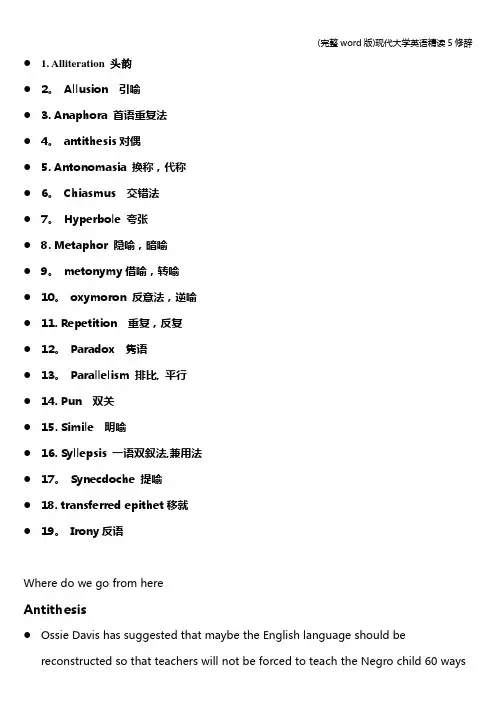
● 1. Alliteration 头韵●2。
Allusion 引喻● 3. Anaphora 首语重复法●4。
antithesis对偶● 5. Antonomasia 换称,代称●6。
Chiasmus 交错法●7。
Hyperbole 夸张●8. Metaphor 隐喻,暗喻●9。
metonymy借喻,转喻●10。
oxymoron 反意法,逆喻●11. Repetition 重复,反复●12。
Paradox 隽语●13。
Parallelism 排比, 平行●14. Pun 双关●15. Simile 明喻●16. Syllepsis 一语双叙法,兼用法●17。
Synecdoche 提喻●18. transferred epithet移就●19。
Irony反语Where do we go from hereAntithesis●Ossie Davis has suggested that maybe the English language should bereconstructed so that teachers will not be forced to teach the Negro child 60 waysto despise himself,and thereby perpetuate his false sense of inferiority, and the white child 134 ways to adore himself,and thereby perpetuate his false sense of superiority。
(para4)●As long as the mind is enslaved,the body can never be free。
(para5)●Psychological freedom ...。
..physical slavery (para5)●And one of the great problems of history is that the concepts of love and powerhave usually been contrasted as opposites - polar opposites——so that love is identified with a resignation of power, and power with a denial of love. (para7)●For through violence you may murder a murderer but you can’t murder.(para19)●The dark yesterdays of segregated schools will be transformed into brighttomorrows of quality,integrated education. (para. 25)●There will be those moments when the buoyancy of hope will be transformed intothe fatigue of despair。
英语修辞学课程教学大纲版汇编
《英语修辞学》课程教学大纲一、课程基本信息1.课程编号:325025062.课程名称:英语修辞学3.英文名称:English Rhetoric4. 课程简介:《英语修辞学》是为英语专业本科高年级开设的一门专业选修课,适用于英语专业教师教育方向和应用翻译方向,于第五学期开设,主要讲授英语修辞的基本原理及其应用,以及各类英语文体的语言风格特征,旨在引导学习者全面认识英语的语体特征、文体风格及其修辞要求和技巧,从本质上了解英语语体,掌握各类文体的修辞手段和语言特点,熟悉各种修辞手法,各类英语的功能,掌握语言使用中的“常规”和变异及其在各种文体中所表现出的规律,提高语言使用中的修辞与文体意识,使学习者具备一定的文学批评和对各类文体的分析和鉴赏水平。
二、课程说明1.教学目的和要求:通过本课程的学习,使学习者较系统地了解英语修辞产生的原因及其对提高语言表现力的重要作用认识,增强对英语的理解能力,提高恰当运用英语语言的交际能力。
学会从修辞的观点出发,从英语语言现象入手,对其内涵进行分析,初步掌握对各类文体的语言进行研究、分析和比较的方法。
掌握各种主要的修辞手段,提高实践中运用英语的能力和理解与欣赏英语文体的能力。
2.与相关课程衔接:先修课程:《英语国家概况》、《基础英语》、《英语听说》、《英语阅读》、《英语写作》、《英语语法》、《英国文学》等专业必修课,以及《英语词汇学》、《西方文化入门》等选修课。
并修课程:《高级英语》、《英语语言学》、《英国文学》后续课程:《美国文学》、《学术论文写作》等必修课,《笔译1》、《笔译2》、《口译1》、《口译2》、《实用文体翻译》等专业方向课程,以及《跨文化交际》、《商务英语翻译》、《经贸口译》、《会展口译》、《计算机辅助翻译》等选修课程。
3.学时:本课程周学时为2,共开16周,讲授学时32,总学时32,共计2学分。
4.开课学期:本课程于第五学期开设5.教学方法:以教师为主导、学生为中心。
英语修辞讲解
第六页,共152页。
2. Metaphor (1-3)
“隐喻”又称暗喻,是用于两个不同类别对象之间的比喻。隐喻与明喻的 区别在于,明喻将本体和喻体说成是相似的,而隐喻则将两者说成是一 致的。明喻中必须有比喻词,而隐喻中则不需要,因此隐喻被称为“压 缩了的明喻”(condensed simile)。
(委婉)
18. Antonomasia (换称)
第三页,共152页。
Content
19. Parody
(仿拟)
20. Reverse
(序换)
21. Anadiplosis
(蝉联)
22. Regression
(回环)
23. Paregmenon
(同源) 24. Malapropism (误用)
25. Correction
第九页,共152页。
Exercise 1
Exercise 1 simile & metaphor (2-2)
Identification of simile or metaphor: 1. Life was like a journey studded (布满了) with pitfalls(陷阱(xiànjǐng)). 2. A real friend is like a mirror that can help you see your mistake clearly. 3. Slimy cannels crept like green snakes beside the road. 4. Applications for jobs flooded the Employment Agency. 5. Not all slim girls are paper tigers. 6. He was a walking encyclopedia.
大学英语写作讲座一:修辞PPT课件
1. Figures of Speech Semantically ( 语义修辞) 1. 1 明喻 (simile): 用like, as, as...as, as if(though) 或用其他词语
指出两个不同事物的相似之处
➢ That boy is as dumb as an oyster
2021
8
1.9 夸张(hyperbole)
运用丰富的想象,过激的言词,渲染和装饰客观 事物,以达到强调的效果。
➢ My blood froze.
➢When I told our father about this, his heart burst.
➢My heart almost stopped beating when I heard my daughter’s voice on the phone.
➢ Intelligence is like a river. The deeper it is the less noise it makes.
➢ He jumped as if he had been stung.
2021
1
1. 2暗喻 (metaphor):
用一个词来指代与该词所指事物有相似特点的另外 一个事物 .
➢ Good technique in medicine and surgery means more quickly—cured patients, less pain, less discomfort, less death, less disease and less deformity.
2021
2021
9
1.10 矛盾修饰 (oxymoron)
高级英语第三册修辞总结第十三单元
高级英语第三册修辞总结第十三单元一、明喻(simile)是以两种具有相同特征的事物和现象进行对比,表明本体和喻体之间的相似关系,两者都在对比中出现。
常用比喻词like,as,as if, as though等,例如:1、This elephant is like a snake as anybody can see.这头象和任何人见到的一样像一条蛇。
2、He looked as if he had just stepped out of my book of fairytales and had passed me like a spirit.他看上去好像刚从我的童话故事书中走出来,像幽灵一样从我身旁走过去。
3、It has long leaves that sway in the wind like slim f ingers reaching to touch something.它那长长的叶子在风中摆动,好像伸出纤细的手指去触摸什么东西似的。
二、隐喻(metaphor)这种比喻不通过比喻词进行,而是直接将用事物当作乙事物来描写,甲乙两事物之间的联系和相似之处是暗含的。
1、German guns and German planes rained down bombs,shel ls and bullets...德国人的枪炮和飞机将炸弹、炮弹和子弹像暴雨一样倾泻下来。
2、The diamond department was the heart and center of t he store.钻石部是商店的心脏和核心。
三、Allusion(暗引)其特点是不注明来源和出处,一般多引用人们熟知的关键词或词组,将其融合编织在作者的话语中。
引用的东西包括典故、谚语、成语、格言和俗语等。
英语引用最多的是源出《圣经》故事以及希腊、罗马神话、《伊索寓言》和那些源远流长的谚语、格言等。
例如:1、Grammar may be his heel of Achilles.语法是他的大弱点。