
比较级,最高级前加more和most的单词
比较级和最高级变化规则

容易的 easy--easier --easiest
忙的 busy --busier-- busiest
5) 其他双音节或多音节词,在前 more 或者most
重要的important-more important-most important
简单地 easily-more easily -most easily
大的 large -- larger --largest
有能力的 able --abler --ablest
3) 以辅元辅,重读结尾的单词,双写尾字母加er/est
大的 big -- bigger-- biggest
热的 hot --hotter--- hottest
瘦的 thin --thinner --thinnest
11. 关于“ as + 形容词或副词原级 + as ”
1)在否定句或疑问句中可用so… as.
eg. He cannot run so/as fast as you.
2)当as… as 中间有名词时采用以下格式.
as +形容词+ a +单数名词
as + many/much +名词
eg. This is as good an example as the other is.
1. 二者相比较,说明“A比B更……一些”时要用一个连词than引导的从句.
句型:A+动词+形容词比较级+than + B.
than后面接代词时,一般要用主格.但在口语中也可使用宾格.
eg. 我比你老: I am older than you.
形容词副词的比较级和最高级变化规则
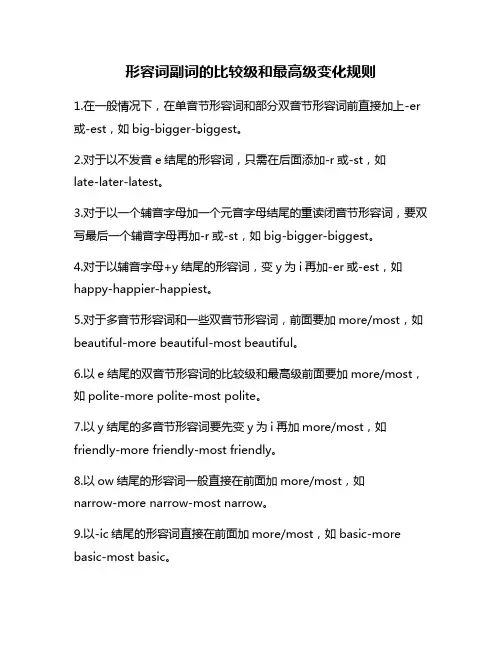
形容词副词的比较级和最高级变化规则1.在一般情况下,在单音节形容词和部分双音节形容词前直接加上-er 或-est,如big-bigger-biggest。
2.对于以不发音e结尾的形容词,只需在后面添加-r或-st,如late-later-latest。
3.对于以一个辅音字母加一个元音字母结尾的重读闭音节形容词,要双写最后一个辅音字母再加-r或-st,如big-bigger-biggest。
4.对于以辅音字母+y结尾的形容词,变y为i再加-er或-est,如happy-happier-happiest。
5.对于多音节形容词和一些双音节形容词,前面要加more/most,如beautiful-more beautiful-most beautiful。
6.以e结尾的双音节形容词的比较级和最高级前面要加more/most,如polite-more polite-most polite。
7.以y结尾的多音节形容词要先变y为i再加more/most,如friendly-more friendly-most friendly。
8.以ow结尾的形容词一般直接在前面加more/most,如narrow-more narrow-most narrow。
9.以-ic结尾的形容词直接在前面加more/most,如basic-more basic-most basic。
10.以-ive结尾的形容词直接在前面加more/most,如active-more active-most active。
11.以-able结尾的形容词直接在前面加more/most,如comfortable-more comfortable-most comfortable。
12.以-ful结尾的形容词直接在前面加more/most,如beautiful-more beautiful-most beautiful。
13.以-al结尾的形容词直接在前面加more/most,如usual-more usual-most usual。
英语比较级和最高级的用法归纳
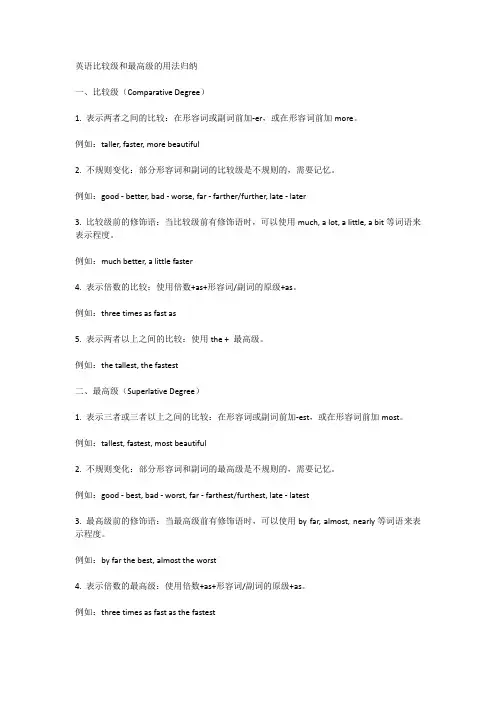
英语比较级和最高级的用法归纳一、比较级(Comparative Degree)1. 表示两者之间的比较:在形容词或副词前加-er,或在形容词前加more。
例如:taller, faster, more beautiful2. 不规则变化:部分形容词和副词的比较级是不规则的,需要记忆。
例如:good - better, bad - worse, far - farther/further, late - later3. 比较级前的修饰语:当比较级前有修饰语时,可以使用much, a lot, a little, a bit等词语来表示程度。
例如:much better, a little faster4. 表示倍数的比较:使用倍数+as+形容词/副词的原级+as。
例如:three times as fast as5. 表示两者以上之间的比较:使用the + 最高级。
例如:the tallest, the fastest二、最高级(Superlative Degree)1. 表示三者或三者以上之间的比较:在形容词或副词前加-est,或在形容词前加most。
例如:tallest, fastest, most beautiful2. 不规则变化:部分形容词和副词的最高级是不规则的,需要记忆。
例如:good - best, bad - worst, far - farthest/furthest, late - latest3. 最高级前的修饰语:当最高级前有修饰语时,可以使用by far, almost, nearly等词语来表示程度。
例如:by far the best, almost the worst4. 表示倍数的最高级:使用倍数+as+形容词/副词的原级+as。
例如:three times as fast as the fastest5. 表示所有事物中的最高程度:使用on earth, in the world等词语。
单音节形容词前能否用more和most修饰构成比较级和最高级
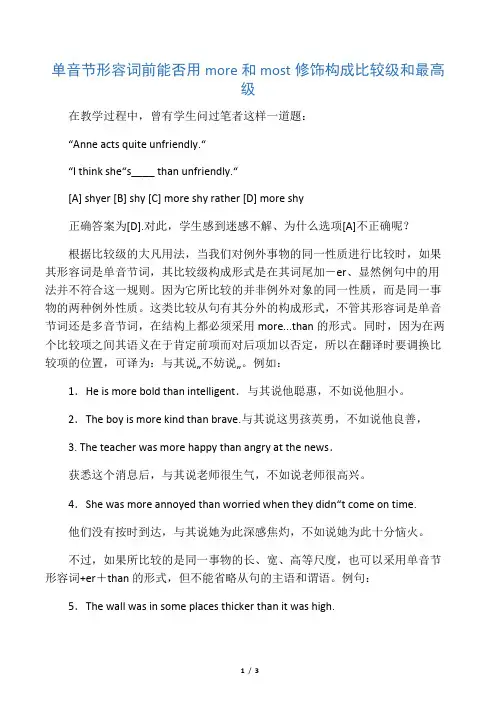
单音节形容词前能否用more和most修饰构成比较级和最高级在教学过程中,曾有学生问过笔者这样一道题:“Anne acts quite unfriendly.““I think she“s____ than unfriendly.“[A] shyer [B] shy [C] more shy rather [D] more shy正确答案为[D].对此,学生感到迷感不解、为什么选项[A]不正确呢?根据比较级的大凡用法,当我们对例外事物的同一性质进行比较时,如果其形容词是单音节词,其比较级构成形式是在其词尾加-er、显然例句中的用法并不符合这一规则。
因为它所比较的并非例外对象的同一性质,而是同一事物的两种例外性质。
这类比较从句有其分外的构成形式,不管其形容词是单音节词还是多音节词,在结构上都必须采用more...than的形式。
同时,因为在两个比较项之间其语义在于肯定前项而对后项加以否定,所以在翻译时要调换比较项的位置,可译为:与其说…不妨说…。
例如:1.He is more bold than intelligent.与其说他聪惠,不如说他胆小。
2.The boy is more kind than brave.与其说这男孩英勇,不如说他良善,3. The teacher was more happy than angry at the news.获悉这个消息后,与其说老师很生气,不如说老师很高兴。
4.She was more annoyed than worried when they didn“t come on ti me.他们没有按时到达,与其说她为此深感焦灼,不如说她为此十分恼火。
不过,如果所比较的是同一事物的长、宽、高等尺度,也可以采用单音节形容词+er+than的形式,但不能省略从句的主语和谓语。
例句:5.The wall was in some places thicker than it was high.这面墙有的地方的厚度大于它的高度。
多音节比较级

写出下列词的比较级和最高级。 写出下列词的比较级和最高级。 famous excited friendly popular dangerous difficult more famous most famous more excited most excited more friendly most friendly more popular most popular more dangerous most dangerous more difficult most difficult
有些双音节词既可以加er, 有些双音节词既可以加 est 也可以在 前面加more 和most: 前面加 quiet quieter, quietest, more quiet, most quiet clever cleverer, cleverest more clever, most clever simple simpler, simplest more simple, most simple
important more important, most important
有部分双音节词在前面加more 和most: 有部分双音节词在前面加 often more often, most often
modern more modern, most modern helpful more helpful, most helpful serious more serious, most serious patient more patient, most patient
多音节词的比较 级和最高级
单音节和部分双音节词比较级和最 高级的构成一般是在词尾加er 或est, 高级的构成一般是在词尾加 但一般三个音节以上的形容词或副 词比较级和最高级要在其前面加 more 或 most来构成。 来构成。 来构成
形容词比较级和最高级more, most

形容词比较级和最高级more, most最高级是英语语法常用的简单的但是又能显示出英语实力的知识,作文里多用这个能提分。
小编在这里整理了相关知识,快来学习学习吧!形容词比较级和最高级more, most形容词比较级和最高级的规则变化2.形容词比较级和最高级more, most形式。
大多数双音节、三音节以及三音节以上的形容词采用“more+原级”构成比较级形式,“most+原级”构成最高级形式。
如下:2.1一般双单音节形容词careful原级→more careful比较级→most careful最高级active原级→more active比较级→most active最高级useful原级→more useful比较级→most useful最高级2.2三单音节以及三音节以上的形容词difficult原级→more difficult比较级→most difficult最高级interesting原级→more interesting比较级→most interesting最高级2.3-ed结尾的形容词tired原级→more tired比较级→most tired最高级worried原级→more worried比较级→most worried最高级欢迎转发~~~发动大家来做作业,学英语~英语作业20180413一、选择填空35.—How do you get to your office every day? Do you walk?—It’s ___ far to walk. I’lltake the subway.A.soB.quiteC.tooD.still36.—Are you leaving for home soon?—Oh,I’ve ___ got a few days in Shanghai. I haven’t finished my job here ___.A.still, yetB.already, nearlyC.still, alreadyD.yet, almost上一期英语作业20180412参考答案:33-34:BB二、分析句子的英语语法结构,并翻译成中文RAF Akrotiri in Cyprus is at the sharp end of the British military presence in the eastern Mediterranean. Rumour is rife on the island that the installation would be targeted if Russia were to retaliate in the event of US-led military action in Syria.【卫报The Guardian】高一英语必修一必背句型1) It was the first time in a year and a half that I had seen the night face to face. (从句时态用完成时) 这是我一年半以来第一次目睹夜晚。
初中英语形容词副词比较级最高级变化规则
初中英语形容词副词比较级最高级变化规则篇一:初中英语形容词副词比较级和最高级知识总结.doc形容词的比较等级和最高等级:形容词的比较级和最高级的构成规则变化:2.多音节词和部分双音节词在其前面加more或 most。
如:原级比较级最高级useful more useful most useful difficultmore difficult most difficult delicious more delicious most delicious3 总结为“两好,两坏,两多,一少,一老,一远” 不规则。
注意:few--fewer--fewest healthy--healthier----healthiestfriendly---friendlier---friendliest crowded---more crowded---most crowded 改错:1,Lesson 9 is more easier than Lesson 10.2, My mother is younger than your.3, He is one of longest boys in hisclass.4,The boy doesn’t draw much well.5,Betty is the youngest on the three girls.6,Tom runs faster than any other girl in hisclass.7,There is fewer bread in the fridge.8. Mother is the busiest of my family.9,Jim is shorter of the two boys.10,You can jump very higher on the moon than on the earth. (一)形容词比较级的用法1.形容词的比较级可以单独使用: Be more careful next time. 下次小心点。
完整版)初中英语比较级和最高级的用法
完整版)初中英语比较级和最高级的用法英语语法——比较级和最高级的用法在英语中,我们通常使用以下方式表示比较级和最高级:在形容词或副词前加more(如more natural。
XXX)或者加上后缀-er(newer。
sooner)。
这些方式典型地表示形容词或副词所表示的质量、数量或关系的增加。
在英语句子中,将两个主体进行比较的方法被称为“比较句型”。
其中,“A比B 更……”的表达方式称为比较级,“A最……”的表达方式则称为最高级。
构成句子的方式是将形容词或副词变成比较级或最高级的形态。
一、形容词和副词的比较级和最高级的构成规则1.一般单音节词和少数以-er、-ow结尾的双音节词,比较级在后面加-er,最高级在后面加-est。
例如:small → smaller → smallest。
short → shorter → shortest。
tall → taller → tallest。
great → greater → greatest。
2.以不发音e结尾的单音节词,比较级在原级后加-r,最高级在原级后加-st。
例如:large → larger → largest。
nic e → nicer → nicest。
able → abler → ablest。
3.在重读闭音节(即:辅音+元音+辅音)中,先双写末尾的辅音字母,比较级加-er,最高级加-est。
例如:big → bigger → biggest。
hot → XXX → hottest。
fat → fatter → fattest。
4.以“辅音字母+y”结尾的双音节词,把y改为i,比较级加-er,最高级加-est。
例如:easy → easier → easiest。
heavy → XXX → XXX。
b usy → busier → busiest。
happy → happier → happiest。
5.其他双音节词和多音节词,比较级在前面加more,最高级在前面加most。
(完整)比较级最高级
(一 )比较级和最高级的构成:1 加-er,-est 构成比较级和最高级。
【1】单音节形容词和副词high-higher-highest hard-harder-hardest 【2】以不发音的 -e 结尾的safe-safer-safest late-later-latest【3】辅音字母要双写的情况:【4】以辅音加 -y 结尾的情况dry-drier-driest merry-merrier-merrist 2 加 more,most 构成比较级和最高级。
【1】多音节的形容词和副词expensive-more expensive-most expensivecarefully-more carefully-most carefully【2】由形容词加 -ly 构成的副词slowly-more slowly-most slowlyhighly-more highly-most highly【3】以-ful,-less,-able,-ous,-ive,-ing 等结尾的双音节形容词useless-more useless-most uselessserious-more serious-most seriuos【4】分词形容词 tired,pleased 及 glad,often,real,right,wrong 等单音节形容词tired-more tired-most tiredglad-more glad-most glad( 3 )形容词、副词的比较级和最高级的不规则构成法。
bad/ill/badly-worse-worstmany/much-more-mostlittle-less-leastfar-farther/further-farthest/furthestold-older/elder-oldest/eldest(二) 比较级和最高级的用法1 比较级的表示法:主语 +be +比较级+than …;主语+谓语+比较级+than …( 1 )不同主语的比较:He is two years younger than I.This machine works better than that one.Li Ming studies harder than Wang Ling.( 2 )同一主语不同方面的比较:She is now happier than she has ever been.The exam was easier than we expected.We have had much more rain this year than last year.( 3 )用于修饰比较级的词: even,(very) much,far,a lot,stillThis book is much thicker than that one.He works even harder than before.( 1 ) 形容词和副词最高级的用法三者或三者以上的比较用最高级。
高中英语的比较级和最高级用法总结
比较级和最高级1.在形容词词尾加上―er‖―est‖构成比较级、最高级:bright(明亮的)—bright er—bright est broad(广阔的)—broade r—broade st cheap(便宜的)—cheape r—cheape st clean(干净的)—cleane r—cleane st clever(聪明的)—clever er—clever est cold(寒冷的)—colder—coldes t cool(凉的)—cooler—cooles t dark(黑暗的)—darker—darkes tdear(贵的)—dearer—deares t deep(深的)—deeper—deepes tfast(迅速的)—faster—fastes t few(少的)—fewer—fewestgreat(伟大的)—greate r—greate st hard(困难的,硬的)—harder—hardes t high(高的)—higher—highes t kind(善良的)—kinder—kindes tlight(轻的)—lighte r—lighte st long(长的)—longer—longes tloud(响亮的)—louder—loudes t low(低的)—lower—lowestnear(近的)—nearer—neares t new(新的)—newer—newestpoor(穷的)—poorer—poores t quick(快的)—quicke r—quicke stquiet(安静的)—quiete r—quiete st rich(富裕的)—richer—riches tshort(短的)—shorte r—shorte st slow(慢的)—slower—slowes tsmall(小的)—smalle r—smalle st smart(聪明的)—smarte r—smarte st soft(柔软的)—softer—softes t strong(强壮的)—strong er—strong est sweet(甜的)—sweete r—sweete st tall(高的)-taller-talles tthick(厚的)—thicke r—thicke st warm(温暖的)—warmer—warmes t weak(弱的)—weaker—weakes t young(年轻的)—younge r—younge st2.双写最后一个字母,再加上―er‖―est‖构成比较级、最高级:big(大的)—bigger—bigges t fat(胖的)—fatter—fattes thot(热的)—hotter—hottes t red(红的)—redder—reddes tsad(伤心的)—sadder—saddes tthin(瘦的)—thinne r—thinne stwet(湿的)—wetter—wettes t mad(疯的)—madder—maddes t3.以不发音的字母e结尾的形容词,加上―r‖―st‖构成比较级、最高级:able(能干的)—abler—ablest brave(勇敢的)—braver—braves tclose(接近的)—closer—closes t fine(好的,完美的)—finer—finestlarge(巨大的)—larger—larges t late(迟的)—later—latestnice(好的)—nicer—nicest ripe(成熟的)—riper—ripestrude(粗鲁的)—ruder—rudest safe(安全的)—safer—safeststrang e(奇怪的)—strang er—strang est wide(宽广的)—wider—widestwise(睿智的,聪明的)—wiser—wisestwhite(白的)—whiter—whites t4.以字母y结尾的形容词,把y改为i,再加上―er‖―est‖构成比较级、最高级:busy(忙碌的)—busier—busies t dirty(脏的)—dirtie r—dirtie stdry(干燥的)—drier—driest early(早的)—earlie r—earlie steasy(容易的)—easier—easies t friend ly(友好的)—friend lier—friend liest funny(好玩的)—funnie r—funnie st happy(开心的)—happie r—happie st health y(健康的)—health ier—health iestheavy(重的)—heavie r—heavie st hungry(饿的)—hungri er—hungri est lazy(懒惰的)—lazier—lazies tlucky(幸运的)—luckie r—luckie st naught y(调皮的)—naught ier—naught iestnoisy(嘈杂的)—noisie r—noisie st pretty(美丽的)—pretti er—pretti estsilly(傻的)—sillie r—sillie st spicy(辣的)—spicie r—spicie stthirst y(渴的)—thirst ier—thirst iestugly(丑的)—uglier—uglies t5.双音节、多音节形容词,在单词前面加上―more‖―most‖构成比较级、最高级:afraid(害怕的)—more afraid—most afraidbeauti ful(美丽的)—more beauti ful—most beauti fulcarefu l(仔细的)—more carefu l—most carefu lcheerf ul(开心的)—more cheerf ul—most cheerf ulcrowde d(拥挤的)—more crowde d—most crowde ddanger ous(危险的)—more danger ous—most danger ousdelici ous(美味的)—more delici ous—most delici ousdiffic ult(困难的)—more diffic ult—most diffic ultexciti ng(令人兴奋的)—more exciti ng—most exciti ngexpens ive(昂贵的)—more expens ive—most expens ivefamous(著名的)—more famous—most famousfright ened(受惊的)—more fright ened—most fright enedfright ening(令人害怕的)—more fright ening—most fright eninghard-workin g(勤奋的)—more hard-workin g—most hard-workin ghelpfu l(有帮助的)—more helpfu l—most helpfu lhonest(诚实的)—more honest—most honestimport ant(重要的)—more import ant—most import antintere sting(有趣的)—more intere sting—most intere stingpolite(有礼貌的)—more polite—most politeterrib le(可怕的)—more terrib le—most terrib letired(累的)—more tired—most tired6.不规则变化的形容词:bad(坏的)—worse—worstfar(远的)—farthe r—farthe st(far—furthe r—furthe st)good(好的)—better—bestill(病的)—worse—worstlittle(少的)—less—leastmany(多的)—more—most much(多的)—more—mostold(年老的)—older—oldest ( old—elder—eldest) well(好的,身体好的)—better—best 原级用法: as + adj/ adv.的原级+ as , 否定式(not)so…as…只能修饰原级的词,very,quite,so,tooe g. The ruleris as long as that one.He singsas well as Jack.He doesn’tsingas(so)wellasJack.形容词比较级的用法:形容词的比较级用于两个人或事物的比较, 结构形式如下:1. A + is/ am/ are + 形容词比较级+ than + BShe is taller than I.Tom is more athlet ic than Sam.It is _________________toda y than it was yester day. 今天的天气比昨天暖和。