
(完整word版)上海牛津广州版七年级下册Unit1-Unit3重难点复习
7下 Unit 4- Unit 5回顾知识点---高频度词汇识记(一) 根据首字母提示用正确的词完成句子。
1.China is a big country with very long c___________on the east and south.2.People in different countries have different c________.3.We went s_________ in the city and enjoyed the a__________scenic.4.The reporter is i_________the famous leader.5.A building was on fire last night and some people were s___________hurt.6.I can’t finish the work w________ your help.7.You need to r________yourself after long and tired work.8.When there is a fire, try to find the fire e____________.(二)根据所给的汉语内容,用英语完成下列句子。
1. 我喜欢旅游,我爱坐火车从一处到另一处旅游。
I am interested in travelling. I like travelling by train _______ ________ ________ ________.2. 这条路很拥挤,因此我们很难穿过车流。
The roads are very crowded, so it’s difficult for us to _________ __________ the traffic.3. 小鹏每天起得很早是为了赶上早班车。
Xiaopeng gets up early every day _______________he can catch the early bus.4.她是一个聪明的孩子,她的父母为她感到骄傲。
She is a very clever child. Her parents ________ _________________ her. 5. 孩子们,请以你们的身高顺序排成行。
Children, please stand in a line ________ ______ ________ your height.6. 老虎处在危险中。
在地球上老虎越来越少了,我们应该采取措施去拯救它们。
Tigers are in danger. There are fewer and fewer tigers on Earth. We should ________ ________ to save them.四、常考句型精析:1. This year, why not visit France?句型结构:“why not + 动词原形”的结构意为“何不、、、?”,用来提出建议。
此处,“why not ……”与“why don’t you / we …….”可互换。
拓展:What / How about + v-ing 或Shall we + 动词原形。
句型应用:你为什么不在花园里种些玫瑰花呢?_______ _______ _______ some roses in your garden?________ ______ _______ ______ some roses in your garden?2. People with children will find EuroDisney a good place to visit.句型结构:find + 宾语+ 名词(短语), 表示“发现、、、是、、、”句型应用:1)我们发现新体育馆是个伟大的建筑。
We ________ the new gym ________________ _________.2)我发现学习英语并不是很容易的事。
I find ________ difficult _______ learn English.I find ________ it is difficult for me ________ learn English.3. We didn’t get home until midnight last night.句型结构:not …until…. 意为“直到…才…”,until 前面主句的谓语动词用短暂性动词。
拓展:…until ….意为“…直到…”,until 前面主句的谓语动词用持续性动词。
如:I did my homework until 11 o’clock.句型应用:1)她帮我们完成所有的工作才回家。
She _______ _________ back home ______ she helped us finish all the work .2) 妈妈直到我走进学校才离开。
My mum ________ ________ _________ I walked into the school.4. What do you mean by “ different kinds of people”?句型结构:What do you mean by …? 意为“你说的…是什么意思?”相当于What’s the meaning of …或What does …mean ?句型应用: 你说“black sheep ”是什么意思?_______ do you _______ ________ “black sheep”?五、易混词汇及短语辨析1、used to do sth. 过去常常做某事如:He used to be lazy , but now he works hard.be used to do sth. 被用来做某事如:The horse was used to carry.be used to (doing)sth. 习惯(做)某事如:I’m used to living here.2、be famous for 因……而著名如:This town is famous for its beautiful buildings.China is famous for the Great Wall.be famous as 作为……出名如:Qi Baishi is famous as a great painter.3、take part in... 参与……如:Can I take part in the contest?These days , students take part in many different after class.join sb. in (doing) sth.. 参与到某人中间做某事如:He joined the army. 他参军了。
Everyone joined in the game. 每个人都参加了游戏。
Let’s join them in the game. 我们和他们一起做游戏吧。
4、listen(to) , hear, soundlisten to+名词听(强调听的过程)例如listen to the radio听广播hear+名词听到(强调听到)例如:Hear your voice听到你的声音sound+形容词听起来(强调听的效果)例如:Sound good听起来不错即时巩固:1)The idea ______ wonderful, but it’s not easy for them to make it.2)If you want to improve your English, try to ________the radio as much as possible.3)He was so sad to _______the bad news.5、say , speak, tell , talkspeak讲语言speak to sb about sthtell告诉tell sb sth/tell sth to sbsay说say sth to sbtalk交谈,聊天talk to sb/talk sb about sthsay ,speak talk 和tell辨析。
▲ say一般作及物动词用,着重说话的内容,它的宾语可以是名词,代词或宾语从句。
eg: He can say his name. 他会说他的名字。
Please say it in English. 请用英语用。
She`s saying ,Don`t draw on the wall.她在说“别在墙上画”。
▲ speak强调说的动作,不强调所说的内容。
作及物动词时,常以某种语言作宾语。
作不及物动词时,常见的搭配形式有:speak of something/somebody谈到某事(某人)speak to sb 跟某人讲话,此外speak还可用于在较为正式的场合了表演讲或演说。
Can you speak Japanese? 你会说日语吗?She is speaking to her teacher. 她正在跟她的老师说话。
He spoke at the meeting yesterday. 他昨天在会上讲了话。
▲ talk 一般为不及物动词,意思是“交谈,谈话,着重强调两具之间的相互说话。
eg: She is talking with Lucy in English.她正在和露茜用英语交谈。
What are you talking about? 你们在谈论什么?The teacher is talking to him. 老师正在和他谈话。
▲ tell常作及物动词,意为“讲述,告诉,动词常跟双宾语。
tell sb sth=tell sth to sb告诉某人某事。
eg: He is telling the children a story.他正在给孩子们讲一个故事。
Did you tell her the news?=Did you tell the news to her?你把这个消息告诉她了吗?即时巩固:1)Can you ________that in English?2)He usually ______ stories before his daughter goes to bed.3)______English, the teacher always asks us to do in English class.4)Tom wanted to ________to Kate, but he was afraid of her.6、stop doing sth, stop to do sth, stop …from doing sthstop doing sth.: 停下现在正在做的事情如:Please stop talking!(请不要再说话了!)stop to do sth:停下现在做的事情去做另外一件事如:Please stop to talk.(请停下你现在做的事,去讨论吧!)stop sb. from doing sth:阻止某人做某事如:Please stop him from talking!(请阻止他继续说话!)拓展:同义短语有:keep …from doing sth “防止…做某事” ( from 不可省略);prevent…from doing sth. “阻止…做某事”( from 可省略)。
(完整word版)广州上海牛津版英语七年级下-重点语法及练习
广州英语-上海牛津版-七年级下-重点语法Unit1 Making Friendswould like to do”表示“想做……” = want to do E.g. I would like/want to play basketball.我想打篮球。
Playing chess是动词-ing短语,用在is后面作表语动词-ing短语还可以作主语 enjoy + doing 形式 finish, keep, practise等+doing sth. work as——从事…工作E.g. He worked as a bus driver when he was 20. He is keen on running. be in glasses = be wearing glasses 意思是“戴着眼镜”=I am wearing glasses舞者dance + r 演员act + or 招待员wait + er 工程师engine + er 表示“参加某一组织”,“代表某一队伍”时,常用介词onone of + superlative(最高级)+ n.(plural)(名词复数),表示…中最(怎么样)的之一 E.g. Beijing is one of the biggest cities in China. 不定冠词a & an 当第一次提及某人或某物时,在名词前使用a或an当以辅音音素开头的单词时,前面用a E.g. a house, a useful book 当以元音因素开头的单词时,前面用an E.g. an apple, an hour定冠词the当我们在次提及到某人或某物时,在名词前用the在表示独一无二的事时要用the国家名和地名前面不用the,例外:the UK, the USA play the guitar, play volleyball 乐器前加the,球类前不加the序数词前加the,三餐前不加the,指一家人前加the many + C.修饰可数名词 much + U. 修饰不可数名词at the beginning of在…的开始 at the end of在…的末尾 in the middle在…中间why not + do sth. = why don’t you do sth.Unit2 Our Daily Life单数概念:one…the other…两者中的一个,另一个 E.g. I have two brothers. One is a doctor, and the other is a teacher.单数概念:one…another…三者或三者中的一个,另一个复数概念:some…other + n.(pl.)一些…,另一些…(无明确范围)E.g. Some students come from Yuexiu, some are from Baiyun and others are from Panyu.复数概念:some…the other + n.(pl.)一些…,另一些…(有明确范围)E.g. There are nine apples on the table. Some are red, the others are green. 一般现在时频率副词通常位于:be动词,助动词,情态动词的后面,行为动词的前面。
七年级英语下册知识点总结牛津上海版.docx
七年级英语下册知识点总结Module 1Garden City and its neighboursUnit 1Writing a travel guideUnit 2Going to see a filmUnit 3 A visit to Garden CityUnit 4Let’s go shopping1. How are you getting on with your travel guide?get on with“进展”;“与??相处( 融洽 ) ”I ’m getting on well with the preparation.How are you getting on with your new classmates?2. be famous for? ( 以/ 由于 ??出名)be (well) known as? ( 以/作为? .被人知晓)Shanghai is famous for its night views.Shanghai is also known as a“Shopping Paradise”becausethere are a lot ofdepartment stores and huge shopping centres.上海被誉为“购物天堂”,因为上海有很多百货商店和大型购物中心。
Qingpu is famous for its fish and rice.3. It is + adj. + that (主语从句),表示“ ??太??了”It is wonderful that we can have dinner on the 91st floor in Shanghai WorldFinancial Centre.It is not surprising that many tourists come to visit Shanghai every yearto shop.It is + adj. + to do sth.It is convenient to travel between Pudong and Puxi.=To travel between Pudong and Puxi is convenient.It is terrible to have dinner in this restaurant. The food tastes awful.=To have dinner in this restaurant is terrible.4. If you go there,you will see a huge open area with green grass,trees,fountainsand pigeons.主句用一般将来(或can, may, must),从句用一般现在时。
最新上海牛津沪教版七年级(下)同步讲义unit3

第三讲Unit3 A visit to Garden City教学过程一、课堂导入教师讲述一个与本节课题目有关的英文小故事,引出今日所要讲解的知识点,然后让学生简单梳理一下所涉及的问题,带着问题学习本节课的内容。
二、复习预习教师引导学生复习上节课学的重点内容,检测单词的用法,(以提问、回顾的形式进行),针对上节课的作业进行讲评、订正、答疑,并通过英文小故事导入本节课所要学习的新知识。
三、知识讲解1. 知识点一:重点单词1)safe [seɪf]【词性】adj.【词义】安全的【易混淆点】save v. 救,节约safety n. 安全,安全地带safely adv. 安全地【经典例句】He save a homeless puppy on his way to work yesterday.昨天他在上班路上救了一只无家可归的小狗。
2)engine ['endʒɪn]【词性】n.【词义】发动机,引擎【易混淆点】engineer n. 工程师【经典例句】My ambition is to be an engineer in the future.我的理想是将来成为一名工程师。
3)report[rɪ'pɔːt]【词性】v.【词义】报告,通告,告发【经典例句】He reported the student for misconduct.他告发那个学生行为不端。
4)cook [kʊk]【词性】v.【词义】烹饪【易混淆点】cooker n. 厨具cookery n.烹饪,烹调术【经典例句】When I came back, Mum was cooking in the kitchen.当我回家的时候,妈妈正在厨房做饭。
5)type [taip]【词性】v.【词义】打印【易混淆点】typist n.打字员typewriter n.打字机【经典例句】If I want to write fast, I must learn to type.如果我想写得快,我就得学会打字。
(word完整版)牛津沪教版英语七年级下期末重点知识复习总结,推荐文档
a(one) third 或one-third三分之一three-fifths五分之三a(one) half二分之一a(one) quarter或one-fourth四分之一three quarters或three-fourths四分之三回答型阅读解题技巧一、专题知识梳理知识点1:回答问题的题型、考点和分值1. 题型:一般疑问句,选择疑问句,反义疑问句,特殊疑问句,主观题2. 考点:对各种疑问句的回答方式及语法的考查(如:时态,主谓一致等)1)一般疑问句的回答:yes or no来回答2)选择疑问句的回答:选择其中的一个或者neither或者both来回答3)反义疑问句的回答:根据事实来回答4)特殊疑问句的回答:why—because/because of, how—by/through doing, how long—for+时间段/since+时间点, when和where提问,介词不能够少,how many或者how far提问时,注意限定词only/more than/ at least/about等5)主观题,注意不能用I think it is interesting或者I think it is good来回答,一定要发表自己的观点和原因。
3. 分值:共12分知识点2:回答问题的技巧1.细节题细节题目比较简单,一般从文中可以直接找到答案,直接抄下来就可以2.归纳总结归纳总结类的题目相对较难,基础好的学生还可以,基础较薄弱的学生一般会抄原文或者自己总结的,但是会出现各种各样的错误二、专题精讲D. Answer the question. (根据短文内容,回答下面问题,12分)It's March, 2050.Frank and Mary Smith wake up in their comfortable house in the morning and switch on the bedroom computer to get the latest news. They used to read the Times, but changed to electronic newspapers many years ago.There is the usual news about space: another space flight has returned from Mars and scientistshave discovered a new planet. Then they turn to business news: the US dollar has risen greatly inShanghai, one of the world's leading business centers. Mary tells the computer to buy 5,000 dollars, andthere is a quick response that it has been done.As they watch the screen, Mary orders one of the household robots to make coffee for them.Frank disappears into the study to join a video conference with his partners aroundthe world. He is a computer engineer, working for several companies. This is histhird job: he used to be in marketing and then television.Mary has a quick look at the shopping channels - the usual selection of electric cars, household robots and cheap travel offers - before picking up the video phone to talk to her assistant. She also hasa job and she is doing medical research. Both she and Frank used to have an office desk in London, butin 2014 they decided to move to the seaside and work from home.Frank and Mary have one daughter, Louise, who also has her own workstation at home. She goes to school only one day a week, mainly to play with other students. Classrooms disappeared in 2030 because there was no longer any need for them: communications systems have made it much easier to learn at home.Louise, now thirteen, is studying Chinese at present, which has become a world language as important as English. Louise has many Chinese friends. They communicate by computer.According to the family doctor, Louise will live to at least 130. Her wish is to work for a few decades (十年) and then spend her time on music and painting.3. Many people didn’t believe Sir Francis Bacon, did they?______________________________________________________.4.Who proved that Sir Francis Bacon was right?_______________________________________________________.5.What do you think of Sir Francis Bacon?______________________________________________________________.(2)Library Rules for TeenagersWe want you to remember these rules for our city libraries.◆Always remember to take your library card with you when you visit the library. If you don’thave your library card, we won’t let you in.◆Your library card is for your use only. If you lend it to others, you will still be responsiblefor (对……负责任) the books on the card.◆If you lose your library card, you can get a new one for free with your ID card.◆Take good care of what you borrow. If you lose it, you will have to pay for it.◆You can keep the books for up to 31 days. Remember to return the books on time.◆Tell us your e-mail address and we will remind (提醒) you when you need to return the books.◆If what you want to borrow has been borrowed by others, you can send us an e-mail. We will keep the book for youwhen it is returned. When it is your turn, we will tell you.Read and answer the following questions(阅读短文并回答问题):80. Who are these rules for?_______________________________________81. Can we lend our own library card to others for use?_______________________________________82. What can you do if you lose your library card?_______________________________________83. What will happen if you borrow a book from the library and lose it?_______________________________________84. How long can you keep a book?_______________________________________85. Why does the library need readers’ e-mail address?_______________________________________。
上海牛津沪教版七年级(下)同步讲义unit3
—-可编辑修改,可打印——别找了你想要的都有!精品教育资料——全册教案,,试卷,教学课件,教学设计等一站式服务——全力满足教学需求,真实规划教学环节最新全面教学资源,打造完美教学模式第三讲Unit3 A visit to Garden City上海牛津沪教版七年级(下)同步讲义Unit3 A visit to Garden City适用学科初中英语适用年级初中三年级适用区域上海课时时长(分钟)120分钟(一对一)知识点知识点1:本单元词汇知识点2:词组知识点3:句型知识点4:现在完成时用法知识点5:被动语态的用法教学目标知识:学生能够基本掌握7年级上册Unit3中的词汇、词组、句型及语法。
方法:牢记各个知识点的用法,归纳总结异同点,通过习题加强巩固。
能力:熟练掌握各种词汇的用法;具备准确判断词性及转换的能力;熟练掌握现在完成时的用法;熟练运用被动语态。
教学重点词性转换;现在完成时的用法,被动语态的用法。
教学难点现在完成时,被动语态的用法教学过程一、课堂导入教师讲述一个与本节课题目有关的英文小故事,引出今日所要讲解的知识点,然后让学生简单梳理一下所涉及的问题,带着问题学习本节课的内容。
二、复习预习教师引导学生复习上节课学的重点内容,检测单词的用法,(以提问、回顾的形式进行),针对上节课的作业进行讲评、订正、答疑,并通过英文小故事导入本节课所要学习的新知识。
三、知识讲解1. 知识点一:重点单词1)safe [seɪf]【词性】adj.【词义】安全的【易混淆点】save v. 救,节约safety n. 安全,安全地带safely adv. 安全地【经典例句】He save a homeless puppy on his way to work yesterday.昨天他在上班路上救了一只无家可归的小狗。
2)engine ['endʒɪn]【词性】n.【词义】发动机,引擎【易混淆点】engineer n. 工程师【经典例句】My ambition is to be an engineer in the future.我的理想是将来成为一名工程师。
牛津沪教版英语七年级下Module 1 Unit3 复习教案
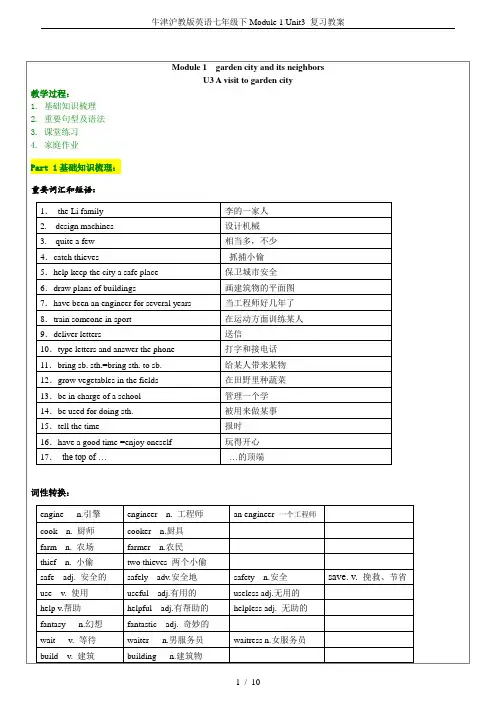
Module 1 garden city and its neighborsU3 A visit to garden city教学过程:1. 基础知识梳理2. 重要句型及语法3. 课堂练习4. 家庭作业Part 1基础知识梳理:重要词汇和短语:1.the Li family 李的一家人2. design machines 设计机械3. quite a few 相当多,不少4.catch thieves 抓捕小偷5.help keep the city a safe place 保卫城市安全6.draw plans of buildings 画建筑物的平面图7.have been an engineer for several years 当工程师好几年了8.train someone in sport 在运动方面训练某人9.deliver letters 送信10.type letters and answer the phone 打字和接电话11.bring sb. sth.=bring sth. to sb. 给某人带来某物12.grow vegetables in the fields 在田野里种蔬菜13.be in charge of a school 管理一个学14.be used for doing sth. 被用来做某事15.tell the time 报时16.have a good time =enjoy oneself 玩得开心17.the top of ……的顶端词性转换:engine n.引擎engineer n. 工程师an engineer 一个工程师cook n. 厨师cooker n.厨具farm n. 农场farmer n.农民thief n. 小偷two thieves 两个小偷safe adj. 安全的safely adv.安全地safety n.安全save. v. 挽救、节省use v. 使用useful adj.有用的useless adj.无用的help v.帮助helpful adj.有帮助的helpless adj. 无助的fantasy n.幻想fantastic adj. 奇妙的wait v. 等待waiter n.男服务员waitress n.女服务员build v. 建筑building n.建筑物词汇详解1. visitn. 参观,拜访 a visit to Garden City 参观花园市这里的visit 是名词v. 参观,拜访to visit Garden City 参观花园市这里的visit 是动词They paid a visit to Shanghai Museum last week.They visited Shanghai Museum last week.2. the Li family 李家辨析:family、house和home1、family的意思是“家庭、家庭成员”,与居住的房子无关。
(完整版)牛津上海版七年级下英语Unit3基础知识点练习
七年级下英语U3基础知识点练习1. Complete the sentences with the given words in their proper forms(用括号中所给单词的适当形式完成下列句子)1. Tom’s mother _______ (teacher) music in a primary school.2. The teacher tells us to cross the road _______ (safe).3. The weather was very _______ (fantasy), let’s go for an outing.4. A cable car is used for _______ (carry) people to the top of the hill.II. Choose the best answer (选择最恰当的答案)( ) 1. My uncle is _______architect. He draws plans of buildings.A.aB. theC.anD. /( ) 2. Computers are super calculators and people often call _______ electronic brains.A.theyB. theirC.theirsD. them( ) 3. Betty has quite _______ friends here. She often goes shopping with them.A. a fewB. fewC. a littleD. little( ) 4. A(n) _______ works in company and designs machines.A.architectB. engineerC.coachD. headmaster( ) 5. After his father passed away, Harry was in charge _______ the family business.A.ofB. forC.withD. at( ) 6. The roast beef tastes so _______. May I have one more piece, mum?A.wellB. badC. terribleD. delicious( ) 7. It’s _______ a good idea.A.veryB. fairlyC. quiteD. quiet( ) 8. The country has _______ soldiers in its army.lion ofB. millions ofC.several million ofD. severalmillions( ) 9. He didn’t realize his mistake _______ he was told about it.A.ifB. whileC. sinceD. untilsaid that people born in the year of the rat _______ ( ) 10. Believe it or not, it’sbecome excellent writers.A.shouldB. canC.mustD. need( ) 11. My father _______ in a travel agency since he _______ school.A.worked; leftB. has worked; has leftC.works; leavesD. hasworked; left( ) 12. My brother _______ a car for three years. He‘s a good driver.A.has boughtB. boughtC.has hadD. drove( ) 13. We use water _______ flowers.A.for waterB. to wateringC.wateringD. for watering( ) 14. David has made quite a few friends since he came to Shanghai._______A.someB. manyC.severalD. a few( ) 15. —I like the party so much, but I have to go home. It’s too late.—_______.A.What a pity!B. Have another try.C. Congratulations!D.It’s a pleasure.III. Complete the following passage with the words in the box. Each word canonly be used once(将下列单词填入空格。
牛津沪教版英语七年级下期末重点知识复习总结
牛津沪教版英语七年级下期末重点知识复习总结牛津沪教版英语七年级下期末重点知识复习总结随着期末考试的临近,作为英语学科的学生,我们需要对本学期学习的重点知识进行复习和总结。
下面将对牛津沪教版英语七年级下册的知识要点进行整理,帮助大家更好地复习备考。
首先是重点词汇的复习。
在这个学期里,我们学习了大量的单词和短语。
复习时,可以将这些单词按照不同的主题进行分类整理,以便更好地记忆和复习。
例如,可以将家庭成员的单词整理在一起,动物的单词整理在一起,食物的单词整理在一起等等。
记忆时,可以运用朗读、默写、拼写等方式,选择适合自己的方法,多练习,加深记忆。
第二是语法知识的复习。
在本学期里,我们学习了很多关于动词时态、代词、名词、形容词、副词等方面的知识。
复习时,可以着重强化这些知识点的掌握,通过做一些专项练习来加强对这些语法知识的运用能力。
同时,还需复习以前学习的知识,如一般现在时、一般过去时的用法、区别及其转化。
通过大量的练习,提高对语法知识的理解和应用能力。
第三是阅读能力的复习。
本学期,我们进行了大量的阅读练习,提高了对文章内容的理解和阅读能力。
复习时,可以选择一些阅读理解题目进行训练,提高自己的阅读速度和理解能力。
同时,对于生词的理解,需要通过上下文推断词义,并可以运用词根词缀的知识进行分析。
通过解读文章,加深对语言的理解和运用。
第四是听力能力的复习。
在这个学期里,我们进行了大量的听力训练,提高了听懂和理解英语的能力。
复习时,可以选择一些较难的听力材料进行听写和理解练习,例如听对话选择答案、听短文填空等。
此外,还可以通过听英语原版的歌曲、电影、电视剧等,提高对真实语境下英语的听力能力。
最后是口语表达的复习。
英语学习的最终目标是能够流利地进行口语的沟通。
复习时,我们可以进行一些角色扮演的练习,模拟真实场景,例如购物、旅游、问路等,同时也可以与同学进行对话,提高自己的口语表达能力。
要注意注意纠正语音、语调和语速,使自己的口语更自然、流利。
(word完整版)牛津沪教版英语七年级下期末重点知识复习总结,推荐文档.docx
牛津沪教版英七年下期末重点知复七年级下期末重点知识复习Unit 1 Lesson 1 Weather一、短语梳理1.all the time = always一直,始2.between⋯and⋯在⋯⋯ 和⋯⋯ 之3.go to⋯for summer/winter holidays去⋯⋯ 度暑假/寒假4.for sightseeing/ fun了旅游/5.go sightseeing去旅游6.Why not +原形?=Why don ’ t you +原形?=What/How about +名?7.the highest temperature 最高温度the lowest temperature 最低温度句型:1.What ’ s the weather like today / there / in Beijing? ---It’ s hot.=How is the weather⋯?2.What ’ s the temperature---⋯It? ’ s⋯⋯3.It is a good time to do sth. 是做某事的好候了=It is a good time for sth.4.---Where have / has⋯ been for⋯ ?--- ⋯ have / has been to⋯ .5.---Where have / has⋯ gone for⋯ ?--- ⋯ have / has gone to⋯ (on a package tour).Lesson Two Seasons短:1.talk about talk with⋯和⋯⋯交2.at the English corner在英角3.like⋯ best最喜⋯⋯4.like⋯ better than⋯ = prefer比⋯起to⋯⋯...来更喜⋯⋯5.have a lot of fun玩得很愉快6.What/How about⋯ ? +- ingV⋯⋯怎么?7.most of the time/students大部分 /学生8.enjoy doing sth. 喜做某事9.in summer 在夏季10.at the beach 在海11.blow away 吹走12.fallen leaves 落叶14.make snowmen 堆雪人牛津沪教版英七年下期末重点知复法:so 和 neither 引的倒装句1、 So 同,也一So 后面接 be,have, has, do, does, did 或情,然后接主,其的与上文一致,人称与主一致。
广州上海牛津版英语七年级下册U1--U7-总复习提纲
7B 下册Unit 1复习一、短语1.plan to do 计划做某事2.go skiing 去滑雪3.these days 如今4.be famous for 因…而著名5.be famous as 作为…而出名6.?7.be similar to 与…相似8.look down on…俯视,鸟瞰9.take part in 参加10.with a difference 与众不同的11.all / different kinds of 各种各样的12. a warm welcome 热烈欢迎13.at first 起初14.give a talk 演讲15.*16.according to 根据,按照17.on one’s way (to) 在…的路上18.interesting places 名胜19.on time 准时20.far away from…远离……21.get through 穿过22.next to 在…旁边23.after dark 黄昏后,天黑后24.…25.sail away 驶走;漂走lions of 很多,上百万的27.do well (in) 善长于28.hope to do 希望做某事29.one day 有一天30.in the future 在未来31.tell sb. about sth. 告诉某人某事32.have a wonderful time 过得愉快33.;34.enjoy oneself35.go abroad 出国36.fruit and vegetables 蔬果37.go sightseeing 观光38.go /be on holiday 渡假39.from place to place 到处40.call sb. on the phone 打电话给某人41.by the way 顺便说说42.)43.the top of………的顶端44.sail down the river 顺流而下45.order food 点菜46.fall over 倒塌47.lean to 向……倾斜48.in fact 事实上49.be closed to the public 不对公众开放50.keep out invaders 阻止侵略者二、词形转换care (v. / n.) - careful (adj.) - careless (adj.) - carefully (adv.)cross (v.) - across (prep.) center (n.) - central (adj.) taste (v. / n.) - tasty (adj.) design (v.) - designer (n.) scenery (n.) - scenic (adj.) meet (v.) - meeting (n.)crowd (v.) - crowded (adj.)France (n.) - French (n. / adj.)wonder (n.) - wonderful (adj.)different (adj.) - difference (n.)interest (v.) - interesting (adj.)amuse (v.) - amusing (adj.) - amusement (n.)三、语法1.with表带有…2.表达建议:why not… / why don’t you… /what / how about doing… / would liketo do / hope to do3.such as & for exampleed to do & be used to doing5.one of + 复数名词+ 动词(单数)6.find的用法7.cross & across & through8.spend & take …9.watch / see / hear sb. …do / doing10.(many) thanks for (doing) sth.11.what do you mean by (doing)…12.and, but, so13.bring / show sb. sth. = bring / show sth.to sb.14.arrive & reach & get to15.voice & noise & sound16.until17.so that18.many & much19.though & but20.it’s believed / shown (that)…21.work hard & hard work22.the number of & a number of23.动名词作主语& It’s + adj. + to do Unit 2复习一.短语1.protect the environment 保护环境2.give out harmful gases排放有害气体3.on Earth=on the earth 在地球上4.on earth 究竟e/be from 来自于6.one another/each other 互相;彼此7.collect some facts 收集信息8.living things 生物9.for example / such as例如10.be useful for…对……有用11.warn sb. (not)to do sth.告诫某人(不)做某事12.know a lot about 对……知道很多13.be in danger 处于危险之中14.be in trouble 处于困境之中;遇到麻烦15.be interested in …对……感兴趣municate with sb. 与某人进行交流17.do the job (of)…起……作用18.pass sth to sb = pass sb sth 传递某物给某人19.cut down 砍掉;砍伐20.not…at all 根本不……21.a little 一点22.write an article 写文章23.be worried about…对……担心24.care about 关心;在乎25.make noise 吵闹;制造噪音26.give sb a hand= help sb 帮助某人27.feel about …对……有某种看法28.provide sth for sb= provide sb with sth提供某物给某人= supply sb with sth =supply sth for/to sb)29.in the past 在过去30.the answer to the question 问题的答案31.do/try one’s best to do sth 尽力做某事32.start out small 从小事做起33.throw rubbish 扔垃圾34.thrwo …into/ onto…把……扔到……里(上)35.both sides of………的双面36.belong to 属于37.make our environment more beautiful使我们的环境更美好38.in the beginning 起初;刚开始的时候39.get /feel tired感到疲惫40.stop… from doing sth. 阻止……做某事41.in one’s opinion在某人看来42.in order of…以……的次序43.bring about 导致;引起44.blow away 吹走45.be caught in (a sandstorm) 遇上(沙尘暴)46.take measures 采取措施47.be washed away 被冲走48.make a difference 造成差别49.take care of 照顾50.run out of 用完51.even if 即使;纵然52.realize the importance of 认识到……的重要性二.词形转换use (v./n.) -useful (adj.) - useless (adj.) harm (v./n.) - harmful (adj.) - harmless (adj.) wonder (v./n.) - wonderful (adj.) noise (n.) - noisy (adj.)rain (v./n.) - rainy (adj.) health (n.) - healthy (adj.)condition (n.) - conditioner (n.) contain (v.) - container (n.)fight (v.) - fighter (n.) pollute (v.) - pollution (n.) communicate (v.) - communication (n.) worry (v. ) - worried (adj.) nature (n.) - natural (adj.) danger (n.) - dangerous (adj.) science (n.) - scientist (n.) choose (v.) - choice (n.) appear (v.) - disappear (v.)tire (v.) - tired (adj.) - tiring (adj.) live (v.) - living (adj.) - alive (adj.) important (adj.) - importance (n.) different (adj.) - difference (n.) environ (v.) - environment (n.) govern (v.) - government (n.) chemistry (n.) - chemical (adj.) die (v.) - dead (adj.) - dying (adj.) produce (v.) - product (n.)三.语法1.few, a few, little, a little2.join & take part in3.talk, say, speak, tell4.voice, sound, noise5.living & alive6.stop to do & stop (from) doing7.-ed & -ing8.on over above 的区别9.for example & such as10.without 的用法11.warn 的用法12.seem 的用法13.make sb. do & make sb. / sth. + adj14.or在否定句中表并列15.现在进行时与一般现在时16.基本的反意疑问句Unit 3 复习一、短语belong to 属于reception desk 接待处book a room 订一个房间allow sb. to do sth. 允许某人做某事lead sb. to …把某人带到…fire exit 消防通道safety first 安全第一describe sth. to sb. 向某人描述…bark loudly (狗)大声吠叫wake up 睡醒smell smoke 闻到烟味fire alarm 火警wet some towels 湿了些毛巾lie on the floor 躺在地板上seem like 似乎像…fire engine 消防车music to one’s ears悦耳的声音show up 出现seconds later 一会儿,几秒后against the rule(s) 违反规定a sense of smell / sight 嗅觉/视觉/ hearing / taste / touch 听觉/味觉/触觉keep one’s balance保持平衡fall down 跌倒have a cold 感冒construction worker 建筑工人use… for doing / to do用…来做某事communicate with sb. 与…沟通in fact 事实上quite a few 许多,相当多perfume maker 香水制造商be useful for 对…有用all day 整天as well(句末)也because of 因为look for a job 找一份工作go forward 向前走on the left / right…在…左/右边in the left-hand corner 在左手(边)角落next to 在…的隔壁welcome to 欢迎来到…listening skills 听力技巧be able/unable to do (不)能做某事get the chance to do 有机会做某事sign language 手语hurt oneself 弄伤自己enjoy oneself 过得愉快be proud of…以…为荣teach oneself 自学=learn by oneselfhelp oneself to…随便吃些…hear about 听说be on fire 起火,着火put out fire 灭火be close to 接近…look out of…朝…外面看decide to do 决定做某事two more/another two 再多两个as fast as one could 尽快as fast as possiblego past 经过call for help 喊救命shout at 朝…大喊be full of 充满be seriously hurt 伤得很严重climb up the ladder 爬上梯子again and again 一次又一次地complain to…向…投诉/抱怨二、词形转换receive (v.) - reception (n.) explanation (n.) - explain (v.) construct (v.) - construction (n.) manage (v.) - manager (n.) safe (adj.) - save (v.) - safety (n.) sleep (v.) - asleep (adj.)die (v.) - dead (adj.)use (v.) - useful (adj.)see (v.) - sight (n.)difference (n.) - different (adj.) hear (v.) - hearing (n.) listen (n.) - listening (n.) build (v.) - building (n.)most (adj.) - mostly (adv.) loud (adj.) - loudly (adv.) serious (adj.) - seriously (adv.) able - unable (opp.)ability - disability (opp.) friendly - unfriendly (opp.) with - without (opp.) fireman - firemen (复数)三、知识要点1.few, (quite) a few, little, (quite) a little 等2.both的用法3.welcome的用法4.不规则动词的过去式(lead, leave, wet, smell, put, lie等)5.seem的用法6.stop to do & stop doing7.because & because of8.人称代词& 反身代词9.taste / smell 等的用法10.two more & another two…11.the + adj. 表…一类人12.thank you for / use for doingU4 复习一.短语a packet of 一盒a pot of 一壶in a way 在某种程度上shake one’s head摇头change…into…=turn… into…把…..变成……be connected to与……相连接look foolish 看起来很愚蠢in packets 用包装的形式flow through…通过……流动use sth to do sth 用……做……all kinds of 各种各样make electricity制电a power station发电厂for example 例如electrical appliance/machine电器glass/plastic container玻璃/塑料容器in our daily life在我们日常生活中make our lives easier使我们的生活更舒适help sb (to) do sth=help sb with sth帮助某人做某事make sth/sb adj使某人/某物怎样make sb do sth使某人做某事leave…on使…..处于工作/使用的状态free…from (doing) sth使…..从……中解脱出来be careful of/with sth对……小心keep sth dry 保持某物干燥(keep sth/sb adj) a piece of advice(不可数) 一条建议turn on/ switch on 打开turn off/ switch off关掉turn up/ turn down (音量)调大声/小声(be) on the safe side 为了安全起见;以防万一make sure (that)确保generally speaking一般而言play chess下棋play the guitar弹吉他figure out 弄清;算出pay special attention to (doing) sth 特别注意deal with sth 处理某事pick sb. up 搭载人,带人走seem to do 看起来像做a series of 一系列;一套in numbers 用数字difference between A and B A和B的不同之处keep a diary写日记by doing sth 以……方式look through通过……看;翻阅put… away将……收起;把……放回原处answer the telephone接电话lean out of 从……探出身dress properly着装得体around 11a.m. 早上11点左右go out 熄灭more and more crowded越来越拥挤in one way or another 以这样或那样的方式shopping mall 大型购物中心keep silent/ quiet保持安静at first 起初start a fire引起火灾二.词形变化fool (v.欺骗;n.傻瓜)-foolish(adj),careful(adj.)---carefully(adv.)---care(v.), safe (adj.)—safely(adv.) explain (v.) –explanation (n.), servant (n.) ---serve (v.), contain (v.)---container(n.), produce(v.)---product(n.), different (adj.)--- difference (n.) battery---batteries, housewife---housewives, move(v.)---movement(n.) patient-impatient, unplug---plug,三.句型/语法1.Not a bad explanation.不错的解释2.Can you get me …你能给我买/拿……3.It is hard to imagine…..很难想象……4.like的用法v.& prep.5.with的用法6.how soon, how long, how often, how far7.动名词的用法8.情态动词:can, may, must9.分数的表达:基数+序数(one tenth十分之一;two tenths十分之二)Unit 5复习1.find…interesting觉得/发现……有趣2.find it adj to do sth 觉得/发现做某事怎样3.in our lives在我们的生活中4.be interested in 对……感兴趣5.be on 上演;播放es and miles好几英里7.go to sleep = fall asleep 入睡;睡着8.go to bed 就寝9.all right 确实;好的10.be similar to…与……相似11.be different from 与……不同12.keep lively 保持活力(keep+adj)13.keep doing sth一直/不停做某事14.hate doing sth讨厌做某事15.hate being bored讨厌烦闷16.the whole(n.)of the town= thewhole(adj) town 整个城镇17.describe sth/sb as…把某物/某人描述成为……18.run in rings 绕圈跑19.knock on/at the door敲门20.fall down掉下来21.stone deaf完全聋的22.mind doing sth介意做某事23.at work 在工作24. a dull moment寂寞的一刻25.ten miles away 十英里远26.in a mess 肮脏;一团糟27.pick out 挑出;辨别出28.blow away吹走29.many a week=many weeks数周30.can’t wait 迫不及待31.make sth for sb为某人做某事32.lots of = a lot of 许多33.win a prize赢得奖项34.win first prize获得一等奖35.go away走开36.keep back别往前走37.right now = right away马上;现在38.take care of = look after照顾39.live on…以……为生40.keep…as pets养……作宠物41.break the rules破例;犯规42.make sure 确保43.get lost 迷路44.on one’s own=by oneself独自;靠自己的力量45.be pleased with…对……满意;喜欢46.be puzzled by…对……感到迷惑47.pay attention to (doing) sth注意某事/做某事48.shout at sb.对某人大喊大叫49.talk with sb 与某人交谈50.in a friendly way 以友好的方式51.be full of…充满/装满……52.rush out 冲出去53.waste time on (doing) sth 浪费时间在某事上/做某事54. a crowd of 一群55.have/take a shower 冲凉;沐浴56.pick up 捡起57.in many ways在许多方面58.at the end of 在……的尽头II词性变化肯定并否定:interesting – uninteresting cheerful - cheerless generous - ungeneroushelpful- helpless patient-impatientmess (n.) – messy (adj.) successful(adj)- success(n.)-succeed(v.) fun(n.)- funny(adj) freeze (v.)-frozen (adj.) poem(n.)-poet(n.) account(v.)-accountant(n.) calculate(v.)-calculator(n.) III语法1.there will be句型2.whole & all3.代词one & it,ones & them4.who, who’s, whose5.find 的用法6.keep/finish/enjoy/practice/mind…+doing7.keep/be/become/get/turn…+adj.8.名词性物主代词=形容词性物主代词+nUnit 6复习1.brush one’s teeth刷牙2.be on 开着3.pour into 涌入;倒进4.turn…off 关掉5.look around四处看6.drop…into…使……落入……里7.flow down流下8.clean…up把……洗干净9.pump…into…用泵把……抽到……10.in the first place 起初;一开始11.remember not to dosth 记得不要做某事12.shake one’s head 摇头e out of 从……出来14.rise from从……升起15.carry…to…把……带到……16.water treatment works水处理厂17.sewage plant污水处理工厂18.ground water地下水19.fresh water淡水20.drinking water饮用水21.in fact 事实上22.fill up 装满;填满23.believe it or not 信不信由你24.at least 至少25.take a shower 冲澡(淋浴)26.take a bath 洗澡(坐浴)27.leave sth doing 使……处于某种状态28. a broken tap 破损的水龙头29.twice as much (as) 两倍(多)30.distilled water 蒸馏水31.the bottom of………的底部32.do an experiment做实验33.break up 分解;分离34.turn into…变成35.be made up of…由……什么组成/构成36.from the start of…从……的开始37.fall to 下降到38.refer to 提到;查阅39.keep warm (keep + adj)保持温暖40.keep sth/sb adj 保持某物怎样41.keep doing sth 继续/不断做某事42.help sb do sth 帮助某人做某事43.drive…crazy让……抓狂44.on holiday 休假;度假45.tell story about…讲关于……故事46.no problem 没问题47.in charge of 负责;管理48.ordinary people 普通人49.flow chart流程图50.bar chart柱状图51.die of(thirst, hunger) 死于(口渴,饥饿)52.happen to发生53.in the end =at last= finally最终54.according to根据55.sound terrible听起来很恐怖56.be in a mess一团糟57.at the end(of)在…的末尾58.instead of (doing)代替(做)59.stop doing sth停止做某事60.plastic bag塑料袋61.cigarette ends烟蒂62.wash over 冲刷63.in total 总共64.waste time doing sth浪费时间做某事65.pick up捡起66.put out扑灭词形变化:value(v.)- valuable(adj) mix(v.) –mixture(n.) drink(v.)- drinkable(adj.)---undrinkable freeze--- froze---frozen break—broke--- broken salt(n.)---salty(adj.)thirst(n) – thirsty(adj) shine(v)---shiny (adj) possible(adj)---possibility(n) treat(v.)---treatment final(adj.) --- finally (adv) drop v& n句型/语法1.we need water for doing sth2.It says that +从句3.take & cost,spend, pay4.数量词5.too…to/ so…that/ enough to do6.It is adj for sb to do sth & it is adj of sb to do sth7.remember to do & remember doing8.until的用法9.if 条件状语从句Unit 7短语1.in different ways用不同的方式2.take off脱掉(衣服等);(飞机)起飞3.have a good/great time=enjoy oneself玩得开心/愉快4.have trouble/difficulty (in) doing sth 做某事有困难5.learn about了解,知道6.eating habits饮食习惯7.for example;such as例如e sth to do sth= use sth for doing sth用……做某事9.find sth adj to do = find it adj to do sth发现/觉得做某事怎样10.cut…into small pieces把……切成小块11.at dinner 吃饭时12.sit at the table 坐在桌子旁13.help oneself(selves) to…随便吃些14.get sth from…从……拿……15. a knife and fork一副刀叉16.cut off切掉;切下17.in the middle of 在……中间18.many different kinds of很多不同种类的19.be dying 就要死了20.get out of 从…..中出来21.as soon as 一……就……22.be saved 获救23.according to 根据24.be good for 对……有益25.(not) far from 离……(不)远26.the same as 和……一样27.tea with sugar 加了糖的茶28.way of doing sth = way to do sth做…的方式29.do a survey 做调查30.spend…on sth /( in) doing sth花……在某事上/做某事e on快点;赶快32.no wonder(+从句)难怪;怪不得33.feel hungry and tired感到又饿又累34.stop doing 停止做某事35.talk about 谈论36.make sb do sth 使某人做某事37.be sure to do sth 一定/务必做某事38.plan to do sth 计划做某事39.have been to 曾经去过某地40.have gone to 去了某地41.have been in 呆在某地42. a bowl of 一碗……43. a bit /a little + adj 有点怎样44. a bit of +n = a little + n 一点……45.thousands of 数千46.start /begin with以……开始ter in the meal 饭后48.at the beginning of在……的开始49.some more 再要一些50.different types/kinds of 不同种类的51.process sth into 把……加工成……52.keep sth adj 保持某物怎样53.the majority of …大多数的…54.in recent years近几年(与现在完成时连用)55.before/after + doing 做……前/后56.one more+n = another + n(单数)再(要)一个词形变化serve(v.)-service(n.) host(n)-hostess(n.女),waiter(n.)-waitress(n.女)save(v)-safe (adj)-safety(n.) smell(n.)-smelly(adj.)(类似的有:tasty, shiny, salty, thirsty,etc) die (v.) -- dying (adj.) servant (n.) -- serve (v.) most (adj.) -- mostly (adv.)true (adj.) -- truly (adv.) sleep (v.) – asleep (adj.)knife-knives句型/语法1.How do feel about…= What do you thinkof …你觉得……怎样2.It’s adj of sb. 某人怎样3.What’s the matter/touble (with you)= What’s wrong with you 你怎么了4.It’s time for sth ……的时间了It’s time to do sth 该做……了5.If, as soon as时间状语从句,“主将从现”原则6.完成时的时间状语:already, yet, just,before, ever, never, since, for 7.用how long 提问for/since 的时间状语8.since 的用法9.have been to, have gone to, have been in的区别$。