
icom_ic-m710短波电台(英文)原版 操作手册
iCOM IC-F1100D和IC-F5062D系列收音机编程手册说明书
2021届衡阳市第一中学高三英语期中考试试题及答案解析第一部分阅读(共两节,满分40分)第一节(共15小题;每小题2分,满分30分)阅读下列短文,从每题所给的A、B、C、D四个选项中选出最佳选项AIn the age of social distancing, using robots for some health care interactions is a promising way to reduce in-person contact between health care workers and sick patients. However, a key question is how patients will react to a robot entering the room. Researchers from MIT and Brigham and Women’s Hospital recently set out to answer that question.In a study, the team found that a large majority of patients reported that interacting with a health care provider through a video screen fixed on a robot was similar to an in-person interaction with a health care worker.“We’re working on robots that can help provide care to ensure the safety of the patient and the health care workforce. The results of this study give us some confidence that people are ready and willing to join us. In a larger online survey carried out nationwide, we also found that a majority of respondents were open to having robots perform small tasks such as taking a nose swab (拭子).” says Giovanni Traverso, an MIT assistant professor and the senior author of the study.After the COVID-19 pandemic began early last year, Traverso and his colleagues turned their attention toward new strategies to reduce interactions between potentially sick patients and health care workers. To that end, they created a mobile robot that could interact with patients as they waited in the emergency department. The robots were equipped with sensors that allow them to measure vital signs, including skin temperature, breathing rate, and pulse(脉搏) rate. The robots also carried an iPad for remote video communication with a health care provider.The study suggests that it could be worthwhile to develop robots that can perform tasks that currently require a lot of human effort, such as turning a patient over in bed. These days, turning COVID-19 patients onto their stomachs requires several people. Doing Covid-19 tests is another task that takes a lot of time and effort from health care workers, who could be arranged for other tasks if robots could help.1. Why did the researchers from MIT and BWH carry out the studies?A. To shorten the social distance between doctors and patients.B. To figure out the response of patients to robotic doctors.C. To reduce the risk of being infected with coronavirus.D. To ensure the safety of patients during the pandemic.2. What could be learned from the study?A. Robots are not welcomed by patients.B. Robots will soon replace doctors.C. Robots may help to deal with Covid-19 patients.D. Robots can operate on different patients.3. Which of the following is the best title for the text?A. StrengthsAnd Weaknesses In Robot CareB. The Robotic Doctor Will See You NowC. The Robots Speed Up COVID-19 TestingD. The Development Of Robots In HospitalsBSonja Redding and her family were on their way home to Omaha, Nebraska, after a weeklong visit to Washington, D. C. with her two sons, one of whom, 5-year-old Xayvior, has autism(自闭症).Although all of the other flights had gone fine, Xayvior became angry during one of the flights, and Redding couldn’t calm him.“It felt like everyone on the plane was looking at us and got angry with my son, ” she wrote in a Facebook post after she got home. “I don’t know what to do when others just don’t understand that he is not just a kid with no discipline(自制力),but a child with special needs who doesn’t know how to control himself.”The day was saved by Delta flight attendant(空乘人员)Amanda Amburgy. She tried to help Xayvior watch a movie, but when that failed, she offered to take him on a tour of the airplane.That worked, and soon the child was not only calm, but having a good time.“When they came back, Xayvior was much calmer and happier,” wrote Redding in the post,which now has 2,700 likes and over 500 shares. “I want to thank this Delta attendant. She didn’t judge, and she just showed love. We need more people like this in the world. ”It wasn’t long before Amburgy was told about the post.“ We’re there to help, and that’s what we want to do,” she said in an interview. “So, we always want to make anything easier for the family as well as other passengers.”She also shared what she felt when she read Redding’s story. “When I read it, it touched my heart. It’s something I would do for anyone on the plane, because that’s what I’m here for. It really made a difference in her life.”4. How did Redding feel on the plane?A. Tired.B. Uncomfortable.C. Very angry.D. Deeply afraid.5. What did Amburgy do to help the family?A. She asked the family to stay beside her.B. She asked the other passengers for help.C. She tried her best to calm the boy.D. She helped look after the other boy.6. Why did Redding post the story?A. To show her thanks.B. To help kids with autism.C. To get in touch with Amburgy.D. To share her travel experience.7. Which of the following words can best describe Amburgy?A. Proud.B. Honest.C. Hard-working.D. Warm-hearted.CA new study has discovered that meditation (冥想) and oxygen sport together reduce depression. The Rutgers University study found that this mind and body combination, done twice a week for only two months,reduced the symptoms for a group of students by 40 percent.“We are excited by the findings because we saw such a meaningful improvement in both clinically depressed and non-depressed students,” said lead author Dr. Brandon Alderman. “It is the first time that both of these two behavioral ways have been looked at together for dealing with depression.”Researchers believe the two activities have an interactive effect on combatingdepression. Alderman and Dr. Tracey Shors discovered that a combination of mental and physical training (MAP) enabled students with major depressive disorder not to let problems or negative thoughts defeat them.Rutgers researchers say those who participated in the study began with 30 minutes of focused attention meditation followed by 30 minutes of oxygen sport. They were told that if their thoughts drifted to the past or the future they should refocus on their breathing, enabling those with depression to accept moment-to-moment changes in attention.Shors, who studies the productionof new brain cells in the hippocampus—part of the brain involved inmemory and learning—says scientists have shown in animal models that oxygen sport exercise keeps a large number of certain cells alive.The idea for the human intervention (干预) came fromher laboratory studies, she says, with the main goal of helping individuals acquire new skills so that they can learn to recover from stressful life events.By learning to focus their attention and exercise, people who are fighting depression can acquire new learning skills that can help them process information and reduce the overwhelming recollection of memories from the past, Shors says.“We know these treatments can be practiced over a lifetime and that they will be effective in improving mental health.” said Alderman. “The good news is that this intervention can be practiced by anyone at any time and at no cost.”8. What made the research so different?A. Adopting a way of meaningful talk.B. Combining the two behavioral ways to treat depression.C. Treating depression with special medicine.D. Comparing the depressed with the non-depressed.9. The underlined word “combating” in Paragraph 3 can be replaced by ______.A. fightingB. identifyingC. distinguishingD. examining10. What did the participants do in the research?A. They did oxygen sport half an hour before thinking.B. They thought quietly and then took exercise.C. They took exercise longer than they thought.D. They took exercise while thinking quietly.11. What is Shors’ main purpose of her studies?A. To find out certain brain cells of humans.B. To study the production of new brain cells.C. To offer people a new method to treat stress.D. To decide the links between stress and exercise.DImagine turning on the GPS and seeing an image of your car from above. As the car drives, the map followsalong in real time, alarming you to any traffic, pedestrians,animals, or other things nearby. Routes and names of roads appear over the live stream. It's like the map has come to life.This type of map isn't available yet. But it could be soon. In 2014, the Worldview-3 satellites was launched into space. Even though it orbits Earth at more than 370 miles(600 km)away, it can capture images of objects on Earth that are just 10 inches(25cm)across.Peeringall the way from outer space, it can make out a smartphone held in your hand. It can tell what types of cars are traveling down a road. But it can't identify your face or read the cars' license plate numbers . . . at least not openly.According to some reports, this satellite and other US spy satellites have the technology to take even sharper images, with a resolution(分辨率)of up to around 4 inches(10cm). ButUS law forbids making these super-sharp pictures public, to prevent enemies from using them. But the idea that anybody might be able to spy on the entire Earth in such detail may seem horrible. Live, high-detail satellite mapping could possibly be used to monitor anybody at any time. Ray Purdy of University College London told CNN that he is concerned about what this could mean for privacy. Most satellites are commercially owned, so if you have money you can buy that imagery. “It means anyone can spy on anyone,” he said.At the same time, live, detailed maps of Earth's surface could be useful in amazing ways. Live maps of a disaster area could quickly discover people in need of rescue as well as the safest routes in or out. Satellite images are already helping catch illegal logging and fishing operations. Higher detail may make it possible to catch other criminals in the act. The images could also make it easier for farmers to watch over their crops.What do you think? Do you wish everyone could access high-detail live maps of Earth's surface?12. What does the underlined word in paragraph 2 mean?A. SeeingB. StandingC. WalkingD. Hearing13. Why does US law forbid making super-sharp pictures public?A. to protect the technology.B. for the sake of safety.C. to protect the environment.D. to threat other countries.14. Which of the following statements is true according to the text?A. This super-sharp map hasn't been put into market.B. Worldview-3 satellites orbits the Earth at 370 km away.C. Personal privacy is safely protected if you use the super-sharp map.D. The super-sharp map should be completely forbidden.15. How is this technology used in agriculture?A. It can help improve the production of crops.B. It can help kill pests.C. It can help farmer to watch over their crops from far away.D. It can help increase farm land.第二节(共5小题;每小题2分,满分10分)阅读下面短文,从短文后的选项中选出可以填入空白处的最佳选项。
日本ICOM单边带电台IC-M802用户说明书

上海聚祥电子通信设备有限公司w w w .j u x i a n g d i a n z i.c o m 电话:021-286311171. 简易操作指南选择频道:1. 使用[GRP]和[CH]旋钮: ¾ 转动[GRP]选择相应的频道组¾ 转动[CH]选择所要频道(按话筒上的[▲]或[▼]也可选择频道)2. 使用面板按键¾ 按相应的数字键输入频道号,再按[ENT] (按[CE]可清除输入数字;连续按[0 DIM ]三次可输入一横[—]) 频道命名:¾ 按[FREQ/CH]选择频道名显示模式,按[GRP]和[CH]或使用面板按键选择所要频道 ¾ 按按[F ],再按[FREQ/CH]¾ 按面板上的数字键和转动[CH]设定频道名¾ 按[ENT]确认 音频输出:转动[VOL]可调整输出音量¾ 注意:如转动[VOL]过程中,显示窗出现“▓SP ”或“SQL ”字样,则可能不会有声音输出。
可按以下操作使声音输出:出现“▓SP ”时,按[F ],再按[4 SP X ]出现“SQL ”时,按[F],再按[2 SQL ]静噪开关与调节:按[F],再按[2 SQL ]可使用和关闭静噪功能1. 静噪开关:按[F],再按[2 SQL ]可使用和关闭静噪功能2. 静噪大小调节:¾ 静噪功能开启后,按[F ],再按[MODE SET ]进入快速设定模式¾ 然后转动[GRP]选择“S-SQL LEVEL ”项 ¾ 再转动[CH]就可调节静噪大小¾ 再按[MODE SET ]退出快速设定模式3. 话音静噪(当信号中含有声音元件的噪音时,使用话音静噪功能可去除此噪音)¾ 按住[MODE SET ]时,按[POWER]键开机进入初始化设定模式¾再转动[GRP]选择“VOICE SQ L ”项¾ 然后转动[CH]选择“ON ”使用话音静噪或“OFF ”关闭¾ 再按[POWER]键关机,然后再次按[POWER]键开机以退出初始化设定模式接收信号1. 按[GRP]和[CH]或使用面板按键选择所要频道(根据需要,使上海聚祥电子通信设备有限公司w ww .j u x i a n g d i a n z i .co m电话:021-28631117用或关闭话音静噪功能,或调节静噪大小)2.当接收到信号时,“RX”字样会出现在显示窗,转动[VOL]可调节音量大小3.根据需要,可使用以下功能以声音清晰:¾噪音消隐:按[F],再按[1 NB]可开关噪音消隐功能(使用噪音消隐时,“NB”字样会出现于显示窗)¾自动增益调节:按[F],再按[5 AGC X]可开关自动增益调节功能(自动增益调节关闭时,“▓AGC”出现于显示窗)¾射频增益调节:按[F],再按[6 RF-G]进入射频增益调节模式;然后,转动[CH]调节增益大小;最后按[MODE SET]退出调节模式¾清晰度:按[F],再按[RX CLAR]可开关清晰度调节功能,再按[CH]微调清晰度发射信号1.按[GRP]和[CH]或使用面板按键选择所要频道2.按[F],再按住[TX TXF]一会儿,以监听所选频道是否被占用3.按[F],再按[7 Lo]或[8 Mid]或[9 Hi]相应选择低,中,高发射功率3.当配有天调时,按[TUNE THRU]进行手动调谐(调谐后,显示窗出现“TUNE”表示调谐正常,出现闪烁的“TUNE”表示调谐错误)4.按住话筒上的[PTT]键就可进行通话发射(正常发射时,“TX”会出现于显示窗;如出现“SWR”,说明天线系统有故障5.松开[PTT]键可接听对方话音收数字选呼(DSC):按[DSC]既可进入DSC值守模式,自动对所有DSC频率值守发送遇险呼叫1.简单遇险呼叫:翻开红色遇险按钮上的护盖,按住[DISTRESS]键5秒钟,遇险呼叫即被发送出去2.常规遇险呼叫:¾按[DSC]既可进入DSC值守模式,再按[MODE SET]进入DSC菜单¾然后转动[CH]选择“DISTRESS”项,按[ENT]进入¾转动[CH]选择遇险类型,按[ENT]选定¾输入遇险位置和时间信息,按[ENT]确定(如连有GPS,则无需人工输入,系统自动显示): 用面板数字键输入数字,转动[CH]可移动光标需要输入东(E)/西(W)经,南(S)/北(N)纬时, 按[3 SCAN]输入东(E)经,[6 RF-G]西(W)经,[7 Lo]南(S)纬,[9 Hi]北(N)纬¾再转动[CH]选择DSC呼叫频率,按[ENT]确定¾翻开红色遇险按钮上的护盖,按住[DISTRESS]键5秒钟,遇呼叫即被发送出去2.面板介绍上海聚祥电子通信设备有限公司www.juxiangdianzi.com电话:21-286311171、 遇险报警键[DISTRESS]按住[DISTRESS]键约5秒钟发送遇险呼叫 2、 DSC 切换键[DSC]切换DSC 值守模式和语音/E-MAIL 通信模式3、 取消/呼叫键[CANCEL/CALL]● 取消遇险报警或遇险重复呼叫 ●设定DSC 内容后,按住1秒开始呼叫4、 耳机插孔[]5、 话筒插座[MIC]6、 频道组选择旋钮[GRP]以20个频道步进选择频道和选择ITU 海用频道组7、 频道选择旋钮[CH]8、 DSC值守/清晰度按钮[RX CLAR ]● 按[F ],按此钮打开或关闭调节清晰度功能([CH]用于调节清晰度)● 工作于DSC 模式时,按此钮进入RX 记忆选择屏幕9、 开关机[POWER]开机后,按住1秒即可关机。
日本ICOM航空电台IC-A110英文说明书

blasting caps or in an explosive atmosphere.
Versions of the IC-A110EURO which display the “CE” symbol on the serial number seal, comply with the essential requirements of the 89/336/EEC directive for Electromagnetic Compatibility.
CAUTIONS
READ ALL INSTRUCTIONS carefully and completely
before using the transceiver.
SAVE THIS INSTRUCTION MANUAL — This in-
struction manual contains important operating instructions for the IC-A110EURO.
上海聚祥电子通信设备有限公司电话:28631117
DO NOT place unit in a non-secure place to avoid inad-
vertent use by children.
DO NOT push the PTT when not actually desiring to trans-
WORD
DEFINITION
RWARNING
Personal injury, may occur.
re hazard or electric ock
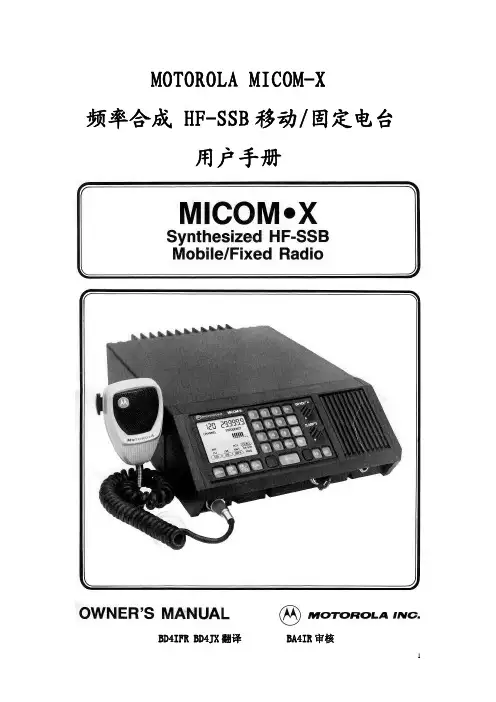
MOTOROLA MICOM中文使用手册
4. 接收声音信号时,可调节 CLARIFIER 使声音自然。本调节对发射频率无效。 5. 电台会保持上次使用的信道,下次开机自动进入。 6. 键盘按动到位时有啪哒感。不要用尖锐物按键以免损坏。 7. 信道选择。两种不同的选择方式:上下箭头和数字键。
钮或按麦克风上的 PTT 键。要扫描少于 10 个信道,在 101 到 110 信道之间不感兴趣的信道 中通过编入 0 来去除其中的频率信息。按 RESET 返回按 SCAN 钮之前使用的信道。
8. 发射 a. 在发射之前先收听。关闭静噪。SQ 钮右上角的灯熄灭。如果是半双工信 道,按 TX/RX 钮监听发射频率的情况。方框将围绕着‘XMIT’直到再 按 RX/TX 钮,或 PTT 钮按下并释放,或 60 秒重设定时器重新设置控制。 如果这信道或频率没人用,扬声器中将听到噪声。如果有人使用,应当改 变信道或等待。 b. 正确握持麦克风 稳定的握住麦克风,网格面对嘴唇约 5cm 距离。 c. 讲话清楚并缓慢 充分按下麦克风侧面的 PTT,功率表图示下面的下划线 出现。如果这信道是单工(收发同频),显示的频率不会改变。如果信道 是半双工(收发不同频),平时显示的是接收频率,PTT 按下去时显示的 是发射频率。用普通声音清楚地缓慢地讲话。说话时观察 RF 功率图示。 产生的 RF 输出大约显示从左至右每一个柱形为 15W 增量。如果天线系 统调谐不合适,产生的反射功率通过从左至右熄灭柱形显示来指示。见下 面图示。
1. 模式 选择下列发射类型之一:SSB,AME。或 PILOT。
2. USB/LSB (可选)选择上边带或下边带用于发射和接收。
3. TX/RX 选择单工(SMPX)或半双工(RCV & XMIT)操作模式。在半双工模式 时也允许监视发射频率。
Icom IC-F1100D和IC-F2100D IDAS数字手持通信器说明书
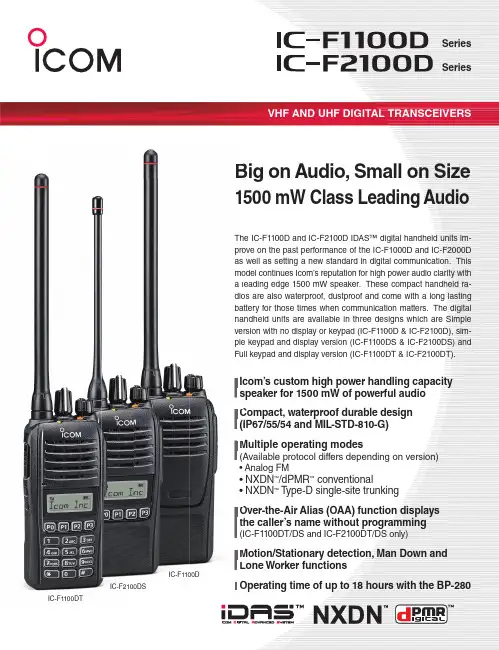
VHF AND UHF DIGITAL TRANSCEIVERSBig on Audio, Small on Size 1500 mW Class Leading Audio The IC-F1100D and IC-F2100D IDAS™ digital handheld units im-prove on the past performance of the IC-F1000D and IC-F2000D as well as setting a new standard in digital communication. This model continues Icom’s reputation for high power audio clarity with a leading edge 1500 mW speaker. These compact handheld ra-dios are also waterproof, dustproof and come with a long lasting battery for those times when communication matters. The digital handheld units are available in three designs which are Simple version with no display or keypad (IC-F1100D & IC-F2100D), sim-ple keypad and display version (IC-F1100DS & IC-F2100DS) and Full keypad and display version (IC-F1100DT & IC-F2100DT). com’s custom high power handling capacity speaker for 1500 mW of powerful audio(IP67/55/54 and MIL-STD-810-G)(Available protocol differs depending on version)• Analog FM• NXDN• NXDNthe caller’s name without programming (IC-F1 Lone Worker functions Operating time of up to 18 hours with the BP-280B 1Th proasmoa ldiobahavepleFuI c sC (M (A •• • O t(IM LIC-F1100DTIC-F2100DSIC-F1100DCheck our website to know more about6.25 kHz FDMA narrow band.www.icom.co.jp/world/fdma/G eneral Features• 136–174, 350–400, 400–470, 450–512, 450–520 MHz versions • 128 Channels / 8 Zones (for LCD types )• 16 Channels (for non-display types )• I com’s customized speaker offers a louder 1500 mW audio output • A n engineered casing that amplifies and improves acoustic sound clarity• C ompact (52.2 (W) × 111.8 (H) mm; 2.1 × 4.4 in) and light-weight• I P67/55/54 waterproof and dust-tight protection• T ested to 12 categories of MIL-STD-810-G environmental tests • A quaQuake™ – Expels water ingress from the speaker grill • DTMF autodial memories• 16-position rotary selector and ON/OFF volume knob • P rogrammable keys – Increase the number of programmable key assignments by using the “Shift key”• O perating times of up to 18 hours (with the supplied BP-280 battery pack)• E ight character alphanumeric display (for LCD types)• Three color LEDOperating Mode (Available protocol differs depending on version)• NXDN or dPMR Mode 1/Mode 2 conventional • NXDN or dPMR multi-site conventional over IP network • N XDN T ype-D single-site trunking • Analog mode• Analog/digital mixed operation (conventional mode)Digital Functions (Voice and Data)• AMBE+2™ vocoder• O ver-the-Air Alias (OAA) displays the caller’s name withoutprogramming (for LCD types)• Individual, Group and All call • Late entry for Group call • Status call and Polling• Short data messages (for LCD types)• Call alert (NXDN)• Radio check (RX only) (NXDN)• GPS position capabilities (requires HM-171GPW)• U p to 500 ID numbers for IDAS or MDC 1200 signaling sys-tem can be saved in the Call List to show the alias nameAnalog Functions• CTCSS and DTCS tone • 2-Tone and 5-T one• M DC functions*; PTT ID, Emergency (TX/RX), Radio check (RX), Stun (RX), Revive (RX) (* Depending on version)• BIIS PTT ID transmissionSafety and Security• Digital voice scrambler (Low level encryption)• Radio Stun/Revive/Kill (RX only)• Remote monitor (NXDN)/ambience listening (dPMR)• Man down, Lone worker and Emergency call key capability • Motion and Stationary detection function• S urveillance function temp orarily turns OFF the beep and LED indicator• Power ON password (for LCD types)Scan Functions•Priority scan monitors one or two p riority channels while scanning non-priority channels• V oting scan automatically selects the optimal repeater site • M ode dependent scan automatically changes the scan list, depending on the operating channel • Power ON scan function• Talk Back timerVoice/Audio Functions• Channel announcement function • VOX function for hands-free operation • Siren sound for security alarm1500 mW powerful audioWaterproof for 30 minutes in one meter depth of waterIcom custom high p ower handling capacity speakerSupplied accessories: (May differ, or not supplied, depending on version)• Battery pack, BP-280 • Belt clip, MB-133 • Antenna• Desktop charger, BC-213* • AC adapter, BC-123SE/SUK/SV or BC-242*Frequency coverage *(* Varies, depending on the version)136–174 MHz (NXDN/dPMR)350–400 MHz (NXDN, EXP)400–470 MHz (NXDN/dPMR, ALL)450–512 MHz (NXDN, USA)450–520 MHz (NXDN, EXP)Number of channels 128 channels/ 8 zones 16 channels 128 channels/ 8 zones 16 channelsT ype of emission * (* Depends on the version)11K0F3E, 4K00F1D (USA)16K0F3E, 14K0F3E, 11K0F3E, 8K50F3E, 4K00F1D (EXP)16K0F3E, 14K0F3E, 8K50F3E , 4K00F1D (EUR)Power supply requirement7.5 V DC nominalCurrent drain (approximate)Tx1.3 A 1.4 ARx520 mA /110 mA (Max. audio (internal SP)/Standby)520 mA /110 mA (Max. audio (internal SP)/Standby)Antenna impedance50 ΩOperating temperature range–30°C to +60°C; –22°F to +140°F (Radio specification) (USA/EXP)–25°C to +55°C (Radio speci fi cation) (EUR)Dimensions (W × H × D; Projections not included)IC-F1100DS/D, IC-F2100DS/D: 52.2 × 111.8 × 29.4 mm; 2.1 × 4.4 × 1.2 in (With BP-280)IC-F1100DT, IC-F2100DT: 52.2 × 111.8 × 34.1 mm; 2.1 × 4.4 × 1.3 in (With BP-280)Weight (approximate)IC-F1100D, IC-F2100D: 260 g; 9.2 oz (With BP-280 and MB-133)IC-F1100DS, IC-F2100DS: 270 g; 9.5 oz (With BP-280 and MB-133)IC-F1100DT, IC-F2100DT: 280 g; 9.9 oz (With BP-280 and MB-133)Output power (Hi, L2, L1)5 W, 2 W, 1 W 4 W, 2 W, 1 WMaximum frequency deviation± 5.0 kHz (25 kHz), ±4.0 kHz (20 kHz), ±2.5 kHz (12.5 kHz)Spurious emissions70 dB minimum (USA)0.25 μW (≤ 1 GHz), 1.0 μW (> 1 GHz) (EUR/EXP)Frequency stability±1.0 ppmAudio harmonic distortion0.7% typical (25 kHz), 0.9% typical (20 kHz), 1.0% typical (12.5 kHz) (at AF 1 kHz 40% deviation)FM Hum and Noise (without CCITT filter)40 dB typical (12.5 kHz) (USA)44 dB typical (12.5 kHz) (USA)Residual modulations (with CCITT filter)52 dB typical (25 kHz), 50 dB typical (20 kHz), 46 dB typical (12.5 kHz) (EUR/EXP)54 dB typical (25 kHz), 52 dB typical (20 kHz),48 dB typical (12.5 kHz) (EUR/EXP)FSK error5% maximumExternal microphone connector3-conductor 2.5 (d) mm (1/10)/2.2 k ΩSensitivity(at 12 dB SINAD)0.21 μV typical 0.24 μV typical (at 20 dB SINAD)–4 dBμV typical emf –5 dBμV typ. emf (25/20 kHz), –2 dBμV typ. emf (12.5 kHz)(at 5% BER)–8 dBμV typical emf (0.20 μV typical)Adjacent channel selectivity 77 dB typ. (25 kHz), 74 dB typ. (12.5 kHz), 69 dB typ. (12.5 kHz), 59 dB typ. (digital) 76 dB typ. (25 kHz), 75 dB typ. (12.5 kHz), 69 dB typ. (12.5 kHz), 58 dB typ. (digital)Spurious response rejection 80 dB typicalIntermodulation rejection75 dB typ. (25/12.5 kHz), 71 dB typ. (digital) (USA/EXP)77 dB typ. (25/12.5 kHz), 70 dB typ. (digital) (USA/EXP)69 dB typ. (25/20/12.5 kHz), 74 dBμV emf typ. (digital) (EUR)70 dB typ. (25/20/12.5 kHz), 74 dBμV emf typ. (digital) (EUR/EXP)Hum and noise(With CCITT filter)47 dB typ. (25 kHz), 43 dB typ. (12.5 kHz) (USA/EXP)42 dB typical (12.5 kHz) (USA/EXP)(Without CCITT filter)52 dB typ. (25 kHz), 50 dB typ. (20 kHz), 46 dB typ. (12.5 kHz) (EUR)50 dB typ. (25 kHz), 48 dB typ. (20 kHz),45 dB typ. (12.5 kHz) (EUR)AF output power (at 5% distortion)Internal SP 1500 mW typical (With an 8 Ω load)External SP400 mW typical (With an 8 Ω load)External speaker connector2-conductor 3.5 (d) mm (1⁄8)/8 ΩAll stated specifications are subject to change without notice or obligation. Measurements made in accordance with TIA-603 (USA/EXP) or EN 300-086, EN 301-166 (EUR).Applicable U.S. Military Specifications & IP RatingMethod ProcedureLow Pressure 500.5I, II High Temperature 501.5I, II Low T emperature 502.5I, II T emperature Shock503.5I-C Solar Radiation 505.5I Rain Blowing/Drip506.5I, III Humidity 507.5II Salt Fog 509.5–Dust Blowing 510.5I Immersion 512.5I Vibration 514.6I Shock516.6I, IVAlso meets equivalent MIL-STD-810-C, -D, -E and -F .Dust & Water IP67/55/54Battery LifeBP-280Li-ion 7.2 V 2400 mAh (typ.), 2280 mAh (min.) Up to 18 hours BP-279Li-ion 7.2 V 1570 mAh (typ.), 1485 mAh (min.) Up to 11.5 hours BP-278Li-ion 7.2 V1190 mAh (typ.), 1130 mAh (min.)Up to 9 hours* TX: RX: standby = 5:5:90. Power save function ON.The “3D GENUINE Icom label” is attached to the rear chassis under the battery. Check the Icom website for details: http://www.icom.co.jp/world/genuine-info/1-1-32, Kamiminami, Hirano-Ku, Osaka 547-0003, Japan Phone: +81 (06) 6793 5302 Fax: +81 (06) 6793 0013Count on us!www.icom.co.jp/world .au Y our local distributor/dealer:E-mail:******************** ■ BATTERY PACKSBP-278: 1190 mAh (typ.), 1130 mAh (min.) rechargeable Li-ion battery.BP-279: 1570 mAh (typ.), 1485 mAh (min.) rechargeable Li-ion battery.BP-280: 2400 mAh (typ.), 2280 mAh (min.) rechargeable Li-ion battery.■ BATTERY CHARGERSBC-213: D esktop charger.Charges the BP-278, BP-279 or BP-280. Charges the BP-280 in 3.5 hours (approximate).+ BC-123SA/SE/SUK/SV or BC-242: AC adapter.BC-214: Multi-charger.Charges up to six radios and/or batteries at the same time.+ BC-157S : AC adapter.* AD-130 charger adapter is supplied with the BC-214, depending on the version.■ POWER SUPPLY CABLES AND CHARGER BRACKETCP-23L : Vehicle charger cable for use with the BC-213.OPC-656: DC power cable for use with the BC-214.MB-130: Charger bracket for use with the BC-213.■ SPEAKER-MICROPHONESHM-171GPW : GPS speaker microphone with a waterproof connector. IP67 protection.HM-168LWP : Waterproof speaker microphone with a waterproof connector. IP67 protection.HM-159LA : Speaker microphone with a 3.5 mm earphone jack.HM-158LA : Compact speaker microphone with a 3.5 mm earphone jack.■EARPHONE-MICROPHONESHM-153LA : Durable lapel microphone with earphone.HM-166LA: Light weight lapel microphone with earphone.■HEADSETS, PTT SWITCH CABLE & PLUG ADAPTERHS-94LWP : Earphone-headset with a waterproof connector.HS-95LWP : Behind-the-head headset with a waterproof connector.HS-94: E arphone-headset. (Use with either the VS-4LA or OPC-2004LA)HS-95: Behind-the-head headset. (Use with either the VS-4LA or OPC-2004LA)HS-97: T hroat microphone. (Use with either the VS-4LA or OPC-2004LA)VS-4LA : P TT switch cable for manual PTT operation.(For use with either the HS-94, HS-95 or HS-97)OPC-2004LA : P lug adapter cable for VOX operation.(For use with either the HS-94, HS-95 or HS-97)■BELT CLIPMB-133:A lligator belt clip. Same as supplied.■ SOFTWARE AND CABLECS-F2100D : Programming software. (#11 NXDN, #12 dPMR)OPC-478UC: USB type radio programming cable.■ANTENNASFA-SC25V: 136–150 MHz FA-SC28V:148–162 MHzFA-SC29V:160–174 MHz FA-SC55V:150–174 MHz FA-SC25U : 400–430 MHz FA-SC57U : 430–470 MHz FA-SC72U : 470–520 MHz FA-SC01U : 350–400 MHz FA-SC02U : 330–380 MHz■ STUBBY ANTENNASFA-SC26VS : 136–144 MHz FA-SC27VS : 142–150 MHz FA-SC56VS : 150–162 MHz FA-SC57VS : 160–174 MHz FA-SC26US : 400–450 MHz FA-SC73US : 450–490 MHz■ CUT-TYPE ANTENNASFA-SC61VC : 136–174 MHz FA-SC61UC : 380–520 MHzIcom, Icom Inc. and Icom logo are registered trademarks of Icom Incorporated (Japan) in Japan, the United States, the United Kingdom, Germany, France, Spain, Russia, Australia, New Zealand and/or other countries. IDAS, IDAS logo and AQUA-QUAKE are trademarks of Icom Incorporated. NXDN is a trademark of Icom Incorporated and JVC KENWOOD Corporation. dPMR and the dPMR logo are trademarks of the dPMR MoU Association. AMBE+2 is a trademark and property of Digital Voice System, Inc. All other trademarks are the properties of their respective holders.BC-123SABC-157SBC-213BC-214HM-153LA HM-166LAHM-159LAHM-168LWPHM-171GPWHM-158LAHS-94LWP HS-95LWP HS-97OPC-2004LAVS-4LA Some options may not be available in some countries. Please ask your dealer for details.FA-SC25V FA-SC55V FA-SC28V FA-SC29V FA-SC25U FA-SC57UFA-SC72U FA-SC01UFA-SC61VCFA-SC61UCOPC-656MB-130CP-23L FA-SC26VSFA-SC56VSFA-SC27VSFA-SC57VSFA-SC26US FA-SC73USBP-279BP-280BP-278。
ICOM电台说明书

ICOM IC-M710使用说明前面板说明:1、MICROPHONE:麦克风插座,插入随机配备的麦克风或插入另配的头戴式麦克风。
说明:不插麦克风时喇叭无输出。
2、POWER:电源开关。
3、SPEAKER:喇叭开关。
4、DIMMER:显示亮度开关,背景灯开关。
5、VOLUME:音量控制电位器。
调节音量大小,如下情况时喇叭不能输出声音:1)麦克风没有插上;2)喇叭开关打开;3)SQL开关打开时没有接收信号。
6、GROUP:通道组旋钮;以每步20个通道选择用户通道和ITU通道。
说明:一些版本没有ITU通道。
7、TUNE:天线调谐器开关;调谐连接到天线的调谐器开关。
只有当天线调谐器上连接有象ICOM AT-130/E才能使用;使用宽带天线时不用此开关。
说明:当在设置方式选择“自动”时,不需要使用此开关。
8、CHA NNEL:通道选择开关。
★在用GROUP通道组选择器选择的通道组内选择通道,用户通道用CHANNEL能从1到160选择,而不必用GROUP旋钮。
压CE键后(显示屏上显示◣)可改变操作频率,但用此方法不能编程。
9、FUNC:功能开关。
压FUNC开关后,激活以下开关的第二功能:1)RESET:当连接象DSC那样的终端时,要关闭终端不由它控制时用此功能。
2)SQL:开始或停止扫描功能。
3)RX:设置射频增益。
4)TX:设置发射功率。
5)CE:编程通道名。
说明:所获得的功能取决于所用电台的版本。
10、CLARITY:清晰度控制旋钮。
调节接受频率漂移,使接受的信号更清楚,可调节范围±150Hz。
11、软键盘:1)RX:直接频道选择时,置入选择的频道号或频率。
★存储接收频率进入用户所选频道方法如下:压CE键,显示屏上显示◣,通过键盘输入所需要的接收频率,按下RX键并保持1秒钟。
所输入的接收频率就存储在所选频道。
按FUNC键后,按RX键来调节接收机的射频增益,以增减接收灵敏度。
2)TX:存储发射频率进入用户所选频道方法如下:按TX键,显示屏的TX字符闪动,再按CE键,显示屏上显示◣,通过键盘输入所选发射频率,然后,按下TX键保持1秒钟,所选频率就存储了。
icom if8101 短波车载电台中文说明书
❍ ALE (自适应)/选呼功能 ❍ 数字信号处理器(DSP)可以灵活选择滤波
器。 ❍ 点阵 LCD 显示器可以显示各种信息。
重要事项
操作电台前请仔细阅读本操作手册。
请保存好本手册,该说明书包含了关于IC-F8101的
重要的使用说明。
FCC 信息
• 对于A类通用辐射器:
本设备经测试证明符合FCC规则第15部分中关于A类 数字设备的限制。这些限制是为了在商业环境中操作 设备提供合理的保护,以防止有害干扰。本设备会产 生,使用并辐射射频能量,如果未按照说明手册进行 安装和使用,可能会对无线电通讯产生有害干扰。 在居民区使用此设备可能会造成有害干扰,在这种情 况下,将要求用户自行纠正干扰。
请在张贴告示牌的地方关闭电台。
■ CFU-F8100 (选件风扇) ............... 9
请勿在对电磁辐射敏感的区域(如医院,飞机和爆破场
■ RMK-6 (可分离组件) ..................... 80 ■HM-192 (可遥控麦克风版本)......................... 2
5
■ 模式选择........................................................9
■ VFO操作........................................................10 3 接收和发射.......................... -1
您的Icom无线电设备在发射模式下回产 生RF电磁能量。本电台为“陆地专用短波 电台”,是专业设备。这意味着它只能在 了解危害的人员,以及了解这种危害的人
员的使用。一般人群须经过培训使用。
icom公司ic-v8对讲机用户手册中文word版
高频无线收发器IC-V8本设备符合FCC行规第15章,其运行条件如下:(1)本设备理论不会产生有害干扰;(2)本设备可以在遭受包括未预估的任何干扰下运行。
ICOM 公司前言感谢您采购IC-V8调频收发器。
本产品设计一流,在任何严苛条件下皆可表现出超常的稳定性。
D 特点❍最大输出功率5.5W❍耐久性达到军用MIL-STD810级标准❍符合CTCSS及DTCS加密/解密标准❍可选择双音多频DTMF解码模式重要请在使用产品前请仔细阅读说明书!请妥善保管此说明书!标志已被日本ICOM公司在美国,英国,德国,法国,西班牙,俄国等地注册,版权所有,违反必究!注释以下注释用于本说明书中预防措施WARNING! 在对话时请勿过近,特别是远离脸与眼睛等暴露部位,在通话时嘴部与麦克风应保持5-10cm距离,并且保持对讲机竖直状态。
WARNING! 耳科医生建议,在使用对讲机时,请勿使用耳机等音量放大设备以避免大音量造成听力受损。
若您在使用时耳部感觉不适,请调低音量并暂停使用。
CAUTION!绝对不要将本产品接保险丝超过5A的直流电源。
本产品能承受疏忽反接导致的电流最大为5A,如果反接时直流电源保险丝超过5A还未跳闸将导致本产品的损坏。
CAUTION!绝对不要直接对干碱电池进行充电,这样做可能损坏电池甚至对讲机。
仅需接通外部直流电源充电即可。
不通话时,请勿按下PTT按键。
将对讲机放到儿童够不到的地方。
请勿在爆破场合使用此设备。
本产品使用存储温度为–10°C ~~~+60°C如您使用ICOM公司以外的充电器及电池所造成的损坏,恕不保修。
即使在关机状态下,本产品内部仍需要弱电流来维持运作,所以在您长时间不使用时请取下电池,以保证镍镉电池延长使用寿命。
以下内容仅在美国有效:Caution:未经ICOM公司允许的改装,在使用时可能造成FCC行规组织对您权限责任的追究。
配件表1.天线2.腰带别夹.3.2251 OPT板4.交流适配器(选配)5.电池/电池盒(选配)6.直立充电器(选配)安全使用规范CAUTION为保证您所受的射频辐射在FCC标准规定的限制以下,请按照以下说明使用:●在使用前确保天线安装完好。
业余无线电知识
天线与接地
适用于ICOM短波SSB无线电收发机IC-M710、IC-M700PRO、IC-M802
前 言
恭喜您选购ICOM的IC-M710海事专用SSB单边带无线电收发机。您已经选择了目前世面上现有最好的单边带无线电收发机组之一。
一般电离层反射一次的距离约3000公里以内,路径损失约100~120db(1010~1012功率比105~106电压比),再每续跳一次功率约降3~6db(100.3~100.6即2~4倍),地球内通话最远约两万公里,求此估算100~120db加6db×7(20000公里/3000公里=7次)=100~120+42db(21db)=121~141→142~168即通南美洲两万公里所要功率约20mW~2W→ 200W即有可能通到。功率大通达机率大,功率小则或许全年通不到几台。一般频率高功率低,夏天午后2W功率用29MHz FM可通荷兰、德国,早晨可通美国加洲,(傍晚可用2W功率通南美巴西在7MHz);再则以50W通日本、台湾14MHz、28MHz USB及29MHz FM、50MHz SSB没什么困难,但时段有限并非全年全日均可通达。
·铅质的龙骨 ·外部的地屏网 ·内部连接的船壳全身
·金属的水槽 ·吃水线下的100呎长金箔 ·金箔辐射网
·水压操舵系统 ·金属的接油盘 ·引擎支架
是的,我们最后列出引擎支架为良好的水下平点。理由是因其没有平坦又贴近您船只所在水面的特大片平面区域。整个理念则是平面区域---而这则是为何龙骨螺栓、水面下的水槽、全部船身,以及任何平坦又贴近水面的物品可以做好此一工作的原因。现在我们知道您的下一道问题---良好的接地难倒不需要实际接触水面吗?一点也不需要!对无线电射频(Radio Frequencies)而言,您的水下接地平衡点将水面看成电容性,提供了与实际接触水面一样的良好接地效果!
Icom721(725)短波电台中文使用说明书
Icom 721/725短波电台中文使用说明书BH1MME整理2011-6-21 一前面板1-3(略)4、可变频率振荡器开关[VFO]选择VFO A或VFO B。
本机中具有两个可变频率振荡器,分别叫做VFOA和VFOB,均可进行接收和发射。
两套系统为机器的使用提供了很大的灵活性。
按一下[VFO]即可选择VFOA或VFOB。
5、异频开关[SPLIT]选择异频操作功能。
6、存储频道选择开关[UP][DOWN]选择存储频道。
7、存储器写入开关[MW]将显示屏上所显示的频率和工作模式写入所显示的存储频道中。
8、存储器读出开关[MEMO]选定存储频道工作模式。
9、接收增量调谐开关[RIT]开启或关断接收增量调谐电路,该电路的作用是微调接收频率,以补偿发射台频率的频率漂移,当不改变本机的发射(即显示的)频率时,可将显示屏上的频率移动+—1KHz(但不显示),以获得满意的接收效果。
10、接收增量调谐旋钮当接收增量调谐电路起作用时,用此移动(微调)接收频率。
11、功能转换开关[FUNC]本机的一些开关具有两种功能,按此开关后,再按相应的开关,即可选择第二功能,见下表:—1KHz(但不显示),以获得满意的接收效果。
10、接收增量调谐旋钮当接收增量调谐电路起作用时,用此移动(微调)接收频率。
11、功能转换开关[FUNC]本机的一些开关具有两种功能,按此开关后,再按相应的开关,即可选择第二功能,见下表:12、天线调谐器开关[TUNER]控制AH-3型高频全自动天线调谐器(选购件)。
13、频段开关[BAND]使调谐旋钮的作用仅仅是选择(改变)频段而不是频率。
14、调谐旋钮锁定开关[LOCK]使调谐旋钮失效,以及当工作于FM模式时,发射一个亚音频信号。
15、M赫兹调谐步进级开关[MHz]选择1MHz的调谐步级。
即调谐旋钮转动时,以MHz步级改变频率。
16、K赫兹调谐步进级开关[MHz]选择1KHz的调谐步级。
即调谐旋钮转动时,以KHz步级改变频率。