
译林牛津版九年级英语上 9a Unit 2 colors 全单元教案
Unit 2 Comic strip &welcome to the unitTeaching aimsTo recognize the names of different coloursTo encourage students to show love to those in needTeaching pointsTo recognize the colours of the rainbow and the order of the coloursTeaching proceduresStep1. Warming – upAsk students what colours they like, then let them talk about their partner’s favourite colours.Step2. Presentation1.Ask students what colour Eddie likes, then let them listen to the tape and find out the answer to this question2. Check the answer.Students read the dialogue between Eddie and Hobo, then the teacher explain some key pointsStep3. PracticeStudents practice the dialogue with the partner, then ask some of them to act out the dialogueStep4. Presentation1.Ask students to guess teacher’s favourite colour, then tell them that the teacher likes the colours of the rainbow2.Teach them the seven colours of the rainbow: red, orange, yellow, green, blue, indigo, violet3.Practice the seven colours, using the dialogue in Part BStep5. A gameStep6. ExercisesI. 根据中文完成下列句子:1.How many colours are there in a __________(彩虹)?2.She wears a (紫色的) blouse today.3.I’d (宁愿) wear blue than pink.4.Thank you for (邀请) us. I really enjoy myself very much.5.In spring, we can hear birds (歌唱)Unit 2 Reading 1Teaching aimsTo understand what colours representTo recognize and understand vocabulary about emotionsTeaching pointsTo match colours to the characteristicsTeaching proceduresStep 1: RevisionRevise different kinds of colours by asking students:What’s your favourite colour?Step 2: Presentation.Tell students that different colours can give people different feelings.Let students enjoy a series of pictures, including different kinds of colours and let students discuss:What’s your feeling after looking at the pictures?Encourage students to say as much as possible.Then teachers make a conclusion:Blue & white can make people calm and peaceful. Blue can also represent sadness and white is the colour of purity.Yellow and orange make you feel warm, happy and contented. Orange represents joy while yellow is the colour of wisdom.Green makes you feel energetic. It represents new life and growth.Red represents power. It is also the colour of heat and strong feelings.Step 3: Discussion.Let students think about:How can colour change people’s moods?Encourage students to express himself using his / her own wordsStep4: HomeworkUnit 2 Reading 2Teaching proceduresStep 4: Reading comprehension.1. Ask students to scan the passage quickly and then match the colour with what they represent.Ask students to read the passage again carefully and then fill in the blanks accordingto the passage ArrayStep 5: Language points.1. Ask a student at a time to read a paragraph. After each paragraph, ask students to say which parts of the text they do not understand.2. Explain some difficult language points to students.e.g. remind sb. of sthhave difficulty (in) doing sth.make/ find / think it + adjective + to do sth.Step 6: Discussion1.Ask students what they think about the article. Do they agree with what it says orwhich part of the text do they like most?Unit 2 GrammarTeaching aimsTo know how to use the object clause with ‘that’ and ‘if/whether’.Teaching pointsThe structure and usage of the object clause with ‘that’ and ‘if/whether’.Teaching proceduresStep 1 Lead-inToday we are going to learn the object clauses introduced by ‘that ‘, ‘if/ whether’.Step 2 The Object clauses introduce d by ‘that’1) Earth is becoming more and more crowded and polluted.What does Daniel think ?-- -Daniel thinks that Earth is becoming more and more crowded and polluted.2 ) People will live on the planet Mars by the year 2100.What does Daniel think?---Good . Daniel thinks that people will live on the planet Mars by the year 2100.3) The robot will do most of the work.What does Daniel think?---Yes, Daniel thinks that the robot will do most of the work.Let’s do some exercises. …Have you finished? Now let’s check the answers.1) He’ll be back in a month.(I hear…)--I hear ( that ) he will be back in a month.2) I have been to the Great Wall once.(He tells me…)-- He tells me ( that ) he has been to the Great Wall once.Can you find out the rules about Object clauses introduced by ‘that’?Step 3 The Object clauses in troduced by ‘if ‘or ‘whether’ (PPT)Daniel has learned a lot about living on Mars. But he’s still worrying about something. Look at his worries.1 ) Could the plants produce enough water?--- Daniel is not sure if / whether the planets could produce enough water.2) Are there any aliens on Mars?----Daniel is not sure if / whether there are any aliens on Mars.3) Are animals on Mars dangerous?--- Daniel is not sure if / whether animals on Mars dangerous.Let’s do more practice together.1 ) Does he live in that house? ( She asks me …)---She asks me if/ whether he lives in that house.2) Have you finished your homework? ( I want to know…)---- I want to know if /whether you have finished your homework.Can you work out the rules yourselves?HomeworkUnit 2 Integrated skillsTeaching aims1.To understand the context of an advertisement and a TV demonstration.2. To understand how a color therapist does.3.To get information from a printed advertisement.4.To get further information from a TV interview.5.To consolidation the information gained from reading and listening and determine the facts. Teaching pointsTo learn through different feelings to different colours.Teaching proceduresStep1 RevisionRevise something learned in the last period.Step2 Practice1. Ask the Ss what they think a color therapist is. A color therapist helps people improve their health, mood and appearance by using colors.2. Ask Ss if they believe that colors can affect our mood.3. Explain to Ss that the paper at the top of page 32 is an advertisement. Ask a student to read the advertisement out loud. Tell the students must use the information in the advertisement to complete Millie’s notes. Remind them that they will not be able to complete the note.4. Ask ss to look carefully at what they have written in Part A1, and pay attention to the gaps they have not yet been able to fill in.5. Ask ss to look at their answers. If they still have some questions, play the tape once more without stopping.6. check the mistakes and pronunciation.Step3 PracticeDeal with Part B1. Review “advice”2. Ask one student to play the role of Millie and another one to play the role of Andy.3. Write some vocabulary on the blackboard for students to use. “blouse, coat, tr ousers, loose, tight, comfortable”. Remind students that each color represents something different . Ask them to refer to the passage to check what different colors represent.4. Work in pairs.5. Role—playing.Step4 Sum upSum up some Language pointsStep4 Assignment1. Revise this period and do some exercises2. Pre-learn the next periodUnit 2 TaskTeaching aimsTo master the words: protection, warmth, powerful, handbag, balanceTo organize ideas and build a plan.To write a report about moods and colors and what they represent. 3. To present a report. Teaching pointsTo learn to express ideas to others.Teaching proceduresStep1 RevisionRevise something learned in the last period.Step2 Presentaton1. Explain the context. Students are working on a projectabout the relationship between colors and moods. They willlook at pictures of people and assess their moods based onthe colors they are wearing.2. Tell students that making a list can be a good way toorganize their thoughts and ideas.3. Point out to students that for each color mentioned in the list, there is an explanation of what the colors mean.Step3 Practice1. Tell students to look at the picture carefully, then answersome questions. After answering some questions, let themwork in groups to finish the report.2. Free talk. According to the advertisement on thebook, ask them that what kind of advertisement can beconsidered as good advertisement.3. Show them other pictures and encourage them to talkabout their feeling. About colors and moods. Thenwork in pairs to ask their desk mates about colors andrepresents.4. Exercise: writing.Step 4 Assignment1. Revise this period2. Pre-learn the next periodMore exercises make perfect根据首字母提示完成下列句子:1. Red represents p __________ and s_____________.2. Paul has strong p_________ and likes to be the leader.3. This can help when you have d__________- making a decision.4. I’d r__________ wear a blue coat than a red coat.5. Green can give us e_________ because it r___________ new life and growth.6. White is the color of p________. If you wear white, you will feel p______.7. Blue can c_______ the feeling of harmony.8. Is there a_________ in the room? I’m hungry.9. Do you know that colours can a_________ our moods?10. Orange can bring you s________ .It can c______ you up when you are sad.。
牛津译林版英语九年级上册 Unit 2 《Colours.》 教学设计6

牛津译林版英语九年级上册 Unit 2 《Colours.》教学设计6一. 教材分析牛津译林版英语九年级上册Unit 2《Colours》主要介绍了颜色类词汇及颜色类词汇的运用。
通过本单元的学习,学生能够掌握颜色的表达,并在实际情境中运用颜色词汇进行交流。
本单元包括颜色类词汇的介绍、颜色类词汇在日常生活中的运用以及颜色对人的心理影响等内容。
二. 学情分析九年级的学生已经具备一定的英语基础,能够听、说、读、写颜色类词汇,但在实际运用中还存在一定的困难。
针对这一情况,教师应注重引导学生将所学知识运用到实际生活中,提高他们的语言运用能力。
三. 教学目标1.知识目标:学生能够掌握颜色类词汇的听说读写技能,并能运用所学词汇进行简单的交流。
2.能力目标:通过小组合作、角色扮演等活动,提高学生的口语表达能力和团队协作能力。
3.情感目标:培养学生对颜色的兴趣,激发他们学习英语的积极性。
四. 教学重难点1.重点:颜色类词汇的听说读写技能。
2.难点:颜色类词汇在实际情景中的运用。
五. 教学方法1.任务型教学法:通过设置各种任务,让学生在完成任务的过程中运用颜色类词汇。
2.情境教学法:创设各种情境,让学生在真实的环境中学习颜色类词汇。
3.小组合作学习:培养学生团队协作能力,提高他们的口语表达能力。
六. 教学准备1.教学材料:牛津译林版英语九年级上册教材、多媒体课件。
2.教学工具:投影仪、电脑、黑板、粉笔。
3.教学资源:网络资源、颜色卡片、实物颜色标本等。
七. 教学过程1.导入(5分钟)利用多媒体展示各种颜色图片,引导学生谈论颜色,激发学生学习兴趣。
2.呈现(10分钟)教师展示颜色类词汇的图片和单词卡片,引导学生跟读,让学生初步感知颜色类词汇。
3.操练(15分钟)设计各种颜色类词汇的练习题,让学生进行听、说、读、写等方面的训练。
例如,听录音选择正确的颜色、看图片说出对应的颜色、用所学的颜色词汇进行句子编写等。
4.巩固(10分钟)学生分组进行角色扮演,用颜色类词汇进行对话。
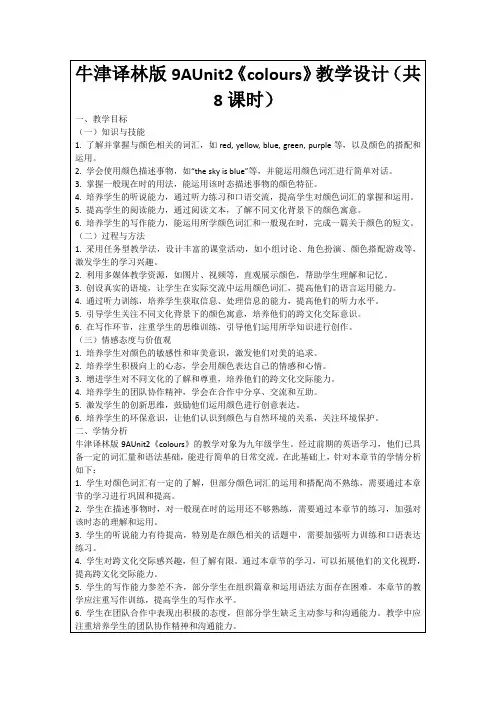
牛津译林版9AUnit2《colours》教学设计(共8课时)
3.完成课后练习册中与颜色相关的听力练习,提高学生对颜色词汇的听力敏感度。
4.学生观看一部英文动画片,关注其中的颜色元素,并运用所学颜色词汇进行口语描述。
5.家长协助孩子观察家里的物品颜色,用一般现在时进行口语练习,家长可记录孩子的表现,作为课堂反馈。
1.采用任务型教学法,设计丰富的课堂活动,如小组讨论、角色扮演、颜色搭配游戏等,激发学生的学习兴趣。
2.利用多媒体教学资源,如图片、视频等,直观展示颜色,帮助学生理解和记忆。
3.创设真实的语境,让学生在实际交流中运用颜色词汇,提高他们的语言运用能力。
4.通过听力训练,培养学生获取信息、处理信息的能力,提高他们的听力水平。
-实物展示:通过展示不同颜色的物品,让学生在实际观察中学习颜色词汇。
-图片辅助:使用丰富的图片资源,帮助学生建立颜色与实物之间的联系。
-视频引入:播放与颜色相关的短片,激发学生兴趣,提供真实的语境。
2.设计互动性强的课堂活动,如小组竞赛、角色扮演、颜色猜谜等,激发学生的学习兴趣,提高他们的参与度。
-小组竞赛:通过小组间的颜色词汇接龙或描述比赛,促进学生主动学习和合作交流。
2.学生分享学习心得,讨论在小组讨论和课堂练习过程中的收获和困惑。
3.教师针对学生的表现,给予鼓励和评价,强调颜色在英语学习中的重要性,并鼓励学生在生活中多观察、多运用颜色词汇。
五、作业布置
为了巩固本节课所学内容,加强学生对颜色词汇和一般现在时的掌握,特布置以下作业:
1.请学生用一般现在时,以“我的色彩世界”为主题,写一篇短文。要求至少运用5个本节课学习的颜色词汇,描述自己生活中的颜色事物,字数不少于80词。
牛津译林版-英语-九上-牛津英语 9A 2单元 Colours教案
Step 3: Discussion.
Let students think about:
How can colour change people’s moods?
教学重点
教学难点
教学过程
教学内容
备课札记
教师活动ቤተ መጻሕፍቲ ባይዱ式
学生活动方式
Teaching steps:
Step 1: Revision
Revisedifferentkinds of colours by askingstudents:
What’s your favourite colour?
Step 2: Presentation.
Tell students that different colours can give people different feelings.
Let students enjoy a series of pictures, including different kinds of colours and let students discuss:
Encourage students to expresshimselfusing his / her own words
Step4: Homework
达标情况
During the first period of reading, the main task is to make students know the main idea of the text.
Yellow and orange make you feel warm, happy and contented.Orange represents joy while yellow is the colour of wisdom.
Unit2colours整套教案牛津译林版英语九年级上册
Wele to the unit 主备人:赵凤英Teaching objectives:1. Knowledge objectivesPharases: try on, look good on sb. in the skyStructures: There’s nothing wrong with pink.I’m sure if blue looks good on you.2. Ability objectivesTo review different colours.To talk about students’ favourite colours.3. Value objectivesTo let students be interested in different colours and the meaning of different colours. Teaching focuses and difficulties1. Words: indigo, violet, rainbow2. To talk about students’ favourite colours.Teaching procedures::Step 1 Warming upPresent some pictures of colours and get the students to say their names.Step 2 ic strip1. Ask the students to talk about their favourite colours.2. Listen and answer the questions.1) Which colour does Eddie like better?2) Why doesn’t Eddie like pink?3. Act the dialogue out.Step 3 Wele to the unit1. Ask the students to talk about the questions below:1) Have you ever seen a rainbow?2) How many colours are there in a rainbow?3) What colour do you like best?2. Present a picture of a rainbow and teach the new words.rainbow indigo violetStep 4 Finish Part A on page 21.Step 5 Dialogue practiceA: Which is your favourite colour?B: I like ... best. What about you?A: I like ... best.Step 6 Finish Part B on page 21.Step 7 Language pointsStep 8 ExercisesTranslation.1. 蓝色是男孩子们喜欢的颜色。
译林牛津版九年级英语上 9a Unit 2 colors 全单元教案
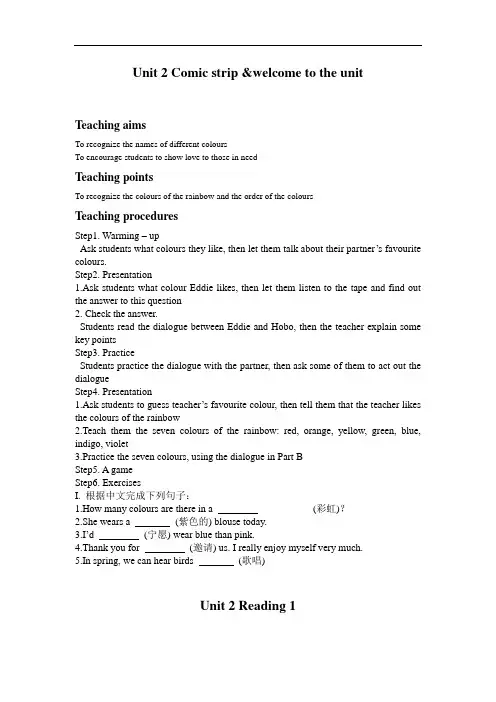
Unit 2 Comic strip &welcome to the unitTeaching aimsTo recognize the names of different coloursTo encourage students to show love to those in needTeaching pointsTo recognize the colours of the rainbow and the order of the coloursTeaching proceduresStep1. Warming – upAsk students what colours they like, then let them talk about their partner’s favourite colours.Step2. Presentation1.Ask students what colour Eddie likes, then let them listen to the tape and find out the answer to this question2. Check the answer.Students read the dialogue between Eddie and Hobo, then the teacher explain some key pointsStep3. PracticeStudents practice the dialogue with the partner, then ask some of them to act out the dialogueStep4. Presentation1.Ask students to guess teacher’s favourite colour, then tell them that the teacher likes the colours of the rainbow2.Teach them the seven colours of the rainbow: red, orange, yellow, green, blue, indigo, violet3.Practice the seven colours, using the dialogue in Part BStep5. A gameStep6. ExercisesI. 根据中文完成下列句子:1.How many colours are there in a __________(彩虹)?2.She wears a (紫色的) blouse today.3.I’d (宁愿) wear blue than pink.4.Thank you for (邀请) us. I really enjoy myself very much.5.In spring, we can hear birds (歌唱)Unit 2 Reading 1Teaching aimsTo understand what colours representTo recognize and understand vocabulary about emotionsTeaching pointsTo match colours to the characteristicsTeaching proceduresStep 1: RevisionRevise different kinds of colours by asking students:What’s your favourite colour?Step 2: Presentation.Tell students that different colours can give people different feelings.Let students enjoy a series of pictures, including different kinds of colours and let students discuss:What’s your feeling after looking at the pictures?Encourage students to say as much as possible.Then teachers make a conclusion:Blue & white can make people calm and peaceful. Blue can also represent sadness and white is the colour of purity.Yellow and orange make you feel warm, happy and contented. Orange represents joy while yellow is the colour of wisdom.Green makes you feel energetic. It represents new life and growth.Red represents power. It is also the colour of heat and strong feelings.Step 3: Discussion.Let students think about:How can colour change people’s moods?Encourage students to express himself using his / her own wordsStep4: HomeworkUnit 2 Reading 2Teaching proceduresStep 4: Reading comprehension.1. Ask students to scan the passage quickly and then match the colour with what they represent.Ask students to read the passage again carefully and then fill in the blanks accordingto the passage ArrayStep 5: Language points.1. Ask a student at a time to read a paragraph. After each paragraph, ask students to say which parts of the text they do not understand.2. Explain some difficult language points to students.e.g. remind sb. of sthhave difficulty (in) doing sth.make/ find / think it + adjective + to do sth.Step 6: Discussion1.Ask students what they think about the article. Do they agree with what it says orwhich part of the text do they like most?Unit 2 GrammarTeaching aimsTo know how to use the object clause with ‘that’ and ‘if/whether’.Teaching pointsThe structure and usage of the object clause with ‘that’ and ‘if/whether’.Teaching proceduresStep 1 Lead-inToday we are going to learn the object clauses introduced by ‘that ‘, ‘if/ whether’.Step 2 The Object clauses introduce d by ‘that’1) Earth is becoming more and more crowded and polluted.What does Daniel think ?-- -Daniel thinks that Earth is becoming more and more crowded and polluted.2 ) People will live on the planet Mars by the year 2100.What does Daniel think?---Good . Daniel thinks that people will live on the planet Mars by the year 2100.3) The robot will do most of the work.What does Daniel think?---Yes, Daniel thinks that the robot will do most of the work.Let’s do some exercises. …Have you finished? Now let’s check the answers.1) He’ll be back in a month.(I hear…)--I hear ( that ) he will be back in a month.2) I have been to the Great Wall once.(He tells me…)-- He tells me ( that ) he has been to the Great Wall once.Can you find out the rules about Object clauses introduced by ‘that’?Step 3 The Object clauses in troduced by ‘if ‘or ‘whether’ (PPT)Daniel has learned a lot about living on Mars. But he’s still worrying about something. Look at his worries.1 ) Could the plants produce enough water?--- Daniel is not sure if / whether the planets could produce enough water.2) Are there any aliens on Mars?----Daniel is not sure if / whether there are any aliens on Mars.3) Are animals on Mars dangerous?--- Daniel is not sure if / whether animals on Mars dangerous.Let’s do more practice together.1 ) Does he live in that house? ( She asks me …)---She asks me if/ whether he lives in that house.2) Have you finished your homework? ( I want to know…)---- I want to know if /whether you have finished your homework.Can you work out the rules yourselves?HomeworkUnit 2 Integrated skillsTeaching aims1.To understand the context of an advertisement and a TV demonstration.2. To understand how a color therapist does.3.To get information from a printed advertisement.4.To get further information from a TV interview.5.To consolidation the information gained from reading and listening and determine the facts. Teaching pointsTo learn through different feelings to different colours.Teaching proceduresStep1 RevisionRevise something learned in the last period.Step2 Practice1. Ask the Ss what they think a color therapist is. A color therapist helps people improve their health, mood and appearance by using colors.2. Ask Ss if they believe that colors can affect our mood.3. Explain to Ss that the paper at the top of page 32 is an advertisement. Ask a student to read the advertisement out loud. Tell the students must use the information in the advertisement to complete Millie’s notes. Remind them that they will not be able to complete the note.4. Ask ss to look carefully at what they have written in Part A1, and pay attention to the gaps they have not yet been able to fill in.5. Ask ss to look at their answers. If they still have some questions, play the tape once more without stopping.6. check the mistakes and pronunciation.Step3 PracticeDeal with Part B1. Review “advice”2. Ask one student to play the role of Millie and another one to play the role of Andy.3. Write some vocabulary on the blackboard for students to use. “blouse, coat, tr ousers, loose, tight, comfortable”. Remind students that each color represents something different . Ask them to refer to the passage to check what different colors represent.4. Work in pairs.5. Role—playing.Step4 Sum upSum up some Language pointsStep4 Assignment1. Revise this period and do some exercises2. Pre-learn the next periodUnit 2 TaskTeaching aimsTo master the words: protection, warmth, powerful, handbag, balanceTo organize ideas and build a plan.To write a report about moods and colors and what they represent. 3. To present a report. Teaching pointsTo learn to express ideas to others.Teaching proceduresStep1 RevisionRevise something learned in the last period.Step2 Presentaton1. Explain the context. Students are working on a projectabout the relationship between colors and moods. They willlook at pictures of people and assess their moods based onthe colors they are wearing.2. Tell students that making a list can be a good way toorganize their thoughts and ideas.3. Point out to students that for each color mentioned in the list, there is an explanation of what the colors mean.Step3 Practice1. Tell students to look at the picture carefully, then answersome questions. After answering some questions, let themwork in groups to finish the report.2. Free talk. According to the advertisement on thebook, ask them that what kind of advertisement can beconsidered as good advertisement.3. Show them other pictures and encourage them to talkabout their feeling. About colors and moods. Thenwork in pairs to ask their desk mates about colors andrepresents.4. Exercise: writing.Step 4 Assignment1. Revise this period2. Pre-learn the next periodMore exercises make perfect根据首字母提示完成下列句子:1. Red represents p __________ and s_____________.2. Paul has strong p_________ and likes to be the leader.3. This can help when you have d__________- making a decision.4. I’d r__________ wear a blue coat than a red coat.5. Green can give us e_________ because it r___________ new life and growth.6. White is the color of p________. If you wear white, you will feel p______.7. Blue can c_______ the feeling of harmony.8. Is there a_________ in the room? I’m hungry.9. Do you know that colours can a_________ our moods?10. Orange can bring you s________ .It can c______ you up when you are sad.。
牛津译林版英语九年级上册 Unit 2 《Colours.》 教学设计2
牛津译林版英语九年级上册 Unit 2 《Colours.》教学设计2一. 教材分析《牛津译林版英语九年级上册 Unit 2 Colours》主要介绍了颜色相关的词汇和表达方式。
通过本单元的学习,学生能够掌握颜色词汇的英文表达,学会使用颜色词汇描述人和物体。
教材中包含了丰富的图片、例句和练习,为学生提供了良好的学习资源。
二. 学情分析九年级的学生已经具备了一定的英语基础,能够听、说、读、写简单的英语句子。
但部分学生在颜色的表达方面可能还存在困难,需要通过大量的练习来巩固。
此外,学生对于实际生活中的颜色应用可能了解不多,需要通过实例来引导他们学会用英语描述颜色。
三. 教学目标1.知识目标:学生能够掌握颜色词汇的英文表达,学会用英语描述人和物体。
2.能力目标:学生能够听、说、读、写关于颜色的简单句子,提高英语表达能力。
3.情感目标:培养学生对色彩的感知和欣赏能力,激发他们学习英语的兴趣。
四. 教学重难点1.重点:颜色词汇的英文表达和运用。
2.难点:用英语描述人和物体,并能在实际情境中运用。
五. 教学方法1.情境教学法:通过设置各种颜色情境,让学生在实际语境中学习颜色词汇。
2.交际法:引导学生进行颜色相关的交际活动,提高他们的英语口语表达能力。
3.任务型教学法:通过完成各种颜色相关的任务,巩固所学知识。
六. 教学准备1.准备颜色相关的图片、实物和视频资料。
2.设计颜色相关的练习题和任务。
3.准备教学课件和板书设计。
七. 教学过程1.导入(5分钟)利用颜色相关的图片、实物和视频资料,引导学生谈论颜色,激发学生的学习兴趣。
例如,展示一幅彩虹图片,让学生说出他们看到的颜色。
2.呈现(10分钟)介绍颜色词汇的英文表达,如 red, yellow, blue 等,并用例句展示这些词汇的用法。
同时,让学生跟读这些词汇,确保他们正确发音。
3.操练(15分钟)设计颜色相关的听力练习,让学生听懂颜色词汇。
例如,播放一段对话,其中涉及到颜色词汇,然后让学生回答相关问题。
牛津译林版-英语-九上-牛津英语 9A 2单元 Colours教案10
To review key vocabulary and grammar items taught in the unit.
教学难点 课前预习
To practice the grammar and vocabulary items.
1. Preview the new words and phrases of this period 2. Pre-learn “Checkout”
教
学
过
程
பைடு நூலகம்
教师活动
学 生 活 动 备课札记
Step1 Revision 1. Tell a student to give a daily report. 2. Review the words and expressions in this unit.
Step2 Practice 1. Tell the Ss to do the exercises on the book. 2. Explain some language points 1) I can’t see anything strange about the photo, either. 我也 看不出这张照片有什么奇怪的地方。 either “也”,常用在否定句中。肯定句中用 too/also/ as well. (as) e.g. He doesn’t know anything about it , either. He (also) knows something about it. He knows something about it ,too/ as well.
Have a revision
Do exercises and correct
在完成课 本练习之 前有必要 对本单元 的重点词 汇及语法 作一简单 的复习。
牛津译林版九年级英语上册 Unit 2 《Colours.》Lesson 2教学设计
牛津译林版九年级英语上册 Unit 2 《Colours.》Lesson 2教学设计一. 教材分析牛津译林版九年级英语上册Unit 2《Colours》Lesson 2主要介绍了颜色词汇的用法。
通过本节课的学习,学生能够掌握表示颜色的词汇,如red, yellow, blue, green等,并能够运用这些词汇进行简单的描述和交流。
教材通过丰富的图片和情景对话,激发学生的学习兴趣,培养学生运用英语进行交流的能力。
二. 学情分析九年级的学生已经具备了一定的英语基础,能够听、说、读、写一些基本的单词和句子。
但部分学生对颜色词汇的掌握还不够熟练,需要在课堂上进行针对性的练习和巩固。
此外,学生之间的英语水平存在一定的差异,教学中需要关注不同层次学生的需求,尽量让每个学生都能在课堂上得到锻炼和提高。
三. 教学目标1.知识目标:学生能够掌握表示颜色的词汇,如red, yellow, blue,green等,并能够正确运用这些词汇进行描述和交流。
2.能力目标:学生能够听懂、会说、会读、会写颜色词汇,并在实际情境中运用。
3.情感目标:通过学习颜色词汇,培养学生对生活的热爱和对美的追求。
四. 教学重难点1.重点:颜色词汇的掌握和运用。
2.难点:颜色词汇的准确发音和描述。
五. 教学方法1.任务型教学法:通过设定各种任务,让学生在完成任务的过程中运用颜色词汇,提高学生的实际运用能力。
2.情境教学法:创设各种情境,让学生在真实的环境中感受和体验颜色词汇的用法。
3.游戏教学法:运用游戏,激发学生的学习兴趣,巩固颜色词汇。
六. 教学准备1.准备颜色词汇的图片,用于展示和练习。
2.准备录音机和磁带,用于播放颜色词汇的发音。
3.准备教案和课件,用于指导教学和辅助学生学习。
七. 教学过程1.导入(5分钟)利用图片和实物,引导学生谈论颜色,激发学生的学习兴趣。
如:“Look at these pictures, what colours do you see?”2.呈现(10分钟)展示颜色词汇的图片,如red, yellow, blue, green等,并引导学生说出这些颜色的英文。
牛津译林版九年级英语上册 9A Unit 2 Colours 单元教案
Step 操练
1通过创设情景、与学生真实交流和展示例句等方式,帮助学生巩固课文的重点词汇、词组。以prefer为例,教师说:Which colour do you prefer, blue or orange? As for me, I prefer orange because it can cheer me up.
课题
9A Unit2Colours
Comic strip and Welcome to the unit
教学目标
1掌握表示不同颜色的词汇。
2了解彩虹的颜色以及它们的顺序。
3能够用英语谈论颜色。
教学重点
掌握表示不同颜色的词汇
教学难点
能够用英语谈论颜色
教学过程
二次备课
Comic strip
Step I导入
2要习学生学过的颜色名称,如red、green、blue、white、brown、black、orange等。让学生四人一组,一个学生挑选任意物品,如水果、蔬菜等,另一个学生说出其颜色并接着给出另一种物品,再由下一个学生回答,以此类推,如:
S1:Banana.
S2:Yellow. Sky.
S3:Blue. Your hair.
Strong colours
牛津译林版九年级上册Unit 2《Colour》(Integrated skills)教学设计
牛津译林版九年级上册Unit 2《Colour》(Integrated skills)教学设计一. 教材分析《牛津译林版九年级上册Unit 2》主要围绕颜色展开,介绍了颜色的分类、颜色的表达以及颜色与情感的关系。
本节课通过学习不同颜色的表达和颜色与情感的关联,提高学生的语言运用能力和跨文化交际意识。
教材包括词汇、对话、阅读和语法等项目,旨在全面提高学生的英语听说读写能力。
二. 学情分析九年级的学生已经具备一定的英语基础,能够听懂并运用基本的日常用语进行交流。
但在本节课中,学生需要掌握关于颜色的词汇和表达,以及颜色与情感的关系,这对部分学生来说可能存在一定的难度。
因此,在教学过程中,需要关注学生的个体差异,合理安排教学内容,提高学生的学习兴趣和参与度。
三. 教学目标1.知识目标:学生能够掌握关于颜色的词汇,如red, yellow, blue,green等;能够用英语表达颜色的混合和颜色与情感的关系。
2.能力目标:学生能够在实际情景中运用所学颜色词汇进行交流,提高语言运用能力;通过小组活动,培养学生的合作意识和跨文化交际能力。
3.情感目标:学生能够了解颜色与情感的关联,培养积极向上的情感态度,提高对美好事物的感知能力。
四. 教学重难点1.重点:颜色词汇的掌握和运用。
2.难点:颜色与情感关系的理解,以及如何在实际情景中运用所学知识。
五. 教学方法1.任务型教学法:通过设定不同任务,让学生在实际操作中运用所学知识,提高学生的语言运用能力。
2.交际法:通过小组讨论、角色扮演等活动,培养学生的合作意识和跨文化交际能力。
3.情境教学法:创设真实情境,让学生在具体环境中感受和理解颜色与情感的关系。
六. 教学准备1.准备颜色词汇卡片,用于教学操练。
2.准备颜色相关的图片或实物,用于展示和引导学生讨论。
3.准备教学课件,包括颜色词汇、颜色与情感的关系等知识点。
4.划分学习小组,每组人数适中,便于讨论和交流。
七. 教学过程1.导入(5分钟)利用颜色相关的图片或实物,引导学生谈论他们喜欢的颜色,激发学生的学习兴趣。