
跨文化交际案例--集体主义文化和个人主义文化
Case Analysis
Her responses towards compliments are unquestionably appropriated between collectivists. Unlike Wang Lin, Lindon Jackson places great value on assertiveness and is encouraged to express personal thoughts and feelings freely.
Case Analysis
Wang Lin, who wore a newly bought coat, met Lindon Jackson on her way to work. When Lindon Jackson complimented Wang Lin on her coat, Wang Lin reacted by saying that her coat was not so beautiful since she, as a collectivist, is accustomed to belittle(轻视) everything related to her.
Relative Case
Case
Wang Lin wore a newly bought coat to work. On the way, she met with a former customer from the U.K, Lindon Jackson.
Lindon complimented her for her beautiful clothes:
To avoid miscommunication, Wang Lin and Lindon Jackson should learn more about each other’s culture and adjust their behaviors accordingly. Lindon Jackson could repeat his compliment by saying “it really looks marvelous” and then turn to another topic. He should also understand that selfdenigration is one of the key values in collectivism.
display self-confidence and Assertiveness(自信), disclosure(披露)
of personal thoughts and
feelings.
Collectivist culture (Confucianism): places little value on individual identity and great value on group identity. Going one's own way is not valued; uniformity and conformity are stressed.
seek the notice of others; affirm open expression risks face their uniqueness
guarding privacy; valuing freedom to do and think whatever they choose
the right to privacy in the sense of freedom is not recognized
Thank you! &
Love you all!
What led Wang Lin into such a dilemma?
Case Analysis (案例分析)
Case Analysis
This is a typical cross-cultural case based on verbal communication. Wang Lin comes from a collectivistic culture which stresses self-denigration(诋 毁). Lindon Jackson comes from an individualistic culture which features assertiveness.
live life guided only by principles such as equality and noninterference
one’s business is also the business of the group; friends should be concerned with each other’s personal matters
Individualist Culture PK
Collectivist Culture
PK 1
Individualist Culture
(liberalism): individuals tend to define themselves
by the extent to which they are different from, rather than similar to other. People are encouraged to
Case Analysis
He, therefore, would inquiry about where to buy the coat and finally led Wang Lin into the dilemma.
Suggestion /
Solution (解决方案)
Suggestion & Solution
Lindon: Oh, you looks gorgeous on this coat, Wang!
Case
Wang: Not so beautiful. It costs only 100 Yuan. (In fact, it was worth 250 Yuan) Lindon: Oh, really. Where did you get it. I want to buy one for my wife. Wang: uh.
PK 2
Individualism
Collectivism
I culture
WE culture
open discussion of disagreement openly speaking one’s mind
are valued forms of talk
appears distasteful
跨文化交际案例--集体主义 文化和个人主义文化全版.ppt

Case Analysis
Wang Lin, who wore a newly bought coat, met Lindon Jackson on her way to work. When Lindon Jackson complimented Wang Lin on her coat, Wang Lin reacted by saying that her coat was not so beautiful since she, as a collectivist, is accustomed to belittle(轻视) everything related to her.
2. There is a desire for independence and separateness, found in foreigners' needs for their own privacy and autonomy and in the freedom they give to children.
Collectivist Culture
课件
PK 1
Individualist Culture
(liberalism):
individuals tend to
define themselves
by the extent to
which they are
different from,
rather than similar
课件
Thank you! &
Love you all!
课件
Lindon complimented her for her beautiful clothes:
Lindon: Oh, you looks gorgeous on this coat, Wang!
【精品】跨文化交际第四章-集体主义vs个人主义精编版

1) The ideal of the individual is deeply rooted in the social, political, and economic institutions of such societies as the United States and England. The individual is the source of moral power, totally competent to assess the effects of his or her own actions, and is expected to be responsible for those actions.
Individuals can do whatever they want, and their “freedom” and their “rights” are necessary values.
They build contracts to protect their rights from others and to protect their dignity.
2) Family ties tend to be relatively unimportant. That is not to say that in the United States the family is unimportant in any absolute sense, for the family remains the primary group to which most Americans have their strongest loyalties.
• Evert from the others in the team or clan;
大学英语跨文化交际案例分析
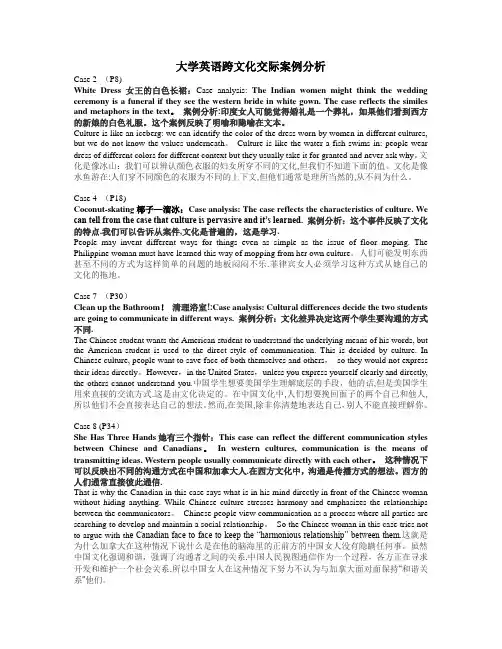
大学英语跨文化交际案例分析Case 2 (P8)White Dress女王的白色长裙:Case analysis: The Indian women might think the wedding ceremony is a funeral if they see the western bride in white gown. The case reflects the similes and metaphors in the text。
案例分析:印度女人可能觉得婚礼是一个葬礼,如果他们看到西方的新娘的白色礼服。
这个案例反映了明喻和隐喻在文本。
Culture is like an iceberg: we can identify the color of the dress worn by women in different cultures, but we do not know the values underneath。
Culture is like the water a fish swims in: people wear dress of different colors for different context but they usually take it for granted and never ask why。
文化是像冰山:我们可以辨认颜色衣服的妇女所穿不同的文化,但我们不知道下面的值。
文化是像水鱼游在:人们穿不同颜色的衣服为不同的上下文,但他们通常是理所当然的,从不问为什么。
Case 4 (P18)Coconut-skating椰子—溜冰:Case analysis: The case reflects the characteristics of culture. We can tell from the case that culture is pervasive and it’s learned.案例分析:这个事件反映了文化的特点.我们可以告诉从案件,文化是普遍的,这是学习.People may invent different ways for things even as simple as the issue of floor moping. The Philippine woman must have learned this way of mopping from her own culture。
大学英语跨文化交际案例分析

大学英语跨文化交际案例分析Case2(P8)WhiteDress女王的白色长裙:Caseanalysis:TheIndianwomenmightthinktheweddingceremonyisafuneralifth eyseethewesternbrideinwhitegown.Thecasereflectsthesimilesandmetaphorsin thetext.案例分析:印度女人可能觉得婚礼是一个葬礼,如果他们看到西方的新娘的白色礼服。
这个案例反映了明喻和隐喻在文本。
Cultureislikeaniceberg:wecanidentifythecolorofthedresswornbywomenindiff erentcultures,butwedonotknowthevaluesunderneath.Cultureislikethewateraf ishswimsin:peopleweardressofdifferentcolorsfordifferentcontextbuttheyus uallytakeitforgrantedandneveraskwhy.文化是像冰山:我们可以辨认颜色衣服的妇女所穿不同的文化,但我们不知道下面的值。
文化是像水鱼游在:人们穿不同颜色的衣服为不同的上下文,但他们通常是理所当然的,从不问为什么。
Case4(P18)Coconut-skating椰子-溜冰:Caseanalysis:Thecasereflectsthecharacteristicsofculture.Wecantellfro mthecasethatcultureispervasiveandit’slearned.案例分析:这个事件反映了文化的特点。
我们可以告诉从案件,文化是普遍的,这是学习。
Peoplemayinventdifferentwaysforthingsevenassimpleastheissueoffloormopin g.ThePhilippinewomanmusthavelearnedthiswayofmoppingfromherownculture.人们可能发明东西甚至不同的方式为这样简单的问题的地板闷闷不乐。
大学英语跨文化交际案例分析
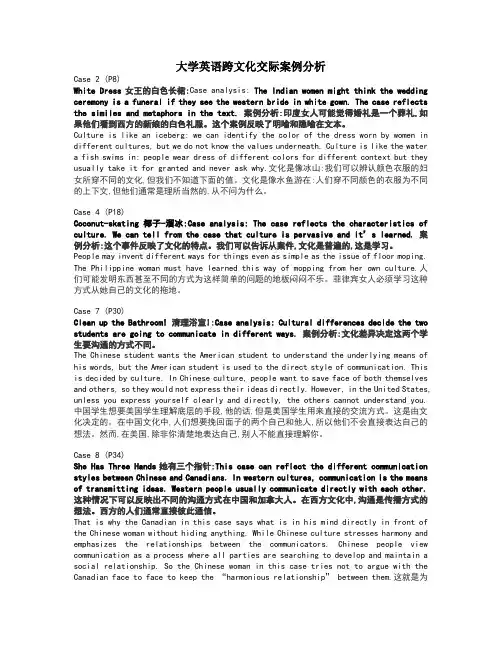
大学英语跨文化交际案例分析Case 2 (P8)White Dress女王的白色长裙:Case analysis: The Indian women might think the wedding ceremony is a funeral if they see the western bride in white gown. The case reflects the similes and metaphors in the text.案例分析:印度女人可能觉得婚礼是一个葬礼,如果他们看到西方的新娘的白色礼服。
这个案例反映了明喻和隐喻在文本。
Culture is like an iceberg: we can identify the color of the dress worn by women in different cultures, but we do not know the values underneath. Culture is like the water a fish swims in: people wear dress of different colors for different context but they usually take it for granted and never ask why.文化是像冰山:我们可以辨认颜色衣服的妇女所穿不同的文化,但我们不知道下面的值。
文化是像水鱼游在:人们穿不同颜色的衣服为不同的上下文,但他们通常是理所当然的,从不问为什么。
Case 4 (P18)Coconut-skating椰子-溜冰:Case analysis: The case reflects the characteristics of cultur e. We can tell from the case that culture is pervasive and it’s learned.案例分析:这个事件反映了文化的特点。
推荐-跨文化交际中的个人主义与集体主义

跨文化交际中的个人主义与集体主义摘要:霍夫斯泰德1980年通过实证调查研究提出了文化维度理论,其中包括四项文化维度,分别是:权利主义、个人主义/集体主义、不确定性规避、男性倾向与女性倾向。
近年来,部分学者却对霍夫斯泰德的二元个人主义/集体主义理论产生了质疑。
他们认为个人主义与集体主义在文化维度上发生了变化,个人主义价值观并非与集体主义价值观处于对立两极,而是呈现出s维度的特征。
关键词:个人主义;集体主义; s维度论价值观念与文化是密切相融的,不同文化背景下的人会持有不同的价值观念。
集体主义与个人主义,作为不同文化的产物,集中体现了东西方价值观念的差异。
随着跨文化交际的发展和经济文化等方面实现全面的全球化,在一个文化背景下,可能存在多种而不是唯一的价值观念,当然在多种的价值观念中,会有一种价值观是作为主流价值观存在的,并且与其他的价值观共存。
二、s维度论的内涵霍夫斯泰德1980年出版了culture’s consequences,在这本书中总结了比较文化差异的四大维度:个人主义/集体主义,权力差距,不确定性规避,男性倾向与女性倾向。
其中个人主义,集体主义一直受到广大学者广泛的关注和运用,很多学者一直认同霍夫斯泰德的二元个人主义/集体主义维度,认为个人主义和集体主义是文化维度上的两极,非此即彼。
然而1990年,当安迪斯对这两种倾向进行实证性研究时发现,个人主义和集体主义并没有表现出必然的相关性。
他的研究强调了文化内的多样性,即在同一文化背景的人群中一部分表现得既个人主义又集体主义,一部分既不个人主义又不集体主义,还有一部分要么个人主义要么集体主义。
而近年来,部分学者认为个人主义与集体主义在这一文化维度上发生了变化,并呈现出s维度的特征。
太极理论和太极图所表征的是事物阴阳平衡、相互转化、相互渗透的原理。
跨文化交际体系中的个人主义与集体主义同样也处于一个太极之中,它们是冲突与和谐的统一体,二者之间有着相互依存和相互制约的关系,也就是常说的“相生相克”。
2021个体主义-集体主义观下的语言交际范文1
2021个体主义-集体主义观下的语言交际范文 在跨文化交际中,因价值观的不同而导致来自不同文化背景的人们交际失败的事例不胜枚举。
如果交际双方都了解对方的价值观,就会使交流变得容易些。
因此,认识和了解价值观对语言交际的影响可以减少跨文化交际的失误。
个体主义-集体主义价值观体现了中西方价值观的基本差异,影响着人们的语言交际。
一、价值观的概念 学者Hofstede认为价值观是"喜欢某种事态而不喜欢另一种事态的大致倾向".人类学家Kluckhohn认为价值观是"个人或群体所特有的一种显型或隐型的认为什么是可取的观念,这一观念影响人们从现有的种种行动模式、方式和目的中做出选择".跨文化交际学者Samovar和Porter认为:"价值观通常是规定性的,告诫人们什么是好的和坏的,什么是正确的和错误的,什么是真实的和虚假的,什么是正面的和反面的,等等。
由此看出,价值观是决定人们所持看法和所采取行动的根本出发点。
文化的核心是价值观,价值观与交际是支配和反映的关系。
价值观决定人们如何进行交际。
无论是语言交际、非语言交际或是社会交往,无一不受到价值观的支配(胡文仲,1999)。
反过来,交际也直接或间接地反映人们的价值观。
荷兰学者Hofstede分离出四个衡量价值观的尺度,Hofstede划分的文化尺度包括:个体主义-集体主义;对权力距离的态度;对不确定因素的回避程度;男性-女性。
二、中西文化观念的差异---个体主义-集体主义价值观 个人主义和集体主义是体现中西文化价值观的两个基本概念。
中国价值观念中最主要的是集体主义取向,这又可分为两方面,一是群体取向,二是他人取向。
群体取向指国家、社会、集体比个人更为重要,集体利益高于个人利益。
他人取向指中国人在做事情时,多为他人考虑,以别人利益为重,较少考虑自身的需要,正如孔子所说":己欲立而立人。
"集体主义观念表达"我们"的意识强烈,表现在:个人身份建立在社会体系之上;个人在感情上依赖于组织和机构;强调对组织的归属;个人相信集体的决策,即便以牺牲个人的权利为代价。
跨文化交际第四章-集体主义vs个人主义
Individualism— being different
Collectivism—how much you can do for the group you are in
Some countries, such as the United States, Canada, Great Britain, and the Netherlands, place a high value on individualism. There cultures emphasize the worth and dignity of the individual over the group, independence rather than interdependence, and relatively few social obligations.
Individuals can do whatever they want, and their “freedom” and their “rights” are necessary values.
They build contracts to protect their rights from others and to protect their dignity.
(1) Other’s behavior is explained by personal traits. (2) One’s success is attributed to his own ability. (3) Self is defined as individual entity. (4) One knows more about self than others. (5) Achievement is made for one’s own sake. (6) Personal goals are over group goals. (7) Self-assuredness is valued. (8) Autonomy and independence is valued. (9) dependence on others is avoided. (10) One bears casual connections to many groups. (11) Task completion is important. (12) One has few obligations to others. (13) Confrontation is acceptable.
跨文化交际案例集体主义文化和个人主义文化课件
各国的福利政策存在 差异,例如北欧国家 的福利水平较高,而 南欧国家的福利水平 相对较低。
在跨文化交际中,需 要对各国的福利政策 进行了解和研究,以 便更好地适应和融入 当地社会。
03
个人主义文化案例
案例一:美国社会的个人主义价值观
总结词
美国社会的个人主义价值观强调个人的独立、自主和自我实 现,鼓励个人奋斗和竞争,以及对个人权利和自由的尊重。
适应能力 面对不同文化背景的人,可能需要调整自己的交际方式,以更 好地适应对方的交际风格。
对未来研究的展望
深入探讨
可以进一步深入研究集体主义和个人主义文化对跨文化交 际的具体影响,例如在沟通策略、决策方式、团队合作等 方面的差异。
跨学科合作 鼓励跨学科的研究合作,例如心理学、管理学、社会学等 领域的学者可以与语言学、传播学等领域的学者合作,共 同探讨跨文化交际的问题。
详细描述
澳大利亚的社会文化中强调个人的独立和自主,鼓励人们自我决策和追求自己的 目标。这种独立精神也体现在澳大利亚的教育、商业和政治领域。然而,这种独 立精神也可能带来一些问题,如社会联系的减弱和孤独感的增加。
案例三:加拿大的社会保障制度
要点一
总结词
要点二
详细描述
加拿大的社会保障制度强调个人的权利和需要,通过 政府提供的福利和服务来满足这些权利和需要,以及 对平等和公正的追求。
跨文化交际
指不同文化背景的人们之间的交流 和沟通。
集体主义文化与Biblioteka 人主义文化的对比0102
03
价值观
集体主义文化重视集体价 值观,个人主义文化重视 个人价值观。
社会关系
集体主义文化强调社会联 系和互相依赖,个人主义 文化强调个人独立和自主。
【跨文化交际】东西方差异之个人主义和集体主义_(1)
中国古代社会是建立在农业经济基础之上的,重家庭和血缘关系,在“天人合一”(“天人合一”的思想概念最早是由庄子阐述,后被汉代思想家、阴阳家董仲
Arkey Works
Arkey Works
中国结语arkeyworksarkeyworksarkeyworks中国古代社会是建立在农业经济基础之上的重家庭和血缘关系在天人合一天人合一的思想概念最早是由庄子阐述后被汉代思想家阴阳家董仲中国古代社会是建立在农业经济基础之上的重家庭和血缘关系在天人合一天人合一的思想概念最早是由庄子阐述后被汉代思想家阴阳家董仲中国古代社会是建立在农业经济基础之上的重家庭和血缘关系在天人合一天人合一的思想概念最早是由庄子阐述后被汉代思想家阴阳家董仲arkeyworks
Collectivistic 东西方文化探讨之二
集
个
体
or
人
主
主
义
义
individualistic Arkey Works
集体主义
——中国
Arkey Works
中国古代社会是建立在农业经济基 础之上的,重家庭和血缘关系,在“天 人合一”(“天人合一”的思想概念最 早是由庄子阐述,后被汉代思想家、阴 阳家董仲舒发展为天人合一的哲学思想 体系,并由此构建了中华传统文化的主 体。在中国思想史上,“天人合一”是 一个基本的信念。季羡林先生对其解释 为:天,就是大自然;人,就是人类; 合,就是互相理解,结成友谊。)的思 想影响下,人们对集体或群体怀有很强 的归属感,这样就形成了集体主义。
Arkey Works
集体主义和个体主义在生活上的差异
在中国,无论什么筵席,不管是出于什么目的,都只 会有一种形式——团圆式。团圆式就是整个家族和所有 朋友团团围坐,共享一席。同时,筵席上一般都要用圆 桌。这在一定程度上可以营造一种团结、礼貌、共趣的 和谐氛围。从另一个角度看,这个团圆式完全符合我们 国家“大一统”的普遍文化现象,反映了中国社会哲 学——“和”对中国的影响。