
英语九大词性归纳
英语九大词性归纳-CAL-FENGHAI.-(YICAI)-Company One1九大词性1. noun(n.) 名词:to describe a person or thing②可数名词不规则变化A、单复数同形:deer-deer fish-fish sheep-sheepB、词尾发生变化:ox-oxen child-childrenC、内部单词发生变化:foot-feet tooth-teeth goose-geese woman-women man-menmouse-mice policeman-policemenD、表示某国人时,中日不变,英法变,其他国家加s:(1)Chinese-Chinese Japanese-Japanese(2)Frenchman- Frenchmen Englishman- Englishmen(3)German-Germans Russian-Russians Americans③特殊情况i. 另一些名词本身即是复数形式,不可用作单数。
如:people,police,trousers,pants,clothes,scissorsii. 有些名词以s结尾,但不是复数形式,如:news,maths,physics,politicsiii. 有些名词既是可数名词又是不可数名词,如:room(空间)—a room(房间) work(工作)—works(著作)(2)不可数名词:(前面不能用a,an等来修饰)①到目前为止我们所学的不可数名词有:A 液体类:water:juice,tea , soup ,milk,cola,coffeeB 肉类:meat,beef, pork, muttonC 粉末类:breadD 抽象名词类news,information,money,advice,friendship,work,homework,housework schoolwork ,help ,fun,health,priceE 食物类:food, broccoli, rice, porridge, junk food ,tofu②不可数名词计量的表达:A个数单位词:piece (张、片、块、条),如:a piece of newsB 容器单位词:bottle(瓶),bag(包),box(盒、箱)如:a bottle of milkC 类别单位词:kind( 种、类)D 度量衡单位词:kilo(千克、公斤)▲翻译下面的词组:▽当一个名词作定语说明另一个名词时,这个名词一般用单数。
eg.an apple tree,five apple trees,a girl friend,two girl friends,a twin sister 但是,当man和woman作定语修饰复数名词时,就要用其复数形式。
eg.two men teachers,three women doctors2. verb(v.) 动词eg. do, make, go, take, bring英语中动词根据其后是否可以加宾语又分为:Vt. (及物动词) eg. speak, give, singVi. (不及物动词) eg. run, work英语中动词有5中形态:原形,第三人称单数形式,过去式,过去分词(用于完成时或被动语态中),现在分词do does did done doingwork works worked worked workingII. 动词过去式和过去分词变化III⑴时态(找时间标志词):一般现在时:结构:am / is / are play / plays判断:sometimes, often, usually, always, every,在if / as soon as等复合句中,主将从现1. If you________ hard, you will pass the exam.A. studiesB. studyC. will studyD. is studying现在进行时:结构:am / is /are playing判断:Look, Listen, now, Where’s sb?典型例题:1. --Where ’s mom I want to go shopping with her.--She______ in the bedroom.A. readsB. readC. is readingD. has read一般过去时:结构:was / were played判断:yesterday, last…, …ago及语境.典型例题:1. --You look tired. What did you do yesterday--I ______ till night.A. worksB. worked一般将来时:结构:will play判断:tomorrow, next…及语境,在if /as soon as等主从复合句中,主将从现 .典型例题:1. She ________ me as soon as she gets there.A. callsB. callC. calledD. will call过去进行时:结构: was /were playing判断: at that time, at this time ,yesterday ,by+过去时间,by the end of+过去时间常用于带有when/ while 的主从复合句中.典型例题:1. Mom______ in the kitchen when I got home.A. cooksB. cookC. was cookingD. cooked2. I________ my homework at this time yesterday .A. didB. doC. will doD. was doing现在完成时(动作从过去持续到现在):结构: has / have played判断: just, already, yet, ever, never, so far(到目前为止)次数(once,twice)since+时间点, for + 时间段, how long…典型例题:1. He______ in the factory for two years.A. worksB. workedC. is workingD. has worked⑵被动语态,(主语与谓语构成被动关系):主语+be(am/is/was/were/will be)+done如:① The hole should(dig) deep enough.② The students (tell) to clean the classroom.情态动词(can (could) ,may (might), must ,shall (should), will (would), dare (dared)敢 , need 等,另外,have to、had better也当作情态动词使用)后加动词原形▲(1)ATom _________ (come) from America. Now he (teach) English in a middle school in Beijing. In his free time, he would like _ _______ (go) in for a traditional sport so that hecan (learn) more about Chinese.BNow, people use satellites to do many things. So far, man (invent) four kinds of satellites. One of them (use) to study the weather.(2)AHenry, a 14-year-old boy, used (be )too fat to play sports. He went to the doctorand (tell) to have a balanced diet. So he tried ___ ____ (not eat) too much meat or sugar because they might make him get heavier. Now he isn’t fat at all. He does sports every dayand(become) a member of the school soccer team. Next week Henry will take part in the school sports meet.BMy mother is very kind and easygoing, she helps me a lot. I (take) good care of in mydaily life by her. When I’m in trouble, she always encourages me to face my difficulties. With her help, I (become) a top student in my class already. I believe she (be) proud of me in the near future.3. adjective(adj.)形容词eg. good, beautiful, nice, happy, long英语中形容词有两种形式:比较级和最高级 eg. good- better- best nice- nicer- nicest2.形容词和副词比较级、最高级的用法 (形容词最高级前面要加定冠词the)(1)形容词和副词比较级的用法①用于两者比较,表示“比…更…”(than前加比较级):eg.I am two years older than my little sister.②用于两者之间的同级比较,表示“…和…一样”( as+原级+as…):eg.Bill is as funny as his father.③表示甲在某方面不如乙:“A+系动词+not +as/so+形容i司原级+as十B”(as/so+原级+as)eg.These books aren’t as interesting as those.④表示某个范围内的三者相比:“the+最高级+of短语(比较范围)+复数名词”eg.Penny is the tallest of these girls. .Penny是这些女孩中最高的一个。
英语词性(完整版)

动词 verb 系v.动(2词)(系是“联系”的意思, 把主语跟其特征或状态联系在一起)
动词的分类She is beautiful. I am a teacher.
They are in the room. be动词
实义动词:
有实际含义(run
Dinner smells good.
感ju观mp
am is are sleefpeel tshminekll soreupnrdesentatste
one
something somebody someone
anything anybody anyone
nothing nobody no one
everything everybody everyone
this that these those such
same
each other(两者之间) one another(三者之
the bag
the heavy bag an orange
a juicy orange
the
the a book
an
形容词、副词
形容词 adjective adj.
XX的: quick lucky 修饰名词: 什么样的东西或什么样的人 I think I'm a lucky guy.
副词 adverb adv.(1)
reflect)
I can speak English.
may (might) 可能 need 需要
系是“联系Sh”e w的ill意co思m,e把to主se语e u跟s.其特征或m状u态st 联必系须在一起 dare 敢
系动词:
I must go home now.
英语各种词性一览表(实用性英语)
英语各种词性总结(非常实用的英语)第一章冠词疑词是一个虚词,须置于名词之前,限定名词的定义,表示名词所表示的人或物。
冠词分为不定冠词(a,an)和定冠词(the)以及零冠词,(即在某些场合不使用冠词)一、不定冠词a、an的用法:1.通常在辅音或半元音前使用a,在元音前使用an。
例:a:Taylor was an 8-year-old daughter who has a gift for painting. [浙江高考题] b:Having graduated form a university, she found it hard to find an ordinary job.c:Data phone is a cellular phone that allows images, text and other visual data.2.使用在名词前表数量―—‖或表范指。
例:a:Rome was not built in a day.b:If you grow up in a large family, you are more likely to develop the ability to get on well with others.注:此时a与one的区别:1、more than a / an more than one例:It’ll take me more than an hour to finish the work.这项工作我要用一个多小时完成。
(不超过两小时)It’ll take me mo re than one hour to finish the work.这项工作不是我一个小时能完成的。
(要两个小时甚至更多的时间)3.表示―一个……另一个…‖之意时用而不用例:O ne man’s meat is another man’s position人各有志。
另:在下列情况下,a,one可以互换:例:in a/one word简而言之,a/one hundred percent百分之百,十足4.、表类别:Generally speaking an adult runs faster than a child.一般来说,成年人比小孩距得块。
(完整版)英语单词词性大全(20201018183532)

英语单词词性大全对单词词性的了解有助于语法的学习英语单词词性n. 名词v. 动词pron. 代词adj.形容词adv.副词num.数词art. 冠词prep. 介词conj. 连词interj. 感叹词英语词性缩写prep = 介系词;前置词,preposition 的缩写pron = 代名词,pronoun 的缩写n二名词,noun的缩写v = 动词,兼指及物动词和不及物动词,verb 的缩写conj = 连接词,conjunction 的缩写s = 主词sc = 主词补语o = 受词oc = 受词补语vi = 不及物动词,intransitive verb 的缩写vt = 及物动词,transitive verb 的缩写aux.v = 助动词,auxiliary 的缩写a = 形容词,adjective 的缩写ad =副词,adverb的缩写art = 冠词,article 的缩写num二数词,numeral的缩写int = 感叹词,interjection 的缩写u =不可数名词,un cou ntable nou n的缩写c =可数名词,cou ntable nou n的缩写pl = 复数,plural 的缩写语气词int.缩写词abbr.abbr abbreviatio n略)略语adj, adjjadjective(s)(形)形容词adv, advvadverb(s)(副)副词adv partadverbial particle 副接)副词接语aux auxiliary(助)助动词cn coun table nou n可数)可数名词conj conjun cti on(连)连接def art defi nite article(定冠)定冠词egfor example 例如)例如esp especially尤指)尤指etc and the others等)等等ie which is to say(意即卩)意即in def art in defi nite article(不定冠词)不定冠词inf infinitive(不定词)不定词int in terjecti on(感)感叹词n noun(s)(名)名词neg negative(ly)(否定)否定的(地)part adj participial adjective(分形)分词形容词pers person人称)人称pers pron personal pronoun人称代)人称代名词pl plural(复)复数(的)pp past participle (过去分词)过去分词pref prefix(字首)字首prep preposition(al)(介词)介词,介系词,介词的pron pronoun (代)代名词pt past tense过去)过去式sb somebody某人)某人sing sin gular(单)单数(的)sth someth ing某事物)某物或某事suff suffix(字尾)字尾un un cou ntable nou n不可数)不可数名词US America(n)(美)美国(的)vverb(s)(动)动词[VP]Verb Pattern(动型)动词类型v iverb intransitive(不及物动词)不及物动词vt verb transitive(及物动词)及物动词除这十大类词之外,英语还另有判断词yes和no。
(完整版)英语十大词性及其详细讲解.docx
(完整版)英语十大词性及其详细讲解.docx.一、词性的分类词类又叫词性,英语单词根据其在句子中的功用,可以分成十个大类。
1.名词 noun n. student学生2.代词 pronoun pron. you你3.形容词 adjective adj. happy高兴的4.副词 adverb adv. quickly迅速地5.动词 verb v. cut 砍、割6.数词 numeral num. three三7.冠词 article art. a 一个8.介词 preposition prep. at在 ...9.连词 conjunction conj. and和10. 感叹词 interjection interj. oh哦前六类叫实词,后四类叫虚词。
二、名词名词复数的规则变化名词的格在英语中有些名词可以加“‘ s”来表示所有关系,带这种词尾的名词形式称为该名词的所有格,如:a teacher ’s book 。
名词所有格的规则如下:1)单数名词词尾加“ 's”,复数名词词尾没有s,也要加“'s”,如the boy ‘s bag男孩的书包,men ’s room男厕所。
2)若名词已有复数词尾-s,只加“'”,如:the workers’struggle工人的斗争。
三、代词大多数代词具有名词和形容词的功能。
英语中的代词,按其意义、特征及在句中的作用分为:人称代词、物主代词、指示代词、反身代词、相互代词、疑问代词、关系代词、连接代词和不定代词九种人称代词的用法:I saw her with them,at least , I thought it was her.我看到她和他们在一起,至少我认为是她。
(her 做宾语, them 做介词宾语,her 作主补)a. -- Who broke the vase?--谁打碎了花瓶?b. -- Me.--我。
并列人称代词的排列顺序1)单数人称代词并列作主语时,其顺序为:第二人称 you第三人称he/she ;it第一人称I如: You, he and I should return on time.2)复数人称代词作主语时,其顺序为:第一人称 we第二人称you第三人称they反身代词指示代词指示代词分单数(this / that )和复数(these / those )两种形式,既可作限定词又可做代词,疑问代词指人: who ,whom ,whose指物:what既可指人又可指物:which四、冠词冠词是位于名词或名词词组之前或之后,在句子里主要是对名词起限定作用的词。
九大词类

第一课英语常识一.九大词类:名词,动词,代词,形容词,副词,数词,冠词,介词,连词二.七大成分:主,谓,宾,表,定,状,补三.六大从句1.名词2.动词3.代词(1)人称代词(2)物主代词(3)反身代词(4)相互代词 each other, one another(5)指示代词this, that, these, those, one, such, so(6)不定代词:every, each, other, another, either, neither, no one, none, no, all, both, many, much, some, any, a few, few, a little, little, some-, any-,every-(-one,-body,- thing)(7)疑问代词:who, whom, whose, which, what(8)连接代词:who, whom, whose, which, what, whoever, whomever, whosever, whichever ,whatever(9)关系代词:who, whom, whose, which, that4.形容词5.副词(1) 时间副词:now, then那时, soon很快, ago, recently, lately, later, before, early, today, tomorrow, yesterday, tonight, suddenly, immediately, already, just, just now刚刚等。
如:(2) 地点副词:here, there, up, down, away, nearby, home, ahead, abroad, indoors, overseas, upstairs, downstairs等。
(3) 方式副词:表示行为方式的副词大多以-ly结尾,常见的有quietly, heavily, warmly, carefully, happily, politely, angrily等。
英语语法的词性及简单用法分类
英语语法
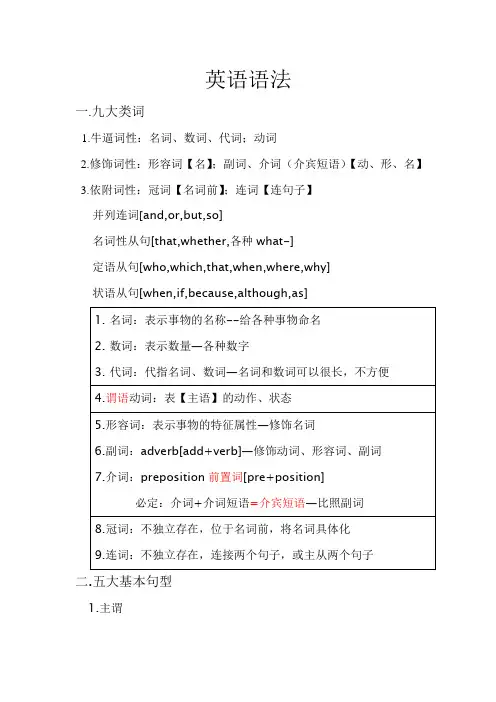
一.九大类词
1.牛逼词性:名词、数词、代词;动词
2.修饰词性:形容词【名】;副词、介词(介宾短语)【动、形、名】
3.依附词性:冠词【名词前】;连词【连句子】
并列连词[and,or,but,so]
名词性从句[that,whether,各种what-]
定语从句[who,which,that,when,where,why]
状语从句[when,if,because,although,as]
二.五大基本句型
1.主谓
2.主系表
3.主谓宾
4.主谓双宾
5.主谓宾宾补
三.六大句子成分
4.定语:功能是,修饰限定某个名词,说明名词的特征属性。
一般
情况下,主要是形容词。
定语从句-形容词性从句
5.状语:功能是,表明[动词、形容词、副词]的程度状况,或[整个
句子]的时间、地点、原因等状况。
状语从句-副词性从句6.补语/表语:宾补[补充说明]宾补,表语[补充说明]主语。
英语中常用词性
英语中常用词性
一、名词(Noun)
名词是指代人、事物、地点或概念的词,可以表示实物或
抽象事物。
二、动词(Verb)
动词是表示动作、变化或状态的词,对句子起到核心作用。
三、形容词(Adjective)
形容词用来描述名词或代词,表示人、事物或地方的特征
或性质。
四、副词(Adverb)
副词用来修饰动词、形容词或其他副词,表示程度、时间、地点等概念。
五、代词(Pronoun)
代词用来代替名词,避免重复使用特定的名词。
六、连词(Conjunction)
连词用来连接词语、短语或句子,使句子结构更加连贯。
七、介词(Preposition)
介词用来表示名词与其他词语之间的关系,通常与名词或
代词一起构成介词短语。
八、数词(Numeral)
数词用来表示数字,包括基数词和序数词两种类型。
九、感叹词(Interjection)
感叹词用来表示强烈的情感或感叹,通常独立成句。
以上是英语中常用的九种词性,它们在句子中扮演不同的
角色,共同构成了丰富多彩的英语语言。
在学习和运用英语时,了解每种词性的特点和用法对提高语言表达能力至关重要。
初中英语语法知识点归纳全套词性
初中英语语法知识点归纳全套词性初中英语语法知识点归纳全套词性主要包括名词、动词、形容词、副词、代词、数词、冠词、介词和连词等。
以下是对这些词性的简要介绍和归纳:1. 名词 (Nouns):- 名词是表示人、事物、地点或概念的词。
- 名词分为可数名词和不可数名词。
可数名词有单数和复数形式,如apple(苹果)和apples(苹果们)。
- 不可数名词通常没有复数形式,如water(水)。
2. 动词 (Verbs):- 动词表示动作或状态。
- 动词有多种时态,如一般现在时、过去时、将来时等。
- 动词的时态和语态变化丰富,例如walk(走)变为walked(走过)表示过去时态。
3. 形容词 (Adjectives):- 形容词用来描述或修饰名词,表达性质或特征。
- 形容词有比较级和最高级形式,如big(大的)变为bigger(更大的)和biggest(最大的)。
4. 副词 (Adverbs):- 副词用来修饰动词、形容词或其他副词,表达方式、程度、时间等。
- 副词也有比较级和最高级,如quickly(快地)变为more quickly(更快地)。
5. 代词 (Pronouns):- 代词用来代替名词,避免重复。
- 代词包括人称代词(如he, she, it)、物主代词(如his, her, its)、反身代词(如myself, yourself)等。
6. 数词 (Numerals):- 数词表示数目或顺序。
- 有基数词(如one, two, three)和序数词(如first, second, third)。
7. 冠词 (Articles):- 冠词用于名词前,表示特指或泛指。
- 英语中有不定冠词a/an和定冠词the。
8. 介词 (Prepositions):- 介词表示名词与其他词的关系,如空间、时间、方式等。
- 常见的介词有in, on, at, by, with等。
9. 连词 (Conjunctions):- 连词用来连接词、短语或句子。
(完整版)英语十大词性及其详细讲解.docx
.一、词性的分类词类又叫词性,英语单词根据其在句子中的功用,可以分成十个大类。
1.名词 noun n. student学生2.代词 pronoun pron. you你3.形容词 adjective adj. happy高兴的4.副词 adverb adv. quickly迅速地5.动词 verb v. cut 砍、割6.数词 numeral num. three三7.冠词 article art. a 一个8.介词 preposition prep. at在 ...9.连词 conjunction conj. and和10. 感叹词 interjection interj. oh哦前六类叫实词,后四类叫虚词。
二、名词名词复数的规则变化名词的格在英语中有些名词可以加“‘ s”来表示所有关系,带这种词尾的名词形式称为该名词的所有格,如: a teacher ’s book 。
名词所有格的规则如下:1)单数名词词尾加“ 's”,复数名词词尾没有s,也要加“'s”,如the boy ‘s bag男孩的书包,men ’s room男厕所。
2)若名词已有复数词尾-s,只加“'”,如:the workers’struggle工人的斗争。
三、代词大多数代词具有名词和形容词的功能。
英语中的代词,按其意义、特征及在句中的作用分为:人称代词、物主代词、指示代词、反身代词、相互代词、疑问代词、关系代词、连接代词和不定代词九种人称代词的用法:I saw her with them,at least , I thought it was her.我看到她和他们在一起,至少我认为是她。
(her 做宾语, them 做介词宾语,her 作主补)a. -- Who broke the vase?--谁打碎了花瓶?b. -- Me.--我。
并列人称代词的排列顺序1)单数人称代词并列作主语时,其顺序为:第二人称 you第三人称he/she ;it第一人称I如: You, he and I should return on time.2)复数人称代词作主语时,其顺序为:第一人称 we第二人称you第三人称they反身代词指示代词指示代词分单数(this / that )和复数(these / those )两种形式,既可作限定词又可做代词,疑问代词指人: who ,whom ,whose指物:what既可指人又可指物:which四、冠词冠词是位于名词或名词词组之前或之后,在句子里主要是对名词起限定作用的词。
专题02 名词-2023年高中英语九大词性分类与用法详解
然而,时间、距离、太阳、地球、月亮、江河、 海洋、船只、国家、城市、团体机构等名词也 可以用~’s属格。
如:today’s newspaper; the city’s transportation
① 一般的名词,包括不以s结尾的复数名词, 在词后加’s。如:the children’s book
good好处
goods货物
water水
It is the custom of foreigners to do so.
Did you have any trouble with the customs?
I hurt my arm. There’s a lot of blood.
Take up arms against the enemy.
2. of~属格: 多用于无生命现象的名词, 也可用于有生命现象 的名词;当一个名词有较长的定语时,就只能用 of~短语来表示所有关系。 如:the cover of the book; a toy of Li Ping’s younger brother
3.双重属格: 既有~’s的属格,又有of~的属格。通常~’s属 格表示所有关系,of属格表示部分与整体的关系。 如:a friend of my father’s; a book of Tom’s
7.部分名词习惯用法
(1)绝对不能与不定冠词连用的名词
weather天气
fun 乐趣
luggage行李
information信息
word/news消息
bread面包
space天空 advice建议 wealth财富
例:Beyond the stars,the astronaut saw nothing but space.