
人教版新目标七年级上册英语导学案Unit 6 Section A(1a-2d)
人教版新目标七年级上册英语导学案Unit 6
课题:Unit 6 Do you like bananas?
第一课时Section A (1a-2d)
学习目标:
1、重点单词
banana(n.) 香蕉;hamburger(n.) 汉堡包;tomato(n.) 西红柿;ice-cream(n.) 冰激凌;salad(n.) 沙拉;strawberry(n.) 草莓;pear(n.) 梨;milk(n.) 牛奶;bread(n.) 面包;birthday(n.)生日;dinner(n.) 正餐;week(n.) 周;星期;food(n.)食物;sure(adv.)当然;肯定;一定;vegetable(n.) 蔬菜;fruit(n.) 水果;right(adj.)正确的;适当的;apple(n.) 苹果;then(adv.)那么
2、重点词组
next week下周;think about考虑;how about怎样;sounds good 听起来好3、重点句式
(1)—— Do you like salad?——你喜欢沙拉吗?
——No, I don’t. / Yes, I do.——不,我不喜欢。
/是的,我喜欢。
(2)Let’s think about the food.让我们考虑一下食物。
(3)Jhon likes hamburgers.约翰喜欢汉堡包。
重点难点:
重点
1).含有like的一般疑问句句型及简略回答。
2).部分食物名称的记忆。
3).听力训练
难点
能根据所学内容自己编对话。
导学设计:
1.Do you like salad?——你喜欢沙拉吗?
——No, I don’t. / Yes, I do.——不,我不喜欢。
/是的,我喜欢
【归纳】like意为“______”,用作及物动词,后面可跟三种结构:
(1) like +sb./sth.,意为“______”。
例如:他不喜欢沙拉。
He _____ ______ salad.
(2) like to do / doing sth.意为“______”。
例如:我们喜欢打篮球。
We like _____ basketball. 那个男孩喜欢玩电脑游戏。
The boy likes _____ computer games. 表示爱好或经常性的情况时,多用like doing something,表示一次性或尚未发生的动作或对某次具体活动的爱好时,用like to do something。
例如:他喜欢踢足球,但他不喜欢今天踢足球。
He likes _____ football, but he doesn’t like ______ football today.
(3) like sb. to do sth.意为“______”。
例如:王老师喜欢我们在课堂上问她问题。
Miss Wang likes us _____ _____ her questions in class.
2. Let’s have strawberries and apples.让我们吃草莓和苹果吧。
【归纳】动词have意为“吃,喝”,是实义动词。
例如:我们七点钟吃早饭。
We ____ breakfast at seven. 。
have 作此义解时,变成疑问句和否定句时必须用助动词_____。
例如:你每天在家吃午饭吗? ____ you _____lunch at home every day? 知识巩固
Ⅰ.写出下列名词的复数形式
hamburger_____________ tomato_____________ orange______________
banana________________ strawberry_______________ pear____________
Ⅱ.根据句意用所给词的适当形式填空
1. Pears and strawberries are _______(fruit).
2. Let us _______(play) football.
3. She wants to eat ___________(vegetable).
4. He has _________(banana) and _______(salad) for lunch.
5.My uncle likes _____________(strawberry).
Ⅲ.单项选择
1. I like ____.
A. tomato and salad
B. tomatoes and chicken
C. tomato and ice-cream
D. a tomato and egg
2. —____ his sister like apples?
—________.
A. Is; Yes, he is
B. Does; Yes, she does
C. Do; No, he doesn't
D. Are; No, he doesn't
3. —What do we have for dinner?
—____ hamburgers and fruit?
A. Let's have
B. How are
C. What about
D. Where are
4.—Let's eat some pears.
—____
A. Sounds good.
B. Thank you.
C. Do you like pears?
D. Where are pears?
5. I have ____ apple and ________ milk for breakfast.
A. an; a
B. a; an
C. an; /
D. a; a
Ⅳ.根据汉语意思完成下列句子。
1. 那些是西红柿。
Those ____ __________.
2.—你父亲喜欢体育运动吗?
—是的,他喜欢。
—______ your father _____ sports?
—_____, he _____.
3.—你喜欢冰激凌吗?
—不,我不喜欢。
—_____ you like_________?
—____, I _____.
4.八个梨子放在桌子上。
______ ______ _____on the table.
5. 我的妹妹和我不喜欢汉堡包。
My sister and I _______ ______ ______________.
参考答案
导学设计
1. 喜欢/喜爱,(1) 喜欢某人或某物,doesn’t lik e, (2) 喜欢做某事,playing, to play,playing, to play (3) 喜欢某人去做某事,to ask
2.have, do/does, Do, have
知识巩固
Ⅰ.hamburgers ;tomatoes ;oranges; bananas; strawberries; pears
Ⅱ.1.fruit 2.play 3.vegetable 4.bananas; salad 5. strawberries
Ш.1-5 BBCAC
Ⅳ.1.are tomatoes 2.Does;like;Yes; does 3.Do;ice-cream; No; don’t 4.Eight pears 5.don’t like hamburgers.。
Starter Unit1 Section A(1a-2d)教学设计七年级英语上册(人教版2024)

Starter Unit 1 Hello 课时教学设计第1课时教学设计授课时间:课题Section A (1a-2d)How do greet people?课型新授课(听说课)课时1主备人审核人语篇研读【What】本课语篇是新学期开学,新同学和老师之间互相问候开展对话。
对话中主要进行了问候、询问姓名、如何拼写以及告别等信息。
【Why】新学期开学同学们复习过去所学的同时,能认识教材的主线任务;让学生复习如何打招呼并询问对方姓名,迈出认识新老师、新同学、新朋友的第一步;让学生在不同情境下使用的打招呼交际用语,同时增进老师和学生之间的了解。
【How】通过阅读单元的主题图让学生了解本教材的主线人物和教材板块的设计,其中包括中国学生和外国学生以及学校老师,学生能使用简单的问候语和告别语来完成简单的对话。
学情分析K(Known) 已知W(Want) 想知L(Learned)已学认识26个英文字母的发音以及一些简单的日常用语和单词。
如何有效、快速地记忆新单词,掌握简单的问候语,学会在真实情境中应用,提高听说读写的能力。
掌握了26个字母的准确发音和规范书写方式。
掌握了简单的英语问候语,学会了自我介绍。
教学重难点重点:掌握26个英文字母的准确发音与规范书写;使用Hello/Hi/Good morning等表达去问候他人,介绍自己。
难点:在不同场景下熟练使用所学语言,得体、礼貌地问候他人、介绍自己。
学习目标1.能正确认读、书写教材中七个主线人物的名字,了解教材单元的构成。
2.能听辨并掌握26个英文字母的准确发音与规范书写;理解常见字母缩略词,以及字母排序在日常生活和学习中的常见运用,学好切分字母的音。
3.能创编一段对话,熟练使用“Hello”,“Hi”或“Good morning”等表达问候他人或对他人问候做出应答,介绍自己并询问对方姓名。
评价评估维度评估标准评估方式评估主体First, introduce myself to the class. Then let students introduce each other.Know each other by introducing themselves.conclusion about the greetings.3.Ask Ss to look at the picture. Match the names with the faces.4.Please work in pairs and come to the front and introduce the main character in our textbook.3.Look at the picture and match the names with the faces.Write their own name on the first page of their own book in correct spelling.4.Work in pairs. Come to the front and introduce the main characters in our textbook.Let Ss listen and say the letter. Then practice writing them. Listen and circle the letters they hear.First, listen and say the letters in 2a. Then, watch a short video and learn how to write the letters correctly. Repeat the letters one by one after the video. Finally, listen and circle the letters you hear in 2a.Ask Ss to observe the picture and ask question.Guide Ss to read the conversations quickly and circle some key words and predict the answers. Then play the recording and check the answers.Look at the picture in 2c and make some prediction. Listen to three conversations and fill in the blanks with the correct sentences in the box. Then role play the conversations.Encourage Ss to work with their partners or group members and greet each other. Provide the structure of the conversation.设计意图:帮助学习整体感知对话内容,并培养学生准确找出关键信息的能力。
人教版新目标七年级英语上册导学案(1-3单元)

人教版新目标七年级英语上册导学案Starter Unit1 Good morning!1a—2e (第1课时)【学习目标】1. 识别和掌握八个人名。
2. 学会早上见面打招呼的用语。
3. 正确认读和书写Aa-Hh八个字母。
4. 了解一些常用缩略字的含义。
【重点、难点】1. Hello! Good morning!2. Alice, Bob, Cindy, Dale, Eric, Frank, Grace, Helen八个人名的掌握。
3.A--H八个字母的学习,能认读,会书写。
【导学指导】温故知新通过听唱英语歌曲“Good morning!”开始英语教学。
看卡片学习英语名字,八个人名Alice, Bob, Cindy, Dale, Eric, Frank, Grace, Helen 。
介绍Hello, Hi 用于见面时打招呼。
Good morning! 用于早上见面问好。
自主互助学习1.观看课本插图,听一听,读一读课本1a 。
2.小组练习打招呼,教师巡回指导。
A: Hello, Frank!B: Hello, Alice!A: Good morning, Frank! (早上好,Frank)B: Good morning, Alice! ( 早上好,Alice)3.学习字母Aa Bb Cc Dd Ee Ff Gg Hh 的正确发音。
Aa /ei/ Bb /bi:/ Cc /si:/ Dd /di:/Ee /i:/ Ff / ef/ Gg /d3/ Hh /eit∫/4.正确书写字母。
【课堂练习】1.小组训练早上见面打招呼。
2.小组表演比赛。
3.完成句子。
______________(早上好,Helen!)______________(嗨,Bob,早上好!)4.写出下列字母的相应大小写字母。
A________ b_______ C________ D_________E_________ f________ G________ h_________5.写出下列字母相邻的字母。
Unit 6 Section A (1a-2d)练习题人教新目标七年级英语上册
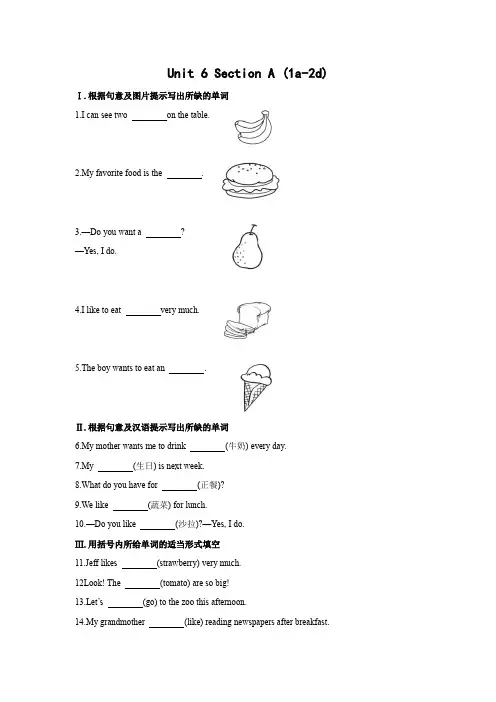
Unit 6 Section A (1a-2d)Ⅰ.根据句意及图片提示写出所缺的单词1.I can see two on the table.2.My favorite food is the .3.—Do you want a ?—Yes, I do.4.I like to eat very much.5.The boy wants to eat an .Ⅱ.根据句意及汉语提示写出所缺的单词6.My mother wants me to drink (牛奶) every day.7.My (生日) is next week.8.What do you have for (正餐)?9.We like (蔬菜) for lunch.10.—Do you like (沙拉)?—Yes, I do.Ⅲ.用括号内所给单词的适当形式填空11.Jeff likes (strawberry) very much.12Look! The (tomato) are so big!13.Let’s (go) to the zoo this afternoon.14.My grandmother (like) reading newspapers after breakfast.15.—How about (play) computer games?—That sounds great.Ⅳ.根据句意及首字母提示补全单词16.A w has seven days.17.—I think milk is healthy.—You’re r.You can drink it every day.18.My favorite f is beef and salad.19.Don’t eat too much meat.You can eat f like apples and oranges.20.—Do you like soccer?—S.I think it’s interesting.Ⅴ.单项选择()21.Jack has apple and Mike has pear.A.a; aB.an; aC.a; anD.an; an()22.Could you please get me some ? I’m hungry.A.appleB.waterC.breadD.egg()23.—What does your brother like?—He likes oranges.A.colorB.sportC.numberD.fruit()24. I like hamburgers, but my brother .A.don’t; likesB.doesn’t; doC.don’t; doesD.doesn’t; does()25.—I don’t know how to thank Mike for his help.—What about him to watch a film?A.askB.asksC.to askD.askingⅥ.按要求完成下列各题,每空一词26.I like vegetables for lunch.(对画线部分提问)you like for lunch?27.He likes ice-cream.(改为否定句)He ice-cream.28.This is a tomato.(改为复数句).29.Do you like sports stars, Jane?(作肯定回答), .30.I like oranges.(改为一般疑问句,并作否定回答)—oranges?—No, I .Ⅶ.根据汉语意思完成句子,每空一词31.比尔非常喜欢水果。
人教版初中英语七年级上册Unit 6 Section A (1a-2d)-课件

A: Do you like salad? B: No, I don’t.
A: Do you like oranges? B: Yes, I.
2b Listen again. Fill in the blanks.
2c (Imagine you are having lunch with your friend.) Practice the conversations in 2b. Give answers
that are true for you.
2d Answer the questions below and then role-play the conversation.
Do you like bananas? 1 Yes, I do.
3
Do you like oranges? Yes, I do.
Practice
1c Practice the conversations above with your
partner. Then make you own conversations.
A: I like _h_a_m__b_u_r_g_e_rs__. Do you like _h_a_m_b_u_r_g_e_r_s____? B: Yes, I do. A: Do you like_t_o_m_a_t_o_e_s ? B: No, I don’t like___to_m__a_t_o_e_s___. A: Let’s have _ic_e_-_cr_e_a_m_. B: Oh, no. A: No? B: I don’t like _ic_e_-_cr_e_a_m___.
人教PEP七年级下册英语unit6Section A (1a~2d)教案与教学反思

第6单元I’m watching TV. 上信中学陈道锋类别课程标准要求掌握的内容话题Everyday activities日常活动Section A 单词newspaper n.报纸 use v.使用;运用 soup n.汤wash v.洗 movie n.电影 just adv.只是;恰好house n.房子 drink v.喝 n.饮料 tea n.茶;茶叶tomorrow adv.在明天 n.明天;未来短语read a newspaper 看报纸 talk on the phone通过电话交谈use the computer 使用电脑 make soup 做汤wash the dishes 洗餐具 go to the movies 看电影eat out出去吃饭 make dinner 做晚饭 drink tea 喝茶句型1.—What’s she doing? 她在做什么?—She’s washing her clothes.她在洗她的衣服。
2.—Are you doing your homework? 你在做你的家庭作业吗?—Yes, I am. /No, I’m not. I’m cleaning my room.是的,我在做。
/不,我没做。
我在打扫我的房间。
3.—Is he reading a newspaper?他在看报纸吗?—Yes, he is./No, he isn’t. He’s playing basketball.是的,他在看。
/不,他没有看。
他正在打篮球。
Section B单词pool n.游泳池;水池 shop v.购物 n.商店supermarket n.超市man n.男人;人 race n.竞赛study v. & n.学习;研究state n.州 the United States 美国;美利坚合众国any adj.任何的;任一的pron.任何;任一 child n.儿童(pl.children)other adj.另外的;其他的pron.另外的人(或物) wish v.希望oung adj.幼小的;年轻的 miss v.怀念;思念;错过delicious adj.可口的;美味的 still adv. 还;仍然American adj.美国的;美洲的 n.美国人;美洲人host n.主人;东道主 dragon n.龙短语live with sb.和某人一起住 Dragon Boat Festival 端午节make zongzi 包粽子 watch… on TV 在电视上看……the night befoe 前一天夜里 host family寄宿家庭read a story to sb.读故事给某人听 living room 客厅talk show脱口秀 study for为……考试而学习句型1.…, so it’s like any other night for Zhu Hui and his host family.……,所以对朱辉和他的寄家庭来说,今晚和任何一个平常的晚上是一样的。
Unit 6 (Section A 1a-2d) 七年级英语下册(人教新目标Go for it!)
Let’s listen 2b Listen and fill in the blanks.
Jack: Hello, Steve. Steve: Hi, Jack. Jack: What ___a_re___ you __d_o_in_g___, Steve? Steve: I’m _w__a_tc_h__in_g__T_V__. What about you? Jack: I’m _li_s_te_n_i_n_g__to__a_C__D_, but it’s kind of _b_o_r_in__g_. Steve: Yeah, my TV show is also not very i_n_t_e_re_s_t_in__g.
What are you doing? What is he/she doing? What are they doing?
I’m ...ing. He/She is ...ing. They are ...ing.
Let’s look
Bob lives in Happy Apartments in a happy neighborhood. Today it’s Sunday, so Bob’s neighbors are all at home. Now it’s six o’clock in the afternoon, and Bob wants to know what they are doing.
Hi, Jack.
What are you doing, Steve?
I’m watch TV. What about you? I’m ...
Group work It’s 8:00p.m. in the Happy Apartment. Everyone is happy.
新教材英语新目标七年级上Unit6导学案
Unit 6 Do you like bananas?The First Period Section A(1a---1c)【学习目标】知识目标:掌握有关食物的词汇及句型:Do you like …? Yes , I do./No, I don’t.能力目标:能用所学词汇及句型表达自己对某种食物的喜好,并询问他人对某种食物的好恶。
【学习重点】:区分可数名词与不可数名词,用所学句型询问他人对食物的喜好。
【学习难点】:区分可数名词与不可数名词。
【学习过程】:一、复习导入:上一单元我们学习了实义动词,如have,play,watch,你还会用吗?翻译以下句子。
(1)--Do you have a basketball ?—No, I don’t..______________________(2)--他有一个足球吗?--是的,他有。
_____________________二、课前自学(1) 预习1a的内容,根据汉语写单词。
1.喜欢_______2.香蕉________3.汉堡包___________4.西红柿_________5.冰激凌__________6.牛奶__________ 7 .橙子_________ 8. 面包________ 9 .沙拉__________ 10.草莓___________ 11.梨__________ 12.苹果_____________(2) 把下列单词按要求分类,可数名词使用复数形式。
(小提示:可参考课本第33页Grammar Focus) banana; hamburger; tomato; salad; apple; pear; orange; ice cream; strawberry; milk; bread可数名词(Countable nouns):___________________________________________________不可数名词(Uncountable nouns):________________________________________________通过预习的疑问是___________________________________________________________________.三、课堂导学学习教材: 1.学生展示预习情况,师生评价。
人教版新目标七年级英语上册Unit6(SectionA1a2d)教学设计
一、教学目标
(一)知识与技能
在本章节的教学中,学生将通过学习人教版新目标七年级英语上册Unit 6(Section A 1a-2d),掌握以下知识与技能:
1.能够听懂、准确认读并运用与本单元话题相关的词汇,如:farm, horse, cow, chicken, pig, rabbit等,以及描述动物和农场的句型。
2.引导学生跟读听力材料,模仿发音,注意语音语调的准确性。
3.对目标词汇和句型进行讲解,结合图片和实际动作,帮助学生理解和记忆。
4.设计师生互动、生生互动的练习,让学生在实际语境中运用所学知识,如:角色扮演、问答等。
(三)学生小组讨论
在小组讨论环节,我将组织以下活动:
1.将学生分成若干小组,每组选择一个农场动物,讨论并记录该动物的特点、活动等信息。
2.每个小组向全班展示讨论成果,其他小组进行评价和补充。
3.教师巡回指导,关注学生的讨论过程,及时给予建议和帮助。
(四)课堂练习
在课堂练习环节,我将设计以下活动:
1.听力练习:播放与本节课话题相关的听力材料,让学生回答问题,巩固所学知识。
2.口语练习:设置不同场景,让学生运用所学词汇和句型进行角色扮演,提高口语表达能力。
5.定期检查作业完成情况,关注学生的学习进度,为下一节课的教学做好准备。
3.听力作业:完成课后听力练习题,要求学生在规定时间内完成,检测学生对听力材料的理解程度。
4.词汇练习:根据本节课所学的词汇,用英文画出农场动物,并在旁边标注对应的英文单词。要求学生通过绘画加深对词汇的记忆。
5.课后总结:请学生撰写一篇关于本节课学习收获的反思,内容包括:自己在课堂上的表现、学习过程中的困难与解决方法、对下一节课的期待等。
Unit 6 第1课时 (Section A 1a-2d) 教学课件-七年级英语上册(人教新目标)
like后接可数名词, 常使用复数形式; 接不可数名词,用 原形。
Let’s talk Ask your partner about his/her eating habits.
Do you like ...?
Yes, I do. I like ...
/peə(r)/
/peə(r)z/
➢ pear -a pear -two pears
➢ orange -an orange -two oranges
/bəˈnɑːnə/
➢ banana -a banana -three bananas /bəˈnɑːnəz/
Let’s learn Let’s learn and talk.
They are/It is … (healthy/
sweet/ juicy/... )
No, I don’t.
I don’t like ... They are/It
is … (unhealthy/...)
开始
Let’s predict Liu Li and John meet their friends in the dining hall.
/ˈsæləd/
➢ salad -a salad-two salads /ˈsælədz/
Let’s learn Let’s learn and talk.
/ˈtʃɪkɪn/
➢ chicken-a chicken-chickens/ˈtʃɪkɪnz/
/mɪlk/
➢ milk -milk -milk
Jack: Hey, John’s birthday dinner is next week. 下周。 该短语前不加介词。
Unit 6 第3课时 (Section B 1a-1e) 导学案-七年级英语上册
Unit 6 Do you like bananas?Section B 1a-1e探究一1. 全班朗读教材P34上的单词,然后将单词编号写在对应的食物旁边。
2. 完成1b练习,小组内比一比,在规定30秒内,哪位同学填写的又快又准确。
3. 利用1a的图片,大家一起来说说自己一日三餐吃什么。
For breakfast, I have ....For lunch, I have ....For dinner, I have ......探究二听教材P34上1c的录音第一遍,在1a中勾出你所听到的食物。
听录音第二遍,完成1d的表格填空。
听录音最后一遍,完成下列问题。
1. Does the boy like carrots?A. Yes, he does.B. No, he doesn’t.C. I don’t know.2.Who likes apples?A. The boyB. The girlC. Nobody3. What does the girl really like?A. Vegetables.B. Ice-cream.C. Eggs.探究三就下面表格的食物向你的同学提问,找出他们喜欢和不喜欢的食物。
Food Likes Doesn’t likeTomatoesHamburgersBananasPearsIce-cream完成任务所需的语言结构:A: Liu Li, do you like.....?B: Yes, I do. Do you like......?A: No, I don’t.参考答案课前预习一、egg carrot chicken breakfast lunch dinner fruit vegetable二、1. doesn’t like2. likes, doesn’t like3. like, don’t like4. likes tomatoes, doesn’t like strawberries合作探究探究二:1-3 ABB随堂速练一、BBCDB二、1. vegetables and fruit; doesn’t like2. breakfast; morning; dinner; evening3. what; for lunch4. milk; breakfast; vegetables; lunch; chicken; fruit; dinner5. Does; hamburgers; What; carrots。