
固定收益证券 姚长辉 第二章 课后题答案
第二章作业
1. 设债券的面值是P ,到期收益率为5%时的债券价格为1P ,到期收益率为6%时的债券价格为2
P .则 123223
12
6%6%6%(15%)(15%)(15%)6%6%6%(16%)(16%)(16%)0.027P P P P P P P
P P P P P P +=
++++++=+++++-=
即价格下降2.72%
2.
543
21003%(13%)1003%(13%)1003%(13%)
1003%(13%)1003%(13%)1003%100
119.4FV =⨯⨯++⨯⨯++⨯⨯++⨯⨯++⨯⨯++⨯+=
3、假定某债券面值为100元,期限为3年,票面利率为年6%,一年支付2次利息,投资者购买价格为103元,请计算在再投资收益率为年4%的情况下投资者的年收益率。
解:
662(12%)110032%(1/2)103
1/2 1.024
1r/2)1 4.91%r r ⎡⎤+-+⨯⎢⎥⎣⎦=++=+-=年实际收益率为(
4、一个投资者按85元的价格购买了面值为100元的2年期零息债券。
投资者预计这两年的通货膨胀将分别为4%和5%。
请计算该投资者
购买这张债券的真实到期收益率。
解:()()100y 1%51%41852=+++)(
y=3.8%
5、到期收益率:
10
10
1100 2.5%100105(1/2)(1/2)3.88%
t t r r r =⨯=+++=∑
解得:
年有效收益率:
由于半年计息一次,所以年有效收益率为:2
1/2)1 3.92%r r =+-=有效(
6、此债券的到期收益率即当将债券持有至到期的收益率,根据:
40401
1003%100
1101/2)(1/2)t t r r =⨯=+++∑( 解得:r=5.2% 至第一回购日的收益率根据现在价格和回购日的回购价格:
10101
1003%1001101/2)(1/2)t t r r =⨯=+++∑回购回购( 解得:3.98%
r =回购 7、设债券的到期收益率为y,则
161618%1000*(
)100021100(1)(1)226.38%
t t y
y
y =+=++=∑
总利息为
16
(1 6.38%/2)140818.473.19%⎡⎤+-⨯=⎢⎥⎣⎦
利息:
1000*8%*8=640
利息的利息: 16(1 6.38%/2)140640178.473.19%⎡⎤+-⨯-=⎢⎥⎣⎦
资本利得:
1000-1100=-100
收益:
640+178.47-100=718.47
利息所占的比例为
640
89.08%718.47=
利息的利息的比例为
178.47
24.84%718.47
= 资本利得为-13.92%
8、(1) ()()
2
1112550
1001135%
550454.54110%y y p =+==
=+ 2
22225
1001125%225
204.545110%y y p =+===+
3
33450
1001350%450409110%y y p =+===+
债券A 最为被低估,债券C 的到期收益率最高
(2)A 和C
()2
450
550
20011213%
y y y =++
+=
B 和C
675
2001237.5%
y
y =+=
所以A 和C 组合的到期收益率为213%,B 和C 组合的到期收益率为237.5%
(3)净现值A 和C 为836.64-200=636.64
B 和
C 为613.64-200=413.64
比较两个组合,A 、C 组合的净现值大于B 、C 组合,但是到期收益率比B 、C 组合小,所以到期收益率不是一个可靠的投资决策指标。
A 、C 组合的收益率为213%,而A 和C 的收益率之加权平均为(135%+350%)/2=242.5%
组合的到期收益率并不等于其各个成分的到期收益率的简单加权平均。
9.设债券在零期的价格为P
债券以3年期的平价收益率的复利计算所得的终值应该等于每一期现金流按照相应年限对应的平价收益率所得终值之和。
即:
110%10110%15110%201P 23++⨯++⨯=+)()()(
求得 P=77.84元
10.根据P120的公式
11)1(H -T 1
H -⎥⎦
⎤⎢⎣⎡++=-)(H T T H T y y y 本题中注意T=90天=41年;H=30天=121
年
故1%41%25.41y 121411
1214
161
-⎥⎥⎦⎤⎢⎢⎣⎡++=-)()(=4.37%。
姚长辉 固定收益证券 第二章
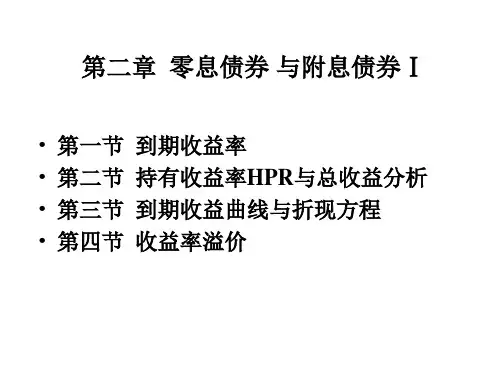
按月复利情况下的到期收益率 按月复利情况下的到期收益率? 12 (1 + ym / 12) 1 = 8.46%
ym = 8.149%
至第一回购日的收益率
例2-3: 20年债券,票面利率 10% ,5年后随时可以按 年债券, 年债券 年后随时可以按 照面值回购.如果5年后到期收益率低于 照面值回购.如果 年后到期收益率低于 10%,那么 , 债券价值会超过面值,因此更可能被回购. 债券价值会超过面值,因此更可能被回购
票面利率与到期收益率
实际上,年金证券可以被理解为票面利率极大化的债 券,零息债券是票面利率最小化的债券,因此,一般 附息债券可以被理解为这两种债券的合成品.因此, 附息债券的到期收益率是这两个证券到期收益率的某 种平均.既然如此,附息债券到期收益率一定介于这 两个证券到期收益率之间.而且,票面利率越低,年 金证券的权重越低,该附息债券的到期收益率越靠近 零息债券;如果票面利率很高,年金证券的权重就越 大,那么附息债券的到期收益率就越靠近年金证券.
票面利率与到期收益率
如果零息债券到期收益率曲线或者说即期利率是向右 上方倾斜的,那么年金证券到期收益率曲线也向右上 方倾斜,并且居于即期利率曲线的下方. 也可以验证下面的结论:如果即期利率曲线向右下方 倾斜,那么年金证券到期收益率曲线也向右下方倾斜, 但居于即期利率的上方; 如果即期利率曲线先上升后下降,那么年金证券到期 收益率曲线也先上升后下降,但最初居于即期利率曲 线的下方,与即期利率曲线相交后,居于即期利率曲 线的上方.
P0 =
∑
n
t =1
C C +Q + t (1 + y / 2 ) (1 + y / 2 ) n
比如,P = 105, C = 3, F = 100, n = 40. 5年后按面值回 比如, 年后按面值回 购,YTM = 5.58%,至第一回购日的收益率(Yield to ,至第一回购日的收益率( first call) = 4.86% )
固定收益证券-课后习题答案
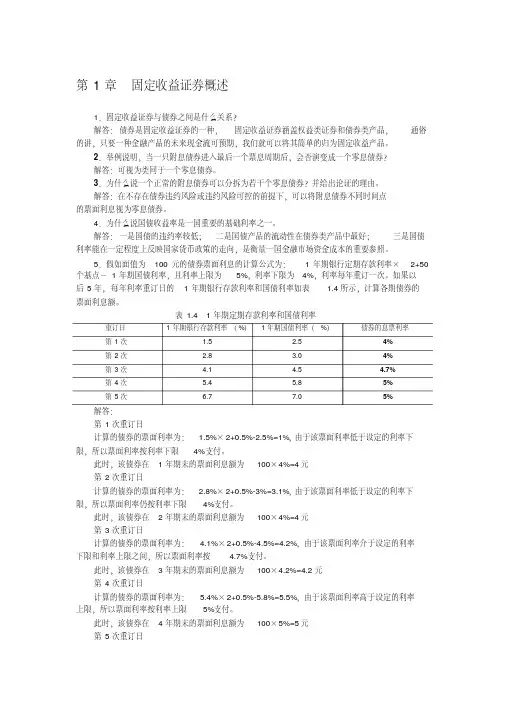
第1章固定收益证券概述1.固定收益证券与债券之间是什么关系?解答:债券是固定收益证券的一种,固定收益证券涵盖权益类证券和债券类产品,通俗的讲,只要一种金融产品的未来现金流可预期,我们就可以将其简单的归为固定收益产品。
2.举例说明,当一只附息债券进入最后一个票息周期后,会否演变成一个零息债券?解答:可视为类同于一个零息债券。
3.为什么说一个正常的附息债券可以分拆为若干个零息债券?并给出论证的理由。
解答:在不存在债券违约风险或违约风险可控的前提下,可以将附息债券不同时间点的票面利息视为零息债券。
4.为什么说国债收益率是一国重要的基础利率之一。
解答:一是国债的违约率较低;二是国债产品的流动性在债券类产品中最好;三是国债利率能在一定程度上反映国家货币政策的走向,是衡量一国金融市场资金成本的重要参照。
5.假如面值为100元的债券票面利息的计算公式为:1年期银行定期存款利率×2+50个基点-1年期国债利率,且利率上限为5%,利率下限为4%,利率每年重订一次。
如果以后5年,每年利率重订日的1年期银行存款利率和国债利率如表 1.4所示,计算各期债券的票面利息额。
表1.4 1年期定期存款利率和国债利率重订日1年期银行存款利率(%)1年期国债利率(%)债券的息票利率第1次 1.5 2.5 4%第2次 2.8 3.0 4%第3次 4.1 4.5 4.7%第4次 5.4 5.8 5%第5次 6.7 7.0 5% 解答:第1次重订日计算的债券的票面利率为: 1.5%×2+0.5%-2.5%=1%,由于该票面利率低于设定的利率下限,所以票面利率按利率下限4%支付。
此时,该债券在1年期末的票面利息额为100×4%=4元第2次重订日计算的债券的票面利率为: 2.8%×2+0.5%-3%=3.1%,由于该票面利率低于设定的利率下限,所以票面利率仍按利率下限4%支付。
此时,该债券在2年期末的票面利息额为100×4%=4元第3次重订日计算的债券的票面利率为: 4.1%×2+0.5%-4.5%=4.2%,由于该票面利率介于设定的利率下限和利率上限之间,所以票面利率按 4.7%支付。
223固定收益证券课后题整理(1—7章)综述

第一章概览1、如何理解固定收益证券?固定收益证券是指其发行人未来向其持有人支付的货币流量将符合某种合约规定的证券。
(1)代表了其持有人的一种权利;(2)发行人未来要支付一定的货币流量;(3)发行人未来支付的货币流量要符合某种合约约定;(4)发行人未来支付的货币流量并不一定是固定不变的。
2、固定收益证券有哪些种类?(1)债务证券类;(2)股权证券类的优先股;(3)资产证券化类。
3、债券的特征体现在哪些方面?(1)偿还性;(2)收益性;(3)安全性;(4)流动性。
4、说明债券与股票的联系与区别。
(1)联系:债券与股票都属于有价证券、债券与股票都是筹措资金的手段、债券和股票的收益率互相影响;(2)区别:债券与股票的权利体现不同的关系、债券与股票的发行目的不完全相同、债券与股票的期限有着不同的属性、债券与股票的债息或股息收益情况存在差异、债券与股票的风险水平不同。
5、说明债券的完整过程。
6、债券可以如何分类?第二章债券发行和偿还1、说明债券发行方式的种类。
(1)直接发行是指债券发行人不依靠中介机构,自己直接向债券认购人出售债券。
间接发行是指债券发行人依靠中介机构的帮助,由中介机构来代理完成债券发行事宜。
(2)公开募集是指债券向全社会公开发行,一般不具体指定债券发行对象或者对债券发行对象做过多的限制。
私下募集是指债券不向全社会公开发行,而是只允许特定类别的投资者承购债券。
(3)竞价发行是指由代表债券认购人方面的竞价人通过一定的竞价程序来决定债券发行价格的方式。
定价发行是指由债券发行人单方面确定债券发行价格、而后由债券认购人认购的方式。
2、债券主要的发行方式有哪些?(1)承购包销法,是指债券发行人与债券承销人签订承购包销合同,由债券承销人负责其所承受的债券发行的销售任务。
(2)招标发行法,是指债券发行人先不规定债券发行价格(或其他某一债券发行条件),由投标人直接竞价,然后发行人根据投标所产生的结果来发行债券。
【免费下载】固定收益证券(姚长辉)第三章作业参考答案

5
∑3������������ + 100������5 = 94
债券 B ������ = 1
5
∑5������������ + 100������5 = 99
债券 C ������ = 1
5
∑������������ = ������
令������ = 1
6A+B=100 (1)
3A+B=94 (2)
5A+B=99 (3)
1
6
3
5
100������5=B 则上面三式可简化成
2
6
3
5
解方程可知三个等式互相矛盾,即债券定价有不合理。以 A B 两债
券为准,得债券 C 定价应为 98
对全部高中资料试卷电气设备,在安装过程中以及安装结束后进行高中资料试卷调整试验;通电检查所有设备高中资料电试力卷保相护互装作置用调与试相技互术关,系电,力根通保据过护生管高产线中工敷资艺设料高技试中术卷资,配料不置试仅技卷可术要以是求解指,决机对吊组电顶在气层进设配行备置继进不电行规保空范护载高与中带资负料荷试下卷高问总中题体资,配料而置试且时卷可,调保需控障要试各在验类最;管大对路限设习度备题内进到来行位确调。保整在机使管组其路高在敷中正设资常过料工程试况中卷下,安与要全过加,度强并工看且作护尽下关可都于能可管地以路缩正高小常中故工资障作料高;试中对卷资于连料继接试电管卷保口破护处坏进理范行高围整中,核资或对料者定试对值卷某,弯些审扁异核度常与固高校定中对盒资图位料纸置试,.卷保编工护写况层复进防杂行腐设自跨备动接与处地装理线置,弯高尤曲中其半资要径料避标试免高卷错等调误,试高要方中求案资技,料术编试交写5、卷底重电保。要气护管设设装线备备置敷4高、调动设中电试作技资气高,术料课中并3中试、件资且包卷管中料拒含试路调试绝线验敷试卷动槽方设技作、案技术,管以术来架及避等系免多统不项启必方动要式方高,案中为;资解对料决整试高套卷中启突语动然文过停电程机气中。课高因件中此中资,管料电壁试力薄卷高、电中接气资口设料不备试严进卷等行保问调护题试装,工置合作调理并试利且技用进术管行,线过要敷关求设运电技行力术高保。中护线资装缆料置敷试做设卷到原技准则术确:指灵在导活分。。线对对盒于于处调差,试动当过保不程护同中装电高置压中高回资中路料资交试料叉卷试时技卷,术调应问试采题技用,术金作是属为指隔调发板试电进人机行员一隔,变开需压处要器理在组;事在同前发一掌生线握内槽图部内 纸故,资障强料时电、,回设需路备要须制进同造行时厂外切家部断出电习具源题高高电中中源资资,料料线试试缆卷卷敷试切设验除完报从毕告而,与采要相用进关高行技中检术资查资料和料试检,卷测并主处且要理了保。解护现装场置设。备高中资料试卷布置情况与有关高中资料试卷电气系统接线等情况,然后根据规范与规程规定,制定设备调试高中资料试卷方案。
《固定收益证券》课程第二次作业

第二次作业:《固定收益证券》Page 124-1253、假定某债券面值为100元,期限为3年,票面利率为年6%,1年支付2次利息,投资者购买价格为103元。
请计算在再投资收益率为年4%的情况下投资者的年收益率。
答:根据债券价格,可求得债券到期收益率y即有103=(3/(1+y/2)^t )6n =1+100/(1+y/2)^6 ∴y=4.909%6、一个20年期限的债券,面值100元,现在价格110元,票面利率6%,1年支付2次利息,5年后可以按面值回购。
计算该债券的到期收益率和至第一回购日的到期收益率。
答:根据债券价格,可求得债券到期收益率y110=100∗3% 1+y 2 t 40t=1+100 1+y 2 40 可得y=5.20%至第一回购日时,有100= 100∗3% 1+y 2t 10t=1+100 1+y 2 10 可得y=3.98%9假设平价到期收益率的单位为年,按年复利计算。
利用上面提供的信息,计算一下债券在零期的价格,该债券获得的现金流如下:C1=10元,C2=10元,C3=110元,其中Ct是在第t期获得的现金收入。
答:由题,1年期平价收益率为10%可得,1年期即期利率为10% 折现因子d1为1/(1+10%)=0.9091根据2年期平价收益率为15%,代表票面利率15%,有15*d1+115*d2=100可得折现因子d2为0.751根据3年期平价收益率为20%,代表票面利率20%,有20*d1+20*d2+120*d3=100可得折现因子d3为0.5567因此,C1=10元,C2=10元,C3=110元的现金流,零时点价格为:10*d1+10*d2+110*d3=77.84。
固定收益证券-姚长辉-作业答案
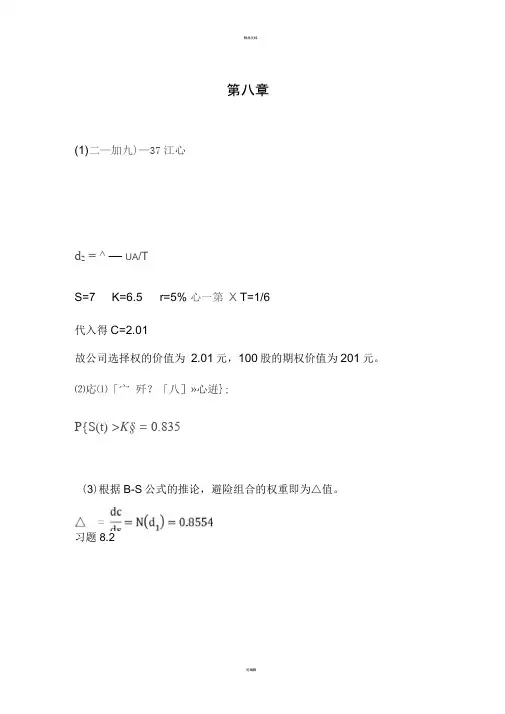
第八章(1)二—加九)—37江心d2= ^ —UA/TS=7 K=6.5 r=5% 心一第X T=1/6代入得C=2.01故公司选择权的价值为2.01元,100股的期权价值为201元。
⑵応⑴「宀歼?「八]»心逬};P{S(t) >K§=0.835(3)根据B-S公式的推论,避险组合的权重即为△值。
习题8.28%6%4%解:在时点2,市场利率分别是8% , 6% , 4%。
如果是8%,固定利率支付方最后支付额的现值二(100000+600 )/1.08=9814.81;而浮动利率最后支付额的现值=10800 /1.08=10000。
期权价值为0。
如果是10%,固定利率支付方最后支付额的现值二(100000+600 )/1.06=10000;而浮动利率最后支付额的现值=10600 /1.06=10000。
期权价值为0.如果是4%,固定利率支付方最后支付额的现值二(100000+600 ) /1.04=10192.3;而浮动利率最后支付额的现值=10400 /1.04=10000。
期权价值为192.3。
在时点1,市场利率分别是7%, 5%.如果是7%,剩下的固定利率支付方支付额的现值=600 /1.07+0.5(10600 /1.08+10600 /1.06) /1.07=9820;浮动利率支付的现值=10000.故不执行.等待的价值为0.5*0+0.5*0=0 。
故期权价值为0。
如果是5%,剩下的固定利率支付方支付额的现值=600 /1.05+0.5(10600 /1.06+10600 /1.04) /1.05=10186.81;浮动利率支付的现值=10000.故执行价值为186.81.等待的价值为0.5*0+0.5*192.3=96.15 。
故期权价值为186.81。
在时点0,利率为6%,剩下的固定利率支付额的现值=10000.839 , 执行价值0.839等待价值=(0.5*0+0.5*186.81) /1.06=88.11故期权的价值为88.11习题8.3(1)Time 0Time 1Time 2(3 )由题可知,若贷款不含箍,则其现金流应该是按照市场利率贴现。
固定收益证券姚长辉第一章课后题答案
固定收益证券姚长辉第一章课后题答案固定收益证券第一章作业 1 解:3年复利:p,1000/1,10%,751.31,,6半年复利:p,1000/(1,5%),746.2212季复利:p,1000/(1,2.5%),743.6536月复利:p,1000/(1,10%/12),741.741095天复利:p,1000/(1,10%/365),740.853n0.3 连续复利:p,1000/(1,10%/n),1000/e,740.822解:8年复利:1000(1,r),2000,r,0.090516半年复利:1000(1,r/2),2000,r,0.088532季复利:(1,r/4),2,r,0.087696月利率:(1,r/12),2,r,0.08702920天利率:(1,r/365),2,r,0.08678n连续利率:(1,r/n),2,r,0.08663解:复利4%,年计息:r1,4%,e,r,ln1.04,0.0392复利,年计息:20%r1,20%,e,r,ln1.2,0.1823复利20%,季计息:4r4(1,20%/4),e,r,ln1.05,0.1952 复利20%,月计息:12r12(1,20%/12),e,r,ln(1,20%/12),0.19844解:净价,101,23/32,101.71875应计利息,100,0.09125/2,79/184100(1,0.09125/2) 全价,105x1,,2184全价,净价,应计利息x,0.029911851解得: 故买入收益率为0.029911851 同理卖出收益率为0.0277823275解:答:(1)设逆浮动利率债券的利率公式为X5000*9%=3000*(LIBOR+3%)+2000X解得X=18%-1.5LIBOR逆浮动利率债券的利率确定公式为18%-1.5 month LIBOR(2)因为0<LIBOR<=12%浮动利率债券的利率=1month LIBOR+3%,故顶为15%,底为3%逆浮动利率债券的利率=18%-1.5monthLIBOR,故顶为18%,底为06 解:5000/100*98.25 =4912.5元所以投资者购买该债券需支付的金额 4912.5元 7 解:浮动利率= LIBOR+1.25%=6.5%+1.25%=7.725%半年支付的利率水平=7.725%/2=3.875%。
《固定收益证券》(姚长辉老师)课程第一次作业
第一次作业:《固定收益证券》Page 78-792、今天投资1000元,8年后肯定可以获得2000元,请计算在下列情况下的年收益率:(1)年复利1000*(1+r%)^8=2000,∴r%=9.051%(2)半年复利1000*(1+r%/2)^16=2000,∴r%=8.855%(3)季度复利1000*(1+r%/4)^32=2000,∴r%=8.759%(4)月复利1000*(1+r%/12)^96=2000,∴r%=8.696%(5)天复利1000*(1+r%/365)^(8*365)=2000,∴r%=8.665%(6)连续复利1000*e^(r%*8)=2000,∴r%=8.664%4、考虑下列问题美国政府债券票面利率为9.125%,在2006年12月31日到期,在2006年9月16日报价(2006年9月17日结算):买入价101:23,卖出价101:25,问:这种债券相应的买入和卖出的收益率是多少?答:按照半年付息,上一利息支付日为2006年6月30日,下一利息支付日为2006年12月31日,结算日为2006年9月17日所以可知,交割日至下一付息日的天数n1=105,上一付息日之下一付息日的天数n2=184,上一付息日至交割日的天数n3=79则,买入收益率:买入价格101:23(101.71825),对应利息为r=100*(9.125%/2)*(79/184)=1.95890 实际购买价格p=101.71825+1.95890=103.67765又p=[100*(1+c/2)]/[(1+y/2)^(n1/n2)],∴y=2.9912%同理,计算卖出收益率卖出价格101:25(101.78125),对应利息为r=100*(9.125%/2)*(79/184)=1.95890实际购买价格p= p=101.78125+1.95890=103.74015且,p=[100*(1+c/2)]/[(1+y/2)^(n1/n2)],∴y=2.7782%国库券(T-bill)在2006年12月31日到期,在2006年9月17日结算的报价则按照收益率方式给出,买入和卖出收益率分别是2.88%和2.86%。
固定收益证券作业及答案
固定收益证券作业及答案1.三年后收到的100元现在的价值是多少?分别考虑复利20%、复利100%、复利0%、复利20%(半年计息)、复利20%(季计息)和复利20%(连续计息)的情况。
2.以连续复利方式计息,分别计算复利4%、复利20%(年计息)、复利20%(季计息)和复利100%的利率。
3.考虑以下问题:a。
___在交易日92年9月16日给出了票面利率为91/8's在92年12月31日到期,92年9月17日结算的政府债券,其标价为买入价101:23,卖出价101:25.求该债券的买入和卖出的收益率。
b。
在同一交易日,___对同时在92年12月31日到期和在92年9月17日结算的T-bill报出的买入和卖出折现率分别是2.88%和2.86%。
是否存在套利机会?(“买入”和“卖出”是从交易者的角度出发,你是以“买入价”卖出,以“卖出价”买入)4.在交易日92年9月16日,以10-26的价格买入了一张面值为2000万美元、到期日为2021年11月15日的STRIPs (零息债券)。
求该债券的到期收益率。
5.今天是1994年10月10日,星期一,是交易日。
以下是三种债券的相关信息:发行机构票面利率到期日到期收益___ 10% 8.00% 星期二,1/31/95费城(市政) 9% 7.00% 星期一,12/2/95___(机构) 8.50% 8% 星期五,7/28/95这三种债券的面值均为100美元,每半年付息一次。
注意到上表中最后一列是到期收益,它反映了给定到期日、某种特定债券的标准惯例。
在计算日期时,不考虑闰年,同时也要忽略假期。
回答以下问题时,需要写清楚计算过程,不能只是用计算器计算价格。
a。
计算___发行的国债的报价,假定该国债按照标准结算方式结算。
b。
计算费城发行的城市债券的报价,假定该债券的标准结算期为三天。
c。
计算___发行的机构债券的报价,假定该债券按照标准结算方式结算。
本题需要根据给定的到期收益曲线来计算固定付息债券的全价,以及在曲线上下移动100个基点时的全价。
固定收益证券试题及部分答案
固定收益证券试题及部分答案国际经济贸易学院研究生课程班《固定收益证券》试题班级序号:学号:姓名:成绩:1)Explain why you agree or disagree with the following statement: “The price of a floater will always trade at its par value.”Answer:I disagree with the statement: “The price of a floater will always trade at its par value.” First, the coupon rate of a floating-rate security (or floater) is equal to a reference rate plus some spread or margin. For example, the coupon rate of a floater can reset at the rate on a three-month Treasury bill (the reference rate) plus 50 basis points (the spread). Next, the price of a floater depends on two factors: (1) the spread over the reference rate and (2) any restrictions that may be imposed on the resetting of the coupon rate. For example, a floater may have a maximum coupon rate called a cap or a minimum coupon rate called a floor. The price of a floater will trade close to its par value as long as (1) the spread above the reference rate that the market requires is unchanged and (2) neither the cap nor the floor is reached. However, if the market requires a larger (smaller) spread, the price of a floater will trade below (above) par. If the coupon rate is restricted from changing to the reference rate plus the spread because of the cap, then the price of a floater will trade below par.2)A portfolio manager is considering buying two bonds. Bond A matures in three years and has a coupon rate of 10% payable semiannually. Bond B, of the same credit quality, matures in 10 years and has a coupon rate of 12% payable semiannually.Both bonds are priced at par.(a) Suppose that the portfolio manager plans to hold the bond that is purchased for three years. Which would be the best bond for the portfolio manager to purchase?Answer:The shorter term bond will pay a lower coupon rate but it will likely cost less for a given market rate.Since the bonds are of equal risk in terms of creit quality (The maturity premium for the longer term bond should be greater),the question when comparing the two bond investments is:What investment will be expecte to give the highest cash flow per dollar invested?In other words,which investment will be expected to give the highest effective annual rate of return.In general,holding the longer term bond should compensate the investor in the form of a maturity premium and a higher expected return.However,as seen in the discussion below,the actual realized return for either investment is not known with certainty.To begin with,an investor who purchases a bond can expect to receive a dollar return from(i)the periodic coupon interest payments made be the issuer,(ii)an capital gainwhen the bond matures,is called,or is sold;and (iii)interest income generated from reinvestment of the periodic cash flows.The last component of the potential dollar return is referred to as reinvestment income.For a standard bond(our situation)that makes only coupon payments and no periodic principal payments prior to the maturity date,the interim cash flows are simply the coupon payments.Consequently,for such bonds the reinvestment income is simply interest earned from reinvesting the coupon interest payments.For these bonds,the third component of the potential source of dollar return is referred to as the interest-on-interest components.If we are going to coupute a potential yield to make a decision,we should be aware of the fact that any measure of a bond’s potential yield should take into consideration each of the three components described above.The current yield considers only the coupon interest payments.No consideration is given to any capital gain or interest on interest.The yield to maturity takes into account coupon interest and any capital gain.It also considers the interest-on-interest component.Additionally,implicit in the yield-to-maturity computation is the assumption that the coupon payments can be reinvested at the computed yield to maturity.The yield to maturity is a promised yield and will be realized only if the bond is held to maturity and the coupon interest payments are reinvested at the yield to maturity.If the bond is not held to maturity and the coupon payments are reinvested at the yield to maturity,then the actual yield realized by an investor can be greater than or less than the yield to maturity.Given the facts that(i)one bond,if bought,will not be held to maturity,and(ii)the coupon interest payments will be reinvested at an unknown rate,we cannot determine which bond might give the highest actual realized rate.Thus,we cannot compare them based upon this criterion.However,if the portfolio manager is risk inverse in the sense that she or he doesn’t want to buy a longer term bond,which will likel have more variability in its return,then the manager might prefer the shorter term bond(bondA) of thres years.This bond also matures when the manager wants to cash in the bond.Thus,the manager would not have to worry about any potential capital loss in selling the longer term bond(bondB).The manager would know with certainty what the cash flows are.If These cash flows are spent when received,the managerwould know exactly how much money could be spent at certain points in time.Finally,a manager can try to project the total return performance of a bond on the basis of the panned investment horizon and expectations concerning reinvestment rates and future market yields.This ermits the portfolio manager to evaluate thich of several potential bonds considered for acquisition will perform best over the planned investment horizon.As we just rgued,this cannot be done using the yield to maturity as a measure of relative /doc/6814708511.html,ing total return to assess performance over some investment horizon is called horizon analysis.When a total return is calculated oven an investment horizon,it is referred to as a horizon return.The horizon analysis framwor enabled the portfolio manager to analyze the performance of a bond under different interest-rate scenarios for reinvestment rates and future market yields.Only by investigating multiple scenarios can the portfolio manager see how sensitive the bond’s performance will be to each scenario.This can help the manager choosebetween the two bond choices.(b) Suppose that the portfolio manager plans to hold the bond that is purchased for six years instead of three years. In this case, which would be the best bond for the portfolio manager to purchase?Answer:Similear to our discussion in part(a),we do not know which investment would give the highest actual relized return in six years when we consider reinvesting all cash flows.If the manager buys a three-year bond,then there would be the additional uncertainty of now knowing what three-year bondrates would be in three years.The purchase of the ten-year bond would be held longer than previously(six years compared to three years)and render coupon payments for a six-year period that are known.If these cash flows are spent when received,the manager will know exactly how much money could be spent at certain points in timeNot knowing which bond investment would give the highest realized return,the portfolio manager would choose the bond that fits the firm’s goals in terms of maturity.3) Answer the below questions for bonds A and B.Bond A Bond BCoupon 8% 9%Yield to maturity 8% 8%Maturity (years) 2 5Par $100.00 $100.00Price $100.00 $104.055(a) Calculate the actual price of the bonds for a 100-basis-point increase in interest rates.Answer:For Bond A, we get a bond quote of $100 for our initial price if we have an 8% coupon rate and an 8% yield. If we change the yield 100 basis point so the yield is 9%, then the value of the bond (P) is the present value of the coupon payments plus the present value of the par value. We have C = $40, y = 4.5%, n = 4, and M = $1,000. Inserting these numbers into our present value of coupon bond formula, we get:41111(1)(10.045)$40$143.5010.045nr P C r --++===The present value of the par or maturity value of $1,000 is: 4$1,000$838.561(1)(1.045)n M r ==+ Thus, the value of bond A with a yield of 9%, a coupon rate of 8%, and a maturity of 2years is: P = $143.501 + $838.561 = $982.062. Thus, we get a bond quote of $98.2062. We already know that bond B will give a bond value of $1,000 and a bond quote of $100 since a change of 100 basis points will make the yield and coupon。