
牛津译林版英语八年级下Unit7全单元教案(8课时)(英语教案)
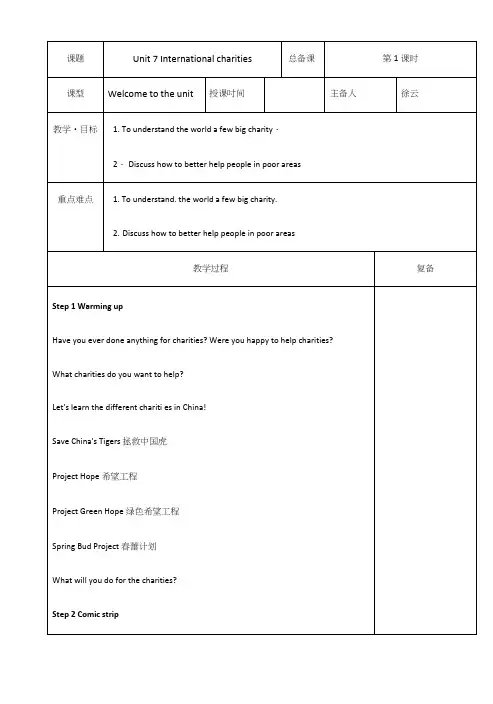
课题8B Unit 7 International charitiesWelcome to the unit & comic strip课时 1 授课时间2016 年5 月25日教学目标To know about some famous charities in the world.To talk about how to help people in need.To lead students to set up the consciousness to help vulnerable groups.教学重难点To know about some famous charities in the world. (Importance) To talk about how to help people in need. (Importance)To talk about how to help people in need. (Difficulty)预习要求To talk about how to help people in need.教学内容及活动设计二次复备及教学随感Step 1 CheckingLet the students try to say the names of the charities of China.Step 2 Lead-inAsk the students to answer the questions:What will you do for the charities?What are Eddie and Hobo doing?Are they ready to help the charity?Step 3 LearningRead and answerWhat is needed for charity?What does Hobo want Eddie to do?What does Eddie want to do first? Why?How far will they go?Step 4 Practice(1).Complete the following passage.Hobo hears that charity n______ money. He wants t o donate Eddie’sp______ money to charity. But Eddie thinks it is lunch t____ because it’s12 o’clock.He wants to have l_____ first. He pretends(假装)that he is toow_____ to walk any f_________. Finally, Hobo encourages (鼓励)Eddiethey only have five k_________ left.(2)Work in pairs and read the conversation between Eddie and Hobo.Step 5 LearningLearn some useful phrasesStep 6 Lead-inWhat can we do for people?If Hobo and Eddie want to help people from other countries, whatcharities should they donate money to? What international charities doyou know about?Step 7 LearningIntroduce some international charitiesStep 8 PracticeFinish Part A on Page 93Step 9 Lead-in﹠ LearningMr Wu is asking the students about international charities. Listen to the tape and tell me how UNICEF helps people.Step 10 PracticeRead the conversation after the tape. Then make a dialogue use the conversation as a model.Step 11 LearningLearn some useful phrasesStep 12 TestingDo some exercises (见课件)Step 13 Homework1.记忆词汇、词组和句型。
2.背诵Comic strip 和B部分的对话。
预习Reading教学反思教研组长审核意见:课题8B Unit 7 International charitiesReading 1课时1 授课时间2016 年5 月26日教学目标To know about what the volunteer doctors and nurses’ work in ORBIS like. To grasp the main idea of the conversation by finishing some tasks.To lead students to set up the consciousness to do some voluntary work.教学重难点To know about what the volunteer doctors and nurses’ work in ORBIS like. (importance) To finish some exercises according the report. (importance)To grasp the main idea of the report. (difficulty)预习要求To search the Internet for some information about ORBIS.教学内容及活动设计二次复备及教学随感Step1 Checking1. 剩下一些零花钱2. 太虚弱以至于不能走的更远3. 吃一顿丰盛的午餐4. 国际慈善机构Which charity can help them?Problem 1: ___________________Problem 2: _______Problem 3: _______Step2 Lead—inLearn some new words and some information about ORBIS.Step3 Learning1. Read the new words and complete Part B1.2.While- readingSkim and write T or F:Read L1—L6 and answer some questions:①How many people does blindness affect around the world?②Where are they mostly from?③How many sick people can be cured or prevented?④Why don’t some people receive medical treatment?Read Lines 10-26 and answer some more questions:①Why don’t ORBIS doctors work in a hospital?②How many operations did Dr Ma perform during his last visit?③Is the plane only a place to perform operations?Can you divide the passage?①(Line 1-6)②(Line 7-15)③(Line 16-20)④(Line 21-26)Step4 PracticeRead the passage again and complete PartsB2.3.4Check the answers and read some useful phrasesStep5Test完成课课练69页T一.二。
Step6 HomeworkFinish off the exercises in the Exercise Book.Try to recite the text教学反思教研组长审核意见:课题8B Unit 7 International charitiesReading 2课时1 授课时间2016 年5 月27日教学目标To grasp the main idea of the conversation further and better.To grasp the important vocabulary and sentences in the conversation. To finish some exercises to grasp these language points further.教学重难点To grasp the important vocabulary and sentences in the conversation (Importance) To finish some exercises to grasp these language points further. (Difficulty)预习要求To revise the conversation in Reading.教学内容及活动设计二次复备及教学随感Step1 CheckingFill in the blanks according to the content of the interview .something about blindness:Blindness affects about _______around the world, mostly in _____ countries.the work of ORBIS:ORBIS uses a flying eye hospital to visit poor countries. On the plane,volunteer doctors__________________. Local doctors and nurses can cometo the plane to _____________________. We teach them _________.Dr Ma’s work and his feeling:The development of medicine:Step2 Lead—inWrite down some of their answers on the Bb and ask :Do you have some problems with them?Step3 Learning1. 80 per cent of these cases can be prevented or cured.2. The plane is used as a training centre.be used as be used to dobe used for doing be used to doing sth.3. Many of our patie nts can’t afford to go to hospitals, so we have to go tothem.句中的afford意思是“买得起;(有时间)做” 通常与can, could, be able to连用,多用于否定句和疑问句.afford sth. afford to do sth.4. Also, local doctors and nurses are invited on board to learn about eyeoperations.on board 在飞机(船、火车)上5. By training them, we hope to help more people.句中的by是介词,意思是“通过某种方法、手段”,后接名词或者动词-ing形式。
牛津译林版八年级下Unit7InternationalCharities教学案.doc
Step 4 Watch a video about ORBISWhy is there a plane in the logo?Because ORBIS workers take a plane to visit poor countries.The plane is called a flying eye hospital.(飞行眼科医院)Step 5 Use pictures to talk about some important words.Amy wants to tell Daniel about Dr Ma and what he does, but she does not know the meanings of some words in the interview. Help her match the words on the left with the meanings on the right・ Write the correct letters in the blanks.Step 6 Do some exercisesSkim a nd write T or F:Step 7 Read and answer some questions.Lines 1-61.How many people does b lindness affect around the world? Where are theymostly from?2.How many sick people can be cured or prevented?3.Why don't some people receive medical treatment?Lines 10-261.Why don't ORBIS doctors work in a hospital?2.How many operations did Dr Ma perform during his last visit?3.Is the plane only a place to perform operations?Step 8 Can you divide the passage?1.(Line 1-6) something about blindness2.(Line 7-15) the work of ORBIS3.(Line 16-20) Dr Ma's work and his feeling4.(Line 21-26) Dr Ma's hopeSte p 9 Amy wants to show how ORBIS helps people. She is making a chart. Help her fill in the blanks with the words in the box.Step 10 Amy made some m ore notes of the interview. Help her put the sentences together. Write the correct letters in the blanks.Step 11 Amy is writing an article about ORBIS for the school newsletter. Help her complete it with the correct fo rms of the word s in the box.The ORBIS plane travels all around the world and helps people with eye problems in poor areas・ Most of the people there cannot (1) _______ t o go to hospital, so ORBIS doctors go to them・ Operations are done to help people with eye problems短语carry on with something表示"继续干某事,坚持做某爭6・主动语态和被动语态的句式转换Step 1 ReviewStep 2 WiitiiigDo you still remember UNICEF?C You want to write a report on the work ofUNICEF. Search for information on the Internet. You can also use the information below. Use Amy's report as a model.Country:Man deepName:Family: many childrepoorIn the past: used to wor k on the f arm all day, could not read or writeO ne day: a UNICEF officer came and learnt about the conditions of the local people. Now: entered a school, can read and writeFuture: hopes to become a -teacherStep 3 Homework.Writ ing: Denny是一名非洲的失明女孩,直到有一天ORBIS的志愿者医生坐着飞机来到她的家乡,她才获得了光明。
牛津译林版英语八年级下册Unit7教案说课稿

在学习本节课之前,学生需要具备一定程度的英语语言基础,包括词汇量、语法知识和基本的听说读写技能。他们可能存在的障碍包括:对过去时和现在时的用法混淆,尤其是在实际语境中不能正确运用;对描述变化的表达方式不熟悉,难以准确表达自己的观点;以及对听力材料的理解不够深入,影响了对文本的整体把握。
四、教学过程设计
(一)导入新课
为了快速吸引学生的注意力和兴趣,我计划采用以下导入方式:首先,我会播放一段关于过去和现在变化的短片,让学生通过视觉感受变化的存在;接着,我会邀请学生分享他们生活中经历的变化,引导学生用英语表达;最后,我会提出一个问题,如“Can you describe a change you have experienced?”,让学生思考并回答,从而引出本节课的主题。
(四)总结反馈
在总结反馈阶段,我会采取以下方式引导学生自我评价,并提供有效的反馈和建议:首先,我会让学生对自己的学习情况进行评估,找出自己的优点和不足;接着,我会根据学生的表现,给予他们积极的反馈和建设性的建议;最后,我会布置一项关于变化的课后作业,要求学生在课后进一步巩固所学知识。
(五)作业布置
课后作业的目的是让学生在课后进一步巩固所学知识,提高自主学习的能力。我会布置一道写作作业,要求学生写一篇关于自己生活中变化的短文,运用过去时和现在时描述。同时,我还会布置一项听力作业,让学生听一段关于变化的录音,并用自己的语言描述所听到的内容。
牛津译林版英语八年级下册Unit7教案说课稿
一、教材分析
(一)内容概述
本节课是牛津译林版英语八年级下册Unit7的教学,主题是描述过去和现在的变化。本节课在整个课程体系中处于重要的位置,它不仅巩固了学生之前学过的知识,还为后续的学习打下了基础。主要知识点包括:1.能够运用过去时和现在时描述人和事物的变化;2.能够听懂、说懂、读懂关于过去和现在的变化的句子和段落;3.能够运用所学知识进行真实的交流和表达。
苏教牛津译林版初中英语八年级下册教案:Unit 7 International
苏教牛津译林初中英语重点知识精选掌握英语语法知识,巩固词汇量和各种语态,学好英语基础一定要扎实,大家一起练习吧!牛津译林初中英语和你一起共同进步学业有成!英语(八年级下册)Unit 7 International charitiesReading ( I )冷雪I. T eaching a ims and learning objectivesBy the end of the lesson, students should be able to:1. get a general idea of ORBIS.2. introduce ORBIS and how it works to others.3. know what they can do to help ORBIS.II. Teaching contents1. New words and phrases: interviewer, blindness, medical, patient, afford, proud, reader,medicine, develop, treat, go to hospital, on board, carry on2. New structures: The plane is also used as a training centre.Many of our patients can’t afford to go to hospital.I’m proud to help people see again and improve their skills.III. Focus of the lesson and predicted area of difficultyTo retell the interview to others.IV. Teaching proceduresStep 1 Pre-reading1. Look and sayT: Look at these logos of charities. Do you know the name of each logo?2. Ask and answerT: This is the logo of ORBIS. What does the logo look like? Why is there a plane in the logo?Why is it a special plane?Step 2 While-reading1. Skimming(1) Read and answer.T: Look at the picture. Who is he? (Dr Ma). He is an ORBIS doctor. Look at this man. He is interviewing Dr Ma. He is an interviewer. Please read the interview quickly and find how many questions the interviewer asks.(2) Read and divide.T: Read the interview quickly and divide it into 4 parts. Tell me the main idea of each part. 2. Scanning(1) Read the first part (Lines 1-6)T: What does the word “blindness” mean?How many people are blind or have other eye problems?Can they be prevented or cured?Where are most of them from?(2) Read the second part (Lines 7-15)Introduce “Flying Eye Hospital” by asking “what does ORBIS use to visit poor areas?”Let the students read and find the answer to the question why the plane is used as an operation room and a training centre.Ask the students to retell the work of ORBIS.Answer the questions: Why is there a plane in the logo? Why is it a special plane?(3)Read the third part (Lines 16-20)Read the interview er’s question and Dr Ma’s answer to know the number 150.Read this part and fill the blanks with adjectives.Dr Ma is very _______.Dr Ma’s work is very ________.Dr Ma feels very __________ of his work.(4) Read the fourth part (Lines 21—26)Why can most eye problems and diseases be treated and cured?What is needed to carry on with ORBIS?What does Dr Ma hope?3. Read the interview loudlyLet the students read the interview together and then in roles. Pay attention to the pronunciation and intonation.Step 3 Post-reading1. Fill in the blanks2. Have an interviewT: Work in pairs and talk about how ORBIS works. Suppose one is an interviewer, and the other is an ORBIS doctor, a local doctor or a patient.3. Have a discussionT: Work in groups of four and talk about what we can do to support ORBIS. The following suggestions may help you.(1) Introduce ORBIS to mo re people.(2) Tell people that it is important to take good care of eyes.(3) Donate more money to ORBIS.4. SummaryGive a helping hand. Many hands ma ke light work.V. Homework1. Read the interview three times after the tape.2. Try to retell the interview.3. Finish B2 on Page 96.相信自己,就能走向成功的第一步教师不光要传授知识,还要告诉学生学会生活。
牛津译林版八年级下册英语教案Unit7InternationalcharitiesTask
牛津译林版八年级下册英语教案Unit7InternationalcharitiesTask英语(八年级下册)Unit 7 International charitiesTask冷雪I. Teaching aims and learning objectivesBy the end of the lesson, students should be able to:1. learn about an ORBIS volunteer called Diana;2. write a report about an Indian girl helped by UNICEF;3. learn the five steps of writing (prewrite—write—revise—edit—publish).II. Teaching contents1. New words and phrases: secretary, India, officer, make up one's mind +Z+X+X+K]科来源学+[2. New structures: She wanted to help poor people with eye problems see again, so she made upher mind to train as a nurse and attended courses after work.She is getting used to travelling by plane.III. Focus of the lesson and predicted area of difficulty1. To write a report about an Indian girl helped by UNICEF.2. To learn the five steps of writing (prewrite—write—revise—edit—publish).|]科来源[:学IV. Teaching proceduresStep 1 Lead-inDescribe the pictures in your own wordsT: Amy wants to write about the work of an ORBIS nurse called Diana for her class presentation. And she found some pictures of Diana.T: Look at these two pictures. Can you guess Diana's job in the past? As you see, she was anoffice lady, a secretary of a pany. Did she look happy? Look at the second one. What does shedo now? Does she look happy? Why does she change the job and what happened? Try todescribe the pictures in your own words.,]科来源[学Step 2 Reading prehension1. Discuss the picturesStudents read the six pictures carefully. They can ask any question about the story, and invitethe other students to answer. They can get the answer from the report or use their imagination toget reasonable answers.The teacher gives six questions. Students read and underline the answers in the report.(1) What was her life like?(2) Which does she like better, travelling by car or by plane?(3) In which way did she learn about ORBIS?(4) After learning about it, how did she feel and what did she do?(5) What is her life like now?(6) How does she feel about the changes?2. Analyze the structure of the articleT: Now please find the topic sentences of each paragraph, and get the main idea of each paragraph. [来源:]3. pare the lives in the past and at presentT: The first paragraph and the third paragraph tell Diana's work, lifestyle and way of travelling. They have similar structures.Step 3 Writing practice1. How to writeShow the five steps of writing; indicate that we should write step-by-step.2. Prewriting—choose a topic/collect details(1) Ask students to write about an Indian girl helped by UNICEF and show the pictures and the information. Show the subject, form, purpose and audience.(2) Ask students to plete a 5 W's chart.Writing tips: An experience includes the basic details, sensory details and dialogues.(3) Ask students to put things in order.Ask students to use the time line to organize things in time order.3. Writing—write a first draft: a beginning + a middle + an ending :ZXXK]来源[Show the structure of the report.(1) The beginning should get the readers' attention and introduce the experience. Show threeways to begin:a. Start with dialogues;b. Begin with a fact or an interesting statement;c. Put yourself in the middle of the action.Give three examples and encourage students to write their own.(2) The middle part tells story in time order. It may include sensory details, use dialogues, and share the feelings people experienced.Give a model middle and guide the students to pay attention to the transition words andsensory details.(3) The ending should bring the story to a close. Show three possible ways:a. Tell what you learnt from the experience;b. Explain how the experience changed you;c. Tell how you felt about the experience.Give three examples and encourage students to write their own.4. Revising—improve your writing(1) Show the steps to revise.Read—review—ask—change(2) Add and move parts.Use the model passage to show how to add and move parts and explains why.5. Editing—check for errorsInvite the students to check the article for punctuation, capitalization, grammar error and spelling.6. Publishing—share your writingShow the final copy.Give two tips:a. Use blue or black ink and write neatly;b. Indent every paragraph and leave a one-inch margin of all sides.7. Assessing the final copyShow how to assess the final copy.8. Reflecting on your writingReflect by answering four questions.9. The advantages of writingShow the advantages of writing:bee a better student, understand your experience, connect with others, enjoy life ... Encourage the students to write more.10. Write your articleV. Homework1. Make your article better.2. Put the best articles onto the wall and enjoy together. 附件1:律师事务所反盗版维权声明附件2:独家资源交换签约学校名录(放大查看)学校名录参见:://.。
初中英语八年级下册(牛津译林版)Unit7Grammar教学设计

-导入:通过讨论学生感兴趣的未来话题,如旅行计划、职业梦想等,激发学生学习兴趣,导入新课。
-新课:采用讲解、示例、练习相结合的方式,引导学生学习一般将来时的用法,并关注情态动词的区分。
-互动:组织小组活动,让学生相互提问、回答关于未来计划的问题,加强口语表达能力。
-巩固:利用课后作业和课堂练习,让学生进行语法填空、句子重构等,巩固所学知识。
3.鼓励学生尊重和理解他人对未来生活的期待和设想,培养合作精神和团队意识。
4.培养学生面对困难和挑战时的积极态度,以及为实现目标而努力的情感态度。
5.引导学生理解学习英语的目的不仅仅是为了考试,更是为了实现个人的梦想和未来的发展,从而树立正确的学习价值观。
本教学设计旨在帮助学生通过掌握一般将来时的语法知识,提高语言实际应用能力,同时培养积极向上的情感态度和价值观,为学生的未来发展奠定坚实的基础。以下方法提升学习能力:
1.采用任务型教学法,让学生在小组合作中讨论和分享个人的未来计划,促进语言的实际运用。
2.利用互动式白板等教学工具,设计语法填空、句子重构等练习,帮助学生通过可视化手段理解和记忆语法规则。
3.创设情境,让学生通过角色扮演、访谈等形式,模拟真实语境中的语言交流,提升学生的语用能力。
在这个阶段,学生正处于青春期,对未来充满好奇和期待,他们的个性鲜明,乐于表达自我。因此,在教学过程中,教师应充分调动学生的积极性,引导他们结合个人兴趣和未来规划进行语法练习。同时,关注学生的个体差异,对基础薄弱的学生给予更多关注和指导,确保他们在课堂上能够跟上教学进度。
此外,学生在团队合作中表现出较强的交流欲望,但自我纠错和评价他人的能力有待提高。因此,在教学过程中,教师应鼓励学生相互学习、相互纠错,培养他们的批判性思维和团队协作能力。通过这种方式,使学生在掌握语法知识的同时,提升人文素养和综合语言运用能力。
牛津译林版英语八年级下册Unit7Reading1教学设计

- Reading strategies.
2.学生分享自己在小组讨论中的收获,教师对学生的表现给予肯定和鼓励。
3.教师强调关爱他人、助人为乐的重要性,提醒学生遵守交通规则,增强安全意识。
4.教师布置课后作业,要求学生运用所学知识完成相关练习,巩固课堂所学。
五、作业布置
为了巩固本节课的学习内容,确保学生对知识点的深入理解和实际运用,特布置以下作业:
1.完成课本练习册中与本节课相关的练习题,包括填空、翻译和句型转换等,以加强对核心词汇、短语和一般过去时的掌握。
要求:认真完成,书写工整,注意时态和语法正确性。
2.根据本节课的故事情节,编写一段关于帮助他人的小故事,运用一般过去时态进行描述。
2.各小组进行讨论,组内成员轮流发言,记录讨论成果。
3.各小组向全班汇报讨论成果,教师对学生的表现给予评价和指导。
(四)课堂练习
1.教师设计以下练习,巩固所学知识:
- Fill in the blanks with the proper words or phrases.
- Translate the following sentences into Chinese.
1.词汇与语法教学:
-利用图片、实物等直观教具,帮助学生形象地理解和记忆词汇。
-创设语境,让学生在实际语境中运用词汇和短语,提高语言实际运用能力。
-通过对比一般现在时和一般过去时的句子,引导学生发现并掌握时态变化规律。
2.阅读教ቤተ መጻሕፍቲ ባይዱ:
-采用预测、扫读、精读等阅读策略,引导学生逐步深入理解文章,提高阅读效率。
八年级学生已经具备了一定的英语基础,对一般过去时态和基础词汇有一定的掌握。在此基础上,学生对本节课的故事情节具有较强的兴趣,但可能在实际运用中遇到困难,如词汇的灵活运用、长句子的理解和表达等。此外,学生在阅读策略的运用上尚需进一步引导和培养。
牛津译林版八年级下册英语Unit 7教学设计
牛津译林版八年级下册英语Unit 7教学设计一. 教材分析Unit 7为牛津译林版八年级下册英语教材中的一个单元,主要围绕日常生活话题展开。
通过本单元的学习,学生将掌握一般现在时态的疑问句和否定句的构成及其运用,同时学习到与日常生活相关的一些词汇和表达方式。
本单元包括三个部分:课文阅读、语法讲解和综合练习。
二. 学情分析八年级的学生已经具备了一定的英语基础,能够听、说、读、写一些简单的日常用语。
但部分学生对英语学习的兴趣不足,学习积极性有待提高。
此外,学生的英语水平参差不齐,因此在教学过程中需要关注不同层次学生的需求,激发他们的学习兴趣,提高他们的英语实际运用能力。
三. 教学目标1.知识目标:学生能够掌握一般现在时态的疑问句和否定句的构成及其运用;学会与日常生活相关的词汇和表达方式。
2.能力目标:学生能够熟练运用一般现在时态进行日常交流,提高英语听说读写能力。
3.情感目标:培养学生对英语学习的兴趣,增强自信心,提高团队合作意识。
四. 教学重难点1.教学重点:一般现在时态的疑问句和否定句的构成及其运用;与日常生活相关的词汇和表达方式的掌握。
2.教学难点:一般现在时态的疑问句和否定句在实际语境中的运用;词汇和表达方式的灵活运用。
五. 教学方法1.任务型教学法:通过设定各种真实的任务,让学生在完成任务的过程中学习和运用英语。
2.情境教学法:创设日常生活情境,激发学生的学习兴趣,提高他们的实际运用能力。
3.合作学习法:引导学生分组讨论、互动交流,培养团队合作意识,提高口语表达能力。
六. 教学准备1.教学PPT:制作包含课文内容、语法讲解、练习题等的PPT。
2.课文录音:下载或录制课文阅读的音频文件。
3.教学卡片:制作包含关键词语和表达方式的卡片。
4.教学视频:准备与日常生活相关的英语视频素材。
七. 教学过程1.导入(5分钟)利用英语歌曲或视频素材,引起学生对日常生活话题的兴趣,激发学习动机。
教师简要介绍本节课的学习内容,引导学生进入学习状态。
牛津译林版英语八年级下册Unit7Welcometotheunit教案
8 B Unit 7 International charitiesWelcome to the unitTeaching objectives:I Knowledge objective1. Phrases: international charities, have some pocket money left, have a big lunch, provide basiceducation for children in poor areas.2. Structures: More money is needed for charity.It helps build a better world for everyone, especially children all over the world.It works for the equal rights of girls and women.It also works to prevent the spread of some serious disease s, like AIDS, amongyoung people.II Ability objectivesTo learn about some famous international charities and how they help people.III Value objectivesDiscuss how to better help people in poor areas and enable students to do everything they can to help others.Teaching focuses and difficulties:1. To learn about some famous international charities and how they help people.2. Some structures: More money is needed for charity.It also works to prevent the spread of some serious disease s, like AIDS, among young people. Teaching aids: PPTTeaching procedures:Step 1 Warming upWatch a song We are in a world.Ask them Why do they sing the song ?Step 2 Comic stripAsk who do you think needs help?1) Look at the picture and answer.the elderly, the blind, the homeless, …A person’s ability is limited. We should join together and set up more charities to help them.2) Introduce the following charities around the worldORBIS['ɔ:bis]奥比斯It helps the blind people in poor areas.It uses a Flying Eye Hospital to visit poor areasV olunteer doctors do operations on them.They teach local doctors and nurses new skills.See a video about WWFIt protects animals and their living conditions, such as forests, oceans, and so on.It prevents people hunting or killing animalsIt encourages people to live happily with animals and save energy for the happy future.It asks people to protect our environment and reduce the pollution.Oxfam['ɔksfæm] 乐施会It works to help people in poor countries.donate money and thingsorganize Oxfam Trailwalker (毅行者)every yearsell second-hand books and goods(商品)care about the climate(气候) and the growth of riceUNICEF ['ju:nisef]United Nations Internatio nal Children's Emergency FundWhat does UNICEF do?It works to build a better world for everyone, especially children all over the world.It works for the equal rights of girls and women.It works to prevent the spread of some diseases, like AIDS, among young people.The Red Cross Listen to the radio finish the exerciseprovide more than half the nation’s ________ supplytrain millions of people in ______________ skillsprovide ______ _______ for over two million peopleteach millions of people to ______provide _______ for poor peopletake _______ to people who are unable to prepare their own food______ ______ in hospitals and treatment centers for sick or disabled persons.Step3Task1: Match the logos with the charitiesTask 2: Which charity or charities can help them?1.Rare birds and animals are caught by people to make money.2.Mr Hill used to be a worker, but now he is out of work. He has no money to support his family.3.Children in Africa don’t have enough food and some of them get ill .4. Mr. Black has been blind since he was born. He is very poor and has no enough money to go to hospital.5. Tom was badly hurt in a traffic accident and he needs blood type A.Task 4:Hot Chair1. WWF works to protect animals and environment.2. ORBIS was set up in 1982 to help deaf people.3. UNICEF wants to make the world a better place for children.4. Both UNICEF and Oxfam work to stop the children going hungry.5. The Red Cross raises money only for people in disaster areas (受灾地区).6. WWF asks people to buy clothes made of animals’fur .7. Oxfam organizes trailwalker(毅行者)every year to raise money to help poor people.8. In order to make sure the rice can grow well, Oxfam asks people to care about the climate and environment.Task 5:Listen and answer:What international charity are they talking about?Step 4 Read and answer:How does UNCEF help people?Step 5 Task 6: Make up a new conversationStep 6 Watch and answer:What does Hobo want Eddie to do for charity?What does Eddie want to do first? Why?How far will they go?Step 7 Discussion : As a student, what can we do to support charities?A bit more love , the world will be more beautiful.Step 8 HomeworkSearch the internet for more information about charities.。
Unit7Grammar教案牛津译林版英语八年级下册
【测一测】一May I speak to Mr.Smith?—_________, please.Here he es.A.Hang outB.Pick upC.Take upD.Hold on3 set up建起,设立,成立eg: They set up a modern school. 他们创办了一所现代化的学校。
【拓展】与set相关的短语:set out出发,开始做某事;set off出发set about doing sth.着手做某事set an example for sb.为某人树立榜样【测一测】UNICEF was_________in1946.It works to help children have a better life.A. set upB.put upC.picked upD.turned upGrammar一般现在时和一般过去时的被动语态在英语中,句子有两种语态,即主动语态和被动语态。
语态说明句子主语和谓语之间的关系。
主动语态表示主语是谓语动词动作的执行者。
被动语态是动词的一种特殊形式,表示主语是谓语动词动作的承受者。
其谓语动词的构成:be+及物动词的过去分词。
be动词有人称、时态和数的变化。
1:主动语态与被动语态的变化图2 【重点】一般现在时和般过去时的被动语态分类谓语动词形式例句一般现在时态am/is/are+vt.ed The job is liked by many people.这份工作被许多人喜欢。
1)there be句型没有被动语态。
eg: There are lots of flowers in the garden. 在花园里有许多花。
2)不及物动词或短语没有被动语态,如:rise, happen,succeed,remain,take place,break out等。
eg:After the fire,nothing remained. 那场大火之后,什么也没留下来。
牛津译林版英语八年级下册Unit7教案优秀教学案例
此外,我还将结合课堂教学,对学生的学习情况进行全面、客观的评价,关注学生的个体差异,鼓励他们在原有基础上不断提高。通过多元化的评价方式,如口头表达、书面作业、课堂表现等,激发学生的学习积极性,帮助他们建立自信,实现英语能力的全面提升。
4.情感态度与价值观的融入
在教学过程中,本案例注重培养学生的情感态度与价值观。通过学习慈善机构的故事,引导学生关爱他人,助人为乐,树立正确的价值观。同时,鼓励学生积极参与公益活动,增强社会责任感。
5.多元化的评价机制
本案例采用多元化的评价机制,全面、客观地评价学生的学习情况。口头表达、书面作业、课堂表现等多种评价方式相结合,激发学生的学习积极性,帮助他们建立自信,实现英语能力的全面提升。
2.通过呈现教材中的对话和课文,引导学生学习一般现在时和一般过去时描述慈善机构的工作和活动。
3.针对课文内容,我会设计一些问题,让学生在阅读过程中寻找答案,帮助他们掌握文章的主要信息。
4.在讲解过程中,我会适时进行板书,将重点知识、语法点等内容进行归纳总结,便于学生课后复习。
(三)学生小组讨论
1.在学生掌握了一定的基础知识后,我会组织他们进行小组讨论。每个小组选择一个国际慈善机构,了解其基本情况、主要项目和活动。
3.强调慈善事业的意义,引导学生树立关爱他人、助人为乐的价值观。
(五)作业小结
1.课后作业分为书面作业和口头作业。书面作业包括:根据本节课所学的知识点,编写一段关于慈善机构的介绍;完成课后练习题。口头作业为:向家人介绍一个慈善机构,并用英语讲述其故事。