
跨文化交际案例分析1
跨文化交际案例
例题一:内容提要:
合资企业中,跨文化差异现象的存在,使得企业领导与员工的沟通具有一定的障
碍,这主要是由于不同的文化背景所造成的。
面对这种文化冲突,要理性地去对待,避免感情用事,致使矛盾愈深。
案例介绍:
飞利浦照明公司人力资源副总裁(美国人)与一位中国员工交谈。
中国员工的回答令副总裁难以理解,甚至不耐烦。
案例名称:《回答的方式》
飞利浦照明公司某区人力资源副总裁(美国人)与一位被认为具有发展潜力的中国员工交谈。
想听听这位员工对自己今后五年的职业发展规划以及期望达到的位置。
中国员工并没有正面回答问题,而是开始谈论起公司未来的发展方向、公司的晋升体系,以及目前他本人在组织中的位置等等。
将了半天也没有正面回答副总裁的问题。
副总有些大惑不解,没等他说完已经有些不耐烦了,因为同样的事情之前已经发生了好几次。
“我不过是想知道这位员工对于自己未来五年发展的打算,想要在飞利浦做到什么样的职位罢了,可为何就不能得到明确的回答呢?”谈话结束后,副总忍不住想人力资源总监甲抱怨道。
这位老外总裁怎么这样咄咄逼人?”谈话中受到压力的员工也很苦恼。
作为人力资
源总监,明白双方之间不同的沟通方式引起了隔阂,虽然他极力想双方解释,但要完全消除已经产生的问题并不容易。
以上便是整个案例,这是一个很典型的跨文化焦急的例子。
首先,我们看到这位副总裁是美国籍人,而那位员工则是中国籍。
既然出生于两个不同的国度,那他们的思维方式、生活习惯、文化程度、教育程度、文化差异等众多方面都存在着差异。
正是由于这些文化差异的存在,才使得双方在交流、沟通过程中产生一系列障碍。
其次,“中国员工并没有正面回答问题”,我们可以想象一下这位中国员工没有正面回答问题的原因。
比如说由于语言障碍、没有理解透彻美国副总裁所说话语的原意;或者说副总的文化方式让中国员工产生了误解;亦或是中国员工有意回避从正面回答……。
以上原因都知识我们的推测而已。
下面我们给出一个假设。
假设这位中国员工从正面直接回答了副总的问题。
比如,中国员工回答:
“……想在五年之内作到营销部经理的职位。
”很显然,按照中国
人的传统心理,这样的回答违反了中国人一向谦虚、委婉的心理习惯。
太直接反而暴露出自己很有野心,高傲自大的缺陷。
谦虚也可以给自己留有后路,万一做不到那个理想的位子,也不至于丢面子,被人耻笑。
恰恰相反,美国人一向简单明了,很直接,这也是他们一贯的思维方式。
跨文化交际案例分析

跨文化交际案例分析 LEKIBM standardization office【IBM5AB- LEKIBMK08- LEKIBM2C】Case Study 1 Age and Status两位同事的矛盾使一家数据处理公司的总经理遇到了麻烦。
一方是一位踌躇满志的法裔加拿大小伙子,另一方是一位有特许签证的年长的中国女性,而此前两人确实很好的合作伙伴…..Case description:A manager in a data-processing company was having difficulty dealing with a conflict between a young, ambitious French Canadian male and his co-worker, an older Chinese woman who was on a special visa from China. She had recently become uncooperative and had made it clear to the manager that she would not be willing to travel to the capital with her co-worker to hold discussion with legislators about a new product with great enthusiasm.When the manager asked her what the problem was, he received no clear explanation. When he asked her co-worker, the young man had no insights to offer. The young French Canadian was clearly annoyed, however, that the Chinese woman was refusing to share her data with him. That meant he couldn’t make the presentation to the legislators because she had all the key data on her computer disks.The manager repeated questions to her but her “problem” got nowhere. So he changed his approach. He began explaining his concerns, as manger and as spokesperson for the company, about the upcoming meeting with legislators. His explanation about his position was unemotional. In that climate she then felt she could explain her position. She revealed she felt that that as an older, and to her mind, more senior person, she should not be sent to the capitol with a younger employee who would do the presentation of material she had worked hard to develop. That would diminish her status, she felt. The general manger knew the root of his headache.Questions:1.What do you think caused the conflict?2. What would you do to resolve the conflict if you were the general manager?矛盾冲突这位年长的中国女士投入极大的热情和精力开发产品.却在最后的关键时刻拒绝与年轻的同事一同去向议员做推介:当经理和同事问其原因.她并未做任何明确的回答:而当经理改变策略,不再直接询问原因,而是迂回地讲起自己的困境时,她才道出自己的顾虑。
跨文化案例分析

案例1:A shoe store in Rome had a sign in front of the shop to attract English—— speaking customers: Shoes for streetwalker. Come in and have a fit. When some English—speaking tourists saw this sign, they laughed.在案例1中,W alker在英语中是步行者、常散步的人等含义, 但短语a street walker则有妓女、娼妓之意, 而这一罗马店主想当然地把街上行人直接翻译为“street walker”。
另外, to have a fit并不意味着to have a try; 虽然fit有“使(服装等) 合身,(服装等) 合..的身”之意, 但to have a fit则表示“大发脾气, 大为烦恼”的意思。
所以, 可以想象当操英语的游客途经此商店, 看到该店的广告: Shoes for streetwalker. Come in and have a fit. 将是怎样的情形。
同理,美国通用汽车公司在墨西哥卖汽车起了一个名字叫“NA VO”,.. “NA VO”在西班牙语中的意思是“it doesn’t go”(不能开)。
给车起了一个不好的名字。
墨西哥人当然不会买了,结果市场惨败。
此外,上海产“白翎”钢笔,英译为“white feather”。
在英语国家无人问津,其原因是在于英语中有一句成语“to show the white feather”.. ,意思是临阵脱逃,白色羽毛象征的胆小鬼。
那么这种钢笔的销售不好,自然也在情理之中。
词汇是语言主要的基本单位, 是语言体系中结构和意义的统一体。
词汇意义有“概念意义”和“内涵意义”之分, 前者比较固定, 通常是字典给定的意义, 而后者则指扩展意义或联想意义。
跨文化交际案例分析
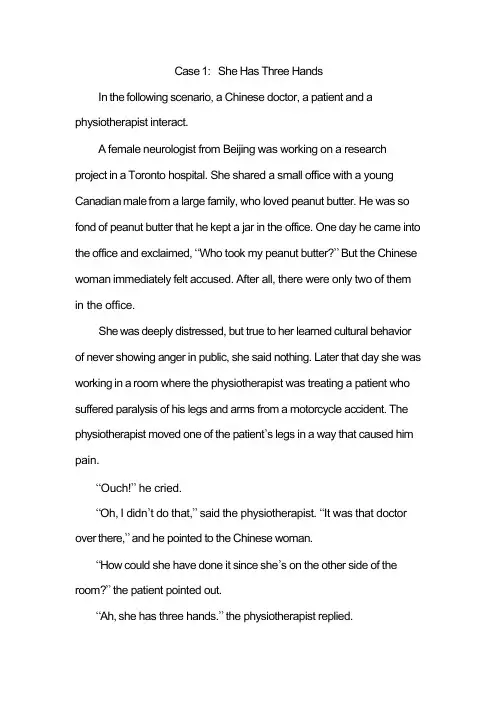
Case 1: She Has Three HandsIn the following scenario, a Chinese doctor, a patient and a physiotherapist interact.A female neurologist from Beijing was working on a research project in a Toronto hospital. She shared a small office with a young Canadian male from a large family, who loved peanut butter. He was so fond of peanut butter that he kept a jar in the office. One day he came into the office and exclaimed, “Who took my peanut butter?” But the Chinese woman immediately felt accused. After all, there were only two of them in the office.She was deeply distressed, but true to her learned cultural behavior of never showing anger in public, she said nothing. Later that day she was working in a room where the physiotherapist was treating a patient who suffered paralysis of his legs and arms from a motorcycle accident. The physiotherapist moved one of the patient’s legs in a way that caused him pain.“Ouch!” he cried.“Oh, I didn’t do that,” said the physiotherapist. “It was that doctor over there,” and he pointed to the Chinese woman.“How could she have done it since she’s on the other side of the room?” the patient pointed out.“Ah, she has three hands.” the physiotherapist replied.At these words the Chinese doctor became even more upset. She was so disturbed that she behaved in a way uncharacteristic of her culture. She waited until the patient had gone, and then said to the physiotherapist, “I’m very upset by what you said. ” The physiotherapist was taken aback. “What had I said?” “You said I had three hands,” the Chinese doctor finally choked. “You think I took the peanut butter.”Answer the following questions:1. How do you understand the phrase “to have three hands”? (3 分)2. What caused their communication conflicts? (7 分)Case 1:This case can reflect the different communication styles between Chinese and Canadians. In western cultures, communication is the means of transmitting ideas. Western people usually communicate directly with each other. That is why the Canadian in this case says what is in his mind directly in front of the Chinese woman without hiding anything. While Chinese culture stresses harmony and emphasizes the relationships between the communicators. Chinese people view communication as a process where all parties are searching to develop and maintain a social relationship. So the Chinese woman in this case tries not to argue with the Canadian face to face to keep the“harmonious relationship”between them.Case 2: Left in the ColdKatherine came to Beijing in 1998 and found a job as an English teacher in a foreign language institute. Soon after her classes began she found that her students showed no interest in her teaching style. Quite a few of them avoided attending her class. She was feeling quite upset and discouraged so she decided to ask the Director, Prof. Wang for help. Prof. Wang reviewed his timetable and suggested they meet at ten o’clock on Thursday morning. When Thursday came, Katherine arrived at Prof. Wang’s office at the exactly ten o’clock finding him talking with another teacher in Chinese. Seeing that she had come, Prof. Wang smiled and gestured her to sit down. Katherine sat down and the professor excused himself and continued to talk with the other teacher. After five minutes, he finished his conversation, and apologized to Katherine, and began to focus his attention on her situation. Prof. Wang showed great concern and asked her what the problem was. Just as she was discussing her problem, another Chinese teacher interrupted, with a form that required the Director’s signature. The Director smiled, apologized to Katherine again, and turned to talk with the Chinese teacher in Chinese. Katherine became impatient, and wondered why their discussion should be interrupted since she had made an appointment. Also, she was upset and frustrated that they continued to speak Chinese in front of her. Although their talk continued, she was apparently unhappy about what had happened.Answer the following questions:1. How would you explain the Director’s behavior toward Kathrine?(5 分)2. How would you make the Director understand why Katherine felt frustrated and angry? (5 分)Case 2:CommentThis is a typical cultural clash between Chinese and Westerners. There is a great difference in the concept of appointment and its behavior pattern in different cultures. To Americans, an appointment is a confirmation to meet at a precise time. If an appointment is scheduled, both parties should respect the appointment time. For example, if a professor makes an appointment with a student at a certain time, it should not be interrupted by other things or people. In addition, Westerners are good timekeepers; they adhere strictly to schedules. However, Chinese view appointments in a more flexible manner. They are more casual about commitments. This difference in attitudes toward appointment was the root of Katherine’s unhappiness. Since the Director made an ten a’clock appointment, he should have tried to avoid any interruption. However, when Katherine arrived on time, the Director was still talking with another teacher. When their meeting finally began, it was interrupted again. There is no wonder Katherine became frustrated and angry.Case 3: Personal SpaceMark had recently moved from Denmark to Sydney to work as a salesperson for a large Australian company. After three weeks, he was invited to join a local club. During the first few weeks at the club, Mark would either stand in the corner talking with someone or sit on a sofa listening to other people talk and chat. As time went by, he came to know most of the club members and seemed to enjoy talking with them. One day, at an evening party one of the female members approached him. Mark immediately showed his interest by talking about the atmosphere of the party. At first, the conversation between them seemed to go quite smoothly, but as it progressed the lady seemed to step further and further away from Mark as he had been gradually moving closer to her. The lady obviously seemed uncomfortable. As Mark was about to ask her questions regarding Australian social customs, another man standing nearby directed a glance toward the lady. She excused herself and went to talk with that man, leaving Mark standing alone and wondering why their conversation had come to such a sudden stop.Answer the following question1. Why did that woman suddenly stop talking with Mark and turned to another man? (10 分)Case 3:This is a typical case of misunderstanding caused by different perceptions abut body distance.There is a lot of evidence to show that body distance varies with different people, different circumstances, and different cultures. In Denmark, at a formal event, the intimate space is usually between 20 to 30 centimeters; while in Australia such an occasion requires a body distance of 40 to 50 centimeters. Therefore when a Dane talks with an Australian, the problem arises: the Dane is accustomed to a close distance while the Australian is comfortable with a great distance.In this case, Mark, by trying to establish his normal intimate space, infringed on the Australian lady’s space. Because of this, she felt somewhat threatened and lost her sense of comfort. At that moment, the nearby man offered her the opportunity to excuse herself from Mark. If Mark had had some knowledge about the expected personal space for Australians, the encounter might have been totally different.Case 4Li Ming, a male Chinese graduate student, studied in the United States. He shared a room with his American classmate Tony in a residence hall. At the very beginning, Li Ming found it easy and enjoyable to get along with Tony, for he was an open-minded person and sometimes he could give Li Ming quite a lot of helpful advice. But later,Li Ming felt it really hard to do the real effective communication. For example:One day Tony went into the bathroom and completely shaved his head. Li Ming easily discovered this fact when he himself visited the bathroom and saw the hair everywhere. He returned to his room and said to Tony, “You’ve shaved your head.” Tony replied, “Yeah, I did.”Li Ming waited a while, then said, I discovered you’d shaved your head when I went into the bathroom and saw the hair. “Yeah.” Tony confirmed. Li Ming was at a loss. He believed he had communicated in the strongest possible language his wish that the American would clean up the mess he’d made in the bathroom. But Li Ming was very much disappointed at his roommate Tony!Later he discussed the surprising episode with some Chinese friends who told him, “Listen, with Americans you actually have to say: Clean up the bathroom!” Li Ming believed his message had been very clear. However, he was relying on the context of the communication for the message to be understood: hair was all over the bathroom, and his roommate now was bare-headed.Questions:1. Why do you think the American student Tony failed to understand what his Chinese roommate Li Ming had wanted to say?2. Suppose the main characters in the story are two Chinese studentsor two American students, in what way will they deal with the matter?Case 7 (P30)Case analysis: Cultural differences decide the two students are going to communicate in different ways. 案例分析:文化差异决定这两个学生要沟通的方式不同。
跨文化交际案例分析

Unit 1 Language and Culture in CommunicationTheory:Communication is something we do every day. It takes place so naturally that we simply fail to notice it until it hiccups or breaks down. Though it is commonplace, it is no exaggeration to say that communication is life and life is communication.1.When you join a social gathering, you must be aware of rules and procedures that govern theway things are going to proceed. There is a technical term for such rules and procedures—schema.2.Face and politeness are two other areas which are extremely value-sensitive. One of thedistinctive features of Chinese politeness is self-denigration and other-elevation.Case 1: Litz is a professor of cross-cultural communication in a university in Finland. She invited her Chinese students home for an evening party.The sche ma from Litz’s point of view includes the following:1. Giving invitation: by phone / by mail2. Prepare everything before the arrival of guests3. Receiving guests: open the door / express welcome / take their overcoats / introduce guests / offer them drinks / make them comfortable4. Serving food: set the table / soup first / main course / desert5. Post dinner activities: chat / play music / offer more drinks6. Seeing guests off: thank them for coming / good nightLitz’s evening party was not very successful, because she was upset by one of her guests. Here was the initial conversation between Litz and Lin:Litz: (opens the door) Oh, Lin, how nice you could come!Lin: It’s not difficult to find your house.Litz: Come on in.Lin: (comes in)Litz: Can I take your coat?Lin: No, thanks.Litz: Ok, this way please.Lin: (take off her coat and hangs it)Analysis: Litz was hurt because Lin did not let her hang her coat. Litz’s offering to hang Lin’s coat is one of Litz’s ways (it’s on Litz’s schema). On Lin’s side, she thought that Litz was her supervisor and that it was inappropriate to let her supervisor hang her coat. Here we have an instance of one action attached with different cultural values.Case 2:Finding an Interested BuyerGeorge Hall was in Beijing attending a trade fair and looking for an opportunity to do business in China. He had been very successful in his business dealings in the US and prided himself on his ability “to get things moving.” His first day was going well .He looked around at the displays of sporting equipment to get some idea of whom he might approach. He was sure that his products, tennis rackets with an unusual new design, would arouse some interests. On thesecond day he approached the company which he felt would be most responsive to his products. He introduced himself to the general, a Mr. Li. Since he had read that Chinese find getting down to business immediately too abrupt and rude, he began a casual conversation, eventually leading up to the topic of his products and suggesting how Mr. Li’s company might benefit from using them. George then suggested that he could arrange to get together with Mr. Li and provide more specifics and documentation on his products.Mr. Li res ponded in fairly good English,” That would be interesting.”Knowing that he had only a few days left in Beijing, George wanted to nail down a time,” When can we meet?” asked George.“Ah. This week is very busy,” replied Mr. Li.“It sure is,” said George,” How about 10 o’clock? Meet you here.”“Tomorrow at 10 o’clock?” asked Mr. Li thoughtfully.“Right,” said George, “I’ll see you then?”“Hmm, yes; why don’t you come by tomorrow,” was the reply.“OK,” responded George,” It was nice meeting you.”The next day at 10 o’clock he approached Mr. Li’s company’s exhibit only to find that Mr. Li had some important business and was not able to meet with George. He called back later in the day and was told that Mr. Li was not available.Analysis: 英美人士做事情讲究守时。
英语跨文化交际案例分析模板

英语跨文化交际案例分析模板引言跨文化交际是指在不同的文化背景下进行沟通和交流的过程。
英语作为全球通用语言,在跨文化交际中起着重要的角色。
本文将通过分析一个跨文化交际案例,探讨在不同文化背景下英语交际可能面临的问题和挑战。
案例背景假设情景:两位年轻人来自不同国家,分别是中国和美国。
他们通过社交媒体结识,并希望通过英语交流进一步了解对方的文化和生活。
他们已经通过文字聊天开始沟通。
语言差异英语是两位年轻人进行跨文化交际的工具,然而,由于他们来自不同的国家,他们对英语的使用和理解可能存在差异。
首先,母语不同会导致对语法、用词和句子结构的理解不同。
中国的英语教育注重文法和翻译,而美国的英语教育更注重口语和交流能力。
因此,两人的表达方式可能存在一些差异。
其次,文化背景的差异也会影响对词汇和表达方式的理解。
中国文化中的礼貌和尊重是非常重要的,而美国文化则更注重直接和开放的表达方式。
因此,在沟通中,他们可能需要适应对方的文化差异,以更好地理解对方的意思。
非语言交际除了语言差异之外,非语言交际也是跨文化交际中需要注意的重要因素。
身体语言和面部表情在跨文化交际中起着重要的作用。
中国人习惯使用面部表情和手势来表达情感和意思,而美国人则更注重身体姿势和手势。
在聊天中,如果两人无法面对面交流,他们的面部表情和身体语言就无法得到传达,可能会影响信息的理解和交流的准确性。
另外,个人空间和触碰也是需要注意的问题。
在中国文化中,个人空间较大,普遍注重隐私和距离感;而在美国文化中,个人空间较小,更习惯于直接接触。
因此,在交流中,他们需要互相理解对方的个人空间和触碰需求,避免造成不必要的尴尬或冲突。
思考与解决策略跨文化交际中的问题和挑战可以通过以下策略来解决:1.意识到差异:双方应意识到彼此文化差异的存在,并用开放的心态看待这些差异。
这有助于双方更好地理解对方的行为和表达方式。
2.尊重和包容:尊重对方的文化差异,并以包容的态度对待不同的习惯和观念。
跨文化交际案例分析题及答案

跨文化交际案例分析题及答案案例描述在跨国公司A的一个国际会议上,来自不同国家的员工们需要共同讨论一个重要项目。
会议进行了几天,但是却一直没有取得明确的进展。
不同国家的员工语言文化差异导致了沟通障碍,讨论过程中出现了许多误解和纠纷。
公司高层深感困惑,希望找到解决这个问题的方法。
障碍分析1. 语言障碍跨国公司A的员工来自不同的国家,他们使用的是各自母语进行交流。
除了英语是共同的工作语言外,其他国别的员工使用的语言差异较大。
这种语言差异导致了语言表达的不准确和理解的模糊,使得员工们无法正常交流和理解对方。
2. 文化差异不同国家的员工具有不同的文化背景和价值观念,这导致了他们在讨论过程中产生了误解和冲突。
文化差异可以涉及到对时间观念、权力关系、政治正确性和个人自由等方面的不同理解,这些差异会影响到他们的决策方式和工作方式,导致合作的困难。
解决方案1. 提供语言支持和培训跨文化交际的第一个挑战是语言障碍。
为了解决这个问题,公司可以提供语言支持和培训,以帮助员工们提高英语或共同工作语言的能力。
这可通过组织语言培训课程,雇佣专业翻译人员或提供翻译工具等方式实现。
提供语言支持和培训可以降低语言障碍,提高员工之间的沟通效率。
2. 开展跨文化培训除了语言障碍外,文化差异也是讨论中的一个重要问题。
公司可以组织跨文化培训,帮助员工了解不同文化之间的差异,并教授他们如何在跨文化环境中进行有效的沟通和合作。
该培训可以包括介绍不同文化的价值观、信念和行为准则,以及跨文化冲突解决的技巧和策略。
通过开展跨文化培训,可以提高员工对文化差异的认识和理解,促进跨文化交际的顺利进行。
3. 引入跨文化中介人为了解决跨文化交际中的难题,公司可以考虑引入跨文化中介人。
跨文化中介人是具有跨文化交际经验和能力的人员,他们可以在员工之间进行翻译和解释,协助双方理解并解决可能出现的误解和冲突。
跨文化中介人的介入可以减少员工之间的摩擦,促进合作和理解。
跨文化交际案例分析答题模板范文
跨文化交际案例分析答题模板范文概述跨文化交际是指不同文化背景下的人或群体之间进行的交流与沟通。
在全球化的背景下,跨文化交际变得越来越重要,因为不同国家和地区之间的交流交流变得日益频繁。
然而,由于文化差异的存在,跨文化交际也会面临一些挑战。
本文将以一个实际案例为例,分析其中的跨文化交际问题,并提供解决方案。
案例描述在某国际会议上,来自不同国家的代表们齐聚一堂,探讨共同关心的问题。
会议主题是「可持续发展与全球环境保护」。
会议期间,参会代表们进行了多场演讲和讨论。
在一次小组讨论中,来自西方国家的代表John对某个问题提出了自己的观点,他认为政府应该采取更严格的法律措施来保护环境。
然而,来自东方国家的代表Li却反对这种观点,他认为法律的过度干预会限制企业的发展。
在讨论的过程中,John和Li之间发生了一些误解和摩擦。
John认为Li不关心环境保护,而Li则认为John过于强调法律的作用。
这种跨文化交际的问题让讨论变得紧张和困难。
分析这个案例揭示了在跨文化交际中常见的问题,即对待问题的态度和观点的差异。
从文化角度来看,西方国家注重环境保护和法律的作用,倾向于通过法律手段来解决问题。
而在东方文化中,更强调的是企业的发展和自由市场经济。
这种文化差异导致了John和Li之间的观点冲突。
此外,语言的差异也是导致误解的一个重要因素。
John和Li使用的是各自的母语进行交流,他们的语言表达方式和理解方式也存在差异。
比如,John可能使用了一些西方文化中常用的词汇、成语或隐喻,而这些对于Li来说可能是不熟悉或难以理解的。
这种语言差异导致了彼此之间的误解和沟通障碍。
解决方案为了解决这个问题,我们可以采取以下措施:1.尊重和理解:参会代表们应该相互尊重和理解彼此的文化差异。
这样可以缓解紧张情绪,并为进一步的交流打下基础。
2.注意语言表达:参会代表们应该尽量使用简单、清晰、易懂的语言进行表达。
避免使用过于专业化或地方化的词汇,以免引起误解。
跨文化交际英语案例分析万能模板
跨文化交际英语案例分析万能模板引言在全球化的趋势下,跨文化交际已成为日常生活和工作中的常态。
无论是国际贸易、跨国合作还是旅游交流,我们都会面临与不同文化背景的人进行交流和沟通的挑战。
特别是在学习和使用英语的过程中,我们需要了解不同文化对于语言使用和交际方式的影响。
本文将通过分析具体的跨文化交际案例,探讨英语学习者在不同文化背景下的沟通策略和技巧。
案例一:商务洽谈中的礼节差异A公司是一家美国跨国公司,打算与中国的B公司展开商务合作。
双方代表进行了一次面对面的商务洽谈。
在会议中,中国代表以客人的身份招待美国代表,并为其安排了一顿丰盛的中餐。
然而,美国代表主动将自己的商业计划一一介绍后,提出了一些具体的问题和要求。
此时,中国代表显然有些紧张和不悦,并没有直接回答问题,而是转移了话题,讲述了一些与商务无关的事情。
这种回应方式在美国文化中被视为不专业和不直接,可能会影响双方的合作关系。
在这个案例中,我们可以看出美国和中国在商务洽谈中的礼节差异。
美国文化注重直接、效率和专业性,而中国文化则更加注重人际关系和面子。
为了避免类似的情况发生,英语学习者可以采取以下策略: - 尊重和理解对方文化的特点,尽量适应对方的沟通方式; - 在交流过程中保持礼貌和尊重,不要过于直接或冷漠; - 尽量避免忽视对方分享的个人经历,可以采用开放式的问题引导对话,促进更深入的交流。
案例二:面试中的语言差异某公司招聘一名国际销售经理,面试环节中的英语口语能力成为了重要的考察点。
一位来自美国的面试官问了一道开放性问题:“你在此之前是如何处理一次跨国销售合作中的文化冲突的?”应聘者来自中国,他理解问题后,迅速开始介绍了自己曾经参与的一次错误的销售合作案例,强调通过学习和理解对方文化后,取得了成功。
然而,面试官希望应聘者更多地关注解决冲突的方法和技巧,而不是侧重于个人经历的叙述。
这使得应聘者在面试中失去了一部分分数。
这个案例揭示了中西文化在表达方式上的差异。
跨文化交际案例分析万能模板
跨文化交际案例分析万能模板案例背景跨文化交际是指在不同文化背景下进行的交流和互动。
由于不同文化具有不同的价值观、信仰、习俗和行为规范,跨文化交际往往面临着挑战和困难。
本文将通过分析一个跨文化交际案例,探讨跨文化交际中常见的问题,并提供解决问题的方法,以此为参考,帮助人们更好地进行跨文化交际。
案例描述案例中,A是中国人,B是美国人。
他们是在一家国际公司工作的同事。
一天,在一个重要会议上,A提出了一个新的想法,但没有得到B的支持,甚至遭到了反对。
A感到困惑和失望,并对B的态度感到不解。
问题分析1.语言障碍:A和B来自不同的文化背景,使用不同的母语。
这可能导致他们在交流中出现理解的困难,甚至存在翻译误解的可能性。
2.价值观冲突:A和B来自具有不同价值观的文化,他们对问题的看法和解决方法可能存在差异。
这造成了他们在会议上的分歧。
3.社交礼节:A和B在社交礼节方面可能存在差异。
比如在会议上,B的反对可能是基于不同的文化背景下对表达意见的方式和场景的理解。
解决方法1.主动沟通:A和B应该积极主动地沟通,充分交流彼此的意见和想法。
他们可以约定一个合适的时间,面对面地沟通,以确保双方对对方的意思有清晰的理解。
2.尊重他人文化:A和B应该尊重彼此的文化差异。
他们可以通过学习对方的文化,了解他人的价值观和习俗,以更好地理解和包容对方的观点。
3.寻求共同利益:A和B可以寻找问题的共同利益,以此为基础来达成共识和解决分歧。
他们可以探讨对方的顾虑并提出解决方案,以达成双赢的结果。
4.适应交流方式:A和B可以适应对方的交流方式。
他们可以根据对方的习惯和文化特点,选择合适的表达方式和场景,以减少误解和冲突的可能性。
结论跨文化交际虽然存在挑战和困难,但通过主动沟通、尊重他人文化、寻求共同利益和适应交流方式等方式,我们可以更好地解决问题,建立跨文化交际的良好关系。
希望通过这个万能模板,能帮助更多人在跨文化交际中更加成功和顺利。
跨文化交际案例及分析(精选5篇)
跨文化交际案例及分析(精选5篇)跨文化交际案例及分析范文第1篇[关键词]跨文化外语教学案例分析大同学跨文化交际本领一、跨文化英语教学现状分析就我国的外语教学现状而言,高一虹(2023:28)指出,现有的跨文化交际本领培育模式都有肯定局限。
行为中心的培育模式,只关注交际行为本身和交际结果,执着于实在目标,但在我们一般性的大学教育中,很难确定同学将来可能与之打交道的目的文化,因此也很难像对特定出国人员进行培训那样对同学实施有较强针对性的训练;学问中心模式,则集中于认知层面,重要向同学灌输有关文化学问,但难以让同学产生切身体验,而且还不适用于处理文化的多样性和动态性,传授文化学问简单变成“定型”(stereotype),反而不利于跨文化交际本领向较高层次进展。
另外,我们的教学大纲设计和教学实践往往缺乏充足的开放性,没有给同学较多面对问题和独立解决问题的机会。
因此在跨文化外语教学中,需要依据跨文化交际本领框架,提高同学使用语言的正确性的同时还要帮忙其提高言语行为的得体性。
在近年来对跨文化交际本领框架的浩繁讨论中,笔者认为杨盈、庄恩平(2023)提出的由全球意识、文化调适、文化学问和交际实践四大本领系统构成的外语教学跨文化交际本领框架,符合教学大纲和教学实践的要求,具较强可行性。
二、案例分析在跨文化英语教学中的作用目前跨文化英语教学普遍采纳的方法重要包括背景学问导入、文化内涵探究、案例分析、角色扮演及情景仿照、实例搜索等。
案例分析教学中将不同文化背景的语言特色、风土人情、历史事件和现实冲突等素材呈现于同学面前,是跨文化学问、意识、思维和交际本领的综合训练过程,能帮忙同学达到学习外语语言技能与培育跨文化交际本领有机结合的目的。
在谈到案例教学法时,陈建平(2023)强调:“案例是为适应特定的教学目的而编写的”,教学过程重要是“同学之间的讨论和辩论”,教学目的重要是“培育同学的本领”。
上述特点,使案例教学能很好适用于跨文化外语教学,它对培育本领的重视大过取得学问,成为语言文化学问向跨文化本领变化的有效途径。