
肖斯塔科维奇作品《第二号爵士组曲-第二圆舞曲》Waltz2;DmitryShostakovich(Tackwan古典吉他谱)
肖斯塔科维奇第二大提琴协奏曲

肖斯塔科维奇第二大提琴协奏曲肖斯塔科维奇(Dmitri Shostakovich)是20世纪苏联最重要的作曲家之一,他的作品被广泛认为是对苏联社会和政治现实的最有力、最直接的表达。
肖斯塔科维奇的第二大提琴协奏曲,作为他的成熟时期的代表作之一,具有独特的音乐语言和深刻的内涵。
该协奏曲于1966年完成,是为苏联著名大提琴家姜根可夫(Mstislav Rostropovich)而作。
肖斯塔科维奇通过这部作品,探讨了个人在政治环境下的挣扎和反抗,以及对社会现实的思考和审视。
整个协奏曲分为四个乐章,每个乐章都展现了肖斯塔科维奇的独特音乐才华和精湛的构思。
第一个乐章以其悲怆、沉重的氛围而闻名,开篇即展现了作曲家对政治和社会的不满和抗议。
大提琴在这一乐章中扮演着强烈拒绝和反叛的角色,仿佛在与命运、世界为敌。
第二乐章则是一个轻松的舞曲,为整部协奏曲带来了一丝欢快的氛围,但在这种欢快之下,却又暗含着对社会虚伪与痛苦的嘲讽。
第三乐章是整个协奏曲中最沉重、最复杂的部分,展现了作曲家对社会的深刻思考和对人类命运的悲伤。
最后一个乐章则是整个协奏曲的高潮,大提琴与管弦乐团在这一部分中展开了激烈的对话和较量,象征着个体与集体、个人与政治的对抗和斗争。
肖斯塔科维奇第二大提琴协奏曲被认为是对苏联政治现实的强烈批判和抗议,同时也表达了作曲家对人类处境的关怀和对艺术自由的追求。
这部作品不仅在音乐史上具有重要地位,也是现代音乐中的杰作之一,展现了肖斯塔科维奇的音乐天才和思想深度。
虽然这部协奏曲的诞生背景是苏联政治压力和社会现实,但其超越了时代的意义和价值,成为了全世界音乐爱好者耳熟能详的经典之作。
肖斯塔科维奇通过这部作品,向世人展示了作为一个独立思考、勇敢表达的艺术家是如何坚守自己的信念和原则,不受任何外在压力和干扰的。
肖斯塔科维奇第二钢琴协奏曲

肖斯塔科维奇第二钢琴协奏曲肖斯塔科维奇第二钢琴协奏曲是俄罗斯作曲家肖斯塔科维奇于1957年创作的一部钢琴协奏曲。
这部协奏曲是肖氏最具代表性的作品之一,也是典型的20世纪音乐代表作之一。
协奏曲包括三个乐章,时长约为40分钟。
第一乐章非常浓重,充满魅力和光芒,而第二乐章则非常伤感和愁绪破人心扉,最后一个乐章非常兴奋和激烈。
在这部协奏曲中,钢琴和乐团的交互非常积极而且紧密,钢琴的音乐非常复杂,并要求演奏者拥有极高的技巧和创造力。
这部协奏曲已被许多著名钢琴家演奏和录制,成为了钢琴音乐历史上的经典之作。
肖斯塔科维奇第二钢琴协奏曲充满情感和力量,是肖氏绝佳的艺术成就之一,也让人们更深入了解了俄罗斯现代音乐的发展。
肖斯塔科维奇《第二钢琴协奏曲》创作特征
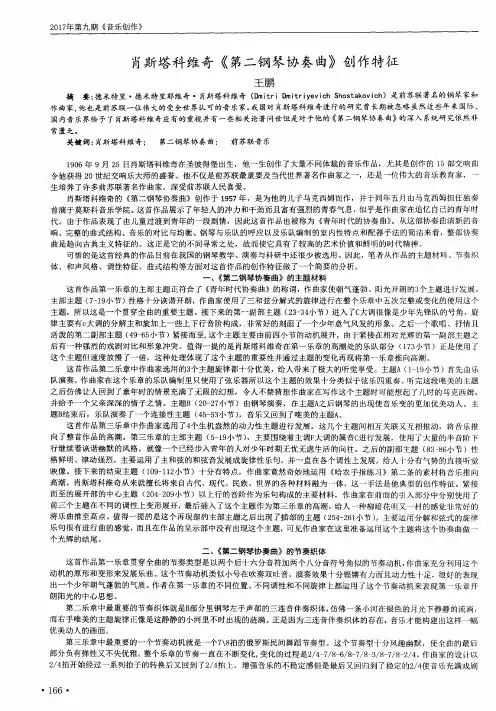
肖斯塔科维 奇 《 第二钢琴 协奏 曲》 创作 特征
王 鹏
摘 要: 德米特里 ・ 德 米 特 里 耶 维 奇 ・肖斯 塔 科 维 奇 ( D m i t r i D mi t r i y e v i c h S h o s t a k o v i c h )是 前 苏 联 著 名 的 钢 琴 家和
关键词 : 肖斯 塔 科 维 奇 ;
第二 钢 琴 协 奏 曲 : 前 苏联 音 乐
1 9 0 6年 9月 2 5日肖斯塔科维奇在圣彼得堡出生,他一生创作 了大量不 同体裁 的音乐作 品,尤其是创作的 1 5部交响曲 令他获得 2 O世纪交响乐大师 的盛誉 。他不仅是前苏联最重要及 当代世界著名 作曲家之 一,还是 一位伟大 的音乐教 育家 ,一 生培养 了许多前苏联著名作 曲家 ,深受前苏联人 民喜爱 。
肖斯塔科维奇 的 《 第二钢琴协奏 曲》创作于 1 9 5 7年 ,是为他 的儿子 马克西姆而作 ,并于同年五 月由马克西姆担任独奏 首演于莫斯科音乐学院 。 这首作 品展示 了年轻人 的冲力和于劲而且 富有 强烈的青春气 息, 似 乎是 作曲家在追忆 自己的青 年时
代 。由于作 品表现 了由儿童过渡 到青年 的一段剧情 ,因此这 首作 品也被称为 《 青年时代的协奏 曲》 。从这 部协奏 曲清新 的音 响、完整的 曲式结构 、音乐的对 比与均衡 、钢琴与乐 队的呼应 以及 乐队编制 的室 内性特 点和配器手法 的简洁来看 ,整部 协奏 曲是趋 向古典主义特征 的。这正是它 的不 同寻常之 处,故而使它 具有 了较 高的艺术 价值 和鲜 明的时代 精神 。 可惜 的是这首经典 的作 品 目前在我 国的钢琴教 学、演奏与科研 中还 很少被选 用。因此 ,笔 者从作 品的主题材料 、节 奏织 体、和声风格 、调性特征 、曲式结构等方面对这首作 品的创作特征做 了一个 简要 的分析 。
肖斯塔科维奇《第二钢琴协奏曲》三个音响版本的对比分析及启示
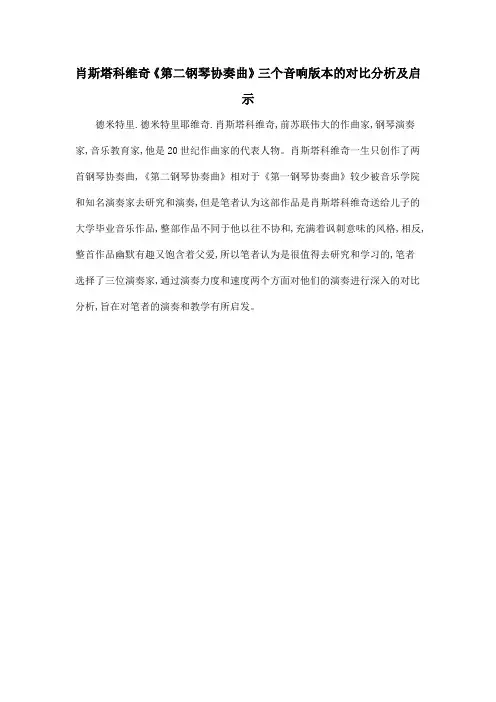
肖斯塔科维奇《第二钢琴协奏曲》三个音响版本的对比分析及启
示
德米特里.德米特里耶维奇.肖斯塔科维奇,前苏联伟大的作曲家,钢琴演奏家,音乐教育家,他是20世纪作曲家的代表人物。
肖斯塔科维奇一生只创作了两首钢琴协奏曲,《第二钢琴协奏曲》相对于《第一钢琴协奏曲》较少被音乐学院和知名演奏家去研究和演奏,但是笔者认为这部作品是肖斯塔科维奇送给儿子的大学毕业音乐作品,整部作品不同于他以往不协和,充满着讽刺意味的风格,相反,整首作品幽默有趣又饱含着父爱,所以笔者认为是很值得去研究和学习的,笔者选择了三位演奏家,通过演奏力度和速度两个方面对他们的演奏进行深入的对比分析,旨在对笔者的演奏和教学有所启发。
肖斯塔科维奇钢琴曲
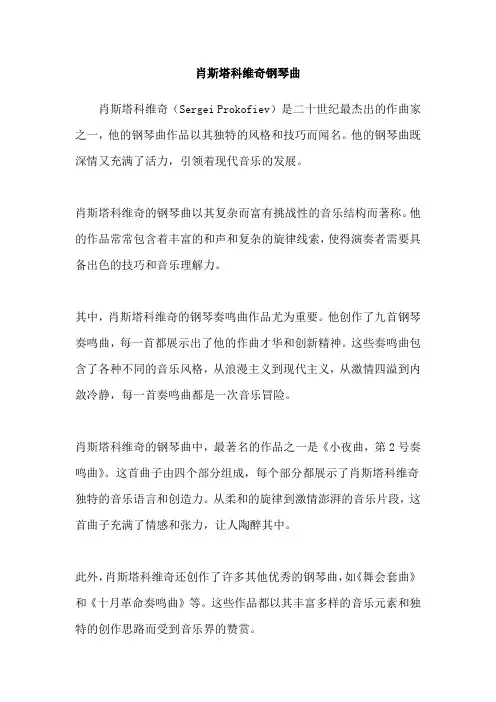
肖斯塔科维奇钢琴曲
肖斯塔科维奇(Sergei Prokofiev)是二十世纪最杰出的作曲家之一,他的钢琴曲作品以其独特的风格和技巧而闻名。
他的钢琴曲既深情又充满了活力,引领着现代音乐的发展。
肖斯塔科维奇的钢琴曲以其复杂而富有挑战性的音乐结构而著称。
他的作品常常包含着丰富的和声和复杂的旋律线索,使得演奏者需要具备出色的技巧和音乐理解力。
其中,肖斯塔科维奇的钢琴奏鸣曲作品尤为重要。
他创作了九首钢琴奏鸣曲,每一首都展示出了他的作曲才华和创新精神。
这些奏鸣曲包含了各种不同的音乐风格,从浪漫主义到现代主义,从激情四溢到内敛冷静,每一首奏鸣曲都是一次音乐冒险。
肖斯塔科维奇的钢琴曲中,最著名的作品之一是《小夜曲,第2号奏鸣曲》。
这首曲子由四个部分组成,每个部分都展示了肖斯塔科维奇独特的音乐语言和创造力。
从柔和的旋律到激情澎湃的音乐片段,这首曲子充满了情感和张力,让人陶醉其中。
此外,肖斯塔科维奇还创作了许多其他优秀的钢琴曲,如《舞会套曲》和《十月革命奏鸣曲》等。
这些作品都以其丰富多样的音乐元素和独特的创作思路而受到音乐界的赞赏。
总之,肖斯塔科维奇的钢琴曲以其复杂的结构、丰富的和声和独特的音乐语言而闻名。
他的作品不仅展示了他作为作曲家的创造力,也为钢琴音乐的发展做出了重要的贡献。
无论是音乐家还是听众,都能从中体验到肖斯塔科维奇独特的音乐世界。
肖斯塔科维奇五首小品简介
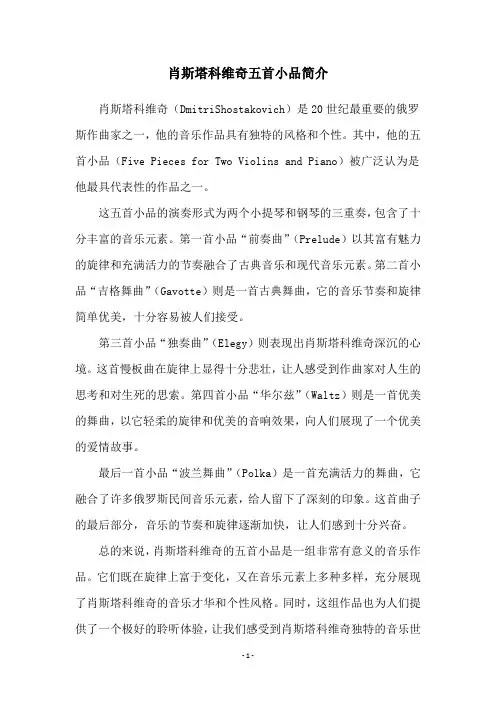
肖斯塔科维奇五首小品简介
肖斯塔科维奇(DmitriShostakovich)是20世纪最重要的俄罗斯作曲家之一,他的音乐作品具有独特的风格和个性。
其中,他的五首小品(Five Pieces for Two Violins and Piano)被广泛认为是他最具代表性的作品之一。
这五首小品的演奏形式为两个小提琴和钢琴的三重奏,包含了十分丰富的音乐元素。
第一首小品“前奏曲”(Prelude)以其富有魅力的旋律和充满活力的节奏融合了古典音乐和现代音乐元素。
第二首小品“吉格舞曲”(Gavotte)则是一首古典舞曲,它的音乐节奏和旋律简单优美,十分容易被人们接受。
第三首小品“独奏曲”(Elegy)则表现出肖斯塔科维奇深沉的心境。
这首慢板曲在旋律上显得十分悲壮,让人感受到作曲家对人生的思考和对生死的思索。
第四首小品“华尔兹”(Waltz)则是一首优美的舞曲,以它轻柔的旋律和优美的音响效果,向人们展现了一个优美的爱情故事。
最后一首小品“波兰舞曲”(Polka)是一首充满活力的舞曲,它融合了许多俄罗斯民间音乐元素,给人留下了深刻的印象。
这首曲子的最后部分,音乐的节奏和旋律逐渐加快,让人们感到十分兴奋。
总的来说,肖斯塔科维奇的五首小品是一组非常有意义的音乐作品。
它们既在旋律上富于变化,又在音乐元素上多种多样,充分展现了肖斯塔科维奇的音乐才华和个性风格。
同时,这组作品也为人们提供了一个极好的聆听体验,让我们感受到肖斯塔科维奇独特的音乐世
界。
肖斯塔科维奇 第二钢琴协奏曲
肖斯塔科维奇的第二钢琴协奏曲是他的代表作之一,创作于1957年。
这首曲子是肖斯塔科维奇为了庆祝他的儿子马克森·肖斯塔科维奇19岁生辰而特别创作的,马克森亦以此曲的首演作为他于莫斯科音乐学院毕业典礼中的表演曲目,由苏联国家交响乐团及指挥亚诺索夫(Nikolai Anosov)所伴奏。
这首协奏曲写于肖斯塔科维奇创作生涯的晚期,也是他的第二部钢琴协奏曲,其风格相较于第一首协奏曲更加成熟和独特。
这首曲子以F大调为主调,充满了浓郁的俄罗斯风情和情感,同时也融入了肖斯塔科维奇个人的音乐元素和风格。
肖斯塔科维奇在创作中运用了丰富的音乐语言和技巧,使得这首协奏曲充满了表现力和感染力。
其中,独奏部分表现了钢琴的技巧和表现力,同时也突显了肖斯塔科维奇对钢琴这件乐器的独特理解和运用。
总的来说,肖斯塔科维奇的第二钢琴协奏曲是一部充满情感和技巧的杰出作品,也是肖斯塔科维奇音乐创作生涯中的重要里程碑。
肖斯塔科维奇第二大提琴协奏曲
肖斯塔科维奇第二大提琴协奏曲肖斯塔科维奇的第二大提琴协奏曲,也被称为《第二大提琴协奏曲》或《大提琴协奏曲第二号》,是苏联作曲家德米特里·肖斯塔科维奇于1966年创作的一部音乐作品。
该曲以其深沉、激情和技巧性而闻名,被公认为提琴家的高难度演奏曲目之一。
肖斯塔科维奇的第二大提琴协奏曲由四个乐章组成:快速,怀旧,快速,怀旧。
整个曲目约有40分钟的演奏时间。
第一乐章以强烈的节奏感和鲜明的动力开场,展示了提琴的技巧和表现力。
第二乐章是该曲的最长部分,情感丰富,充满了温柔、忧伤和激情。
快速的第三乐章带来了更多的动感和活力,提琴和乐队之间展开了激烈的对话。
最后一个乐章以缠绵悱恻的旋律和慷慨激昂的尾声结束。
肖斯塔科维奇的第二大提琴协奏曲具有浓郁的个人风格和独特的音乐语言。
他以其深刻的情感表达和对人类苦难的关怀而闻名于世。
这首协奏曲以纯熟的曲式结构和丰富的和声运用来塑造独特的音乐环境。
肖斯塔科维奇通过对不同音乐元素的巧妙运用,创造出了紧张、冲突和和谐的音乐对比。
这部作品对演奏者来说是一种巨大的挑战,要求具有高超的技巧和深厚的情感表达能力。
演奏者需要通过快速的音阶运行、大跨度的音程和复杂的技巧来完美地演绎肖斯塔科维奇对提琴的要求。
同时,在音乐表达方面,演奏者还需要抓住作曲家对情感的细腻描绘,以及对音乐主题的多样阐释。
这对于提琴家来说是一个技术和艺术上的双重挑战。
《肖斯塔科维奇第二大提琴协奏曲》在首演时并没有获得普遍认可和成功,但随着时间的推移,它逐渐获得了音乐界的赞誉和认可。
如今,这首作品已成为世界各地提琴家们的重要演奏曲目之一,并被广大观众所喜爱。
肖斯塔科维奇的第二大提琴协奏曲是一部充满激情和复杂性的音乐作品,展现了作曲家才华横溢的创作风格和个人风味。
它不仅仅是一件音乐作品,更是一次对情感的深入探索和当代艺术的传世之作。
作曲家作品目录_肖斯塔科维奇
为大提琴和钢琴而作的小品 3 首。 f 小调第 1 交响曲。
1923-1924 1923-1925 Symphonic 20th/21st Century Symphony Octet for Eight String Instruments 20th/21st Century Sonata/Sonatina for Keyboard Character/Single-Movement/Miscellaneous Work for Keyboard
Symphonic 20th/21st Century Symphony with Chorus
014b Reduction of the choral score of Symphony No. 2, for voices and piano 015 The Nose, opera 015a The Nose, opera suite
为钢琴独奏而作的“黄金时代”中 1935 的波尔卡舞曲。
Polka from "The Age of Gold". for piano 为钢琴四手联弹而作的“黄金时 1962 four hands 代”中的波尔卡舞曲。 Pieces (2) for E. Dressel's "Kolumbus", for orchestra The Shot, incidental music Music to the Play "Virgin Soil" (Lost) 根据 E· 德雷赛尔的“哥伦布”为 1929 管弦乐队而作的小品 2 首。 射击,配乐 戏剧音乐“处女地”(遗失)。 1929 1930 Orchestra 20th/21st Century Orchestral Music Orchestra 20th/21st Century Incidental Music for Orchestra
肖斯塔科维奇作品索引
肖斯塔科维奇作品索引德米特里·德米特里耶维奇·肖斯塔科维奇作品索引一、肖斯塔科维奇主要作品中文目录(一)交响曲第一交响曲,F小调,Op.10(1924-25)第二交响曲,B大调,《十月》,Op.14(1927)第三交响曲,降E大调,《五一》,Op.20(1929)第四交响曲,C小调,Op.43(1935-36)第五交响曲,D小调,Op.47(1937)第六交响曲,B小调,Op.54(1939)(1924-25)第七交响曲,C大调,Op.60《列宁格勒》(1941)第八交响曲,C小调,Op.65(1943)第九交响曲,降E大调,Op.70(1945)第十交响曲,E小调,Op.93(1953)第十一交响曲,G小调,Op.103《1905年》(1957)第十二交响曲,D小调,Op.112《1917年》(1961)第十三交响曲,降B小调,Op.113《娘子谷》(1962)第十四交响曲,Op.135(1969)第十五交响曲,A大调,Op.141(1971)(二)其他管弦乐曲1、《塔希提岛漫步》(Tahiti Trot)(根据《鸳鸯茶》改编),Op.16(1928)2、《霹雳》组曲(芭蕾组曲No.5)(The Bolt suit),Op.27a(1931)3、《爵士组曲》No.1,(1938)第一段:圆舞曲第二段:波尔卡第三段:狐步舞,4、《爵士组曲》No.2,(1938)5、《节日序曲》(Festival Overture),Op.96,(1954)6、《室内交响曲》,Op.110a(巴尔沙伊根据第八弦乐四重奏改编)7、交响诗《十月》(October),Op.113,(1967)8、芭蕾《黄金时代》(The Age of Gold),Op.22(1927-30)9、芭蕾《霹雳》(The Bolt),Op.27(1930-31)10、芭蕾《明亮的小溪》(Bright Stream),Op.39(1934-35)11、芭蕾《空想家》(The Dreamers),(1975)(三)协奏曲1、第一钢琴协奏曲,C小调,Op.35(1933)2、第二钢琴协奏曲,F大调,Op.102(1957)3、第一小提琴协奏曲,A小调,Op.77(1947-48)4、第二小提琴协奏曲,升F小调,Op.129(1967)5、第一大提琴协奏曲,降E大调,Op.107(1959)6、第二大提琴协奏曲,G大调,Op.126(1966)(四)室内乐(含弦乐或钢琴独奏)1、15首弦乐四重奏第一弦乐四重奏,C大调,Op.49(1938)第二弦乐四重奏,A大调,Op.68(1944)第三弦乐四重奏,F大调,Op.73(1946)第四弦乐四重奏,D大调,Op.83(1949)第五弦乐四重奏,降B大调,Op.92(1953)第六弦乐四重奏,G大调,Op.101(1956)第七弦乐四重奏,F小调,Op.108(1960)第八弦乐四重奏,C小调,Op.110(1960)第九弦乐四重奏,降E大调,Op.117(1964)第十弦乐四重奏,降A大调,Op.118(1964)第十一弦乐四重奏,F小调,Op.122(1966)第十二弦乐四重奏,降D大调,Op.133(1968)第十三弦乐四重奏,降B小调,Op.138(1970)第十四弦乐四重奏,升F大调,Op.142(1972-73)第十五弦乐四重奏,降E小调,Op.144(1974)2、两首弦乐四重奏小品(Two Pieces for String Quartet,Op.36)(1931)《悲歌》和《波尔卡》3、第一钢琴三重奏,Op.8(1923)4、第二钢琴三重奏,E小调,Op.67(1944)5、钢琴五重奏,G小调,Op.57(1940)6、弦乐八重奏曲2首——前奏曲与谐谑曲,Op.11(1924-25)7、大提琴奏鸣曲,Op.40(1934)8、中提琴奏鸣曲,Op.147(1975)9、第一钢琴奏鸣曲,Op.12(1926)10、第二钢琴奏鸣曲,B小调,Op.61(1942)11、前奏曲5首,(1920-21)12、幻想舞曲3首,Op.13(1927)13、前奏曲与赋格24首,Op.87(1950-51)(五)歌剧和声乐1、《鼻子》(The Noes),Op.15(1927-28)2、《姆钦斯克县的麦克白夫人》(The Lady macbeth of theMesensk District),Op.29(1930-32)3、音乐喜剧《莫斯科,可爱的稠李》(Moscow,Cheryomushki),Op.105(1958)根据同名小歌剧改编的组曲4、《森林之歌》(男高音、男中音与儿童合唱团用的清唱剧),Op.81(1949)二、肖斯塔科维奇编号作品英文目录Opus 1: Scherzo F sharp minor for orchestra (1919)Opus 2: Eight Preludes for piano (1919-1920)Opus 2B: Minuet, Prelude and Intermezzo for piano (1919-1920)Opus 2C: Murzilka for piano (1920)Opus 2D: Five Preludes for piano (1920-1921)Opus 2E: Orchestration of "I Waited in the Grotto" by Rimsky-Korsakov for soprano and orchestra (1921)Opus 3: Theme and Variations B flat major for orchestra (1921-1922)Opus 3B: Transcription of Theme and Variations B flat major for solo piano (1921-1922)Opus 4: "Two Fables of Krilov" for mezzo-soprano, female chorus and chamber-orchestra (1922)Opus 4B: Transcription of "Two Fables of Krilov" for mezzo-soprano and piano (1922)Opus 5: "Three Fantastic Dances" for piano (1922)Opus 6: Suite F sharp minor for two pianos (1922)Opus 7: Scherzo E flat major for orchestra (1923-1924)Opus 7B: Transcription of Scherzo E flat major for solo piano (1923-1924)Opus 8: Trio for violin, cello and piano No. 1 (1923)Opus 9: Three pieces for cello and piano (1923-1924)Opus 10: Symphony No. 1 F minor (1924-1925)Opus 11: Prelude and Scherzo for string octet (or stringorchestra) (1924-1925)Opus 12: Piano Sonata No. 1 (1926)Opus 13: "Aphorisms", ten pieces for piano (1927)Opus 14: Symphony No. 2 B major "T o October" with chorus (1927)Opus 14B: Reduction of the choral score of Symphony No. 2 for voices and piano (1927)Opus 15: "The Nose", opera in 3 acts after Gogol (1927-1928) Opus 15A: Suite from "The Nose" for tenor, baritone and orchestra (1927-1928)Opus 15B: Reduction of the accompaniment of "The Nose" for piano (1927-1928)Opus 16: "Tahiti-Trot" for orchestra (1928)Opus 17: Two Pieces by Scarlatti for windorchestra (1928)Opus 18: Music to the Silent Film "New Babylon" for small orchestra (1928-1929)Opus 18B: Suite from "New Babylon" for orchestra (1976)Opus 19: Music to the Comedy "The Bedbug" by Mayakovsky (1929)Opus 19B: Suite from "The Bedbug" for orchestra (1929).Opus 19C: Arrangement of Music to "The Bedbug" for piano (1929)Opus 20: Symphony No. 3 E flat major "The First of May" withchorus (1929)Opus 20B: Reduction of Symphony No. 3 for solo piano including a vocal score of the final chorus (1929)Opus 21: Six Romances on Words by Japanese Poets for tenor and orchestra (1928-1932)Opus 21B: Six Romances on Words by Japanese Poets for tenor and piano (1928-1932)Opus 22: "The Age of Gold", ballet in 3 acts (1929-1930)Opus 22A: Suite from "The Age of Gold" for orchestra (1929-1930)Opus 22B: Polka from "The Age of Gold" for solo piano (1935) Opus 22C: Polka from "The Age of Gold" for piano four hands (1962)Opus 23: Two Pieces for Erwin Dressel's Opera "Armer Columbus" for orchestra (1929)Opus 24: Music to the Play "The Gunshot" by Bezymensky (1929)Opus 25: Music to the Play "Virgin Soil" by Gorbenko and L'vov (1930)Opus 25B: Transcription of "Symphony of Psalms" by Strawinsky for two pianos (1930)Opus 26: Music to the Film "Alone" (1930-1931)Opus 26B: Suite from "Alone" for orchestra (1930-1931)Opus 27: "The Bolt", ballet in 3 acts (1930-1931)Opus 27A: Suite from "The Bolt" for orchestra (1931)Opus 28: Music to the Play "Rule, Britannia!" by Piotrovsky (1931)Opus 29: "Lady Macbeth of the Mtsensk District", opera in 4 acts after Leskov (1930-1932)Opus 29A: Suite from "Lady Macbeth of the Mtsensk District"for orchestra (1930-1932)Opus 29B: Passacaglia from an Entr'acte to "Lady Macbeth of the Mtsensk District" for organ (1930-1932)Opus 30: Music to the Film "Golden Mountains" (1931)Opus 30A: Suite from "Golden Mountains" for orchestra (1931)Opus 30B: Two Pieces for string quartet (1931)Opus 30C: "The Green Company", overture (1931)Opus 31: Music to the Stage Revue "Hypothetically Murdered" by Voyevodin and Riss (1931)Opus 31A: Orchestration of "Hypothetically Murdered" (1992) Opus 31B: Reduction of Four Movements of the Music to "Hypothetically Murdered" for piano (1931)Opus 32: Music to the Play "Hamlet" by Shakespeare (1931-1932)Opus 32A: Suite from "Hamlet" for small orchestra (1932)Opus 32B: "From Karl Marx to Our Own Days", symphonic poem for solo voices, chorus and orchestra (1932)Opus 32C: "The Big Lightning", comic opera (1932)Opus 33: Music to the Film "Counterplan" (1932)Opus 33B: "Song about the Oncoming Train" and "My Heart's Aching and Moaning" from "Counterplan" for voice and piano (1956)Opus 33C: "We meet this Morning (The Song of the Young Workers)" from "Counterplan" for voice and piano (1956) Opus 34: Twenty-Four Preludes for piano (1932-1933)Opus 34B: Transcription of "Twenty-Four Preludes" for violin and piano (1932-1933)Opus 34C: Transcription of "Twenty-Four Preludes for orchestra (1932-1933)Opus 34D: Transcription of Prelude opus 34 No. 14 for orchestra (1932-1933)Opus 35: Concerto No. 1 C minor for piano, trumpet and orchestra (1933)Opus 35B: Reduction of Piano Concerto No. 1 for two pianos (1933)Opus 36: Music to the Trickfilm "The T ale of the Priest and His Worker Balda" for chamber orchestra (1933-1934)Opus 36B: Suite from "The Tale of the Priest and his Worker Balda" (1935)Opus 37: Music to the Play "The Human Comedy" after Balzac for small orchestra (1933-1934)Opus 38: Music to the Film "Love and Hate" (1934)Opus 38B: Suite for jazz orchestra No. 1 (1934)Opus 39: "The Limpid Stream", ballet in 3 acts (1934-1935)Opus 39B: Suite from "The Limpid Stream" for orchestra (1934-1935)Opus 39C: Moderato from "The Limpid Stream" for cello and piano (1934-1935)Opus 40: Sonata D minor for cello and piano (1934)Opus 40B: Moderato for cello and piano (1934)Opus 41: Music to the Film "The Youth of Maxim" (1934-1935) Opus 41A: Music to the Film "Girl Friends" (1934-1935)Opus 42: Five Fragments for small orchestra (1935)Opus 43: Symphony No. 4 C minor (1935-1936)Opus 43B: Reduction of Symphony No. 4 for two pianos (1935-1936)Opus 44: Music to the Play "Hail, Spain" by Afinogenov (1936) Opus 45: Music to the Film "The Return of Maxim" (1936-1937)Opus 46: Four Romances on Verses by Pushkin for bass and piano (1936-1937)Opus 46B: Orchestration of "Four Romances on Verses by Pushkin for bass and orchestra (1936-1937)Opus 46C: Arrangement of Nos. 1, 2 and 3 of Four Romances on Verses by Pushkin for bass and stringorchestra (1936-1937) Opus 47: Symphony No. 5 D minor (1937)Opus 47B: Reduction of Scherzo (Allegretto) of Symphony No. 5 for solo piano (1937)Opus 48: Music to the Film "Volochayev Days" (1936-1937) Opus 48B: Orchestration of "Internationale" by Degeyter (1937)Opus 48C: "The Twelve Chairs", operetta (1937-1938)Opus 49: String Quartet No. 1 C major (1938)Opus 50: Music to the Film "The Vyborg District" (1938)Opus 50A: Suite from "The Maxim Film-Trilogy" for orchestra and chorus (1938)Opus 50B: Suite for jazz orchestra No. 2 (1938)Opus 51: Music to the Film "Friends" (1938)Opus 51B: "Vocalise" from "Friends" for unaccompanied chorus (1938)Opus 52: Music to the Film "The Great Citizen", first part (1938)Opus 53: Music to the Film "The Man with a Gun" (1938)Opus 53B: Lenin Symphony for soli, chorus and orchestra (1938-1939)Opus 54: Symphony No. 6 B minor (1939)Opus 55: Music to the Film "The Great Citizen", second part (1939)Opus 56: Music to the Trickfilm "The Silly Little Mouse" (1939)Opus 57: Piano Quintet G minor (1940)Opus 58: Orchestration of the Opera "Boris Godunov" by Mussorgsky (1939-1940)Opus 58A: Music to the Play "King Lear" by Shakespeare (1940)Opus 58B: Reduction of "King Lear" for piano (1940)Opus 58C: "Songs of the Fool" and "Ballad of Cordelia" from "King Lear" for voice and piano (1940)Opus 58D: Orchestration of "Wiener Blut" by Strauss (1940) Opus 58E: Orchestration of "The Excursion Train Polka" by Strauss (1940)Opus 58F: Orchestration of 27 Romances and Songs Arrangements (1941)Opus 58G: "The Oath to the People's Commissar" for bass, chorus and piano (1941)Opus 58H: "The Fearless Regiments Are On the Move", marching song with simple accompaniment for bayan or piano (1941)Opus 58I: Polka for harp duet F sharp minor (1941)Opus 59: Music to the Film "The Adventures of Korzinkina" (1940)Opus 59B: Suite from "The Adventures of Korzinkina" (1940) Opus 59C: Three Pieces for solo violin (1940)Opus 59D: "Katyusha Maslova", opera after Tolsty's novel "Resurrection" (1940)Opus 60: Symphony No. 7 C major "Leningrad" (1941)Opus 61: Piano Sonata No. 2 B minor (1942)Opus 62: Six Romances on Verses by English Poets for bass and piano (1942)Opus 62A: Six Romances on Verses by English Poets for bass and orchestra (1943)Opus 63: Music to the Spectacle "Native Country", suite "Native Leningrad"(1942)Opus 63B: Piece of the Opera "The Gamblers" after Gogol (1941-1942)Opus 63C: Solemn March for military band/wind orchestra (1942)Opus 63D: "Patriotic Song" after Dolmatovsky for voice(s) (1943)Opus 63E: "Song About the Red Army" after Golodny (1943) Opus 63F: Orchestration of Eight British and American Folk Songs for voice(s) and orchestra (1943)Opus 63G: Russian Folk Songs for chorus (1943)Opus 63H: Three Russian Folk Songs for two soloists and chorus with piano accompaniment (1943)Opus 64: Music to the Film "Zoya" (1944)Opus 64A: Suite from "Zoya" for chorus and orchestra (1944) Opus 64B: "She Was Born a Brave Girl in Her Homeland" from "Zoya" for voice and piano (1944)Opus 65: Symphony No. 8 C minor (1943)Opus 66: Music to the Spectacle "Russian River" for soloists, choir and orchestra (1944)Opus 66B: Orchestration of Fleishman's Chamber-Opera "Rothschild's violin" after Chekhov (1944)Opus 67: Trio for violin, cello and piano No. 2 E minor (1944) Opus 68: String Quartet No. 2 A major (1944)Opus 69: "Children's Notebook", six pieces for piano (1944-1945)Opus 70: Symphony No. 9 E flat major (1945)Opus 70B: Reduction of Symphony No. 9 for piano four hands (1945)Opus 71: Music to the Film "Simple People" (1945)Opus 72: Two Songs to the Spectacle "Victorious Spring" after Svetlov for voices and orchestra (1945)Opus 72B: Accompaniment of Nos. 1 and 2 of "Victorious Spring", arranged for piano (1945)Opus 73: String Quartet No. 3 F major (1946)Opus 73A: Transcription of String Quartet No. 3 for strings and woodwinds (1946)Opus 73B: Reduction of String Quartet No. 3 for two pianos (1946)Opus 74: "Poem of the Motherland", cantata for mezzosoprano, tenor, two baritones, chorus and orchestra (1947) Opus 75: Music to the Film "The Young Guards" after Fadeyev's novel (1947-1948)Opus 75A: Suite from "The Young Guards" (1951)Opus 76: Music to the Film "Pirogov" after German (1947)Opus 76A: Suite from "Pirogov" for orchestra (1947)Opus 76B: Three Pieces for orchestra (1947-1948)Opus 77: Violin Concerto No. 1 A minor (1947-1948)Opus 77B: Reduction of Violin Concerto No. 1 for violin and piano (1947-1948)Opus 78: Music to the Film "Michurin" (1948)Opus 78A: Suite from "Michurin" for chorus and orchestra (1964)Opus 78B: "Rayok" (Little Paradise) for four voices, chorus and piano (1948)Opus 79: "From Jewish Folk Poetry", song cycle for soprano, contralto, tenor and piano (1948)Opus 79A: "From Jewish Folk Poetry", song cycle for soprano, contralto, tenor and small orchestra (1948)Opus 80: Music to the Film "Meeting on the Elbe" for voices and piano (1948)Opus 80A: Suite from "Meeting on the Elbe" for voices and orchestra (1948)Opus 80B: Three Songs from "Meeting on the Elbe" for voice and piano (1956)Opus 81: "Song of the Forests", oratorio after Dolmatovsky for tenor, basssoli, mixed & boys' chorus and orchestra (1949) Opus 81B: "In the Fields Stand the Collective Farms" from "Song of the Forests" for children's chorus and mixed chorus (1960)Opus 81C: "A Walk into the Future" from "Song of the Forests" for voice and piano (1962)Opus 82: Music to the Film "The Fall of Berlin" (1949)Opus 82A: Suite from "The Fall of Berlin" for chorus and orchestra (1950)Opus 82B: "Beautiful Day" from "The Fall of Berlin", song for two-part children's chorus and piano (1950)Opus 82C: "Vocalise" from "The Fall of Berlin", song for s.a.t.b. chorus a cappella (1950)Opus 83: String Quartet No. 4 D major (1949)Opus 83A: Transcription of String Quartet No. 4 for orchestra (1949)Opus 83B: Reduction of String Quartet No. 4 for two pianos four hands (1949)Opus 84: Two Romances on Verses by Lermontov for malevoice and piano (1950)Opus 84B: Ballet Suite No. 1 for orchestra (1949)Opus 84C: Merry March for two pianos (1949)Opus 85: Music to the Film "Byelinsky" for orchestra and chorus (1950)Opus 85A: Suite from "Byelinsky" for chorus and orchestra (1960)Opus 85B: Four Choruses from the Music to "Byelinsky" for s.a.t.b. chorus a cappella (1950)Opus 86: Four Songs to Words by Dolmatovsky for voice and piano (1951)Opus 86B: "The Homeland Hears" for chorus and tenor soloist with wordless chorus (1951)Opus 86C: "Ten Russian Folk Song Arrangements" for soloists, mixed chorus and piano (1951)Opus 87: Twenty-Four Preludes and Fugues for piano (1950-1951)Opus 87B: Arrangement of No. 15 of "Twenty-Four Preludes and Fugues" for two pianos (1963)Opus 87C: Arrangement of No. 8 of "Twenty-Four Preludes and Fugues" for orchestra (1990)Opus 87D: Transcription of "Twenty-Four Preludes and Fugues" for violin and piano (1990)Opus 88: Ten Poems on Texts by Revolutionary Poets for chorus and boys' chorus a cappella (1951)Opus 89: Music to the Film "The Unforgettable Year 1919" (1951)Opus 89A: Suite from "The Unforgettable Year 1919" for orchestra (1953)Opus 89B: Ballet Suite No. 2 for orchestra (1951)Opus 89C: Two Pieces from "Ballet Suite No. 2" for cello and piano (1951)Opus 90: "The Sun Shines on Our Motherland", cantata after Dolmatovsky for mixed & boys' chorus and orchestra (1952) Opus 90B: Reduction of the Accompaniment of "The Sun Shines on Our Motherland" for piano (1952)Opus 91: Four Monologues on Verses by Pushkin for bass and piano (1952)Opus 91B: Orchestration of "Four Monologues on Verses by Pushkin" for bass and orchestra (1952)Opus 91C: "Seven Doll's Dances" for piano (1952)Opus 91D: Ballet Suite No. 3 for orchestra (1952)Opus 91E: Greek Songs for voice and piano (1952-1953)Opus 91F: Ballet Suite No. 4 for orchestra (1953)Opus 92: String Quartet No. 5 B flat major (1952)Opus 93: Symphony No. 10 E minor (1953)Opus 93B: Reduction of Symphony No. 10 for piano four hands (1953)Opus 94: Concertino for two pianos A minor (1953)Opus 95: Music to the Film "Song of the Great Rivers" (1954) Opus 95B: "Poem of Labour" from "Unity", arranged for mixed chorus and orchestra (1954)Opus 95C: Two Songs from "Unity" ("A Song of Unity" and "Peaceful Labour"),arranged for voice and piano(1954)Opus 95D: Waltz from "Unity" for orchestra (1954)Opus 95E: Music to the Play "Hamlet" by Shakespeare (1954) Opus 95F: "Pendozalis", Greek Song for voice and piano (1954)Opus 95G: "October Dawn", song for soloists and chorus(1954)Opus 96: Festive Overture A major for orchestra (1954)Opus 97: Music to the Film "The Gadfly", based on the novel by Voynich (1955)Opus 97A: Suite from "The Gadfly" for orchestra (1955)Opus 97B: "Tarantella" from "The Gadfly" for two pianos (1955)Opus 97C: Four Waltzes for flute, clarinet and piano (1955) Opus 97D: Three Violin Duets for two violins with piano accompaniment (1955)Opus 98: Five Romances on Verses by Dolmatovsky for bass and piano (1954)Opus 98B: "There Were Kisses", song after Dolmatovsky for voice and piano (1954)Opus 99: Music to the Film "The First Echelon" (1955-1956) Opus 99A: Suite from "The First Echelon" for chorus and orchestra (1956)Opus 99B: Two Songs from the Music to "The First Echelon" for voice and piano (1956)Opus 100: "Spanish Songs" for (mezzo)soprano and piano (1956)Opus 101: String Quartet No. 6 G major (1956)Opus 102: Piano Concerto No. 2 F major (1957)Opus 102B: Reduction of Piano Concerto No. 2 for two pianos (1957)Opus 103: Symphony No. 11 G minor "The Year 1905" (1957) Opus 103B: Reduction of Symphony No. 11 for piano four hands (1957)Opus 104: Cultivation: Two Russian Folk Song Arrangements for chorus a cappella (1957)Opus 104B: Eleven Variations on a Theme by Glinka for piano (1957)Opus 105: "Moscow-Cheryomushki", operetta in 3 acts (1958) Opus 105A: Music to the Film "Cheryomushki" (1962)Opus 106: Re-orchestration of Mussorgsky's Opera "Khovanshchina" (1959)Opus 107: Cello Concerto No. 1 E flat major (1959)Opus 107B: Reduction of Cello Concerto No. 1 for cello and piano (1959)Opus 108: String Quartet No. 7 F sharp minor (1960)Opus 109: "Satires (Pictures of the Past)", Five Romances on Verses by Chorny for soprano and piano (1960)Opus 109B: Orchestration of "Satires", Five Romances on Verses by Chorny for soprano and orchestra (1960)Opus 110: String Quartet No. 8 C minor (1960)Opus 110A: Chamber Symphony C minor (1960)Opus 111: Music to the Film "Five Days - Five Nights" (1960) Opus 111A: Suite from "Five Days - Five Nights" for orchestra (1961)Opus 111B: "Novorossiisk Chimes, the Flame of Eternal Glory" for orchestra (1960)Opus 112: Symphony No. 12 D minor "The Year 1917" (1961) Opus 112B: Reduction of Symphony No. 12 for piano four hands (1961)Opus 113: Symphony No. 13 B flat minor "Babi-Yar" after Poems by Yevtushenko for bass, bass chorus and orchestra (1962) Opus 113B: Reduction of Symphony No. 13 for two pianos four hands (1962)Opus 114: "Katerina Izmailova", opera in 4 acts after Leskov (1956-1963)Opus 114A: Suite of Five Fragments from the Opera "Katarina Izmailova" for orchestra (1963)Opus 114B: Music to the Film "Katerina Izmailova" (1966)Opus 114C: Passacaglia from the Opera "Katerina Izmailova" for organOpus 115: Overture on Russian and Khirghiz Folk Themes for orchestra (1963)Opus 116: Music to the Film "Hamlet" after Shakespeare for orchestra (1963-1964)Opus 116A: Suite from "Hamlet" for orchestra (1964)Opus 117: String Quartet No. 9 E flat major (1964)Opus 118: String Quartet No. 10 A flat major (1964)Opus 118A: Symphony for Strings A flat major (1964)Opus 119: "The Execution of Stepan Razin", cantata after Yevtushenko for bass, mixed chorus and orchestra (1964) Opus 119B: Reduction of "The Execution of Stepan Razin" for voices and piano (1964)Opus 120: Music to the Film "A Year Is Like a Lifetime" for orchestra (1965)Opus 120A: Suite from "A Year Is Like a Lifetime" for orchestra (1965)Opus 121: Five Romances on Texts from the Magazine "Krokodil" for bass and piano (1965)Opus 122: String Quartet No. 11 F minor (1966)Opus 123: "Preface to the Complete Collection of My Works and Brief Reflections on this Preface" for bass and piano (1966) Opus 124: Two Choruses after Davidenko for chorus and orchestra (1962)Opus 124B: Transcription of "Songs and Dances of Death" byMussorgsky for voice and piano (1962)Opus 124C: The Lady and the Hooligan, ballet in one actOpus 125: Instrumentation of Schumanns Cello Concerto A minor (1963)Opus 126: Cello Concerto No. 2 G minor (1966)Opus 126B: Reduction of Cello Concerto No. 2 for cello and piano (1966)Opus 127: Seven Romances on Poems by Blok for soprano, violin, cello and piano (1967)Opus 128: Romance "Spring, Spring" to Verses by Pushkin for bass and piano (1967)Opus 128B: Orchestration of Romance "Spring, Spring" to Verses by Pushkin for bass and orchestra (1967)Opus 129: Violin Concerto No. 2 C sharp minor (1967)Opus 129B: Reduction of Violin Concerto for violin and piano (1967)Opus 130: Funeral-Triumphal Prelude for orchestra (1967)Opus 131: "October", symphonic poem C minor for orchestra (1967)Opus 132: Music to the Film "Sofya Perovskaya" (1967)Opus 133: String Quartet No. 12 D flat major (1968)Opus 134: Sonata for violin and piano (1968)Opus 134B: Orchestration of Tishchenko's Cello Concerto No.1 (1969)Opus 135: Symphony No. 14 for soprano, bass, string orchestra and percussion (1969)Opus 135B: Reduction of Symphony No. 14 for voices and piano (1969)Opus 136: "Loyalty", eight ballads after Dolmatovsky forunaccompanied male chorus (1970)Opus 137: Music to the Film "King Lear" after Shakespeare (1970)Opus 137B: "People's Lamentation" from "King Lear", arranged for voice and piano (1970)Opus 138: String Quartet No. 13 B flat minor (1970)Opus 139: "March of the Soviet Militia" for military band/wind orchestra (1970)Opus 140: Six Romances on Verses by English Poets for bass and chamber-orchestra (1971)Opus 141: Symphony No. 15 A major (1971)Opus 141B: Reduction of Symphony No. 15 for two pianos (1971)Opus 141C: Transcription of "Serenada" by Braga for soprano, mezzo-soprano, violin and piano (1972)Opus 142: String Quartet No. 14 F sharp major (1972-1973) Opus 143: Six Poems by Marina Tsvetayeva, suite for (contr)alto and piano (1973)Opus 143A: Six Poems by Marina Tsvetayeva, suite for (contr)alto and chamber-orchestra (1974)Opus 144: String Quartet No. 15 E flat minor (1974)Opus 144A: "Epilogue", Transcription of String Quartet No.15 for string orchestra (1994)Opus 145: Suite on Verses by Buonarrotti for bass and piano (1974)Opus 145A: Suite on Verses by Buonarrotti for bass and orchestra (1975)Opus 146: Four Verses of Captain Lebyadkin to Texts by Dostoyevsky for bass and piano (1975)Opus 146B: Orchestration of Beethovens Arrangement (opus 75 No. 3) of Mephistopheles's Song of the Flea (1975)Opus 146C: "The Dreamers" ballet in 4 acts (1975)Opus 147: Sonata for viola and piano (1975)Opus 147A: Transcription of Opus 147 for cello and piano (1975)Opus 147B: Transcription of Opus 147 for viola, strings and celesta (1990)Opus 147C: Symphony No. 16 (1975)。