
人教版新目标七年级英语上册Unit 9集体备课教案设计
授课人
授课时间
授课班级
备课组
课题
Unit 8 My favorite subject is science.
Section A第2课时(3a~3c)
二次备课
学习
目标
1.学会运用特殊疑问句。。
2.能听懂关于自己最喜欢的学科等内容的对话并与同学谈论此话题;学会周一到周日的英语表达法;能读懂有关描述学校课程安排以及课程喜好的短文;能简单介绍自己某天的课程表和所喜爱的学科并说明原因。
2.让学生说出自己最喜欢的学科。
A: My favorite subject is math.
B: My favorite subject is science.
C:…
【完成教材1a~1c的教学任务】
1.教师让学生读1a中的单词,如果发现有发音错误及时纠正。
2.教师教读1a中的生词。
3.教学1a。学生将1a中的单词与图片配对。
(3)what是疑问代词,多用来询问物体是什么。what还可与其他名词(如color,time,class等)一起引导特殊疑问句。
例句:What class are you in?你在几班?
What time is it now?现在是几点?
What color is your pen?你的钢笔是什么颜色?
1.学生读2a中的句子。
2.教学2a。听2a录音,为句子编号,组成对话。
3.练习对话。
4.教学2b。听录音,将学科名称与形容词匹配。(提醒学生注意那些形容词的含义及用法)
5.教学2c。让学生用2b的单词编造对话。
6.让几组学生表演自己所编对话。学生读2d对话,回答下列问题:
(1)What's Bob's favorite day?
(2)询问星期通常有两种句型:
①What day is it today?今天星期几?(回答: It’s…today.)
②What’s the date today?(回答:Today is…)
介词搭配:表示“在星期几,星期几的上午/下午/晚上”,介词都用on。
例如: : on Wednesday在周三
拓展:who做主语提问时,通常看作单数,因而谓语动词也用单数。
例句:Who knows that?谁知道那件事?
IV.1. —你最喜欢的科目是什么?
—我最喜欢的科目是英语。
—What’syourfavoritesubject?
—Myfavorite subject is English.
2.Mr. Wangis his favorite teacher.(对划线部分提问)
2.小结训练。
3.认真阅读3a中的对话,然后用what, who或why将对话补全。集体核对答案,两人一组练习小对话,并让学生表演对话。
4.认真阅读3b中的句子,根据答语写出问句。完成后小组内核对答案,并熟读对话。
5.教学3c。分组进行,每组采访三位同学,然后在组内汇报。
【语法提要】
特殊疑问句
1.定义:特殊疑问句是指以特殊疑问词开头,提出疑问的句子,也称wh-问句。句末用问号,它不能用yes或no进行回答,而应该根据实际情况作答。
(1)who是疑问代词,当在句中做主语时,谓语动词通常用单数形式。
例句:Who has a dictionary?谁有字典?
(2)why是疑问副词,用于询问原因,回答通常用because来引导。
例句:—Why do you like English?你为什么喜欢英语?
—Because it's interesting.因为它有趣。
2. A. M.
A. M.是缩略词,意为“上午”。是拉丁语ante meridiem的缩写。位于表时间的数字之后;通常也用小写a. m. ;此时常用12小时制计时法。
例句:I’ll catch the 10: 20 a. m train.我要赶上午10: 20的火车。
(2)Who is Bob's P.E. teacher?
(3)Why does Bob like history?
(4)What's Frank's favorite day?
7.教师讲解重难点。
【语法提要】
1.Chinese
(1)Chinese用作不可数名词,意为“语文;汉语;中文”。
例句:Can you speak Chinese?你会说汉语吗?
IV.(D)1.—_____ do you have music?
—We have it on Tuesday afternoon.
A.HowB.WhyC.WhereD.When
(C)2.—______ is the man over there?
—Oh, he's my P.E. teacher, Mr. Li.
集体备课教案
首备人
七年级组
复备人
课型
课时
授课人
授课时间
授课班级
备课组
课题
Unit 8 My favorite subject is science.
Section A第1课时(1a~2d)
二次备课
学习
目标
1.学会运用特殊疑问句。。
2.能听懂关于自己最喜欢的学科等内容的对话并与同学谈论此话题;学会周一到周日的英语表达法;能读懂有关描述学校课程安排以及课程喜好的短文;能简单介绍自己某天的课程表和所喜爱的学科并说明原因。
4.教学1b。听录音,在1a中圈出所听到的学科。
5.听录音并跟读。
6.教学1c。练习1c中的对话。
7.学生根据1a中的图片及单词编造新的对话。
8.学生分小组练习对话,教师让2-3组同学表演对话。
eg: A: What’s your favorite…?
B: My favorite…
【完成教材2a~2d的教学任务】
(2)Chinese用作可数名词,意为“中国人”,其单复数形式相同。
例如:a Chinese一个中国人some Chinese一些中国人
(3)Chinese用作形容词,意为“中国的;中国人的;汉语的”。
例句:He is the first Chinese astronaut.他是中国的第一个宇航员。
重点
难点
1.学会运用特殊疑问句。。
2.能听懂关于自己最喜欢的学科等内容的对话并与同学谈论此话题;学会周一到周日的英语表达法;能读懂有关描述学校课程安排以及课程喜好的短文;能简单介绍自己某天的课程表和所喜爱的学科并说明原因。
教法
学法
导学、独学、互学、小展示
教
学
过
程
教
学
过
程
教
学
过
程
Ⅰ.1.教师通过上课时所学知识导入新的语言点。
重点
难点
1.学会运用特殊疑问句。。
2.能听懂关于自己最喜欢的学科等内容的对话并与同学谈论此话题;学会周一到周日的英语表达法;能读懂有关描述学校课程安排以及课程喜好的短文;能简单介绍自己某天的课程表和所喜爱的学科并说明原因。
教法
学法
导学、独学、互学、小展示
教
学
过
程
教
学
过
程
教
学
过
程
Ⅰ.1.教师引导学生进入新的语言点。
S: Her favorite subject is geography.
T: Why does she like it?
S: Because it’s fun.
T: When is the class?
S: It’s on Thursday.
【语法提要】
1.英语中的星期
(1)书写形式:星期名词为专有名词,首字母均要大写;表示在星期几,前面一般不加冠词。在表达日期时,人们还经常用到星期名词的缩写形式; Sun. , Mon. , Tues. /Tue. , Wed. /Weds. , Thur. /Thurs. , Fri. , Sat.。
2.What's your favorite…?用来询问对方最喜爱的事物,意思是“你最喜欢的……是什么?”常用“My favorite…is…”或“主语+be动词+my favorite.”两种方式回答。它的同义句是“I like sth. best.”。
3.why是疑问副词,意为“为什么”,用来询问原因。“Why +一般疑问句?”构成的特殊疑问句,其答句一般由because引导。
T: Do you like Chinese?
S: Yes, I do.
T: What’s your favorite subject?
S: My favorite subject is…(教师可以帮助/引导学生回答)
T: Oh, your favorite subject is history, but my favorite subject is geography.
Whoishis favorite teacher?
3. He likes math becauseit's interesting.(对划线部分提问)
Whydoeshelikemath?
Homework
师引导学生课后完成本课时对应练习,并预习下一课时内容。
教
学
反
思
集体备课教案
首备人
七年级组
复备人
课型
T:What’s your favorite subject?
S: My favorite subject is English.
T: Why?
S:(教师帮助学生回答)Because it’s easy/fun.
T: What’s your favorite day?
人教版新目标七年级英语上册Unit9SectionA(1a2d)优秀教学案例
在教学过程中,我还注重与学生的互动和交流,鼓励他们积极参与课堂活动,表达自己的观点和想法。我相信每个学生都有无限的潜能,通过适当的教学策略和方法,他们都能够取得更好的学习成绩和全面的发展。
四、教学内容与过程
(一)导入新课
1.利用多媒体展示一些关于购物的图片,引导学生谈论自己喜欢的商品和购物经历,激发学生对购物话题的兴趣。
2.播放一段购物场景的录音,让学生跟读并模仿对话中的语音语调,提高他们的口语表达能力。
3.向学生提问:“你们在日常生活中是否曾经遇到过购物时的问题?”,引导学生思考和讨论购物中的常见问题。
2.设计模拟购物的情景,将学生分成不同的小组,分别扮演顾客和售货员的角色,进行角色扮演练习。
3.邀请学生分享自己的购物心得和经验,创设真实的交流环境,提高学生的口语表达能力。
(二)问题导向
1.针对购物主题,设计一系列问题,引导学生思考和讨论,如“你最喜欢的商品是什么?为什么?”“你在购物时一般会遇到哪些问题?”等。
2.通过提问,激发学生的思维和想象力,培养他们独立思考和解决问题的能力。
3.引导学生关注购物中的文化差异,思考如何用英语与不同背景的人进行交流。
(三)小组合作
1.将学生分成不同的小组,每组成员共同完成一个购物相关的任务,如编写一段对话、设计一份购物清单等。
2.鼓励学生相互合作、讨论和交流,培养他们的团队合作精神和创新思维。
5.教学策略的综合运用:在本案例中,我综合运用了情景创设、问题导向、小组合作和反思与评价等多种教学策略。这些策略的运用不仅使学生能够更好地学习和掌握知识,还能够培养他们的思维能力、合作精神和创新能力。通过这些策略的运用,我能够更好地达到教学目标,提高学生的学习效果和语言运用能力。
人教版新目标七年级英语上册Unit 9集体备课教案设计

3. He likes math becauseit's interesting.(对划线部分提问)
Whydoeshelikemath?
Homework
师引导学生课后完成本课时对应练习,并预习下一课时内容。
教
学
反
思
集体备课教案
首备人
七年级组
复备人
课型
5.教师让学生把1c中的日程表中从Monday—Sunday的单词及学科单词读出来。(教师听学生在发音上是否有错误,如有及时纠正)
6.教学1d。将1d的对话补充完整,学生依照1d的模式谈谈戴维最喜欢的学科。
7.以组为单位调查小组各成员最喜欢的学科及原因,及上课的时间。教师与小组代表问答。
T:What’s Wang Hui’s favorite subject?
(2)Who is Bob's P.E. teacher?
(3)Why does Bob like history?
(4)What's Frank's favorite day?
7.教师讲解重难点。
【语法提要】
1.Chinese
(1)Chinese用作不可数名词,意为“语文;汉语;中文”。
例句:Can you speak Chinese?你会说汉语吗?
重点
难点
1.学会运用特殊疑问句。。
2.能听懂关于自己最喜欢的学科等内容的对话并与同学谈论此话题;学会周一到周日的英语表达法;能读懂有关描述学校课程安排以及课程喜好的短文;能简单介绍自己某天的课程表和所喜爱的学科并说明原因。
教法
学法
导学、独学、互学、小展示
新人教版七年级英语上册精美教案Unit 9 教案(共计21页)
新人教版七年级英语上册精美教案Unit 9 教案(共计21页)----ec96e5d2-6eb3-11ec-ac1e-7cb59b590d7d新人教版七年级英语上册精美教案unit9教案(共计21页)第九单元我最喜欢的主观性。
一、单元教材分析本单元以“谈论你最喜欢的话题”为主题,开展听、说、读、写等多种学习活动。
主要学习一周中从周一到周日的表达方式;掌握纪律的表达;学会用因为和形容词来表达品质来表达理性;学习由什么、为什么和谁引导的特殊问题。
通过本单元的学习,学生可以学会谈论自己喜欢的话题或其他事情,并给出理由;学会一周说七天;学会合理安排工作和休息时间。
2、单元学习情境分析本单元的主题是“谈论自己所喜欢的学科”,主要是学习学科的表达、表示品质的形容词、一周中星期一到星期天的表达方式;学习用because表示理由。
在询问“对方所喜欢的学科和人物”、“星期几”时,要使用以前所学过的what、who疑问句,再学习“询问理由”所用的why疑问句。
教师可引导学生通过比较、对照的方法掌握所学疑问句的结构和使用以及回答。
三、单元教学建议本单元可完成4学时的教学任务:a部分(1a-2d)1学时sectiona(grammarfocus-3c)用1课时sectionb(1a-2c)用1课时sectionb(3a-selfcheck)用1课时A部分(1a-2d)一、教学目标:1.语言知识目标:1)能够掌握以下词汇:最喜欢的、学科、体育科学、音乐、数学、语文、地理、历史、为什么、因为、星期一、星期五、星期六2)能够掌握以下句型:①―what'syourfavoritesubject?―myfavoritesubjectisscience.②―what'syourfavor iteday?―it'smonday.③―whydoyoulikep.e.?―becauseit'sfun.④―how'syourday?―很好。
人教版新目标初一英语七年级上册Unit9全单元教案
Unit 9 My favorite subject is science 一、教学内容,目标和要求题目My favorite subject is science题材内容1本单元以学生的学科为题材,谈论自己最喜欢的学科并给出理由。
2谈论自己喜爱的其他东西并给出理由。
3学会说出一周的七天。
4学会合理安排自己的作息时间。
教学目标语言知识目标功能谈论自己喜爱的东西并给出理由语法What , Why, Who引导的特殊疑问句;because 表示理由;表示性质的形容词。
词汇math, science, history, P.E. favorite, teacher, Monday, Tuesday,Wednesday, Thursday, Friday, Saturday, Sunday.语言技能目标听能听懂别人谈论偏好以及所阐述的原因。
说能询问对方或他人的偏好以及原因;能根据他人的询问做出回答。
读能读懂谈论人物偏好的文章。
写能向别人介绍自己偏好的内容并能阐述理由。
演示表达能在同学之间谈论自己的偏好并阐述理由。
学习策略自学策略培养看图说话和逻辑思维的能力合作策略掌握询问对方偏好的方式,了解对方。
文化意识了解英美国家课程安排上的不同。
情感态度说话时情真意切,令对方感觉诚实,借机培养积极的情感。
任务能够运用所学句式结构询问不同的人的偏好及原因。
二、教学内容分析本单元作为七年级上册最后一个单元,具有加深和总结的作用。
因此,在内容选择上具有梳理作用,谈论自己或询问对方的偏好并阐明原因。
以一般现在时态的特殊疑问句的询问为主,并借此学习了学科和一周中星期一至星期五的表达。
三、教学过程建议这里所写的教学过程建议是以教材活动的安排为线索,分为“导入”,“听力/阅读”,“说”和“写”几个部分,基本体现了课堂教学程序。
在教学过程中,对于大家所熟知的活动操作不做具体描述,对整个课堂的操作不做细致的描写,对于每一个活动可以采用的操作变化有适当的补充。
人教版英语七年级上册 Unit 9 全单元教案
Unit 9 My favorite subject is science一、教材分析本单元主要学习掌握各学科的英语表达,以及表示程度的形容词,学会使用自己对东西或者事情喜好的表达,并简单表示喜欢于不喜欢的原因.Section A 是以talking and listening为主,让学生去充分运作语言功能,和感受语言what’s your favorite subject?及其新词汇。
Section B 以读写为主,教材设置要求学生用所学的语言去完成任务,培养学生的综合运用能力。
二、教学目标1、知识目标词汇:学习并掌握学科名称以及星期名称favorite, subject, math, science, biology, P.E., because, Monday, Tuesday, Wednesday, Thursday, Friday等.语法:掌握what,why,who引导的特殊疑问句及其回答的运用;学会使用表示品质的形容词:fun,interesting,relaxing,difficult等.2、功能目标:能流利地应用本单元所学的新词汇、新语法进行听、说、读、写,能学会安排自己的作息时间。
3、情感目标:学会合理安排学习,作息时间;学唱星期歌song of the week三、教学重点和难点①掌握重点词汇及what,why,who引导的疑问句、及肯定与否定回答.②学会谈论自己喜欢的科目及东西,并说明理由.③学会表达一周的七天,并学会安排自己的作息时间.四、教学安排本单元共分为4课时:Section A 2课时,Section B & Self check 2课时五、教学设计Section APeriod 1Step 1 Warming up and lead in1.用电影Harry Potter预告片作为本课热身,看完之后向学生提问:Do you like the film?然后老师继续表达自己的看法:I like this film best. It’s my favorite movie. What’s your favorite movie?(教师这个时候把这个句型写在黑板上,引起学生的注意。
新人教七年级英语上册Unit_9公开课教案
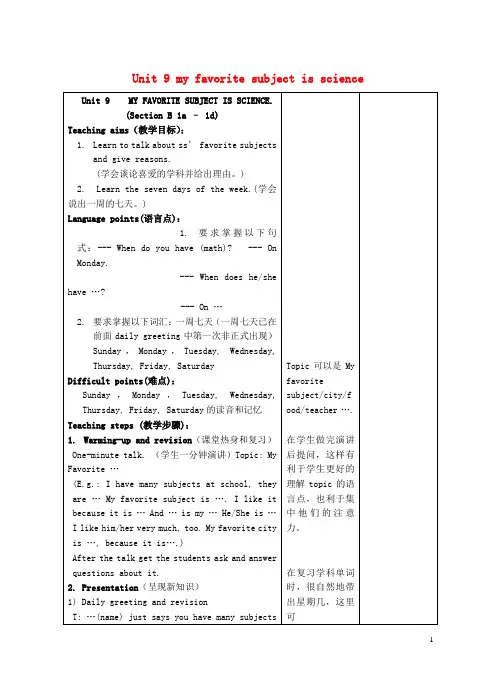
Unit 9 my favorite subject is scienceUnit 9 MY FAVORITE SUBJECT IS SCIENCE.(Section B 1a – 1d)Teaching aims(教学目标):1.Learn to talk about ss’favorite subjectsand give reasons.(学会谈论喜爱的学科并给出理由。
)2. Learn the seven days of the week.(学会说出一周的七天。
)Language points(语言点):1.要求掌握以下句式:--- When do you have (math)? --- OnMonday.--- When does he/shehave …?--- On …2.要求掌握以下词汇:一周七天(一周七天已在前面daily greeting中第一次非正式出现)Sunday,Monday,Tuesday, Wednesday,Thursday, Friday, SaturdayDifficult points(难点):Sunday,Monday,Tuesday, Wednesday, Thursday, Friday, Saturday的读音和记忆Teaching steps (教学步骤):1.Warming-up and revision(课堂热身和复习)One-minute talk. (学生一分钟演讲)Topic: My Favorite …(E.g.: I have many subjects at school, they are … My favorite subject is …. I like it because it is … And … is my … He/She is …I like him/her very much, too. My favorite city is …, because it is….)After the talk get the students ask and answer questions about it.2. Presentation(呈现新知识)1) Daily greeting and revisionT: …(name) just says you have many subjects Topic可以是My favorite subject/city/f ood/teacher ….在学生做完演讲后提问,这样有利于学生更好的理解topic的语言点,也利于集中他们的注意力。
新目标英语七年级上教案unit9
Do you want to go to moive?一教学目标1 通过谈论对某一类电影的喜好及理由,学习相关的词汇和句型2 能够谈论自己的喜好,并询问他人的喜好3 根据自己的爱好制定出周末或假日的行动计划。
二教学难、重点类别语言项目词汇go, movie, thriller, comedy, sad kind find funny scary exciting fun action documentary Beijing Opera someone think learn about history with favorite actor new successful weekend too重点词组go to a movie, action movie what kind, Beijing Opera, a lot, Rush Hour, Chinese history, on weekend, a great actor交际用语1 Do you want to go to a movie? Yes, I do / No, I don’t.2 Does she want to go to a movie? Yes, she does. / No, she doesn’t.3 I want to go to an action movie / I want to see an action movie.4 What kind of movies do you like?5 I like acti on movies and thrillers, but I don’t like documentaries.6 He often goes to see Beijing Opera on weekends.7 She thinks she can learn about Chinese history.语言技能知识技能1 动词want 在一班现在时中的用法及其疑问句的回答2 What kind of …引导的特殊疑问句3 表示品质的形容词和名词复数的使用三语法名词变复数英语中名词分为可数名词和不可数名词。
人教版新目标七年级英语上册unit9单元教案
人教版新目标七年级英语上册unit9单元教案Unit 9 XXX.教材解读:本单元主要讨论学科的喜好和理由,引导学生了解和喜爱各种学科,并从中引发学生的理想和奋斗目标。
通过了解同学们的喜好,促进同学间的交流和感情。
单元目标:一、知识与技能1.了解各种学科。
2.能够表达喜欢某个学科的理由,并掌握相关形容词。
3.表达自己的理想,并为之奋斗。
4.使用不同的疑问词what、why、who、when等提问并回答。
5.了解同学们最喜欢的学科,加强同学间的交流,增进感情。
6.培养学生对科学的兴趣,激发学生探究科学的热情。
二、过程与方法观看图片、视频、听录音、对话、表演、游戏、小组活动等。
三、情感态度与价值观通过本单元的研究,培养学生对科学的兴趣,激发学生探究科学的热情。
通过了解同学们最喜欢的学科,加强同学间的交流,增进感情。
教法导航:注重精讲和多练,坚持以学生为主体的原则。
学法导航:多读多思,小组合作研究。
课时安排:第1课时:n A1a-2d第2课时:n A3a-3c第3课时:n B1a-2c第4课时:n B3a-3c第1课时 n A1a-2d教学目标:一、知识与技能1.掌握词汇:1)school .2)形容词:interesting。
relaxing.2.掌握句式:1)——What’s your favorite subject? XXX。
2)——Why do you like。
Because it’s。
3.谈论喜欢的学科并表述理由。
二、过程与方法通过图片和视频激发学生的兴趣和求知欲,引导学生主动探索知识。
三、情感态度与价值观通过互相询问和谈论彼此所喜欢的学科,可以增进同学之间的了解和友情,并培养学生热爱研究、热爱科学的思想和良好的研究、生活惯。
教学重点:1.掌握目标词汇和短语,掌握重点句子。
2.培养学生热爱研究、热爱科学的思想和良好的研究、生活惯。
教学难点:1.主动探索知识,小组讨论疑难点,自主解决。
培养学生热爱研究和科学的思想,以及良好的研究和生活惯是教育的目的。
人教版新目标七年级英语上册Unit9SectionA(1a2d)教学设计
4.互动交流:鼓励学生大胆开口说英语,进行师生、生生之间的互动交流,培养学生的听说能力和自信心。
5.反馈与评价:及时给予学生反馈,肯定他们的优点,指出不足,并提供具体的改进建议。同时,开展自评、互评等形式,让学生在评价中反思、成长。
4.布置课后作业,要求学生运用所学知识描述自己的家庭环境,巩固课堂所学。
5.鼓励学生在课后继续关注家庭环境,将所学知识运用到实际生活中,不断提高英语水平。
五、作业布置
为了巩固本节课所学的知识,提高学生的英语实践能力,特布置以下作业:
1.家庭环境描述:请学生运用本节课所学的词汇和语法,写一篇关于自己家庭环境的短文。要求包括家中各个房间的名称和特点,以及房间内物品的描述。鼓励学生尽量使用一般现在时态,不少于100词。
4.教师应关注学生的作业完成情况,及时给予反馈,鼓励学生持续进步。
(二)过程与方法
1.通过图片展示、情景模拟、小组讨论等形式,激发学生的学习兴趣,提高学生的英语听说能力。
2.运用任务型教学法,引导学生积极参与课堂活动,培养学生的合作意识和团队精神。
3.通过自主探究、合作学习,让学生在实践中掌握英语知识,提高解决问题的能力。
4.鼓励学生大胆开口说英语,培养学生的自信心和表达能力。
2.邀请学生分享自己家中类似房间的布置和物品,激发学生对家庭环境的关注。
3.通过提问方式引导学生思考:“How many rooms are there in your house? What is there in each room?”等,为新课内容的学习做好铺垫。
(二)讲授新知
1.教师播放教材中的对话,让学生跟读并关注核心词汇和语法结构,如:There is, There are, bedroom, bathroom等。
人教版新目标 初一英语七年级上册Unit 9 单元教案
Unit 9 My favorite subject is science.Part 1: Teaching design (第一部分:教学设计)SECTION AGoals●To teach the students what questions, why questions●To let the students talk about their favorite subjectsProceduresWarming up by learning about wh-questionsWhat is a wh-question?DefinitionA wh-question is a question that contains an interrogative proform.Also known as: Content question, question word question, information questionExamples (English)Here are some examples of words that begin wh-questions in English. Most of them begin with wh-: who ; what ; when ; where ; why ;Warming up by discussingT: Good mornin g, everyone! We’re going to have our English class. You have many subjects everyday. Subject is the lesson you learn everyday, such as English, math,Chinese and so on. Maybe you think some of them are interesting and so youare good at them. But some are not. Right?S:Yes…T:Now let’s see how many subjects we have everyday.S:Math, English, Chinese, art, music, geography, P.E.…T: And we have science. Science includes chemistry, physics and geography and so on.1a Matching the words with the picturesLook at the picture on page49, there are many subjects in the picture. Please match the words with picture.1b Listening and circling the subjects you hear in 1aWe have many different subjects everyday. Now let’s listen to the tape and circle the subjec ts you hear in 1a.Read the tapescript to underline the wh-question.1c.Doing pairworkI think you must have your favorite subjects. Please practice the conversationbelow. First read after me and practice it with your partner. I will ask some pair toact it out.Then make your own conversations with your partner like this:2a Listening and putting in order.Listen to the tape and please put the conversation in order. First you just listen and then put them in order. Can you try to place the sentences in right order?2b Listening and matchingYou will hear the conversation. In the conversation, people talk about school subjects. Listen and matching the subjects you hear with the description words.2cThinking and matchingNow what do you think of your subjects? You can give your opinion. You can practice this conversation first.Then you can make up your conversation with your partners and match the subjects with the description words.The answers may be like this:OK, stop! Now please make a conversation using the information in 2a.2d Role-playRead the conversation below, then practice in pairs.Afer a several minutes, I ’ll ask some of you to perform the conversation.3a Filling in the blanks.Fill in the blanks with what, who or why to complete the conversations.3b Writing questons for the answers.Use the setense partern of “what, who or why ” to complete 3b.3c Groupwork1.Ask and answer questions about your favorite subject in the class..2.Fill the chart.SECTION BGoals● To go on talking about favorite subjects● To learn the days of week and the expressions of datesProceduresWarming up by talking about the dateT: Boys and girls! Today we’re going to learn a new part Section B. By theway, what day is it today?S: It’s Tuesday.T: What’s the date today?S: It’s October 9.T:Oh! I see. Let’s open you book and turn to Page52, and learn 1a.1a MatchingLook at your book and find the opposite words for the left words:1b&1c Listening andCheckingNow listen to the tape for 3 times. The first time you have to check the words you hear in 1a. Then listen again and circle the classes David talks about on the schedule in 1c. The third time, you have to check the answers.1d Doing pairworkLook at the schedule in 1c and talk about David’s favorite subject with your partners. Then talk about your favorite subject in pairs.2a WritingThere list some subjects you have learned in school. Write a description for each one.2b Reading and circlingLet’s read the following letter. Underline the things Yu Mei likes. Circle the things she doesn’t like. While reading you should pay attention to the pronunciations and intonation and underline the expressions.2c Completing scheduleWe have read Yu Mei’s letter in 3a. here is Yu Mei’s schedule. Please complete it with the information from 3a. Then we have a clear look about what she does on that day.3a NumberingNumber these parts of an e-mail massage.3b&3c WritingI know you all have busy days. What is your favorite school day? Write your schedule for that day ,then write a e-mail massage to a friend of you.Closing down by playing a guessing gameLet’s play a guessing game.We can play it like this: One student does some actions about one of subjects. And the others guess what su bject it is. Let’s see who can guess the most subjects.SELF CHECK1 WritingWrite out the subjects you have at school and your feelings about them. Thenmake a dialogue as 1d.S2 Filling the blanksComplete the questions with what, when, who or why. Then answer thequestions.Closing down by making a lectureI think everyone has a favorite subject and has his reasons too. Let’s talk about “my favorite subject”. You have five minutes to prepare. Then stand up to give your lecture to us. You can use body language when needed.Let’s learn some names of English songs.Honkey Pokey; How Is The Weather?(天气怎么样?); I Love Little Pussy(我喜欢小猫); I’M A Little Teapot(我是一把小茶壶); If You're Happy(如果你感到快乐); Jimmy Crack Corn (撬开裂纹玉米); Jingle Bells(铃儿响叮当<1>); Jingle Bells(铃儿响叮当<2>); Lazy Mary(懒惰的玛丽); Let Everyone Clap Hands(让每一个人拍手); Let Us Sing Together (让我们一起唱歌); Little Cabin In The Wood(森林中的小木屋); Little Goldfish(小金鱼); Little Green Frog(绿色的小青蛙); Little Peter Rabbit(小兔彼得); Make New Friends (结识新朋友); My Aunt Came Back(我的姑妈回来了); My Brother And I(我的哥哥和我); Oh, Christmas Tree(哦,圣诞树); Oh, Susanna(噢,苏珊娜);Pat A Cake(做个面包); Pop!Goes The Weasel(砰!追逐鼹鼠!); Rain, Rain, Go Away(雨,雨,走开); Reuben Reuben(鲁宾); Roll That Bal(滚动那个球); Round The Clock(围着时钟转); Sally, Go' Round The Sun(萨利绕着太阳转); Sea Shells(海洋贝壳); She'll Be Comin' Round The Mountain(她将绕过这座山脉过来); Simple Simon(头脑简单的西蒙); Sing Together(一起歌唱); Six Little Ducks(六只小鸭子); Smile(微笑); Ten Fat Sausages(十根肥香肠); The Ants Go Marching(蚂蚁在行军); The Bear Went Over The Mountain(小熊上了山); The Family(家庭); The Farmer In The Dell(农夫在小山谷中); The Finger Family(手指家庭); The Months(月份); The More We Get Together(我们在一起越多)Part 2: Teaching Resources (第二部分:教学资源)I. Background readings——Time (美国人的时间观)What is time? Is it a thing to be saved or spent or wasted, like money? Or is itsomething we have no control over, like the weather? Is time the same allover the world? That's an easy question, you say. Wherever you go, a minute is60 seconds, an hour is 60 minutes, a day is 24 hours, and so forth. Well, maybe.But in America, time is more than that. Americans see time as a valuable resource. Maybe that's why they are fond of the expression, "Time is money."Because Americans believe time is a limited resource, they try to conserve and manage it. People in the U.S. often attend seminars or read books on time management. It seems they all want to organize their time better. Professionals carry around pocket planners-some in electronic form-to keep track of appointments and deadlines. People do all they can to squeeze more life out of their time. The early American hero Benjamin Franklin expressed this view best: "Do you love life? Then do not waste time, for that is the stuff life is made of."To Americans, punctuality is a way of showing respect for other people'stime. Being more than 10 minutes late to an appointment usually callsfor an apology, and maybe an explanation. People who are running lateoften call ahead to let others know of the delay. Of course, the less formal the situation, the less important it is to be exactly on time. At informal get-togethers, for example, people often arrive as much as 30 minutes past the appointed time. But they usually don't try that at work.II.Fun materials——Holes and coversOnce San Diego was badly flooded. Some residents suggested removing manhole covers to speed up the draining of rain flooded streets. That sounded a good idea. However, it made matters worse because the underground system was flooded too. Several covers became lost inknee-deep water, and police were called in to help.“we’re picked up the lost covers all right.” One officer asked headquarters. “Now how do we find the holes?”Back came the order: “That’s easy. Walk till you fall in.”III Word studies1.strict(stricter, strictest)a. 1.严格的;严谨的精确的;正确的exact; accurate: The men who make the parts of an airplane must use strict measurements. 制造飞机零件的工人必须使用精确的量具。