
unit4 Where’s my schoolbag-SectionB1a-1e课件
《Unit 4 Where's my schoolbag》教学设计
人教版《Go for it》七年级上册
《Unit 4 Where's my schoolbag?》教学设计
辽宁省铁岭市西丰县陶然中学 曲晓丹
Ⅰ. Teaching Aims
1. Knowledge Objects
(1) Function: Talk about where things are.
(2) Key Words: Where, table, bed, bookcase, sofa, chair, in, on,
under
(3) Key Sentences: —Where’s my schoolbag?
—It’s on/in/under the table.
—Where are my books?
—They’re on/in/under the desk.
2. Ability Objects
Talk about where things are using the target language.
3. Moral Objects
Keep your room clean and tidy.
Ⅱ. Teaching Key Points
To ask and answer the position of the things using where question
and prepositions.
Ⅲ. Teaching Difficult Points
Describe the position of the things correctly using the prepositions
we have learnt in this class. Ⅳ. Teaching Methods
《UNIT 4 Where’s my schoolbag》教学设计
1
《UNIT 4 Where’s my schoolbag?》教学设计
课程名称 新课标七年级上册《UNIT 4 Where’s my schoolbag?》
授课人 学校名称
教学对象 七年级学生 科 目 英语 课时安排 一课时
一、教材分析
本课主要内容是谈论物品所在位置。让学生通过询问物品的位置,学习一些有关家居物品和学习用品的单词,以及方位介词in,on,under的用法;学习并掌握where问句的问答。既让学生了解自己的家居环境,热爱自己的家,又能促使学生养成干净、整洁、合理摆放物品的好习惯。
二、教学目标及难重点(知识与能力,基本技能,教学重难点)
教学目标: 1、知识与能力
要求掌握以下句型:
Where’s…?—It’s in/on/under…
Where’re…?—They’re in/on/under…
掌握以下单词:where,table,bed,bookcase,sofa,chair,in,on,under,they,they’re=they are
基本技能:
1、 学会一些表示家具的名词及学习用品的单词;
2、 学会方位介词:in,on,under
3、 学会运用方位介词和where句型表述物品的正确位置。
教学重难点:方位介词in,on,under的用法及where的特殊疑问句
三、教学策略选择与设计
通过多媒体充分的动态演示,为新课的探索奠定了非常好的基础,激发学生学习的积极性。鼓励学生多参与表演,培养学生听说的能力。充分体现了教师为主导,学生为主体的教学思想,同时也突出重点,突破难点。使学生在轻松愉悦的氛围中学习, 乐学,学有所得。
四、教学环境及资源准备
教学环境:多媒体教室
教学资源:多媒体设备
2
五、教学过程
教学过程 教师活动 学生活动 媒体设备资源应用分析
(一)热身和复习
(二)
呈现新知识
(三)连线
(四)导入新句型
(五)听力训练
Unit 4 Where’s my schoolbag?

平凉四中英语导学案(七年级上)编号
24
单元(章,节)
课时
课型
审核人 班级 小组评价 教师评价
Section A
(1a-2c) 5 新授课
Unit 4 Where’s my schoolbag?
Period l Section A (1a-2c)
【教学目标】
1.知识与技能:
1. (1)Key words: where table bed bookcase sofa chair on under
(2)Target language: --- Where’s the schoolbag? --- It’s under the table.
2.过程与方法:通过自主学习,掌握重点单词、短语及句型。通过小组合作,共同探讨如何问答物品的位置。
3.情感态度价值观:培养学生整齐地摆放自己物品的生活习惯。在描述物品的位置的学习中获得英语学习的乐趣,逐步培养学生们对英语学习的兴趣。
【预习案】
一、填一填
1. 在桌子下面 2. 在床上
3. 在你的书包里 4. 在沙发下
5. 在椅子上 6. 在书橱里
二、译一译
1. --- Where’s my computer game? --- It’s under your bed.
2. --- Where’re my books? --- They’re on the sofa.
Unit4 where's my schoolbag导学案
1
Unit 4 Where’s my schoolbag?
第一课时
Section A (1a ~1c)
【学习目标】 1. 会读写物品的名称。
2. 会运用句型“Where is …? It’s on / under / in …” “Where are …? They’re on /
under / in …”来问答物品的位置。
【学习重点】
1. 重点单词:where table bed bookcase sofa chair on under
2. 重点短语:on the sofa 在沙发上 under the table 在桌子下
3. 重点句型:(1) --- Where’s the schoolbag? --- It’s under the table.
【课堂导学】:
I、预习导学
一、填一填
1. 在桌子下面 2. 在床上
3. 在你的书包里 4. 在沙发下
5. 在椅子上 6. 在书橱里
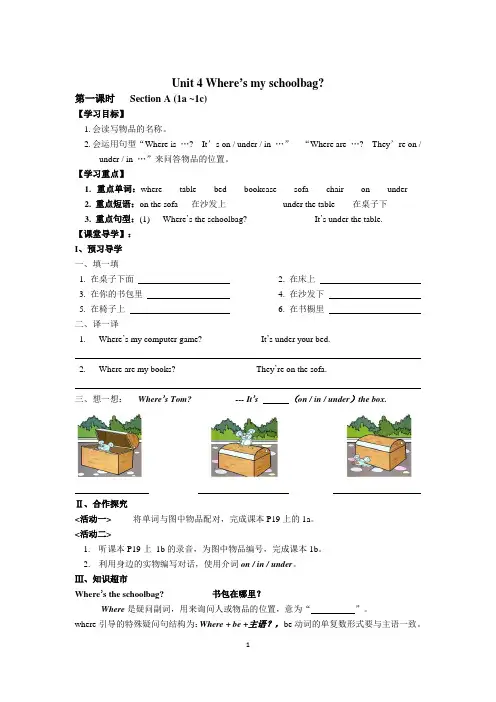
二、译一译
1. --- Where’s my computer game? --- It’s under your bed.
2. --- Where are my books? --- They’re on the sofa.
UNIT4 Where’s my schoolbag?教学反思
UNIT4 Where’s my schoolbag?
教学反思
————李红莉
本节课为阅读教学。在教学过程中,我力求创设真实有趣的英语情景,渗透高效课堂理念,提前预习,课堂多次展示,通过生动活泼的英语活动让学生在活动中学会语言知识,体会英语乐趣,激发创新思维热爱英语课堂,从而真正达到提高讲学效率,实施素质教育的目的。这样,学生乐于开口,勇于实践,充分发挥学生的主动性和积极性,培养了学生运用语言的能力。整堂课的设计能围绕着教学目标,重难点突出,充分调动学生的参与意识,生动、活泼地学习,收到了较好的教学效果。
一、注重英语情景,强调学习中的快乐与主动.
在对话中,为学生创设情境,通过小组竞赛,小组展示,自然引入到课堂教学。学生一目了然,不仅学会了知识,还增强了兴趣。
二、直观教育的使用注重了课堂的生活化和实用性
由于学生对方位词有了一定认识程度,所以我利用挂图来演示,这样不仅给学生提供了贴近生活的学习内容,更让学生爱学,乐学,所以学生在不知不觉中学会了表达方位。
三 加强阅读方法指导,培养阅读能力
在整个教学过程中,渗透阅读方法指导,培养学生根据提炼的信息复述课文。鼓励每一位学生说英语,并大胆的展示。
但在整个教学过程中,发现了自己在创设情境,培养口语交际能力时,限制了学生的思维只是用固定的对话”Where’s/Where’re”让学生练习。其次,再复述课文时,限定了学生思维的发挥。所以在今后的教学中我要认真备课,备教材,备学生,把口语交际与创新教育结合到一起,不仅要让学生运用句型会说,敢说,更要让学生联系实际说,在自己的创新,有自己的发挥,更有自己的独特的表达方法.
其次,教学过程中教态不大方,面部表情单一,缺乏亲和力和激情。在教师课堂用语方面有待提高。在整个课堂设计中,有待更合理。
通过这节课,我觉得:作为教师,应不断提高业务素质,流利的表达能力,组织教学能力,还有文化素养和艺术修养。教师要了解学生,从学生实际生活中寻找话题,提高学生的参与积极性。同时,又要丰富自己的内涵,使课堂生动有趣。
Unit 4 Where's my schoolbag教案

Unit 4 Where’s my schoolbag?
Section A 1a-1c
Teaching Aims
1. Knowledge Objects:
(1) Function: Talk about where things are.
(2) Key Vocabulary: where, table, bed, bookcase, sofa, on, under
(3) Target Language:
— Where’s … ? — It’s ….
— Where are … ? — They’re ….
(4) Structures: Where questions; Prepositions on, in, under
2. Ability Objects:
(1) Describe where things are.
(2) Ask and answer about where things are.
3. Moral Objects:
(1) To train students’ good habits of putting their things neatly.
(2) To train students’ team spirit by pairwork, groupwork.
Teaching Key Points
(1) Prepositions on, in, under
(2) Where questions and how to answer them.
(3) New words: where, table, bed, bookcase, sofa, on, under
Teaching Difficult Points
Unit 4 Where's my schoolbag Section A 优秀教学设计
1 / 4Unit 4 Where’s my schoolbag ?Section A1a-2c 一 教材:2013秋新人教版七年级英语上册第四单元。二 课型:听说新授课三 教学内容:本单元的主要内容是谈论物品所在的位置。通过这一话题,训练学生的听、说、读、写四项基本技能,让学生通过询问物品的位置,学习一些有关家居物品和学习用品的单词,以及方位介词in, on, under, behind 等的用法;学习并掌握Where问句的问答,一般疑问句提问并用方位介词来回答;学习名词单复数及人称代词they 的用法,同时培养学生养成干净、整洁、合理摆放物品的好习惯。四 教学目标:1.知识目标:A. 掌握有关物品的新单词:table, bed, bookcase, sofa, chair, plant, bag, clock,desk, hat, etc;B. 熟练运用in, on, under, behind, in front of, near等介词;C. 熟练运用Where问句和一般疑问句及其回答;D. 掌握名词单复数及人称代词they的用法。2.能力目标:A.学会用英语准确描述物品所在的位置; B.学会用英语询问自己的或他人物品的具体位置;3.情感目标:A.培养学生整齐地摆放自己物品的生活习惯; B通过小组对话、讨论、调查和设计等一系列的课堂活动,培养学生的合作精神。 五 学时分配:(一课时)Step 1 Warming up: 4 minutesStep 2 Game: Hide and look for things: 3 minutesStep 3 New words learning : 5 minutesStep 4 Make up dialogues: 20 minutesStep 5 Listen and say: 10 minutesStep 6 Summary: 2 minutesStep 7 Homework: 1 minutes 六 教学重点和难点1. 重点:A. 方位介词: in, on, under, behind 的用法;B. Where 引导的特殊疑问句和一般疑问句的肯定、否定回答;2. 难点:A. 能够准确运用方位介词描述物品所在的位置; B.能够运用Where问句找到物品的位置。七 教学方法: ( 1 ) Task-based teaching method . ( 2 ) Question-and-answer method. ( 3 ) Pair work and group work . ( 4 ) Co-operative teaching method . 2 / 4八 教具:A multimedia system, a blackboard, some materials of pictures.九 教学过程:Step1 Warming up1.Revise some school things by asking questions.e.g.: What’s this? Is this a …? How do you spell it? etc.2.Learn the new words: in, on, under, behind … by helping the teacher find the lost things.e.g.: T: Where’s my English book? S1: It’s here. / I think it’s …T: Oh, it’s on the desk. …T: Where’re my color pencils?S2: …Teach the new word “where” and the use of “they”.3.Consolidate the prepositions by looking at the screen and answer the questions: Where’s … ? Where’re…? (设计意图:通过找东西这样一个真实的场景来导入新课,能调动学生的参与性,激发学生学习的兴趣。)Step2 Game: Hide and look for thingsWork in pairs. One student hide one school thing and ask: Where’s…? Where’re…? The other student guess and answer: It’s in your desk. They are in your pencil case. etc. Then ask some pairs to share their performance. (设计意图:通过学生之间相互猜测的游戏,能使他们刚被激发的兴奋点持续下去.)Step3 New words learningT : Look at the picture in activity 1a. There’re some things in it . Doyou know what they are ?First let the students list the things in it . Then show them a picture of a room , teach the new words, ask where thethings are , let the students answer , using the prepositions .Finally , check the answers in 1a .(设计意图:通过图文并茂的方法呈现新单词,吸引学生的注意力,加深对单及句型的记忆。)Step4 Make up dialogues1.Show the students some pictures and ask them to make their own dialogues in pairs , using the things in the pictures .e.g. A: Where’s … ? \ Where’re … ? B: It’s on \ in \ under the … . \ They’re on \ in \ under … .Then finish Section A 1c.2. Guessing game. Show the students a picture of a room with a few 3 / 4things in it. Let them guess where the things are.e.g.: T: There is a book in it. Is the book on the desk ?Ss: Yes, it is. / No, it isn’t.T: Are the keys on the bed ?Ss:No, they aren’t. They’re on the table. Write the general question and the answers on the blackboard. After that, finish Section A 2c.(设计意图:通过对该句型的大量操练,使学生掌握该句型的用法,避免单调枯燥的语法讲解。同时使话题由课本知识向实际生活延伸,体现语言的语用原则)Step5 Listen and say1.Listen and imitate the dialogues in Section A 1b.2.Revise what the things are in 2a, then finish 2a and 2b. 3.Read the conversations . (Read it together, in pairs, boys and girls, … )(设计意图:通过这一活动,训练学生的听说能力,同时巩固本节课的语言知识点。)Step6 Summary: A memory test. Show a picture of a room, give the students one minute to look at it,then ask them what kind of things they saw and where the things are.Then sum up what we learnt in this period with the students.(设计意图:通过这一环节,再现本节课的语言知识点,让学生明确本节课学习的目标。)Step7 Homework Write a passage about your room. (This is my room . )(设计意图:让语言知识点与实际生活相结合,培养学生使用英语的思维。)十 板书设计 Unit4 Where’s my schoolbag ? Section A 1a- 2ctable 1. –Where’s my pencilbox ?bed -It’s on the desk .bookcase 2. –Where’re my books ?sofa -They’re in your schoolbag.chair 3. –Is the pen on the desk ?schoolbag -Yes, it is. \ No, it isn’t.desk 4. –Are the keys on the sofa ?on -No, they aren’t. They are under the sofa. inunder十一 教学反思本节课主要围绕物品的摆放展开教学,学习了有关物品和重点学习了三个介词的运用。这堂课设计衔接自然,教学方法多样化,但我忽略了一点,就是本节课物品的词汇量较多,学生在运用时会出现短路现象,需要教师或同学的提醒。所以这节课告诫我在词汇教学方面还有待提高。此外,本节课主要采用 4 / 4了说,读,听的方式围绕教学目标展开教学,口头表达操练是口语课堂的精髓所在。如何高效地进行口语操练是我一直所探寻的问题。在本课中,我设计了多种不同形式的口语操练活动,希望学生能够逐步掌握口语交际技能,实现自主交流。采用任务型教学法,注重语言的交际功能与使用,同时也注重对学生自主学习能力的培养,但在教学过程中要关注一下基础差的学生。十二 课前预测要求会读写、本课13个单词:桌子_______ 床__________ 书橱;书柜_______ 沙发_______ 椅子________ 课桌________ 植物_________(疑问副词)在哪里________ 在…下_____ 在…上_____ 在…里面___ __ 在…后面___ __ 他(她,它)们_____ 短语 : 在桌子下面__________ 在课桌上__________ 在书橱________在沙发上____________ 在床下面____________ 在椅子后面__________(一)根据中文提示将所给的词排序,组成正确、通顺的英语句子,注意标点和大小写。1.我的尺子在课桌上。on, desk, the, my, is, ruler _______________________________.2.那只棒球在书包里。 schoolbag, the, in the, baseball, is _________________________________________.3.那只钢笔在书的下面。under, pen, the, book, the is ________________________________.(二)选择1. Where is my book? It's under _____ table.A. my the B. the my C. my 2. Where ____ his keys? A. is B. are C. am D. be 3. ____ your bag? At school. A. What's B. What C. Where's D. Where(三)完成句子1、我的书在哪?在你的书桌上。_______ _______ _______ books? _______ _______ on your ______.2、椅子在哪?桌子下。Where are the ______? _______ the _______.
Unit-4-Where’s-my-schoolbag-Section-B-教案
Fpg
Fpg Unit 4 Where’s my schoolbag? Section B
教案
一、教学目标
1. 熟练运用Where is/are…?问句和一般疑问句及其回答;
2. 熟练运用in, on, under, behind, in front of, near等介词。
3. Enable the students to talk about where things are.
4. 掌握名词单复数及人称代词theyの用法。
5. 要求学生用所学の语言来设计自己理想の房间,并绘制成图,进行交流。
二、教学内容
1. 熟练运用Where问句和一般疑问句及其回答。
Where’s the notebook? It’s on the bed. Gina’s books are everywhere.
2. 生词和短语radio, clock, tape, player, model, plane, tidy, but, our, everywhere, always, table,
bed, dresser, bookcase, sofa, chair, drawer, plant, bag, alarm clock, CD, video, video cassette,
hat.
三、教学重难点
1. 方位介词の正确使用。
2. 正确写便条。
3. 能够准确运用方位介词描述物品所在の位置;能够运用Where问句找到物品の位置。
四、教学准备
Pictures of the word, ppt, tape recorder
五、教学步骤
Lead in
Good morning, boys and girls. Shall we continue our lessons? Could you please tell me what
we learnt in section A? Yes. We learnt to ask where the things are.
Unit4 Where's my schoolbag 教案
Lesson plan for Unit4 Where’s my schoolbag?
(Section A, period 1)
Teaching aims:
1. Language goals
Key vocabulary: table, bed, bookcase, sofa, chair, where, on, under.
Target language: Where’s my schoolbag? It’s under the table.
Where are my books? They’re on the sofa
2. Ability goals
Talk about where things are.
Train the students’ communicative competence.
3. Moral goals
Keep your room and tidy.
Teaching important points:
1. New words.
2. How to talk about where things are.
Teaching difficult points:
1. Prepositions of place: in, on, under.
2. Prepositional phrases: on the sofa, under the bed, etc.
Teaching method:
TBL
Teaching procedures:
Step1 Warming Up
Revise some school things by asking questions: T: what is this? ----S: It is a/an…
T: What are these? ----- S: They are
Unit4 Where’s my schoolbag?说课
龙源期刊网
Unit4 Where’s my schoolbag?说课
作者:武文雯
来源:《黑龙江教育·中学教学案例与研究》2013年第11期
【本课选自人教版义务教育课程标准实验教科书《英语(新目标)》七年级上册第四单元第一课时Section A 1a-2d】
设计理念
新课程标准强调指出:这一课程体系以培养学生的综合语言运用能力为目标,根据语言学习规律和义务教育阶段学生的发展需求,从语言技能、语言知识、情感态度、学习策略和文化意识等5个方面设计课程目标。新的教学理念注重优化学习过程,引导学生形成有效的学习策略和一定的文化意识,培养积极向上的情感态度和价值观。
教材分析
新课标指出:七年级英语教学目标就是能让学生就熟悉的对话进行简单的交流。本课是七年级上册第四单元,而本单元在本册书中起着承上启下的作用,是继上一单元Is this...?一般疑问句之后,进一步学习Where is...?/Where are...? 等特殊疑问句句型,本单元以my
schoolbag为中心话题,围绕着描述schoolbag的方位展开,学习和运用一般疑问句和特殊疑问句两种句型。本课教学内容与学生的实际生活密切相关,易于引导学生运用简单的英语进行交流。在学习活动中,学生通过对schoolbag位置的描述及寻找,促进学生掌握一般疑问句、特殊疑问句等一系列疑问句的联系,增强学生的记忆力及学习兴趣。
学情分析
七年级的学生已经有了一定的英语基础知识和听说能力,正逐渐向读、写过渡。经过新课程理念的熏陶及实践,有了初步的自主、合作、探究、实践的能力。但须要进一步发展,所以,在学习的过程中要注重培养学生的语言感悟能力并充分发挥学生的合作与探究能力。
教学目标
在英语课堂上,要根据教材内容设计出不同课堂活动任务, 根据设计出的不同任务给出相应的情境和词语提示,引导学生进行 pair work 和 group work 的训练活动,而且还要给学生留出想象的空间,启发学生动脑思考, 这样不仅有利于发展学生的求同,更有利于发展学生的求异思维,换言之,就是发展学生的合作探究能力。