
step by step3000第三册unit1答案及原文
5. What are the problems with the nuclear facilities and nuclear plants in Japan? Some nuclear facilities have breached many health and safety laws.More than half of the nuclear plants failed some basic tests, such as checking radiation measurements.Tapescripts:1. With the final declaration on its role in the 21st century, the summit's statement is expected to call on UN members to make commitments to eradicate poverty, promote democracy and education, and reverse the spread of AIDS. More than 150 heads of state and government attended the summit, the largest gathering of world leaders in history.2. The Association of South-East Asian Nations has decided to invite Burma to join its ranks, shrugging off western denunciations of the military regime in Rangoon. ASEAN foreign ministers voted on Saturday to admit Burma, Cambodia, and the Laos.3. The missing, four of them teenagers, were among 35 people aboard a high school fishing vessel from Japan. On Friday, a U.S. nuclear submarine tore through the ship, sinking it within minutes. The USS Greenville, which was not seriously damaged, was performing an emergency surfacing drill when the collision occurred about ten miles south of Pearl Harbor. Coast Guard rescue teams plucked all but nine of the victims from the rough seas.4. Gun battles between Israeli troops and Palestinian gunman have been raiding overnight in the West Bank and Gaza. The upsurge in violence comes after Israeli attack helicopters targeted and killed a member of an elite Palestinian security force.5. Some nuclear facilities in Japan have breached many health and safety laws. Government inspectors checked 17 nuclear plants. More than half of them failed some basic tests, such as checking radiation measurements. Japanese nuclear regulators have been ordered to crack down following the country's worst nuclear accident in September. Sixty-nine people were exposed to dangerous levels of radiation in the accident.Part II News reportsSummary:This news report tells us that the United Nations General Assembly has elected Columbia, Ireland, Mauritius, Norway and Singapore as its new non-permanent members of the Security Council.Statements:1. Columbia, Ireland, and Singapore won their seats as nonpermanent members of the Security Council on the first round of balloting while Mauritius and Norway won their seats on the fourth ballot.2. Sudan and Mauritius are two candidates for the second seat for the African and Asian group.3. There were three countries contending for the two seats allotted to the western industrialized group of nations.4. The Security Council is made up of 15 members, including five permanent members -- China, France, Great Britain, Russia, and the United States--and 10non-permanent members.Tapescript:The United Nations General Assembly has elected' Columbia, Ireland, Mauritius, Norway and Singapore as the new non-permanent members of the Security Council. The vote follows several weeks of haggling and maneuvering.Columbia, Ireland, and Singapore won the required two thirds majority on the first round of balloting. But it took another three rounds of voting to decide on the remaining two regional seats.Contention marked the voting for the second seat for the African and Asian group. The United States lobbied intensely against Sudan, the candidate of the Organization of African Unity. Mauritius, the candidate supported by Washington, won on the fourth round of voting.Ireland easily captured one of the two seats allotted to the western industrialized group of nations on the first ballot. But Norway and Italy campaigned vigorously for the second spot. King Harald of Norway came to New York last week to press the case for his nation's representation on the Security Council for the first time since1982. Norway also won on the fourth ballot. The new members begin their two-year terms in January. The Security Council is made up of a total of 15 members, including five permanent members -- China, France, Great Britain, Russia, and the United States -- and 10 non-permanent members. Five non-permanent members are elected to two-year terms each year.BSummaryThis news report tells us that the United Nations Human Rights Commission was going to hold an emergency meeting to deal with the crisis situation between Israelis and Palestinians.Answers to the questions:1. 532. 483. 34. The United States5. Canada6. October 18th7. No more than three days8. To get the Israelis and Palestinians back to the negotiating table9. 4 / Bosnian war / genocide in Rwanda / violence in East TimorTapescript:Forty-eight of the ( United Nations Human Rights Commission's) 53 member nations voted to hold the emergency meeting. The United States cast the sole dissenting vote and Canada abstained. Three other countries did not vote.The special meeting will begin October 18th and will last for no more than three days. UN spokeswoman Marie Heuze says one purpose of the meeting is to try to learn how the cycle of violence between Israelis and Palestinians can be stopped."When you have such a high-profile for a crisis which is so dangerous, not only for the people in Palestine and in Israel, but in the region, there is a fear -- and this is probably why there was a large consensus on this meeting to discuss the issue --because the situation in this part of the world is so volatile, so dangerous, so important to control that everybody thinks that they have something to contribute."Ms Heuze says she thinks the United Nations and the international community as a whole can play a constructive role in the present situation and in trying to get the Israelis and Palestinians back to the negotiating table. Officials from the UN Human Rights Commission will discuss the agenda toward the meeting on Wednesday.This is only the fifth time the commission has gone into emergency meeting to deal with a crisis situation. Previous sessions dealt with the Bosnian war, the genocide in Rwanda, and the violence in East Timor.Questions:1. How many members are there in the UN Human Rights Commission?2. How many of them voted to hold the emergency meeting?3. How many of them didn't vote?4. Which country cast the dissenting vote?5. Which country abstained?6. When will the meeting begin?7. How long will it last?8. What's the purpose of this meeting?9. How many emergency meetings have been held before this one?What were the three crisis situations that they dealt with?Part III Anti-piracy missionAEU’s Naval OperationThe massive problem: Piracy off Somalia’s waters… 100 ships … 16 ships … more than 350 crew members ….EU’s mission:… 6 warships … 3 surveillance planes…• Aim: To deter, to prevent, to protect …• Headquarters: Near London• D uration: At least a year2. As he said many times, in many parts of this nation, to those he touched and who sought to touch him: "Some men see things as they are and say 'Why?' I dream things that never were and say 'Why not?'" (Edward M. Kennedy 08/06/1968)3. I have a dream that one day on the red hills of Georgia, sons of former slaves and the sons of former slave-owners will be able to sit down together at the table of brotherhood. I have a dream that one day, even the State of Mississippi, a state sweltering with the heat of injustice, sweltering with the heat of oppression, will be transformed into an oasis of freedom and justice. I have a dream that my four little children will one day live in a nation where they will not be judged by the color of their skin, but by the content of their character. (Rev. Martin Luther King, Jr.28/08/1963)4. America needs a full-time President and a full-time Congress. Particularly at this time, with problems we face at home and abroad. To continue to fight through the months ahead for my personal vindication would almost totally absorb the time and attention of both the President and the Congress in a period when our entire focus should be on the great issues of peace abroad and prosperity without inflation at home. (Richard M. Nixon 08/08/1974)5. Thank you for opening up your minds and your hearts, for seeing the possibility of what we could do together for our children and for our future here in this state and in our nation. I am profoundly grateful to all of you for giving me the chance to serve you. I will... I will do everything I can to be worthy of your faith and trust and to honor the powerful example of Senator Daniel Patrick Moynihan ... I promise you tonight that I will reach across party lines to bring progress for all of New York's families. Today we voted as Democrats and Republicans. Tomorrow we begin again as New Yorkers .... (Hillary Clinton 07/11/2000)。
step by step 第三册Unit 1-10 World News Up in Space词汇
Unit 1 World News: Up in Space(刘亚兰)Part I Warming UpVocalbulary:1. dock [d?k] n. 码头,船坞v. 靠码头,入坞2. triumph [‘trai?mf] n. 凯旋,欢欣v. 得胜,成功3. order back 命令返回4. launch [l?:nt?, lɑ:nt?] n.&v. 下水,发射,开始5. fledging n. 羽毛初长的雏鸟,刚会飞的幼鸟,无经验的人6. outpost [‘autp?ust] n. 前哨,前哨基地,警戒部队7. checkout ['t?ekaut] n. 检查(调整,验算,检查输出结果,工时扣除)8. revive [ri'vaiv] v. 使...生醒,复生,恢复精神9. probe [pr?ub] n. 探针,调查,探测针v. 用探针测,详细调查10. volcanic [v?l‘k?nik] a. 火山的11. daunting [d?:nti?] a. 令人畏惧的12. abbreviated [?bri:vi‘eit] a. 简短的, 仅可蔽体的,小型的13. space shuttle n. 航天飞机14. panel[‘p?nl] n. 面板,嵌板,仪表盘,座谈小组15. spacecraft n.宇宙飞船;航天器16. fiery [‘fai?ri] a. 炽热的,热烈的,暴躁的17. solar system 太阳系18. pull off v. 努力实现, 赢得19. power generator 电力发电机20. fuel cell 燃料电池21. module n. [‘m?dju:l][计算机] 模块, 组件,部件【航空学】航天舱,(航天器的)舱;子机;子船Part II News ReportAVocabulary:1. robotic rover 机器漫游车2. robotic arm 机械臂3. installment [in'st?:lm?nt] n. 分期付款(安装,一期)4. retrorocket [‘retr??r?kit]n.制动火箭5. descent [di‘sent] n. 降落6. condensate n. 浓缩物,聚合物7. finale [fi‘nɑ:li] [意大利语] n.结局,终了,最后的一个乐章8. tentatively ['tent?tivli] adv. 试验的CVocabulary:1. organic molecule[‘m?likju:l, ’m?u-] n. 有机分子2. carbon n. 碳3. nitrogen n. 氮4. pockmark [‘p?kmɑ:k] n. 痘疮pockmarkd adj. 布满痘痕的5. asteroid n. 小游星,小行星,海盘车 a. 星状的6. Stake [steik] n. 木柱,赌注,奖金v. 打赌,下赌注7. pre-biology n. the beginning of life Part III China' s space' and aeronautics industryA.Vocabulary1. module n. 【航空学】航天舱,(航天器的)舱;子机;子船2. unmanned adj. 无人的;无人驾驶的3. brief v. 对...作简报,摘要4. map put 详细制定,筹划5. payload n. (导弹、火箭的)有效载荷,有效负荷,有效载重BVocabulary:1. untimately adv. in the end; after everything or everyone else has been taken into account 最终;最后2. Shenzhou II “神舟二号”2001年1月16日19时22分,我国第二艘无人飞船“神舟二号”在内蒙古中部地区成功着陆。
stepbystep3000第三册答案听力原文(供参考)
STEP BY STEP 3000 第三册答案Unit 1World News: International RelationsPart I Warming upA Tapescripts:1.The former American Defense Secretary William Perry hasrecommended a radical change of policy towards North Korea.2.Hundreds of thousands of mother s from across the United Statesgathere d here in Washington Sunday to push for tougher gun control laws.3.There's been further fighting between Macedonian forces and EthnicAlbanian guerrillas inside the Macedonian border with Kosovo.4.A bomb dropped by the United State's navy aircraft during training inKuwait has hit a group of military observers, killing six of them.5.NATO is taking a number of steps to allay growing disquiet about thepossible health risks from ammunitions containing depleted uranium, which it used in Kosovo and Bosnia.B1. What is the summit's statement expected to call on UN members? To make commitments to eradicate poverty, promote democracy and education, and reverse the spread of AIDS.2. Which three countries are admitted by ASEAN on Saturday? Burma, Cambodia, and the Laos.3. What happened on Friday about ten miles south of Pearl Harbor?A U. S. nuclear submarine tore through a Japanese fishing vessel, sinking it within minutes.How many people were on the vessel? And how many were missing?35/9.4. What happened in the West Bank and Gaza?Gun battles between Israeli troops and Palestinian gunmen have been raiding overnight.5. What are the problems with the nuclear facilities and nuclear plants in Japan?Some nuclear facilities have breached many health and safety laws. More than half of the nuclear plants failed some basic tests, such as checking radiation measurements.Tapescripts:1. With the f inal declaration on its role in the 21st century, the summit's statement is expected to call on UN members to make commitments to eradicate poverty, promote democracy and education, and reverse the spread of AIDS. More than 150 heads of state and government attended the summit, the largest gathering of world leaders in history.2. The Association of South-East Asian Nations has decided to invite Burma to join its ranks, shrugging off western denunciations of the military regime in Rangoon. ASEAN foreign ministers voted on Saturday to admit Burma, Cambodia, and the Laos.3. The missing, four of them teenagers, were among 35 people aboard a high school fishing vessel from Japan. On Friday, a U.S. nuclear submarine tore through the ship, sinking it within minutes. The USS Greenville, which was not seriously damaged, was performing an emergency surfacing drill when the collision occurred about ten miles south of Pearl Harbor. Coast Guard rescue teams plucked all but nine of the victims from the rough seas.4. Gun battles between Israeli troops and Palestinian gunman have been raging overnight in the West Bank and Gaza. The upsurge in violence comes after Israeli attack helicopters targeted and killed a member of an elite Palestinian security force.5. Some nuclear facilities in Japan have breached many health and safety laws. Government inspectors checked 17 nuclear plants. More than half of them failed some basic tests, such as checking radiation measurements. Japanese nuclear regulators have been ordered to crack down following the country's worst nuclear accident in September. Sixty-nine people were exposed to dangerous levels of radiation in the accident.Part II News reportsSummary:This news report tells us that the United Nations General Assembly has elected Columbia, Ireland, Mauritius, Norway and Singapore as its new non-permanent members of the Security Council.Statements:1. Columbia, Ireland, and Singapore won their seats as nonpermanent members of the Security Council on the first round of balloting while Mauritius and Norway won their seats on the fourth ballot.2. Sudan and Mauritius are two candidates for the second seat for the African and Asian group.3. There were three countries contending for the two seats allotted to the western industrialized group of nations.4. The Security Council is made up of 15 members, including five permanent members -- China, France, Great Britain, Russia, and the United States--and 10 non-permanent members.Tapescript:The United Nations General Assembly has elected' Columbia, Ireland, Mauritius, Norway and Singapore as the new non-permanent members of the Security Council. The vote follows several weeks of haggling and maneuvering.Columbia, Ireland, and Singapore won the required two thirds majorityon the first round of balloting. But it took another three rounds of voting to decide on the remaining two regional seats.Contention marked the voting for the second seat for the African and Asian group. The United States lobbied intensely against Sudan, the candidate of the Organization of African Unity. Mauritius, the candidate supported by Washington, won on the fourth round of voting.Ireland easily captured one of the two seats allotted to the western industrialized group of nations on the first ballot. But Norway and Italy campaigned vigorously for the second spot. King Harald of Norway came to New York last week to press the case for his nation's representation on the Security Council for the first time since 1982. Norway also won on the fourth ballot. The new members begin their two-year terms in January. The Security Council is made up of a total of 15 members, including five permanent members -- China, France, Great Britain, Russia, and the United States -- and 10 non-permanent members. Five non-permanent members are elected to two-year terms each year.BSummaryThis news report tells us that the United Nations Human Rights Commission was going to hold an emergency meeting to deal with the crisis situation between Israelis and Palestinians.Answers to the questions:1. 532.483.34. The United 18th7.No more than three days8. To get the Israelis and Palestinians back to the negotiating table9. 4 / Bosnian war / genocide in Rwanda / violence in East Timor Tapescript:Forty-eight of the ( United Nations Human Rights Commission's) 53 member nations voted to hold the emergency meeting. The United States cast the sole dissenting vote and Canada abstained. Three other countries did not vote.The special meeting will begin October 18th and will last for no more than three days.UN spokeswoman Marie Heuze says one purpose of the meeting is to try to learn how the cycle of violence between Israelis and Palestinians can be stopped."When you have such a high-profile for a crisis which is so dangerous, not only for the people in Palestine and in Israel, but in the region, thereis a fear -- and this is probably why there was a large consensus on this meeting to discuss the issue -- because the situation in this part of the world is so volatile, so dangerous, so important to control that everybody thinks that they have something to contribute."MsHeuze says she thinks the United Nations and the international community as a whole can play a constructive role in the present situation1. I believe that this nation should commit itself to achieving the goal, before this decade is out, of landing a man on the moon and returning him safely to the earth. No single space project in this period will be more impressive to mankind, or more important for the long-range exploration of space; and none will be so difficult, or expensive to accomplish... But, in a very real sense, it will not be one man going to the moon. If we make this judgment affirmatively, it will be an entire nation ... I believe we should go to the moon. (John F. Kennedy 25/05/1961)2. As he said many times, in many parts of this nation, to those he touched and who sought to touch him: "Some men see things as they are and say 'Why?' I dream things that never were and say 'Why not?'" (Edward M. Kennedy 08/06/1968)3. I have a dream that one day on the red hills of Georgia, sons of former slaves and the sons of former slave-owners will be able to sit down together at the table of brotherhood. I have a dream that one day, even the State of Mississippi, a state sweltering with the heat of injustice, sweltering with the heat of oppression, will be transformed into an oasis of freedom and justice. I have a dream that my four little children will one day live in a nation where they will not be judged by the color of their skin, but by the content of their character. (Rev. Martin Luther King, Jr. 28/08/1963)4. America needs a full-time President and a full-time Congress. Particularly at this time, with problems we face at home and abroad. To continue to fight through the months ahead for my personal vindication would almost totally absorb the time and attention of both the President and the Congress in a period when our entire focus should be on the great issues of peace abroad and prosperity without inflation at home. (Richard M. Nixon 08/08/1974)5. Thank you for opening up your minds and your hearts, for seeing the possibility of what we could do together for our children and for our future here in this state and in our nation. I am profoundly grateful to all of you for giving me the chance to serve you. I will... I will do everything I can to be worthy of your faith and trust and to honor the powerful example of Senator Daniel Patrick Moynihan ... I promise you tonight that I will reach across party lines to bring progress for all of New York's families. Today we voted as Democrats and Republicans. Tomorrow we begin again as New Yorkers .... (Hillary Clinton 07/11/2000)Unit 2Earth and EnvironmentPart 1Warming upA1....impact of climate change… damage to crops … worse...2. ...2000 delegates…northern Brazil … third United Nations Conference on Desertification.3....A huge oil spill … Mexico,...4. Wildfires … Florida … contained … a week...5....Greenland is melting around the edges …50 cubic kilometers raise global sea level ...B 1. It attempts to balance environmental concerns and the needs of the community.2. Reptile species are in greater trouble than amphibian species.3. A new approach in the fight against the illegal drugs trade.4. One in every eight species of plants is threatened with extinction.5. A new local directory for the environmentally-aware, called the “Boulder County Green Pages”.Part II News ReportsA...Washington … the information economy … deteriorating health of the planet … information economy … communication … education and entertainment … physical exam … vital signs … species … climate … temperatures … water tables … glaciers … forests … fisheries … to stabilize both climate and world population growthB Summary… the severe shortage of water in some developing nations. … global solutions are found soon.Answers to the questions1.1502. Monday3. Almost one billion people could suffer from ascarcity of water.4. Middle East, parts of Africa, western Asia, Northeastern China, western and southern India, large parts of Pakistan and Mexico, parts of the Pacific coast of the United States and South America.5.To treat water as a precious resource.6. 5 liters7. 50 liters8.500 litersPart IIICity recyclingA a. 2 b. 4 c. 3 d. 1B130,000 / 80%2. Plastic / glass / tin cans / newspapers3. Recycle truck pick it up.4. One of community’s recycling centers5. Each weekday6. Conducts tours of the plant7. 3 / 48. Sod to other companies that make them into different products9. Made into new containers10. One of the top five in the USAUnit 3World News: Economic DevelopmentsPart I Warming upA1. Who have been meeting in Hong Kong today to discuss the outlook for the global economy?Central Bank governors from more than a dozen countries.2. What does UNCTAD say about the worldwide total of foreign investment?It grew by 40% last Year to more than 600 billion dollars.3. Who has approved a cut in income tax rates?The United States House of Representatives.4. Who has announced job cuts after a fall in demand for its products? IntelWhat is its plan?To reduce its workforce by5,000.5. What decisions have been made by EU, the U.S. and Canada after a case of foot-and-mouth disease was confirmed in France?EU has imposed further restrictions on the movement of livestock.The U.S. and Canada have issued temporary bans on the import of animal produce from EU.Tapescript:1. Central Bank governors from more than a dozen countries have been meeting in Hong Kong today. One subject they likely discussed is the outlook for the global economy because of the U. S. slowdown and Japan's struggling recovery. Another topic they may have discussed is how to strengthen financial markets in emerging economies in Asia and elsewhere.2. A United Nations' report says the worldwide total of foreign investment grew by nearly 40% last year to more than 600 billion dollars. The report by the UN Conference on Trade and Development, UNCTAD says most of it took place between developed countries as big companies took one another over.3. The United States House of Representatives has approved a cut in income tax rates, the first part of a package of tax cutting measures put forward by President Bush. The income tax reductions will amount to nearly 1 trillion dollars over ten years.4. The world's largest maker of computer chips, Intel, has announced job cuts after a fall in demand for its products. Intel said it expected its revenue in the first quarter of this year to fall by a quarter than the same period last year. The California-based company plans to reduce its85,000-strong work force by 5,000.5. The European Union has imposed further restrictions on the movement of live-stock after a case of foot-and-mouth disease was confirmed in France. The United States and Canada have issued temporary bans on the import of all animal produce from EU countries.BForeign exchange rates:1 dollar=1.733 German marks =126.9 Japanese yen1 pound =1.624 dollarsShare IndexDow Jones (up to)6,783 (+45) London’s 100 (up to)4,390 (+20)Nikkie closed2. Share Index:Dow Jones 10,116(+96)Standrd and Poor’s 500 1,254(+6) NASDAQ: (-1.5%)3. Share Index:Dow Jones 8,094 ( - 66 ) NASDAQ 1,662 (- 3 )FT100 ( -36 ) CAC Quarante( -33, -1% )DAX ( -1% )4. Most active stocks:Cable and Wireless HKT up $ 0.45 HSBC down $ 0.50 Hutchison down $ 0.50 Shanglongkai Property up$ 2.25China Telecom down $ 1.50 Chang Kong down $ 0.25 Pacific Century Cyberworlds down $ 0.10CCT Telecom down $ 0.275 New World CyberBasedown $ 0.075Hanong Holdings down $ 0.25Gold prices:Hong Kong gold:HK$ 2,670 London gold: US $ 2895. Earnings:Philips Electronics (last year): $ 2.4 billion ($ 300 million)Royal Dutch Shell (4th quarter): $ 3.6 billionElectronic Data Systems (4th quarter): $ 0.70 per share ( $ 0.02 up) Tapescripts:1. The dollar is trading at one German mark seventy-three point three and at 126.9 Japanese yen. The pound buys one dollar sixty-two point four. In New York, the Dow Share Index closed 45 higher at 6,783. Earlier London's 100 Share Index ended 20 higher at 4,390. In Tokyo, the Nikkei Share Index is closed for a holiday.2. The Dow Jones Industrial Average closed up 96 points at 10,116. The Standard and Poor's 500 Index gained 6 points to close at 1,254. But the NASDAQ Index lost 1.5% as high technology and Internet stocks were battered.3. Right now the Dow is down another 66 points at 8,094; the NASDAQ Composite down 3 points at 1,662. Turning to Europe's major markets: London stocks were hit by a wave of profit taking after five straight record closes; the FT 100 Index down 36 points; Paris seeing losses as well, the CAC quarante down 33 points or 1%; and Frankfurt's DAX also fell 1% after briefly moving into record territory.4. The Hang Seng Index closed down 89 points at 3,521. The turnover was 7.71 billion dollars. Now look at the ten most active stocks. Cable and Wireless HKT up 45 cents, HSBC holdings down 50 cents, Hutchison down 50 cents, Shanglongkai Property up $2.25, and China Telecom down $1.50, Chang Kong up 25 cents, Pacific Century Cyberworlds down 10 cents, CCT Telecom down 27.5 cents, New World Cyberspace down 7.5 cents, and Hanong Holdings down 25 cents. The Hang Seng Index future for November and December were all down. Hong Kong gold closed at 2,670 Hong Kong dollars, and London gold is trading at 289 U.S. dollars.5. Consumer electronics maker Philips Electronics reported a lower than expected profit for last year. The company made about $2.4 billion, more than $300 million below estimates. Oil company Royal Dutch Shell posted its earnings. It made roughly a $3.6 billion profit for its fourth quarter. That was essentially in line with Street expectations. Electronic Data Systems also reported its fourth quarter numbers last night. It posted a 70-cent profit per share, two cents better than expectations.Part II News reportsASummary:This news report is about Forbes's "Super 100 Global" list.Answer the questions:1. Which of the following corporations are the top five on Forbes's list? Mark their ranks.2 Citigroup4 HSBC Banking Company-- BP-Amoco5 Daimler-Chrysler1 General Electric Corporation Microsoft3 Bank of America2. How are the companies ranked?The companies are ranked with a composite formula, which includes total sales, profits, assets and market capitalization, or the total value of their stock.3. How are the 100 companies distributed?46 in the United States, 54 in Europe and Japan.4. Why were none of the Internet-related firms included in the list? Because most of the Internet-related firms have little or no profits so far. Tapescripts:For the second year in a row, the General Electric Corporation is ranked number one in an annual survey of the 100 most powerful corporations in the world. The survey, compiled and published by Forbes business magazine, shows General Electric of the United States ranked number one, followed in second and third place by the U.S. banking and financial services giants Citigroup and Bank of America. In fourth and fifth place are the British-based HSBC Banking Company and Daimler-Chrysler, the German-American auto-company. The companies are ranked with acomposite formula, which includes total sales, profits, assets and market capitalization, or the total value of its (their) stock. What the magazine calls its "Super 100 Global" list are 46 companies based in the United States and 54 in Europe and Japan.Mike Ozanian, the Forbes editor who compiled the list, says there is a growing trend of international mergers and acquisitions, citing companies such as Daimler-Chrysler andBP-Amoco, the Anglo-American Oil Company. Mr. Ozanian says that despite the huge capitalizations of many Internet-related firms, none were included because most have little, if any, profits -- at least not yet.B Summary:This news report gives us a general picture of the U.S. stock market. It also presents some analysts' views on the market.Statements:1. The Dow Jones Industrial Average went up less than one percent, to 10,546.2. An analyst said that sales growth at Intel could be stronger than expected.3. Retail stocks gained on stronger-than-expected sales because of the Thanksgiving holiday shopping season.4. Sales of existing homes fell a steep 3.9% in October, their second monthly decline.5. According to investment strategist Alan Skrainka, this is a very good entry point for a long-term investor to get into the market. Tapescript:U.S. stock prices were mixed on Monday, with the "blue-chips" in a rally mode. But volume was only moderate after a holiday-shortened week last week, showing lingering uncertainty among investors.The Dow Jones Industrial Average went up 75 points, less than one percent, to 10,546. The S & P 500 Index gained 7 points. But the NASDAQ Composite backed off an early rally, taking a loss of almost one percent on weakness in selected technology stocks.The Dow Industrials actually got a boost from their technology components. Shares of Intel traded higher after an analyst said sales growth at the leading computer chip-maker could be stronger than expected. Microsoft stock also edged higher.Retail stocks gained on stronger-than-expected sales over the Thanksgiving weekend, as the holiday shopping season got underway. However, analysts caution the retail picture is still clouded because many stores offered bargains to attract shoppers. Experts worry that higher oil prices and interest rates will make this a less than merry Christmas season for U.S. merchants.The latest on the U.S. economy points to slower growth. Sales of existing homes fell a steep 3.9 percent in October, their second monthly decline.Many analysts think uncertainty over the economy makes it increasingly likely that the major stock averages will close lower for the year. But investment strategist Alan Skrainka says the longer-term looks better. "No one can guess what will happen to the market over the next month. But over the long-term, we think the market looks very good. If you're a long-term investor, this is a very good entry point for getting into the market because this is what you've been waiting for. All the fear and uncertainty in the marketplace is setting us up for some very good values in the market."Part III Voice mail may cost company’s businessAJud Jessup (TakeCare HMO): …personalized service…”high service”…getting a recording…efficient…cost effective……individual problems….Stanley Plogue (Plogue Research): …a fourth…let out…voice mail system…given up…Sandy hale (Pacific Bell):…bottom line…costs…more efficient…customer service operations…a valuable tool.B1. T2. T3.F4.F5.T6.F7.F8.T9.T10. TC3. Five years ago, people were wary of voice-mail.4. TakeCare used a funny voice-mail message in its advertisements.6. V oice-mail decreases contact between customers and companies.7. The problem is not the technology, but the voice-mail menus.Part IV Business jargonA1.…language shorthand….2.…overuse business jargon…a negative effect…3.…a low opinion…management jargon…a third…a lack ofconfidence…one in five …untrustworthy…cover something up. 4.…an effective boss…can easily understand…of management jargon.B1. T2. T3.F4.F5. FC1.blue-sky thinking: imagine new or different ways of doing things2.get our ducks in a row: have everything arranged efficiently3.brain dump: tell everything you know about a particular subject4.think outside the box: be creative in how you think about problems5.the helicopter view: an overview6.a heads up: a warning7.that’s a real no-brainer: that’s simpleUnit 4World News: Up in SpacePart I Warming upA 1.To Mars / March of next year. 2. Because of a mechanical problem.3. 5 males and 2 females.4. NASA / At the end of September, 83 days after landing.5. To return home at the Kennedy Space Center after completing repairs on the Hubble Telescope.B Mir Facts15 years the Soviet Union, now Russia$ 4.2 billion (for building and maintaining) 10 years (1986 —1996)135 tons 9,900 cubic feet63 feet wide and 85 feet long104 cosmonauts, astronauts 46 438 days747 days, three Mar. 23rd,Part II News reportsA Summary :… the smallest and most earth-like extra solar planet.Answers to questions:1.About a dozen.2. Five times the mass of the earth.3. A red dwarf.4.Two.5. One is similar to Neptune and the other is 8 times themass of the earth.B Event :NASA’s 12-year program of Mars • Starting time: 1996• Finishing time: 2008First installment:• Names of spacecrafts: the Mars Global Surveyor Orbiter / the Pathfinder Lander• Arrival time: 1997• Mission: To collect and analyze rocksSecond installment:• Names of spacecrafts: the Polar Lander / the Mars Climate Orbiter• Launch time:December• Arrival time: Next DecemberMission:a.To inspect for subsurface waterb.To measure the distribution of water vapor, dust and condensates Grand finale: • Launch time: 2005 • Return time: 2008•Mission: To return soil and rock samples to Earth.Part III Returning to the MoonSummary:… UK’s possible collaboration with China on the Chang’e program. Answers to the questions:1. Four phases2. a. robotic spacecraftb. to return astronauts to the moonc. to set up a permanent space station3. Building of scientific instruments by UK4. Five days5. Thirteen daysUnit 5Part IA11.A successful brain tissue transplant carried out by a South Africansurgeon.2.The discovery of a new way to increase the effectiveness ofchemotherapy.3.The possibility of a new way to treat glaucoma.4.A new research on writing which shows that writing can result inclinically meaningful outcomes.A new research on writing which shows that writing can help people with chronic illness improve their health.5.The theory and function of acupuncture.A21.A week ago / Parkinson’s disease.2.A natural defense mechanism3.The death of brain cells4.Meeting patients’ psychological needs produces physical healthbenefits.5.Side effects / cut back on medication.1.The world’s leading transplant surgeon, Dr Christopher Bernard,has carried out one of the most difficult brain tissue transplants yet attempted. The South African surgeon has succeeded in transplanting tissues into the human brain in what is thought to be the first operation of its kind. The surgery was performed a week ago on a patient suffering from Parkinson’s disease. A portion ofthe patient’s adrenal gland was implanted into a part of the patient’s brain, an operation which has previously been performed only on rats and monkeys.2.Approximately a third of all people develop cancer at one point intheir lives. Chemotherapy has its limitations, but it is one of the major treatment options. Some American scientists have discovered they can increase the effectiveness of chemotherapy by inhibiting a natural defense mechanism employed by cancer cells.3.Glaucoma is responsible for blindness in an estimated 67 millionpeople around the world. Until now, treatments have focused exclusively on the eyes. But that may change in the next few year, following the discovery that glaucoma involves the death of brain cells.4.New research shows that the simple act of writing down thoughtsabout a stressful event can help people with chronic illnesses improve their health. This is the first study to show that writing can result in clinically meaningful outcomes for chronically-ill patients.The study adds to the growing amount of scientific literature suggesting that meeting patient’s psychological needs produces physical health benefits.5.Traditional Chinese medicine says that good health is associatedwith the balance of Qi. Qi can be hindered or helped by yang andyin. According to traditional theory, the goal of acupuncture is to promote the flow of qi by keeping yin and yang in balance ---- and this is done by inserting needles at various points along primary channels and meridians that crisscross the body. One of the key benefits of acupuncture is that it has few, if any, side-effects; and that when used with standard drug treatment --- in anesthesia, for example ---it allows physicians to cut back on medication, delivering the same level of benefit with fewer negative effects/B1.Instructions / characteristic / DNA / another / organism / geneticallymodified organism / genetic engineering2.Artificial fertilizers / pest control / food / farming / artificial fertilizers/ half3.Genetic material / unrelated / another species / animal /plant / goingacross4.Animals / cows, goats and pigs / genetically changed / pharmaceuticaldrugs / farming5.Novel / 1797-1851/ scientist / subhuman / destroying / creation thatends up destroying the creator.Part II(答案见听力原文中的红色部分)In North Beach in San Francisco, where some pretty super food gets served every night.。
step by step 第三册Unit 1-10 World News Up in Space词汇
Unit 1 World News: Up in Space(刘亚兰)Part I Warming UpVocalbulary:1. dock [d?k] n. 码头,船坞v. 靠码头,入坞2. triumph [‘trai?mf] n. 凯旋,欢欣v. 得胜,成功3. order back 命令返回4. launch [l?:nt?, lɑ:nt?] n.&v. 下水,发射,开始5. fledging n. 羽毛初长的雏鸟,刚会飞的幼鸟,无经验的人6. outpost [‘autp?ust] n. 前哨,前哨基地,警戒部队7. checkout ['t?ekaut] n. 检查(调整,验算,检查输出结果,工时扣除)8. revive [ri'vaiv] v. 使...生醒,复生,恢复精神9. probe [pr?ub] n. 探针,调查,探测针v. 用探针测,详细调查10. volcanic [v?l‘k?nik] a. 火山的11. daunting [d?:nti?] a. 令人畏惧的12. abbreviated [?bri:vi‘eit] a. 简短的, 仅可蔽体的,小型的13. space shuttle n. 航天飞机14. panel[‘p?nl] n. 面板,嵌板,仪表盘,座谈小组15. spacecraft n.宇宙飞船;航天器16. fiery [‘fai?ri] a. 炽热的,热烈的,暴躁的17. solar system 太阳系18. pull off v. 努力实现, 赢得19. power generator 电力发电机20. fuel cell 燃料电池21. module n. [‘m?dju:l][计算机] 模块, 组件,部件【航空学】航天舱,(航天器的)舱;子机;子船Part II News ReportAVocabulary:1. robotic rover 机器漫游车2. robotic arm 机械臂3. installment [in'st?:lm?nt] n. 分期付款(安装,一期)4. retrorocket [‘retr??r?kit]n.制动火箭5. descent [di‘sent] n. 降落6. condensate n. 浓缩物,聚合物7. finale [fi‘nɑ:li] [意大利语] n.结局,终了,最后的一个乐章8. tentatively ['tent?tivli] adv. 试验的CVocabulary:1. organic molecule[‘m?likju:l, ’m?u-] n. 有机分子2. carbon n. 碳3. nitrogen n. 氮4. pockmark [‘p?kmɑ:k] n. 痘疮pockmarkd adj. 布满痘痕的5. asteroid n. 小游星,小行星,海盘车 a. 星状的6. Stake [steik] n. 木柱,赌注,奖金v. 打赌,下赌注7. pre-biology n. the beginning of life Part III China' s space' and aeronautics industryA.Vocabulary1. module n. 【航空学】航天舱,(航天器的)舱;子机;子船2. unmanned adj. 无人的;无人驾驶的3. brief v. 对...作简报,摘要4. map put 详细制定,筹划5. payload n. (导弹、火箭的)有效载荷,有效负荷,有效载重BVocabulary:1. untimately adv. in the end; after everything or everyone else has been taken into account 最终;最后2. Shenzhou II “神舟二号”2001年1月16日19时22分,我国第二艘无人飞船“神舟二号”在内蒙古中部地区成功着陆。
stepbystep第三册答案
Unit 1 World News: International RelationsPart I Warming upATapescripts:1.The former American Defense Secretary William Perry hasrecommended a radical change of policy towards North Korea.2.Hundreds of thousands of mothers from across the United Statesgathered here in Washington Sunday to push for tougher gun control laws.3.There's been further fighting between Macedonian forces and EthnicAlbanian guerrillas inside the Macedonian border with Kosovo.4.A bomb dropped by the United State's navy aircraft during training inKuwait has hit a group of military observers, killing six of them.5.NATO is taking a number of steps to allay growing disquiet about thepossible health risks from ammunitions containing depleted uranium, which it used in Kosovo and Bosnia.BSummaryThis news report tells us that the United Nations Human Rights Commission was going to hold an emergency meeting to deal with the crisis situation between Israelis and Palestinians.Answers to the questions:1. 532. 483. 34. The United States5. Canada6. October 18th7. No more than three days8. To get the Israelis and Palestinians back to the negotiating table9. 4 / Bosnian war / genocide in Rwanda / violence in East Timor Tapescript:Forty-eight of the ( United Nations Human Rights Commission's) 53 member nations voted to hold the emergency meeting. The United States cast the sole dissenting vote and Canada abstained. Three other countries did not vote.The special meeting will begin October 18th and will last for no more than three days.UN spokeswoman Marie Heuze says one purpose of the meeting is to try to learn how the cycle of violence between Israelis and Palestinians can be stopped."When you have such a high-profile for a crisis which is so dangerous, not only for the people in Palestine and in Israel, but in the region, there is a fear -- and this is probably why there was a large consensus on thismeeting to discuss the issue -- because the situation in this part of the world is so volatile, so dangerous, so important to control that everybody thinks that they have something to contribute."Ms Heuze says she thinks the United Nations and the international community as a whole can play a constructive role in the present situation and in trying to get the Israelis and Palestinians back to the negotiating table. Officials from the UN Human Rights Commission will discuss the agenda toward the meeting on Wednesday.This is only the fifth time the commission has gone into emergency meeting to deal with a crisis situation. Previous sessions dealt with the Bosnian war, the genocide in Rwanda, and the violence in East Timor. Questions:1. How many members are there in the UN Human Rights Commission?2. How many of them voted to hold the emergency meeting?3. How many of them didn't vote?4. Which country cast the dissenting vote?5. Which country abstained?6. When will the meeting begin?7. How long will it last?8. What's the purpose of this meeting?9. How many emergency meetings have been held before this one?What were the three crisis situations that they dealt with?Unit 2 Earth and EnvironmentPart 1 Warming upB1. It attempts to balance environmental concerns and the needs of the community.2. Reptile species are in greater trouble than amphibian species.3. A new approach in the fight against the illegal drugs trade.4. One in every eight species of plants is threatened with extinction.5. A new local directory for the environmentally-aware, called the “Boulder County Green Pages”.Part II News ReportsA...Washingto n … the information economy … deteriorating health of the planet … information economy … communication … education andentertainment … physical exam … vital signs … species … climate … temperatures … water tables … glaciers … forests … fisheries … to stabilize both climate and world population growthUnit 3 World News: Economic DevelopmentsPart I Warming upA1. Who have been meeting in Hong Kong today to discuss the outlook for the global economy?Central Bank governors from more than a dozen countries.2. What does UNCTAD say about the worldwide total of foreign investment?It grew by 40% last Year to more than 600 billion dollars.3. Who has approved a cut in income tax rates?The United States House of Representatives.4. Who has announced job cuts after a fall in demand for its products? IntelWhat is its plan?To reduce its workforce by5,000.5. What decisions have been made by EU, the U.S. and Canada after a case of foot-and-mouth disease was confirmed in France?EU has imposed further restrictions on the movement of livestock.The U.S. and Canada have issued temporary bans on the import of animalproduce from EU.Tapescript:1. Central Bank governors from more than a dozen countries have been meeting in Hong Kong today. One subject they likely discussed is the outlook for the global economy because of the U. S. slowdown and Japan's struggling recovery. Another topic they may have discussed is how to strengthen financial markets in emerging economies in Asia and elsewhere.2. A United Nations' report says the worldwide total of foreign investment grew by nearly 40% last year to more than 600 billion dollars. The report by the UN Conference on Trade and Development, UNCTAD says most of it took place between developed countries as big companies took one another over.3. The United States House of Representatives has approved a cut in income tax rates, the first part of a package of tax cutting measures put forward by President Bush. The income tax reductions will amount to nearly 1 trillion dollars over ten years.4. The world's largest maker of computer chips, Intel, has announced job cuts after a fall in demand for its products. Intel said it expected its revenue in the first quarter of this year to fall by a quarter than the same period last year. The California-based company plans to reduce its85,000-strong work force by 5,000.5. The European Union has imposed further restrictions on the movement of live-stock after a case of foot-and-mouth disease was confirmed in France. The United States and Canada have issued temporary bans on the import of all animal produce from EU countries.Part II News reportsASummary:This news report is about Forbes's "Super 100 Global" list.Answer the questions:1. Which of the following corporations are the top five on Forbes's list? Mark their ranks.2 Citigroup4 HSBC Banking Company-- BP-Amoco5 Daimler-Chrysler1 General Electric Corporationn Microsoft3 Bank of America2. How are the companies ranked?The companies are ranked with a composite formula, which includes total sales, profits, assets and market capitalization, or the total value of their stock.3. How are the 100 companies distributed?46 in the United States, 54 in Europe and Japan.4. Why were none of the Internet-related firms included in the list? Because most of the Internet-related firms have little or no profits so far. Tapescripts:For the second year in a row, the General Electric Corporation is ranked number one in an annual survey of the 100 most powerful corporations in the world.The survey, compiled and published by Forbes business magazine, shows General Electric of the United States ranked number one, followed in second and third place by the U.S. banking and financial services giants Citigroup and Bank of America. In fourth and fifth place are theBritish-based HSBC Banking Company and Daimler-Chrysler, the German-American auto-company. The companies are ranked with a composite formula, which includes total sales, profits, assets and market capitalization, or the total value of its (their) stock. What the magazine calls its "Super 100 Global" list are 46 companies based in the United States and 54 in Europe and Japan.Mike Ozanian, the Forbes editor who compiled the list, says there is a growing trend of international mergers and acquisitions, citing companies such as Daimler-Chrysler and BP-Amoco, the Anglo-American Oil Company. Mr. Ozanian says that despite the huge capitalizations of manyInternet-related firms, none were included because most have little, if any, profits -- at least not yet.英语专业学生经典的听力材料Part IA11. A successful brain tissue transplant carried out by a South African surgeon.2. The discovery of a new way to increase the effectiveness of chemotherapy.3. The possibility of a new way to treat glaucoma.4. A new research on writing which shows that writing can result in clinically meaningful outcomes.A new research on writing which shows that writing can help people with chronic illness improve their health.5. The theory and function of acupuncture.A21. A week ago / Parkinson’s disease.2. A natural defense mechanism3. The death of brain cells4. Meeting patients’ psychological needs produces physical health benefits.5. Side effects / cut back on medication.1. The world’s leading transplant surgeon, Dr Christo pher Bernard, has carried out one of the most difficult brain tissue transplants yet attempted. The South African surgeon has succeeded in transplanting tissues into the human brain in what is thought to be the first operation of its kind. The surgery was performed a week ago on a patient suffering from Parkinson’s disease. A portion of the patient’s adrenal gland was implanted into a part of the patient’s brain, an operation which has previously been performed only on rats and monkeys.2. Approximately a third of all people develop cancer at one point in their lives. Chemotherapy has its limitations, but it is one of the major treatment options. Some American scientists have discovered they can increase the effectiveness of chemotherapy by inhibiting a natural defense mechanism employed by cancer cells.3. Glaucoma is responsible for blindness in an estimated 67 million people around the world. Until now, treatments have focused exclusively on the eyes. But that may change in the next few year, following the discovery that glaucoma involves the death of brain cells.4. New research shows that the simple act of writing down thoughts about a stressful event can help people with chronic illnesses improve their health. This is the first study to show that writing can result inclinically meaningful outcomes for chronically-ill patients. The study adds to the growing amount of scientific literature suggesting that meeting patient’s psychological needs produces physical health benefits.5. Traditional Chinese medicine says that good health is associated with the balance of Qi. Qi can be hindered or helped by yang and yin. According to traditional theory, the goal of acupuncture is to promote the flow of qi by keeping yin and yang in balance ---- and this is done by inserting needles at various points along primary channels and meridians that crisscross the body. One of the key benefits of acupuncture is that it has few, if any, side-effects; and that when used with standard drug treatment --- in anesthesia, for example --- it allows physicians to cut back on medication, delivering the same level of benefit with fewer negative effects/Part IV1. NHS’(英国国民健康保险制度) greater focus on prevention1. a gimmick2. a: increased screening2. proper timetablee.g. heart disease, stroke, cancer 3. treatmentb: the most vulnerable4. private healthcarec: more widely available听力原文:It seems that politicians around the world are thinking about the health of their countries. While in China, Chen Zhu has announced his plans for a universal health service and reform across health services, Gordon Brown, the UK Prime Minister, ahs also announced he is planning to make some changes in our heath service.The crux of Mr. Brown’s propos als are related to giving the NHS (National Health Service)a greater focus on prevention, rather than just curing patients.He is planning to introduce increased screening for common diseases such as heart disease, strokes, and cancer, for example breast cancer. In Britain there are 200,000 deaths a year from heart attacks and strokes, many of which might have been avoided if the condition had been known about.Initially, the diagnostic tests will be available fro those who are most vulnerable, or most likely to have the disease, but later on the Prime Minister claims that they will be more widely available. One example is a plan to offer all men over 65 an ultrasound test to check for problems with the main artery, a condition which kills 3,000 men a year.The opposition have criticized Mr Brown’s proposals, saying that they are just a gimmick, and claiming that there is no proper timetable for thechanges. They also say that Mr. Brown is reducing the money available for the treatment of certain conditions while putting more money towards testing for them.The NHS was founded in 1948, and is paid for by taxation. The idea is that the rich pa more towards the health service than the poor. However in recent years there has been a great increase in the use of private healthcare.Many people who can afford it choose to pay for medical care, often because it can be quicker, although the doctors and hospitals are often the same!! NHS waiting lists for operations can be very long, so people can jump the queue by paying for their operation.英语专业学生经典的听力材料Unit 8 ArchitecturePart I Warming upB1.The Palais du Louvre:Location: heart of ParisBeginning year of construction: 1527Time when first used as a public art gallery: 1793The Louvre Pyramid:Designer: Ieoh Ming PeiUse: the main entrance to the Palais du LouvreHeight: 21mWidth: 33mMaterials: steel tubes, cables, sheet glassYear of completion: 1988Tapescript:The Palais du Louvre stands at the heart of Paris, and houses one of the world's greatest collections of works of art. The original palace dates from 1527, and it was extended and added to over the next four centuries. It was first used as a public art gallery in 1793. In 1981, theChinese-American architect Ieoh Ming Pei was commissioned to redevelop the public part of the Louvre and create more space for reception areas and services. He designed the famous Glass Pyramid, which serves as the main entrance to the building, leading underground to the museum and art gallery. The Pyramid is 21 meters high and 33 meters wide, and uses a combination of steel tubes, cables and sheet glass. It was completed in 1988, and quickly became a major tourist attraction in its own right.B21. She likes the Louvre Pyramid because of the transparency, and it has a light effect.2. She likes the Louvre Pyramid for its contrast of shapes. It emphasizesthe beauty of the Louvre.3. She thinks the right thing is to put something so contradictory to the Louvre. They stand in dialogue with each other and they don't try to complement each other.4. She thinks it would have been the biggest mistake to try to build something similar to the Louvre.Tapescript:I like the Louvre Pyramid because of its transparency, because you can just look through it, and it has a very light effect. It is not heavy and it is made of glass, and so it looks like a light object. And I like it for its contrast of shapes, because it is such a contrast to the Louvre building that in fact it doesn't interfere with the beauty of the Louvre, but it even, it emphasizes the beauty of the Louvre. And in the evening when this pyramid is lighted, it's just a source of light to put the Louvre into a new light. And this has for me also a symbolic meaning. And it is such an unexpected shape in this urban context, just to use a traditional shape of a pyramid built in new materials with new technologies, high-tech, and so on, that it is a completely surprising effect. So that people get shocked by it or they like it, but there is nobody who would be uninvolved or who could just pass and not notice this building. So it's something you have to look at. And I think this is also very important in building, and creating something in the cities, and exactly for example close to these historicalbuildings which are such a... they are so sensitive topics that nobody dares to touch them. I think the right thing is really to put something so contradictory to it that they stand in dialogue with each other and they don't even try to complement each other. Because it would have been the biggest mistake to try to build something similar to the Louvre, to put a building which would copy the Louvre, because it would just mean that we don't live in continuity, the architecture doesn't continue its history, but it would mean that architecture stands still on the level of the 17th century, and that would be a lie.Part II eco-conscious constructionAThe world’s first eco-city /off the coastAgricultural land /half a million /$1.3 billion /a sustainability consultantSustainable developmentA more ecologically friendly model /minimize impact on nature /solar and wind power /power and fertilizers /electric cars英语专业学生经典的听力材料Unit 11 TourismPart IA1. resort3. Golden Mile4. stag and hen partiesThe south coast 1. its pier with theaters / restaurants 2.shoppingSouthwest 1. scenery2.warmer climate2. British surfing1. Blackpool2. South CornwellTranscript:Most visitors to the UK come here expecting the rain and miserable weather for which the country is famous. However, when summer finally does arrive, the British people like nothing more than packing their trunks and swimming costumes and heading for the coast. The UK is, after all, an island, and with 12,400 km of coastline to explore. Any visitor to the UK will be spoilt for choice. Here are some of the more famous resorts that you could expect to visit on a rip to BritainBlackpool, in the northwest of England, is the most visited resort in the UK. Each year around 6.5 to 7 million people come to enjoy the mile of sandy beaches, the 158 m Blackpool Tower and the 11 km-long Golden Mile, where there are entertainments, pubs, ice rinks and even a zoo. A firm family favorite, it has also become a popular destination for stag and hen parties.At the other end of the country on the south coast you can find Brighton. Until 1786, Brighton was a sleepy village. Then the future King George IV decided to build a residence there, and over the years Brighton grew into the large, cosmopolitan center it is now.A part from the beaches, Brighton is famous for its pier. On the pier there are theaters, entertainments and restaurants. Brighton is also fantastic for shopping.If you fancy traveling a little further, why not go to Cornwell inn the far southwest the UK? South Cornwell offers miles of sandy beaches andbeautiful scenery. The climate here is warmer than the rest of Britain and you can even find plan trees.For a bit more excitement, go to North Cornwell. The scenery here is more dramatic, and the beaches are famous for their powerful waves. As a result, North Cornwell has become the home f British surfing.One word of warning though, if you are using the roads in the UK on bank holidays or during school holidays, you can expect long traffic jams on the motorways. It might be better to take the train.Part IIAExcessive visitors (averaged 50,000 during golden weeks)Cultural relics in the museumAn electronic ticket checking system1). Real time record of the number of visitors inside the museum2). Maximum reception capacityThe flow of touristsTranscript:Troubled by excessive visitors, the Palace Museum or Forbidden Cityin Beijing will adopt an electronic ticket checking system and make the control of the flow of tourists. The new system will keep a real time record of the number of visitors inside the museum, and inform the ticket office to hold ticket sales onc e the number exceeds the musuem’s maximum reception capacity. The Palace Museum, on of the most comprehensive Chinese museums, in terms of history and art, was established on the foundation of the palace that was the ritual center during two dynasties, the Ming and the Qing, and their collection of treasures. It has topped the must-see list of almost every visitor to the capital city. In recent years, the number of daily visitors to the Palace Museum averaged 50,000 during golden weeks, the week-long national holidays observed three times a year in China. Superfluous tourists have caused damage to cultural relics in the museum.。
StepByStep3000英语听力入门3课后练习题含答案

StepByStep3000英语听力入门3课后练习题含答案练习题1.What time does the library close today?A. At 5:30 p.m.B. At 6:00 p.m.C. At 7:00 p.m.2.What is the man’s problem?A. He lost his book.B. He wants to check out a book.C. He needs to renew his library card.3.What is the woman wearing?A. A blue shirt and jeans.B. A red blouse and a skirt.C. A green sweater and pants.4.What is the man doing in the video?A. Cooking dinner.B. Trying to fix a bike.C. Putting together a desk.5.What did John forget?A. His keys.B. His phone.C. His jacket.6.Why did Sarah leave early from the party?A. She didn’t like the food.B. She was feeling sick.C. She had another appointment.7.How does the man feel about his job interview?A. He was nervous.B. He was prepared.C. He was angry.8.Where did the woman park her car?A. In the garage.B. On the street.C. In a parking lot.9.What does the woman want to do?A. Go to the movies.B. Eat dinner.C. Play tennis.10.What is the man’s favorite sport?A. Football.B. Basketball.C. Tennis.答案1.B2.C3.A4.C5.A6.B7.A8.C9.A10. B以上是StepByStep3000英语听力入门3课后练习题的内容和答案,希望对您的听力提升有所帮助。
英语听力入门step-by-step-3000第一册答案与原文
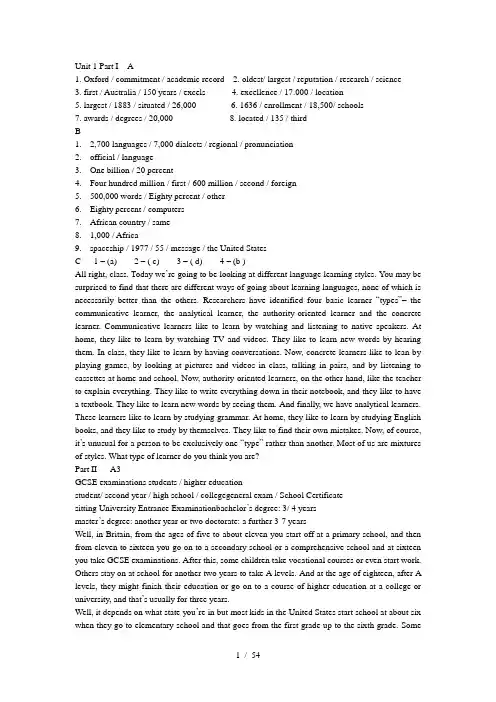
Unit 1 Part I A1. Oxford / commitment / academic record2. oldest/ largest / reputation / research / science3. first / Australia / 150 years / excels4. excellence / 17.000 / location5. largest / 1883 / situated / 26,0006. 1636 / enrollment / 18,500/ schools7. awards / degrees / 20,000 8. located / 135 / thirdB1.2,700 languages / 7,000 dialects / regional / pronunciation2.official / language3.One billion / 20 percent4.Four hundred million / first / 600 million / second / foreign5.500,000 words / Eighty percent / other6.Eighty percent / computers7.African country / same8.1,000 / Africa9.spaceship / 1977 / 55 / message / the United StatesC 1 – (a) 2 – ( c) 3 – ( d) 4 – (b )All right, class. Today we’re going to be looking at different language learning styles. You may be surprised to find that there are different ways of going about learning languages, none of which is necessarily better than the others. Researchers have identified four basic learner “types”–the communicative learner, the analytical learner, the authority-oriented learner and the concrete learner. Communicative learners like to learn by watching and listening to native speakers. At home, they like to learn by watching TV and videos. They like to learn new words by hearing them. In class, they like to learn by having conversations. Now, concrete learners like to lean by playing games, by looking at pictures and videos in class, talking in pairs, and by listening to cassettes at home and school. Now, authority-oriented learners, on the other hand, like the teacher to explain everything. They like to write everything down in their notebook, and they like to have a textbook. They like to learn new words by seeing them. And finally, we have analytical learners. These learners like to learn by studying grammar. At home, they like to learn by studying English books, and they like to study by themselves. They like to find their own mistakes. Now, of course, it’s unusual for a person to be exclusively one “type” rather than another. Most of us are mixtures of styles. What type of learner do you think you are?Part II A3GCSE examinations students / higher educationstudent/ second year / high school / collegegeneral exam / School Certificatesitting University Entrance Examinationbachelor’s degree: 3/ 4 yearsmaster’s degree: another year or two doctorate: a further 3-7 yearsWell, in Britain, from the ages of five to about eleven you start off at a primary school, and then from eleven to sixteen you go on to a secondary school or a comprehensive school and at sixteen you take GCSE examinations. After this, some children take vocational courses or even start work. Others stay on at school for another two years to take A levels. And at the age of eighteen, after A levels, they might finish their education or go on to a course of higher education at a college or university, and that’s usually for three years.Well, it depends on what state you’re in but most kids in the United States start school at about six when they go to elementary school and that goes from the first grade up to the sixth grade. Somekids go to a kindergarten the year before that. Then they go on to junior high school, that’s about eleven, and that’s the seventh, eighth and ninth grades. And then they go on to senior high school around age fourteen starting in the tenth grade and finishing in the twelfth grade usually. Some students will leave school at sixteen and they’ll start work, but most of them stay on to graduate from high school at age eighteen. In the first year at high school or college students are called “freshmen”, in the second they’re called “sophomores”, in the third year we call them “juniors”and in the fourth year they’re called “seniors”. Now a lot of high school graduates then go to college or university and they do a four-year first degree course. Some of them might go to junior college which is a two-year course.Well, in Australia, well most states anyway, children start their primary education at five after perhaps a brief time in kindergarten. They will stay at primary school until they’re about eleven, then they’ll either stay there or go to an intermediate school for a couple of years. Then they start high school usually twelve or thirteen, which you start in the third form. Now, after three years at high school you sit a general exam, some states call it School Certificate and that is a sort of general qualification and that if a sort of general qualification. After that you can leave school at sixteen or you can go on and sit your University Entrance Examination, which then gives you entrée into a university or it’s another useful qualification, and from then on you go to various sorts of higher education.Education in Canada is a provincial responsibility, but schools are administered by local school boards.Kindergarten is for children who are four or five years old. Children begin formal full-day schooling in Grade 1, when they are about six years old. They must stay in school at least until they are sixteen. However, most students continue to finish high school. Some go to college or university. Each year of schooling represents one grade. (The school year extends from the beginning of September to the end of June.) Elementary school includes kindergarten to about Grade 8. Secondary school (or high school) may start in Grade 8, 9, or 10 and it usually continues until Grade 12.In Canada, students may go to university or to a community college. If they want to learn skills for specific job, they attend college for one or four years to get a diploma or certificate. For example, lab technicians, child-care workers, and hotel managers go to college. Universities offer degree programs as well as training professions, such as law, medicine, and teaching.Universities offer three main levels of degrees. Students earn a bachelor’s degree after three or four years of study. A master’s degree can take another year or two. A doctorate may take a further three to seven years to complete.B1 Idioms / vocabulary / French / spelling / pronunciationB2 1. F 2. T 3. FI – Interviewer P – ProfessorI: And now we have an interview with Professor J. T. Lingo, Professor of Linguistics at ChimoUniversity, who is here to talk to us about the growing business of teaching English. Good morning, professor Lingo.P: Good morning.I: I understand that teaching English is becoming “big business” all around the world.P: It seems that language schools are springing up everywhere.I: Why is that?P: With the move toward a global economy, English has become the most widely used language in the world. It is the language of business, aviation, science and international affairs and people find that they must learn English to compete in those fields.I: And do people find English an easy language to learn?P: Well, every language has something about it that other people find difficult to learn. English is such a hodgepodge of different languages–it’s essentially Germanic but a lot of its vocabulary comes from French, and technical words stem from Latin and Greek. This feature makes English fairly adaptable – which is a good thing for a world language– but it causes irregularity in spelling and pronunciation.I: English spelling baffles me, too.P: English also has the largest vocabulary. Often there are words for the same thing, one is Anglo-Saxon and one from the French – like “buy” which is Anglo-Saxon and “purchase” which is from the French. The French word often has more prestige.I: Anglo-Saxon?P: That’s the word for Old English. The Norman Conquest in 1066 brought the French language to Britain and helped English evolve into the English it is today.I: Is there anything else particularly difficult about English?P: Well, the idioms in informal English pose a problem for some students.I: Informal English?P: As with any language, there are different varieties: slang, colloquial. Formal, written, as well as the different dialects – British, American and Canadian English.I: And how is Canadian English different from American and British?P: Canadian English is closer to American in pronunciation and idiom. Some of our words and our spellings do reflect British usage, however. We wouldn’t use the British term “lorry” for truck, but we have kept the “o-u-r” spellings in words such as “honour” and “colour”.I: This has been very interesting. I’m afraid we’re out of time. It has been a pleasure talking to you.PartIIIUniversity Life A1 I. Age / Foreign student population II. 15 hrs (+2 or 3 for lab) / Discussion group: 15-20 / much smaller / informal, friendly / 2-3 hrs: 1 hrToday I’d like to give you some idea about how life at an American university or college might be different from the way it is in your country. To be sure, the student body on a U. S. campus is a pretty diverse group of people. First of all, you will find students of all ages. Although most students start college at around the age of 18, you will see students in their 30s and 40s and even occasionally in their 60s and 70s. Students on a U.S. campus come from a wide variety of socioeconomic backgrounds. Many students work at least part-time, some of them work full-time. Many students live in dormitories on campus, some have their own apartments usually with other students, and others live at home. Some colleges and universities have a very diverse student population with many racial and ethnic minorities. Some schools have a fairly large foreign student population. So you can see that one meets all kinds of people on a U.S. college or university campus. Now that you have some general idea of differences in the student population, I’d like to talk a few minutes about what I think an average student is and then discuss with you what a typical class might be like.Let’s begin my talking about an average student entering his or her freshman year. Of course, such a person never really exists, but still it’s convenient to talk about an “average”student for ourpurposes. Foreign students are often surprised at how poorly prepared American students are when they enter a university. Actually, at very select schools the students are usually very well prepared, but at less selective schools, they may not be as well prepared as students in your country are. Schools in the States simply admit a lot more students than is usual in most other countries. Also, most young American university students have not traveled in other countries and are not very well-versed in international matters and do not know a lot about people from other countries. Foreign students usually find them friendly but not very well-informed about their countries or cultures.What kind of academic experiences will this so-called “average”student have? The average undergraduate student takes five classes a semester and is in class for 15 hours a week. If her or she takes a class that has a laboratory, this will require tow or three more hours. Many introductory undergraduate classes are given in large lectures of 100 or more students. However, many of these classes will have small discussion groups of 15 to 20 students that meet once a week. In these smaller groups, a teaching assistant will lead a discussion to help classify points in the lectures. Other kinds of classes – for example, language classes – will be much smaller so that students can practice language. In general, American professors are informal and friendly with their students, and, as much as possible, they expect and invite participation in the form of discussion. A large amount of reading and other work is often assigned to be done outside class, and students are expected to take full responsibility for completing these assignments and asking questions in class about those areas they don’t understand. As a rule of thumb, students spend two to three hours preparing for each hour they spend in class. American professors often encourage their students to visit them during office hours, especially if the students are having problems in the class.A2 II. Examinations / quizzesIII. Graduate school / Seminars / some area of interest / a research paperLet’s move on now to discuss student obligations in a typical American class. These obligations are usually set down in the course syllabus. A syllabus is generally handed out to students on the first or second class meeting. A good syllabus will give students a course outline that mentions all the topics to be covered in class. It will also contain all the assignments and the dates they should be completed by. An average university course of one semester might have three examinations or two examinations and a paper. The dates of the examinations and what the examinations will cover should be on the syllabus. If a paper id required, the date it is due should also be in the syllabus. The professor may also decide that he or she will be giving quizzes during the semester, either announced or unannounced. For students coming from a system where there is one examination in each subject at the end of the year, all this testing can be a little surprising at first. By the by, maybe this would be a good place for me to mention the issue of attendance. Another real difference in our system is out attendance policies. Perhaps you come from a system where attendance is optional. Generally speaking, American professors expect regular attendance and may even grade you down if you are absent a lot. All this information should be on your syllabus, along with the professor’s office number and office hours.I have only a couple of hours left, and I’d like to use them to talk about how graduate school is somewhat different from undergraduate school. Of course, it’s much more difficult to enter graduate school, and most students are highly qualified and high motivated. Students in graduate school are expected to do much more independent work than those in undergraduate schools, withregularly scheduled exams, etc. some classes will be conducted as seminars. In a seminar class, there may be no exams, but students are expected to read rather widely on topics and be prepared for thorough discussion of them in class. Another possibility in graduate classes is that in addition to readings done by all students, each student may also be expected to work independently in some area of interest and later make a presentation that summarizes what her or she has learned. Usually each student then goes on to write a paper on what he or she has researched to turn in to the professor for a grade.I hope that today’s lecture has given you some idea about student life on an American campus and that you have noticed some difference between our system and yours.B2 to make mistakes / every new thing / the language/ Working outside the classroomPassive / the teach / stick his neck out / more likely to be right than himselfHow would you describe a good student or a bad student, sort of things they do or don’t do in the classroom?He’s eager to experiment with every new thing that he learns, whether it be a structure of a function or a new word, he immediately starts trying to use it.He’s interested in the mistakes he makes, he’s not afraid to make them.He’s not simply interested in having it corrected and moving on?He plays with language.I’ve done this chapter I know this, without trying to experiment at all, without really testing himself.He’s usually passive, he won’t speak up much in the classroom. He’ll rarely ask you why this …Just sort of accepts what you give him and doesn’t do anything more with it.… and in a test he’s the one person who’s likely to suddenly realize that he wasn’t too sure about that after all.And peep over at his neighbor’s paper.An alternative learning strategy.He invariably decides that the other person is more likely to be right than himself. That’s the result of this sort of unwillingness to make mistakes and stick his neck out.That characterizes the good or bad learner?He’ll do more off his own bat as well, he won’t rely entirely on the teacher.He’ll work outside the classroom as well as in it.Students who make most progress are first of all those who experiment and secondly those who read books.Part IV University Campus A2. the History Department3. the Psychology Department4. the Library5. the Education Department6. the Philosophy Department7. the Geography Department8. the Sports Ground9. the Foreign Languages Department 10. the Chinese Department 11. the Physics Department 12. the Mathematics Department 13. the Chemistry Department 14. the Clinic 15. the Auditorium 16. the AdministrationBuildingLook at the map. At the bottom of the page, fine the gate (1). Now locate 16. It is between the river and the lake, close to the Main Road. The building behind the Administration is 15. Where is 4? It’s on the right-hand side of theMain Road, close to the river. Across the Main road from the Library, the building by the river is 5. The first building on the left-hand side of the Main Road is 7. 6 is between the Education and the Geography. The building at the end of the Main Road is 12.on its left is 11 and on its right, near the lake, is 13. Another building behind the like is 14. 10 is facing the lake, across the Main Road. The building between the Chinese Department and the river is 9. 2 is the first building on the right of the Main Road. Next to the History Department is 3. And last, 8 is behind the Education, Philosophy and Geography Departments.B Robert Martin / biology / next fall / six years in a public school in the hometown; two years in a military school, high school in the hometown / science (biology in particular), sportsSo I had to earn a little money to help pay my way.It sounds as if you’re a pretty responsible fellow. I see that you attended two grade schools.I don’t find a transcript among your papers.But it’s hard to keep up with both sports and studies.I’ll hold your application until we get the transcript.What did your guidance counselor tell you?He told me I had a real knack for scientific things. I have been fascinated with science since I was a child. An interest of that kind really signifies something.Unit 2 Colorful lands, colorful people16,998,000 / 64,186,300/ 840,000 / 1,000,000 / 3,320,000 / 143,244 / 32,483 / 2,966,000 / 5,105,700 / 29,028 / -1,312 / 5,315 / 36,198 / 4,145 /The biggest continent in the world is Asia. It covers 16,998,000 square miles.The Pacific Ocean is the largest ocean with 64,186,300 square miles.Which is the biggest island? It’s Greenland. It occupies an area of 840,000 square miles.The ArabiaPeninsula is the largest peninsula and has an area of 1, 000,000 square miles.Do you know which is the largest desert?Yes, it’s the SaharaDesert in North Africa. It covers 3,320,000 square miles.The biggest saltwater lake is the Caspian Sea, which is 143,244 square miles large.Lake Superior is the biggest fresh water lake and it covers a total area of 32,483 square miles. The smallest continent is Oceania, with an area of 2,966,000 square miles, and the smallest ocean is the Arctic Ocean with 5,105,700 square miles.You all know the world’s highest peak, don’t you? Mt.Qomolangma (or Mt.Everest) is 29,028 feet above sea level. In contrast, the lowest altitude in the world is the Dead Sea, 1,312 feet below sea level, or you can say -1,312 feet.The deepest lake is Baykal in Russia. The depth is 5,315 feet.Mariana Trench near the Philippines is the deepest oceanic trench, with a depth of 36, 198 feet. The longest river in the world is the Nile in Africa. It is 4, 145 miles long.B1,243,738,000 / 955,220,000 / 267,901,000 / 199,867,000 / 159,884,000 / 147,105,000 / 138,150,000 / 125,638,000 / 122,013,000 / 118,369,000 / 96,400,000 / 82,071,0001.The country with the largest population in the world is China. According to the 1997 census,the total population was 1,243,738,000.2.The second largest in population is India. It listed a population of 955,220,000 in 1997.3.And the third largest is the United States, with its estimated population of 267,901,000 in1997.4.Which country is the fourth largest in population? It’s Indonesia. About 199,867,000 peoplelive there.5.Brazil ranks the fifth in its population. There the population was 159,884,000.6.Next comes the Russian Federation, with a population of 147,105,000.7.The seventh in line is Pakistan, with an estimated population of 138,150,000.8.Japan is the country with the eighth largest population. Its population estimated in 1997reached 125,638,000.9.The next larges country in population is Bangladesh. The estimated population was122,013,000 in 1997.10.Nigeria in Africa ranks the tenth in its population. There are about 118,369,000 people livingthere.11.The eleventh? Mexico. According to statistics, its population was 96, 400, 000 in 1997.12.And last, the twelfth larges is Germany. Its 1997 census showed it had a population of82,071,000.CChinese 1,300 million / Spanish 332 million /English 322 million / 189 million / 182 million / 170 million / Russian 170 million / Japanese 125 million / German 98 million / 75.5 million / Korean 75 million / French 72 million / Vietnamese 67 million / 66 million / 64 million / 63 million / Turkish 59 million / 58 million / 44 million / Polish 44 million / Arabic 42.5 million / 41 millionDo you know which languages are spoken by more than 40 million people?Chinese has the largest number of speakers, more than 1,300 million. Next, Spanish is spoken by 332 million people. The next on the line is English, which has more than 322 million speakers. Number 4, Bengali is spoken by 189 million people. Next comes Hindi, the language spoken chiefly in India, which has 182 million speakers. Portuguese and Russian are next on the line and they are both spoken by 170 million people. Number 8, Japanese is spoken by 125 million. Next, German has 98 million speakers, while Javanese has 75.5 million. We have Korean on the list with 75 million, and it is followed by French, which is spoken by 72 million. Number 13, Vietnamese is spoken by 67 million and Telugu is spoken by 66 million. Next, we have Marathi on the list and it has 64 million speakers. Marathi is followed by Tamil, with 63 million speakers. Next comes Turkish, the language spoken in Turkey, and it has 59 million speakers. Number 18, Urdu is spoken by 58 million people. Gujarati has 44 million speakers, and Polish is also spoken by 44 million people. Number 21, which 42.5 million people speak, is Arabic and last, the number of people who speak Ukrainian is 41 million.Part II1. A baby boy2.social/ ecological/ populations3.longer/ healthierA baby boy born in Bosnia-Herzegovina overnight has officially been named the world’s six billionth inhabitant.Although several other babies are likely to have been born at the same time elsewhere in the world, the United Nations had declared that the first child to be delivered at the KosovoHospital in Sarajevo today would symbolize the passing of the mark.The U Secretary General is visiting the mother and her son as a UN attempt to draw attention to the social and ecological problems of rapidly expanding populationsThe boy who came into the world a short time ago in Bosnia to such international acclaim willbe sharing a birthday with a few hundred thousand people and in the next year another eighty million will be joining him on the planet. The earth’s population has doubled since 1960 and with more than a billion young people just entering their productive years. The population growth has plenty of momentum. But birth control programs are beginning to have an impact. Demographers predict that by the middle of the new century the global count will level off at something under ten billion. The UN population agency has presented today’s achievement as a success for humanity, pointing out that people are living longer and healthier lives than any generation in the history.B b c aThe boy will be sharing a birthday with a few hundred thousand people and in the next year, another eighty million will be joining him on the planet.The earth’s population has doubled since 1960 and with more than a billion young people just entering their productive years.Demographers predict that by the middle of the new century, the global count will level off at something under ten billion.Part IIIAwater/ 70% red or brown/ plant cover snow/ continents islandsarms of the ocean connecting a channel valleys plainsB 12 million / 2/ 10 million/10/ 3/ 6/ 4/16 million/ 18 million1. Mexico City2. Sao Paulo3. Rio de Janeiro4. Bombay5. Delhi6. Shanghia7. SeoulI-Interview E-ExpertI: In Britain we are often told that people are leaving the big cities to live in the countryside but is this the case worldwide?E: Not at all. If you look at the biggest cities in 1950, seven out of the top ten were in the developed countries but by the year 2000, the developing countries will have eight out of the top ten. New York, which in 1950 was number one with a population of around 12 million, will only be the sixth largest city in the world but with an extra 2 million.I: And London?E: London, which was number two, won’t even be in the top ten. Its population in 1950, by the way, was about 10 million.I: And why is this happening? Why are people moving to the big cities from the country in the developing countries?E: The reasons are complex but many are moving to look for work. And the problems this creates are enormous. It’s estimated that 26 million people will be living in Mexico City by the year 2000, with Sao Paulo in Brazil not far behind.I: I t’s difficult to believe.E: I know. Rio de Janeiro will have a population of a mere 13 million. Well, just imagine the kinds of difficulties this is going to cause in terms of health, transport and education.I: Yes. What about the cities of Asia? Will they be experiencing a similar sort of growth?E: In some cases, yes. Calcutta in India which was No. 10 in the league in 1950 is expected to be the fourth biggest city in the world with a population of 16 million- quadrupling its size in just 50 years. Bombay and Delhi too are expected to be in the top ten.I: What about Japan?E: Ah! Well, Tokyo was number three in 1950 and that’s where it’ll be at the beginning of the nextcentury, although its population will have trebled to about 18 million. Looking at the other major cities in Asia, Shanghai and Seoul will be in the top ten as well but, perhaps surprisingly, not Beijing or Hong Kong.I: Now, if we could turn our attention to home, what about the trend of people moving out of the cities…Part IV skills /the main idea/what/recognize/central / important/direction/ purpose/inform/compare/answer/stated/atopicsentence/ first/ details/ difficult/ persuade/ end/ implied/ hinted at/a wholeUnit 3 Traveling from Place to Place PartⅠABA912/11:20/17BA877/11:20/14BA292/11:25/19TW695/11:30/164EA831/11:35/24BA838/9IB290/11:35/15LH039/11:40/9BA666/11:40/18AI141/6BA560/22Last call for British airways flight BA912 for Tokyo. BA912 for Tokyo due to depart at 11:20 boarding at gate 17.British airways flight BA877 to Boston. British airways flight BA877 to Boston duo to depart at 11:20 boarding now at gate 14.British airways flight BA292 for Frankfurt, Athens and Karachi. Flight BA292 for Frankfurt, Athens and Karachi duo to depart at 11:25 now board at gate 19.TWA flight, TW695to NewYork. TW A flight TW695 to NewYork departing at 11:30 boarding at gate 16.BTea, soft drinks, coffee, Egg and tomato, ham and tomato, egg and chips, roast chicken, cheeseburgersTape script:Chief Steward: may I have your attention please, ladies and gentlemen? This is the chief steward speaking. We would like to inform all passengers that the buffet car is now open. The buffet car is situated towards the middle of the train. On sale are tea, coffee and soft drinks, a selection of fresh and toasted sandwiches including egg and tomato, ham and tomato, egg and cress, roast chicken and toasted cheese; cheeseburgers, beef burgers and sausages and a licensed bar. The buffet car is situated towards the middle of the train. Thank you.PartⅡ9:15/10:3010:30/13:30Quick/beautiful view /frequent service (hourly)/modern/comfortable/lovely view from dining car Have to get Gatwick airport/ expensive quite crowded/quite expensiveA-Annabel C-Charles D-DouglasD: Ah! That’s much better!C: Ah! That’s yours, I think…er…Doug.D: Thank you very much, Charles.C: Right. You have a good journey then, Douglas?D: Yes I did, I did. I must say the plane was marvelous, marvelous.C: Very quick, then?D: Er…the plane journey was terrifically quick…er…I mean, you…er…what…you met me about 9…er…what…er…10…10:45.C: About 10:30.。
step_by_step_3000_1_Unit_1
cosmopolitan
Adj. 世界性的,全世界的; 全球的 London has always been a cosmopolitan city. 伦敦一直是一个国际化都市。
stimulate
vt. 刺激; 激励,鼓舞; They counted on foreign investment to stimulate their economy. 他们想依靠外国投资来刺激他们的经济。 Your encouragement will stimulate me to further efforts. 你的鼓励会激发我进一步努力。
n. 教育委员会; 学校董事会 board of education
diploma
n. 毕业文凭; 学位证书 A diploma is a qualification which may be awarded to a student by a university or college, or by a high school in the United States. She worked hard to earn her music diploma. 她刻苦用功,以求获得音乐学位证书
包括,由……组成 能力,系,全体教职员 男女合校的 授予,颁发 博士 硕士 高等学位 靠着
A Vocabulary end
bankt 1 Part I A 1. Oxford / commitment / academic record 2. oldest/ largest / reputation / research / science 3. first / Australia / 150 years / excels 4. excellence / 17.000 / location 5. largest / 1883 / situated / 26,000 6. 1636 / enrollment / 18,500/ schools 7. awards / degrees / 20,000 8. located / 135 / third
英语听力入门step-by-step-3000第一册答案与原文
Unit 1 Part I A1. Oxford / commitment / academic record2. oldest/ largest / reputation / research / science3. first / Australia / 150 years / excels4. excellence / 17.000 / location5. largest / 1883 / situated / 26,0006. 1636 / enrollment / 18,500/ schools7. awards / degrees / 20,000 8. located / 135 / thirdB1.2,700 languages / 7,000 dialects / regional / pronunciation2.official / language3.One billion / 20 percent4.Four hundred million / first / 600 million / second / foreign5.500,000 words / Eighty percent / other6.Eighty percent / computers7.African country / same8.1,000 / Africa9.spaceship / 1977 / 55 / message / the United StatesC 1 – (a) 2 – ( c) 3 – ( d) 4 – (b )All right, class. Today we’re going to be looking at different language learning styles. You may be surprised to find that there are different ways of going about learning languages, none of which is necessarily better than the others. Researchers have identified four basic learner “types”–the communicative learner, the analytical learner, the authority-oriented learner and the concrete learner. Communicative learners like to learn by watching and listening to native speakers. At home, they like to learn by watching TV and videos. They like to learn new words by hearing them. In class, they like to learn by having conversations. Now, concrete learners like to lean by playing games, by looking at pictures and videos in class, talking in pairs, and by listening to cassettes at home and school. Now, authority-oriented learners, on the other hand, like the teacher to explain everything. They like to write everything down in their notebook, and they like to have a textbook. They like to learn new words by seeing them. And finally, we have analytical learners. These learners like to learn by studying grammar. At home, they like to learn by studying English books, and they like to study by themselves. They like to find their own mistakes. Now, of course, it’s unusual for a person to be exclusively one “type” rather than another. Most of us are mixtures of styles. What type of learner do you think you are?Part II A3GCSE examinations students / higher educationstudent/ second year / high school / collegegeneral exam / School Certificatesitting University Entrance Examinationbachelor’s degree: 3/ 4 yearsmaster’s degree: another year or two doctorate: a further 3-7 yearsWell, in Britain, from the ages of five to about eleven you start off at a primary school, and then from eleven to sixteen you go on to a secondary school or a comprehensive school and at sixteen you take GCSE examinations. After this, some children take vocational courses or even start work. Others stay on at school for another two years to take A levels. And at the age of eighteen, after A levels, they might finish their education or go on to a course of higher education at a college or university, and that’s usually for three years.Well, it depends on what state you’re in but most kids in the United States start school at about six when they go to elementary school and that goes from the first grade up to the sixth grade. Somekids go to a kindergarten the year before that. Then they go on to junior high school, that’s about eleven, and that’s the seventh, eighth and ninth grades. And then they go on to senior high school around age fourteen starting in the tenth grade and finishing in the twelfth grade usually. Some students will leave school at sixteen and they’ll start work, but most of them stay on to graduate from high school at age eighteen. In the first year at high school or college students are called “freshmen”, in the second they’re called “sophomores”, in the third year we call them “juniors”and in the fourth year they’re called “seniors”. Now a lot of high school graduates then go to college or university and they do a four-year first degree course. Some of them might go to junior college which is a two-year course.Well, in Australia, well most states anyway, children start their primary education at five after perhaps a brief time in kindergarten. They will stay at primary school until they’re about eleven, then they’ll either stay there or go to an intermediate school for a couple of years. Then they start high school usually twelve or thirteen, which you start in the third form. Now, after three years at high school you sit a general exam, some states call it School Certificate and that is a sort of general qualification and that if a sort of general qualification. After that you can leave school at sixteen or you can go on and sit your University Entrance Examination, which then gives you entrée into a university or it’s another useful qualification, and from then on you go to various sorts of higher education.Education in Canada is a provincial responsibility, but schools are administered by local school boards.Kindergarten is for children who are four or five years old. Children begin formal full-day schooling in Grade 1, when they are about six years old. They must stay in school at least until they are sixteen. However, most students continue to finish high school. Some go to college or university. Each year of schooling represents one grade. (The school year extends from the beginning of September to the end of June.) Elementary school includes kindergarten to about Grade 8. Secondary school (or high school) may start in Grade 8, 9, or 10 and it usually continues until Grade 12.In Canada, students may go to university or to a community college. If they want to learn skills for specific job, they attend college for one or four years to get a diploma or certificate. For example, lab technicians, child-care workers, and hotel managers go to college. Universities offer degree programs as well as training professions, such as law, medicine, and teaching.Universities offer three main levels of degrees. Students earn a bachelor’s degree after three or four years of study. A master’s degree can take another year or two. A doctorate may take a further three to seven years to complete.B1 Idioms / vocabulary / French / spelling / pronunciationB2 1. F 2. T 3. FI – Interviewer P – ProfessorI: And now we have an interview with Professor J. T. Lingo, Professor of Linguistics at ChimoUniversity, who is here to talk to us about the growing business of teaching English. Good morning, professor Lingo.P: Good morning.I: I understand that teaching English is becoming “big business” all around the world.P: It seems that language schools are springing up everywhere.I: Why is that?P: With the move toward a global economy, English has become the most widely used language in the world. It is the language of business, aviation, science and international affairs and people find that they must learn English to compete in those fields.I: And do people find English an easy language to learn?P: Well, every language has something about it that other people find difficult to learn. English is such a hodgepodge of different languages–it’s essentially Germanic but a lot of its vocabulary comes from French, and technical words stem from Latin and Greek. This feature makes English fairly adaptable – which is a good thing for a world language– but it causes irregularity in spelling and pronunciation.I: English spelling baffles me, too.P: English also has the largest vocabulary. Often there are words for the same thing, one is Anglo-Saxon and one from the French – like “buy” which is Anglo-Saxon and “purchase” which is from the French. The French word often has more prestige.I: Anglo-Saxon?P: That’s the word for Old English. The Norman Conquest in 1066 brought the French language to Britain and helped English evolve into the English it is today.I: Is there anything else particularly difficult about English?P: Well, the idioms in informal English pose a problem for some students.I: Informal English?P: As with any language, there are different varieties: slang, colloquial. Formal, written, as well as the different dialects – British, American and Canadian English.I: And how is Canadian English different from American and British?P: Canadian English is closer to American in pronunciation and idiom. Some of our words and our spellings do reflect British usage, however. We wouldn’t use the British term “lorry” for truck, but we have kept the “o-u-r” spellings in words such as “honour” and “colour”.I: This has been very interesting. I’m afraid we’re out of time. It has been a pleasure talking to you. PartIIIUniversity Life A1 I. Age / Foreign student population II. 15 hrs (+2 or 3 for lab) / Discussion group: 15-20 / much smaller / informal, friendly / 2-3 hrs: 1 hrToday I’d like to give you some idea about how life at an American university or college might be different from the way it is in your country. To be sure, the student body on a U. S. campus is a pretty diverse group of people. First of all, you will find students of all ages. Although most students start college at around the age of 18, you will see students in their 30s and 40s and even occasionally in their 60s and 70s. Students on a U.S. campus come from a wide variety of socioeconomic backgrounds. Many students work at least part-time, some of them work full-time. Many students live in dormitories on campus, some have their own apartments usually with other students, and others live at home. Some colleges and universities have a very diverse student population with many racial and ethnic minorities. Some schools have a fairly large foreign student population. So you can see that one meets all kinds of people on a U.S. college or university campus. Now that you have some general idea of differences in the student population, I’d like to talk a few minutes about what I think an average student is and then discuss with you what a typical class might be like.Let’s begin my talking about an average student entering his or her freshman year. Of course, such a person never really exists, but still it’s convenient to talk about an “average”student for our purposes. Foreign students are often surprised at how poorly prepared American students are whenthey enter a university. Actually, at very select schools the students are usually very well prepared, but at less selective schools, they may not be as well prepared as students in your country are. Schools in the States simply admit a lot more students than is usual in most other countries. Also, most young American university students have not traveled in other countries and are not very well-versed in international matters and do not know a lot about people from other countries. Foreign students usually find them friendly but not very well-informed about their countries or cultures.What kind of academic experiences will this so-called “average”student have? The average undergraduate student takes five classes a semester and is in class for 15 hours a week. If her or she takes a class that has a laboratory, this will require tow or three more hours. Many introductory undergraduate classes are given in large lectures of 100 or more students. However, many of these classes will have small discussion groups of 15 to 20 students that meet once a week. In these smaller groups, a teaching assistant will lead a discussion to help classify points in the lectures. Other kinds of classes – for example, language classes – will be much smaller so that students can practice language. In general, American professors are informal and friendly with their students, and, as much as possible, they expect and invite participation in the form of discussion. A large amount of reading and other work is often assigned to be done outside class, and students are expected to take full responsibility for completing these assignments and asking questions in class about those areas they don’t understand. As a rule of thumb, students spend two to three hours preparing for each hour they spend in class. American professors often encourage their students to visit them during office hours, especially if the students are having problems in the class.A2 II. Examinations / quizzesIII. Graduate school / Seminars / some area of interest / a research paperLet’s move on now to discuss student obligations in a typical American class. These obligations are usually set down in the course syllabus. A syllabus is generally handed out to students on the first or second class meeting. A good syllabus will give students a course outline that mentions all the topics to be covered in class. It will also contain all the assignments and the dates they should be completed by. An average university course of one semester might have three examinations or two examinations and a paper. The dates of the examinations and what the examinations will cover should be on the syllabus. If a paper id required, the date it is due should also be in the syllabus. The professor may also decide that he or she will be giving quizzes during the semester, either announced or unannounced. For students coming from a system where there is one examination in each subject at the end of the year, all this testing can be a little surprising at first. By the by, maybe this would be a good place for me to mention the issue of attendance. Another real difference in our system is out attendance policies. Perhaps you come from a system where attendance is optional. Generally speaking, American professors expect regular attendance and may even grade you down if you are absent a lot. All this information should be on your syllabus, along with the professor’s office number and office hours.I have only a couple of hours left, and I’d like to use them to talk about how graduate school is somewhat different from undergraduate school. Of course, it’s much more difficult to enter graduate school, and most students are highly qualified and high motivated. Students in graduate school are expected to do much more independent work than those in undergraduate schools, with regularly scheduled exams, etc. some classes will be conducted as seminars. In a seminar class,there may be no exams, but students are expected to read rather widely on topics and be prepared for thorough discussion of them in class. Another possibility in graduate classes is that in addition to readings done by all students, each student may also be expected to work independently in some area of interest and later make a presentation that summarizes what her or she has learned. Usually each student then goes on to write a paper on what he or she has researched to turn in to the professor for a grade.I hope that today’s lecture has given you some idea about student life on an American campus and that you have noticed some difference between our system and yours.B2 to make mistakes / every new thing / the language/ Working outside the classroomPassive / the teach / stick his neck out / more likely to be right than himselfHow would you describe a good student or a bad student, sort of things they do or don’t do in the classroom?He’s eager to experiment with every new thing that he learns, whether it be a structure of a function or a new word, he immediately starts trying to use it.He’s interested in the mistakes he makes, he’s not afraid to make them.He’s not simply interested in having it corrected and moving on?He plays with language.I’ve done this chapter I know this, without trying to experiment at all, without really testing himself.He’s usually passive, he won’t speak up much in the classroom. He’ll rarely ask you why this …Just sort of accepts what you give him and doesn’t do anything more with it.… and in a test he’s the one person who’s likely to suddenly realize that he wasn’t too sure about that after all.And peep over at his neighbor’s paper.An alternative learning strategy.He invariably decides that the other person is more likely to be right than himself. That’s the result of this sort of unwillingness to make mistakes and stick his neck out.That characterizes the good or bad learner?He’ll do more off his own bat as well, he won’t rely entirely on the teacher.He’ll work outside the classroom as well as in it.Students who make most progress are first of all those who experiment and secondly those who read books.Part IV University Campus A2. the History Department3. the Psychology Department4. the Library5. the Education Department6. the Philosophy Department7. the Geography Department8. the Sports Ground 9. the Foreign Languages Department 10. the Chinese Department11. the Physics Department 12. the Mathematics Department 13. the Chemistry Department 14. the Clinic 15. the Auditorium 16. the AdministrationBuildingLook at the map. At the bottom of the page, fine the gate (1). Now locate 16. It is between the river and the lake, close to the Main Road. The building behind the Administration is 15. Where is 4? It’s on the right-hand side of theMain Road, close to the river. Across the Main road from the Library, the building by the river is 5. The first building on the left-hand side of the Main Road is 7. 6 is between the Education and the Geography. The building at the end of the Main Road is 12. on its left is 11 and on its right, near the lake, is 13. Another building behind the like is 14. 10 isfacing the lake, across the Main Road. The building between the Chinese Department and the river is 9. 2 is the first building on the right of the Main Road. Next to the History Department is 3. And last, 8 is behind the Education, Philosophy and Geography Departments.B Robert Martin / biology / next fall / six years in a public school in the hometown; two years in a military school, high school in the hometown / science (biology in particular), sportsSo I had to earn a little money to help pay my way.It sounds as if you’re a pretty responsible fellow. I see that you attended two grade schools.I don’t find a transcript among your papers.But it’s hard to keep up with both sports and studies.I’ll hold your application until we get the transcript.What did your guidance counselor tell you?He told me I had a real knack for scientific things. I have been fascinated with science since I was a child. An interest of that kind really signifies something.Unit 2 Colorful lands, colorful people16,998,000 / 64,186,300/ 840,000 / 1,000,000 / 3,320,000 / 143,244 / 32,483 / 2,966,000 / 5,105,700 / 29,028 / -1,312 / 5,315 / 36,198 / 4,145 /The biggest continent in the world is Asia. It covers 16,998,000 square miles.The Pacific Ocean is the largest ocean with 64,186,300 square miles.Which is the biggest island? It’s Greenland. It occupies an area of 840,000 square miles.The ArabiaPeninsula is the largest peninsula and has an area of 1, 000,000 square miles.Do you know which is the largest desert?Yes, it’s the SaharaDesert in North Africa. It covers 3,320,000 square miles.The biggest saltwater lake is the Caspian Sea, which is 143,244 square miles large.Lake Superior is the biggest fresh water lake and it covers a total area of 32,483 square miles. The smallest continent is Oceania, with an area of 2,966,000 square miles, and the smallest ocean is the Arctic Ocean with 5,105,700 square miles.You all know the world’s highest peak, don’t you? Mt.Qomolangma (or Mt.Everest) is 29,028 feet above sea level. In contrast, the lowest altitude in the world is the Dead Sea, 1,312 feet below sea level, or you can say -1,312 feet.The deepest lake is Baykal in Russia. The depth is 5,315 feet.Mariana Trench near the Philippines is the deepest oceanic trench, with a depth of 36, 198 feet. The longest river in the world is the Nile in Africa. It is 4, 145 miles long.B1,243,738,000 / 955,220,000 / 267,901,000 / 199,867,000 / 159,884,000 / 147,105,000 / 138,150,000 / 125,638,000 / 122,013,000 / 118,369,000 / 96,400,000 / 82,071,0001.The country with the largest population in the world is China. According to the 1997 census,the total population was 1,243,738,000.2.The second largest in population is India. It listed a population of 955,220,000 in 1997.3.And the third largest is the United States, with its estimated population of 267,901,000 in1997.4.Which country is the fourth largest in population? It’s Indonesia. About 199,867,000 peoplelive there.5.Brazil ranks the fifth in its population. There the population was 159,884,000.6.Next comes the Russian Federation, with a population of 147,105,000.7.The seventh in line is Pakistan, with an estimated population of 138,150,000.8.Japan is the country with the eighth largest population. Its population estimated in 1997reached 125,638,000.9.The next larges country in population is Bangladesh. The estimated population was122,013,000 in 1997.10.Nigeria in Africa ranks the tenth in its population. There are about 118,369,000 people livingthere.11.The eleventh? Mexico. According to statistics, its population was 96, 400, 000 in 1997.12.And last, the twelfth larges is Germany. Its 1997 census showed it had a population of82,071,000.CChinese 1,300 million / Spanish 332 million /English 322 million / 189 million / 182 million / 170 million / Russian 170 million / Japanese 125 million / German 98 million / 75.5 million / Korean 75 million / French 72 million / Vietnamese 67 million / 66 million / 64 million / 63 million / Turkish 59 million / 58 million / 44 million / Polish 44 million / Arabic 42.5 million / 41 millionDo you know which languages are spoken by more than 40 million people?Chinese has the largest number of speakers, more than 1,300 million. Next, Spanish is spoken by 332 million people. The next on the line is English, which has more than 322 million speakers. Number 4, Bengali is spoken by 189 million people. Next comes Hindi, the language spoken chiefly in India, which has 182 million speakers. Portuguese and Russian are next on the line and they are both spoken by 170 million people. Number 8, Japanese is spoken by 125 million. Next, German has 98 million speakers, while Javanese has 75.5 million. We have Korean on the list with 75 million, and it is followed by French, which is spoken by 72 million. Number 13, Vietnamese is spoken by 67 million and Telugu is spoken by 66 million. Next, we have Marathi on the list and it has 64 million speakers. Marathi is followed by Tamil, with 63 million speakers. Next comes Turkish, the language spoken in Turkey, and it has 59 million speakers. Number 18, Urdu is spoken by 58 million people. Gujarati has 44 million speakers, and Polish is also spoken by 44 million people. Number 21, which 42.5 million people speak, is Arabic and last, the number of people who speak Ukrainian is 41 million.Part II1. A baby boy2.social/ ecological/ populations3.longer/ healthierA baby boy born in Bosnia-Herzegovina overnight has officially been named the world’s six billionth inhabitant.Although several other babies are likely to have been born at the same time elsewhere in the world, the United Nations had declared that the first child to be delivered at the KosovoHospital in Sarajevo today would symbolize the passing of the mark.The U Secretary General is visiting the mother and her son as a UN attempt to draw attention to the social and ecological problems of rapidly expanding populationsThe boy who came into the world a short time ago in Bosnia to such international acclaim will be sharing a birthday with a few hundred thousand people and in the next year another eightymillion will be joining him on the planet. The earth’s population has doubled since 1960 and with more than a billion young people just entering their productive years. The population growth has plenty of momentum. But birth control programs are beginning to have an impact. Demographers predict that by the middle of the new century the global count will level off at something under ten billion. The UN population agency has presented today’s achievement as a success for humanity, pointing out that people are living longer and healthier lives than any generation in the history.B b c aThe boy will be sharing a birthday with a few hundred thousand people and in the next year, another eighty million will be joining him on the planet.The earth’s population has doubled since 1960 and with more than a billion young people just entering their productive years.Demographers predict that by the middle of the new century, the global count will level off at something under ten billion.Part IIIAwater/ 70% red or brown/ plant cover snow/ continents islandsarms of the ocean connecting a channel valleys plainsB 12 million / 2/ 10 million/10/ 3/ 6/ 4/16 million/ 18 million1. Mexico City2. Sao Paulo3. Rio de Janeiro4. Bombay5. Delhi6. Shanghia7. SeoulI-Interview E-ExpertI: In Britain we are often told that people are leaving the big cities to live in the countryside but is this the case worldwide?E: Not at all. If you look at the biggest cities in 1950, seven out of the top ten were in the developed countries but by the year 2000, the developing countries will have eight out of the top ten. New York, which in 1950 was number one with a population of around 12 million, will only be the sixth largest city in the world but with an extra 2 million.I: And London?E: London, which was number two, won’t even be in the top ten. Its population in 1950, by the way, was about 10 million.I: And why is this happening? Why are people moving to the big cities from the country in the developing countries?E: The reasons are complex but many are moving to look for work. And the problems this creates are enormous. It’s estimated that 26 million people will be living in Mexico City by the year 2000, with Sao Paulo in Brazil not far behind.I: I t’s difficult to believe.E: I know. Rio de Janeiro will have a population of a mere 13 million. Well, just imagine the kinds of difficulties this is going to cause in terms of health, transport and education.I: Yes. What about the cities of Asia? Will they be experiencing a similar sort of growth?E: In some cases, yes. Calcutta in India which was No. 10 in the league in 1950 is expected to be the fourth biggest city in the world with a population of 16 million- quadrupling its size in just 50 years. Bombay and Delhi too are expected to be in the top ten.I: What about Japan?E: Ah! Well, Tokyo was number three in 1950 and that’s where it’ll be at the beginning of the next century, although its population will have trebled to about 18 million. Looking at the other majorcities in Asia, Shanghai and Seoul will be in the top ten as well but, perhaps surprisingly, not Beijing or Hong Kong.I: Now, if we could turn our attention to home, what about the trend of people moving out of the cities…Part IV skills /the main idea/what/recognize/central / important/direction/ purpose/inform/compare/answer/stated/atopicsentence/ first/ details/ difficult/ persuade/ end/ implied/ hinted at/a wholeUnit 3 Traveling from Place to Place PartⅠABA912/11:20/17BA877/11:20/14BA292/11:25/19TW695/11:30/164EA831/11:35/24BA838/9IB290/11:35/15LH039/11:40/9BA666/11:40/18AI141/6BA560/22Last call for British airways flight BA912 for Tokyo. BA912 for Tokyo due to depart at 11:20 boarding at gate 17.British airways flight BA877 to Boston. British airways flight BA877 to Boston duo to depart at 11:20 boarding now at gate 14.British airways flight BA292 for Frankfurt, Athens and Karachi. Flight BA292 for Frankfurt, Athens and Karachi duo to depart at 11:25 now board at gate 19.TWA flight, TW695to NewYork. TW A flight TW695 to NewYork departing at 11:30 boarding at gate 16.BTea, soft drinks, coffee, Egg and tomato, ham and tomato, egg and chips, roast chicken, cheeseburgersTape script:Chief Steward: may I have your attention please, ladies and gentlemen? This is the chief steward speaking. We would like to inform all passengers that the buffet car is now open. The buffet car is situated towards the middle of the train. On sale are tea, coffee and soft drinks, a selection of fresh and toasted sandwiches including egg and tomato, ham and tomato, egg and cress, roast chicken and toasted cheese; cheeseburgers, beef burgers and sausages and a licensed bar. The buffet car is situated towards the middle of the train. Thank you.PartⅡ9:15/10:3010:30/13:30Quick/beautiful view /frequent service (hourly)/modern/comfortable/lovely view from dining car Have to get Gatwick airport/ expensive quite crowded/quite expensiveA-Annabel C-Charles D-DouglasD: Ah! That’s much better!C: Ah! That’s yours, I think…er…Doug.D: Thank you very much, Charles.C: Right. You have a good journey then, Douglas?D: Yes I did, I did. I must say the plane was marvelous, marvelous.C: Very quick, then?D: Er…the plane journey was terrifically quick…er…I mean, you…er…what…you met me about 9…er…what…er…10…10:45.C: About 10:30.D: Yes, the plane got in at…er…10:30 and we left at 9:15.。
step by step3000 unit3 文本以及答案
英语专业学生经典的听力材料Unit 3 World News: Economic DevelopmentsPart I Warming upA1. Who have been meeting in Hong Kong today to discuss the outlook for the global economy?Central Bank governors from more than a dozen countries.2. What does UNCTAD say about the worldwide total of foreign investment?It grew by 40% last Year to more than 600 billion dollars.3. Who has approved a cut in income tax rates?The United States House of Representatives.4. Who has announced job cuts after a fall in demand for its products? IntelWhat is its plan?To reduce its workforce by5,000.5. What decisions have been made by EU, the U.S. and Canada after a case of foot-and-mouth disease was confirmed in France?EU has imposed further restrictions on the movement of livestock.The U.S. and Canada have issued temporary bans on the import of animal produce from EU.Tapescript:1. Central Bank governors from more than a dozen countries have been meeting in Hong Kong today. One subject they likely discussed is the outlook for the global economy because of the U. S. slowdown and Japan's struggling recovery. Another topic they may have discussed is how to strengthen financial markets in emerging economies in Asia and elsewhere.2. A United Nations' report says the worldwide total of foreign investment grew by nearly 40% last year to more than 600 billion dollars. The report by the UN Conference on Trade and Development, UNCTAD says most of it took place between developed countries as big companies took one another over.3. The United States House of Representatives has approved a cut in income tax rates, the first part of a package of tax cutting measures put forward by President Bush. The income tax reductions will amount to nearly 1 trillion dollars over ten years.4. The world's largest maker of computer chips, Intel, has announced job cuts after a fall in demand for its products. Intel said it expected its revenue in the first quarter of this year to fall by a quarter than the same period last year. The California-based company plans to reduce its 85,000-strong work force by 5,000.5. The European Union has imposed further restrictions on the movement of live-stock after a case of foot-and-mouth disease was confirmed in France. The United States and Canada have issued temporary bans on the import of all animal produce from EU countries.B1. Foreign exchange rates:1 dollar = 1.733 German marks= 126.9 Japanese yen1 pound =1.624 dollarsShare IndexDow Jones (up to) 6,783 (+45)London’s 100 (up to) 4,390 (+20)Nikkie closed2. Share Index:Dow Jones 10,116 (+96)Standrd and Poor’s 500 1,254 (+6)NASDAQ: (-1.5%)3. Share Index:Dow Jones 8,094 ( - 66 )NASDAQ 1,662 (- 3 )FT100 ( -36 )CAC Quarante ( -33, -1% )DAX ( -1% )4. Most active stocks:Cable and Wireless HKT up $ 0.45HSBC down $ 0.50Hutchison down $ 0.50Shanglongkai Property up $ 2.25China Telecom down $ 1.50Chang Kong down $ 0.25Pacific Century Cyberworlds down $ 0.10CCT Telecom down $ 0.275New World CyberBase down $ 0.075Hanong Holdings down $ 0.25Gold prices:Hong Kong gold: HK$ 2,670London gold: US $ 2895. Earnings:Philips Electronics (last year): $ 2.4 billion ($ 300 million)Royal Dutch Shell (4th quarter): $ 3.6 billionElectronic Data Systems (4th quarter): $ 0.70 per share ( $ 0.02 up) Tapescripts:1. The dollar is trading at one German mark seventy-three point three and at 126.9 Japanese yen. The pound buys one dollar sixty-two point four. In New York, the Dow Share Index closed 45 higher at 6,783. Earlier London's 100 Share Index ended 20 higher at 4,390. In Tokyo, the Nikkei Share Index is closed for a holiday.2. The Dow Jones Industrial Average closed up 96 points at 10,116. The Standard and Poor's 500 Index gained 6 points to close at 1,254. But the NASDAQ Index lost 1.5% as high technology and Internet stocks were battered.3. Right now the Dow is down another 66 points at 8,094; the NASDAQ Composite down 3 points at 1,662. Turning to Europe's major markets: London stocks were hitby a wave of profit taking after five straight record closes; the FT 100 Index down 36 points; Paris seeing losses as well, the CAC quarante down 33 points or 1%; and Frankfurt's DAX also fell 1% after briefly moving into record territory.4. The Hang Seng Index closed down 89 points at 3,521. The turnover was 7.71 billion dollars. Now look at the ten most active stocks. Cable and Wireless HKT up 45 cents, HSBC holdings down 50 cents, Hutchison down 50 cents, Shanglongkai Property up $2.25, and China Telecom down $1.50, Chang Kong up 25 cents, Pacific Century Cyberworlds down 10 cents, CCT Telecom down 27.5 cents, New World Cyberspace down 7.5 cents, and Hanong Holdings down 25 cents. The Hang Seng Index future for November and December were all down. Hong Kong gold closed at 2,670 Hong Kong dollars, and London gold is trading at 289 U.S. dollars.5. Consumer electronics maker Philips Electronics reported a lower than expected profit for last year. The company made about $2.4 billion, more than $300 million below estimates. Oil company Royal Dutch Shell posted its earnings. It made roughly a $3.6 billion profit for its fourth quarter. That was essentially in line with Street expectations. Electronic Data Systems also reported its fourth quarter numbers last night. It posted a 70-cent profit per share, two cents better than expectations.Part II News reportsASummary:This news report is about Forbes's "Super 100 Global" list.Answer the questions:1. Which of the following corporations are the top five on Forbes's list? Mark their ranks.2 Citigroup4 HSBC Banking Company-- BP-Amoco5 Daimler-Chrysler1 General Electric Corporationn Microsoft3 Bank of America2. How are the companies ranked?The companies are ranked with a composite formula, which includes total sales, profits, assets and market capitalization, or the total value of their stock.3. How are the 100 companies distributed?46 in the United States, 54 in Europe and Japan.4. Why were none of the Internet-related firms included in the list?Because most of the Internet-related firms have little or no profits so far. Tapescripts:For the second year in a row, the General Electric Corporation is ranked number one in an annual survey of the 100 most powerful corporations in the world.The survey, compiled and published by Forbes business magazine, shows General Electric of the United States ranked number one, followed in second and third placeby the U.S. banking and financial services giants Citigroup and Bank of America. In fourth and fifth place are the British-based HSBC Banking Company and Daimler-Chrysler, the German-American auto-company. The companies are ranked with a composite formula, which includes total sales, profits, assets and market capitalization, or the total value of its (their) stock. What the magazine calls its "Super 100 Global" list are 46 companies based in the United States and 54 in Europe and Japan.Mike Ozanian, the Forbes editor who compiled the list, says there is a growing trend of international mergers and acquisitions, citing companies such as Daimler-Chrysler and BP-Amoco, the Anglo-American Oil Company. Mr. Ozanian says that despite the huge capitalizations of many Internet-related firms, none were included because most have little, if any, profits -- at least not yet.BSummary:This news report gives us a general picture of the U.S. stock market. It also presents some analysts' views on the market.Statements:1. The Dow Jones Industrial Average went up less than one percent, to 10,546.2. An analyst said that sales growth at Intel could be stronger than expected.3. Retail stocks gained on stronger-than-expected sales because of the Thanksgiving holiday shopping season.4. Sales of existing homes fell a steep 3.9% in October, their second monthly decline.5. According to investment strategist Alan Skrainka, this is a very good entry point fora long-term investor to get into the market.Tapescript:U.S. stock prices were mixed on Monday, with the "blue-chips" in a rally mode. But volume was only moderate after a holiday-shortened week last week, showing lingering uncertainty among investors.The Dow Jones Industrial Average went up 75 points, less than one percent, to 10,546. The S & P 500 Index gained 7 points. But the NASDAQ Composite backed off an early rally, taking a loss of almost one percent on weakness in selected technology stocks.The Dow Industrials actually got a boost from their technology components. Shares of Intel traded higher after an analyst said sales growth at the leading computer chip-maker could be stronger than expected. Microsoft stock also edged higher. Retail stocks gained on stronger-than-expected sales over the Thanksgiving weekend, as the holiday shopping season got underway.However, analysts caution the retail picture is still clouded because many stores offered bargains to attract shoppers. Experts worry that higher oil prices and interest rates will make this a less than merry Christmas season for U.S. merchants.The latest on the U.S. economy points to slower growth. Sales of existing homes fell a steep 3.9 percent in October, their second monthly decline.Many analysts think uncertainty over the economy makes it increasingly likely that the major stock averages will close lower for the year. But investment strategist AlanSkrainka says the longer-term looks better."No one can guess what will happen to the market over the next month. But over the long-term, we think the market looks very good. If you're a long-term investor, this is a very good entry point for getting into the market because this is what you've been waiting for. All the fear and uncertainty in the marketplace is setting us up for some very good values in the market."Part III V oice mail may cost company’s businessAJud Jessup (TakeCare HMO): …personalized service…”high service”…getting a recording…efficient…cost effective……individual problems….Stanley Plogue (Plogue Research): …a fourth…let out…voice mail system…given up…Sandy hale (Pacific Bell):… bottom line…costs…more efficient…customer service operations…a valuable tool.B1. T2. T3. F4. F5. T6. F7. F8. T9. T 10. T C3. Five years ago, people were wary of voice-mail.4. TakeCare used a funny voice-mail message in its advertisements.6. V oice-mail decreases contact between customers and companies.7. The problem is not the technology, but the voice-mail menus.Part IV Business jargonA1. …language shorthand….2. …overuse business jargon…a negative effect…3. …a low opinion…management jargon…a third…a lack of confidence…one in five …untrustworthy…cover something up.4. …an effective boss…can easily understand…of management jargon.B1. T2. T3. F4. F5. FC1. blue-sky thinking: imagine new or different ways of doing things2. get our ducks in a row: have everything arranged efficiently3. brain dump: tell everything you know about a particular subject4. think outside the box: be creative in how you think about problems5. the helicopter view: an overview6. a heads up: a warning7. that’s a real no-brainer: that’s simple。
step by step 3000 第三册 英语听力 Unit 1
Some nuclear facilities have breached many health and safety laws.More than half of the nuclear plants failed some basic tests, such as checking radiation measurements.Tapescripts:1. With the final declaration on its role in the 21st century, the summit's statement is expected to call on UN members to make commitments to eradicate poverty, promote democracy and education, and reverse the spread of AIDS. More than 150 heads of state and government attended the summit, the largest gathering of world leaders in history.2. The Association of South-East Asian Nations has decided to invite Burma to join its ranks, shrugging off western denunciations of the military regime in Rangoon. ASEAN foreign ministers voted on Saturday to admit Burma, Cambodia, and the Laos.3. The missing, four of them teenagers, were among 35 people aboard a high school fishing vessel from Japan. On Friday, a U.S. nuclear submarine tore through the ship, sinking it within minutes. The USS Greenville, which was not seriously damaged, was performing an emergency surfacing drill when the collision occurred about ten miles south of Pearl Harbor. Coast Guard rescue teams plucked all but nine of the victims from the rough seas.4. Gun battles between Israeli troops and Palestinian gunman have been raiding overnight in the West Bank and Gaza. The upsurge in violence comes after Israeli attack helicopters targeted and killed a member of an elite Palestinian security force.5. Some nuclear facilities in Japan have breached many health and safety laws. Government inspectors checked 17 nuclear plants. More than half of them failed some basic tests, such as checking radiation measurements. Japanese nuclear regulators have been ordered to crack down following the country's worst nuclear accident in September. Sixty-nine people were exposed to dangerous levels of radiation in the accident.Part II News reportsSummary:This news report tells us that the United Nations General Assembly has elected Columbia, Ireland, Mauritius, Norway and Singapore as its new non-permanent members of the Security Council.Statements:1. Columbia, Ireland, and Singapore won their seats as nonpermanent members of the Security Council on the first round of balloting while Mauritius and Norway won their seats on the fourth ballot.2. Sudan and Mauritius are two candidates for the second seat for the African and Asian group.3. There were three countries contending for the two seats allotted to the western industrialized group of nations.4. The Security Council is made up of 15 members, including five permanent members -- China, France, Great Britain, Russia, and the United States--and 10non-permanent members.Tapescript:The United Nations General Assembly has elected' Columbia, Ireland, Mauritius, Norway and Singapore as the new non-permanent members of the Security Council. The vote follows several weeks of haggling and maneuvering.Columbia, Ireland, and Singapore won the required two thirds majority on the first round of balloting. But it took another three rounds of voting to decide on the remaining two regional seats.Contention marked the voting for the second seat for the African and Asian group. The United States lobbied intensely against Sudan, the candidate of the Organization of African Unity. Mauritius, the candidate supported by Washington, won on the fourth round of voting.Ireland easily captured one of the two seats allotted to the western industrialized group of nations on the first ballot. But Norway and Italy campaigned vigorously for the second spot. King Harald of Norway came to New York last week to press the case for his nation's representation on the Security Council for the first time since 1982. Norway also won on the fourth ballot. The new members begin their two-yearterms in January. The Security Council is made up of a total of 15 members, including five permanent members -- China, France, Great Britain, Russia, and the United States -- and 10 non-permanent members. Five non-permanent members are elected to two-year terms each year.BSummaryThis news report tells us that the United Nations Human Rights Commission was going to hold an emergency meeting to deal with the crisis situation between Israelis and Palestinians.Answers to the questions:1. 532. 483. 34. The United States5. Canada6. October 18th7. No more than three days8. To get the Israelis and Palestinians back to the negotiating table9. 4 / Bosnian war / genocide in Rwanda / violence in East TimorTapescript:Forty-eight of the ( United Nations Human Rights Commission's) 53 member nations voted to hold the emergency meeting. The United States cast the sole dissenting vote and Canada abstained. Three other countries did not vote.The special meeting will begin October 18th and will last for no more than three days. UN spokeswoman Marie Heuze says one purpose of the meeting is to try to learn how the cycle of violence between Israelis and Palestinians can be stopped."When you have such a high-profile for a crisis which is so dangerous, not only for the people in Palestine and in Israel, but in the region, there is a fear -- and this is probably why there was a large consensus on this meeting to discuss the issue -- because the situation in this part of the world is so volatile, so dangerous, so importantto control that everybody thinks that they have something to contribute."Ms Heuze says she thinks the United Nations and the international community as a whole can play a constructive role in the present situation and in trying to get the Israelis and Palestinians back to the negotiating table. Officials from the UN Human Rights Commission will discuss the agenda toward the meeting on Wednesday.This is only the fifth time the commission has gone into emergency meeting to deal with a crisis situation. Previous sessions dealt with the Bosnian war, the genocide in Rwanda, and the violence in East Timor.Questions:1. How many members are there in the UN Human Rights Commission?2. How many of them voted to hold the emergency meeting?3. How many of them didn't vote?4. Which country cast the dissenting vote?5. Which country abstained?6. When will the meeting begin?7. How long will it last?8. What's the purpose of this meeting?9. How many emergency meetings have been held before this one?What were the three crisis situations that they dealt with?Part III Anti-piracy missionAEU’s Naval OperationThe massive problem: Piracy off Somalia’s waters … 100 ships … 16 ships … more than 350 crew members ….EU’s mission:…6 warships … 3 surveillance planes…• Aim: To deter, to prevent, to protect …• Headquarters: Near London• Duration: At least a yearsought to touch him: "Some men see things as they are and say 'Why?' I dream things that never were and say 'Why not?'" (Edward M. Kennedy 08/06/1968)3. I have a dream that one day on the red hills of Georgia, sons of former slaves and the sons of former slave-owners will be able to sit down together at the table of brotherhood. I have a dream that one day, even the State of Mississippi, a state sweltering with the heat of injustice, sweltering with the heat of oppression, will be transformed into an oasis of freedom and justice. I have a dream that my four little children will one day live in a nation where they will not be judged by the color of their skin, but by the content of their character. (Rev. Martin Luther King, Jr.28/08/1963)4. America needs a full-time President and a full-time Congress. Particularly at this time, with problems we face at home and abroad. To continue to fight through the months ahead for my personal vindication would almost totally absorb the time and attention of both the President and the Congress in a period when our entire focus should be on the great issues of peace abroad and prosperity without inflation at home. (Richard M. Nixon 08/08/1974)5. Thank you for opening up your minds and your hearts, for seeing the possibility of what we could do together for our children and for our future here in this state and in our nation. I am profoundly grateful to all of you for giving me the chance to serve you. I will... I will do everything I can to be worthy of your faith and trust and to honor the powerful example of Senator Daniel Patrick Moynihan ... I promise you tonight that I will reach across party lines to bring progress for all of New York's families. Today we voted as Democrats and Republicans. Tomorrow we begin again as New Yorkers .... (Hillary Clinton 07/11/2000)。