
非典型抗精神病药伊潘立酮
・新药介绍・2008年第32卷第1l期第520页药学进履统计学差异(15.4伪10.0个月,P=0.12),未能达到主要考察指标的预期。
但对北美组(,l=348)进行的亚群分析表明,在确诊肿瘤发生转移的早期即被随机分组接受治疗的患者中,本品可使患者的神经性疾病进展时间从8.8个月延长到24.2个月(尸=0.004)。
另两项试验中,共有805名发生脑转移的NSCLC患者被随机分组接受本品联合WBRT或WBRT单独治疗。
结果显示,联用组患者的神经性疾病进展时间中值大于WBRT单独治疗组(15.4its9.0个月,P=0.016)。
(金璐燕艾敏编译)非典型抗精神病药伊潘立酮[关键词]lloperidone;伊潘立酮;非典型抗精神病药;5一HT2./D2双重拮抗剂【中图分类号】.R971.41一般来说,对精神分裂症都是采用经典的抗精神病药(安定药)来治疗,如氟哌啶醇,它是通过阻断中脑边缘多巴胺D:受体而发挥疗效。
但这些药物治疗窗相对较窄,且过量或长期使用会引起锥体束外系副作用(EPS),如肌张力障碍(可致面容扭曲的肌肉痉挛)、静坐不能、帕金森病样症状(肌肉僵直、震颤)、迟发性运动障碍[异常的反射性和(或)扭动性运动]以及可能致命的精神抑制性恶性症状(肌肉强直、发热和脉搏不规则)。
氯氮平是第一个能够明显降低EPS发生率的抗精神病药物,开创了一类新型药物——非典型抗精神病药物,具有同时拮抗5-羟色胺受体5一HT2.和D:受体的双重作用。
临床上,这类药物不仅能在有效治疗精神分裂症阳性症状(幻觉、妄想、行为怪异)的同时减少EPS的发生,而且能改善精神分裂症阴性症状(情感和语言平淡、回避社交以及缺乏注意力),氟哌啶醇则无此作用。
伊潘立酮(iloperidone,ZomarilTM)就是一个非典型抗精神病药物,即5-HT2./D:双重拮抗剂,其研发过程经历了一段漫长而曲折的历史。
本品首先由赫斯特一罗素制药公司合成并鉴定,后来该公司决定放弃对其的进一步开发,并将其转让给Titan制药公司;1997年1月,Titan制药公司又将本品二次转让给了5202008,Vo/.32,No.11Progress跏PharmaceuticalSciences诺华公司,后者投资本品的Ⅲ期临床开发并承担除了日本(Titan制药公司仍保留本品在日本的开发权)以外的全球范围的本品注册费用;然而,Vanda制药公司于2004年又从诺华公司获得本品的开发权。
本品化学结构式:O.H.3c/。
OⅣ.∥cHFCAS:133454-47-4药理作用伊潘立酮是一种哌啶基苯嚼唑衍生物,在啮齿类动物中,对5-FIT2受体具有较高的亲和力(IC轴=9.3nmoL/L),而对D:受体的亲和力则相对降低了一个数量级(IC如=109nmol/L);对肾上腺素位。
受体亦具极高的亲和力(IC50=0.4nmol/L),但对d:、5-HTI^、叮和D,受体的亲和力则低得多(Ic50分别为60、210、180和750nmol/L)。
本品不与毒蕈碱乙酰胆碱受体和Ⅳ-甲基一D一天门冬氨酸离子通道位点结合。
体内外实验表明,本品具有与其他非典型抗精神病药物一样的药理学特性,即具对中脑边缘的选择性作用和抗精神病症状作用,因而致低EPS发生率。
活体外受体放射自显影术研究发现,连续19天给大鼠腹腔注射5mg/kg剂量的本品,能够显著减少额叶皮质中5-HT2受体的数量,但不影响受体亲和性,而且也不影响伏隔核和纹状体6个区域中D:受体的数量和亲和性。
这是本品与氟哌啶醇明显不同之处,后者能够增加这些区域D:受体的数量(这或许是其EPs发生率高的因素之一)。
在表达有人D:.受体和人ot:。
肾上腺素能受体的HEK-293和CHO—K1细胞中考察本品对麦角二乙胺(LSD)激动剂活性影响的研究显示,LSD对D:^受体和仅:。
肾上腺素能受体的激动剂活性(pIC卯分别为8.694-0。
08和8.73±0.05)均能被本品完全阻断[p岛分别为(8.6844-0.14)和(8.13±0.03)]。
所以,对仪:。
肾上腺素能受体的阻断可能万方数据2008,V01.32,No.11521ProgressinPharmaceuticalSciences药学进展增强D:受体阻断所致的抗精神病作用。
放射配体结合试验显示,本品对a。
肾上腺素能受体以及D,和5.HT2.受体具高亲和力,表明其为一潜在的具有较少副作用的广谱抗精神病药物。
药动学与代谢动物实验显示,大鼠经口给予伊潘立酮(20mg/kg)后,本品能被很好地吸收;其代谢途径主要是乙酮基被还原成乙醇基和3・甲氧基脱甲基化,在服药后0.5一1.0小时,母体药物和两个主要代谢产物的血浆浓度分别达峰值700、40和15∥L,并呈现二项指数消除动力学特性,这3种化合物都能广泛渗透进入脑组织中,其间动力学特性与在血浆中平行。
而实验犬经口给予本品(5mg/kg)后,本品的主要代谢方式为脱甲基化,其代谢产物的血浆浓度在给药后4小时达峰值90o,g/L。
研究发现,本品的体内代谢具有明显的种属特异性,它在大鼠、狗和人类体内能够被广泛代谢为多种不同产物。
在人体内,本品在血浆和尿中的主要代谢产物为一种还原类似物,即4一[3一[4一(6一氟-l,2-苯并异嘿唑-3一基).1.哌啶基]丙氧基]-3.I甲氧基-a一甲基苯甲醇,推测主要是由细胞溶质酶系代谢产生,而且肝脏细胞色素P450亚型CYIBA、CYPlA2或CYP2E1也参与了此代谢过程;其他代谢产物还包括6.氟-3-[1一(3.羟丙基)4一哌啶基]一1,2-苯并异曙唑和1.[4.[3一[4.(6一氟.1,2-苯并异嘿唑.3一基)一1一哌啶基].丙氧基].2.羟基苯]乙酮,它们是经。
一脱烷基化而产生;而氧化^L脱烷基化则导致产生6一氟_3一(4一哌啶基)一l,2・苯并异曙唑和二级代谢物3-(4-乙酰基-2一甲氧苯氧基)丙酸;羟基化则产生l一[4一[3一[4(6.氟.1,2一苯并异曙唑-3-基)一l一哌啶基]一丙氧基]-2一羟基-5一甲氧基苯乙酮和1一[4一[34・(6・氟一1,2一苯并异嚼唑-3。
基).1.哌啶基]丙氧基]3一甲氧苯基]-2一羟乙酮,后者为狗体内的主要代谢物;苯并异嚼唑的开环似乎并不是本品在人体内主要代谢过程中的重要一步。
上述这些代谢研究结果已发表在若干分析应用论文中,这些论文论证了应用LC/MS技术可测定各种相关体液中的代谢物。
该联用技术对本品及其主要代谢物的灵敏度可达皮克级。
不过,这些主要代谢物是否具有药理活性尚不明了。
两项在健康男性志愿者中进行的I期临床试验显示。
空腹单次服用本品3或5nag,吸收良好,并在・新药介绍・2008年第32卷第1l期第521页服药后2~3小时血药浓度达峰值;本品药动学参数值随着给药剂量的增加而增加(C一为2.2—5.2Ve:/L,AUC为16—50斗g/L・h);本品体内消除缓慢,平均半衰期为13.5—14.0h;而与食物同服时,并不会明显改变本品的AUC、l一和C。
,但可降低不良反应的发生率和严重程度,如体位性低血压、眩晕、嗜睡等;单次服用本品5mg,会对心率和收缩压产生影响,而服用lnag本品,未见任何明显的副作用。
在另一项I期双盲试验中,18名男性精神分裂症患者以5:l的比例被随机分成服用本品和安慰剂的两组,在28天的双盲试验期间,本品组受试者的给药剂量逐步增加到最大剂量4mg(bid)。
结果显示,本品组受试者在服药后2.5—3.6小时,其血药浓度达峰值,而t一值与健康受试者基本一致,且C一和AUCo.12值随着给药剂量(1-4mg,bid)的增加而成比例增加;本品给药后O.75h,便可明显检测到其主要代谢产物,其动力学特性与母体药物的相似(t。
为3.1—3.7h);在试验剂量范围内,本品C一和t一与给药剂量成线性关系;本品终末半衰期也与健康受试者实验结果一致,即大于10h,而其代谢产物似乎具有更长的半衰期;常见副作用有心动过速、眩晕和体位性低血压,但均为轻至中度。
毒性有关伊潘立酮的临床前毒理学研究信息尚未公布。
在一项有5名精神分裂症患者参与的小型药物一脑电图比较试验中,发现本品对快频率的作用最大,而氯丙嗪则可致更多的慢波变化。
诺华公司于2000年完成了一项旨在考察本品对精神分裂症患者心电图影响的研究,在这项为期6周的试验中,约150名受试患者分别随机服用本品8mg(bid)、12rag(bid)或24mg/d或另一种刚获准上市的药物,主要终点考察指标为6周后受试者Q-Te间期的变化。
结果表明,本品对此考察指标的影响与另一非典型抗精神病药物齐拉西酮相当。
临床研究一项有621名精神分裂症或情感性分裂症患者参与的随机、双盲、安慰剂对照试验中,受试者1日2次分别接受伊潘立酮2、4、6mg或氟哌啶醇7.5mg和安慰剂,结果显示,伊潘立酮安全性和耐受性良好,且6mg剂量组的风险/效益比要优于其他剂量组和氟哌啶醇组。
另一项在600名精神分裂症或情感性分裂症患者中进行的随机、双盲、万方数据・新药介绍・2008年第32卷第11期第522页豹学进展多中心、为期1年的试验中,受试者分别接受本品(2—8mg,bid)和氟哌啶醇(2.5一lOmg,bid),结果也显示,两组的抗精神病疗效相似,但本品组的不良反应发生率和因不良反应而中止治疗的比例更低,且EPS发生率也更低。
一项为期6周的多中心、安慰剂对照临床研究考察了本品在2个剂量水平(20~24mg/d和12—16mg/d)的疗效,结果显示,高剂量本品可明显改善精神分裂症患者的18项简明精神病评定量表(BPRS)评分以及阳性与阴性症状量表(PANSS)总评分,而低剂量组在第3、4、5周甚至在第6周也可产生较安慰剂组更为明显的疗效,且本品的安全性和耐受性良好,EPS和心血管事件发生率低,体重增加和镇静作用不明显。
涉及3500多名受试患者、试验剂量范围为4—24mg/d、在全球约300个地点进行的若干项Ⅲ期临床研究也显示,本品具有良好的安全性、耐受性和疗效。
其中3项约有1200名患者参加的双盲安全性试验的长期数据显示,52周后,本品组患者体重平均仅增加1.6—3.7kg,EPS发生率低且在52周内保持稳定甚至有所改善;在52周内,本品组患者的血清催乳激素水平未升高,未出现癫痫发作,心率和血压的影响也不明显。
Vanda制药公司已在美国和欧盟递交了本品的报批申请。
最近该公司公布了本品的一项Ⅲ期临床试验的完整数据和另外3项Ⅲ期临床研究的合并分析数据,并称所有这些数据是其在美国递交的新药上市申请(NDA)的组成部分。
该公司声称,本品用于短期和长期治疗精神分裂症都有很好的疗效。
在有593名患者参与、为期4周的上述第一项随机、双盲、对照Ⅲ期试验中,受试者分别接受本品(24mg/d)、安慰剂和齐拉西酮(160rag/d)的治疗,其主要终点指标为PANSS总评分(PANSS・T),次要终点指标包括PANSS阳性症状评分(PANSS—P)和阴性症状评分(PANSS—N)以及BPRS及临床疗效总评量表蝙情严重程度(CGI—S)评分。
新型非典型抗精神病药伊潘立酮临床应用新进展

倍。 目 前 已有实验证 明, 伊潘立酮符合这种相对亲和 力, 并 且 其 在 边 缘 系 统 的活 性 是 在 黑 质 纹 状 体 中 的 3 0 0倍 J , 因此 伊 潘 立酮 不 仅 可 降低 大 脑 边 缘 系统 的 多 巴胺 活性减轻 阴性症 状 , 也 能 增 加额 叶皮 质 的 多 巴 胺 能活性 改善 阴性症 状和认 知缺 陷 。 伊潘立酮对组胺 H 受体亲和力较低 , 导致 的过 度镇静或体质量增加的风险较低 ] 。伊潘立酮对 M 受体 有较 低 的亲和力 , 因此 能 预 测 它导 致 抗 胆碱 能 不 良反 应 的可能性 较小 , 包 括 认 知 功 能异 常 和 胃肠 功 能 紊乱 等 。 2 药 物动 力学 研 究表 明 , 伊 潘 立酮 在 口服 给药 后 可 迅 速被 胃肠 道 吸收 , 生 物利 用度为 9 6 %E 5 1 , 血浆 浓度 约在 服药后 2 4 h达到最 大值 , 半衰 期 大约 为 1 3 . 5—1 4 h , 多次 给 药后 约需 4 d达到稳 定血 药浓 度 J 。伊 潘 立酮 及其 代
【 摘要 】 目的 在 P u b M e d , O v i d , S p r i n g e r , P r o q u e s t 和E l s e v i e r 中 搜 索近期发表 的关于新型非典型抗精神病 药伊潘立酮
临床应用的文献 , 进行分析 、 归纳和总结。伊潘 立酮是一种新型非典型抗精神病 药, 对D : 和5 - H T 受体具有很 强的亲和
图1 伊潘 立酮 的化 学结 构 式
伊潘立酮对 5 一 羟色胺 ( 5 - H T ) 、 多巴胺 ( D A ) 和仅 一 肾上腺 素的 多个受 体 均有 绝 对 和相 对 的亲 和 力 , 如5 - H T l ^ 、 5 - H T 2 c 、 5 一 H T 6 、 D 3 、 D 4 、 1 和 2 c 受体等。其 中对 D : 和5 - H T : 受 体具 有更 高的 亲和力 , 对D , 和O t 受体 也 有较 强 的亲 和 力 。对 多 巴胺 D 4 、 5 - H T 、 5 - H T 2 c 、 5 一 H T 受体 具有 中度 亲 和力 , 对 多 巴胺 D 和 组胺 H, 受 体 亲和力 低 。 伊潘 立 酮 主 要 通 过对 D : 、 D 、 5 - H T 和 去 甲肾上 腺素( N E ) 仅 / c t 受 体 阻断而 发挥 对 阳性症 状 、 阴性症 状 的治疗 作用 , 阻 断这 些 受体 还 有 助 于改 善 患 者 的情 绪障碍和认知功能 J 。理论上来 说, 如果一种抗精神 病 药有效 且 不 引 起 明 显 的锥 体 外 系 反 应 , 该 药对 5 一
介绍几种新型非典型抗精神病药_翟金国

非典型抗精神病药(atypical antipsychotics)与传统抗精神病药相比,对多巴胺D2受体的亲和力相对较低,而对5-羟色胺(5-HT)和α1、α2肾上腺素受体的亲和力相对较高,对精神分裂症的阳性症状、阴性症状、认知缺陷症状和情感症状均有效,并产生较少的锥体外系综合征(extrapyramidal syndrome,EPS)和泌乳素升高相关不良反应,被越来越广泛地用于精神分裂症的治疗[1]。
目前大部分国家的治疗指南都把非典型抗精神病药推荐为治疗精神分裂症的一线用药[氯氮平(clozapine)除外]。
利司哌酮(risperidone)、奥氮平(olanzapine)、喹硫平(quetiapine)、齐拉西酮(ziprasidone)、阿立哌唑(aripiprazole)等药物被广泛应用于临床[2]。
最近又有几种新型非典型抗精神病药上市或即将上市。
本文对帕利哌酮(paliperidone)、伊洛哌酮(iloperidone)和阿塞那平(asenapine)作简要介绍。
帕利哌酮帕利哌酮,又名9-羟利司哌酮(9-hyd-roxy-risperidone),是利司哌酮的主要血浆代谢产物,属于苯并异恶唑类非典型抗精神病药,药理作用与利司哌酮相似[3]。
帕利哌酮缓释片(商品名:Invega,芮达)2007年被美国FDA批准用于精神分裂症的急性期治疗和维持治疗[4]。
帕利哌酮的化学名为(±)-3-[2-[4-(6-氟-1,2-苯并异恶唑-[文章编号]1007-7669(2009)11-0873-06介绍几种新型非典型抗精神病药翟金国1,王中刚2,赵靖平3(1.济宁医学院精神卫生学院,山东济宁272013;2.济宁医学院附属第二医院,山东济宁272051;3.中南大学湘雅二医院精神卫生研究所,湖南长沙410011)[关键词]精神分裂症;抗精神病药;临床试验;帕利哌酮;伊洛哌酮;阿塞那平[摘要]对新型非典型抗精神病药帕利哌酮、伊洛哌酮和阿塞那平的作用机制、药动学、临床应用、药物相互作用及不良反应等进行简要介绍。
伊潘立酮的合成新工艺

伊潘立酮的合成新工艺戴颖萍;戴立言;王晓钟;陈英奇【摘要】开发新合成路线以解决非典型抗精神病药伊潘立酮合成过程中产品纯度低的问题.以(2,4-二氟苯基)-4-哌啶基甲酮盐酸盐为原料,经过肟化、闭环、N-烷基化以及Mitsunobu反应4步制得伊潘立酮.各步反应条件及收率如下:肟化反应以盐酸羟胺为肟化试剂,在乙醇中回流反应10 h,收率为83.0%;闭环反应在5%的氢氧化钠水溶液中进行,回流1h,收率为94.5%;以廉价的3-氯丙醇为烷化剂,乙腈为溶剂,在碘化钾催化下进行N-烷基化反应,回流24 h,收率为79.1%;在偶氮二甲酸二异丙酯(DIAD)和三苯基膦作用下进行Mitsunobu反应,反应温度为0℃,反应时间为1h,收率为75.7%.此工艺操作简便,总收率为47%、产品纯度为99.8%,具有较好的工业应用价值.主要化合物经1 H-NMR、HRMS确证结构.【期刊名称】《浙江大学学报(工学版)》【年(卷),期】2015(049)003【总页数】6页(P585-589,597)【关键词】伊潘立酮;抗精神病药;Mitsunobu反应【作者】戴颖萍;戴立言;王晓钟;陈英奇【作者单位】浙江大学化学工程与生物工程学系,浙江杭州310027;浙江大学化学工程与生物工程学系,浙江杭州310027;浙江大学化学工程与生物工程学系,浙江杭州310027;浙江大学化学工程与生物工程学系,浙江杭州310027【正文语种】中文【中图分类】TQ244.2伊潘立酮,化学名为4-[3-[4-(6-氟-1,2-苯并异噁唑-3-基)-1-哌啶基]丙氧基]-3-甲氧基苯乙酮,是最新开发的非典型抗精神病药,临床用于治疗成年人精神分裂症.伊潘立酮属于5-HT2/D2受体拮抗剂,对多巴胺D3受体有很高的亲和力,对肾上腺素α1受体、多巴胺D4受体、5-HT6和5-HT7具有适当的亲和力,对5-HT1A、多巴胺D1和组胺H 1受体有较低的亲和力.临床短期、长期的安全实验结果显示,伊潘立酮比目前使用的抗精神病药物的效果好且副作用少,并且该药物对缓解疼痛具有一定的疗效,是一种安全有效的抗精神病药物[1].目前对伊潘立酮的合成有很多报道,但对该药的全合成涉及不是很多.徐勤耀[2]、Bjork 等[3]和Strupczewsk等[4-6]报道以4-羟基-3-甲氧基苯乙酮和1-溴-3-氯丙烷为原料,在碳酸钾存在下合成4-(3-氯丙氧基)-3-甲氧基苯乙酮,再与6-氟-3-(4-哌啶基)-1,2-苯并异噁唑发生N-烷基化反应得到伊潘立酮.由于采用1-溴-3-氯丙烷为原料,反应过程中有副产物生成,导致产品的后处理及纯化较为困难.后处理需要通过减压蒸馏得到目标化合物,影响产品的纯度和收率.在前人研究的基础上,设计一条新的合成路线:以(2,4-二氟苯基)-4-哌啶基甲酮盐酸盐(1)[7]为原料,与盐酸羟胺反应制得(2,4-二氟苯基)-4-哌啶基甲酮肟盐酸盐(2),然后在强碱作用下闭环得到6-氟-3-(4-哌啶基)-1,2-苯并异噁唑(3),再与3-氯丙醇发生 N-烷基化反应,得到6-氟-3-[1-(3-羟丙基)-4-哌啶基]-1,2-苯并异噁唑(4),最后与4-羟基-3-甲氧基苯乙酮(5)发生 Mitsunobu反应,制得伊潘立酮(8).该合成路线采用价格低、毒性低的3-氯丙醇代替1-溴-3-氯丙烷,避免副产物(7)的生成,得到高纯度的产品伊潘立酮,而且反应条件温和,收率良好,有较好的工业应用价值.同时,通过考察不同参数对反应的影响,确定合适的工艺条件.1 试验部分1.1 试验原料及仪器各原料及其质量分数为:(2,4-二氟苯基)-4-哌啶基甲酮盐酸盐(自制),3-氯丙醇(99.5%,国药集团化学试剂有限公司),盐酸羟胺(98.5%,国药集团化学试剂有限公司),4-羟基-3-甲氧基苯乙酮(98.0%,阿拉丁试剂有限公司),三苯基膦(99.0%,阿拉丁试剂有限公司),偶氮二甲酸二异丙酯(DIAD)(95.0%,阿拉丁试剂有限公司),碳酸钾、氢氧化钠、无水硫酸镁等均为市售分析纯.AVANCE DMX 500型核磁共振仪,Agilent 1200型高效液相色谱仪,GC 6820型气相色谱仪,Electrothermal IA 9200型熔点仪.具体合成路线如图1所示.图1 伊潘立酮的新合成路线Fig.1 New synthetic route of iloperidone1.2 合成方法1.2.1 (2,4-二氟苯基)-4-哌啶基甲酮肟盐酸盐(2)将(2,4-二氟苯基)-4-哌啶基甲酮盐酸盐(1)(20.0 g,76.4 mmol)、盐酸羟胺(6.9 g,99.4 mmol)、100 m L无水乙醇加入到250 m L三口烧瓶中,加热至回流.薄层色谱(TLC)检测10 h后反应完全,停止加热,冷却至室温后析出白色固体,将反应液过滤,滤饼干燥后得17.5 g白色固体(2),收率为83.0%,高效液相色谱(HPLC)检测的产品纯度值为98.5%.熔点(mp)为258.6~258.9℃.(陆学华等[8]提到的熔点为256~258℃).1.2.2 6-氟-3-(4-哌啶基)-1,2-苯并异噁唑(3)将化合物(2)(15.0 g,54.2 mmol)、氢氧化钠(4.8 g,119.3 mmol)、90 m L水加入到250 m L三口烧瓶中,加热至回流反应1 h.TLC检测原料消失,停止反应,反应液冷却至室温,析出白色晶体,滤出晶体,水洗,真空干燥后得11.3 g白色固体(3),收率为94.5%,HPLC检测的产品纯度值为99.1%.mp为118.6~119.8℃.1 H NMR (500 MHz,CDCl3):δ7.68~7.71(dd,J1=5.0 Hz,J2=9.0 Hz,1H,Ar H),7.23~7.24(d,J=2.0 Hz,1H,Ar H),7.04~7.07(t,J=10.0 Hz,1H,Ar H),3.88(s,1H,NH),3.23~3.26(t,J=9.0 Hz,2H,CH2),2.79~2.85(t,J=13.5 Hz,2H,CH2),2.18 (m,1H,CH),2.04~2.06(q,J=10.5 Hz,2H,CH2),1.90~1.98(q,J=12.0 Hz,2H,CH2).1.2.3 6-氟-3-[1-(3-羟丙基)-4-哌啶基]-1,2-苯并异噁唑(4)将化合物(3)(10.0 g,45.4 mmol),3-氯丙醇(4.7 g,49.9 mmol),K 2 CO3(6.3 g,45.4 mmol),KI(0.7 g,4.5 mmol),50 m L乙腈加入到100 m L 三口烧瓶中,回流反应24 h.TLC检测原料基本消失,停止加热,冷却至室温,反应液减压浓缩后,加入50 m L水,用二氯甲烷萃取(50 m L×2),合并有机层,无水硫酸镁干燥,浓缩溶剂至干,用乙醇重结晶,得10.0 g白色晶体(4),收率为79.1%,HPLC(99.5%).mp为140.5~141.5℃.Mutlib等[9]提到的熔点为140~142℃)1 H NMR(500 MHz,CDCl3):δ7.69~7.74(dd,J1=5.5 Hz,J2=9.5 Hz,1 H,Ar H),7.24~7.26(d,J=2.0 Hz,1H,Ar H),7.05~7.10(t,J=9.0 Hz,1 H,Ar H),3.85~3.87(t,J=5.0 Hz,2H,CH 2),3.31(s,1H,OH),3.25~3.29(t,J=9.0 Hz,2 H,CH 2),2.81~2.83(t,J=12.5 Hz,2H,CH 2),2.20(m,1H,CH),2.12~2.28(m,6 H,CH 2),1.85~1.88(q,J=12.0 Hz,2H,CH 2).1.2.4 4-[3-[4-(6-氟-1,2-苯并异噁唑-3-基)-1-哌啶基]丙氧基]-3-甲氧基苯乙酮(8)在N2保护下,将化合物(4)(1.0 g,3.6 mmol)、4-羟基-3-甲氧基苯乙酮(5)(0.9 g,5.4 mmol)、三苯基膦(1.2 g,4.7 mmol)、10 m L无水四氢呋喃加入25 m L三口烧瓶中,冰浴条件下缓慢滴加DIAD(0.9 g,4.7 mmol),冰浴反应.TLC检测1 h后反应完全,反应液经柱层析分离,得到1.2 g白色固体伊潘立酮(8),收率为75.7%,HPLC(99.8%).mp为119.8~120.3℃ (Bordeau等[10]提到的熔点为118~120℃).1 H NMR(500 MHz,CDCl3):δ6.92~7.74(m,6H,Ar H),4.19~4.21(t,J=6.25 Hz,2 H,CH 2),3.92(s,3 H,CH 3),3.16(m,3 H,CH,CH 2),2.71(m,2H,CH 2),2.57(s,3H,CH 3),2.31 (m,2 H,CH 2),2.17 (m,6 H,CH 2);HRMS calcd.for C24 H 27 N2 O4 F426.195 5,found 426.195 5.2 试验结果与讨论2.1 (2,4-二氟苯基)-4-哌啶基甲酮肟盐酸盐2.1.1 盐酸羟胺用量对反应的影响在肟化反应中,羟胺的用量都是过量的,过量大多为30%,有的高达100%[11].针对盐酸羟胺用量的试验,原料投料量均为(2,4-二氟苯基)-4-哌啶基甲酮盐酸盐20.0 g(76.4 mmol),乙醇100 m L,回流反应10 h.不同盐酸羟胺用量(mA)下所得反应收率(Y)如表1所示.由表1可知,随着盐酸羟胺用量的增加,反应收率明显增大.当盐酸羟胺与(2,4-二氟苯基)-4-哌啶基甲酮盐酸盐的物质的量的比为1.3:1时,反应收率达83.0%,再增加盐酸羟胺的用量对收率影响不大.故选用盐酸羟胺与(2,4-二氟苯基)-4-哌啶基甲酮盐酸盐的物质的量比为1.3:1作为反应配比.表1 盐酸羟胺用量对肟化反应的影响Tab.1 Effect of hydroxylamine hydrochloride amount on_______oximation reactionmA/g n(盐酸羟胺):n((2,4-二氟苯基)-4-哌啶基甲酮盐酸盐)_____________Y/%5.3 1.0:1 68.6 5.8 1.1:1 72.5 6.4 1.2:1 75.9 6.9 1.3:1 83.0 8.0 1.5:183.6_10.6___________________________________________2.0:1__84.02.1.2 反应时间对反应的影响反应时间是影响肟化反应的另一个重要因素,针对反应时间进行的试验,原料投料量均为(2,4-二氟苯基)-4-哌啶基甲酮盐酸盐20.0 g(76.4 mmol),盐酸羟胺6.9 g(99.4 mmol),乙醇100 m L,回流反应.不同反应时间下所得反应收率如表2所示.由表2可知,当反应时间达10 h时,再继续延长反应时间对收率影响不大,故最佳反应时间选择10 h.表2 反应时间对肟化反应的影响_Tab.2 Effect of reaction time on oximation reaction____t/h__________Y/% t/h Y/%5 70.1 1083.0__________________775.9_______________________________12__83.52.2 6-氟-3-(4-哌啶基)-1,2-苯并异噁唑闭环反应在强碱作用下进行,试验发现氢氧化钾和氢氧化钠对反应都有较好的效果,本研究选用氢氧化钠进行反应.通过改变氢氧化钠用量,考察碱的用量对反应的影响,原料投料量均为(2,4-二氟苯基)-4-哌啶基甲酮肟盐酸盐15.0 g(54.2 mmol),氢氧化钠质量分数保持5%,回流反应1 h.在不同氢氧化钠用量(mC)下所得反应收率如表3所示.由表3可知,当氢氧化钠的用量为2.2当量时,再继续增加氢氧化钠的用量对收率几乎没影响,故选择2.2当量的氢氧化钠.表3 氢氧化钠用量对闭环反应的影响Tab.3 Effect of sodium hydroxide amount on ring closure_______reactionm C/__________g n(NaOH):n ((2,4-二氟苯基)-4-哌啶基甲酮肟盐酸盐)________w(NaOH)/%______Y /%__4.3 2.0:1 5 86.2 4.6 2.1:1 5 88.9 4.8 2.2:1 5 94.55.0___________________________________________________2.3:1_594.32.3 6-氟-3-[1-(3-羟丙基)-4-哌啶基]-1,2-苯并异噁唑(4)2.3.1 溶剂对反应的影响 N-烷基化反应一般在极性溶剂中进行.针对几种常用极性溶剂所进行的试验,原料投料量均为6-氟-3-(4-哌啶基)-1,2-苯并异噁唑10.0 g(45.4 mmol),3-氯丙醇4.7 g(49.9 mmol),K 2 CO3 6.3 g(45.4 mmol),KI 0.7 g(4.5 mmol),回流反应.在不同溶剂中,不同温度(θ)和反应时间(t)下所得反应收率如表4所示.表4 反应溶剂对N-烷基化反应的影响___Tab.4 Effect of solvents on N alkylation reaction溶剂θ/℃ t/h Y/%_reflux 30 69.5乙腈 reflux 24 79.1_N,N-二甲基甲酰胺(DMF)丙酮80________27__________75.0由表4可知,用丙酮作溶剂,反应收率比乙腈和DMF较低,因为丙酮的回流温度为56℃,反应温度低导致反应不完全,收率较低;如果N-烷基化反应的温度太高,3-氯丙醇自身易发生醚化副反应,所以在用DMF作溶剂时选择反应温度为80℃,收率和在乙腈回流温度下反应接近,考虑到DMF沸点较高,工业化操作比较困难,故选择乙腈作为反应溶剂.2.3.2 3-氯丙醇用量对反应的影响 3-氯丙醇作为烷化剂,反应效果较好且价格低廉.针对3-氯丙醇用量进行的试验,原料投料量均为6-氟-3-(4-哌啶基)-1,2-苯并异噁唑 10.0 g (45.4 mmol),K 2 CO3 6.3 g(45.4 mmol),KI 0.7 g (4.5 mmol),50 m L乙腈,回流反应24 h.不同3-氯丙醇用量(mD)下所得反应收率如表5所示.由表5可知,当3-氯丙醇用量为1.1当量时,收率达到79.1%,再增加3-氯丙醇的量对收率影响不大,故选择3-氯丙醇与6-氟-3-(4-哌啶基)-1,2-苯并异噁唑的物质的量的比为1.1:1为反应配比.表5 3-氯丙醇用量对N-烷基化反应的影响Tab.5 Effect of 3-chloropropanol amount on N alkylation______reactionmD/g n(3-氯丙醇):n(6-氟-3-(4-哌啶基)-1,2-苯并异噁唑)__________Y/%4.3 1.0:1 76.7 4.5 1.05:1 77.2 4.7 1.1:1 79.1_5.2___________________________________________1.2:1__79.72.3.3 催化剂对反应的影响 Bolos[12]和刘员等[13]提到类似的反应,选用溴化钠或碘化钾为催化剂可提高3-氯丙醇的反应活性,以促进该类反应进行,提高反应收率,故对催化剂进行考察.原料投料量均为 6-氟-3-(4-哌啶基)-1,2-苯并异噁唑 10.0 g(45.4 mmol),3-氯丙醇4.7 g(49.9 mmol),K2 CO3 6.3 g(45.4 mmol),50 mL乙腈,回流反应24 h.不同催化剂及其用量(mE)下所得反应收率如表6所示.表6 催化剂N-烷基化对反应的影响___Tab.6 Effect of catalysts on N alkylation reaction催化剂 mE/g n(催化剂):n(6-氟-3-(4-哌啶基)-1,2-苯并异噁唑)______Y/%53.8 NaBr 0.5 0.1:1 65.5 KI 0.7 0.1:1 79.1—00___KI______1.5_______________________________________0.2:179.5由表6可见,催化剂对反应收率的影响非常明显,碘化钾的催化效果比溴化钠好.当碘化钾催化量由0.1当量增加到0.2当量时,反应收率增加不明显,故选用0.1当量的碘化钾作为催化剂.2.4 4-[3-[4-(6-氟-1,2-苯并异噁唑-3-基)-1-哌啶基]丙氧基]-3-甲氧基苯乙酮(8)2.4.1 4-羟基-3-甲氧基苯乙酮用量对反应的影响在Mitsunobu反应中,醇与带有活性氢的各种亲核试剂进行脱水缩合反应,构建C-O、C-S、C-N、C-C等键.亲核试剂一般是带有-OH、-SH、-NH等基团的酸性化合物,其酸度系数p Ka≤15.常见的亲核试剂有羧酸、酚、酰亚胺、嘌呤、硫醇等.4-羟基-3-甲氧基苯乙酮(p Ka<9)作为亲核试剂,其用量对于反应有重要影响.针对亲核试剂用量的试验,原料投料量均为6-氟-3-[1-(3-羟丙基)-4-哌啶基]-1,2-苯并异噁唑 1.0 g (3.6 mmol),Ph3 P 1.2 g (4.7 mmol),DIAD 0.9 g(4.7 mmol),10 m L无水四氢呋喃,冰浴反应1 h.在不同亲核试剂用量(mF)下所得反应收率如表7所示.由表7可知,当亲核试剂的用量达到1.5当量时,反应已完全,收率达75.7%,再增加用量对收率影响不大,故选择4-羟基-3-甲氧基苯乙酮与6-氟-3-[1-(3-羟丙基)-4-哌啶基]-1,2-苯并异噁唑的物质的量的比为1.5:1为反应配比.表7 4-羟基-3-甲氧基苯乙酮用量对Mitsunobu反应的影响Tab.7 Effect of 4-hydroxy-3-methoxyacetophenone amount______on Mitsunobu reactionmF /g n(亲核试剂)n:(6-氟-3-[1-(3-羟丙基)-4-哌啶基]-1,2-苯并异噁唑)____________Y/%0.66 1.1:1 63.8 0.78 1.3:1 71.1 0.84 1.4:1 73.7 0.90 1.5:1 75.7 0.96___________________________________________1.6:175.9 2.4.2 Mitsunobu试剂用量对反应的影响对于亲核试剂的p Ka<11的Mitsunobu反应来说,Ph3 P-DIAD体系作为反应试剂能得到较高的收率.针对Mitsunobu试剂用量的试验,原料投料量均为6-氟-3-[1-(3-羟丙基)-4-哌啶基]-1,2-苯并异噁唑1.0 g(3.6 mmol),4-羟基-3-甲氧基苯乙酮0.9 g(5.4 mmol),10 m L无水四氢呋喃,冰浴反应1 h.不同Ph3 P用量(mG)和DIAD 用量(mH)下所得反应收率如表8所示.由表8可知,当Ph3 P、DIAD和6-氟-3-[1-(3-羟丙基)-4-哌啶基]-1,2-苯并异噁唑的物质的量之比为1.3:1.3:1时,反应已基本完全,收率达75.7%,再增加Mitsunobu试剂用量对收率基本没影响,故选择Mitsunobu试剂的物质的量为1.3当量.表8 Mitsunobu试剂用量对Mitsunobu反应的影响Tab.8 Effect of Mitsunobu reagent amount on Mitsunobu_______reactionmG/g mH/g n(Ph3 P):n(DIAD):n(6-氟-3-[1-(3-羟丙基)_________________-4-哌啶基]-1,2-苯并异噁唑)Y/%1.04 0.80 1.1:1.1:1 63.8 1.13 0.87 1.2:1.2:1 68.6 1.22 0.94 1.3:1.3:1 75.7 1.31 1.01 1.4:1.4:176.1_1.40____1.08_______________________________________1.5:1.5:1__75.93 结论(1)以(2,4-二氟苯基)-4-哌啶基甲酮盐酸盐为原料,经过肟化、闭环、N-烷基化、Mitsunobu反应得到伊潘立酮,总收率达47.0%以上.该合成路线操作简便、收率良好,因此具有较好的工业应用前景.(2)肟化反应一般要加碱(如碳酸钠、氢氧化钠)来中和盐酸羟胺,以释放游离的羟胺.试验发现,肟化反应不需要加碱,直接用盐酸羟胺与(2,4-二氟苯基)-4-哌啶基甲酮盐酸盐反应也能进行,同时优化反应条件,减少盐酸羟胺的用量以降低生产成本.(3)环合反应在碱性水溶液中进行,反应结束后冷却,直接析出产品,无需溶剂萃取,不仅简化了试验操作,而且避免了有机溶剂的使用,路线更为绿色环保. (4)在N-烷基化反应中,采用价格低、毒性低的3-氯丙醇代替1-溴-3-氯丙烷,与6-氟-3-(4-哌啶基)-1,2-苯并异噁唑反应.由于3-氯丙醇中2个取代基反应活性不同,羟基不易被取代,通过控制反应条件来防止其副产物的生成,得到纯度为99.8%的产物.(5)在 Mitsunobu反应条件下,醇类化合物和酸性化合物易发生分子间脱水反应,形成C-O键.通过Mitsunobu反应来合成伊潘立酮,反应条件温和、产品纯度和收率都较高.参考文献(References):【相关文献】[1]朱玉莹,胡春.伊潘立酮[J].中国药物化学杂志,2009,19(5):400.ZHU Yu-ying,HU Chun.Iloperidone[J].Chinese Journal of Medicinal Chemistry,2009,19(5):400. [2]徐勤耀,任白燕,胡文浩,等.伊潘立酮的合成[J].中国医药工业杂志,2011,42(2):88- 89.XU Qin-yao,REN Bai-yan,HU Wen-hao,et al.Synthesis of iloperidone[J].Chinese Journal of Pharmaceuticals,2011,42(2):88- 89.[3]BJORK A K K,ABRAMO A L,KJELLBERG B E S.Aryl ethers of N-alkyl-piperidines and acid addition salts thereof:US,4,366,162[P].1982-12-28.[4]STRUPCZEWSKI J T.Intermediate compounds in the synthesis of heteroarylpiperidines,pyrrolidines and piperazines:US,5,663,449[P].1997-09-02. [5]STRUPCZEWSKI J T.N-(aryloxyalkyl)heteroarylpiperidines and-heteroarylpiperazines,a process for their preparation and their use as medicaments:EP,0,402,644[P].1995-08-16.[6]STRUPCZEWSKI J T,ALLEN R C,GLAMKOWSKI E J,et al.Synthesis and neuroleptic activity of 3-(1-substituted-4-piperidinyl)-1,2-benzisoxazoles[J].Journal of Medicinal Chemistry,1985,28(6):761- 769.[7]沈健芬,郑睿.2,4-二氟苯基-4-哌啶基甲酮盐酸盐的合成工艺研究[J].精细化工中间体,2010,40(4):34- 37.SHEN Jian-fen,ZHENG Rui.Research on the synthesis of(2,4-difluorophenyl)(piperidin-4-yl)methanone hydrochloride[J].Fine Chemical Intermediates,2010,40(4):34- 37.[8]陆学华,潘莉,唐承卓,等.利培酮的合成[J].中国药物化学杂志,2007,17(2):89- 91.LU Xue-hua,PAN Li,TANG Cheng-zhuo,et al.Synthesis of risperidone[J].Chinese Journal of Medicinal Chemistry,2007,17(2):89- 91.[9]MUTLIB A E,STRUPCZEWSKI J T,CHESSON S M.Application of hyphenated LC/NMR and LC/MS techniques in rapid identification of in vitro and in vivo metabolites of iloperidone [J].Drug Metabolism and Disposition,1995,23(9):951- 964.[10]BORDEAU K J,CHIANG Y,STRUPCZEWSKI J T,et al.3-[[(aryloxy)alkyl]piperidinyl]-1,2-benzisoxazoles as D2/5-HT2 antagonists with potential atypical antipsychotic activity:antipsychotic profile of iloperidone(HP 873)[J].Journal of Medicinal Chemistry,1995,38(7):1119- 1131.[11]周玉林,金柏林.肟化、羟肟化反应中降低羟胺用量的方法[J].有色金属,1992,3:45- 46.ZHOU Yu-lin,JIN Bai-lin.The method of reducing hydroxylamine in oximation,hydroxyl oximation reactions[J].Nonferrous Metals,1992,3:45- 46.[12]BOLOS J,GUBERT S,ANGLADA L,et al.7-[3-(1-piperidinyl)propoxy]chromenones as potential atypical antipsychotics[J].Journal of Medicinal Chemistry,1996,39(15):2962- 2970.[13]刘员,南云,戴立言,等.3-正丙基-2,4-二羟基苯乙酮的合成工艺[J].浙江大学学报:工学版,2012,46(9):1697- 1701.LIU Yuan,NAN Yun,DAI Li-yan,et al.Synthesis technology of 3-n-propyl-2,4-dihydroxyacetophenone[J].Journal of Zhejiang University:Engineering Science,2012,46(9):1697- 1701.。
五种具有前景的精神病类药物市场分析
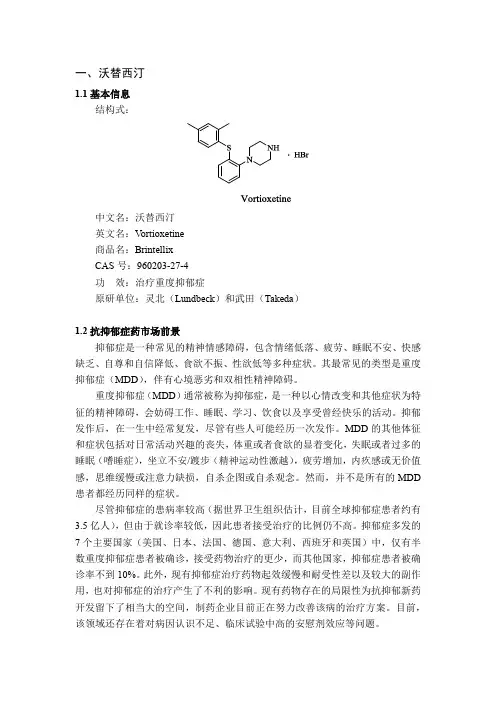
一、沃替西汀1.1基本信息结构式:中文名:沃替西汀英文名:V ortioxetine商品名:BrintellixCAS号:960203-27-4功效:治疗重度抑郁症原研单位:灵北(Lundbeck)和武田(Takeda)1.2抗抑郁症药市场前景抑郁症是一种常见的精神情感障碍,包含情绪低落、疲劳、睡眠不安、快感缺乏、自尊和自信降低、食欲不振、性欲低等多种症状。
其最常见的类型是重度抑郁症(MDD),伴有心境恶劣和双相性精神障碍。
重度抑郁症(MDD)通常被称为抑郁症,是一种以心情改变和其他症状为特征的精神障碍,会妨碍工作、睡眠、学习、饮食以及享受曾经快乐的活动。
抑郁发作后,在一生中经常复发,尽管有些人可能经历一次发作。
MDD的其他体征和症状包括对日常活动兴趣的丧失,体重或者食欲的显着变化,失眠或者过多的睡眠(嗜睡症),坐立不安/踱步(精神运动性激越),疲劳增加,内疚感或无价值感,思维缓慢或注意力缺损,自杀企图或自杀观念。
然而,并不是所有的MDD患者都经历同样的症状。
尽管抑郁症的患病率较高(据世界卫生组织估计,目前全球抑郁症患者约有3.5亿人),但由于就诊率较低,因此患者接受治疗的比例仍不高。
抑郁症多发的7个主要国家(美国、日本、法国、德国、意大利、西班牙和英国)中,仅有半数重度抑郁症患者被确诊,接受药物治疗的更少,而其他国家,抑郁症患者被确诊率不到10%。
此外,现有抑郁症治疗药物起效缓慢和耐受性差以及较大的副作用,也对抑郁症的治疗产生了不利的影响。
现有药物存在的局限性为抗抑郁新药开发留下了相当大的空间,制药企业目前正在努力改善该病的治疗方案。
目前,该领域还存在着对病因认识不足、临床试验中高的安慰剂效应等问题。
在中国,抑郁症的患病率为3%~5%,根据推算我国抑郁症患者可达3800万人,在国内市场中,抗抑郁药约占市场分额为12%,市场规模至少在50亿元以上。
我国抑郁症患者目前就诊人数不多,其中不到10%得到了正规的药物治疗。
新型非典型抗精神病药物的应用及研究进展

新型非典型抗精神病药物的应用及研究进展摘要典型抗精神病药能减少精神分裂症的阳性症状,却伴发锥体外系不良反应。
新型非典型抗精神病药物相比已有的典型抗精神病药物,具有疗效好、不良反应小等优点,有望为精神分裂症的治疗开创新的局面。
本文从药物应用方面综述了自2000年上市的一些非典型抗精神病药物的最新研究进展,期待越来越多的新型非典型抗精神病药物能应用于临床,更好地服务患者。
ABSTRACT Typical antipsychotics result in extrapyramidal side-effects though they can alleviate positive symptoms. Atypical antipsychotics with good potency and less side-effect will start a new era in the field of antipsychotics. This review summarizes the recent advances in the application of atypical antipsychotics agents approved since 2000 in the treatment of schizophrenia. We expect that more and more new atypical antipsychotics can be applied to the clinic to serve the patient better.KEY WORDS atypical antipsychotics;paliperidone;aripiprazole;lurasidone近年来精神疾病已经成为威胁人类健康的主要疾病之一,目前患者约占世界总人口的1%,越来越受到社会的广泛关注。
自1952年氯丙嗪问世至今,抗精神病药物已经历了60多年的发展,其开发研究也有了很大的进展,大量新型抗精神病药物进入各期临床试验,一些新药在部分国家获准上市,这些新药的临床使用,给精神疾病的药物治疗带来了新希望。
HPLC法测定伊潘立酮片中伊潘立酮的含量

一
目前抗精 神病 药物研发的焦点集 中l 在非典 型抗精神病药物 上。
伊潘立 酮是 由 V a n d a 制 药公司研 制生产的一 种新型非典 型抗精 神 病药 , 对5 一 羟色胺和多巴胺 D 受体有双重拮抗作用。 伊潘立酮片于
2 . 2色谱 条件 与系 统 适用 性 试 验 采用 E c l i p s e X D B — C l 8( 1 5 0 × 4 . 6 mm, 5 ¨ m)柱为色谱柱 ;以甲醇一 乙腈一 O . 0 1 mo l ・ L 一 1 磷 酸氢二钾
~ ( 3 8 : 2 5 : 3 7 ) 为流动相 ; 流速为 1 . O m l ・ a r i n 一 1 ; 检测波 长为 2 3 O h m, 柱温
2 0 0 9 年 5月获美 国 F D A批准上市 j 。 本文采用 H P L C法测定伊潘立
关键词 : HP L C: 伊 潘 立 酮片 ;含 量测 定
色谱 柱 为 E c l i p s eXDB — C1 8 ( 1 5 0 x 4 . 6 mm , 5 1 * m) ; 甲醇 一乙腈 一 0 . O 1 mo l ‘ 本 方 法在 1 0- 1 5 0 g ・ mL 一1范 围 内 线性 关 系
wa s 1 0 0 . 5 l %. Co n c l u s i o n T h e me t h o d i s s e l e c t i v e s e n s i t i v e .a c c u r a t e a n d c a n b e u s e d or f t h e d e t e r mi n a t i o n o f i l o p e r i d o n e i n i t s t a b l e t s . Ke y wo r d s :HPL C; l l o p e r i d o n e t a b l e t s ;As s a y
布瑞哌唑—非典型抗精神病药物
布瑞哌唑
布瑞哌唑,又名依匹哌唑(Brexpiprazole) 原研由丹麦灵北制药和日本大家制药共同研发,是一种非典型抗精神病药物。
2015年获FDA批准上市,用于治疗精神分裂症和作为抗抑郁药物的辅助疗法治疗重度抑郁症(MDD)。
2023年5月,美国FDA批准其用于阿尔茨海默症患者躁动、创伤后应激障碍、边缘型人格障碍的治疗。
01作用机制及临床应用
布瑞哌唑它对大脑内的单胺能神经传导系统具有调控作用,是血清素受体5-HT1A和多巴胺受体D2和D3的部分激动剂,同时还是血清素受体5-HT2A和5-HT2B以及肾上腺素受体α-1和α-2的部分拮抗剂。
布瑞哌唑是新型多靶点作用机制的精神障碍治疗药物,目前已获批用于精神分裂症和阿尔茨海默症。
02上市及备案情况
片剂上市情况
国内:原研大冢制药株式会社2022年12月24日提交生产申报。
国外:2015年美国FDA批准上市;2018年欧盟批准上市;2022年日本批准上市。
CDE备案注册如下:
03布瑞哌唑发展前景
布瑞哌唑自上市以来,布瑞哌唑全球销售额逐年增长,据全球药物研发数据库统计,该药2019年全球销售额突破11亿美元,2021年达16亿美元,同比增长20%。
(数据来源:全球药物研发数据库)
布瑞哌唑作为一种常见的抗精神病药物,我国精神病、抑郁症患者数量较多,抗精神病药、抗抑郁药市场发展空间广阔。
布瑞哌唑具有良好的开发前景,且随着研发进程加快,未来布瑞哌唑市场发展空间较大。
(以上关于布瑞哌唑内容介绍来源于网络)。
伊潘立酮-羟丙基-β-环糊精包合物的制备及表征、肌肉刺激和药代动力学研究
伊潘立酮-羟丙基-β-环糊精包合物的制备及表征、肌肉刺激和药代动力学研究欧云国;何海云;单雪峰;黄华【摘要】目的通过对伊潘立酮与羟丙基-β-环糊精(HP-β-CD)包合作用进行对比研究,达到制备安全、有效的肌肉注射给药制剂的目的.方法分别研究伊潘立酮在HP-β-CD水溶液与HP-β-CD 0.2%磷酸溶液中的相溶解度曲线;采用溶液搅拌法,冷冻干燥技术制备包合物;采用红外、分光光度法、差示扫描量热分析法(DSC)、溶解度法对包合物进行验证;肌肉注射给予伊潘立酮-HP-β-CD包合物溶液,对兔股四头肌进行肌肉刺激性试验;对比格犬进行伊潘立酮-HP-β-CD包合物溶液肌肉注射给药和伊潘立酮片口服给药,对药代动力学指标进行研究.结果相溶解度曲线呈Ap 型,表明客分子与主分子包合比例为1:n(n≥2);红外、DSC、溶解度试验结果表明,伊潘立酮包合于HP-β-CD的空腔结构中;包合物溶液对肌肉注射部位无刺激性;药代动力学结果表明,伊潘立酮与HP-β-CD包合后,肌肉注射给药药物吸收较快,与口服片剂相比,其相对生物利用度为143%.结论伊潘立酮-HP-β-CD包合物可显著提高溶解度,能很好地应用于注射给药途径.%Objective To study the inclusion complex of Iloperdone-Hydroxypropyl-β-Cyclodextrin(HP-β-CD),in order to prepare a stable and effective parenteral formulation. Methods Phase solubility study was carried out using distilled water and 0. 2% phospho-ric acid solution as dissolution medium,respecticely;the solution method and lyophilization techniques were used for inclusion complex preparation. The complexes were characterized by fourier transform infrared spectroscopy and differential scanning calorimetry studies and the solubility was determined by UV spectroscopy. The muscular stimulation test ofIloperdone-HP-β-CD inclusion complex solution was perform in rabbits,the pharmacokinetic of Iloperdone tablet and Iloperdone inclusion complex were evaluated after oral administration and muscular injection in dogs. Results The phase-solubility profiles were classified as Ap type,indicating the formation of 1: n(n≥2) stoichiometric inclusion complexes. The complexes were characterized by fourier transform infrared spectroscopy(IR)and differential scan-ning calorimetry(DSC)indicated that Iloperdone was able to form an inclusion complex with HP-β-CD. Iloperdone- HP-β-CD inclusion complex solution had no significant stimulation on muscles. In vivo pharmacokinetic study showed that the absorption rates of Iloperdone across muscles tissues were enhanced compared with oral administra tion . The relative bioavailabity was 143%. Conclusion The Iloperdone-HP-β-CD complex can significantly improve the sotubility,it is an attractive formulation for use in the parenteral.【期刊名称】《中国药业》【年(卷),期】2017(026)010【总页数】6页(P21-26)【关键词】羟丙基-β-环糊精;伊潘立酮;包合物;注射剂【作者】欧云国;何海云;单雪峰;黄华【作者单位】重庆医药工业研究院有限责任公司,重庆 400061;重庆医科大学,重庆400016;重庆医科大学,重庆 400016;重庆医科大学,重庆 400016【正文语种】中文【中图分类】R943;R969.1临床常用的抗精神病药分为典型和非典型两类。
五种具有前景的精神病类药物市场分析
一、沃替西汀1。
1基本信息结构式:中文名:沃替西汀英文名:V ortioxetine商品名:BrintellixCAS号:960203—27-4功效:治疗重度抑郁症原研单位:灵北(Lundbeck)和武田(Takeda)1.2抗抑郁症药市场前景抑郁症是一种常见的精神情感障碍,包含情绪低落、疲劳、睡眠不安、快感缺乏、自尊和自信降低、食欲不振、性欲低等多种症状。
其最常见的类型是重度抑郁症(MDD),伴有心境恶劣和双相性精神障碍。
重度抑郁症(MDD)通常被称为抑郁症,是一种以心情改变和其他症状为特征的精神障碍,会妨碍工作、睡眠、学习、饮食以及享受曾经快乐的活动。
抑郁发作后,在一生中经常复发,尽管有些人可能经历一次发作。
MDD的其他体征和症状包括对日常活动兴趣的丧失,体重或者食欲的显着变化,失眠或者过多的睡眠(嗜睡症),坐立不安/踱步(精神运动性激越),疲劳增加,内疚感或无价值感,思维缓慢或注意力缺损,自杀企图或自杀观念.然而,并不是所有的MDD患者都经历同样的症状。
尽管抑郁症的患病率较高(据世界卫生组织估计,目前全球抑郁症患者约有3。
5亿人),但由于就诊率较低,因此患者接受治疗的比例仍不高。
抑郁症多发的7个主要国家(美国、日本、法国、德国、意大利、西班牙和英国)中,仅有半数重度抑郁症患者被确诊,接受药物治疗的更少,而其他国家,抑郁症患者被确诊率不到10%。
此外,现有抑郁症治疗药物起效缓慢和耐受性差以及较大的副作用,也对抑郁症的治疗产生了不利的影响.现有药物存在的局限性为抗抑郁新药开发留下了相当大的空间,制药企业目前正在努力改善该病的治疗方案。
目前,该领域还存在着对病因认识不足、临床试验中高的安慰剂效应等问题。
在中国,抑郁症的患病率为3%~5%,根据推算我国抑郁症患者可达3800万人,在国内市场中,抗抑郁药约占市场分额为12%,市场规模至少在50亿元以上.我国抑郁症患者目前就诊人数不多,其中不到10%得到了正规的药物治疗。
伊潘立酮的说明书
HIGHLIGHTS OF PRESCRIBING INFORMATIONThese highlights do not include all the information needed to use FANAPT safely and effectively. See full prescribing information for FANAPT.FANAPT® (iloperidone) tabletsInitial U.S. Approval: 2009WARNING: INCREASED MORTALITY IN ELDERLY PATIENTS WITH DEMENTIA-RELATED PSYCHOSISSee full prescribing information for complete boxed warning. Elderly patients with dementia-related psychosis treated with antipsychotic drugs are at an increased risk of death. FANAPT is not approved for use in patients with dementia-related psychosis. (5.1)--------------------------RECENT MAJOR CHANGES-----------------------Warnings and Precautions, Metabolic Changes (5.5) 01/2012 -----------------------------INDICATIONS AND USAGE------------------------ FANAPT is an atypical antipsychotic agent indicated for the treatment of schizophrenia in adults. (1) Efficacy was established in two short-term (4- and 6-week) placebo-and active-controlled studies of adult patients with schizophrenia. (14) In choosing among treatments, prescribers should consider the ability of FANAPT to prolong the QT interval and the use of other drugs first. Prescribers should also consider the need to titrate FANAPT slowly to avoid orthostatic hypotension, which may lead to delayed effectiveness compared to some other drugs that do not require similar titration.--------------------------DOSAGE AND ADMINISTRATION-----------------The recommended target dosage of FANAPT tablets is 12 to 24 mg/day administered twice daily. This target dosage range is achieved by daily dosage adjustments, alerting patients to symptoms of orthostatic hypotension, starting at a dose of 1 mg twice daily, then moving to 2 mg, 4 mg, 6 mg, 8 mg, 10 mg, and 12 mg twice daily on days 2, 3, 4, 5, 6, and 7 respectively, to reach the 12 mg/day to 24 mg/day dose range. FANAPT can be administered without regard to meals. (2.1)-------------------------DOSAGE FORMS AND STRENGTHS---------------- 1 mg, 2 mg, 4 mg, 6 mg, 8 mg, 10 mg and 12 mg tablets. (3)-------------------------------CONTRAINDICATIONS---------------------------- Known hypersensitivity to FANAPT or to any components in the formulation.(4)-------------------------WARNINGS AND PRECAUTIONS-------------------- • Elderly patients with dementia-related psychosis who are treated with atypical antipsychotic drugs are at an increased risk of death andcerebrovascular-related adverse events, including stroke. (5.1)• QT prolongation: Prolongs QT interval and may be associated with arrhythmia and sudden death—consider using other antipsychotics first.Avoid use of FANAPT in combination with other drugs that are known to prolong QTc; use caution and consider dose modification whenprescribing FANAPT with other drugs that inhibit FANAPTmetabolism. Monitor serum potassium and magnesium in patients at risk for electrolyte disturbances. (1, 5.2, 7.1, 7.3, 12.3)• Neuroleptic Malignant Syndrome: Manage with immediate discontinuation of drug and close monitoring. (5.3)• Tardive dyskinesia: Discontinue if clinically appropriate. (5.4) • Metabolic Changes: Atypical antipsychotic drugs have been associated with metabolic changes that may increase cardiovascular/cerebrovascular risk. These metabolic changes include hyperglycemia, dyslipidemia, and weight gain. (5.5)o Hyperglycemia and diabetes mellitus: Monitor patients for symptoms of hyperglycemia including polydipsia, polyuria,polyphagia, and weakness. Monitor glucose regularly inpatients at risk for diabetes. (5.5)o Dyslipidemia: Undesirable alterations have been observed in patients treated with atypical antipsychotics. (5.5)o Weight Gain: Weight gain has been reported. Monitor weight.(5.5)• Seizures: Use cautiously in patients with a history of seizures or with conditions that lower seizure threshold. (5.6)• Orthostatic hypotension: Dizziness, tachycardia, and syncope can occur with standing. (5.7)• Leukopenia, Neutropenia, and Agranulocytosis have been reported with antipsychotics. Patients with a pre-existing low white blood cell count(WBC) or a history of leukopenia/neutropenia should have theircomplete blood count (CBC) monitored frequently during the first few months of therapy and should discontinue FANAPT at the first sign of a decline in WBC in the absence of other causative factors. (5.8)• Suicide: Close supervision of high risk patients. (5.12)• Priapism: Cases have been reported in association with FANAPT treatment. (5.13)• Potential for cognitive and motor impairment: Use caution when operating machinery. (5.14)• See Full Prescribing Information for additional WARNINGS and PRECAUTIONS.------------------------------------ADVERSE REACTIONS----------------------- Commonly observed adverse reactions (incidence ≥5% and two-fold greater than placebo) were: dizziness, dry mouth, fatigue, nasal congestion, orthostatic hypotension, somnolence, tachycardia, and weight increased. (6.1) To report SUSPECTED ADVERSE REACTIONS, contact Novartis Pharmaceuticals Corporation at 1-888-669-6682 or FDA at 1-800-FDA1088 or /medwatch.------------------------------------DRUG INTERACTIONS----------------------- • The dose of FANAPT should be reduced in patients co-administered a strong CYP2D6 or CYP3A4 inhibitor. (2.2, 7.1)----------------------------USE IN SPECIFIC POPULATIONS----------------- • Pregnancy: No human or animal data. Use only if clearly needed. (8.1) • Nursing Mothers: Should not breast feed. (8.3)• Pediatric Use: Safety and effectiveness not established in children and adolescents. (8.4)• Hepatic Impairment: Not recommended for patients with hepatic impairment. (8.7)• The dose of FANAPT should be reduced in patients who are poor metabolizers of CYP2D6. (12.3)See 17 for PATIENT COUNSELING INFORMATIONRevised: 01/2012FULL PRESCRIBING INFORMATION: CONTENTS* WARNING: INCREASED MORTALITY IN ELDERLY PATIENTS WITH DEMENTIA-RELATED PSYCHOSIS1 INDICATIONS AND USAGE2 DOSAGE AND ADMINISTRATION2.1 Usual Dose2.2 Dosage in Special Populations2.3 Maintenance Treatment2.4 Reinitiation of Treatment in Patients Previously Discontinued2.5 Switching from Other Antipsychotics3 DOSAGE FORMS AND STRENGTHS4 CONTRAINDICATIONS5 WARNINGS AND PRECAUTIONS5.1 Increased Risks in Elderly Patients with Dementia-RelatedPsychosis5.2 QT Prolongation5.3 Neuroleptic Malignant Syndrome (NMS)5.4 Tardive Dyskinesia5.5 Metabolic Changes5.6 Seizures5.7 Orthostatic Hypotension and Syncope5.8 Leukopenia, Neutropenia and Agranulocytosis 5.9 Hyperprolactinemia5.10 Body Temperature Regulation5.11 Dysphagia5.12 Suicide5.13 Priapism5.14 Potential for Cognitive and Motor Impairment6 ADVERSE REACTIONS6.1 Clinical Studies Experience6.2 Postmarketing Experience7 DRUG INTERACTIONS7.1 Potential for Other Drugs to Affect FANAPT7.2 Potential for FANAPT to Affect Other Drugs7.3 Drugs that Prolong the QT Interval8 USE IN SPECIFIC POPULATIONS8.1 Pregnancy8.2 Labor and Delivery8.3 Nursing Mothers8.4 Pediatric Use8.5 Geriatric Use8.6 Renal Impairment8.7 Hepatic Impairment8.8 Smoking Status9 DRUG ABUSE AND DEPENDENCE9.1 Controlled Substance9.2 Abuse10 OVERDOSAGE10.1 Human Experience10.2 Management of Overdose11 DESCRIPTION12 CLINICAL PHARMACOLOGY12.1 Mechanism of Action12.2 Pharmacodynamics12.3 Pharmacokinetics13 NONCLINICAL TOXICOLOGY13.1 Carcinogenesis, Mutagenesis, Impairment of Fertility14 CLINICAL STUDIES16 HOW SUPPLIED/STORAGE AND HANDLING17 PATIENT COUNSELING INFORMATION17.1 QT Interval Prolongation17.2 Neuroleptic Malignant Syndrome17.3 Metabolic Changes17.4 Orthostatic Hypotension17.5 Interference with Cognitive and Motor Performance17.6 Pregnancy17.7 Nursing17.8 Concomitant Medication17.9 Alcohol17.10 Heat Exposure and Dehydration* Sections or subsections omitted from the full prescribing information are not listedFULL PRESCRIBING INFORMATIONWARNING: INCREASED MORTALITY IN ELDERLY PATIENTS WITH DEMENTIA-RELATEDPSYCHOSISElderly patients with dementia-related psychosis treated with antipsychotic drugs are at an increased risk of death. Analysis of seventeen placebo-controlled trials (modal duration 10 weeks), largely in patients taking atypical antipsychotic drugs, revealed a risk of death in the drug-treated patients of between 1.6 to 1.7 times the risk of death in placebo-treated patients. Over the course of a typical 10-week controlled trial, the rate of death in drug-treated patients was about 4.5%, compared to a rate of about 2.6% in the placebo group. Although the causes of death were varied, most of the deaths appeared to be either cardiovascular (e.g., heart failure, sudden death) or infectious (e.g., pneumonia) in nature.Observational studies suggest that, similar to atypical antipsychotic drugs, treatment with conventional antipsychotic drugs may increase mortality. The extent to which the findings of increased mortality in observational studies may be attributed to the antipsychotic drug as opposed to some characteristic(s) of the patients is not clear. FANAPT is not approved for the treatment of patients with Dementia-Related Psychosis. [see Warnings and Precautions (5.1)]1 INDICATIONS AND USAGEFANAPT® tablets are indicated for the treatment of adults with schizophrenia. Efficacy was established in two short-term (4- and 6-week) placebo- and active-controlled studies of adult patients with schizophrenia [see Clinical Studies (14)]. When deciding among the alternative treatments available for this condition, the prescriber should consider the finding that FANAPT is associated with prolongation of the QTc interval [see Warnings and Precautions (5.2)]. Prolongation of the QTc interval is associated in some other drugs with the ability to cause torsade de pointes-type arrhythmia, a potentially fatal polymorphic ventricular tachycardia which can result in sudden death. In many cases this would lead to the conclusion that other drugs should be tried first. Whether FANAPT will cause torsade de pointes or increase the rate of sudden death is not yet known.Patients must be titrated to an effective dose of FANAPT. Thus, control of symptoms may be delayed during the first 1 to 2 weeks of treatment compared to some other antipsychotic drugs that do not require a similar titration. Prescribers should be mindful of this delay when selecting an antipsychotic drug for the treatment of schizophrenia [see Dosage and Administration (2.1) and Clinical Studies (14)].The effectiveness of FANAPT in long-term use, that is, for more than 6 weeks, has not been systematically evaluated in controlled trials. Therefore, the physician who elects to use FANAPT for extended periods should periodically re-evaluate the long-term usefulness of the drug for the individual patient [see Dosage and Administration (2.3)].2 DOSAGE AND ADMINISTRATION2.1 Usual DoseFANAPT must be titrated slowly from a low starting dose to avoid orthostatic hypotension due to its alpha-adrenergic blocking properties. The recommended starting dose for FANAPT tablets is 1 mg twice daily. Increases to reach the target dose range of 6-12 mg twice daily may be made with daily dosage adjustments to 2 mg twice daily, 4 mg twice daily, 6 mg twice daily, 8 mg twice daily, 10 mg twice daily, and 12 mg twice daily on days 2, 3, 4, 5, 6, and 7, respectively. Efficacy was demonstrated with FANAPT in a dose range of 6 to 12 mg twice daily. Prescribers should be mindful of the fact that patients need to be titrated to an effective dose of FANAPT. Thus, control of symptoms may be delayed during the first 1 to 2 weeks of treatment compared to some other antipsychotic drugs that do not require similar titration. Prescribers should also be aware that some adverse effects associated with FANAPT use are dose related.The maximum recommended dose is 12 mg twice daily (24 mg/day); FANAPT doses above 24 mg/day have not been systematically evaluated in the clinical trials.FANAPT can be administered without regard to meals.2.2 Dosage in Special PopulationsDosage adjustments are not routinely indicated on the basis of age, gender, race, or renal impairment status [see Use in Specific Populations (8.6, 8.7)].Dosage adjustment for patients taking FANAPT concomitantly with potential CYP2D6 inhibitors: FANAPT dose should be reduced by one-half when administered concomitantly with strong CYP2D6 inhibitors such as fluoxetine or paroxetine. When the CYP2D6 inhibitor is withdrawn from the combination therapy, FANAPT dose should then be increased to where it was before [see Drug Interactions (7.1)].Dosage adjustment for patients taking FANAPT concomitantly with potential CYP3A4 inhibitors: FANAPT dose should be reduced by one-half when administered concomitantly with strong CYP3A4 inhibitors such as ketoconazole or clarithromycin. When the CYP3A4 inhibitor is withdrawn from the combination therapy, FANAPT dose should be increased to where it was before [see Drug Interactions (7.1)].Dosage adjustment for patients taking FANAPT who are poor metabolizers of CYP2D6: FANAPT dose should be reduced by one-half for poor metabolizers of CYP2D6 [see Pharmacokinetics (12.3)].Hepatic Impairment: FANAPT is not recommended for patients with hepatic impairment.2.3 Maintenance TreatmentAlthough there is no body of evidence available to answer the question of how long the patient treated with FANAPT should be maintained, it is generally recommended that responding patients be continued beyond the acute response. Patients should be periodically reassessed to determine the need for maintenance treatment.2.4 Reinitiation of Treatment in Patients Previously DiscontinuedAlthough there are no data to specifically address re-initiation of treatment, it is recommended that the initiation titration schedule be followed whenever patients have had an interval off FANAPT of more than 3 days.2.5 Switching from Other AntipsychoticsThere are no specific data to address how patients with schizophrenia can be switched from other antipsychotics to FANAPT or how FANAPT can be used concomitantly with other antipsychotics. Although immediate discontinuation of the previous antipsychotic treatment may be acceptable for some patients with schizophrenia, more gradual discontinuation may be most appropriate for others. In all cases, the period of overlapping antipsychotic administration should be minimized.3 DOSAGE FORMS AND STRENGTHSFANAPT tablets are available in the following strengths: 1 mg, 2 mg, 4 mg, 6 mg, 8 mg, 10 mg and 12 mg. The tablets are white, round, flat, beveled-edged and identified with a logo “ ” debossed on one side and tablet strength “1”, “2”, “4”, “6”, “8”, “10”, or “12” debossed on the other side.4 CONTRAINDICATIONSFANAPT is contraindicated in individuals with a known hypersensitivity reaction to the product. Reactions have included pruritus and urticaria.5 WARNINGS AND PRECAUTIONS5.1 Increased Risks in Elderly Patients with Dementia-Related PsychosisIncreased MortalityElderly patients with dementia-related psychosis treated with atypical antipsychotic drugs are at an increased risk of death compared to placebo. FANAPT is not approved for the treatment of patients with dementia-related psychosis [see Boxed Warning].Cerebrovascular Adverse Events, Including StrokeIn placebo-controlled trials with risperidone, aripiprazole, and olanzapine in elderly patients with dementia, there was a higher incidence of cerebrovascular adverse events (cerebrovascular accidents and transient ischemic attacks) including fatalities compared to placebo-treated patients. FANAPT is not approved for the treatment of patients with dementia-related psychosis [see Boxed Warning].5.2 QT ProlongationIn an open-label QTc study in patients with schizophrenia or schizoaffective disorder (n=160), FANAPT was associated with QTc prolongation of 9 msec at an iloperidone dose of 12 mg twice daily. The effect of FANAPT on the QT interval was augmented by the presence of CYP450 2D6 or 3A4 metabolic inhibition (paroxetine 20 mg once daily and ketoconazole 200 mg twice daily, respectively). Under conditions of metabolic inhibition for both 2D6 and 3A4, FANAPT 12 mg twice daily was associated with a mean QTcF increase from baseline of about 19 msec.No cases of torsade de pointes or other severe cardiac arrhythmias were observed during the pre-marketing clinical program.The use of FANAPT should be avoided in combination with other drugs that are known to prolong QTc including Class 1A (e.g., quinidine, procainamide) or Class III (e.g., amiodarone, sotalol) antiarrhythmic medications, antipsychotic medications (e.g., chlorpromazine, thioridazine), antibiotics (e.g., gatifloxacin, moxifloxacin), or any other class of medications known to prolong the QTc interval (e.g., pentamidine, levomethadyl acetate, methadone). FANAPT should also be avoided in patients with congenital long QT syndrome and in patients with a history of cardiac arrhythmias. Certain circumstances may increase the risk of torsade de pointes and/or sudden death in association with the use of drugs that prolong the QTc interval, including (1) bradycardia; (2) hypokalemia or hypomagnesemia; (3) concomitant use of other drugs that prolong the QTc interval; and (4) presence of congenital prolongation of the QT interval; (5) recent acute myocardial infarction; and/or (6) uncompensated heart failure.Caution is warranted when prescribing FANAPT with drugs that inhibit FANAPT metabolism [see Drug Interactions (7.1)], and in patients with reduced activity of CYP2D6 [see Clinical Pharmacology (12.3)].It is recommended that patients being considered for FANAPT treatment who are at risk for significant electrolyte disturbances have baseline serum potassium and magnesium measurements with periodic monitoring. Hypokalemia (and/or hypomagnesemia) may increase the risk of QT prolongation and arrhythmia. FANAPT should be avoided in patients with histories of significant cardiovascular illness, e.g., QT prolongation, recent acute myocardial infarction, uncompensated heart failure, or cardiac arrhythmia. FANAPT should be discontinued in patients who are found to have persistent QTc measurements >500 ms.If patients taking FANAPT experience symptoms that could indicate the occurrence of cardiac arrhythmias, e.g., dizziness, palpitations, or syncope, the prescriber should initiate further evaluation, including cardiac monitoring.5.3 Neuroleptic Malignant Syndrome (NMS)A potentially fatal symptom complex sometimes referred to as Neuroleptic Malignant Syndrome (NMS) has been reported in association with administration of antipsychotic drugs. Clinical manifestations include hyperpyrexia, muscle rigidity, altered mental status (including catatonic signs) and evidence of autonomic instability (irregular pulse or blood pressure, tachycardia, diaphoresis, and cardiac dysrhythmia). Additional signs may include elevated creatine phosphokinase, myoglobinuria (rhabdomyolysis), and acute renal failure.The diagnostic evaluation of patients with this syndrome is complicated. In arriving at a diagnosis, it is important to identify cases in which the clinical presentation includes both serious medical illness (e.g., pneumonia, systemic infection, etc.) and untreated or inadequately treated extrapyramidal signs and symptoms (EPS). Other important considerations in the differential diagnosis include central anticholinergic toxicity, heat stroke, drug fever, and primary central nervous system (CNS) pathology.The management of this syndrome should include: (1) immediate discontinuation of the antipsychotic drugs and other drugs not essential to concurrent therapy, (2) intensive symptomatic treatment and medical monitoring, and (3) treatment of any concomitant serious medical problems for which specific treatments are available. There is no general agreement about specific pharmacological treatment regimens for NMS.If a patient requires antipsychotic drug treatment after recovery from NMS, the potential reintroduction of drug therapy should be carefully considered. The patient should be carefully monitored, since recurrences of NMS have been reported.5.4 Tardive DyskinesiaTardive dyskinesia is a syndrome consisting of potentially irreversible, involuntary, dyskinetic movements, which may develop in patients treated with antipsychotic drugs. Although the prevalence of the syndrome appears to be highest among the elderly, especially elderly women, it is impossible to rely on prevalence estimates to predict, at the inception of antipsychotic treatment, which patients are likely to develop the syndrome. Whether antipsychotic drug products differ in their potential to cause tardive dyskinesia is unknown.The risk of developing tardive dyskinesia and the likelihood that it will become irreversible are believed to increase as the duration of treatment and the total cumulative dose of antipsychotic administered increases. However, the syndrome can develop, although much less commonly, after relatively brief treatment periods at low doses.There is no known treatment for established cases of tardive dyskinesia, although the syndrome may remit, partially or completely, if antipsychotic treatment is withdrawn. Antipsychotic treatment itself, however, may suppress (or partially suppress) the signs and symptoms of the syndrome and thereby may possibly mask the underlying process. The effect that symptomatic suppression has upon the long-term course of the syndrome is unknown.Given these considerations, FANAPT should be prescribed in a manner that is most likely to minimize the occurrence of tardive dyskinesia. Chronic antipsychotic treatment should generally be reserved for patients who suffer from a chronic illness that (1) is known to respond to antipsychotic drugs, and (2) for whom alternative, equally effective, but potentially less harmful treatments are not available or appropriate. In patients who do require chronic treatment, the smallest dose and the shortest duration of treatment producing a satisfactory clinical response should be sought. The need for continued treatment should be reassessed periodically.If signs and symptoms of tardive dyskinesia appear in a patient on FANAPT, drug discontinuation should be considered. However, some patients may require treatment with FANAPT despite the presence of the syndrome.5.5 Metabolic ChangesAtypical antipsychotic drugs have been associated with metabolic changes that may increasecardiovascular/cerebrovascular risk. These metabolic changes include hyperglycemia, dyslipidemia, and body weight gain [see Patient Counseling Information (17.3)]. While all atypical antipsychotic drugs have been shown to produce some metabolic changes, each drug in the class has its own specific risk profile.Hyperglycemia and Diabetes MellitusHyperglycemia, in some cases extreme and associated with ketoacidosis or hyperosmolar coma or death, has been reported in patients treated with atypical antipsychotics including FANAPT. Assessment of the relationship between atypical antipsychotic use and glucose abnormalities is complicated by the possibility of an increased background risk of diabetes mellitus in patients with schizophrenia and the increasing incidence of diabetes mellitus in the general population. Given these confounders, the relationship between atypical antipsychotic use and hyperglycemia-related adverse events is not completely understood. However, epidemiological studies suggest an increased risk of treatment-emergent hyperglycemia-related adverse events in patients treated with the atypical antipsychotics included in these studies. Because FANAPT was not marketed at the time these studies were performed, it is not known if FANAPT is associated with this increased risk.Patients with an established diagnosis of diabetes mellitus who are started on atypical antipsychotics should be monitored regularly for worsening of glucose control. Patients with risk factors for diabetes mellitus (e.g., obesity, family history of diabetes) who are starting treatment with atypical antipsychotics should undergo fasting blood glucose testing at the beginning of treatment and periodically during treatment. Any patient treated with atypical antipsychotics should be monitored for symptoms of hyperglycemia including polydipsia, polyuria, polyphagia, and weakness. Patients who develop symptoms of hyperglycemia during treatment with atypical antipsychotics should undergo fasting blood glucose testing. In some cases, hyperglycemia has resolved when the atypical antipsychotic was discontinued; however, some patients required continuation of antidiabetic treatment despite discontinuation of the suspect drug.Data from a 4- week, fixed-dose study in adult subjects with schizophrenia, in which fasting blood samples were drawn,are presented in Table 1.Table 1. Change in Fasting GlucoseFANAPT ® Placebo 24 mg/day Mean Change from Baseline(mg/dL)n=114 n=228Serum Glucose Change from Baseline-0.5 6.6 Proportion of Patients with Shifts Serum Glucose Normal to High2.5 % 10.7 % (<100 mg/dL to ≥126 mg/dL) (2/80) (18/169)Pooled analyses of glucose data from clinical studies including longer term trials are shown in Table 2. Table 2: Change in GlucoseMean Change from Baseline (mg/dL) 3-6 months 6-12 months >12 months FANAPT 10-16 mg/day 1.8 (N=773) 5.4 (N=723) 5.4 (N=425) FANAPT 20-24 mg/day -3.6 (N=34)-9.0 (N=31)-18.0 (N=20) Dyslipidemia Undesirable alterations in lipids have been observed in patients treated with atypical antipsychotics.Data from a placebo-controlled, 4-week, fixed-dose study, in which fasting blood samples were drawn, in adult subjects with schizophrenia are presented in Table 3. Table 3. Change in Fasting LipidsFANAPT ® Placebo 24 mg/day Mean Change from Baseline (mg/dL)Cholesterol n = 114 n =228Change from baseline-2.17 8.18 LDL n =109 n =217Change from baseline-1.41 9.03 HDL n = 114 n =228Change from baseline-3.35 0.55 Triglycerides n = 114 n =228Change from baseline16.47 -0.83 Proportion of Patients with Shifts Cholesterol1.4 % 3.6%Normal to High (1/72) (5/141)(<200 mg/dL to ≥240 mg/dL) LDL2.4% 1.1%Normal to High(1/42) (1/90)(<100 mg/dL to ≥160 mg/dL) HDLNormal to Low23.8% 12.1% ( ≥40 mg/dL to <40 mg/dL) (19/80) (20/166) Triglycerides Normal to High8.3% 10.1% (<150 mg/dL to ≥200 mg/dL)(6/72)(15/148)5.6 SeizuresIn short-term placebo-controlled trials (4- to 6-weeks), seizures occurred in 0.1% (1/1344) of patients treated with FANAPT compared to 0.3% (2/587) on placebo. As with other antipsychotics, FANAPT should be used cautiously in patients with a history of seizures or with conditions that potentially lower the seizure threshold, e.g., Alzheimer’s dementia. Conditions that lower the seizure threshold may be more prevalent in a population of 65 years or older.5.7 Orthostatic Hypotension and SyncopeFANAPT can induce orthostatic hypotension associated with dizziness, tachycardia, and syncope. This reflects its alpha1adrenergic antagonist properties. In double-blind placebo-controlled short-term studies, where the dose was increased slowly, as recommended above, syncope was reported in 0.4% (5/1344) of patients treated with FANAPT, compared with 0.2% (1/587) on placebo. Orthostatic hypotension was reported in 5% of patients given 20-24 mg/day, 3% of patients given 10-16 mg/day, and 1% of patients given placebo. More rapid titration would be expected to increase the rate of orthostatic hypotension and syncope.FANAPT should be used with caution in patients with known cardiovascular disease (e.g., heart failure, history of myocardial infarction, ischemia, or conduction abnormalities), cerebrovascular disease, or conditions that predispose the。