
Roots and consequences of stress
Roots and consequences of stress
When it comes to stress, which refers to mental stress, I deem that everyone has ever experienced that individual of physical and mental tension. It is reported that approximately one in ten individuals is in the state of stress for a long time, which extremely dose haem to the public's health.
There are several factors which could weight heavily for mental stress, yet suspended on the top of the list is the following three aspects. First of all, the most significant factor contributing to mental stress is the quickening pace of modern life, which gives rise to fierce competition. Staying in the atmosphere of competition for a long time can make individuals extremely nervous, depressed and disappointed, which gives rise to mental stress eventually. Additionally, unforeseen events of life including divorce, unemployment, retirement and even pregnancy are prone to give rise to mental stress. Moreover, disease which is liable to make individuals lose confidence in life also lead to mental stress.
There is no doubt that stress seriously affects the physical and mental health of mankind. Researches have found that stress, no matter long-term or short-term, affects the activity of the immune system. Additionally, chronic stress is in particular rough on the body, which contributes to higher blood pressure, migraines, stomach issues and even skin breakouts. According to a survey released recently of the Chinese Medical Association, stress makes the facial skin irritation, can appear allergic rash wait for a phenomenon.
It is, undoubtedly, the overwhelmingly time that we ought to take some available methods to alleviate psychological stress.。
新视野大学英语视听说教程第二版3(参考答案完整版)
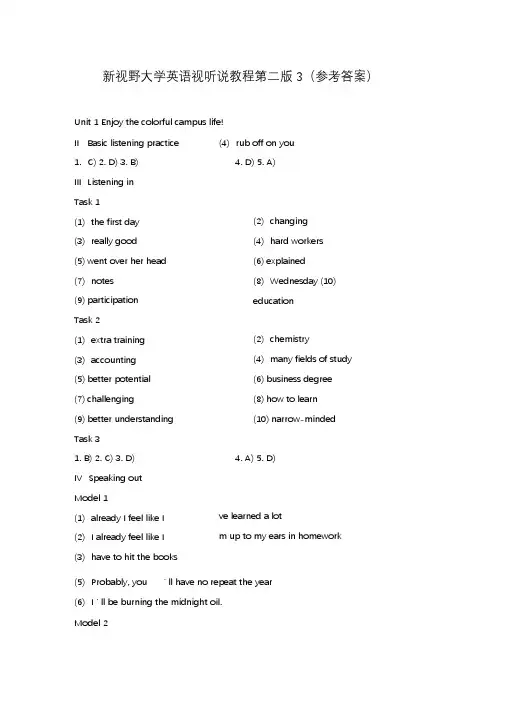
新视野大学英语视听说教程第二版 3(参考答案)Unit 1 Enjoy the colorful campus life!II Basic listening practice 1.C) 2. D) 3. B)III Listening inTask 1(1)the first day(3)really good(5) went over her head (7)notes(9) participationTask 2(1)extra training(3)accounting(5) better potential(7) challenging(9) better understanding Task 31. B)2. C)3. D)IV Speaking outModel 1(1)already I feel like I(2)I already feel like I(3)have to hit the books (4)rub off on you4. D)5. A)(2)changing(4)hard workers(6) explained(8)Wednesday (10)education(2)chemistry(4)many fields of study(6) business degree(8) how to learn(10) narrow-minded4. A)5. D)ve learned a lotm up to my ears in homework(5)Probably, you ' ll have no repeat the year(6)I ' ll be burning the midnight oil.Model 2(1)how I ' m going to stay awake(2)He could put the entire basketball team to slee-pduring the championship game(3)She ' s tough(4)No pain, no gain(5)he usually fails half on the students(6)I ' m bored to deathModel 3(1)what are your primary duties as a professor(2)I do a lot of research and writing(3)Teaching is an important part of being a professor(4)applying for grants to fund my research(5)being a professor sounds pretty competitive(6)So you get an F in this courseV Let ' s talk(1) quality (2) young (3) 25(4) difficult (5) government (6) quality(7) cut (8) extra-cautions (9) afford(10) experience (11) more (12) blame(13) budget (14) puzzled (15) serviceVI Furthering listening and speakingListeningTask 1(1)standardized tests (3)interest(5)well -rounded(7)the rest of the school Task 2(2)abilities and interest (4)pressure(6)get into good colleges (8)from bad to worse(S1) course (S2) quizzes (S3) semester(S4) confident(S5) party(S6) make(S7) missed(S8) they had a flat tire on the way back and didn ' t have a spare(S9) placed them in separate rooms, handed each of them a paper(S10) On the second page was a question worth 95 points: “ Which of the tires was flat Task 31. B)2. A)3. C)4. D)5. D)Viewing and speaking1. (1) increasing (2) 12 (3) more(4) facilities (5) lecturers (6) poorer(7) grant (8) one (9) budget(10) less (11) young (12) classic(13) part-time (14) growing (15) two-yearUnit 1 testPart I Keys:1.A2.B3.D4.B5.DPart II(1)f or (2)with (3)opportunity (4)tuition (5)explore (6)encounter (7)adventure (8)As with any country, it is not advisable to carry large amounts of cash around with you(9)T raveler's checks are one of the safest and easiest ways to transport money, because you may have them replaced if they get lost or stolen (10)It is wise to bring about $100 with you in U.S. cash, so you will be able to manage upon your arrival in the StatesPart III1.C2.A3.B4.D5.APart IV1.C2.A3.A4.D5.C6.B7.A8.C9.B 10.C新视野大学英语视听说教程第二版 3(参考答案)Unit 2 Our globe is in danger!I Lead -in 1. 3II Basic listening practice1. B)2.D)3.A)4.A)5. C)III Listening inTask 1(1) nature (2) environmental problem (3) pollution (4) promote(5) aware of (6) from occurring(7) law (8) throw away(9) finde (10) trashTask 21. D)2. A)3. B)4. C)5. D)Task 31. D)2. D)3. A)4. B)5. C)IV Speaking outModel 1(1) getting along during this usually hot weather(2) the hot, humid weather is killing her(3) does bring global warming and rain(4)Everybody should know what causes global warming. Otherwise we won(5)not to burn any more wood or coal(6)the polar ice caps melt and oceans riseModel 2(1)asking for donations to save the rainforests(2)They need hot, tropical climates(3)heavy rainfall leads to dense vegetation(4)plant and animal species exist only in rainforests(5)are in danger of destruction by(6)find a way to save themModel 3(1) a big sandstorm hit our city(2)The air was full of dirt and sand dust(3)comes after a long period of drought(4)the soil can be lifted up(5)plant more trees and grass(6)launching a new afforestation program in a bid to address the environmental problemV Let ' s talk(1) - b (2) - a (3) - h (4) - d(5) - g (6) – e (7) – c (8) -fVI Furthering listening and speakingListeningTask 1(1)water pollution(3)economic growth(5)social advancement(7)government planning(9)remarkable steps Task 2 t stop it.(2) overconsumption (4) resources(6) restricted(8) economic policy (10) balance(S1) negative (S2) report (S3) warming (S4) pressures (S5) mountainous (S6) barely (S7) make way for(S8) expect 98 percent of the mountain areas to experience severe climate change by 2055 (S9) the UN is anxious to raise awareness of the problems facing mountain areas (S10) Thousands of villages in Europe are deserted most of the year Task 3 1. B) 2. A)3. C)4. D)5. D)Viewing and speaking1. (1) signs (2) warmer temperatures(3) warmest (4) snow (5) attracts(6) trouble(7) normal(8) best season(9) one-time(10) whiteUnit 2 test Part I Keys: 1. C 2.C 3.B 4.C 5.D Part II(1) c hemicals (2)atmosphere (3)particles (4)trapped (5)lasts (6)human-based(7) p rogressed (8)Even in Ancient Rome people complained about smoke put into the atmosphere (9)Air pollution can have serious consequences for the health of human beings (10)Cities with large numbers of automobiles or those that use great quantities of coal often suffer most severely from air pollution problems1. D)Task 32. B)3. A)4. C)5. C)Part III1. A2.C3.D4.C5.B Part IV1.B2.C3.D4.C5.C6.A7.D8.D9.B 10.C新视野大学英语视听说教程第二版 3(参考答案)Unit 3 Culture makes me what I am. I Lead -in 1) C2) I3) I4) CII Basic listening practice 1. C)2. A)3. D)4. B)III Listening in Task 1 1. C) 2. A) 3. C) 4. B)Task 2 (S1) roots (S2) what (S3) moral (S4) diligence (S5) sin (S6) teachings(S7) centuries well (S9) In English a new world has been created to describe people who work compulsively(S10) Others hold that workaholics are valuable members of society because they are extremely productive Task 35. A)5. D)(S8) Even as children they were taught,If it w'ortsh doing at all, it w'ortsh doing1. D)2. A)3. D)4. A)5. C) IV Speaking outModel 1(1)individual interests rank above everything else(2)it ' s a sharp contrast to the oriental collectivism(3)is not necessarily an equivalent for selfishness(4)all values, rights, and duties originate in individuals(5)in oriental countries the interests of the group are moreimportant than anything else(6)Why do Americans cherish individualismModel 2(1)always seem to be in a hurry(2)What do you think are the reasons for that difference(3)Does this strong sense of time affect their lifestyle(4)led them to create fast food(5)globalization shrinks the differences between cultures(6)the gap will eventually be bridgedModel 3(1)they ' re on top(2)they definitely get the best marks(3)They never skip class(4)did homework each night until the early hours(5)That ' s the secret of their success(6)I just want to learn it in an interesting wayV Let ' s talk1. (1) transatlantic slave trade(2)unknown lands(3)dignity or payment2.(1) rich(2)cotton and sugar3.(1) all over the world(2)family history(3)changed4.200th anniversary5.(1) banned(2)taking part in(3)slavery(4)freedVI Furthering listening and speakingListeningTask 12. B)3. A)4. C)5. D)1. C)Task 21. T2. F3. T4. F5. FTask 31. The Russian hurled the hal-ffull bottle of vodka out of the open window.2.He answered, “V odka is plentiful in my country. In fact, we have thousands and thousands of liters of it-far more than we need. ”3.The businessman said, “ I thought the Cuban economy was not good this year. Yet you threw that perfectly good cigar away. I find your actions quite puzzling.4.He replied, “ Cigars are a dime a dozen in Cuba. We have more of them than weknow what to do with. ”5.The American businessman sat in silence for a moment. Then he got up, grabbed the lawyer, and threw him out of the window. He did that probably because he thought there were too many lawyers in the United States.Viewing and speaking1. (1) disappearing (2) kicking (3) tea shop(4)image crisis (5) update (6) compete(10) similar (11) want (12) challenge(13) consumer (14) traditionalUnit 3 testPart I Keys: 1.B 2.C 3.B 4.B 5.DPart II(1)values (2) purpose (3) true (4) Nowhere (5) equality (6) races (7) laboratory (8) Although Edwards specifically mentions young men, young women also compete in organized sports without regard to their race or economic background (9) Many Americans believe that learning how to win in sports helps develop the habits necessary to compete successfully in later life (10) the competitive ethic taught in sports must be learned and cultivated in youth for the future success of American business and military efforts Part III 1.C 2.A 3.B 4.D 5.DPart IV 1.D 2.B 3.A 4.D 5.D 6.C 7.A 8.B 9.B 10.A新视野大学英语视听说教程第二版 3(参考答案)Unit 4 Taste the sweets and bitters of family life.I Lead -in1. 3 2 4 1II Basic listening practice1. C)2. A)3. B)4. C)5. D)III Listening inTask 1(S1) typical(S2) known(S3) Generally(S4) find(S5) apartment(S6) sole(S7) principal(S8) Dual -earner families are the predominant type for families with children in the United States(S9) adequate day care of children is necessary for du-aelarner families (S10) companies are getting involved in the arrangement of day careTask 21. F2. T3. T4. F5. TTask 31. A)2. A)3. A)4. D)5. C)IV Speaking outModel 1(1)I ' m having a hectic time working on this report(2)it ' s been more than five years, almost six, since we were married(3)Time has gone so fast(4)I ' m this close to getting a promotion(5)What has that got to do with it(6)you have a great pointModel 2(1)So many people in the United States get divorced(2)the divorce rate can be as high as 50 percent(3)Westerners fall head over heels in love quickly(4)some marriages break up, but most couples stay together(5)Do people get married young(6)Do women usually work after they get marriedModel 3(1)haven ' t seen dad for ages(2)my mom ' s been pretty sick(3)don ' t exaggerate(4)Never thought I was good enough for you(5)seriously, mom ' s not so bad(6)Why not just have both our parents here for ChristmasV Let ' s talk(1) cry (2) relief (3) strong(4) understanding (5) angry (6) left(7) wondering (8) five (9) sad(10) stress (11) friends (12) helps(13) Christmas (14) cousins (15) presentsVI Furthering listening and speakingListeningTask 1(1) divorce her husband (2) irresponsible(3) challenging jobs (4) stability(5) bills (6) poverty line(7) apartment (8) yells at(9) calls him names (10) halfTask 21. B)2. C)3. A)4. D)5. C)Task 3(1) the last word (2) remarriage failures (3) picture(4) eight times (5) wife (6) dating(7) loneliness and anxiety (8) second (9) response to her (10) lukewarm (11) warmed up (12) accepted(13) ripe (14) blended into (15) rightViewing and speaking(2)similar (5)children (8)angry (3)room (6)patience (9)medicine1. (1) Lovely(4) apologize(7) listen(10) fantasticUnit 4 test Part I DADCC Part II(1) a t (2)wheel (3)tone (4)expression (5)Honey (6)divorce (7)speed (8)I don'wt antyou to try to talk me out of it because I don accounts, and all the credit cards, too (10)No, I Part III CABDA Part IV ADBCADABCD新视野大学英语视听说教程第二版 3(参考答案)Unit 5 Here are the seasons to enjoy. I Lead -in 1. 8 1 7645t love you any more (9)I want the bank ' ve got everything I need1. C)2. A)3. B)4. C) III Listening inTask 11. D)2. C)3. D)4. A) Task 21. T2. F3. T4. F Task 3(1) buy (2) office wear (4) cats (5) pet 5. C)5. B)5. T(3) likes (6) time (9) little tripII Basic listening practice(7) special dish (8) little party(10) countrysideIV Speaking out Model 1(1)We have goose and ham for Christmas dinner(2)we eat leftovers for days(3)he ' ll refuse a huge dinner and stick to a healthy meal(4)We heap up our presents under the tree(5)Your family prolongs the celebration for three days(6)Isn ' t that what the true spirit if Christmas is supposed to be Model 2(1)spend the holiday with her mother and brother(2)They were happy just to have survived their first harsh winter(3)that ' s good reason to celebrate(4)symbolize a family reunion(5)to be together and share a huge dinner(6)Just thinking about all that food makes my mouth water Model 3(1)Are you OK?(2)People in funny costumes and masks everywhere(3)dressing like witches and ghosts(4) A crowd of children followed me, shouting(5)They were hoping you ' d give them candy(6)it ' s a funny kind of holidayV Let ' s talk(1) - e (2) - b (3) - g (4) - d(5) - h (6) - a (7) - f (8) - cVI Furthering listening and speakingListeningTask 11. A)2.D)3.C)4.B)5.C)Task 2(S1) celebration(S2) popular(S3) American(S4) died(S5) remarrying(S6) daughter(S7) 1900s(S8) the tradition was born, on the third Sunday every June, close to the anniversaryof Sonora ' s father 's death(S9) The card probably has a nice message on it saying what a great dad their father is (S10) British people might give their dad a bit of a res-tmake him a cup of tea, or even wash his car and mow the lawnTask 31. He thought that if men were not married, they would not mind joining the army.So he passed a law to forbid any more marriages.2.He kept on performing marriage ceremonies, secretly.3.They came to the jail to visit him. They threw flowers and notes up to his window.4.She was one of those young people and the daughter of the prison guard.5.Before he was killed, Valentine left the girl a little note thanking her for her friendship and loyalty. Hesigned, “ Love from your Valentine. ” That note started the custom.Viewing and speaking(1) fun (2) headache (3) 150(4) two million (5) feeling (6) atmosphere(7) traditional-looking (8) lights (9) regulations(10) family (11) translates (12) children(14) different (15) spreadsUnit 5 testPart I CACDD Part II(1) h ang (2)remains (3)symbol (4)performed (5)what (6)that (7)represent (8)By the year 1600, some Germans began bringing evergreen trees into their homes. They put fruit, nuts and sweets on the trees. (9)They say he did this to show how wonderful the stars had appeared to him as he traveled one night.(10)The Christmas tree tradition spread to many parts of the world. Today, some form of Christmas tree is part of most Christmas celebrations. Part III DABCD Part IV CABCCABDAC新视野大学英语视听说教程第二版 3(参考答案)Unit 6 Here are tips for finding a job. II Basic listening practice1. B)2. C)3. C)4. A)5. D)Task 31. C)2. A)3. A)4. C)5. B)IV Speaking out Model 1(1) Did you go to the job fairs(2) I can ' t find anything interesting that I(3) You can use a search engine to find a job site related to your field (4) I just saw a job opening (5) submit my resume by e-mail1. C)2. D) III Listening in Task 11. T2. F Task 23. A)4. C) 3. T 4. T5. B)5. F6.T7. Tm qualified for(6)have you updated your resumeModel 2(1)be sure to maintain good eye contact(2)Don ' t look too shy, nor should you sound too aggressive(3)Many companies don ' t want a completely green hand(4)I gained some experience at an IT company(5)ability for teamwork is usually valued(6)Should I ask about salary and fringe benefitsModel 3(1)our best bet is to recruit from the competition(2)We also don ' t believe that a rigid management system will work wonders(3)that philosophy will help you attract many worthwhile people(4)he ' ll help us start a recruitment drive(5) A number of firms have been downsizing(6)can David help us pin them downV Let ' s talk1. (1) 900 (2) customer calls (3) 70(4) human resources (5) supported (6) customer-facing (7) place (8) two (9) right people (10) realistic (11) friends (12) helps(13) Christmas (14) cousins (15) presents2. 3 2 1 4 VI Furthering listening and speakingListeningTask 1(1) coast (2) impressed (3) shipping company (3) cargo (4) communication skills (6) essential(7) asset (8) team spirit (9) her age(10) her parentsTask 21. F2. T3. T4. F5. TTask 31. C)2. C)3. B)4. A)5. D)Viewing and speaking1. (1) selection (2) pressure (3) marketing(4) interview (5) business (6) nervous(7) laugh (8) redundant (9) difficult(10) sackingUnit 6 testPart I CBCDCPart II(1)ice (2) Examples (3) parking (4) response (5) provide (6) impression (7) ages (8) If this is the place where you would be working, they would automatically be worried that you will be late for work everyday (9) They might be historical questions regarding your previous employment or education (10) Make a statement, then support it by giving an example of a situation and how you handled it Part III CBACDPart IV DABCBCAADC新视野大学英语视听说教程第二版3(参考答案)Unit 7 Why don ' t we start a business of our own?II Basic listening practice1. B)2. C)3. A)4. B)5. C)III Listening inTask 1(1) reception (2) new connections (3) distributed(4) green hand (5) business cards (6) talk business(7)card(8) follow up (9) more ground(10) piece of cakeTask 21. C)2. B)3. B)4. A)5. D)Task 3(1) technology-oriented (2) higher (3) returns (4) options (5) Venture capital (6) cash(7) founders (8) business ideas (9) potential (10) intellectual property protection (11) 100 percent (12) creators(13) stockIV Speaking outModel 1(1)you already know this company inside out(2)You have just barely enough funds to cover your da-yto-day operational expenses(3)my best bet is to secure a small business loan(4)They help underwrite loans for small business(5)I can still qualify for a loan(6)cover our overheadModel 2(1)I ' ve been searching for a loan(2)the company has been experiencing serious financial difficulties(3)we ' ve been operating in the red(4)the best course of action is to bankruptcy(5)we ' ll have to face even stiffer competition(6)they are interested in acquiring our companyModel 3(1) we ' ve been looking for a merger partner(2)Are you sure your operation has much to bring to the table(3)Definitely(4)we ' ve already received a few attractive bids(5) keep our shareholders ' interests in mind(6) It ' s reasonable to keep your employees ' welfare in mind V Let ' s talk (2) shock (4) shot up (6) opportunities (8) stable(9) money(10) ownVI Furthering listening and speaking Listening Task 1Part I ADDCD Part II(1) resulting (2) demand (3)on (4)trends (5)elderly (6)trend (7)pet -related (8)Look at existing businessesa nd the products and services they offer, and then determine if there's a need for more of those products or services (9) Keep an open mind and continue to assess everything you read and hear from a business point of view (10) Dream, think, plan, and you'll be ready to transform that business idea into the business you've always wanted Part III CBDAC(1) rapid growth (3) large (5) hard (7) different (9) money(10) ownVI Furthering listening and speaking Listening Task 1 1. D)2. C)3. C)4. A)Task 21. F2. T3. F4. FTask 31. C)2. B)3. D)4. C)Viewing and speaking1. The items in favor of the idea that 2), 4), 6), 7), 8). Unit 7 test 5. C)5. T5. A)Cadbury should be sold for more moneyPart IV BDBCA BDCDD新视野大学英语视听说教程第二版 3(参考答案)Unit 8 Here is a darker side of a society. II Basic listening practice 1. C) 2. C) 3. B) III Listening in Task 1 1. B) 2. A)3. C)Task 2 1. C) 2. D)3. C)Task 3 (1) 49(3) health care systems (5) expenses (7) lower (9) education(11) more opportunities (13) social ladder IV Speaking out Model 1(1) abuse of the elderly (2) people live longer now (3) try to save money on food and (4) is a national epidemic (5) care was substandard (6) in cases of abuse Model 2(1) she tells women the dangers of drinking4. A)5. D)4. C)5. D)4. B)5. C)(2) first birthday (4) reduce (6) increasing (8) faster(10) reduce poverty (12) live bettercare(2) I can ' t imagine someone as pretty as she is to be a drunk(3) there are alcoholics all over the world(4) who lack the willpower to stop(5) It ' s a disease that strikes(6) alcohol helped her to relaxModel 3(1) Why do you look so depressed(2) you ' ve been hooked(3) Apparently it ' s just like being addicted to drugs or alcohol(4) It takes over your life(5) he ' s a compulsive gambler(6) Tough but worth itV Let ' s talk(1) easier (2) loneliness(3) passed away (4) brain(5) health problems (6) younger(7) doctor (8) assumption(9) history (10) attitudesVI Furthering listening and speakingListeningTask 11. B)2.A)3.C)4.B)5. C)Task 21. She thinks many of the big spenders on lottery tickets are poor; they spend money they can 't afford to spend2.He just buys lottery tickets for him. He thinks if he won a huge amount, it would be exciting.3.They buy lottery tickets out of desperation. Also the thrill of a win, of something for nothing,is addictive.4.Casinos are opening everywhere, many people go on gambling on holidays, andone can even take a gambling cruise.5.It will be helpful for habitual gamblers only when they want to be cured themselves.Task 31. C)2. D)3. A)4. B)5. A)Viewing and speaking1. (1) condition (2) dignity (3) fire(4) further (5) distinction (6) status(7) prosperity (8) fate (9) AnsweringUnit 8 testPart I CBADDPart II(1)h abit (2)crucial (3)among (4)decade (5)did (6)issues (7)adult (8)teens get turned off if you ask them a lot of direct questions (9)The first phone call generally takes about 45 minutes, with discussion about why the teen began smoking and the extent of the habit (10)Now 260 teens who have participated in the program are being followedPart III ABCBDPart IV CBACB ABCDC新视野大学英语视听说教程第二版3(参考答案)Unit 9 What mode of travel do you prefer?I Lead -in1) plane 2) bike 3) truck / lorry 4) ship5) bus 6) motorcycle 7) subway / undergroundII Basic listening practice(1) I ' d like to book hotel and airline reservations (2) what ' s your destination (3) I ' m headed for(4) Will that be a one-way or a round-trip ticket (5) Return(6) Will you be flying first class or business class Model 2 (1) How did it go? Everything smooth sailing(2) It took me quite a while to find the United Airlines check-in counter (3) it was displayed on the monitor (4) there was a terrible line-up(5) I can stretch my legs and occasionally stand up in the aisle. (6) and it said that my flight would be boarding at Gate 33 Model 3 (1) You look like something the cat dragged in (2) You would too if you' d been through what I have(3) See my eyes? They ' re all bloodshot1. C)2. B) III Listening in Task 1 (1) security checks (4) carry-ons (7) seized (10) bags Task 2 1. A) 2. C)Task 3 1. A)2. B) IV Speaking out Model 13. C)4. D) (2) searched (5) checking (8) digital camera (11) on his way3. C)4. D)3. D)4. D)5. A)(3) fear (6) greater (9) take pictures (12) strange5. D)5. A)(4)How long does this jet lag last(5)I would whether a long flight like that is worth the high cost(6) reset my biological clock after a flightV Let ' s talk1. 1) (1)close (2) 12.9 million (3) dreamed2) (1) exhausted (2) cup of tea3) (1) abandon (2) set down (3) low4) (1) Pole (2) fly over5) (1) on (2) fast asleepVI Furthering listening and speakingListeningTask 1(1) a couple of hours (2) less than an hour (3) fare(4) regular passengers (5) convenient (6) the same day(7) conditions of aircraft (8) accidents (9) large quantities of cargo(10) far awayTask 21. D)2. C)3. D)4. A)5. B)Task 31. (1) best (2) none of them2. (1) land (2) wings3. (1) small children (2) before4. smoothly5. (1) distributed evenly (2) clean itViewing and speaking1. (1) landing (2) followed (3) headed(4) present (5) succeeded (6) arrested(7) publish (8) attention (9) happened(10) cheering (11) charge (12) dropped(13) humorous (14) missed (15) get backUnit 9 testPart I CDCBCPart II(1) tiny (2) identity (3) maintain (4) fuel (5) networks (6) insurance (7) external (8) Ticket prices include a number of fees, taxes (9) If airlines carry passengers without proper documents on an international flight, they are responsible for carrying them back to the originating country (10) While airlines as a whole earned 6% return on capital employed, airports earned 10% Part III CABDCPart IV ABDCBDBADB新视野大学英语视听说教程第二版 3(参考答案)Unit 10 With a failing memory, you meet a lot of new people. I Lead -in1. T 6. T2. T7. F3. T8. T4. F9. TII Basic listening practice1. C)2. D)3. A)4. B)Task 11. B)2. C)3. D)4. C)Task 21. T2. F3. F4. T5. T 10. T5. C) 5. A) 5. F(1) brain (4) your brain (2)nerve connections(5)blood circulation(3)musical instrument(6)vegetablesIII Listening in Task 3IV Speaking outModel 1 (1) Do you have anything in mind (2) Remember I asked the chef for the recipe (3) did you forget that Linda doesn (4) It just slipped my mind(5) everyone forgets something sometimes (6) I ' m getting forgetful Model 2(1) Do you know what Jack' s home phone number is(2) I can ' t think of it off the top of my head (3) why don ' t you call Jane (4) They usually don' t release private information over the phone(5) have a powerful memory(6) I do have a good memory for faces and names, but a poor one for numbers and dates Model 3 (1) where was I(2) You were talking about your tour in London (3) I can ' t remember any more (4) What ' s wrong with your memory (5) I don ' t want to forget my own name (6) it ' s just temporary forgetfulness V Let ' s talk (1) memory power (4) saw (7) memories(7) Protect and support (8) healthy (9) sugar (10) memory loss (11) never functions (12) tobacco (13) Improve(14) remembering(15) temporaryt eat chicken(2) test (5) verdict (8) endure(3) new (6) seconds (9) volunteers。
theory and practice of counseling and psychotherapy:心理咨询与心理治疗的理论与实践

Below is given annual work summary, do not need friends can download after editor deleted!!!!!! Welcome to visit againXXXX annual work summaryDear every leader, colleagues:Look back end of XXXX, XXXX years of work, have the joy of success in your work, have a collaboration with colleagues, working hard, also have disappointed when encountered difficulties and setbacks. Imperceptible in tense and orderly to be over a year, a year, under the loving care and guidance of the leadership of the company, under the support and help of colleagues, through their own efforts, various aspects have made certain progress, better to complete the job. For better work, sum up experience and lessons, will now work a brief summary.To continuously strengthen learning, improve their comprehensive quality. With good comprehensive quality is the precondition of completes the labor of duty and conditions. A year always put learning in the important position, trying to improve their comprehensive quality. Continuous learning professional skills, learn from surrounding colleagues with rich work experience, equip themselves with knowledge, the expanded aspect of knowledge, efforts to improve their comprehensive quality.The second Do best, strictly perform their responsibilities. Set up the company, to maximize the customer to the satisfaction of the company's products, do a good job in technical services and product promotion to the company. And collected on the properties of the products of the company, in order to make improvement in time, make the products better meet the using demand of the scene.Three to learn to be good at communication, coordinating assistance. On‐site technical service personnel should not only have strong professional technology, should also have good communication ability, a lot of a product due to improper operation to appear problem, but often not customers reflect the quality of no, so this time we need to find out the crux, and customer communication, standardized operation, to avoid customer's mistrust of the products and even the damage of the company's image. Some experiences in the past work, mentality is very important in the work, work to have passion, keep the smile of sunshine, can close the distance between people, easy to communicate with the customer. Do better in the daily work to communicate with customers and achieve customer satisfaction, excellent technical service every time, on behalf of the customer on our products much a understanding and trust.Fourth, we need to continue to learn professional knowledge, do practical grasp skilled operation. Over the past year, through continuous learning and fumble, studied the gas generation, collection and methods, gradually familiar with and master the company introduced the working principle, operation method of gas machine. With the help of the department leaders and colleagues, familiar with and master the launch of the division principle, debugging method of the control system, and to wuhan Chen Guchong garbage power plant of gas machine control system transformation, learn to debug, accumulated some experience. All in all, over the past year, did some work, have also made some achievements, but the results can only represent the past, there are some problems to work, can't meet the higher requirements. In the future work, I must develop the oneself advantage, lack of correct, foster strengths and circumvent weaknesses, for greater achievements. Looking forward to XXXX years of work, I'll be more efforts, constant progress in their jobs, make greater achievements. Every year I have progress, the growth of believe will get greater returns, I will my biggest contribution to the development of the company, believe inyourself do better next year!I wish you all work study progress in the year to come.。
典范英语8-2单词汇总
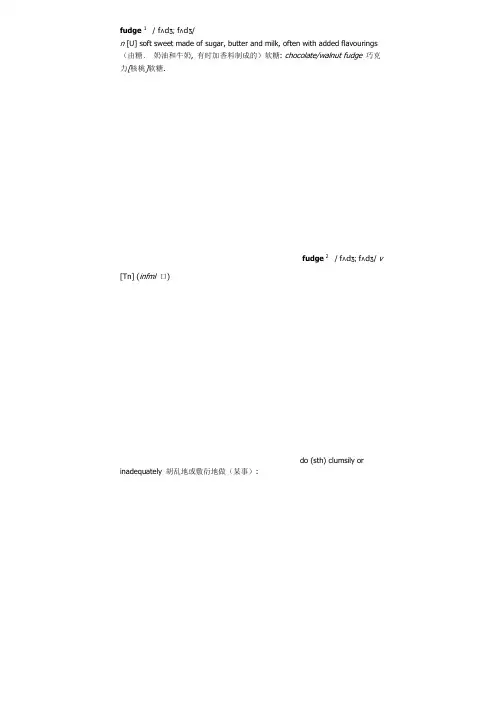
fudge1 / fʌdʒ; fʌdʒ/n [U] soft sweet made of sugar, butter and milk, often with added flavourings (由糖﹑奶油和牛奶, 有时加香料制成的)软糖: chocolate/walnut fudge巧克力[核桃]软糖.fudge2 / fʌdʒ; fʌdʒ/ v [Tn] (infml 口)do (sth) clumsily or inadequately 胡乱地或敷衍地做(某事):bar1/ bɑː(r); bɑr/ n[C] (a) piece of solid material 棒; 条:trail / treɪl; trel/ nmark or sign in the form of a long line left by sth or sb passing by 痕迹; 足迹; 踪迹:mince / mɪns; mɪns/ v[Tn] chop or cut (esp meat) into very small pieces in a machine with revolving blades 用绞肉机绞(尤指肉).mole1 / məul; mol/ n small permanent dark spot on the human skin 痣; 色素痣. Cf 参看freckle.2 / məul; mol/ nsmall dark-greyfur-covered animal with tiny eyes, living in tunnels which it makes underground ?. =>illus at App 1 鼹鼠(infml口) person whoworks within an organization and secretly passes confidential information to another organization or country (将本组织的秘密情报暗中传给另一组织或国家的)内奸sneak / sniːk; snik/ v[I, Ipr] ~ (on sb) (to sb) (Brit infml derog 口, 贬) (used esp by children 尤为儿童用语) tell an adult about the faults, wrongdoings, etc of another child 告状; 打小报告[Tn] (infml口) take (sth) secretly (often without permission) 偷偷地做(某事)或取(某物)(常指未获许可crawl / krɔːl; krɔl/ v[I, Ipr, Ip] (a) moveslowly, with the body on or close to the ground, or on hands and knees 爬; 爬行; 匍匐行进accent / ˈæksent, ˈæksənt; ˋæksɛnt/ n[C] emphasis given to a syllable or word by means of stress or pitch 重音(用重读或提高音调的方法使一音节或词突出).[C, U] national, local or individual way of pronouncing words (民族﹑地方或个人的)口音, 腔调, 土腔wrestle / ˈresl; ˋrɛsl/ v(a) [I, Ipr] ~ (with sb)fight (esp as a sport) by grappling with sb and trying to throw him to the ground 摔交(尤指运动):wrist / rɪst; rɪst/n (a) part of the body between the hand and the forearm; joint on which the hand moves 腕; 腕部; 腕关节grip / grɪp; ɡrɪp/ v (-pp-)[I, Tn] take and keep a firm hold of (sth/sb) 紧抓(某物[某人]); 紧握twist1 / twɪst; twɪst/ v(a) [Tn, Tn.pr, Tn.p] ~ sth (round sth/round) coil or wind sth round sth else 使某物缠绕或盘绕另一物specs / speks; spɛks/n [pl] (infml 口) = glasses (glass 5).edge1 / edʒ; ɛdʒ/ nsharp cutting part of a blade, knife, sword, or some other tool or weapon (刀片﹑刀﹑剑或其他工具或武器的)锋利部分; 刀口; 锋(line marking the) outside limit or boundary of a solid (flat) object, surface or area (扁的固体﹑物体表面或一范围的)外围界线, 边缘:dumb / dʌm; dʌm/ adj (-er, -est)unable to speak 哑的punch3 / pʌntʃ; pʌntʃ/ v[Tn, Tn.pr] strike (sb/sth) hard with the fist 用拳猛击(某人[某物springy adj (-ier, -iest)1 that can return to its original shape easily after being pushed, pulled, stretched, etc; elastic 有弹性的; 有弹力的wrapper ['ræpə]n. (饺子)皮, 包装用品hopeless / ˈhəuplɪs; ˋhoplɪs/ adjmost unlikely to improve, succeed, be settled, etc; causing despair 没有希望的; 令人绝望的grin / grɪn; ɡrɪn/ v (-nn-)[I, Ipr] ~ (at sb) smile broadly, so as to show the teeth, expressing amusement, foolish satisfaction, contempt, etc 露齿而笑(表示高兴﹑愚蠢的满足﹑轻蔑等); 咧着嘴笑; 龇着牙笑stammer / ˈstæmə(r); ˋstæmɚ/ v(also stutter) [I] speak with sudden pauses and a tendency to repeat rapidly the same sound or syllable (because of a speech defect or from fear, excitement, etc) 口吃; 结巴着说话picture v1 [Tn, Tn.pr] ~ sth (to oneself) form a mental image of sth; imagine sth 想像或设想某事物lap1 / læp; læp/ narea formed by the upper part of a seated person's thighs (人坐着时)大腿的上方bash / bæʃ; bæʃ/ v (infml 口)[Tn, Tn.pr] strike (sb/sth) heavily so as to break or injure 猛击(某人[某物])gut / gʌt; ɡʌt/ nguts [pl] (infml 口) (a) internal organs of the abdomen (腹腔的)内脏:guts [pl] (fig infml 比喻, 口) courage and determination 勇气与决心; 胆量; 魄力audition/ ɔːˈdɪʃn; ɔˋdɪʃən/ n trial hearing of a person who wants to perform as an actor, a singer, a musician, etc (对拟做演员﹑歌手﹑乐师等人的)试听, 试音spellbound ['spelbaund]adj.被迷住的, 茫然不知所之的chewing-gum (also gum) n [U] sticky substance flavoured and sweetened for prolonged chewing 口香糖nerve / nɜːv; nəv/ n[C] fibre or bundle of fibres carrying impulses of sensation or of movement between the brain and all parts of the body 神经:nerves [pl] (infml 口) condition in which one is very nervous, irritable, worried, etc; nervousness 神经过敏; 神经紧张; 神经质: events.. *(a) [U] boldness; courage 胆量; 勇气tune v1 [Tn] adjust (a musical instrument or note) to the correct pitch 为(乐器)调音; 调(音): tune a guitar为吉他调弦.2 [Tn] adjust (an engine, etc) so that it runs smoothly and efficiently 调整(发动机等)(使之运转正常).bubble / ˈbʌbl; ˋbʌbl/ nfloating ball formed of liquid and containing air or gas (液体形成的)气泡:cram / kræm; kræm/ v(a) [Tn.pr, Tn.p] ~ sth (into sth/in) push or force too much of sth into sth 将某物塞进某物中; 尽力塞入ceiling / ˈsiːlɪŋ; ˋsilɪŋ/ ntop inner surface of a room 天花板; 顶篷powder / ˈpaudə(r); ˋpaʊdɚ/ n(a) [U] (substance in the form of a) mass of fine dry particles 粉; 粉末; 粉状物chaos / ˈkeɪɔs; ˋkeɑs/ n[U] complete disorder or confusion 混乱; 紊乱bulb / bʌlb; bʌlb/ n =>illusthick rounded underground stem of certain plants (eg the lily, onion, tulip) sending roots downwards and leaves upwards 球茎(如百合﹑洋葱﹑郁金香等植物的地下茎).(also `light bulb) pear-shaped glass container for the filament of an electric light 电灯泡frame1/ freɪm; frem/ nborder of wood, metal, etc in which a picture, door, pane of glass, etc is enclosed or set (木材﹑金属等做的)框架:rigid structure of a piece of furniture, building, vehicle, etc which makes its shape and forms a support for its parts (家具﹑建筑物﹑车辆等的)框架, 支架, 骨架:(usu pl 通常作复数) structure of plastic, metal, etc that holds the lenses of a pair of glasses in place 眼镜框presto / ˈprestəu; ˋprɛsto/ adj, advblob / blɔb; blɑb/ ndrop of (esp thick) liquid; small round mass or spot of colour 液体(尤指浓液)的一滴; 颜料的小圆块或小圆stink / stɪŋk; stɪŋk/ v (pt stank / stŋk; stæŋk/ or stunk / stʌŋk; stʌŋk/, pp stunk) (infml[I, Ipr] ~ (of sth) have a very unpleasant and offensive smell 有臭味; 发臭:[I, Ipr] ~ (of sth) (fig 比喻) seem very unpleasant, bad or dishonest 似乎很让人讨厌﹑很糟糕或很不正当:crook / kruk; krʊk/ n(infml 口) person who is habitually dishonest 一贯耍花招的人; 行骗或行窃的老手bend or curve, eg in a river or path 弯曲; 弯子; (河流﹑道路等的)弯曲处:dummy / ˈdʌmɪ; ˋdʌmɪ/ n[C] model of the human figure, used for displaying or fitting clothes, etc (用於展示或试穿服装等的)人体模型:[C] thing that appears to be real but is only an imitation 仿制品.[C] (esp Brit) (US comforter, pacifier) rubber teat, not attached to a bottle, for a baby to suck (不装在瓶子上的)橡皮奶头.[sing] (a) (in card-games, esp bridge) player whose cards are placed facing upwards on the table and played by his partner (纸牌游戏, 尤指桥牌)明手, 梦家(将牌摊出者). (b) these cards 明手﹑梦家摊出之牌[C] (US infml 口) stupid person 笨蛋; 蠢货sensible / ˈsensəbl; ˋsɛnsəbl/ adj(a) (approv 褒) having or showing good sense(3); reasonable 识别力强的; 合理的sake1 / seɪk; sek/ n(idm 习语) for God's, goodness', Heaven's, pity's, etc sake (used as an interjection before or after a command or request, or to express irritation 用作感叹语, 可置於表示命令或要求的词语之前或之後, 或表示恼怒)shrug / ʃrʌg; ʃrʌɡ/ v (-gg-)[I, Tn] raise (one's shoulders) slightly to express doubt, indifference, ignorance, etc 耸(肩)(以示怀疑﹑与己无关﹑不知道等):inky / ˈɪŋkɪ; ˋɪŋkɪ/ (-ier, -iest) adj 1 made dirty with ink 用墨水弄脏的black like ink 墨汁般黑的; 漆黑的liquid / ˈlɪkwɪd; ˋlɪkwɪd/ n[C, U] substance that flows freely but is not a gas, eg water or oil 液体measure1 / ˈmeʒə(r); ˋmɛʒɚ/ v(a) [I, Ip, Tn, Tn.pr, Tn.p] ~ (sth) (up) find the size, length, volume, etc of (sth) by comparing it with a standard unit 量度; 测量(某物)widen[ˈwaidn]vt.加宽,放宽vi.变宽froth / frɔθ; US frɔːθ; frɔθ/ n [U]mass of small bubbles, esp on the surface of a liquid; foam 泡(尤指液体表面上的); 泡沫fizz / fɪz; fɪz/ v [I](of a liquid) produce bubbles of gas; effervesce (指液体)冒泡, 起泡.make a hissing or spluttering sound 发出嘶嘶声glow / gləu; ɡlo/ v[I] send out light and heat withoutflame 发出光和热; 燃烧(无焰):lid / lɪd; lɪd/ nhinged or removable cover for a box, pot, etc 盖子sip / sɪp; sɪp/ v(-pp-) [I, Tn] drink (sth), taking very small quantities each time 小口喝examine / ɪgˈzæmɪn; ɪɡˋzæmɪn/ v [Tn, Tn.pr]~ sth/sb (for sth) (a)look at carefully in order to learn about or from; inspect closely 仔细观察; 检查; 调查; 审查:gape / geɪp; ɡep/ v[I, Ipr] ~ (at sb/sth) (often derog 常作贬义) stare with an open mouth, usu in surprise 目瞪口呆地凝视fumble / ˈfʌmbl; ˋfʌmbl/ v[I, Tn] touch or handle (sth) awkwardly or nervously (笨拙地或紧张地)摸索或处理desperate / ˈdespərət; ˋdɛspərət/ adjfeeling or showing greatdespair and ready to do anything regardless of danger 感到绝望而不惜冒险的; 拚命的; 不顾一切的barge2 / bɑːdʒ; bɑrdʒ/ v (infml口)[I, Ipr, Ip] rush or bump heavily and clumsily 鲁莽而大力地冲撞midget / ˈmɪdʒɪt; ˋmɪdʒɪt/ n extremely small person 矮人; 侏儒reckless / ˈreklɪs; ˋrɛklɪs/ adj ~ (of sth) (of people or their actions) not thinking of the consequences or of danger; rash or impulsive (指人或其行为)不考虑後果的, 不顾危险的, 鲁莽的, 由冲动引起的cork / kɔːk; kɔrk/ n[U] light springy buoyant substance that is the thick bark of a type of oak tree growing around the Mediterranean 栓皮; 软木furious / ˈfjuərɪəs; ˋfjʊrɪəs/ adj~ (with sb)/(at sth) full of violent anger 满腔愤怒的; 大发雷霆的ketchup/ ˈketʃəp; ˋkɛtʃəp/ (also esp US catsup / ˈktsəp;ˋkætsəp/) n [U] thick sauce made from tomatoes, vinegar, etc and used cold as a seasoning 番茄酱. incredible / ɪnˈkredəbl; ɪnˋkrɛdəbl/ adjimpossible to believe 不可相信的survive / səˈvaɪv; sɚˋvaɪv/ v[I, Ipr] ~ (from sth); ~ (on sth) continue to live or exist 继续生存或存在sting1 / stɪŋ; stɪŋ/ n[C] sharp pointed organ of some insects (eg bees, wasps) and other animals, used for wounding and (usu) injecting poison (某些昆虫, 如蜜蜂﹑黄蜂, 及其他动物的)螫针, 螫刺, 毒刺: The sting of a scorpion is in its tail. 蝎子的毒钩在其尾部.[C] sharp pointed hair on the surface of the leaf of some plants (eg nettles) that causes pain when touched (某些植物, 如荨麻, 叶子表面上的)螫毛.[C] (a) (pain from) wounding by an animal's or a plant's sting (动物螫刺或植物螫毛造成的)螫痛, 刺痛hasty / ˈheɪstɪ; ˋhestɪ/ adj (-ier, -iest) (a)said, made or done quickly or too quickly; hurried 急急忙忙的; 过於匆忙的; 仓促完成的:scene / siːn; sin/ nplace of an actual or imagined event (实际或想像中的)事发地点:situation or incident in real life (现实生活中的)情景,(incident where there is an) outburst of emotion or anger 吵闹; 发脾气(a) sequence of continuous action in a play, film, etc (戏剧或电影中的)片段, 场面:place represented on the stage of a theatre; the painted background, woodwork, etc representing such a place; scenery (舞台上的)场景, 布景:view as seen by a spectator 景色; 景象; 景致gang / gæŋ; ɡæŋ/ n [CGp]organized group of criminals (罪犯有组织的)一帮, 一伙:group of young people, usu males in their teens and early twenties, who are typically troublesome (闹事的青少年, 通常指男性)一群, 一伙:finger2 / fɪŋgə(r); ˋfɪŋɡɚ/ v [Tn]touch or feel (sth) with the fingers 触摸(某物):snigger / ˈsnɪgə(r); ˋsnɪɡɚ/ nhalf-suppressed unpleasantlaugh (esp at sth improper or at another's misfortune) 窃笑, 暗笑(尤指笑某事物不当或他人不幸):smash / smæʃ; smæʃ/ v[I, Ipr, Tn, Tn.pr, Tn.p, Cn.a] ~ sth (up); ~ sth open (cause sth to) be broken violently into pieces (使某物)粉碎, 破碎puddle / ˈpʌdl; ˋpʌdl/ n[C] small pool of water, esp of rain-water on the road 水坑tadpole / ˈtædpəul; ˋtædˏpol/ nform of a frog or toad at the stage when it lives under water and has gills and a tail 蝌蚪.burn2/ bɜːn; bən/ v (pt, pp burnt / bɜːnt; bənt/ or burned / bɜːnd; bənd/)(a) [Tn] destroy, damage, injure or mark(sb/sth) by fire, heat or acid 烧毁, 烧坏, 烧伤, 烧焦, 烫伤, 酸蚀(某人[某物]):engine / ˈendʒɪn; ˋɛndʒən/ nmachine with moving parts that converts energy such as heat, electricity, etc into motion 发动机; 引擎jeer / dʒɪə(r); dʒɪr/ v[I, Ipr, Tn] ~ (at sb/sth) laugh at or mock (sb/sth) 嘲笑, 嘲弄(某人[某事物]):gaze / geɪz; ɡez/ v[I, Ipr] look long and steadily (at sb/sth), usu in surprise or admiration 久久地凝视, 注视(通常指因惊讶或赞赏):glare1 / gleə(r); ɡlɛr/ n[U] strong unpleasant dazzling light 耀眼的光:[C] angry or fierce look; fixed look 怒视; 恶狠狠的注视; 凝视mouth2 / mauð; maʊð/ v[I, Tn] speak or say (sth) with movement of the jaw but no sound 嘴动而不出声地说(某事)replace / rɪˈpleɪs; rɪˋples/ v[Tn] put (sth) back in its place 将(某物)放回原处:.[Tn, Cn.n/a] take the place of (sb/sth) 代替, 取代(某人[某事物]):beam / biːm; bim/ nlong piece of wood, metal, concrete, etc, usu horizontal and supported at both ends, that carries the weight of part of a building or some other structure 梁.ray or stream of light or other radiation (eg from a lamp or a lighthouse, the sun or the moon) (灯﹑灯塔﹑日月等的)光线﹑光束或其他射线genius / ˈdʒiːnɪəs; ˋdʒinjəs/ n (pl geniuses)(a) [U] exceptionally great mental or creative ability 天才; 创造力blank / blæŋk; blæŋk/ adj (-er, -est)(a) without writing or print; unmarked 空白的; 无痕迹的without expression, understanding or interest; empty 没表情的; 不理解的; 没兴趣的; 空虚的effect / ɪˈfekt; ɪˋfɛkt/ n[C, U] ~ (on sb/sth) change produced by an action or cause; result or outcome 效应; 结果; 後果bicarbonate/ ˏbaɪˈkɑːbənət; baɪˋkɑrbənɪt/ n [U] (chemistry化) salt containing double proportion of carbon dioxide 碳酸氢盐; 重碳酸盐.disbelief / ˏdɪsbɪˈliːf; ˏdɪsbəˋlif/ n[U] lack of belief; failure to believe 不相信; 怀疑trick / trɪk; trɪk/ nthing done in order to deceive or outwit sb 诡计; 计谋; 花招; 骗术。
2现实主义六原则

sm
Key Words
• • • • • • impervious: adj. 不受影响的,密封的. illuminate: v.照明,阐明,说明. prejudice: n.偏见,成见. endeavor: vi.努力,尽力. ascertain: vt.确定,探知. surmise: vt.猜测.
• • • •
correlation: n.相互关系,相关性. condone: vt. 宽恕,赦免. deflect: vt. 偏斜,偏离. marshal: v.整顿,排列,集合.
The first
• Political realism believes that politics, like society in general, is governed by objective laws that have their roots in human nature. In order to improve society it is first necessary to understand the laws by which society lives.
The second
• The main signpost that helps political realism to find its way through the landscape of international politics is the concept of interest defined in terms of power.
• History shows no exact and necessary correlation between the quality of motives and the quality of foreign policy. This is true in both moral and political terms.
河南省平顶山市叶县高级中学2024-2025学年高二上学期9月月考英语试卷

河南省平顶山市叶县高级中学2024-2025学年高二上学期9月月考英语试卷一、听力选择题1.What did the woman buy for her mum?A.A hat.B.A coat.C.A T- shirt.2.What does the man like doing?A.Travelling alone.B.Joining a guided tour.C.Backpacking with friends. 3.Why is the woman broke at the end of the month?A.She likes shopping.B.She doesn't work hard.C.She earns little money. 4.What time will the man’s party probably start?A.At 7: 30 p.m.B.At 8: 00 p.m.C.At 11: 00 p.m.5.Where are the speakers probably?A.In a hospital.B.In the police office.C.On the street.听下面一段较长对话,回答以下小题。
6.What should the woman do to order checks?A.Wait in a line.B.Fill in a form.C.Check the mail.7.When will the woman probably get the check?A.In two days.B.In four days.C.In a week.听下面一段较长对话,回答以下小题。
8.What is the man’s attitude towards art class?A.Favourable.B.Unconcerned.C.Worried.9.What does the woman mean about talent?A.She wants to be a painter too.B.She knows how to draw and paint.C.She hopes she could have some kind of talent.10.What are the speakers mainly talking about?A.The man’s hobby.B.The talent of the woman.C.The woman’s favourite class.听下面一段较长对话,回答以下小题。
2023高考英语北京卷试卷带答案解析(完整版)

2023高考英语北京卷试卷带答案解析2023高考英语北京卷试卷带答案解析(完整版)2023北京高考英语听说考试满分50分,其他外语(非英语)听力考试满分30分,取两次听说(听力)考试的最高成绩与其他部分试题成绩一同组成外语科目成绩计入高考总分。
以下是小编汇总关于2023高考英语北京卷试卷带答案解析的相关内容,供大家参考!2023年北京市高考英语试卷第一部分知识运用(共两节,30分)第一节(共15分)阅读下面短文,掌握其大意,从每题所给的A、B、C、D四个选项中,选出最佳选项,并在答题卡上将该项涂黑。
I was always timid(羞怯的). Being new to the school made me even ____1____ , so it was surprising I’d ____2____ to anyone around me. Now I was paying the price﹣to write a five﹣page es say on “Why I Should Not Talk in Class”. That would take all night!After I got home, though. I took my time petting the cat﹣postponing the pain.When I finally sat down to ____3____, I began with the reasons Ms Black would want to hear.Talking kept me and my neighbours from ____4____. One paragraph down; now what? I chewed on my pencil. Aha! What if talking were the first step towards life as a criminal? Without the education I was throwing away, I’d turn to theft and go to prison. When I got out, people would say, “She used to talk in class.” The pages began ____5____.But when mum got home from work, I was still ____6____, “Five pages! That’s impossible!”“Well, you’d better get back to work,” she said. “and Iwant to read it when you’re through.”Soon after dinner, I handed the essay to mum. I half expected a____7____﹣at least an “I hope you’ve learned your lesson”. ____8____, mum laughed and laughed as she read.The next day, when Ms Black read the essay to the class, everyone laughed. I could ____9____ they weren’t making fun of me: they laughed because I had the power to tell a funny story. My____10____ still needed some nudging(激发), but I did learn I wasn’t shy in print.1. A. freer B. shyer C. calmer D. happier2. A. nod B. point C. listen D. chat3. A. weep B. rest C. write D. read4. A. learning B. playing C. planning D. laughing5. A. standing out B. flying by C. breaking up D. checking in6. A. celebrating B. longing C. complaining D. warning7. A. lecture B. reason C. reward D. solution8. A. Therefore B. Moreover C. Meanwhile D. Instead9. A. hope B. imagine C. tell D. predict10. A. patience B. confidence C. tolerance D. independence第二节(共15分)A阅读下面短文,根据短文内容填空。
托福阅读TPO30(试题+答案+...
托福阅读TPO30(试题+答案+译文)第2篇:ThePaceofEvolutionaryChange为了帮助大家备考托福。
提高阅读成绩,打有准备的仗,下面小编给大家带来托福阅读TPO30(试题+答案+译文)第2篇:The Pace of Evolutionary Change,希望大家喜欢。
托福阅读原文【1】A heated debate has enlivened recent studies of evolution. Darwin's original thesis, and the viewpoint supported by evolutionary gradualists, is that species change continuously but slowly and in small increments. Such changes are all but invisible over the short time scale of modern observations, and, it is argued, they are usually obscured by innumerable gaps in the imperfect fossil record. Gradualism, with its stress on the slow pace of change, is a comforting position, repeated over and over again in generations of textbooks. By the early twentieth century, the question about the rate of evolution had been answered in favor of gradualism to most biologists' satisfaction.【2】Sometimes a closed question must be reopened as new evidence or new arguments based on old evidence come to light. In 1972 paleontologist Stephen Jay Gould and Niles Eldredge challenged conventional wisdom with an opposing viewpoint, the punctuated equilibrium hypothesis, which posits that species give rise to new species in relatively sudden bursts, without a lengthy transition period. These episodes of rapid evolution are separated by relatively long static spans during which a species may hardly change at all.【3】The punctuated equilibrium hypothesis attempts to explain a curious feature of the fossil record—one that has been familiar to paleontologist for more than a century but has usuallybeen ignored. Many species appear to remain unchanged in the fossil record for millions of years—a situation that seems to be at odds with Darwin's model of continuous change. Intermediated fossil forms, predicted by gradualism, are typically lacking. In most localities a given species of clam or coral persists essentially unchanged throughout a thick formation of rock, only to be replaced suddenly by a new and different species.【4】The evolution of North American horse, which was once presented as a classic textbook example of gradual evolution, is now providing equally compelling evidence for punctuated equilibrium. A convincing 50-million-year sequence of modern horse ancestors—each slightly larger, with more complex teeth, a longer face, and a more prominent central toe—seemed to provide strong support for Darwin's contention that species evolve gradually. But close examination of those fossil deposits now reveals a somewhat different story. Horses evolved in discrete steps, each of which persisted almost unchanged for millions of years and was eventually replaced by a distinctive newer model. The four-toed Eohippus preceded the three-toed Miohippus, for example, but North American fossil evidence suggests a jerky, uneven transition between the two. If evolution had been a continuous, gradual process, one might expect that almost every fossil specimen would be slightly different from every year.【5】If it seems difficult to conceive how major changes could occur rapidly, consider this: an alteration of a single gene in files is enough to turn a normal fly with a single pair of wings into one that has two pairs of wings.【6】The question about the rate of evolution must now be turned around: does evolution ever proceed gradually, or does italways occur in short bursts? Detailed field studies of thick rock formations containing fossils provide the best potential tests of the competing theories.【7】Occasionally, a sequence of fossil-rich layers of rock permits a comprehensive look at one type of organism over a long period of time. For example, Peter Sheldon's studies of trilobites, a now extinct marine animal with a segmented body, offer a detailed glimpse into three million years of evolution in one marine environment. In that study, each of eight different trilobite species was observed to undergo a gradual change in the number of segments—typically an increase of one or two segments over the whole time interval. No significant discontinuous were observed, leading Sheldon to conclude that environmental conditions were quite stable during the period he examined.【8】Similar exhaustive studies are required for many different kinds of organisms from many different periods. Most researchers expect to find that both modes of transition from one species to another are at work in evolution. Slow, continuous change may be the norm during periods of environmental stability, while rapid evolution of new species occurs during periods of environment stress. But a lot more studies like Sheldon's are needed before we can say for sure.托福阅读试题1.The word "innumerable" in the passage is closest in the meaning toA.countless.B.occasional.rge.D.repeated.2.According to paragraph 1, all of the following are true EXCEPTA.Darwin saw evolutionary change as happening slowly and gradually.B.Gaps in the fossil record were used to explain why it is difficult to see continuous small changes in the evolution of species.C.Darwin's evolutionary thesis was rejected because small changes could not be observed in the evolutionary record.D.By the early twentieth century, most biologists believed that gradualism explained evolutionary change.3.Which of the sentences below best expresses the essential information in the highlighted sentence in the passage paragraph 2 ? Incorrect choices change the meaning in important ways or leave out essential information.A.The punctuated equilibrium hypothesis challenged gradualism, which holds that species evolve in relatively sudden bursts of brief duration.B.The punctuated equilibrium hypothesis developed by Stephen Jay Gould and Niles Eldredge was challenged in 1972.C.In 1972 Stephen Jay Gould and Niles Eldredge challenged gradualism by positing that change from one species to another cannot occur without a lengthy transition period.D.The punctuate equilibrium hypothesis, in opposition to gradualism, holds that transitions from one species to another occur in comparatively sudden burst.4.According to paragraph 1 and paragraph 2, the punctuated equilibrium hypothesis and the gradualism hypothesis differed aboutA.Whether the fossil record is complete.B.Whether all species undergo change.C.Whether evolution proceeds an a constant rate.D.How many new species occur over long periods of time.5.According to paragraph 3, the lack of intermediate fossils in the fossil record of some speciesA.has been extensively studied by paleontologist for over a century.B.contradicts the idea that most species have remained unchanged for millions of years.C.challenges the view that evolutionary change is gradual.D.is most common in the fossil records of clam and coral species.6.The word "compelling" in the passage paragraph 4 is closest in the meaning toA.surprising.B.persuasive.C.controversial.D.detailed.7.Paragraph 4 mentions that North American horses have changed in all the following ways EXCEPT inA.the number of toes they have.B.the length of their face.C.their overall size.D.the number of years they live.8.The word "alteration" in the passage paragraph 5 is closest in meaning toA.imperfection.B.replacement.C.change.D.duplication.9.According to paragraph 7, Peter Sheldon's studies demonstrated which ofthe following about trilobites?A.They underwent gradual change over a long time period.B.They experienced a number of discontinuous transitions during their history.C.They remained unchanged during a long period of environmental stability.D.They evolved in ways that cannot be counted for by either of the two competing theories.10.The word "occasionally" in the passage paragraph 7 is closest in meaning toA.undoubtedly.B.basically.C.once in a while.D.to some extent.11.The main purpose of paragraph 7 is toA.Describe one test of the competing theories.B.Provide an example of punctuated equilibrium.C.Describe how segmented animals evidence both competing theories.D.Explain why trilobites became extinct.12. Look at the four squares [■] that indicate where the following sentence can be added to the passage.Where could the sentence best fit? They believe that environmental conditions may play a crucial role in determining which of the two modes will be in operation over a given period.■【A】Similar exhaustive studies are required for many different kinds of o rganisms from many different periods. ■【B】Most researchers expect to find that both modes of transition from one species to another are at work in evolution.■【C】Slow,continuous change may be the norm during periods of environmental stability, while rapid evolution of new species occurs during periods of environment stress. ■【D】But a lot more studies like Sheldon's are needed before we can say for sure.13.Directions: selected from the seven phrases below the phrases that correctly characterize punctuated equilibrium and the phrases that correctly characterize gradualism. Two of the phrases will not be used. This question is worth 3 points.A.States that new species emerge from existing species during relatively brief period of time.B.Was first formulated by Charles Darwin.C.Explain why North American horses have become smaller over time.D.States that new species evolve slowly and continuously from existing species.E.Explain the lack of intermediate fossil forms in the fossil record of many species.petition is usually strongest when the density of the competing populations is the same.G.States that a species will not change unless its environment changes.1 )GradualismA B C D E F G2 )punctuated equilibriumA B C D E F G托福阅读答案1.innumerable是不可计数的,A是无数的,B是偶然的,C是大的,D是重复的。
考研英语(一)模拟试卷193
考研英语(一)模拟试卷193(总分:144.00,做题时间:90分钟)一、 Use of English(总题数:2,分数:80.00)1.Section I Use of EnglishDirections: Read the following text. Choose the best word(s) for each numbered blank and mark A, B, C or D.(分数:40.00)__________________________________________________________________________________________ 解析:Industrialism, at least within our experience of it for more than 200 years, never 【B1】______ a point of equilibrium or a level plateau. 【B2】______ its very principle of operation, it ceaselessly innovates and changes. Having largely 【B3】______ the agricultural work force, it moves on manufacturing 【B4】______ by creating new automated technology that increases manufacturing productivity 【B5】______ displacing workers. Manufacturing, from 【B6】______ a half or more of the employed population of industrial societies, shrinks to between a quarter and a third. Its place is filled by the service sector. The move to a service society is 【B7】______ by a great expansion in education, health, and other private and public welfare 【B8】______ . The population typically becomes not just healthier, better housed, and better fed but also better educated. Professional and scientific knowledge becomes the most marketable 【B9】______ The link between pure science and technology, loose and uncertain in the early 【B10】______ of industrialization, becomes pivotal. Struck by these changes, as 【B11】______ with the classic forms of industrial society of the 19th and early 20th centuries, some theorists have discerned a 【B12】______ to a new postmodern or postindustrial society. Such 【B13】______ may be premature. Most of the changes 【B14】______ late industrialism can be seen as the results of long-term developments 【B15】______ in the process of industrialization from the start. The rise of service industries has 【B16】______ in part from the increase in leisure and in disposable wealth and in part from the 【B17】______ process of mechanization and technical innovation, 【B18】______ constantly raises manufacturing productivity 【B19】______ replacing human labour with machines. It can also be seen as the 【B20】______ of the growth of multinational corporations.(分数:40.00)(1).【B1】(分数:2.00)A.reaches √B.obtainsC.arrivesD.maintains解析:解析:本题考查上下文推理和近义词辨析。
关于现象阐述的英语作文
关于现象阐述的英语作文英文回答:The phenomenon in question is a complex and multifaceted one, with roots in a variety of factors. It is a social, psychological, and cultural issue that has far-reaching implications for individuals and society as a whole.One of the key factors contributing to this phenomenon is the increasing pressure and competition that people face in today's world. In a globalized economy, where jobs are constantly being outsourced and the cost of living is rising, people are feeling more and more stressed and anxious about their future. This stress and anxiety can lead to a variety of negative consequences, including mental health problems, substance abuse, and relationship difficulties.Another factor contributing to this phenomenon is thedecline of traditional social structures and institutions. In the past, people relied on their families, communities, and religious organizations for support and guidance. However, these structures are becoming increasingly fragmented and weakened, leaving people feeling isolated and alone. This isolation and loneliness can lead to a variety of problems, including depression, anxiety, and suicidal thoughts.Finally, the rise of social media and technology has also contributed to this phenomenon. While social media can be a great way to stay connected with friends and family,it can also be a source of stress and anxiety. The constant pressure to present oneself in a positive light and the fear of missing out on important events can lead tofeelings of inadequacy and depression. Additionally, the excessive use of technology can lead to sleep problems, eye strain, and other health issues.The phenomenon in question is a serious problem that has a wide range of negative consequences for individuals and society as a whole. It is important to understand thefactors that contribute to this phenomenon in order to develop effective strategies for addressing it.中文回答:该现象是一个复杂且多方面的问题,涉及多种因素。
新视野大学英语(第三版)读写教程Book2-unit8-textA课文翻译
Unit 8 Section A Animals or children?—A scientist's choice动物还是孩子?——一位科学家的选择1 I am the enemy! I am one of those cursed, cruel physician scientists involved in animal research. These rumors sting, for I have never thought of myself as an evil person. I became a children's doctor because of my love for children and my supreme desire to keep them healthy. During medical school and residency, I saw many children die of cancer and bloodshed from injury —circumstances against which medicine has made great progress but still has a long way to go. More importantly, I also saw children healthy thanks to advances in medical science such as infant breathing support, powerful new medicines and surgical techniques and the entire field of organ transplantation. My desire to tip the scales in favor of healthy, happy children drew me to medical research.1 我就是那个敌人!我就是那些被人诅咒的、残忍的、搞动物实验的医生科学家之一。