
《土壤学》第九章 主要土壤类型
–加强土壤耕作管理措施
–合理施肥,提高土壤肥力水平
–因土种植,发挥土壤潜力优势
–适当发展畜牧业,走农牧结合的道路
石灰性褐土上的肥城桃
生长在褐土上的小麦
(三) 红壤
中亚热带湿润季风气候,生 物富集和脱硅富铁铝化作用 下形成的地带性铁铝土 。土 壤红色或棕红色,酸性,有 机质含量较高,核块状结构 。
棕钙土 :温带干旱大陆性季 风气候、荒漠草原与草原化 荒漠下,弱腐殖质积累过程 与与弱粘化和铁质(红化) 过程形成的干旱土壤。土壤 呈碱性,有机质积累很少。
第三节 主要荒漠土壤
一、荒漠土壤类型和分布 二、荒漠土壤的共同特征 三、主要荒漠土壤类型简介
一、荒漠土壤类型和分布
中国的荒漠区面积很大,主要分布于内蒙古鄂尔 多斯高原西北部、宁夏西部、青海西北部、甘肃 河西走廊中、西段的祁连山山前平原和赤金盆地 西缘以及新疆全境。
为多。
3.形成过程
• 粘化过程:残积粘化及淋溶粘化同时进 行,有一深厚的粘化层。
• 钙化过程:CaCO3的淋溶,淀积明显, 土壤正处于脱钙阶段,沉积层中有菌丝 体,砂姜。
• 生物积累过程:比棕壤弱,
4.基本性状 • 褐土的典型剖面构型为Ah-Bt(Ca)-C-
R。 • 腐殖质层一般为10-15厘米,有机质含量
较高 • 粘化层明显,有钙积 • 中性-碱性反应 • 盐基饱和度大于80%。
石
济
灰
南
岩 风
黄 土 母
化
质
物 发
发 育 的
育
褐
的
土
褐 土
剖 面
剖
面
5.改良利用
• 光热条件较好,可两年三熟或一年两熟。可 种植小麦、玉米、甘薯、花生、棉花、烟草、 苹果等。主要问题是降水量偏少和降水量集 中、农业土壤有机质含量偏低。改良:
高,砾石含量高,侵蚀强,植被状况差。
5.改良利用
• 自然肥力较高,可多种经营。
• 在平地丘陵区,适于栽培棉花、花生、红 薯等喜温作物及高粱、大豆、玉米等中晚 品种的大田作物。
• 在山区则应发展林业、桑蚕、果园。
• 增施有机肥,
• 丘陵山地应采取农林水利等综合措施,进 行水土保持工作。
(二)褐土
第一节 主要森林土壤 forest soil
一、森林土壤类型和分布 二、森林土壤的共同特征 三、主要森林土壤类型简介
❖暗棕壤 ❖棕壤 ❖褐土 ❖黄棕壤 ❖砖红壤 ❖红壤 ❖黄壤
一、森林土壤类型和分布
我国是一个森林土壤资源丰富的国家。主 要分布在东半部广大地区,从东北一直到 海南岛和台湾南部。
灰棕漠土:降水极少(<100mm)条 件下,母质多为山前砾质洪积物, 地表有砾幂,土壤砾石含量多的干 旱土。
棕漠土:极端干旱(降水量<50mm) 的暖温带,母质多是戈壁滩,地表 砾幂覆盖,多为砾质的土壤。
第四节 主要水成土壤
一、水成土壤的形成和主要类型 二、水成土壤的共同特征 三、主要水成土壤类型简介
在我国,森林土壤分布的地区跨度很大。 自北而南依次为寒温带的灰化土(漂灰土、 棕色针叶林土),温带的暗棕壤(灰棕壤) 和灰色森林土,暖温带的棕壤和褐土,亚 热带的黄棕壤、红壤和黄壤,以及热带的 砖红壤等。
二、森林土壤的共同特征
气候湿润,淋溶强烈,盐基不饱和。 有机质集中在土壤表层,向下突然减少。 常趋向酸性反应。 常含有一定量的游离铁、铝氧化物,特别
耕作层 梨底层 黑土层 砂姜层
质地粘,腐殖质不新鲜,不能改善土壤结构,中性至微碱性。 有砂姜,锈纹锈斑,铁锰结核。
利用和改良 主要为农业利用; 问题:旱、涝、瘠、僵。
土地开发利用:兴建水利设施,避免漫灌(喷滴灌);施用 有机肥,改良耕性;耕作制度改革,免耕深松,种耐粘作物。
三泥炭土
泥炭土:是指在潜育层以上 具有泥炭层的土壤。泥炭层 的厚度在50cm以上。
和度50—70%。 • Bt层鲜棕色,粘粒聚积,
质地粘重,棱快结构,铁 锰胶膜多。
5.亚类划分
普通棕壤 :棕壤性质,主要农田 白浆化棕壤 A-E-Bt-C,白浆层 酸性棕壤 A-(Bt)-C,pH4.5-6 潮棕壤 潴育化过程,分布地势低平,
地下水位高,主要农田 棕壤性土 A-C,发育弱,地形部位
干草原植被下发育而成的土壤,
具有较薄(20~30cm)腐殖质层
,1m内有钙积层。
土地利用:植被干草原;属于农牧兼宜型土壤。建
设口粮田和人工草场育肥基地;主要发展畜牧业,
防超载过牧,草场退化;秸杆还田,少耕免耕,等
高耕作,保持水土;防风蚀,防护林体系。
棕钙土
棕钙土
土地利用:植被为临近干草原的 荒漠草原和向荒漠过渡的草原化 荒漠两个亚地带;农业利用方向 以牧为主,有少量灌溉农业。
四 水稻土
分布 我国的水稻土遍布全国,南至海南 北到黑龙江均有分布。但主要分布区是在 秦岭—淮河一线以南,其中以长江中下游 平原、珠江三角洲、四川盆地和台湾西部 平原最为集中。
形成条件 人为活动 ,长期淹水耕耘、 施肥、水旱轮作、灌排结合,产生新的氧 化还原、腐殖化、盐基淋复、粘粒淋移淀 积等成土过程。
地处欧亚大陆腹地,年降雨量一般不到100mm, 极端干旱地区只有几毫米到十几毫米,有时甚至 终年无雨。由于干旱,植物生长缓慢,植被覆盖 度极低,在高原、丘陵、盆地及冲积平原、高阶 地等不同区域,形成荒漠土壤。包括灰漠土、灰 棕漠土、棕漠土。
二、荒漠土壤的共同特征
1、无明显的腐殖质层,组成与成土母质 非常相近;
产土壤类型,需改良。 旱、涝、盐、碱是潮土生产的主要限
制因素。 注意增施有机肥、合理用水。
山东临沂潮土上的麦田 脱潮土上的曹州牡丹
(二)砂姜黑土
是在暖温带半湿润气候条 件下,主要受地方性因素 (地形、母质、地下水) 及生物因素作用,形成的 一种半水成土壤。土体中 同时具有黑土层和砂姜层。
(一)分布 山东主要分布在莱西、即墨 盆地、胶莱河谷、临沂、郯城、苍山汶泗 河平原洼地及南四湖周围的交接洼地。
第九章 主要土壤类型
第一节 主要森林土壤 第二节 主要草原土壤 第三节 主要荒漠土壤(自学) 第四节 主要水成土壤 第五节 盐成土壤 第六节 水稻土 第七节 初育土壤(自学) 第八节 高山土壤(自学) 分布与成土条件、形成过程和形成特点、主要剖
面形态和基本理化性质以及利用管理改良等方面 进行介绍。
是各种形态的氧化铁,土壤带有各种颜色
归属 分布 成土条件 形成过程和形成特点 主要剖面形态 基本理化性质 亚类划分 利用管理改良
三、主要森林土壤类型简介
• (一)棕壤
• 1. 地理分布 淋溶土纲,湿暖温淋溶土亚纲,也称棕色森林土,在我国,
棕壤集中分布于暖温带的湿润地区,纵跨辽东与山东半岛。
2.形成条件(我国):
• 气候:暖温带季风气候,夏季暖热多雨, 冬季寒冷干旱,年均温6---16℃,年降水 为600—1000毫米。
• 植被:落叶阔叶林、针阔叶混交林,农田 或果园。
• 地形:主要为低山丘陵 • 母质:花岗岩、片麻岩、部分黄土性物质。
3.形成过程 粘化过程、淋溶过程、生物积累过程:
4.基本性状 • 凋落物层(O)明显, • Ah表层有机质含量高 • 呈微酸性至酸性,盐基饱
一、水成土壤的形成和主要类型
水成土壤是指现代土壤形成过程中,长期或 季节性水分过度湿润或水分饱和的土壤。 水成土壤的主要成土过程包括潜育过程、潴 育过程、腐殖质累积过程和泥炭化过程等。
二、水成土壤的共同特征
土壤湿度大,有机质含量高,土体一定部 位显灰蓝色或白色,有锈斑和铁子等新生体。
三、主要水成ห้องสมุดไป่ตู้壤类型简介
黑土景观
黑土景观(黑龙江富锦市)
黑土的利用(黑龙江富锦市)
黑钙土
黑钙土:温带半干旱半湿润 季风气候、草甸草原植被下 ,发育的具有较深厚腐殖质 表层,下部有钙积层或石灰 反应的土壤。
土地利用:草甸草原植被 ,针茅、兔毛蒿;农业利 用主要种植大豆、高粱、 玉米、小麦、甜菜、向日 葵等。
栗钙土
栗钙土 :温带半干旱季风气候、
水成土
❖沼泽土 ❖泥炭土
半水成土
❖暗半水成土 草甸土 ❖淡半水成土
➢潮土 ➢砂姜黑土 ➢林灌草甸土 ➢山地草甸土
(一)潮土
1.分布: 广泛分布于我国黄淮海平原、长江中下游平原以
及山间盆地,珠江、辽河中下游河谷平原也有分 布。山东、河南、河北在400万公顷以上,江苏、 内蒙古、安徽、辽宁、湖北、山西、天津。 鲁西北黄河冲积平原,鲁东鲁区各大小河流下游 冲积平原、河谷平原。山东省主要旱作土壤。 属半水成土,曾称为冲积土、原始褐土。
1.地理分布 • 褐土又名褐色森林土。在我国,褐土
主要分布在暖温带半湿润和半干旱山 地和丘陵地区
2.形成条件(我国):
• 气候:半湿润地区,季风影响明显,全年有明显的 干湿季,冬季寒冷干燥,夏季炎热多雨。年均温 11--14℃,年降水量500—700毫米。
• 植被:阔叶针叶林,灌丛、草原植被、农田作物。 • 地形:山地 丘陵、平原等 • 母质:有各种岩石风化物,石灰母质,黄土性母质
潮土形成条件:
母质:多为近代河流冲积物,部分为 洪积物和浅海沉积物。
在 各 区 生 物 气 候 条 件 下 , 主 要 受 区 域 水文地质、成土母质、人类旱耕熟化 等诸多因素影响。
潮土
腐殖质层 犁底层 心土层
氧化还原层 (锈色斑纹层)
母质层
利用改良
质地、耕性、肥力好,理想农业用地 湿潮土质地粘重,耕性不良,涝害。 盐化潮土和碱化潮土是潮土中两种低
土地利用:天然植被是常绿热 带雨林、季雨林,常见荔枝、 桉树、黄桐、木麻黄、橡胶等 。农业利用为橡胶园、荔枝、 香蕉、木薯等,粮食作物一年 两熟或两年五熟。
第九章土壤酸碱性

映土壤酸度。
土壤学
水稻土及其母质的pH与pH-0.5pCa的比较 土壤 类型 砖红壤 红 壤 黄棕壤
林 学 院
pH 水稻土 5.23 6.56 6.86 母质 5.12 5.15 5.71 相差 0.11 1.41 1.12 3.40 4.93 5.32
pH –0.5pCa 水稻土 母质 2.29 3.02 3.91 相差 1.11 1.91 1.41
土壤pH表示法:pH(H2O)—水浸提; pH(KCl)—中性盐1mol/L KCl溶液浸提。 一般土壤pH(H2O)>pH(KCl)。 地理分布。我国土壤大部分pH在4.5~8.5之间。
“南酸北碱,沿海偏酸,内陆偏碱”的地带性特点。
土壤学
2、石灰位 Al3+,其次决定于致酸离子与交换性盐基离子(以
二、土壤酸度的数量指标
1、交换酸
土壤胶体吸附的氢离子或铝离子通过交换进
入溶液后所反映出的酸度。
Al3++3H2O
土壤学
Al(OH)3+3H+
用1mol/L的KCl(pH5.5~6.0)处理土壤,K+
交换出氢离子或铝离子,通过滴定得到的酸度。
交换性酸是酸度的容量因素,单位Cmol/kg。
2、水解酸
具有羟基化表面的土壤胶体,通过解离氢离
土壤学
(2)生物因素
Na、K 、Ca、Mg等盐基生物积累。一些植物 适应在干旱条件下生长,有富集碱性物质的作用。 如:海蓬子含Na2CO3 3.75%,碱蒿含2.76%, 盐蒿含2.14%,芦苇含0.49%。
(3)母质
林 学 院
碱性物质的基本来源。基性岩、超基性岩富含 碱性物质,含盐基物质多,形成的土壤为碱性。
《土壤学》课程教学大纲-参考模板
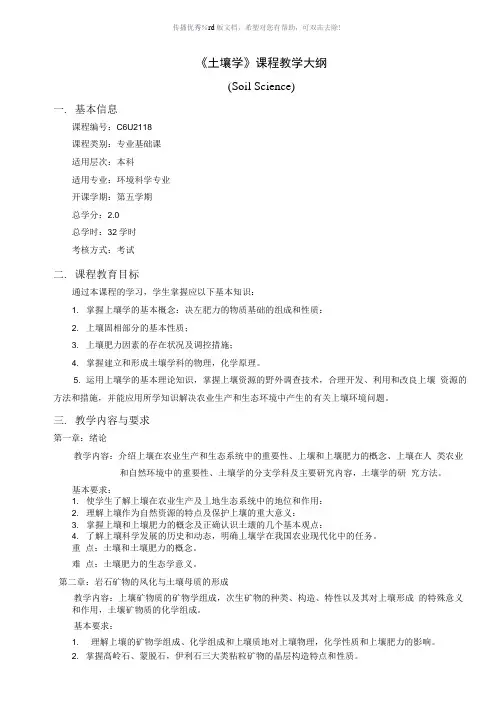
《土壤学》课程教学大纲(Soil Science)一. 基本信息课程编号:C6U2118课程类别:专业基础课适用层次:本科适用专业:环境科学专业开课学期:第五学期总学分:2.0总学时:32学时考核方式:考试二. 课程教育目标通过本课程的学习,学生掌握应以下基本知识:1. 掌握上壤学的基本概念:决左肥力的物质基础的组成和性质:2. 上壤固相部分的基本性质;3. 上壤肥力因素的存在状况及调控措施;4. 掌握建立和形成土壤学科的物理,化学原理。
5. 运用上壤学的基本理论知识,掌握上壤资源的野外调查技术,合理开发、利用和改良上壤资源的方法和措施,并能应用所学知识解决农业生产和生态环境中产生的有关上壤环境问题。
三. 教学内容与要求第一章:绪论教学内容:介绍上壤在农业生产和生态系统中的重要性、上壤和上壤肥力的槪念、上壤在人类农业和自然环境中的重要性、土壤学的分支学科及主要研究内容,土壤学的研究方法。
基本要求:1. 使学生了解上壤在农业生产及丄地生态系统中的地位和作用:2. 理解上壤作为自然资源的特点及保护上壤的重大意义:3. 掌握上壤和上壤肥力的槪念及正确认识土壊的几个基本观点:4. 了解上壤科学发展的历史和动态,明确丄壤学在我国农业现代化中的任务。
重点:土壤和土壤肥力的槪念。
难点:土壤肥力的生态学意义。
第二章:岩石矿物的风化与土壤母质的形成教学内容:上壤矿物质的矿物学组成,次生矿物的种类、构造、特性以及其对上壤形成的特殊意义和作用,土壤矿物质的化学组成。
基本要求:1. 理解上壤的矿物学组成、化学组成和上壤质地对上壤物理,化学性质和上壤肥力的影响。
2. 掌握髙岭石、蒙脱石,伊利石三大类粘粒矿物的晶层构造特点和性质。
3. 了解粘土矿物形成的理论及粘土矿物的分布规律,重点:上壤矿物质的主要元素组成和硅铝铁率。
难点:三大类粘粒矿物的晶体构造特点。
第三章:土壤有机质教学内容:上壤有机质的来源及其组成、土壤有机质的矿质化作用.上壤有机质的腐殖化作用.影响土壤有机质分解转化的因素、土壤有机物质的性质。
《土壤学》参考复习题

《土壤学》复习题第一章绪论一、填空1.德国化学家李比希创立了(矿质营养)学说和归还学说,为植物营养和施肥奠定了理论基础。
2.土壤形成的五大自然因素是(母质)、(气候)、(生物)、(地形)和时间。
3.发育完全的自然土壤剖面至少有(表土层)、(淀积层)和(母质层)三个层次。
4.土壤圈处于(岩石圈)、(大气圈)、(生物圈)、(水圈)的中心部位,是它们相互间进行物质,能量交换和转换的枢纽。
5.土壤四大肥力因素是指(水分)、(养分)、(空气)和(热量)。
6.土壤肥力按成因可分为(自然肥力)、(人工肥力);按有效性可分为(有效肥力)、(潜在肥力)。
二、判断题1.(√)没有生物,土壤就不能形成。
2.(×)土壤三相物质组成,以固相的矿物质最重要。
3.(×)土壤在地球表面是连续分布的。
4.(×)土壤的四大肥力因素中,以养分含量多少最重要。
5.(×)一般说来,砂性土壤的肥力比粘性土壤要高,所以农民比较喜欢砂性土壤。
6.(√)在已开垦的土壤上自然肥力和人工肥力紧密结合在一起,分不出哪是自然肥力,哪是人工能力。
三、名词解释1. 土壤:是具有肥力特性因而能生产植物收获物的地球陆地疏松表层。
2. 土壤肥力:土壤能适时地供给并协调植物生长所需的水、肥、气、热、固着条件和无毒害物质的能力。
3. 土壤剖面:在野外观察和研究土壤时,从地面垂直向下直到母质挖一断面。
四、简答题1. 土壤在农业生产和自然环境中有那些重要作用?(1)土壤是植物生长繁育和生物生产的基地,是农业的基本生产资料。
(2)土壤耕作是农业生产中的重要环节。
(3)土壤是农业生产中各项技术措施的基础。
(4)土壤是农业生态系统的重要组成部分。
2. 土壤是由哪些物质组成的?土壤和土壤肥力的概念是什么?土壤是由固体、液体和气体三相物质组成的疏松多孔体。
五、论述题1. 论述土壤在农业生产和自然环境中的作用。
(1)概念:土壤:是具有肥力特性因而能生产植物收获物的地球陆地疏松表层。
土壤学第九章-土壤养分循环ppt课件

土壤学
资源环境学院土地资源与农业化学系
采用PP管及配件:根据给水设计图配置好PP管及配件,用管件在 管材垂 直角切 断管材 ,边剪 边旋转 ,以保 证切口 面的圆 度,保 持熔接 部位干 净无污 物
反硝化的临界Eh约为334mv,最适pH为7.0~8.2, pH小于5.2~5.8的酸性土壤,或高于8.2~9.0的碱性 土壤,反硝化作用显著下降。
有机肥
养分资源
挥
发
淋 洗
地下水
土壤学
资源环境学院土地资源与农业化学系
土壤养分的基本概念
土壤养分-指植物所必需的,主要是土壤来提供的营养元 素就叫做土壤养分。土壤养分是土壤肥力的物质基础,是土 壤肥力的重要组成因素。
有效养分-能够直接或经过转化被植物吸收利用的土壤养 分。
速效养分-在作物生长季节内,能够直接、迅速为植物吸 收利用的土壤养分,称速效养分。
(3)这种养料元素在植物的代谢过程中具有直接 的作用。
土壤学
资源环境学院土地资源与农业化学系
采用PP管及配件:根据给水设计图配置好PP管及配件,用管件在 管材垂 直角切 断管材 ,边剪 边旋转 ,以保 证切口 面的圆 度,保 持熔接 部位干 净无污 物
土壤养分循环是“土壤圈”物质循环的重 要组成部分,也是陆地生态系统中维持生物生 命周期的必要条件。
有机质C/N
>30
30~15
<15
氮的固定量>矿化量 固定量=矿化量 固定量<矿化量
补充化肥
补充有机质
(2)应用“激发效应”调节土壤有机质和氮素平 衡
有机质丰富的土壤,施用绿肥等新鲜有机肥 产生正激发效应。
有机质缺乏的土壤,施用富含木质素的粗有
机肥,产生负激发效应。
《土壤学》课程笔记

《土壤学》课程笔记第一章:什么是土壤?1.1 土壤的重要性与功能土壤不仅是地球表面的一个物理层,它还是一个动态的生态系统,具有多种重要性和功能:- 生命支持系统:土壤是植物生长的基础,为植物提供必需的养分、水分和栖息地,从而支撑着地球上绝大多数生物的生命活动。
- 水循环的关键参与者:土壤是大气降水的主要接收者,通过渗透、蒸发和径流等过程参与水循环,维持水文平衡。
- 养分循环的枢纽:土壤是生物地球化学循环的核心,包括碳、氮、磷、硫等元素的循环,这些元素是所有生命体必需的。
- 环境净化器:土壤具有过滤、吸附、降解和转化污染物质的能力,有助于保护地下水和地表水质量。
- 土壤保持文化遗产:土壤记录了地球历史和人类活动的信息,是自然和文化遗产的一部分。
1.2 一方水土养一方人土壤的特性直接影响着一个地区的生态环境、经济发展和人类生活方式:- 地域性:不同地区的土壤类型和特性不同,这决定了当地的植被类型、农作物种植模式和农业生产效率。
- 文化影响:土壤条件影响人类居住模式、饮食习惯和传统技艺,如稻田文化、葡萄种植文化等。
- 经济发展:土壤资源丰富与否直接影响地区经济的发展,如农业、矿业和旅游业等。
1.3 土壤的概念与土壤学内容土壤是由矿物质、有机质、水分、空气和生物组成的复杂混合体,具有以下特点:- 物理性质:土壤的物理性质包括质地、结构、孔隙度、水分和温度等。
- 化学性质:土壤的化学性质涉及pH值、养分含量、阳离子交换量、有机质含量等。
- 生物性质:土壤是地球上生物多样性最丰富的栖息地之一,包括微生物、昆虫、植物根系等。
土壤学内容主要包括:- 土壤的形成与演变:研究土壤如何从母质经过生物、气候和时间的作用形成,以及土壤剖面的发育过程。
- 土壤分类:根据土壤的形态、性质和发生特性,将土壤划分为不同的类型。
- 土壤的物理、化学和生物性质:研究土壤的物理结构、化学成分和生物活动对土壤功能的影响。
- 土壤肥力和植物营养:探讨土壤如何提供植物生长所需的养分,以及如何通过施肥等手段提高土壤肥力。
(完整)《土壤学》教学大纲

《土壤学》教学大纲一、基本信息二、教学目标及任务要求学生掌握土壤学的基本概念,了解并掌握土壤的基本组成份和土壤主要特性。
牢固树立土壤作为一种资源在农业生产乃至整个国民经济发展以及在整个生态圈中的地位和作用。
掌握土壤资源形成的自然要素及社会经济特征、掌握环境对土壤形成的影响、掌握土壤的主要形成过程、土壤的发生学分类制、系统分类法的分类依据、掌握中国土壤资源的地理优势、开发特点、中国土壤资源的数量、质量、开发对策、世界土壤资源的现状及变化。
土壤资源利用的限制因素、系列规划和多目标决策、全国土壤资源的类型、各土纲、土类的主要形成条件和过程、土壤性质以及利用改良途径、掌握全国的土壤地理分布规律。
三、学时分配以表格方式说明各章节的学时分配,表格如下:教学课时分配四、教学内容及教学要求绪论(土壤学部分)本章重点、难点:土壤的基本概念、土壤在农业生产中的重要意义本章教学要求:需要牢固掌握“土壤”和“土壤肥力”的概念,了解土壤所具有的独特性质,认识土壤在农业生产中的重要性,了解土壤科学的发展简史,以及研究的内容和方法。
习题要点:1、什么是土壤和土壤肥力?2、土壤在农业生产中有哪些的重要意义?3、土壤学有哪些研究内容?与相邻学科的关系如何?第一章土壤矿物质第一节土壤矿物质的矿物组成和化学组成1、土壤矿物质的主要元素组成2、土壤矿物质组成习题要点:土壤矿物质由哪些元素组成的?第二节粘土矿物1、层状硅酸盐粘土矿物2、非硅酸盐粘土矿物习题要点:层状硅酸盐粘土矿物的结构如何?第三节我国土壤粘土矿物分布规律1、风化和成土作用与粘土矿物组成的关系2、我国土壤粘土矿物分布规律习题要点:什么是风化作用?我国土壤粘土矿物分布规律如何?本章重点、难点:土壤矿物质的主要元素组成;层状硅酸盐粘土矿物的结构;我国土壤粘土矿物分布规律本章教学要求:通过本章学习,了解土壤母质的来源,土壤母质与岩石、矿物间的相互关系,重点掌握土壤母质的形成过程,通过风化作用将岩石逐渐解体的分解破碎的过程,了解各种风化作用的类型、作用特点、风化产物以及影响风化作用强度的因素,了解岩石风化物在各种外力作用下搬运一沉积下来的堆积物。
土壤学
NH
3
氨
吸收
挥 发
硝化
NO3-
可交换态 固定态
地下水
淋 洗
粘粒矿物
NO3-
土壤氮素转化过程与氮素循环示意图
第二节 土壤中的大量元素
一、土壤中的氮
氮素是构成一切生 命体的重要元素 在植物生产中,植物 对氮的需要量较大: 肥料三要素 氮素肥料施用过剩 会造成江湖水体富 营养化、地下水硝 态氮(NO3-N)积累 及毒害等。
铁(Fe)硼(B)锰(Mn)铜(Cu)锌(Zn)
钼(Mo)氯(Cl)镍(Ni)
Ni
二、土壤养分来源
1、土壤养分的基本来源——矿物岩石
P、K、Ca、Mg、Fe、B、Mo、Cu、Mn、S等
2、土壤养分的主要来源——森林凋落物 N 灰分元素 凋落物 灌、草、伐根等 保存 聚集
3、土壤养分的其他来源
生物固氮、大气降水、人工施肥、客土、灌溉等
Fe3(PO4)2Fe(OH)2存在。
(3)闭蓄态磷(O—P) 氧化铁或氢氧化铁胶膜包被的磷酸盐。 (4)磷酸铁铝和碱金属、碱土金属复合而成的磷酸盐 磷酸盐成分更复杂,种类也多,溶解度极小 ,数量不多。
我国主要土壤类型中,一般分布有以下规律:
风化程度较高的南方砖红壤、红壤中,以O—P占的比重 最大,最高可达90%以上,其次是Fe—P, Al—P; Ca—P 很少。 风化程度较低的北方石灰性土壤中,Ca—P所占比例大,
N2
收获
灌施 水肥 枯枝落叶 腐殖质 微生物 矿化 固持 风化 固持
NH4+
NH
3
氨
吸收
挥 发
硝化
NO3-
可交换态 固定态
地下水
土壤学第九章 土壤养分(英文版)
全文电子教材土壤与土壤资源学(上篇:土壤学)林学专业2 O 2SO2H 2OO 2MineralNutrients英文版—土壤养分Chapter 9. Soil NutrientsSoil nutrient availability is one of the factors that often limit tree growth and soil productivity. Other factors commonly limiting for tree growth can include soil moisture availability, climate (such as temperature and precipitation), soil physical properties (such as drainage and soil compaction), or a combination of the above factors. N is often a nutrient that is most deficient for plant growth. Nitrogen deficiency can be caused by low N content in the soil or by the slow release rate in ecosystems such as the boreal forests or peatlands where low temperature or poor aeration encourages accumulation of organic matter and reduces N mineralization rates. Phosphorus is also frequently deficient in soils where there is very little P in the parent material or where most of the P has been lost through weathering during the soil formation processes, such as in the tropics.There are 16 elements that are considered essential for plant growth. Lack of any of those essential nutrients will hinder the proper growth and functioning of the plants and will prevent the plants from completing their life cycle. Among those 16 essential nutrients, C, H, and O come from the air and water and are usually not deficient, although recent climate change studies using CO2 enriched air showed that increasing atmosphere CO2 concentration can significantly increase forest productivity; however, plants usually acquire the other essential nutrients from the soil. Among the macronutrients (N, P, K, Ca, Mg, and S), Mg and S can also sometimes be deficient for tree growth. Potassium and calcium deficiencies in forests are very rare. In terms of micronutrients (Mn, Zn, Cu, Fe, Mo, B, and Cl), B, Zn, Cu, and Fe deficiencies, especially B deficiency, are most frequently reported. These nutrients are called micronutrients because they usually exist on the earth and are required by plants in very small quantities. In addition to those 16 essential nutrients, cobalt (Co), vanadium (Va), nickel (Ni), silicon (Si), and sodium (Na) have been found to be essential to some plants. For example, nickel has been found to be essential for soybeans and Si for rice. In this chapter, we will discuss the importance of soil nutrients in tree growth, discuss the macronutrients and micronutrients, describe the cycling of nutrients in the soil, and provide an introduction to the mechanisms of plant nutrient uptake.9.1 Nutrients: available forms, availability and functionalityThe interaction of numerous physical, chemical, and biological properties in soils controls the availability of soil nutrients for plant uptake. Understanding these processes will enable us to manage selected soil properties to optimize nutrient availability and soil productivity. To understand these interacting processes will require us to have a good knowledge of the soil properties and processes covered in the earlier chapters. Not all nutrients present in the soil are available for plant uptake and different nutrients have different available forms.a) Forms of nutrients plant can uptakeDetails of available nutrient forms will be discussed in the next section where the individual macro- and micronutrients are presented. The forms of the essential nutrients that plants can uptake, along with their functionality and normal amounts in plants, are listed in Table 11.1. One thing common to all nutrients is that plants acquire most of their needed nutrients from the soil solution and mostly in the inorganic form. Some acquisition of nutrients through the gaseous form is possible. For example, plants can absorb NH3 and SO2 in the air through the stomata. Nitrogen cycling is one of the most complex as compared with the cycling of the other essential nutrients. One of the important mechanisms for increasing plant N availability is through symbiotic N-fixation. With this mechanism, most of the N the host plant uptake comes from the bacterial that can fix N2 in the air. There have been reports to indicate that trees sometimes can take up organic N in the form of simple amino acids and proteins. The uptake of organic form of N has been found to be mostly assisted by mycorrhizas and this uptake mechanism is very important in soils with low fertility and for nutrients with low mobility in the soil. A few species of plants are able to use animal proteins as an N source directly. These carnivorous plants, such as the common bladderwort (Utricularia vulgaris) and the sundew (Drosera rotundifolia), have special adaptations that are used to lure and trap insects and other very small animals. The plants digest the trapped organisms, absorbing the nitrogenous compounds the organisms contain as well as other compounds and minerals, such as potassium and phosphate. Most of the carnivores of the plant world are found in bogs, a habitat that is usually quite acidic and thus not favorable for the growth of nitrifying bacteria.b) Nutrient availabilityNutrient availability is an important area of interest in soil nutrient management. Nutrient availability falls into the soil science discipline of soil fertility. Soil fertility is narrowly defined as “the status of a soil with respect to the amount and availability to plants of elements necess ary for plant growth”. Of all soil properties, fertility is the one with which man is most involved; it is the property that can be readily changed by man in his exploitation or management of the land. In intensively managed forest systems, such as in plantations, soil nutrient availability can be altered and managed through silvicultural techniques such as site preparation, weed control, thinning, and fertilization. Even in natural forests, where there is very little human control of processes, soil nutrient availability is not a completely stable factor but changes with stage of forest succession, natural disturbance regimes, and with soil profile development. Occurrence of fire and extensive wind throw can result in sudden dramatic changes in soil nutrient availability. A soil, particularly one with the heterogeneity of many forest soils, cannot be considered to have a unique single, static level of soil fertility.Since plants take up most of their needed nutrients from the soil solution, nutrient availability is controlled by the interaction of numerous physical, chemical, and biological properties in soils. The basic relationship between the various components of the dynamic soil system is depicted in Figure 11.1. In reactions 1 and 2, plants absorb nutrients (cations and anions) from the soil solution and release small quantities of ions such as H+ (to balance the charge in soil solution, ifcations are absorbed by plants), or OH- and HCO3- (if anions are absorbed). In reactions 3 and 4, changes in ion c oncentrations in soil solution are “buffered” by ions adsorbed on the surface of soil minerals. Ion removal from solution causes partial desorption of the same ions from these surfaces. In reactions 5 and 6, minerals contained in the soil can dissolve to re-supply soil solution with many ions; likewise, increases in ion concentration in soil solution resulting from fertilization or other inputs can cause some minerals to precipitate. In reactions 7 and 8, soil microorganisms can remove ions from soil solution and incorporate them into microbial tissues, and conversely, when microbes or other organisms die, they release nutrients to the soil solution. Microbial activity produces and decomposes organic matter or humus in soils. These dynamic processes are very dependent on adequate energy supply from organic C, inorganic ion availability, and numerous environmental conditions. In reactions 9 and 10, plant roots and soil organisms utilize O2 and respire CO2 through metabolic activities. As a result, CO2 concentration in the soil air is greater than in the atmosphere. Diffusion of gases in soil decreases dramatically with increasing soil water content and soil depth. In reactions 11 and 12, numerous environmental factors and human activities can influence ion concentration in soil solution, which reacts with the mineral and biological processes in soil. For example, adding ammonium fertilizer to soil can increase the N concentration in the soil solution, but over time, N concentration in the soil solution will decrease due to plant uptake, volatilization losses, transformation of ammonium into nitrate through the nitrification process, and immobilization of ammonium by microorganisms and fixation by clays and organic matter through inorganic reactions.All of these processes and reactions are important to the availability of plant nutrients; however, depending on the specific nutrient, some processes are more important than others. For example, microbial processes are more important to N and S availability than mineral surface exchange reactions, whereas the opposite is true for K, Ca, and Mg.c) Functions of inorganic nutrients in plantsTable 9.1 lists some of the functions of nutrients in plant growth and physiology. Inorganic ions affect osmosis and thus help to regulate water balance in plants. Several inorganic ions can serve interchangeably in this role, in many plants this particular requirement is described as non-specific. On the other hand, an inorganic nutrient may function as part of an essential biological molecule; in this case the requirement is highly specific. An example of a specific function is the presence of magnesium in the chlorophyll molecule. Some of the common functions of mineral nutrients are discussed below.Catalysts: A key role of the inorganic nutrients is their participation in some of the enzymatic reactions of the plant cell. In some cases, they are essential structural parts (a “prosthetic group”) of the enzyme. In other cases, they serve as activators or regulators of certain enzymes. Potassium, for instance, which probably affects 50-60 enzymes, is believed to regulate the conformation of some proteins. Changing the shape of an enzyme could, for example, expose or obstruct reaction sites.Electron transport:Many of the biochemical activities of cells, including photosynthesis and respiration, are oxidation-reduction reactions. In such reactions, electrons are transferred to or from a molecule that functions as an electron acceptor or donor. The cytochromes, which contain iron, are involved in electron transfer.Structural and molecular components:Some mineral elements serve as structural components of cells, either as part of a physical structure or as part of the molecules involved in cellular metabolism. Calcium combines with pectic acid in the middle lamella of the plant cell wall. Phosphorus occurs in the sugar-phosphate backbone of DNA and RNA and in the phospholipids of the cellular membranes. Nitrogen is an essential component of amino acids, chlorophylls, and nucleotides. Sulphur is found in two amino acids that form a component of proteins.Osmosis:The movement of water into and out of plant cells is largely dependent on the concentration of solute in the cells and in the surrounding medium. The uptake of ions by a plant cell thus may result in the entry of water into the cell. The increased turgor pressure results in expansion of the immature cell, which is the chief cause of cellular growth, and in the maintenance of turgor in the mature cell. This is an example of conversion of energy from one form to another by a living system; the chemical energy (ATP) expended in the active uptake of ions by the plant cell is translated into the physical energy of water movement.Effects of cell permeability: Calcium has a direct effect on the physical properties of cellular membranes. When there is a calcium deficiency, membranes seem to lose their integrity, and solutes within the membranes or cells leak out.9.2 Macronutriens: N, P, K, Ca, Mg, and S9.2.1 Nitrogena) Origin and distribution of NThe N in soil is derived from the earth’s atmosphere. The N content of surface mineral soils typically ranges from 0.02 to 0.5%. About 98% of the earth’s N is contained in the igneous rocks deep under the planet’s crust, where it i s effectively out of contact with the soil-plant-air-water environment in which we live. Therefore, we must concentrate our discussion of N cycling on the remaining 2% that cycles in the biosphere. Most of the N found in the soil comes from biological N fixation. The atmosphere contains a large amount of N2 (78% of the atmosphere is N2 gas). Some 75,000 Mg of N is found in the air above 1 ha of the land surface. However, the very strong triple bond between two nitrogen atoms makes this gas quite inert and not directly usable by plants or animals. Were it not for the ability of certain microorganisms to break this triple bond to form nitrogen compounds, vegetation in the terrestrial ecosystems around the world would be rather sparse, and little N would be found in soils.Most of the N in terrestrial ecosystems is found in the soil. The soil contains 10 to 20 times as much N as does the standing vegetation (including roots) of forest ecosystems. Most soil N occurs as part of organic molecules. Soil organic matter typically contains about 5% N; therefore, the distribution of soil N closely parallels that of soil organic matter. Except where large amounts of chemical fertilizers have been applied, inorganic N (NH4+ and NO3-) seldom accounts for more than 1 to 2% of the total N in the soil. Unlike most of the organic N, the mineral forms of N are mostly quite soluble in water and may be easily lost from soils through leaching and volatilization.b) Forms of N in the soilThe different forms of N that can be found in the soil can be divided into two categories: inorganic and organic forms of N. As discussed above, most of the soil N exists in the organic form.Inorganic N: Inorganic forms of N include ammonium (NH4+), nitrate (NO3-), nitrite (NO2-), nitrous oxide (N2O), nitric oxide (NO), and the nitrogen gas (N2). Trace amounts of nitrite may be present in the soil. Nitrite is toxic to plants and is generally quickly converted to nitrate in the nitrification processes. Therefore, nitrite usually does not accumulate in the soil. N2O, NO, and N2 are the products of dinitrification or contained in the air trapped in the soil pores. As will be discussed below, conditions in forest soils generally favor the formation of ammonium and plants are adapted to this dominant form of N as a N source. Ammonium is the product of mineralization of organic N. Nitrate is formed through the nitrification process. There is usually abundant nitrate accumulation in the soil where conditions favor nitritication. The inorganic N content in soils is very dynamics as its concentration is affected by a large number of factors, including temperature, moisture content, plant uptake, microbial population, organic matter content, and so on. There are distinct seasonal and diurnal changes in soil inorganic N contents in the soil.Both inorganic N forms are soluble in water. Ammonium is mainly present in the soil on exchangeable sites and the positively charged ammonium can be attracted on to the negatively charged surfaces of clay and organic particles. This mechanism presents NH4+ from being easily lost from the soil solution. NH4+ can also be fixed in the clay structure, making it unavailable for plant uptake as well as from being lost through leaching. On the other hand, most of the NO3-, if present, will be found in the soil solution and is much more proven to be lost through leaching.Organic N: Organic N usually represent greater than 95% of the total soil N. Organic N occurs as proteins, amino acids, and other complex N compounds. Organic N can be separated into three types based on their solubility and how easy they can be hydrolyzed: a) soluble organic N: usually less than 5% of the total soil N content. Some of the soluble organic N (such as simple amino acids) can be take up directly by plants, especially with the assistance of mycorrhizas. This fraction of the organic N can be easily hydrolyzed to release NH4+ for plant uptake; b) hydrolyzable organic N. This fraction of organic N can be hydrolyzed to simpler soluble organic N when treated with acids or alkalis; and c) non-hydrolyzeable organic N. The content of this fraction can be as high as 50% of the total N in the soil. This is the most stable fraction of the soil organic N and the nature of this fraction of N is still not very clear. Much of the organic N forms organo-mineral complexes. Organic N in these complexes are much more stable than the non-complexed organic N in the soil.c) N cycling processesThe processes of N cycling are presented in Figure 11.2. The main N cycling processes are discussed below.Biological N fixation:Through biological N-fixation, certain organisms convert the inert dinitrogen gas of the atmosphere to N-containing organic compounds that become available to all form of life through the N cycle. Terrestrial ecosystems have been estimated to fix 130 to 180million Mg of N, about twice as much as is industrially fixed in the manufacturing of fertilizers.Symbiotic bacteria (Rhizobia) fix N2 in nodules present on the roots of legumes. This fixed N may be utilized by the host plant, excreted from the nodule into the soil and be used by other nearby plants, or released as nodules or legume residues decompose after the plant dies or is incorporated into the soil. Other microorganisms that are also capable of fixing N include Actinomycetes and Frankia that fix N in symbiosis with non-legume tree species such as alders, Myrica, and Casuarina; Azotobacter and Azospirillum are heterotrophic free-living fixers; and blue-green algae and Anabaena are autotrophic free-living fixers.Regardless of the organisms involved, the key to biological N fixation is the enzyme Nitrogenase, which catalyzes the following reaction:(Nitrogenase)N2 + 8H+ + 6e- ® —————————→2NH3 + H2(Fe, Mo)The nitrogenase are proteins that contain Fe and Mo. The nitrogen fixation process requires a great deal of energy. The energy either comes from the host plant for organisms that form symbiosis, or from the soil organic matter for the heterotrophic free-living bacteria, or from the sun light for the autotrophic free-living organisms. The accumulation of ammonia will inhibit N fixation and too much nitrate in the soil will inhibit the formation of nodules. In addition to Fe and Mo, N-fixing organisms also require high amounts of P and S as these nutrients are either part of the nitrogenase molecule or are needed for its synthesis and use.The production of N by industrial fixation is based on the Haber-Bosch process, in which H2 and N2 gases react to form NH3, under high temperature and pressure:Catalyst3H2 + N2 ® ——————→NH31,200 °C, 500 atmImmobilization and mineralization: The majority (95-99%) of the soil N is in organic compounds that protect it from being lost but this also leaves it largely unavailable to higher plants. The quantities of NH4+ and NO3- available to plants depend largely on the amounts applied as N fertilizers and mineralized from organic N in soil. Much of the organic N is present as amine groups (R-NH2), largely in proteins or as part of humic compounds. When soil microbes attack these compounds, simple amino compounds (R-NH2), such as lysine (CH2NH2COOH) and alanine (CH3CHNH2COOH), are formed. Then the amine groups are hydrolyzed, and the N is released as ammonium ions (NH4+), which can be oxidized to the nitrate form. This enzymatic process is termed mineralization, that includes the ammonification (from simple amino compounds to NH4+) and nitrification (from NH4+ to NO3-) processes. A specific term called aminization describes the process from the amine groups and proteins to simple amino compounds:H2OProteins ® RCHNH2COOH + R-NH2 + CO(NH2)2 + CO2 + energyBacteria, fungiUsing an amino compound (R-NH2) as an example of the organic N source, the mineralization process can be indicated as follows:+2H2O +O2 +1/2O2R-NH2 ⇌OH- + R-OH + NH4+ ⇌4H+ + energy + NO2- ⇌energy + NO3--2H2O -O2 -1/2O2The opposite of the mineralization process is immobilization, the conversion of inorganic N ions (NH4+ and NO3-) into organic forms. Immobilization can take place by both biological and non-biological (abiotic) processes, the latter being of considerable importance in forest soils. Through the biological processes, as microorganisms decompose carbonaceous organic residues in the soil, they may require more N than is contained in the residues themselves and thus may immobilize NH4+ and NO3- in the soil solution. The microbes need N to maintain a C:N ratio of about 8:1. The microorganisms incorporate mineral N ions into their cellular components, such as proteins, leaving the solution essentially void of NO3- and NH4+ ions. During the immobilization process, microorganisms can compete very effectively with plants for NH4+ or NO3-. When the organisms die, some of the organic N in their cells may be converted into forms that make up the humus complex, and some may be released as NH4+ and NO3- ions. During the decomposition of nitrogenous compounds, microorganisms incorporate the N into amino acids and proteins (as part of the microbial biomass) and release excess N in the form of ammonium ions. In alkaline media, the N may be converted to ammonia (NH3), but this conversion usually occurs only during the decomposition of large amounts of N-rich material, as in the mature pile or a compost heap that has contact with the atmosphere. Within soil, the ammonia produced by ammonification is dissolved in the soil water, where it combines with protons to form the ammonium ions. Mineralization and immobilization occur simultaneously in the soil; whether the net effect is an increase or decrease in the amount of mineral N available in the soil depends primarily on the ratio of C to N in the organic residues undergoing decomposition.The amount of plant available N released from organic N depends on many factors affecting N mineralization, immobilization, and losses of NH4+ and NO3- from the soil. Mineralization being a microbial process will increase with a rise in temperature and is enhanced by adequate, although not excessive, soil moisture and a good supply of O2. Maximum aerobic activity and N mineralization occur between 50 and 80% water-filled pore space. Optimum temperature for N mineralization ranges between 25 and 35 °C.One of the factors affecting N mineralization and immobilization is the C:N ratio of the decomposing material. The N content of humus or stable soil organic matter ranges from 5 to 6%, whereas C ranges from 50 to 60%, giving a C:N ratio ranging between 8 and 12. When fresh organic material is added to the soil, there is a rapid increase in the number of heterotrophic organisms, accompanied by the evolution of large amounts of CO2, during the initial stage of decomposition. If the C:N ratio of the initial material is greater than 30:1, N immobilization occurs. As decay proceeds, the C:N ratio of the residue narrows and energy supply diminishes.Some of the microbial population dies because of the decreased food supply, and ultimately a new equilibrium is reached, accompanied by the mineralization of N. Generally speaking, when organic substances with C:N ratios between 20 and 30 are added to the soil, there may be neither immobilization nor release of mineral N. For organic materials with C:N ratio less than 20, there is usually a release of mineral N early in the decomposition process.In the organic matter mineralization processes, bacteria dominate the breakdown of proteins in neutral and alkaline environments, with some involvement of fungi, while fungi predominate under acidic environments (and most forest soils are acidic).Many studies have shown that only about 1 to 4% of the organic N of a soil mineralizes annually. Even so, the rate of mineralization provides sufficient mineral N for normal growth of natural vegetation (such as forests) in almost all soils except those with low organic matter, such as the soils of deserts and sandy areas. Mineralized soil N constitutes a major part of the N taken up by plants.Nitrification: Several species of bacteria common in soils are able to oxidize ammonia or ammonium ions in a process called nitrification. This is an energy yielding process, and the energy released in the process is used by these bacteria to reduce CO2 in much the same way that photosynthetic autotrophs use light energy in the reduction of CO2. Such organisms are known as chemosynthetic autotrophs (as distinct from photosynthetic autotrophs). The chemosynthetic nitrifying bacterium Nitrosomonas is primarily responsible for oxidation of ammonium to nitrite ions (NO2-).Nitrosomonas2NH4+ + 3O2 ® 2NO2- + 4H+ + 2H2O + energybacteriaNitrite is toxic to plants, but it rarely accumulates in the soil. Nitrobacter, another genus of bacteria, oxidizes the nitrite to form nitrate ions (NO3-), again, with a release of energy:Nitrobacter2NO- + O2 ® 2NO3- + energybacteriaOnce nitrate is formed and if it is not quickly taken up by plants or microbial organisms (in the process of microbial immobilization), it can be lost from the soil through leaching, when there is water percolating through the soil profile, and denitrification under anaerobic conditions. Nitrification will significantly increase soil acidity by producing H+ ions. Nitrification requires NH4+ ions, but excess NH4+ is toxic to Nitrobacter and must be avoided. The nitrifying organisms, being aerobic, require O2 to make NO2- and NO3- ions, and are therefore favored in well-drained soils.In forest soils, fortunately, nitrification rates are very low and most of the available form of N is present in the ammonium ion form. There are several possibilities that nitrification rates are low in forest soils. One possibility is that nitrification rates are inhibited by the low soil pH as forest soils are usually acidic. A second possibility is that nitrifying bacteria population is very low (that itself may be related to the inhibition by the acidic condition and other limiting factors) in forestsoils. Under prolonged incubations in the lab, nitrification eventually develops, although this may take as long as one year under optimum conditions. Another possibility is that microbial populations in forest soils have a very strong ability to immobilize the nitrate produced from nitrification. Therefore, under such a scenario, as soon as the nitrate is formed the microbial populations take it up. Recent gross N mineralization studies using 15N-labeled fertilizers confirmed such cases.Nitrification is also a microbial process and is thus affected by soil environmental factors. Nitrification is affected by 1) soil NH4+ content, 2) population of nitrifying organisms, 3) soil pH, 4) soil aeration, 5) soil moisture, and 6) temperature. If there is no NH4+ in the soil solution, nitrification does not occur. Variation in populations of nitrifiers results in differences in the lag time between the addition of the NH4+ and the buildup of NO3-. Because of the tendency of microbial populations to multiply rapidly in the presence of an adequate supply of C, the total amount of nitrification is not affected by the number of organisms initially present, provided that temperature and moisture conditions are favorable for sustained nitrification.Nitrification takes place over a wide range in pH (4.5 to 10), with an optimum pH of 8.5. Nitrifying bacterial need an adequate supply of Ca2+, H2PO4-, and a proper balance of micronutrients. Nitrifying bacteria are aerobes and maximum nitrification occurs at the same O2 concentration in the aboveground atmosphere. Nitrification rates are generally highest in soil water contents at field capacity or 1/3 bar water potential (80% of total pore space filled with water). In terms of temperature, the temperature coefficient, Q10, is 2 over the range 5 to 35 °C. Thus, a twofold change in the nitrification rate is associated with a shift of 10 °C within this temperature range. Optimum soil temperature for nitrification is 25 to 35 °C.Nitrate leaching:Nitrate ions are not adsorbed by the negatively charged colloids that dominate most soils. Therefore, nitrate ions move down easily with drainage water and are thus readily leached from the soil. This process constitutes a loss of N from the soil system for plant uptake and also causes several serious environmental problems. Leaching of nitrate from acidic sources (nitrification or acid rain) also facilitates the loss of Ca and Mg and other nutrient cations. Much of the nitrate mineralized in certain highly weathered, acid, tropical Oxisols and Ultisols leach below the root zone before annuals can take it up. It has been found that some of this leached nitrate is not lost to groundwater, but is stored several meters deep in the profile where the highly weathered clay have adsorbed it on their anion exchange sites. Deep-rooted trees are capable of taking up this deep subsoil nitrate and subsequently using it to enrich the surface soil when they shed their leaves. Trees such as Sesbania, grown in rotation with annual food crops, can make this pool of leached N available for food production and prevent its further movement to ground water. Agroforestry practices such as this have the potential to make a significant contribution to both crop production and environmental quality in the humid tropics.Ammonium fixation: Ammonium ions carry positive charges and thus can be attracted to the negatively charged surfaces of clay and humus, where they are held in exchangeable form, available for plant uptake, but partially protected from leaching. However, because of the particular size of the ammonium (and potassium) ion, it can become entrapped within cavities in the crystal structure of certain clays. Several 2:1 type clay minerals, especially vermiculites, have the capacity to fix both ammonium and potassium ions in this manner. Vermiculite has the greatest capacity, followed by fine-grained micas and some smectites, to fix ammonium and potassium in this manner. Ammonium and potassium ions fixed in the rigid part of a crystal structure are held in。
土壤学 1-9章复习提纲及答案
土壤学题型一、名词解释。
(10道*3=30分)二、选择题。
(5道*2=10分)三、图形题。
(共20分)四、简答题。
(5道*4=20分)五、论述题。
(2道*10=20分《土壤学》复习提纲第一章一、概念:1.土壤P2:土壤是地球陆地表面具有肥力能够生长植物的疏松层,是独立的历史自然体。
2.聚合土体P5 :在空间上相邻、物质组合和性状上相近的多个单个土体便组成聚合土体3.土壤圈物质循环P51 :是指土壤圈内部的物质迁移转化过程及其与地球其他圈层之间的物质交换过程。
4.土壤的自净能力P10 :是指土壤对进入土壤中的污染物通过负载多样的物理过程、化学及生物过程,是其浓度降低、毒性减弱或者消失的性能。
5.土壤发生层P4:二、其他1、单个土体图解P42、西欧主要土壤地理学派的代表学家及观点P15-16以化学家李比希(1803-1873)为代表的农业化学土壤学派;“归还学说”以地质学家法鲁(1794-1877)为代表的农业地质土壤学派;“岩石-岩石”以土壤学家库比纳(1897-1970)为代表的土壤形态发生学派。
“土壤演替序列”3、土壤的自净能力包括哪些?P10土壤的自净能力包括:①物理自净,②化学自净,③物理化学自净,④生物自净土壤的自净能力是有限的。
第二章一、概念1、次生矿物P29: 原生矿物在风化和成土过程中新形成的矿物叫次生矿物。
2、粒级P36: 把土壤颗粒中粒径大小相近、性质相似的土粒归为一类,就为粒级3、土壤质地P40: 土壤中各个粒级所占的相对比例或质量分数,称为土壤质地4、灰分P42: 植物组织回落土壤之后,将经历化学变化和降解过程,则构成植物组织的元素,从植物组织分解后,将以离子或离子团形式保留在土壤中,它们就是灰分元素,简称灰分。
5、土壤腐殖质P437、土壤结构P57: 土壤原生矿物颗粒与次生矿物颗粒、其它土壤颗粒单元或土壤自然结构体相互组合重排的一种物理排列样式。
8、土粒密度P60: 是指单位容积土壤固相颗粒的质量(风干)。
《土壤学》章节笔记
《土壤学》章节笔记第一章土壤概述一、土壤的定义与功能1. 土壤的定义:土壤是地球陆地表面的一层复杂自然体,它是由矿物质、有机质、水分、空气和生物等多个组成部分相互作用形成的。
土壤不仅是植物生长的介质,也是地球生态系统的重要组成部分。
2. 土壤的功能:(1)生产功能:- 提供植物生长所需的水分和养分。
- 为植物根系提供支持和固定。
- 作为农业生产的基础,直接影响作物产量和品质。
(2)生态环境功能:- 维持生物多样性,为微生物、动物和植物提供栖息地。
- 参与地球上的水循环,影响地表水和地下水的质量和数量。
- 吸收、转化和降解环境中的污染物,具有自净能力。
- 固定碳素,对全球气候变化有重要影响。
(3)水文功能:- 调节降水径流,减少水土流失。
- 储存水分,缓解干旱对植物生长的影响。
- 过滤和净化水分,影响水质。
(4)社会功能:- 提供建筑和工程用地的基础。
- 作为文化和历史遗产的一部分,反映人类活动的历史。
- 为人类提供休闲娱乐的场所。
二、土壤的形成与分类1. 土壤的形成:土壤的形成是一个长期的地质过程,主要包括以下几个阶段:(1)成土过程:母质经过物理、化学和生物作用形成土壤的过程。
(2)土壤风化:母质在气候因素作用下发生物理和化学变化。
(3)土壤侵蚀:水流、风力等自然因素和人类活动导致土壤流失。
(4)土壤沉积:侵蚀后的土壤物质在低洼地带沉积。
土壤形成的主要因素:(1)气候:温度和降水影响土壤的风化和生物活动。
(2)母质:提供土壤的矿物质和部分养分。
(3)生物:植物、动物和微生物通过其生命活动影响土壤的形成。
(4)地形:影响土壤的水分、温度和侵蚀程度。
2. 土壤的分类:土壤分类系统多样,以下是一些常见的分类方法:(1)按土壤质地分类:- 砂土:颗粒粗糙,通透性好,但保水保肥能力差。
- 壤土:颗粒适中,通透性和保水保肥能力较好。
- 粘土:颗粒细小,保水保肥能力强,但通透性差。
(2)按土壤酸碱度分类:- 酸性土壤:pH值小于7,常见于湿润气候区。