
新译林牛津英语九年级上册Unit 6 全单元教案
课题9A Unit 6 Comic strip & Welcome to the unit 课型New1. To grasp the words of different types of TV programmes.教学目标2. To talk about students’favourite TV programmes.教学重点Students can tell about their favourite TV programmes and reasons.教学难点Students can tell about their favourite TV programmes and reasons.教学过程集体备课备课札记Step 1 Free talk1. Do you like watching TV?2. How often do you watch TV?3. What type of TV programmes do you like?Step 2 New wordsPresent some pictures and teach the new words.Step 3 Welcome to the unitTypes of TV programmes1. Sandy is doing a quiz. Help her match the scenes belowwith the types of TV programmes. Write the correct nameunder each picture.2. Practice the dialogue:A: What type of TV programmes do you like?B: I like ... best. What about you?A: My favourite TV programme is.../ I don't like....3. Sandy and her friends are talking about TV programmes.Listen to their conversation and answer the followingquestions:Why does the girl like watching documentary ?4. Work in pairs and talk about the types of TV programmesyou like.Step 4 Free talkAsk the students to talk about the question:1. Do you know whether dogs like watching TV?2. What type of TV programmes does Eddie like watching?Can you guess?Step 5 Comic stripListen and answer the questions.(1) Is Eddie getting bored with staying at home all day?(2) Does Hobo think Eddie is so busy? Why?(3) What kind of things does Eddie do every day?Act the dialogue out.Step 6 Language points1. Eddie, aren't you getting bored with staying at home allday? get bored with ... 意为“厌倦了...”。
e.g. After a while, I began to get bored with my job.过了一段时间,我开始厌烦这份工作。
2. A dog's work is never done.句中done意为“完毕,结束”。
e.g. I am done with the book. 这本书我看完了。
Step 7 ExercisesⅠ. Complete the sentences.1. Children like watching _________.(卡通片)2. D____________ can help people learn more about nature, history and real-life events .3. When I am upset I like to watch c________ to cheer myself up.4. Famous people always talk about their lives on ___________(访谈节目).5. My mother is not so ______ (busy) as my father.6. There are some boys on the playground _______ (play) football.7. A dog's work is never_______ (do).8. I have got bored with ________ (watch) drama series. Ⅱ. Translate the following sentences.1. 如果你和我一样忙碌,你就不会厌烦了。
2. 你喜欢哪种类型的电视节目?3. 我希望有一天能参加一个竞赛节目。
Step 8 Homework板书设计教学反思课题9A Unit 6 Reading (1) 课型New教学目标1. To know some further information and words about TV.2. To grasp some common reading skills.3. To encourage students to have some moderate interests.教学重点To know some further information and words about TV.教学难点To grasp some common reading skills.教学过程集体备课备课札记Step 1 Free talk•What do you usually do at weekends?•Do you watch TV?•What type of TV programmes do you usually watch? Why?Step 2 PresentationIf you want to find out when a TV programme will be shownand what it’s about, what can you do?TV guide.Step 3 Listening and reading (Skimming)Millie is reading a TV guide online.A TV guide gives you information about different TVprogrammes.1. Listen to the Sports world and answer the question.Is the weekly round-up in sport all about basketball?2. Do you like music? Have you ever seen any musicprogrammes? Do you like watching music awards? What otherawards do you know?Listen to the Beijing Music Awards and answer the question.How many fans have voted online for their favourite songs,singers and music videos?3. Do you like horror films?Listen to the Murder in a Country House and answer thequestion.Can you find out who the murderer is at the end of the film?4. Have you ever watched documentaries about tigers?Listen to the Tiger Watch Golden TV and answer the question.What can you see in the documentary?Step 4 Word exercisesMillie has read the TV guide, but she does not understand some of the words on the web pages. Help her work out their meanings.Step 5 While-readingMillie made some notes of Saturday's TV programmes. Help her check them.Write a T if a sentence is true or an F if it is false.Step 6 Intensive readingMillie is thinking about the information in the TV guide. Help her find the words on pages 80 and 81.Step 7 Exercise1. I booked a w_______ magazine.2. The programme c________ that great event.3. As we know, China is an ________(亚洲的)country.4. The game will __________ (hold) in Nanjing this _________(come) Saturday.5. In this film a doctor was found _______ (die) in his house. Step 8 Homework1. Listen and read the passages after the tape after class.2. Recite the new words and expressions in the article.板书设计教学反思课题9A Unit 6 Reading 2 课型New教学目标1. To understand the uses of the important phrases and sentences in the article.2. To get some further information about the article.教学重点Ss know the meaning of passage and learn about important phrases.教学难点Ss know the meaning of passage and learn about important phrases.教学过程集体备课备课札记Step 1 RevisionStep 2 Language points1. A weekly round-up of what is happening in sport, withup-to-date information.这是一个省略句,相当于(Here is) a weekly round-up of ...直接将句子的中心词放在开头,而省去一些不重要的词,是新闻报道或节目导读的语言风格,目的是引起读者的兴趣和关注。
新牛津译林版英语九年级上册《unit 6 detective stories》优秀教案三(重点资料).doc
9A Unit 6 Main task A detective story主讲教师:吕华兵(南京市第十三中学)一、年级:九年级二、教学内容:9A Unit 6 Detective stories三、课型:Main task四、教学目标1. 知识目标学习如何根据所给图片提示写一篇侦探故事。
2. 能力目标能根据所提供的图片,展开合理的想象,写出语意清晰、结构合理的侦探故事。
3. 情感目标通过对侦探或警员办案过程的了解,让同学们养成积极思维、关注细节的好习惯。
五、教学重难点1. 重点能依据所提供的图片或文字,按事件发展的顺序编写出合乎逻辑的侦探故事。
2. 难点如何让学生用熟悉的语言来表述案件的一些细节问题,而且做到语句流畅、条理清晰。
六、教学步骤Step 1 Warming-upTell the students that they are going to have a good time in this period and they are going to be turned into detectives and solve cases on their own.Say “First, let’s learn from a famous detective. Do you know him?”Play a short flash about the famous detective Conan.(Conan is the most popular detective they know. It may be easier for them to talk about him.)Ask the students the following questions:Do you think he is a good detective? Why or why not?(I think so. Because he careful and brave.)Would you like to be a detective like Conan?(If the answer is “Yes.”, it is very natural to take a small test before becoming a detective.)Use questions to help the students figure out the general ways of solving a case. (This will be very important in helping the students to organize their detective stories.)Step 2 Modeling the taskEncourage the students by saying that they have already knows a lot about how to solve acase. And then, ask them for help. Say “one of my friends, Tom, was arrested yesterday.” Show the following pictures and introduce the new words: be under arrest; a diamondnecklace; be charged with robbery; a jewellery shop; shocked.******Tell the students that Tom is not guilty. But it is also hard to prove it. Millie has learned about this and she has drawn some pictures about it. Get the students to label the pictures with numbers and put the pictures in right order.Show the pictures one by one and at the same time, invite the students to read out the sentences matching the picture to check if students have developed the right story line.Tell the students that Millie has also written an article about it. But she missed a few words.Ask the students to help her complete the sentences and do part A2 on page 113.Check the answers.Divide the students in groups of four and find a way to help Tom. Each group writes an ending to the story.Encourage the students to share their stories with their classmates.Step 3 Writing a Detective StoryAsk the students to open their books. Look at the pictures carefully and match the sentences with them. Do part B1 on page 114.Give the students some instructions about how to develop the story and how to have more ideas!Make it clear that it is a good way to ask oneself more questions.Show the first picture and encourage the students to ask as much questions using the wh- words given beside.Show the second picture and ask the students, “What the policeman will do?”Encourage them to guess what the police can find there.Ask the students what else the policeman can do. And then show picture 3&4.*Talk to the witnesses*Talk to a cook in a nearby restaurant(If possible, we can also invite the students to think about the questions and the answers that they ask and answer. )Show picture five and ask “what has the policeman find.”“What do you think he will do with them?”Show the last picture and ask “The policeman arrests the cook.”*How does the detective know the cook is the murderer?*Why did the cook do this?Show the student all the six pictures and help them to catch the story line.Remind the students the elements of writing a detective story by saying “There are also some elements (要素) you’d better include in your.”Encourage the students to find them in their books and then help them to understand it by translating them.Step 4 Homework*Write your own detective story!You can write about either the story in Part B1 or a totally creative story.Try to make your story interesting.七、说明本节课是第六单元的主要任务,要求学生编写一个侦探故事。
最新牛津译林版九年级英语上册 Unit 6 TV programmes wordlist教案
Unit6教学目标1.跟读磁带录音,学生能用正确的语音语调读新单词2.看着单词会读,并能翻译成汉语(英译汉)重难点重点:正确都四会单词难点:英译汉教学过程I.Learning aims:1.跟读磁带录音,能用正确的语音语调读新单词2.看着单词会读,并能翻译成汉语(英汉互译)III. PresentationStep1. self- study (7’)1.Read the new words of unit 6 by yourself and un derlinethe difficult ones. 2’2.Read the new words with your group members and learnfrom them. 5’Step2. Listen and read 13’1. Listen to the tape and correct your pronunciation.3’2. Read the new words again with your partners in right pronunciation 5’3.Have a match ‘who is the best reader’(Now close yourbook and look at the screen. You have 1 minute to prepare for it.)Documentary, real-life, up- to- date/latest Cover live voteAnnounce murderer directorWealthy un less recordSilly waste attackRound up a number of coming4.Transformer 3’Murder v.-----____ _____nDirect v.------_________nWealt hy adj. ---_______nCan you re ad them?Record n.______ record v.________ 学生活动学生活动设计意图设计意图Male 反义词femaleStep 3 Read and remember (10)1.Read the words by yourself and remember theirChinese meanings.2.Let’s try how can remembe r the most words.(Close your book and then we will have a match: read and translate)announce dialogue 杀人犯 director纪录片, real-life, up- to- date/latest funcover Asian live voteround up 一些 vote comingwealthy mystery 除非 recordsilly fear waste attackPractice in class1. Messi has many _____ (迷) in China.2. The twins are both ______ (喜欢动物的人) .3. This is Jay Chou’s _____ (最新的)record.4. What’s your plan for the __________ (come) weekend.5. We’ll enjoy some young ________ (direct) films at the Film Festival.6.The popular newspaper is a__________ (week) one.7. We will go to the square to watch the raising of national flag ______ it rains tomorrow.A.unlessB. ifC. sinceD. when8. Detective Konan is a famous characterin Japanese ______. (2013无锡)A. cartoonsB. documentariesC. chat showsD. comidies板书设计。
牛津译林版英语九年级上册Unit6教案说课稿
五、板书设计与教学反思
(一)板书设计
我的板书设计注重布局合理、内容精炼、风格清晰。板书布局分为三个区域:标题区、知识点区和总结区。标题区位于板书顶部,清晰地标明课题和目标;知识点区按照教学流程依次展开,包括关键词汇、语法规则、课文要点等;总结区位于板书底部,用于总结本节课的主要内容和学习要点。
(二)媒体资源
我将使用以下教具、多媒体资源或技术工具来辅助教学:
1.多媒体课件:展示鸟类图片、视频和课文内容,增强视觉效果,提高学生的学习兴趣。
2.白板和投影仪:用于展示重点词汇、句型和语法规则,方便学生随时复习和回顾。
3.互动式学习软件:通过软件的互动功能,让学生在电脑或平板上完成练习,实时反馈答案,提高学习效率。
(二)学习障碍
在学习本节课之前,学生可能具备以下前置知识或技能:
1.掌握基本的英语语法和词汇。
2.具备一定的阅读理解能力。
3.了解一些关于鸟类的常识。
然而,学生可能存在以下学习障碍:
1.对不规则动词过去式的记忆和应用可能存在困难。
2.阅读长篇英文文章时,可能难以捕捉关键信息,概括文章大意。
3.对鸟类保护的重要性认识不足,可能缺乏实际操作经验。
5.结合课文内容,讲解与鸟类相关的文化背景和知识,拓宽学生的视野。
(三)巩固练习
为了帮助学生巩固所学知识并提升应用能力,我将设计以下巩固练习和实践活动:
1.设计填空、选择、改写句子等书面练习,让学生在纸上完成,巩固词汇和语法知识。
2.进行小组活动,如角色扮演、情景对话等,让学生在实际语境中运用所学知识。
(2)通过学习鸟类知识,提高学生对生态环境保护的意识。Байду номын сангаас
牛津译林版九年级上册Unit 6《TV programmes》(Task)教学设计
牛津译林版九年级上册Unit 6《TV programmes》(Task)教学设计一. 教材分析牛津译林版九年级上册Unit 6《TV programmes》主要介绍电视节目的类型及特点。
通过本单元的学习,学生能够掌握电视节目的分类,运用所学语言描述不同类型的电视节目,提高他们的语言运用能力。
本单元还包括了关于电视节目的调查,以培养学生的合作意识和解决问题的能力。
二. 学情分析九年级的学生已经具备了一定的英语基础,能够运用英语进行简单的交流。
但部分学生在英语表达上仍存在一定的困难,需要教师在教学中给予关注和指导。
此外,学生对于电视节目的兴趣各不相同,因此在教学过程中,教师需要充分调动学生的积极性,引导他们参与到课堂活动中来。
三. 教学目标1.知识目标:学生能够掌握电视节目的分类,学会用英语描述不同类型的电视节目。
2.能力目标:学生能够在日常生活中运用所学语言进行交流,提高他们的语言运用能力。
3.情感目标:培养学生对电视节目的兴趣,增强他们的合作意识。
四. 教学重难点1.重点:电视节目的分类及用英语描述不同类型的电视节目。
2.难点:电视节目相关词汇和表达方式的掌握,以及如何在实际语境中运用。
五. 教学方法1.任务型教学法:通过设定各种任务,引导学生主动参与课堂活动,提高他们的语言运用能力。
2.合作学习法:分组进行调查和讨论,培养学生的合作意识和团队精神。
3.情境教学法:创设各种真实的语境,让学生在实践中学习和运用英语。
六. 教学准备1.教材:牛津译林版九年级上册Unit 6《TV programmes》2.多媒体设备:投影仪、电脑、音响等3.教学课件:根据教学内容设计的课件4.调查表:用于学生分组调查电视节目的类型和特点七. 教学过程1.导入(5分钟)利用多媒体展示不同类型的电视节目图片,引导学生进行话题讨论,激发他们的学习兴趣。
2.呈现(10分钟)教师通过课件呈现电视节目的分类,让学生初步了解本节课的内容。
牛津译林版九年级上册英语(新)教案Unit6Task

2. They ran towards the three men and tried to stop them from leaving.
Language points
Language points
教师活动内容、方式
学生活动
备注(个性化设计)
他们向那三个男人跑过去试图阻止他们离开。
To write a drama script.
教学难点
To have a revision of the topic of this unit.
To write a drama script.
教学设计
Teaching aids:A computer, notebooks and work sheets.a calenda
•The twins, Justin and Luke, were at home.
•Their friend Sarah lived in Hill Building.
•The twins received a message from Sarah, who was asking for help.
Reading
教师活动内容、方式
学生活动
备注(个性化设计)
Keys:The twins, Justin and Luke.
Their friend Sarah.
She was asking for help. There were some burglars in Hill Building.
They called the police.
Justin and Luke called the (4) _______ at once. Then they (5) _____ to Hill Building quickly. When they arrived there, they saw three men in (6) _______________ coming out of the building with (7) _______ in their hands. "They aren’t policemen. They're the burglars," the twins thought. They ran
新牛津译林版英语九年级上册第六单元教案
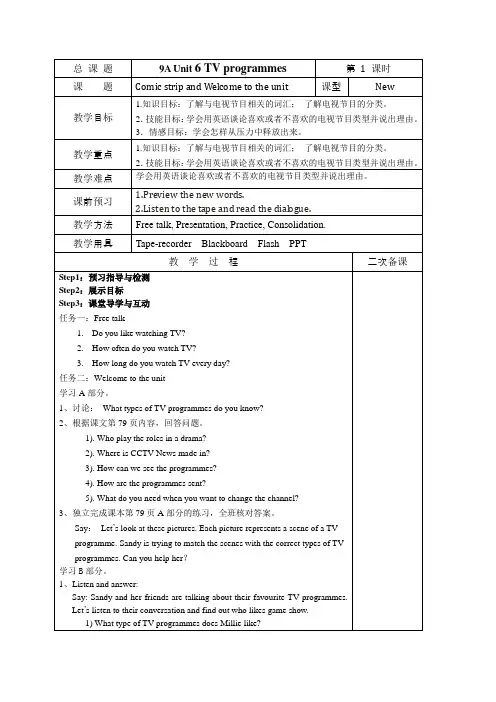
9A Unit6TV programmes
第1课时
课题
Comic strip and Welcome to the unit
课型
New
教学目标
1.知识目标:了解与电视节目相关的词汇;了解电视节目的分类。
2.技能目标:学会用英语谈论喜欢或者不喜欢的电视节目类型并说出理由。
3.情感目标:学会怎样从压力中释放出来。
1).Who play the roles in a drama?
2).Where is CCTV News made in?
3).How can we see the programmes?
4).How are the programmes sent?
5).What do you need when you want to change the channel?
...
SomeLanguage points
总课题
9A Unit6TV programmes
第2课时
课题
Reading I
课型
New
教学目标
1.知识目标:进一步认识和掌握与电视节目相关的词汇、词组。
2. 能力目标:
1)学会不同电视节目的特征及描述用语。
2)将学生自己的偏好和时间安排与电视节目匹配起来。
Do you get bored with staying at home all day?
If you get bored, what will you do?
Will you watch TV? Will you keep yourself busy all day?
2、听第78页comic strips回答问题:
牛津译林版九年级英语上册unit6全单元教案
牛津译林版九年级英语上册Unit 6 TV programsThe first periodObjectives:1.To learn vocabulary about TV programs2.To learn types of TV programsEmphasis and difficulties:1.The new words and expressions2.Talk about your own favourite TV programsTeaching steps :1.Have a free talk with the Ss like this :Do you like watching TV ? How often do you watch TV ?How long do you watch TV every day ?2.Ask the Ss how many types of TV programs they know . Show somepictures of types of TV programs to the Ss , present the new words and expressions: cartoon , chat show , comedy , documentary , drama series , game show .Ss repeat them after the teacher .3.Ss complete the exercises in Part A on page 79 on their own . Then asksix students to read the dialogue and check the answers with the class .4.Tell the Ss Sandy and her friends are talking about their favourite TVprograms .Play the tape for them to listen and answer : Who likes game shows .5.Books open ! Ss read the dialogue by themselves and answer some morequestions :What type of TV programs does Millie like ?Why does Millie like watching documentaries ?What does Amy think of chat shows ?Who loves cartoons ?6.Ask the Ss to practice the dialogue in pairs and then make up their owndialogue , talking about their favourite TV programs .7.Ask the Ss : Do you often stay at home at the weekend ? Do you getbored with staying at home all day ?Present the expressions: get bored , all day8.Play the tape in Comic strip , and ask a question :Is Eddie busy all day9.Ss read the dialogue by themselves , and ask some more questions:Is Eddie getting bored with staying at home all day ?Why not ?Does Hobo agree with Eddie ?What does Eddie do every day ?10.S s repeat the dialogue after the tape , then act it out .Homework :1.Recite the new words and expressions ;2.Finish off some exercises .The second periodReading (1)Objectives:1.To learn more vocabulary about TV programs2.To learn four types of TV programsEmphasis and difficulties :1.The new words and expressions2.Learn four types of TV programsTeaching steps :1.Ask the Ss how many types of TV programs they know .2.Ss talk about their favourite TV programs in pairs :What is your favourite TV program ? Why ?3.Tell the Ss : If you want to find out when a TV program will be shownand what it is about , you can read a TV guide .4.Explain the content in Reading to the Ss : Millie is reading a TV guideonline . A TV guide gives you information about different TV programs .( TV guide )5.Play the tape for Sports World . Ask : Is the weekly round-up in sportall about basketball ?6.Ss read the first TV program after the tape . Write the new words andexpressions on the Bb : round-up , up-to-date , fan , a number of , coming Ask the Ss to read this part together .7.Ask the Ss if they like watching music awards. If so , encourage someto say something about these shows .8.Play the tape for Beijing Music Awards , ask :9.How many fans have voted online for their favourite songs , singers andmusic videos ? Write down the new words and expressions : cover , live , Asian , vote , music video , announce , text message Ask the Ss to read this part together .10.A sk the Ss if they like horror films . Play the tape for A Murder in aCountry House and ask : Can you find out who the murderer is at the end of the film ? Write the following down on the Bb .11.Ask the Ss if they have watched any documentaries about tigers . Playthe tape for Tiger Watch and ask :What can you see in the documentary Write the following down on the Bb : unless , animal-lover , scene .Ask the Ss to read this part after the tape .12.A sk the Ss to complete the exercise in Part B1 , choose several studentsto read the whole sentences , and check the answers .13.Tell the Ss : Millie made some notes of Saturday’s TV programs . Askthem to do the exercise in Part B2.14.S s read the text again and do the exercise in Part B3 and check theanswers .Homework :1.Read the text for retelling .2.Recite the new words and expressions .3.Finish off some exercises .The third periodReading (2)Objectives :1.To be able to retell the text2.To grasp the language pointsEmphasis and difficulties :1.Grasp the language points2.Retell the textTeaching steps :1.Revise what was learnt in the second period by asking the Ss to fill inthe blanks .Let me tell you about this Saturday’s TV programs . Fist is Sports World .There is a weekly _____ of what is happening in sport , with ______ information . Then it is Beijing Music Awards . It will be covered ______ . Many ____ pop stars will attend . On Golden TV, you will seea film called Murder in a Country House . It is a _____ film _____ byCindy Clark . The film is full of horror and ______ . The last one is a _____ named Tiger Watch . You can see _____ from India in it . Tiger Watch won an _____ for its amazing photography .2.While doing this , revise the useful expressions : a weekly round-up ,be covered live , be director by , win an award3.Ask the Ss to read the text ,and do the exercises in Part B4 on their own ,then let some students read the sentences in the bubbles , and check the answers .4.Ask the Ss to find out the problems they have , and discuss them withthe students .5.Ask the Ss to retell the text , according to some given expressions .6.Extra exercises :1)I would like to _______ Lily as our monitor because she is very helpfuland organized .2)Last week , a sports meeting ______ at our school .3)If you do the same thing day after day , you may ______ .4)After reading this book , I cried because I ______ the death of the doctorin it .5)Nick _____ the Best Designer at the fashion show competition lastmonth .6)I have watched ______ documentaries on Chinese food .7.Encourage the Ss to write a short passage about their favourite TVprograms and the reasons .Homework :1.Recite the new words and expressions .2.Finish off some exercises .The fourth periodGrammar (1)Objectives :1. To learn to talk about the result of a possible action with if2. To be able to use the if-clause correctlyEmphasis and difficulties :Learn the if –clauseTeaching steps :1.Ask the Ss : What TV program will you watch if you finish your homework this evening ? Write some students’ answers on the Bb:e,g., If I finish my homework early , I will watch the basketball match onTV .2. Tell the Ss : We use if to talk about the result of a possible action . Ask them to pay attention to the two tenses : the simple present tense in the if-clause ,and the future tense in the main clause .3. Look through the sample sentences on page 84 .4. Give some more examples to the Ss :If we grow more bamboo , giant pandas will have more food .If we don’t protect tigers , they will die .If he studies harder , he might be one of the top students in his class .If you send text messages to 1396 , you may win two free concert tickets ,Attention : We put a comma after the if-clause when it is the first part ofa sentence .4.Ask the Ss to finish the exercise in Part A1 , then invite five students toread the completed sentences and check the answers as a class .5.Work out the rules !6.Let the Ss complete the exercise in Part A 2 ,then ask a pair of studentsto read the dialogue , and check the answers .7.Give some extra exercises:1)I ______ (join) the Singing Club next term if you _____(join) it too .2)If we ______(win) the basketball match tonight , we ______(be) inthe final .3)If Tom _____(pass) the exam , his father _____(take) him to HongKong .4)If I ______(watch) this TV program about animals carefully , I_______(get) enough information for my class report .5)If you ______(arrive) at noon , you _____(see) the feeding of animals . Homework :1.Revise the grammar .2.Finish off some exercises .The fifth periodGrammar (2)Objectives :1. To learn to talk about the result of a possible action with unless2. To be able to use the unless-clause correctlyEmphasis and difficulties :Learn the unless–clauseTeaching steps :1.Work in pairs to talk about what they will do this Saturday if it does not rain .2.Encourage the Ss to translate the following sentences in English .1)除非下雨,否则我们明天要去公园。
牛津译林版英语九年级上册Unit6教案说课稿
(一)板书设计
我的板书设计将采用清晰的布局和简洁的风格。板书分为三个部分:左上角列出本节课的主要词汇,中间部分展示关键的句型结构,右下角用于记录学生在讨论中的精彩表达。板书的风格将以简洁明了为主,使用不同颜色的粉笔突出重点,使学生在视觉上能够快速抓住关键信息。
板书在教学过程中的作用是帮助学生梳理知识结构,强化记忆。为确保板书清晰、简洁且有助于学生把握知识结构,我将:
本节课在课程体系中的位置是继前五个单元学习日常生活中的各种话题后,进一步拓展学生的视野,让他们学会用英语讨论和评价电视节目,提高他们的语言运用能力课的词汇和句型,运用一般现在时描述自己喜欢的电视节目,并能进行简单的讨论和评价。
过程与方法目标:通过小组合作、讨论、汇报等形式,培养学生运用英语进行沟通和表达的能力,提高他们的合作意识和解决问题的能力。
3.课堂时间安排可能紧张,影响教学进程。
应对这些问题,我将:
1.在课堂上增加对新词汇的复习和巩固环节,提高学生的掌握程度。
2.引导学生学会分工合作,确保每个小组成员都能积极参与。
3.精心安排课堂时间,合理分配各环节,确保教学目标的实现。
课后,我将通过以下方式评估教学效果:
1.收集学生的课堂练习和作业,分析他们对知识点的掌握情况。
(二)学习障碍
学生在学习本节课之前,已经掌握了基本的英语语法和词汇,具备了一定的听说读写能力。然而,他们可能在前置知识上存在以下不足:1.对电视节目类型的了解有限,可能无法准确区分和描述各种电视节目;2.对一般现在时的运用不够熟练,特别是在描述习惯性动作和状态时容易出错;3.在讨论和表达个人观点时,可能缺乏自信,导致表达不流畅。
3.教师评价:针对学生的表现,给予及时的反馈和建议,鼓励他们继续努力,不断提高。
Unit6 Grammar教案 牛津译林版九年级英语上册
Unit6 TV programmes Grammar教案(一)Grammar教案(二)I. Teaching aims and learning objectivesBy the end of the lesson, students should be able to:1.learn to use if-clause;2.learn to use unless-clause.II. Teaching contents1.New words and phrases:be in danger live in the wildlive as a family realize your dreamweather report have a chance to do sth.Take your own food with you have little interest in sth. 2.New structures:If you enjoy solving mysteries, you might like this film.Unless you try your best, you will not realize your dream.You will have a chance to see how a TV programme is recordedunless you have little interest in it.III. Focus of the lesson and predicted area of difficulty1. To use if-clause to talk about the result of a possible action.2. To use unless to say that something can only happen or be true in a particular situation.IV. Teaching proceduresGrammar AStep 1 Sing a song -I f You Are HappyIf you’re happy and you know it , clap Your handsIf you’re happy and you know it , clap your handsIf you’re happy and you know itNever be afraid to show it...【设计意图:通过英文歌曲调节气氛,同时迅速进入本课重点if-clause。
牛津译林版九年级英语上册教案:Unit6TVprogrammesReadingI
Unit6 TV ProgrammesReading ITeaching aims and demands:New words: weekly, round-up, up-to-date, cover, live, coming, attend, announce, text, message, concert Phrases: a TV guide onlinea weekly round-upup-to-date infromationsuch asfind this week’s programme a bit boringa number ofwill be heldvote on lineduring this programmewrite downwin two free concert ticketsTeaching methods: task-based approachTeaching task:1 To recognize and understand vocabulary related to TV programmes.2 To identify statements as true or false based on the reading passage.3 To match students’ preferences and schedules to TV programmes.Teaching aids: tape recorder, computerTeaching procedures:Ⅰ. Warm-upAsk the Ss to spell the words according to the picture.weekly, round-up, up-to-date, interview, cover, live, presentation, coming, vote, announce, text, concert Then match the words.Ⅱ.ListeningNow, listen to the text, please answer the question “What’s on this Saturday?”Listen again, Ss read after the tape, and do some exercises.Ⅲ. ReadingSs read the articles by yourselves. Do the Exx on the blackboard. Check the answers with the whole class.1. We can watch sports news on Saturday afternoon.2. Sports World covers badminton this week.3. There are many interviews with the famous football coaches in this week’s Sports World.4. Beijing Music Awards was recorded last week.5. Just a few big film stars will come to the show.6. Twenty thousand journalists have voted online for their favourite songs, singers and music videos.7. You could get a free ticket if you answer the questions during the awards.Then let the students read the text carefully and answer the questions:1)It’s a w eekly round-up of what is happening in sport, isn’t it?2)What is it with?3) What does this programme cover ?4.How many fans have voted online for their favourite songs, singers and music videos?5.When will the results be announced?Then what will follow?6. How can people win two free concert tickets ?Let the studetns fill in the form according to the text.Fill in the blank according to the text.This Saturday you can watch ____________ and ___________________ on Sunshine TV. If you watch Sports World, there is ________________ of what is happening in sports. The pragramme are mainly about _______. There are ____________________ with the famous football players.The ___________ of Beijing Music Awards will be held this coming Saturday and it will be __________. Before the awards, there will be _________ with the most famous stars. Twenty thousand fans _________ _________ their favourite songs, singers and music videos.Language points:1.A weekly round-up of what is happening in sport, with lots of up-to-date(latest) information.2.cover的用法1)The programme covers different sports.(涉及、涵盖)2)This year’s Beijing Music Awards will be covered live.(报道)3)She woke up early only to find the ground was covered with snow.(覆盖)3.sport的含义1).A weekly round-up of what is happening in sport.(不可数名词,表体育运动)2) The programme covers different sports.(可数名词,表某项体育运动)4.boring(事物)/bored(人)The concert was so _____ that half of the audience were _________.(bore)5.There are a number of interviews with some famous football players.1)a number of ==many+可数名词复数许多A large number of young people are interested in fashion.2)The number of--的数量,谓语动词用单数The number of the teachers in our school is 83.3)have an interview withI had an interview with Lily’s grandpa this morning.6.include (V.动词)包含including(Prep.介词)包含A report on preparations for the coming World Cup will also be included.The course covers many topics including travel and hotels, food and drink and shopping and money.7.This year’s Beijing Music Awards will be co vered live.be covered live 现场直播报道1)The thief was caught alive.(活着的)2)This is a live football match.(实况转播的)3)They bought live sheep on board.(活的)4) He is a lively young man full of energy.(充满活力的)8.Many famous Asian pop stars will attend (the presentation.)attend the meeting 参加会议9.Some of the most famous stars will be interviewed about their recent work before the awards start.10.Twenty thousand fans have voted online for their favourite songs,singers and music videos.1) twenty thousand数词+ thousand2) thousands of 成千上万的3)vote online for11.As you are watching the show, write down your answers and send text messages to 1396.1)as==when//while2)send text messages to---发送短信到---12.win two free concert tickets.Ⅵ.Sum-upGo through the new words and the language points learnt during this lesson. Then do the exercise.1、本周六将实况转播这场乒乓球赛。