
初中英语动词复习
八、动词考试标准:1. 熟悉常用的基本形式:动词原形,过去式,过去分词,现在分词和第三人称单数形式。
2. 能正确使用常用及物动词和不及物动词。
3. 掌握常用连系动词如be, get, look, seem等,及其与表语连用的特点。
4. 能分清look, get, grow, turn 等作连系动词和作为行为动词用的不用含义。
5. 能正确使用助动词如be, do ,have ,shall, will 等。
6. 掌握情态动词can,may,must等的基本用法,can’t,may,must,might 等表推测的用法,以及needn’t,mustn’t等在答语中的基本用法。
7. 能正确使用六种时态:一般现在时、一般过去时、现在进行时、过去进行时、现在完成时、一般将来时。
8. 掌握一般现在时、一般过去时和带有情态动词can,may,must等的被动语态。
9. 熟悉并掌握动词不定式作宾语、状语和作宾语补足语的用法。
10. 理解现在分词与过去分词在用法上的区别。
动词的四种形式A、动三单的变法1) “辅+y”结尾, 变y为i加es;2) “以s; sh; ch; x; o结尾, 加es;3)直接加s但have----hasB、现在分词的变法1)去e加ing (e不发音);2)双写加ing (“辅元辅”结尾且重读,y;w列外);3)直接加ing写出下列动词的现在分词1.see_______e ________3.stop_______4.open _______5.listen_______6.drop ______7.prefer________8.fix_______ 9.relax ______10.die _______11.tie _______12.lie _______C、动词的过去式和过去分词(一)不规则变化(见课本不规则变化表P255)(二)规则变化1) “辅+y”结尾,变y为i加ed;2)双写加ed;3)直接加ed写出下列动词的过去式和过去分词1.drop ______ _______2.stop ______ ______3.prefer ________ _________4.study ______ ______5.try ______ ____6.fix _____ ______7.relax ______ ______附Ⅱ——情态动词(can/ could; may/ might; must; should)+动原1.must(必须)——needn’t(不必)may(可以)——mustn’t(不许;不准;不可以)2.注意几个题:1)—May I go with you? —No, you _________.2)—Must I turn off the light now? —Yes, you ______/ No, you _________ 附Ⅲ——动词不定式与动名词A 、动词不定式作宾补1)tell / ask / want sb to do ______________否定式:tell/ask/want sb not to do ______________________________2)省to 不定式作宾 ,即:(l, m, n, 3h, 2看, 1f) sb dol —let; m —make; n —notice; 3h —hear, have, help; 2看—see, watch; 1f —feel但注意:1)help sb (to) do (to 可省、可不省)2)在改作被动语态时省去的to 应还原eg. Someone heard him sing in the room.He was heard to sing in the room.B 、动词不定式与动名词的区别1.(hope; learn; want=would like; decide) to do2.(enjoy; finish; keep; mind; practise) doingdoing worth be problems some have fun have to doing prefer to on contributi a make from prevent keep stop like feel in spend in busy be ⎪⎪⎪⎪⎪⎪⎭⎪⎪⎪⎪⎪⎪⎬⎫⎪⎪⎪⎪⎪⎪⎩⎪⎪⎪⎪⎪⎪⎨⎧...//)...()(⎪⎪⎪⎪⎩⎪⎪⎪⎪⎨⎧⋯⋯⋯⋯⋯⋯⋯⋯(已做)记住已做了(未做)记住做(已做)忘记已做了(未做)忘记做停止做(正在做的事))停下来去做(另一件事::::::.3doing do to remember doing do forget doing do to stop 动作在进行)动作结束)((),,.(4doing do sb hear watch see (原来的事)继续做(另一件事)接着做⋯⋯⋯⋯::.5doing do to on go 常可替换)((),,.6doing dolike start begin 动原+⎪⎪⎭⎪⎪⎬⎫⎪⎪⎩⎪⎪⎨⎧than rather do to prefer please you Could would Will better had not Why //.7 8.介词+doingeg. 1)What/ How about doing2)be good at doing附Ⅳ——宾语从句与状语从句中的时态1.状语从句中的时态:eg.1)I’ll call you as soon as he ______ (come) back.2)He won’t go to bed until he _________ (finish) his homework.3)I’ll help you if I _____ (be) free tomorrow2.宾语从句中的时态:但当宾语从句是指客观事实、普遍真理、自然现象时,则只能用一般现在时。
eg.1)He said his father _________(come) back in two days.2)The teacher said light ________(travel) faster than sound.附Ⅴ——主谓一致1.表“时间、距离、金钱、长度”的名词短语做主语时应看作一个整体,视为三单eg. Two months is quite a long time.2.people; police形单实为复,作主为复eg. The police are looking for the missing boy.3.maths, news, physics形复实为单,作主为单4.family; class看作整体时作主语为单数;看作整体中的各成员时则为复数。
eg. 1)My family is a big one.2)My family are watching TV.5.由with, except, as well as连接的两名词作主语,谓语由前者决定eg. The teacher with his students is going to Beijing tomorrow.6.由neither…nor; either…or; not only…bout also连接的两名词作主语,谓语由后者决定eg. Neither he nor I am a teacher.7.不定代词(something; anything; nothing; someone; anyone; everyone…)作主语为三单Nobody knows it except me.8.One of + 复名… 作主语为单数eg. One of my friends is a computer engineer.9.“the +姓的复数”作主语为复数eg. The Lius are watching TV now.10.sheep; deer; fish单复同形,注意区别作主语是单还是复eg. 1)There are many sheep on the hill.2)Milk ____ white, and sheep ______ white, too. (be填空)11.there be结构中,如果有两个以上的名词作主语,则be应与最接近的那个名词一致。
(即:靠近原则)eg.1)There ____a box and some pens on the desk.2)There ____some pens and a box on the desk.12. either, neither, each作主语为三单eg. Neither of the twins ______(like) drawing.13.由两部分构成的事物名词(trousers, glasses, chopsticks)作主语为复数,但当前面有pair 短语修饰时,则谓语由pair的单复数来决定谓语。
eg.1)Where ____(be) my glasses?2)That pair of trousers ____(be) Mr. Green’s附Ⅵ——“短命”动词与“长命”动词之间的转化buy—have ; borrow—keep ; die—be dead ; leave—be away (from); come back—be back; fall asleep—be asleep ; open—be open ;catch a cold—have a cold; go /get out—be out;arrive (reach / get to / come to) +地点—be in +地点;join—be in +集体(或be + 成员);turn on—be on; turn off—be off ;get a letter from—have a letter from.end /finish—be over ; get up—be up ;练习一、用所给动词的适当形式填空1.Mother ________ (watch) TV every evening.2.We________(talk) when the teacher came in.3.He ________(go) to Beijing two days ago.4.He ________(leave) Chengdu in two days.5.Look! The boy________(play) football on the playground.6.My uncle ______(live) here for ten years.7.He often helps the old woman _______ (carry) water.8.Would you like to make a contribution to ________ (improve) our living conditions?9.Don’t forget ________(turn) off the lights before you go out.10.Please let the girls _____(go) first.二、选择填空( )1.—Must I turn off the light now? ---No, you ____ A. needn’t B. mustn’t C. can’t ( )2.Our teacher told us the sun ____ in the east. A. rose B. rises C. is rising ( )3.He ___ back in a month. A. will come B. come C. came( )4.I ___ him before. A. met B. had met C. have met( )5.The teacher ____ to Japan this year. She’s now telling her pupils abou t it.A. wentB. has beenC. has gone( )6.It ____ hard when I got home yesterday. A. rained B. is raining C. was raining ( )7.Why not ____ again? A. to try B. try C. trying( )8.He has finished ____ the letter. A. writing B. to write C. wrote( )9.It _____ every night. A. happens B. is happened C. happened( )10.The policeman told the children ____ in the street.A.to not playB.not playC.not to play。
动词五种基本形式(初中英语专题复习)2
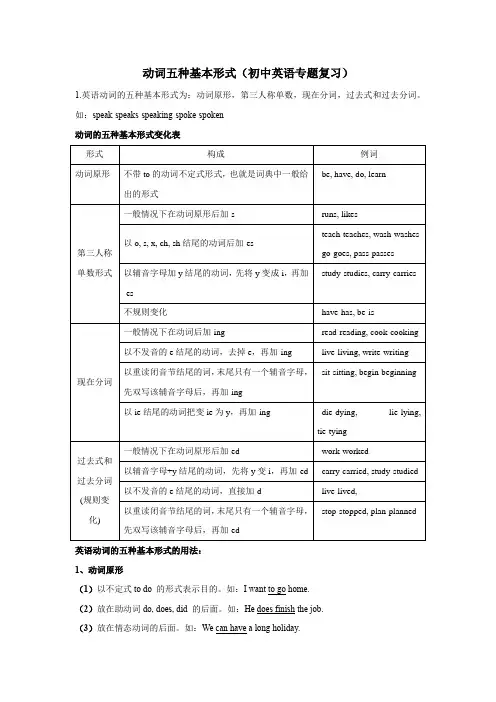
动词五种基本形式(初中英语专题复习)1.英语动词的五种基本形式为:动词原形,第三人称单数,现在分词,过去式和过去分词。
如:speak-speaks-speaking-spoke-spoken动词的五种基本形式变化表英语动词的五种基本形式的用法:1、动词原形(1)以不定式to do 的形式表示目的。
如:I want to go home.(2)放在助动词do, does, did 的后面。
如:He does finish the job.(3)放在情态动词的后面。
如:We can have a long holiday.(4)用于一般现在时(除第三人称单数外)。
如:I like playing the piano.2、第三人称单数形式:用于主语为第三人称单数的一般现在时。
如:Tom often goes to school by bus.3、现在分词:用于进行时态,包括现在进行时,过去进行时等。
如:The students are reading the books now. // When the storm was coming, I was sleeping.4、过去式:用于一般过去时态,表示过去某一时刻或某一段时间内所发生的动作或情况。
通常一般过去式带有表示动作时间状语的词,词组或从句。
如yesterday, the day before last, last week, two days ago 等,上下文清楚时可以不带时间状语。
如:I was late yesterday. // They went to see a film two days ago. // The man smoked a lot in the past.5、过去分词:用于被动语态和完成时。
如:A new bridge will be built next year. // He has told me the sports meet might be put off.。
动词及动词短语(63张PPT)初中英语专项复习课件

can
Can I go home now?我现在可以回
表示请求、允许,意为 家了吗?
“可以”,较口语化 You can tell him about that now.你现
在可以告诉他那件事了。
表示推测,意为“可能”, —Where can it be?它会在哪
常用于否定句和疑问句中。 儿?
satisfy 使满意
S save 挽救;节约
score 得分
search 搜索
seem 好像;似乎;看来 sell 卖
send 寄;送
separate 分离;分开
ser ve 服务;端菜
set 设置;摆放
shake 摇;握
share 分享
spread 传播;扩散
stand 站立;忍受
start 开始;出发 steal 偷 stick 粘;贴 store 储存 suggest 建议;暗示 suppose 认为
fail 失败 fall 掉落 fight 打架;争斗 finish 完成 follow 跟着;按照 form 形成
F feed 喂食 feel 感觉 fill 填满 fix 安装 force 强迫
grow 生长;种植 guess 猜
G guard 保卫 guide 引导;带领
hang 悬挂 hate 讨厌 hit 击;撞 hold 持有;握着;举行 hurry 匆忙
—Need I go there tomor row?明天 need 其引导的一般疑问句,
我需要去那儿吗? 肯定回答用 must,否定
—Yes,you must./No,you needn't. 回答用 needn't
初中英语动词表(适合动词专项复习用,归纳的很全面哦)

mind 介意 wash 洗;洗涤 rest 休息 hear 听见;听说 send 发送;寄 shower 淋浴 laugh 笑;感到好笑 begin 开始 mix 混合在一起;混合 roll 卷;裹 call 把…叫做;称呼 act 表演;演戏 travel 旅行;长途旅行 sweep 扫除;清除;清扫 invite 邀请;恳请 fly 飞行 paly 播放 fit 适合;适应 send 派遣;打发;安排去 follow 跟随;追随 kill 杀死;致死 return 回来;返回 allow 允许;准许 criticize 批评;批判 receive 受到;接受 enter 参加;进入 fear 害怕;担心 prononce 发…音;正确吐(字音等) deal 处理;应付 lose 失去;丧失 replay 回答;答复 cover 覆盖;遮盖 treat 对待 catch 赶上(车船等);捕获 miss 错过;遗漏 increase 增加;增大 provide 提供;供应;供给 establish 建立;建造;设立 fill 装满;填满 appreciate感激 produce 生产;创造;产生 knock 敲;击;碰撞 rush 冲;奔 marry 嫁;娶;与…结婚 shake 摇动;震动 stick 刺;戳;插 form 构成;组成 list 列出;列举;列表 pull 拉;托;拔
will would
将(会);将(要) 表示愿意
1、情态动词 shall should 3、系动词
将(会);将(要) 应该;
look seem
看;望;看起来 似乎;像是
taste
become
尝试;尝起来 变得
terrify remaid thrill stress
3、(含有)使…的动词 、(含有) 含有 使害怕;使恐惧 cause 造成;使发生 使记起 suit 适合;使感到满意 (使)非常激动(使)非常紧张 trouble 使烦恼;麻烦 加压力于;使紧张 surprise 使惊奇;使意外
动词及动词短语(88张PPT)初中英语专项复习课件
进入。故选C。
( A )2. — Would you please ______ your email address? I missed it just now. — No problem. It's fox@163com. A. repeat B. review C. record 【解析】 考查动词辨析。句意:——你可以再重复一下你的电子邮箱吗?我刚刚忘记了。——没问题 。是fox@163com。repeat重复;review复习;record记录。故选A。
动词的基本形式 1. 动词原形 2. 一般现在时的第三人称单数的变化规则
一般情况下直接加-s
read — reads write — writes
run — runs
以 ch, sh, s, x 或 o 结尾的词 加-es
以“辅音字母+y”结尾的 词变 y 为 i 再加-es, 但以 “元音字母+y”结尾的词 则直接加-s
The film has been on for
不 能 和 表 示 一 finish, arrive,
动词
ten minutes. 电 影 开 始 十
段 时 间 的 状 语 join,
go,
分钟了。(这里不能用 has
连用
come, catch
begun)
2.助动词 助动词本身没有意义或意义不完整,不能单独用作谓语。助动词在句中与实义动词或系动词一起构成谓 语,以表示时态、语态、人称和数。此外,还可以用来构成否定句、疑问句或强调句等句型。具体用法 见下表。
lie — lying tie — tying
初中阶段常见的需要双写最后一个辅音字母变动词ing形式的动词有: shop, stop, drop, run, get, sit, dig, put, begin, swim, chat, prefer等。 【闪记】 现在分词构成歌诀
动词的分类(19张PPT)初中英语专项复习课件

一、实义动词 实义动词,含有实际意义,表动作或状态,可独立做谓语。 动词按照其后是否能跟宾语可分为及物动词和不及物动词。 1.及物动词 及物动词就是后面必须跟宾语意义才完整的动词。如 love,need,want,ask,have,help,teach,make等。 I love my mother.我爱我的母亲。
2.不及物动词 (1)不及物动词本身意义完整,其后不必跟宾语。如 come,go,run,travel,listen,swim,live,work等。 The man works hard.这个人工作很努力。 (2)如果需要带宾语,则不及物动词需要跟适当的介词连用。 Look at the blackboard.看黑板。 动词按照其是否具有延续性,又可分为延续性动词和短暂性动词。 1.延续性动词,如:study,sleep,live,stay。延续性动词常和能表示 一段时间的状语连用。 2.短暂性动词,如:begin,buy,borrow,die。短暂性动词不能与表示一 段时间的状语连用。
go,turn 等
布莱克先生的脸变红了。
keep,stay, remain 等
The shop stays open till 8 in the evening. 商店一直营业到晚上 8 点。
三、助动词 助动词本身没有意义,不能单独做谓语,只能和别的动词一起构成谓语, 表示时态、语态、语气等特征,帮助构成否定、疑问、强调、省略等。 主要的助动词有be,do,have,shall,will等。
I have borrowed that book for one month.(×)
I have kept that book for one month.(√)
初中英语常见动词
初中英语常见动词
1. “哎呀,我最喜欢的动词就是‘like’啦!”
- 我和小伙伴一起逛街,看到一件漂亮的衣服,我就会说:“I really like this dress!”
2. “‘go’这个动词超常用的好不好!”
- 早上妈妈喊我:“Time to go to school!”我赶紧收拾书包出门。
3. “‘have’可是少不了呀!”
- 我问朋友:“Do you have a pen?”他摇摇头说没有。
4. “e’,快过来呀!”
- 在公园里,我朝小伙伴喊:“Come here and see this beautiful flower!”
5. “‘do’,每天都要做很多事情呢!”
- 我自言自语:“I have to do my homework first after school.”
6. “‘get’,我经常说 I get it!”
- 课堂上老师讲完题问我们懂没懂,我大声说:“I get it!”
7. “‘give’,把东西给别人就用这个动词呀!”
- 我把我的玩具分享给弟弟,说:“Here, I give you this toy.”
8. “‘take’,拿东西就得用它呀!”
- 我准备去游泳,对妈妈说:“I will take my swimming suit.”
9. “‘see’,看到美好的东西就会很开心呢!”
- 我和爸爸去动物园,看到可爱的猴子,我兴奋地说:“Look, I see the monkeys!”
10. “‘say’,说话不就得用这个嘛!”
- 我和朋友闹别扭了,最后我主动说:“I want to say sorry.”。
初中常考总复习英语动词
初中常考总复习英语动词1、带动词ing形式:1、keep doing坚持做某事2、 keep sb、 doing使某人一直做某事3、 practise doing sth、练习做某事4、 enjoy doing喜欢做某事5、 finish doing完成做某事6、 be afraid of doing 害怕做某事 be busy doing 忙于做某事7、 look forward to doing盼望做某事8、 how about doing、、/what about doing做某事怎么样9、 spend some time (in)doing花时间做某事10、 spend some money (in)buying 花钱做某事11、feel like doing想做某事12、stop/keep/prevent … from doing阻止某人做某事13、 thank sb for doing感谢某人做某事14、 thanks for doing感谢做某事15、 do somecooking/cleaning/reading/shopping/washing做点饭、打扫一下卫生、读点书、逛逛街、洗洗衣服16、 go swimming/fishing/shopping/skating/boating去游泳、钓鱼、逛街、滑冰、划船17、 mind doing介意做某事18、can’t help doing情不自禁做某事19、 consider doing考虑做某事20、 have fun doing sth、、做某事有趣21、have difficulty doing sth做某事有困难 have trouble doing sth做某事有困难 have problem doing sth 做某事有困难22、 waste time/money doing浪费时间或金钱做某事23、 instead of doing代替做某事24、 miss doing 错过做某事25、 hold on to doing坚持做某事26、 pay attention to doing集中精力做某事27、 suggest doing建议做某事28、It’s time for doing 到该做某事的时间了It’s time to do sth、到该做某事的时间了29、 There is sb doing sth有人正在做某事30、 be used to doing sth 习惯做某事31、be used for doing sth被用来做某事32、 have a lot of experience具有做某事的丰富经验33 sb allow doing sth允许做某事34、 put off doing sth推迟做某事35、 succeed in doing sth 成功做某事36、 end up doing以做某事结束37、 give up doing放弃做某事二、含有不带to的动词不定式句型:1、had better (not)do sth、最好(不)做某事2、 would you please (not)do sth 你可以做某事吗?3、 why not do sth、为什么不做某事?why don’t you do sth、为什么你不做某事?4、 Shall we do sth、?我们要做某事吗?5、 let sb do sth、让某人做某事6、 make sb、 do sth、 have sb do sth使某人做某事7、 feel sb do sth感觉某人做某事三、含有带to的动词不定式句型:1、It’s time to do sth、该是做某事的时候了2、 It takes sb、 some time to do sth做某事花了某人时间3、 tell/ ask/ want/encourage/invite/ sb、 to do sth、告诉、叫、想、鼓励、邀请某人做某事4、 Would you like to do sth、?你想做某事吗?5、It’s good/bad to do sth做某事好/不好6、It’s good/bad for sb、to do sth、对某人来说,做某事好/不好7、 be +adj、+ enough to do sth、足够+形容词做某事8、 sb、 is ready to do sth、某人准备好做某事9、It’s + adj、+ for sb、 to do sth、做某事对某人+形容词(做这件事对你好)10、It’s + adj、+ of sb、 to do sth某人做某事+形容词(你做这事真好)11、would like/love /decide/want/wish/to do sth、想、喜欢、决定、想、希望做某事12、 would like/love sb、 to do sth、想让某人做某事13、 prefer to do rather than do sth、宁愿做某事而不愿做某事例如:I prefer to read rather than write 、意思同I prefer reading to writing、又如:I prefer to stay at home rather than go out、再如:prefer=like better ,即:I prefer red、=I like red better、14、 how/ when/where/whether to do sth怎么、什么时候、在哪里、要不要做某事15、can’t wait to do 迫不及待做某事16、too … to do … 太怎么样而不能做某事17、 be afraid /ready/able/sure to do害怕、准备、能够、确定做某事18、It’s time to do sth到该干某事的时候了19、 My job is to do sth我的工作是做某事20、 My dream is to do sth我的梦想是做某事21、My hobby is to do sth我的业余爱好是做某事22、 refuse to do sth拒绝做某事23、 warn sb to do sth告诫某人做某事24、 pretend to do sth假装做某事25、 teach/learn to do sth 教做某事、/学习做某事26、 need to do sth需要做某事27、 be willing to do sth愿意做某事28、、try to do sth努力做某事29、try one’s best to do sth尽某人最大努力做某事30、 agree to do sth同意做某事31、seem to do sth 好像似乎做某事32、 plan to do sth /make a plan to do sth计划做某事33、 in order to do sth 为了做某事34、 have a chance to do sth有机会做某事35、 find it +adj + for sb to do sth发现做某事是……36、 have sth to do有某事要做37、 There is sth for sb to do对某人来说,有某事要做38、 be anxious to do渴望做某事39、 afford to do sth 支付得起做某事四、两个动作连用,表目的:40、 used to do sth 过去常常做某事41、be used to do sth被用来做某事42、 be supposed to do sth理应做某事,应该做某事43、 allow sb to do sth允许某人做某事44、 sb be allowed to do sth某人被允许做某事46、 the best way is to do sth最好的方法是做某事47、 the next step is to do sth 下一步是做某事48、 have nothing to do with 与某事无关49、 the first thing is to do sth第一件事是做某事50、it’s best to do sth最好做某事51、it’s a good time to do sth这是做某事的最好时间45、 it is a good way to do sth 做某事是个好的办法52、 add to do补充做某事53、 urge sb to do 催促某人做某事54、 educate sb to do 教育某人做某事55、 wait for sb to do等待某人做某事46、 order sb to do命令某人做某事56、 happen to do sth碰巧做某事57、 lead sb to do sth领导某人做某事58、it’ a good place to do sth这是做某事的好地方59、 invite sb to do邀请某人做某事47、 get to do sth设计做某事48、 expect to do 期望做某事60、 volunteer to do sth志愿做某事61、offer to do sth 主动提供做某事62、 have an opportunity to do有机会做某事63、 get sb to do sth使某人做某事64、it’s one’s duty to do sth做某事是某人的责任65、 use sth to do sth用某物做某事66、 be sure to do sth一定会做某事67、 have to do sth不得不做某事68、 be able / unable to do sth能够 /不能做某事五、既用带to的动词不定式又用ing形式的句型:1、stop to do/ doing停下来做另一件事 /停止做某事2、 forget to do/ doing忘记去做某事 /忘记做过某事3、 remember to do/doing记住去做某事/记得做过某事4、 go on to do/doing继续做另一件事 /继续做某事5、 like to do/doing 喜欢做某事(临时 /长期)6、 love to do/doing 喜欢做某事(临时 /长期)7、 prefer to do/doing 更喜欢做某事(临时 /长期)8、 hate to do/doing讨厌做某事(临时 /长期)六、下列结构用带to的动词不定式和ing形式含义相同:、1、、begin to do/doing开始做某事2、 start to do/doing开始做某事3、 continue to do/doing继续做某事4、 go on doing 继续做某事5、 take turns to do/doing 轮流做某事七、既用不带to 的动词不定式又用现在分词的句型:用不带to的动词不定式强调动作的完成过程;用现在分词强调动作的进行状态。
动词及动词短语(17张PPT)初中英语专项复习课件
动
词
的
第 ①一般动词在词尾加-s。如:look-looks; get-gets
基
动 词 和
动本 词
形
三 ②以s, x, sh, ch结尾加-es。如:address-addresses; box-boxes; finish人 finishes; touch-touches
动
称 ③以"辅音字母+y"结尾的词,变y为i加-es。如:study-studies
动词
中考主要是在语境中对动词进行考查,常见命题角度: (1)实义动词辨析。 中考选择填空和完形填空中都常涉及对实义动词辨析的考查,做题时: ✓ 首先要明确动词的含义; ✓ 然后通过分析语境找出关键词,或根据前后的逻辑关系确定答案。
动词
常考的几组近义动词: ①divide与separate ②hear, listen与sound ③invent, discover, create与find ④cost, spend, pay与take
规 则 变 化
过去分词
不规则变 化
动
词
的
基
动 词 和 动 词
动本 词
形 式
①一般动词在词尾加-ing:go-going; look-looking ②以不发音的e结尾的词,去e加-ing:come-coming; use-using 现 ③以辅音字母结尾的重读闭音节词,双写该辅音字母加-ing:begin在
类
sound, seem, feel, stay, turn, get, keep, remain
助动词 没有词义,不能单独作谓语:be, do/does/did, have/has/had, will, shall
情态动词(12张PPT)初中英语专项复习课件
例句
可能性
The storybook could be Jim’s. He likes reading
小
could 很可能 stories.这本故事书很可能是吉姆的,他喜欢读故
事。
This book must be Lucy’s, for her name is on the must 一定 cover.这本书一定是露西的,因为封面上有她的名 大
态 动
had better 最好,用来提出建议
today.
词
情态动词的基本含义
分析近三年中考真题可知,情态动词的基本用法是中考必考点,考生需 掌握各个情态动词的基本含义(见"考点帮")。
在答题时,应注意结合语境,并考虑常见句型。 常考情态动词有can、may和must及情态动词的否定形式needn’t、
基 本 句
②可能,也许,表示推
They might laugh at me.
型
might 测
情
态 动 词
常 见 情
①必须,表示命令或主观 看法
—Must I finish the homework today? —No, you needn’t/don’t have to. He must be staying here.
基
①能,会,表示能力
I can sing.
本
②可能,表示推测,常用于否定句和疑 Can it be right?
句
问句
型
can ③可以,表示许可和征求对方意见
Can you help me?
情
①能,会,can的过去式,表 I could do it.
态
常
过去的能力
初中英语动词的知识点总结
初中英语动词的知识点总结动词,就是表示动作和状态的词。
根据其在句中的功能,动词可分为四类,分别是:实义动词、系动词、助动词、情态动词。
下面是小编为大家整理的关于初中英语动词的知识点总结,希望对您有所帮助。
欢迎大家阅读参考学习!一、实义动词实义动词又叫行为动词,分成及物动词和不及物动词。
1、及物动词是必须带宾语的动词,可分为如下两类。
1) 及物动词+宾语例:I love my home. 我爱我家。
He bought an English dictionary. 他买了一本英语词典。
2) 及物动词+间接宾语+直接宾语例:She taught us maths. 她教我们数学。
My mother gave me a new pen. 母亲给了我一支新钢笔。
提示:常用的能接双宾语的及物动词有:give, teach, buy, lend, find, hand, leave, sell, show, read, pay, make, offer, build, pass, bring, cook等。
2、不及物动词不及物动词不需要跟宾语,本身意义完整。
例:She came last week. 她上周来的。
It is raining hard. 正下着大雨。
Class began at half past seven. 7点半开始上课。
What happened yesterday? 昨天发生了什么事?3、同一动词有时可用作及物动词,有时可用作不及物动词。
例如:She can dance and sing. 她能唱歌又能跳舞。
(sing在此用作不及物动词。
) She can sing many English songs. 她能唱好多首英文歌曲。
(sing用作及物动词。
)二、系动词系动词不能单独作谓语,后面必须跟表语构成合成式谓语。
表语通常由名词、形容词,或相当于名词或形容词的词或短语等充当,说明主语是什么或怎么样。