
光刻胶MSDS-东进
○ 应停留在上风处。 ○ 避免停留在低洼处。 ○ 出入密闭空间以前应进行通风。 ○ 不得向大气环境排放。 ○ 应注意避免排放到河流等,以防污染环境。 消除方法: ○ 迅速切断所有火源(禁止附近吸烟或有火花、火焰)。 ○ 防止流入排水口、下水道、地下室或封闭场所。 ○ 在地面形成很滑或易滑表面,需完全清除。
吸入: ○ 患者移到通风新鲜空气处,逾期保持呼吸畅通姿势休息。 ○ 就医接受诊疗。
食入: ○ 漱口。 ○ 就医接受诊疗。
第五部分 消防措施
危险特征: 通常条件下稳定 有害燃烧产物:不会产生危险的聚合反应 灭火方法及灭火剂:
○ 灭火方法:窒息灭火 ○ 适用灭火剂:粉末灭火剂、二氧化碳、洒水、一般泡沫灭火剂、洒水、水喷雾、一般泡沫灭火
物质安全资料表 MSDS
第一部分 化学品及企业标识
化学品中文名称: DSP-B10
化学品俗名或商品名: DSP-B10
化学品英文名称: DSP-B10
企业名称:(株)东进世美肯
地址: 京幾道华城市杨甘面寥塘里 625-3
邮编:445-935
电子邮件:jge@
传真:+82-31-353-2200
亚急性和慢性毒性: 刺激性:未分类
○ 腐蚀皮肤或刺激性:未分类. • PGMEA:兔子:无刺激性(IUCLID) • Novolac Resin:无资料 • PAC:无资料
○ 眼睛受伤严重或刺激性:未分类. • PGMEA:兔子:弱刺激性 (IUCLID) – 未分类. • Novolac Resin:无资料 • PAC:无资料
生物降解性: ○ PGMEA:log Kow = 0.36, 28 天后 99 %(DOC), 87 % (BOD) (GLP) (HSDB) ○ Novolac Resin:无资料 ○ PAC:无资料
非生物降解性:无资料 生物富集或生物积累性:
○ PGMEA:易分解性(OECD TG 301), Log Pow = 0.36(25°C) ○ Novolac Resin:无资料 ○ PAC:无资料 其他有害作用:无资料
混合物
浓度 80~90% 5~15% <5%
CAS No. 108-65-6 9003-35-4 107761-81-9 ※ 该内容属经营机密,请做好保密工作。
第三部分 危险性概述
危险性类别: ○ 可燃性液体:区分 3 ○ 特定标的器官毒性物质(1 次暴露):区分 2 ○ 特定标的器官毒性物质(反复暴露):区分 2
E2010-6021-O 第 1/9页
燃爆危险: 加热后容器可能会出现爆炸。
第四部分 急救措施
皮肤接触: ○ 脱掉污染的衣服和鞋子,再次使用前需洗净。 ○ 迅速清洗皮肤。 ○ 用大量水和肥皂洗净。 ○ 就医接受诊疗。 ○ 污染的衣服应洗净后再穿。
眼睛接触: ○ 用流动清水至少清洗 20 分钟以上。 ○ 佩戴隐形眼镜的,如能轻易取出应立即取出。 ○ 就医接受诊疗。
眼睛防护: • 为了从飞溅物、有害液体中保护眼睛,应佩戴可与防护眼镜一起使用的面罩。 • 应在距离现场不远处安装洗漱设备和紧急洗涤设备(淋浴式)。
身体防护: 可能直接接触的,应穿戴非渗透性防护服。 手部防护:可能直接接触的,应佩戴非渗透性防护手套。 其他防护:无资料
第九部分 理化特性
外观与性状 :黑红色粘性液体
引燃温度(℃): 无资料
爆炸上限%(V/V):7.0vol%
爆炸下限%(V/V):1.5vol%,
溶解性:无资料
主要用途: 半导体及 TFT-LCD 制作中 Pattern 形成工序使用的 Positive Photoresist.
其他理化性质:无资料
E2010-6021-O 第 4/9页
第十部分 稳定性和反应性
– 应采用中和、氧化、还原、聚合、缩合反应处置,或用凝聚、沉淀、过滤、脱水方法
重新处理后,焚烧残余物。
废弃注意事项:
○ 排放工厂废物的业主(工厂废物排放者)应自行处理工厂产生的废物,或委托废物处理单位、 再生处理他人废物的单位、安装经营废物处理设施的单位进行处理。
○ 应遵守废物管理法规定。
第十四部分 运输信息
E2010-6021-O 第 7/9页
○ 持久性有机污染物管理法:非限制对象 ○ EU 分类信息
• 确定分类结果 - PGMEA:R10, Xi; R36 - Novolac Resin:未分类 - PAC:未分类
• 危险语句 - PGMEA:R10, R36 - Novolac Resin:无资料 - PAC:无资料
稳定性: 通常条件下稳定 禁配物: 强氧化剂 避免接触的条件:热、火花、火焰等火源 聚合物: 不会产生危险的聚合反应 分解产物: 一氧化碳、二氧化碳、氮氧化物、硫氧化物
第十一部分 毒理学信息
急性毒性: • 口服:未分类. (ATEmix>5000mg/kg) - PGMEA:LD50>5000 mg/kg (rat) (OECD SIDS) - Novolac Resin:LD50>5000 mg/kg (rat) (NLM) - PAC:无资料 • 注射:未分类. (ATEmix>5000mg/kg) - PGMEA:LD50>5000 mg/kg (rabbit) (OECD SIDS, IUCLID, NLM) - Novolac Resin:LD50>2000 mg/kg (rat) (NLM) - PAC:无资料 • 吸入:无资料
第十三部分 废弃处置
E2010-6021-O 第 6/9页
废弃物性质:
危险废物
工业固体废物
废弃处置方法:
○ 混有 2 种以上指定废物较难分类处置的,可用焚烧或类似方法减量化、稳定化处置。
• 油水可分离的应按油水分离法事先处理。
• 焚烧处理。
– 用蒸发、浓缩方法处理后,焚烧残余物。
– 用分类、蒸馏、提取、过滤方法精炼后,焚烧残余物。
• 安全(预防措施)语句 - PGMEA:S2, S25 - Novolac Resin:无资料 - PAC:无资料
○ 美国管理信息 • OSHA 规定(29CFR1910.119):非限制对象 • CERCLA 103 规定(40CFR302.4):非限制对象 • EPCRA 302 规定(40CFR355.30):非限制对象 • EPCRA 304 规定(40CFR355.40):非限制对象 • EPCRA 313 规定(40CFR372.65):非限制对象
储存注意事项: ○ 保管场所的墙壁、柱子、地面应采用耐火结构,且使用阻燃材料。 ○ 保管场所屋顶应使用阻燃材料,且用非金属板材的轻型阻燃材料装修内部,不得有天顶。 ○ 保管场所地面应采用防水结构,防止浸水或渗水。 ○ 保管场所地面应采用非渗透性结构,设计适当斜坡以便收集。 ○ 保管场所应配备采光、照明及通风设施,以便存储或操作危险品。 ○ 应与热、火花、火焰等火源隔离保管-禁烟。 ○ 应从氧化剂隔离保管。 ○ 容器应避免阳光直射或火具。 ○ 容器应密闭置于通风、阴凉处。 ○ 应上锁保管。 ○ 容器包装材料:使用法规规定容器。
剂. 灭火注意事项: 禁止使用自来水
第六部分 泄漏应急处理
应急处理: ○ 不得触摸泄漏物或在其内容起动。 ○ 立即全方位隔离适当距离作为泄漏区域。 ○ 除相关人士以外禁止出入。 ○ 工作人员应穿戴合适防护用具(见 8.防泄漏及防护用具内容),避免接触眼睛、皮肤或吸入。
E2010-6021-O 第 2/9页
E2010-6021-O 第 3/9页
第八部分 接触控制/个体防护
最高容许温度:无资料 监测方法:无资料 工程控制:
○ 业主应对气体、蒸汽、雾、烟或粉尘飞散的工作车间安装抑制气体等飞散的设备,或安装密闭 气体等飞散源的设备,或安装局部通风设备或整体通钢换气设备,保障空气中所含浓度不至危 害健康。
呼吸系统防护: • 使用频率高或暴露严重情况下需要佩戴呼吸用防护用具。 • 空气呼吸器已从最低浓度分类至最高浓度,使用前需考虑警告特征。 - 带有有机蒸汽药筒的呼吸器防护用具 - 带有防护面罩和有机蒸汽药筒的呼吸器防护用具 - 带有防护面罩和有机蒸汽过滤用吸收筒的呼吸器防护用具 •未知浓度或其它危及生命或健康的情况 - 带有防护面罩且排放和供应分离的正压供气式呼吸器防护用具 - 带有防护面罩的自给式呼吸器防护用具
致敏性: ○ 呼吸道过敏性:无资料 ○ 皮肤过敏性:未分类 • PGMEA:天竺鼠/maximization test (GLP):无过敏 • Novolac Resin:无资料 • PAC:无资料
E2010-6021-O 第 5/9页
致突变性:未分类 • PGMEA:in vitro:negative, Ames test, Salmonella typhimurium (GLP) (IUCLID) • Novolac Resin:无资料 • PAC:无资料
危险货物编号:
UN 编号(UN Code):1866
包装标签:Class 3
包装类别:III
包装方法:
运输注意事项:
○ 火灾时应急措施种类:F-E
○ 泄漏时应急措施种类:S-E
○ 其它运输注意事项
• 运输前应检查确保容器没有损坏、腐蚀、泄漏等。
• 危险品堆垛应保证该危险品不至滚落或装载该危险品的搬运容器掉落、颠倒或损坏。
侵入途径: ○ (呼吸道):吸入后可引起过敏反应、哮喘或呼吸困难,可刺激呼吸系统。 ○ (经口):无资料 ○ (眼睛、皮肤):对皮肤有刺激,入眼后引发严重刺激或可引起过敏性皮肤反应。
健康危害: ○ 吸入或皮肤接触后可引发刺激及过敏反应。 ○ 暴露在产品中,可能会影响生育能力、对胎儿造成有害影响。
环境危害:无资料
其 他:无资料
第十二部分 生态学信息
生态毒性: ○ PGMEA: • 鱼类:LC50 (96 hr)=161 mg/L Pimephales promelas (GLP) (IUCLID) • 甲壳类:EC50 (48 hr) = 370 mg/L Daphnia magna (NITE) • 藻类:EC50 (72 hr)>1,000 mg/L Selenastrum capricornutum (OECD SIDS) ○ Novolac Resin:无资料 ○ PAC:无资料
光刻胶知识简介

光刻胶知识简介光刻胶知识简介:一.光刻胶的定义(photoresist)又称光致抗蚀剂,由感光树脂、增感剂(见光谱增感染料)和溶剂三种主要成分组成的对光敏感的混合液体。
感光树脂经光照后,在曝光区能很快地发生光固化反应,使得这种材料的物理性能,特别是溶解性、亲合性等发生明显变化。
经适当的溶剂处理,溶去可溶性部分,得到所需图像(见图光致抗蚀剂成像制版过程)。
二.光刻胶的分类光刻胶的技术复杂,品种较多。
根据其化学反应机理和显影原理,可分负性胶和正性胶两类。
光照后形成不可溶物质的是负性胶;反之,对某些溶剂是不可溶的,经光照后变成可溶物质的即为正性胶。
利用这种性能,将光刻胶作涂层,就能在硅片表面刻蚀所需的电路图形。
基于感光树脂的化学结构,光刻胶可以分为三种类型。
①光聚合型采用烯类单体,在光作用下生成自由基,自由基再进一步引发单体聚合,最后生成聚合物,具有形成正像的特点。
②光分解型采用含有叠氮醌类化合物的材料,经光照后,会发生光分解反应,由油溶性变为水溶性,可以制成正性胶.③光交联型采用聚乙烯醇月桂酸酯等作为光敏材料,在光的作用下,其分子中的双键被打开,并使链及链之间发生交联,形成一种不溶性的网状结构,而起到抗蚀作用,这是一种典型的负性光刻胶。
柯达公司的产品KPR胶即属此类。
三.光刻胶的化学性质a、传统光刻胶:正胶和负胶。
光刻胶的组成:树脂(resin/polymer),光刻胶中不同材料的粘合剂,给及光刻胶的机械及化学性质(如粘附性、胶膜厚度、热稳定性等);感光剂,感光剂对光能发生光化学反应;溶剂(Solvent),保持光刻胶的液体状态,使之具有良好的流动性;添加剂(Additive),用以改变光刻胶的某些特性,如改善光刻胶发生反射而添加染色剂等。
负性光刻胶。
树脂是聚异戊二烯,一种天然的橡胶;溶剂是二甲苯;感光剂是一种经过曝光后释放出氮气的光敏剂,产生的自由基在橡胶分子间形成交联。
从而变得不溶于显影液。
负性光刻胶在曝光区由溶剂引起泡涨;曝光时光刻胶容易及氮气反应而抑制交联。
光刻胶知识简介
光刻胶知识简介光刻胶知识简介:一.光刻胶的定义(photoresist)又称光致抗蚀剂,由感光树脂、增感剂(见光谱增感染料)和溶剂三种主要成分组成的对光敏感的混合液体。
感光树脂经光照后,在曝光区能很快地发生光固化反应,使得这种材料的物理性能,特别是溶解性、亲合性等发生明显变化。
经适当的溶剂处理,溶去可溶性部分,得到所需图像(见图光致抗蚀剂成像制版过程)。
二.光刻胶的分类光刻胶的技术复杂,品种较多。
根据其化学反应机理和显影原理,可分负性胶和正性胶两类。
光照后形成不可溶物质的是负性胶;反之,对某些溶剂是不可溶的,经光照后变成可溶物质的即为正性胶。
利用这种性能,将光刻胶作涂层,就能在硅片表面刻蚀所需的电路图形。
基于感光树脂的化学结构,光刻胶可以分为三种类型。
①光聚合型采用烯类单体,在光作用下生成自由基,自由基再进一步引发单体聚合,最后生成聚合物,具有形成正像的特点。
②光分解型采用含有叠氮醌类化合物的材料,经光照后,会发生光分解反应,由油溶性变为水溶性,可以制成正性胶.③光交联型采用聚乙烯醇月桂酸酯等作为光敏材料,在光的作用下,其分子中的双键被打开,并使链与链之间发生交联,形成一种不溶性的网状结构,而起到抗蚀作用,这是一种典型的负性光刻胶。
柯达公司的产品KPR胶即属此类。
三.光刻胶的化学性质a、传统光刻胶:正胶和负胶。
光刻胶的组成:树脂(resin/polymer),光刻胶中不同材料的粘合剂,给与光刻胶的机械与化学性质(如粘附性、胶膜厚度、热稳定性等);感光剂,感光剂对光能发生光化学反应;溶剂(Solvent),保持光刻胶的液体状态,使之具有良好的流动性;添加剂(Additive),用以改变光刻胶的某些特性,如改善光刻胶发生反射而添加染色剂等。
负性光刻胶。
树脂是聚异戊二烯,一种天然的橡胶;溶剂是二甲苯;感光剂是一种经过曝光后释放出氮气的光敏剂,产生的自由基在橡胶分子间形成交联。
从而变得不溶于显影液。
负性光刻胶在曝光区由溶剂引起泡涨;曝光时光刻胶容易与氮气反应而抑制交联。
光刻胶

5 正胶的典型反应
一、光化学反应
化学反应速度 k 可表示为
k
A
exp
EA RT
式中,A 、R 为常数,T 为绝对温度,EA 为化学反应激活能, 随电子状态的不同而不同。EA 越小,则在同样的温度下反应 速度越快。
1 TR
是无量纲常数,可见减薄胶膜厚度有利于提高对比度和分辨率。
3 临界调制传输函数
另一个与对比度有关的光刻胶性能指标是 临界调制传输函 数 CMTF ,代表在光刻胶上获得图形所必须的最小光调制传 输函数,其定义为
CMTF D100 D0 D100 D0
利用对比度的公式,可得
感光物质的电子在未曝光时处于基态 S0 ,基态的反应激活 能 EA 大 ,因此反应很慢。曝光后,感光物质的电子处于激发 态 S1 、S2 、S3 等, 激发态的 EA 小,因此反应变快。
二、势能曲线
可以借助于感光物质的势能曲线来讨论光化学反应。下图 是重氮基萘的 RN - N2 切断反应的势能曲线。
例如,负性电子束光刻胶 COP 的 S = 0.3×10 -6C/cm2,则 其 Lmin = 0.073 m 。若其灵敏度提高到 S = 0.03×10 -6C/cm2 , 则其 Lmin 将增大到 0.23 m 。
3、对比度
对比度的定义为
lg
D100 D0
1
D0
COP 胶,典型特性:灵敏度 0.3 ~ 0.4 C/cm2(加速电压 10KV
时)、分辨率 1.0 m 、对比度 0.95。限制分辨率的主要因素是 光刻胶在显影时的溶胀。
东进-FPD材料介绍

Copper
Substrate
Slice etching
Normal strip
Copper
Substrate
Copper
Substrate
Remained the Residue on Copper layer.
Slice etching
Copper
Substrate
Remove the Residue on Copper layer
Stripper
DPS-series
LCD
Etchant Cu Etchant - series
Rinser
DJR-series
Contents
I.
Cu Photoresist
II. Cu Stripper
III. Cu Rinser
Concept of Cu Photoresist
Comparison of Cu 4M PR and N-4M PR
Process Temp. : 70℃ For The Fast Strip Time. But Must Use IPA because Metal Damage
Process Temp. : 70℃ For The Fast Strip Time.
Process Temp. : 50℃ Because the Fast Evaporate Rate of Polar Solvent Or Good Strip Ability to 50 ℃
Materials for cu process
Classification Supplies
PR
Item
DSP, DTFR-series
S1805光刻胶MSDS
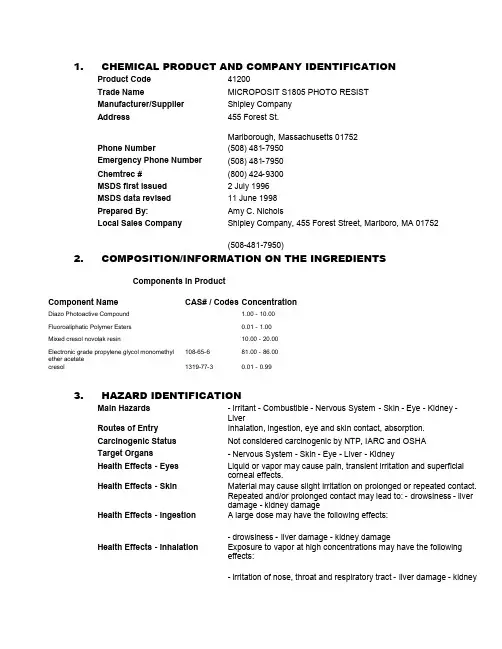
1.CHEMICAL PRODUCT AND COMPANY IDENTIFICATIONProduct Code41200Trade Name MICROPOSIT S1805PHOTO RESISTManufacturer/Supplier Shipley CompanyAddress455Forest St.Marlborough,Massachusetts01752Phone Number(508)481-7950Emergency Phone Number(508)481-7950Chemtrec#(800)424-9300MSDS first issued2July1996MSDS data revised11June1998Prepared By:Amy C.NicholsLocal Sales Company Shipley Company,455Forest Street,Marlboro,MA01752(508-481-7950)POSITION/INFORMATION ON THE INGREDIENTSComponents in ProductComponent Name CAS#/Codes ConcentrationDiazo Photoactive Compound 1.00-10.00Fluoroaliphatic Polymer Esters0.01-1.00Mixed cresol novolak resin10.00-20.00Electronic grade propylene glycol monomethyl108-65-681.00-86.00ether acetatecresol1319-77-30.01-0.993.HAZARD IDENTIFICATIONMain Hazards-Irritant-Combustible-Nervous System-Skin-Eye-Kidney-LiverRoutes of Entry Inhalation,ingestion,eye and skin contact,absorption.Carcinogenic Status Not considered carcinogenic by NTP,IARC and OSHATarget Organs-Nervous System-Skin-Eye-Liver-KidneyHealth Effects-Eyes Liquid or vapor may cause pain,transient irritation and superficialcorneal effects.Health Effects-Skin Material may cause slight irritation on prolonged or repeated contact.Repeated and/or prolonged contact may lead to:-drowsiness-liverdamage-kidney damageHealth Effects-Ingestion A large dose may have the following effects:-drowsiness-liver damage-kidney damageHealth Effects-Inhalation Exposure to vapor at high concentrations may have the followingeffects:-irritation of nose,throat and respiratory tract-liver damage-kidneydamage4.FIRST AID MEASURESFirst Aid-Eyes Immediately flush the eye with plenty of water for at least15minutes,holding the eye open.Obtain medical attention if sorenessor redness persists.First Aid-Skin Wash skin with water.Obtain medical attention if blistering occurs orredness persists.First Aid-Ingestion Wash out mouth with water.Obtain medical attention.First Aid-Inhalation Remove from exposure.If there is difficulty in breathing,giveoxygen.Seek medical attention if symptoms persist.Advice to Physicians Treat symptomatically.5.FIRE FIGHTING MEASURESExtinguishing Media Use water spray,foam,dry chemical or carbon dioxide.Keepcontainers and surroundings cool with water spray.Special Fire-Fighting Procedures This product may give rise to hazardous vapors in a fire.Vapors cantravel a considerable distance to a source of ignition and result inflashback.Unusual Fire&Explosion Hazards Pressure may build up in closed containers with possible liberation of combustible vapors.Protective Equipment for Fire-FightingWear full protective clothing and self-contained breathing apparatus.6.ACCIDENTAL RELEASE MEASURESSpill Procedures Contain and absorb using earth,sand or other inert material.Transfer into suitable containers for recovery or disposal.Finallyflush area with plenty of water.Personal Precautions Wear appropriate protective clothing.Wear respiratory protection.Eliminate all sources of ignition.Environmental Precautions Prevent the material from entering drains or water courses.7.HANDLING AND STORAGEHandling Use local exhaust ventilation.Avoid contact with eyes,skin andclothing.Keep container tightly closed when not in use.Storage Store in original containers.Store away from sources of heat orignition.Storage area should be:-cool-dry-well ventilated-out of direct sunlightOtherProprietary photoresist film contains approximately2-4%of2,3,4-trihydroxybenzophenone(THBP),which may sublime during soft-bake or hard-bake processing.THBP has low acute toxicity(LD50>5g/kg).Contact with eyes,skin or mucous membranes cause irritation.To prevent accumulation of THBP on equipment surfaces and ventilation ducts,preventative maintenance program including regular cleaning should be implemented.Wipe surfaces using an appropriate cleaning solvent when possible.Provide adequate general or local exhaust ventilation during the cleaning process.In situations where this is not possible or where solvent or dust concentrations become excessive,use an air purifying respirator with an organic vapor/toxic particulate cartridge.When cleaning residual THBP,wear protective gloves and adequate protective clothing to prevent skin contact.Practice good personal hygiene to prevent accidental exposure.Clean all protective clothing and equipment thoroughly after each use.8.EXPOSURE CONTROLS/PERSONAL PROTECTIONOccupational Exposure StandardsElectronic grade propylene glycol monomethyl ether acetate Manufacturer recommends30ppm8h TWA and90ppm15min STEL.cresol ACGIH:TLV5ppm(22mg/m3)8h TWA.OSHA:PEL5ppm(22mg/m3)8h EH40:OES5ppm(22mg/m3)8h TWA.Canbe absorbed through skin.Engineering Control Measures Engineering methods to prevent or control exposure are preferred.Methods include process or personnel enclosure,mechanicalventilation(local exhaust),and control of process conditions.Respiratory Protection Respiratory protection if there is a risk of exposure to high vaporconcentrations.The specific respirator selected must be based onthe airborne concentration found in the workplace and must notexceed the working limits of the respirator.Hand Protection Butyl rubber gloves.Eye Protection Chemical goggles.Body Protection Normal work wear.9.PHYSICAL AND CHEMICAL PROPERTIESPhysical State Viscous liquidColor RedOdor SweetVOC(g/l)839.80Specific Gravity 1.010pH NeutralBoiling Range/Point(°C/F)145.8/295Flash Point(PMCC)(°C/F)40.5-46.1/105-115Explosion Limits(%)Lower limit1.5at20°C.Upper limit7.0at20C..Solubility in Water Insoluble.Vapor Density(Air=1)Heavier than air.Evaporation Rate Slower than etherVapor Pressure Propylene Glycol Monomethyl Ether Acetate:3.7mmHg at20°C. 10.STABILITY AND REACTIVITYStability Stable under normal conditions.Conditions to Avoid-High temperatures-Static dischargeIncompatibilities-Oxidizing agentsHazardous Polymerization Will not occur.Hazardous DecompositionProductsCombustion will generate:-carbon monoxide-Carbon Dioxide-phenols-toxic fluorinecompounds-aldehydes-oxides of nitrogen-acrid smoke andirritating fumes11.TOXICOLOGICAL INFORMATIONAcute Data Propylene Glycol Monomethyl Ether Acetate:Oral LD50(rat)8532mg/kg.Dermal LD50(rabbit)5000mg/kg.Chronic/Subchronic Data No data.Genotoxicity It was not mutagenic when tested in bacterial or mammaliansystems.Reproductive/Developmental Developmental effects were seen in laboratory animals only at doseToxicity levels that were maternally toxic.Additional Data None known.12.ECOLOGICAL INFORMATIONMobility Propylene Glycol Monomethyl Ether Acetate:Koc is0-50.Persistence/Degradability The product is partially or slowly biodegradable.BOD20greater than40%Bio-accumulation No data.Ecotoxicity The product is rated as practically non-toxic to aquatic species.Tests on the following species gave a LC50of161mg/litre:-fatheadminnowsTests on the following species gave a LC50of408mg/litre:-daphnia 13.DISPOSAL CONSIDERATIONSProduct Disposal Incineration is the recommended method of disposal.Dispose of inaccordance with all applicable local and national regulations.Container Disposal Labels should not be removed from containers until they have beencleaned.Empty containers may contain hazardous residues.Dispose of containers with care.14.TRANSPORT INFORMATIONDOT Ground:Not Regulated per49CFR173.150(f)(2)UN Proper Shipping Name Flammable liquid,n.o.s.UN Class(3)Flammable LiquidUN Number UN1993UN Packaging Group IIIN.O.S.1:Propylene Glycol Monomethyl Ether AcetateN.O.S.2:Subsidiary Risks None.ADR/RID SubstanceIdentification NumberCLASS3-31(c)CERCLA RQ Cresol(100#)Marine Pollutant No.15.REGULATORY INFORMATIONTSCA Listed YesTSCA ExemptionsWHMIS Classification D.2.B B.3MA Right To Know Law All components have been checked for inclusion on theMassachusetts Substance List(MSL).Those components present atthe de minimus concentration have been identified in the hazardousingredients section of the MSDS.California Proposition65This product does not contain materials which the State of Californiahas found to cause cancer,birth defects or other reproductive harm.SARA TITLE III-Section311/312Categorization(40CFR370)Immediate,delayed,flammability hazardSARA TITLE III-Section313(40 CFR372)This product does not contain a chemical which is listed in Section 313at or above de minimis concentrations.16.OTHER INFORMATIONNFPA Rating-FIRE2NFPA Rating-HEALTH2NFPA Rating-REACTIVITY0NFPA Rating-SPECIAL None.Revisions Highlighted Flash Point(PMCC)(°C/F)Abbreviations CAS#:Chemical Abstract Services NumberACGIH:American Conference of Governmental Industrial HygienistsOSHA:Occupational Safety and Health AdministrationTLV:Threshold Limit ValuePEL:Permissible Exposure LimitSTEL:Short Term Exposure LimitNTP:National Toxicology ProgramIARC:International Agency for Research on CancerR:RiskS:SafetyLD50:Lethal Dose50%LC50:Lethal Concentration50%BOD:Biological Oxygen DemandKoc:Soil Organic Carbon Partition Coefficient.TLm:Median Tolerance LimitDisclaimerThe data contained herein is based on information that Shipley Company believes to be reliable,but no expressed or implied warranty is made with regard to the accuracy of such data or its suitability for a given situation.Such data relates only to the specific product described and not to such products in combination with any other product and no agent of Shipley Company is authorized to vary any of such data.Shipley Company and its agents disclaim all liability for any action taken or foregone on reliance upon such data.。
负性光刻胶MSDS

危险性
提示词
化学品标识
危险性标志
个体防护措施
易燃!
负性光刻胶
危规号:
危险性理化数据
危险特性
熔点(℃):
沸点(℃):145
闪点(℃):48
相对密度(水=1):
相对密度(空气=1):救措施
泄漏处理及防火防爆措施
对眼有强烈的刺激。可能造成对呼吸器官的刺激。可能引起嗜睡或头晕。
【皮肤接触】:脱掉所有污染的衣服和鞋子,立即用肥皂和大量的水冲洗。如果刺激发展并持续,就医。
【眼睛接触】:用大量水彻底冲洗至少15分钟并请教医生。取下隐形眼镜。
【吸入】:将受伤者移到新鲜空气处并保持其平静请迅速就医并提供给医生相应物质安全资料表。
【食入】:禁止催吐。请迅速就医并提供给医生相应物质安全资料表如果清醒,大量饮水。
【泄漏处理】:穿戴合适的个人防护装备,避免与皮肤及眼睛接触,远离火源。用惰性材料吸收(如砂子,硅胶,酸性粘结剂,通用粘结剂锯末)。放入合适的封闭的容器中待处理。在遵守环境法规的前提下,彻底地清洗污染了的地面和物体。
【灭火方法】:火灾时,可能因燃烧而产生有害气体一氧化碳(CO)、二氧化碳(CO2)、氮氧化物(COx)、硫氧化物(SOx)。灭火剂:水雾状喷射、二氧化碳灭火、干粉灭火、泡沫灭火。
光刻胶
抗蚀性(Anti-etching; Etching resistance)即光刻胶材料在刻蚀过程中的抵抗力。在图形从光刻胶转 移到晶片的过程中,光刻胶材料必须能够抵抗高能和高温(>150℃)而不改变其原有特性 。在后续的刻蚀工序 中保护衬底表面。耐热稳定性、抗刻蚀能力和抗离子轰击能力 。在湿法刻蚀中,印有电路图形的光刻胶需要连 同硅片一同置入化学刻蚀液中,进行很多次的湿法腐蚀。只有光刻胶具有很强的抗蚀性,才能保证刻蚀液按照所 希望的选择比刻蚀出曝光所得图形,更好体现器件性能。在干法刻蚀中,例如集成电路工艺中在进行阱区和源漏 区离子注入时,需要有较好的保护电路图形的能力,否则光刻胶会因为在注入环境中挥发而影响到注入腔的真空 度。此时注入的离子将不会起到其在电路制造工艺中应起到的作用,器件的电路性能受阻 。
1890年。德国人格林(Green)和格罗斯(Gross)等人将重氮化的混合物制成感光材料。取得了第一个重氮 感光材料的专利。不久,德国的卡勒(Kalle)公司推出了重氮印相纸,从而使重氮感光材料商品化,并逐渐代 替了铁印相技术。
工作原理
辐射线
光学
纳米压印技术
光刻胶类型及应用制程
紫外光刻胶
紫外光刻胶适用于g线(436 nm)与i线(365 nm)光刻技术。
2.紫外压印光刻胶:使用透明的模板,将预先制作好的带有微图形特征的硬模版压入常温下液态光刻胶中, 用紫外光将光刻胶固化后抬起模板,从而将模板上的微特征转移到光刻胶上。按照光引发反应机理,可分为自由 基聚合和阳离子聚合两大体系 。光刻胶材料主要有甲基丙烯酸酯体系、有机硅改性的丙烯酸或甲基丙烯酸酯体 系、乙烯基醚体系、环氧树脂体系等。
1.
热压印与紫外压印原理示意图纳米压印技术是通过压模来制作微纳特征的一种图形转移技术,其最明显的优 势是高产能、高分辨率、低成本,主要工艺流程:模板制作、硅衬底滴胶、压印、曝光、脱模、离子刻蚀,图像 精度可以达到5 nm。使用的光刻胶种类主要分为两种:
光刻胶知识大全
光刻胶知识⼤全光刻胶知识⼤全光刻胶(Photo Resist)光刻胶的定义及主要作⽤光刻胶是⼀种有机化合物,它受紫外光曝光后,在显影液中的溶解度会发⽣变化。
⼀般光刻胶以液态涂覆在硅⽚表⾯上,曝光后烘烤成固态。
光刻胶的作⽤:a、将掩膜板上的图形转移到硅⽚表⾯的氧化层中;b、在后续⼯序中,保护下⾯的材料(刻蚀或离⼦注⼊)。
光刻胶起源光刻开始于⼀种称作光刻胶的感光性液体的应⽤。
图形能被映射到光刻胶上,然后⽤⼀个developer就能做出需要的模板图案。
光刻胶溶液通常被旋转式滴⼊wafer。
如图wafer被装到⼀个每分钟能转⼏千转的转盘上。
⼏滴光刻胶溶液就被滴到旋转中的wafer 的中⼼,离⼼⼒把溶液甩到表⾯的所有地⽅。
光刻胶溶液黏着在wafer上形成⼀层均匀的薄膜。
多余的溶液从旋转中的wafer上被甩掉。
薄膜在⼏秒钟之内就缩到它最终的厚度,溶剂很快就蒸发掉了,wafer上就留下了⼀薄层光刻胶。
最后通过烘焙去掉最后剩下的溶剂并使光刻胶变硬以便后续处理。
镀过膜的wafer对特定波成的光线很敏感,特别是紫外(UV)线。
相对来说他们仍旧对其他波长的,包括红,橙和黄光不太敏感。
所以⼤多数光刻车间有特殊的黄光系统。
光刻胶的主要技术参数a、分辨率(resolution)。
区别硅⽚表⾯相邻图形特征的能⼒。
⼀般⽤关键尺⼨(CD,Critical Dimension)来衡量分辨率。
形成的关键尺⼨越⼩,光刻胶的分辨率越好。
b、对⽐度(Contrast)。
指光刻胶从曝光区到⾮曝光区过渡的陡度。
对⽐度越好,形成图形的侧壁越陡峭,分辨率越好。
c、敏感度(Sensitivity)。
光刻胶上产⽣⼀个良好的图形所需⼀定波长光的最⼩能量值(或最⼩曝光量)。
单位:毫焦/平⽅厘⽶或mJ/cm2。
光刻胶的敏感性对于波长更短的深紫外光(DUV)、极深紫外光(EUV)等尤为重要。
d、粘滞性/黏度(Viscosity)。
衡量光刻胶流动特性的参数。
粘滞性随着光刻胶中的溶剂的减少⽽增加;⾼的粘滞性会产⽣厚的光刻胶;越⼩的粘滞性,就有越均匀的光刻胶厚度。
AZ P4000系列正相光刻胶技术数据表说明书
Technical datasheetAPPLICATIONGeneral purpose positive tone photoresists featuring a special PAC (Photo Active Compound) engineered to prevent poisoning of plating solutions and extend plating bath life. Excellent substrate adhesion for wet etch applications.•Wide compatibility with electro -plating solu-tions•Safe solvent•Single coat thicknesses from 1.0 to >20µm •May be cured as a permanent dielectric in-* Contact your AZ product representative for more in-formation and special spin programs for ultra thick films.COMPANION PRODUCTSThinning/Edge Bead RemovalAZ ®EBR Solvent or AZ® EBR 70/30 DevelopersAZ ® 400K 1:3 or 1:4, AZ ® 421K, AZ Developer 1:1, AZ 340 RemoversAZ ® 300T, AZ ® 400T, AZ Kwik StripAZ® P4000 SeriesPositive Tone PhotoresistsTYPICAL PROCESSSoft Bake: 90-115C*Rehydrate: for films > 4.0µm thick Expose: 350-450nm sensitive Develop: Spray or immersionDeveloper type: Inorganic (IN) * Use higher soft bake temp. for best adhesion to metals. Ramped temperature may be required for thicker films.OPTICAL CONSTANTS*96µm gold bump plated in AZ P4620 Cyanide electro -plating solutionTYPICAL SPIN CURVES (150MM SUBSTRATE)Note: Thicker films will be coated by varying spin times and other dispense parameters (or via multiple coats). Single films above 7.0µm are not spun to equilibrium.TYPICAL AU PLATING RESULTS (CYANIDE PLATING SOLUTION; PH = 5.5)Resist: AZ P4620Thickness: 24µmDevelop: AZ 400K 1:3Plating Temp: 45CPlating Time: 50 min.Metal Thickness: 20µmStrip: AZ 400TREFERENCE PROCESS (12µM THICK AZ P4620 FILM)* Thicker films may require a ramped soft bake process to avoid bubble formation due to rapid outgassing ofsolvents. Contact your AZ product representative for ultra-thick coat and bake processing guidelines.EXPOSURE LATITUDE FOR 20µM LINES AZ P4620 AT FT = 12µM EXPOSURE LATITUDE FOR 40µM LINES AZ P4620 AT FT = 24µMABSORBANCE SPECTRA OF P4000 SERIES PHOTORESISTS (UNBLEACHED, NORMAL-IZED TO 1µM)PROCESSING P4000 AS A DIELECTRIC INSULATORAZ P4000 Series photoresists may be thermally cured after develop to form stable dielectric isolators. The die-lectric properties are cure temperature dependent as shown in the table below.EXAMPLE COATING SEQUENCE FOR 20+ µM THICK FILMSAZ P4000 SERIES FLUID VISCOSITIESDILL MODELLING PARAMETERSAPPROXIMATE EXPOSURE DOSE REQUIRE-MENT VS. FILM THICKNESS (SUSS MA -200)PROCESS CONSIDERATIONSSUBSTRATE PREPARATIONSubstrates must be clean, dry, and free of organic residues. Oxide forming substrates (Si, etc.) should be HMDS primed prior to coating AZ P4000. Contact your AZ product representative for detailed information on pre-treating with HMDS.COATINGFilms up to 8.0µm thick (depending upon wafer size) may be set and spun to equilibrium using the spin curve graphs as a reference. Thicker films require special coat programs using carefully timed spread and spin cycles. Contact your AZ products representative for additional information.SOFT BAKESoft bake times and temperatures may be application specific. Process optimization is recommended to ensure stable lithographic and adhesion performance. Soft bake temperatures for AZ P4000 should be in the 95-115C range. Temperatures towards the high end of this range will improve adhesion to most metals. Thick films may require gradual ramping of the soft bake temperature to prevent bubbling.FILM REHYDRATIONP4000 photoresist films thicker than 4.0µm require a rehydration hold between soft bake and exposure. Hold times are typically 30-60 minutes (depending upon film thickness) @ relative humidity 40 - 45%.EXPOSUREAZ P4000 is sensitive to exposure wavelengths between 310 and 450nm. 365-436nm is recommended.POST EXPOSE BAKEA PEB is not generally required for P4000 but may be employed to maximize process latitudes and to mitigate standing wave effects caused by monochromatic exposure. PEB temperatures and times may be application specific. As a general rule, PEB temperatures should be in the 100 to 115C range.DEVELOPINGSpray or immersion developing in AZ 400K series developers is recommended. AZ 400K 1:3 or AZ 421K (unbuffered) are recommended for resist film thicknesses above 12µm. AZ 400K 1:4 provides improved devel-oper selectivity for thinner films. AZ Developer 1:1 may be used in applications requiring zero etch rate on Alu-minum substrates.HARD BAKEHard baking (post develop bake) improves adhesion in wet etch or plating applications and improves pattern stability in dry etch processes. Hard bake temperatures should be in the 100 to 110C range to ensure minimal thermal distortion of the pattern. Higher temperatures may be used to cure the pattern (cross link the resin) for use as a permanent insulator.COMPATIBLE MATERIALSAZ P4000 Series materials are compatible with all commercially available lithography processing equipment. Compatible materials of construction include glass, quartz, PTFE, PFA, stainless steel, HDPE, polypropylene, and ceramic.Rev. (08/21)Products are warranted to meet the specifications set forth on their label/packaging and/or certificate of analysis at the time of shipment or for the expressly stated duration. MERCK MAKES NO REPRESENTATION OR WARRANTY OF ANY KIND, EXPRESS OR IMPLIED, INCLUDING MERCHANTABILITY OR FITNESS FOR A PARTICULAR USE REGARDING OUR PRODUCTS OR ANY INFORMATION PROVIDED IN CONNECTION THEREWITH. Customer is responsible for and must independently determine suitability of Merck´s products for customer ’s products, intended use and processes, including the non -infringement of any third parties´ intellectual property rights. Merck shall not in any event be liable for incidental, consequential, indirect, exemplary or special damages of any kind resulting from any use or failure of the products: All sales are subject to Merck ’s complete Terms and Conditions of Sale. Prices are subject to change without notice. Merck reserves the right to discontinue products without prior notice.The information on our trademarks is available in the Trademarks section on . Detailed information on our trademarks is also available via publicly accessible resources. All other trademarks are the property of their respective owners. © 2021 Merck KGaA, Darmstadt, Germany and/or its affiliates.DisclaimerHANDLING/DISPOSALAZ P4000 Series materials are flammable liquids containing PGMEA (1-Methoxy -2-propanol acetate). Refer to the current version of the MSDS and to local regulations for up to date information on safe handling and proper disposal. AZ P4000 is compatible with drain lines handling similar organic solvent based materials.。
光刻胶综述
此之前约1950年发明了重氮萘醌—酚醛树脂系光刻胶,它最早应用于印刷业,目前是电子工业用用最多的光刻胶,近年随着电子工业的飞速发展,光刻胶的发展更是日新月异,新型光刻胶产品不断涌现。
光刻胶按其所用曝光光源或辐射源的不同, 又可分为紫外光刻胶、深紫外光刻胶、电子束胶、离子束胶、X射线胶等。
2. 光刻技术及工艺电子工业的发展离不开光刻胶的发展, 这是由电子工业微细加工的线宽所决定的。
众所周知,在光刻工艺中离不开曝光。
目前采用掩膜版的曝光方式主要有接触式曝光和投影式曝光两种。
光刻工艺过程光刻胶的种类虽然很多,使用主艺条件依光刻胶的品种不同而有很大的不同,但大体可遵从如下步骤:a.基片处理:该工序包括脱脂清洗、高温处理等部分,有时还需涂粘附增强剂进行表面改性处理。
脱脂一般采用溶剂或碱性脱脂剂进行清洗,然后再用酸性清洗剂清洗,最后用纯水清洗。
高温处理通常是在150-160℃对基片进行烘烤去除表面水分。
粘附增强剂的作用是将基片表面亲水性改变为憎水性, 便于光刻胶的涂布, 增加光刻胶在基片上的粘附性电。
b.涂胶:光刻胶的涂布方式有旋转涂布、辗涂、浸胶及喷涂等多种方式。
在电子工业中应用较多的是旋转涂布。
该方式的涂胶厚度一般取决于光刻胶的粘度及涂胶时的转速。
膜厚-转速曲线是光刻胶的一个重要特性。
c.前烘:前烘的目的是为了去除胶膜中残存的溶剂,消除胶膜的机械应力。
在电子工业中烘烤方式通常有对流烘箱和热板两种。
前烘的温度和时间根据光刻胶种类及胶膜的厚度而定。
以北京化学试剂研究所BN308系列紫外负性光刻胶为例,当胶膜厚度为1-2μm时,对流烘箱,70-80℃,20min;热板,100℃,1min。
d.曝光:正确的曝光量是影响成像质量的关键因素。
曝光不够或曝光过度均会影响复制图形的再现性。
曝光宽容度大有利于光刻胶的应用。
光刻胶的曝光量同样取决于光刻胶的种类及膜厚。
以BN308系列负胶为例,当膜厚为1-2μm时,曝光20-30mJ/cm2e.中烘:曝光后显影前的烘烤,对于化学增幅型光刻胶来说至关重要,中烘条件的好坏直接关系到复制图形的质量。