
会话中常用的口语及对应书面语
英语口语交际常用语
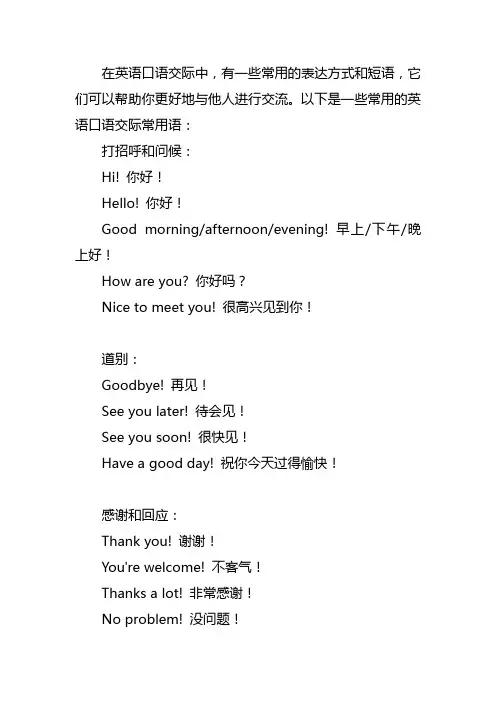
在英语口语交际中,有一些常用的表达方式和短语,它们可以帮助你更好地与他人进行交流。
以下是一些常用的英语口语交际常用语:打招呼和问候:Hi! 你好!Hello! 你好!Good morning/afternoon/evening! 早上/下午/晚上好!How are you? 你好吗?Nice to meet you! 很高兴见到你!道别:Goodbye! 再见!See you later! 待会见!See you soon! 很快见!Have a good day! 祝你今天过得愉快!感谢和回应:Thank you! 谢谢!You're welcome! 不客气!Thanks a lot! 非常感谢!No problem! 没问题!道歉和回应:Sorry! 对不起!I'm sorry! 我很抱歉!Excuse me! 请原谅!That's OK! 没关系!It's all right! 没关系!请求和提供帮助:Can you help me? 你能帮我吗?Sure, I'd be happy to help! 当然,我很乐意帮忙!Could you please... ? 你能...吗?No problem, I can do that! 没问题,我可以做到!表达意见和看法:I think... 我认为...In my opinion... 在我看来...I agree/disagree... 我同意/不同意...表达喜好和厌恶:I like/love... 我喜欢...I don't like/hate... 我不喜欢/讨厌...询问和回答问题:What's your name? 你叫什么名字?My name is... 我的名字是...Where are you from? 你来自哪里?I'm from... 我来自...邀请和建议:Would you like to...? 你想要...吗?How about...? ...怎么样?Let's... 我们一起...吧。
书面语和口语的例子大全
书面语和口语的例子大全在我们的日常生活和交流中,书面语和口语是两种常见的语言表达方式。
它们在词汇、语法、语气、用途等方面都存在着一定的差异。
下面就让我们通过一系列的例子来深入了解书面语和口语的不同之处。
先来看词汇方面。
书面语往往会使用一些比较正式、文雅、精确的词汇,而口语则更倾向于使用通俗易懂、简洁明快的词汇。
比如,在书面语中,我们会说“商榷”“莅临”“伊始”等;而在口语中,我们则会说“商量”“来”“开始”。
再比如,“诞辰”这个词在书面语中常见,而口语中我们更常说“生日”;“盈利”在书面语中常用,口语里则多是“赚钱”。
语法方面也有明显的区别。
书面语的语法结构通常比较严谨、完整,遵循严格的语法规则。
例如,“由于天气原因,会议不得不延期举行。
”这是一个典型的书面语句子,结构完整,逻辑清晰。
而口语中可能会说:“因为天气不好,会议得推迟了。
”相对来说,口语的语法更加灵活、随意,有时甚至会出现省略、倒装等情况。
语气上,书面语通常比较庄重、严肃,而口语则更加亲切、自然。
比如,在书面通知中可能会写:“请各位务必按时参加会议,如有特殊情况,请提前请假。
”这种语气比较正式、严肃。
但在口语交流中,可能会说:“大家记得按时来开会哈,要是有事儿来不了,提前说一声。
”这样的表述就显得亲切、随和。
从用途来看,书面语多用于正式的场合,如公文、学术论文、法律文件等;而口语则主要用于日常的交流、对话、演讲等。
比如,在签订合同的时候,使用的语言就是书面语,会有明确的条款和规范的表述。
而和朋友聊天时,用的就是口语,轻松自在,没有太多的约束。
接下来,我们通过一些具体的场景来感受书面语和口语的差异。
在学校里,老师批改作业时写的评语通常是书面语,比如:“该生此次作业态度认真,书写工整,解题思路清晰,但在细节处理上仍需加强。
”而课堂上老师与学生的交流则多是口语,像:“同学们,这道题大家都听懂了吗?没听懂的举手我再讲一遍。
”在职场中,工作报告、商务邮件等一般都使用书面语,比如:“经过团队的不懈努力,本季度的销售业绩有了显著提升,然而,仍存在部分问题亟待解决。
英语口语日常情景对话用语

英语口语日常情景对话用语一、祝愿、祝贺和应答1.- Well done and congratulations to you. - Thanks very much.2.- I hope you‘ll succeed in everything. - So do I.3.- I wish you success. - Thank you.4.- We send you our best wishes. - Thank you very much.5.- Happy new year ! - Happy new year! (The same to you.)6.- A merry Christmas to you. - Thank you.7.- I hope you‘ll have a good time. - Thank you.8.- Happy birthday! - Thank you.二、邀請和应答1.- Would you like to come to the party? - Oh yes, thank you.2.- I hope you can come to the dance next Saturday. - I‘m sorry, but I can‘t.3.- Will you go dancing with us? - Of course. I‘ll be glad to.4.- Will you come to our English Evening? - Yes, thank you.5.- Would you please give us a talk on English Learning? - OK. When?6.- You and your friends must come over to my house and see mooncakes.- OK. Thank you very much.三、表示同意和不同意1.- I think the shop is closed at this time of day. - No, I think it‘s open.2.- I think foreign languages are more interesting than science.- I really can‘t agree with you. I prefer science.3.- I think I shall read a book instead.- Good idea. That‘s much better than watching a bad TV Programme.4.- I don‘t think that it‘s true. He‘s always telling strange stories.- I know. But this time I can‘t decide if he is right or not.5.- I think Chinese is more popular than any other subject. - Maybe. But I prefer art.6.- Don‘t think in Chinese when you‘re speaking English. - You are quite right.四、道歉和应答1.- Sorry to trouble you. - That‘s all right.2.- Oh, I am so sorry. - That‘s quite all right.3.- I‘m sorry to give you so much trouble. - No trouble at all.4.- I‘m soory. I lost the key to your bike. - It doesn‘t matter.5.- Sorry to have kept you waiting for a long time. - It doesn‘t matter.6.- You haven‘t paid for it yet. - Oh, I‘m really very sorry.五、劝告和建议1.- The park isn‘t far from here. Shall we walk there? - OK.2.- You‘d better close the windows. It‘s cold in the room. - All right.3.- If you are not better by then, I‘ll take you to see the doctor. - OK. Thank you very much.4.- You must look after yourself and keep healthy. - Yes, I will. Thanks.5.- The museum is very far from here. Let‘catch a bus, shall we? - OK. Let‘s catc h a bus.6.- You must remember the saying: Whatever you do, do it well. - Thank you for your advice.六、打电话1.- Hello! - Hello, Bill? - No, this is Sam. - Hi, Sam. This is Mike. How are you?2.- Hello. - Hello. May I speak to Mr Green?3.- No. 5 Middle School.- Mr Green, please.- I‘m sorry. Mr Green is not in.- When will he be back?- About six this afternoon.- All right. I‘ll ring again then.- Very well.4.- Hello!- Hello, Ham Mei. Could I borrow your Chinese-English Dictionary please?- Sorry! It‘s not a very good line. Could you speak more loudly?- Could I borrow your Chinese-English dictionary?- Sure. I‘ll bring it to you tomorrow.- Thank you. Goodbye.七、請求允許和应答1.- Please let me help you. - No, thanks. I can carry it.2.- Can I see your licence, please? - OK.3.- May I call you James? - Of course, if you wish.4.- Could I borrow a pen, please? - Of course. With pleasure.5.- Excuse me. May I use your dictionary? - Yes, here you are.6.- May I ask you several questions? - Yes, of course.八、提供…和应答1.- May I help you? - Oh yes, thank you.2.- Let me help you with the bags. - Well, I can manage all right. Thanks just the same.3.- Can we help you? - I want to go to hospital. But I can‘t. My leg hurts.4.- Must I clean the classroom now? - Oh, you needn‘t.5.- Would you like a cup of tea? - Yes, please.6.- What can I do for you? - I‘d like to have an English-English dictionary.九、问路和应答1.- Excuse me. Where is the washroom, please? - Oh, it‘s over there.2.- Excuse me. Can you tell me where the bookshop is? - Look! It‘s on the other side of the road.3.- How far is the post office, please? - Only a few kilometers.4.- Will you please tell me the way to the railway station?- Go down this street. At the end of the road you‘ll see it.5.- Excuse me. Could you tell me how I can get to the supermarket?- Go straight along this road. Then go over the bridge and turn right at the bookshop. You‘ll fi ndit.十、购物1.- What can I do for you? - I‘d like some apples.2.- Where can I buy some stationery?- Let‘s look at the shopping guide. Oh, it‘s on the ground Floor.3.- Could I buy half a kilo oranges? - Certainly. Here you are.4.- Will you please show me that radio? - Certainly.5.- How much is the radio? - Ninety yuan.6.- Good morning, sir. May I help you? - Yes, I‘d like to buy a sweather.十一、谈论天氣1.- It‘s a fine day for a walk. - Yes, the air is nice and clean.2.- Oh dear! It‘s very cold to day. - Yes, you need to wear warmer clothes.3.- What‘s the weather like today? - It‘s fine.4.- What‘s the weather like in your country now? - It‘s very hot.5.- Lovely weather, isn‘t it? - Yes, isn‘t it?6.- I missed the weather report this morning. Did you hear it?- Yes. It said partly cloudy today, with a strong wind from The northwest.十二、时间或日期和应答1.- Hi, Mary. What time is it now? - It‘s about three.2.- What day is it today? - It‘s Wednesday.3.- Excuse me. Could you tell me what time the plane leaves?- Certainly. It leaves at ten in the evening.4.- What‘s the time? My watch has stopped. - Let me see. It‘s five to ten.5.- Excuse me. Have you got the time? - Yes, it‘s six twenty.6.- Excuse me. Could you tell me the time? - Oh sorry, I don‘t have my watch with me.十三、約会1.- Are you free next Wednesday evening? I want to go to the cinema with you? - Yes, I‘d like to.2.- When shall we meet, this evening or tomorrow evening? - I don‘t mind. Either time is OK.3.- Are you free later today? - Sorry, I‘m free every day except today.4.- Are you able to come tomorrow morning? - I think so.5.- Are you free this afternoon? - Oh no. Will this evening be all right?6.- I‘m busy today. What about tomorrow afternoon?- That would be fine. Shall we make it nine o‘clock?十四、禁止和警告1.- Don‘t climb that ladder! It‘s broken. - OK. Thank you.2.- Look out! There‘s a car coming. - Oh, thank you.3.- You mustn‘t play on the street. It‘s dangerous. - No, we won‘t.4.- Don‘t touch the machine when it is working. - No, I won‘t. Thank you.5.- You are not allowed to smoke here. - Oh, I‘m so rry.6.- You can‘t walk your dog in the park. - Oh, I‘m sorry. I‘ll never do it again.十五、看病1.- I‘m feeling tired, doctor. - Have a good rest and then you‘ll feel better.2.- How are you feeling today? - I‘m feeling even worse.3.- Doctor, she is not feeling well. - Nothing serious, I hope.4.- Doctor, do I have to take the medicine before or after meals? - Three times a day after meals.5.- What‘s the matter? - I‘ve got a headache.6.- What‘s your trouble? - I‘ve had a pain in my stomach since morn ing.十六、语言困难1.- I don‘t quite follow you, Mr Green. Will you please say it again? - OK.2.- Do you follow what I‘m saying? - Sorry, I can‘t follow you.3.- I beg your pardon. Will you say it again? - All right.4.- Will you say it again more slowly? I can‘t follow you. - OK.5.- Will you please repeat what you‘ve just said? - OK. I‘ll repeat what I have said.6.- I‘m sorry, I don‘t understand French. Do you speak English? - Yes, I do.介绍:A: Mary, this is Joe's brother David.B; I'm very glad to meet you.C: It's a pleasure to meet you.B: How do you like Texas so far?C: It's really different from what I expected.B: Don't worry. You'll get used to it in no time.2.A: Mrs. Smith, I'd like to introduce a friend of mine, Pierre Dubois.B: How do you do?C: Hello.B: What's your impression of the United States?C: Well, I can't get over how different the weather is here.B: Oh, you'll get used to it soon!3.A: Wendy, I'd like you to meet my brother Sam.B: Hi.C: Nice to meet you.B: What do you think of Dallas?C: Well, I'm still feeling a little homesick and so many things seem strange to me.B: You're bound to feel that way at first, I guess.4.A: Mrs.Hughs, this is Peter Brown.B: Pleased to meet you.C: How do you do?B: I hope you're enjoying your stay here.C: If it weren't for the climate, I'd like it here very much.B: It always takes time to get used to a new place.。
口语表达常用短语

口语表达常用短语一、问候与礼貌用语在日常口语交流中,问候与礼貌用语是非常重要的,可以帮助建立友好的氛围。
以下是一些常用的问候与礼貌用语:1. Hello!/Hi!(你好!): 这是常见的打招呼方式,适用于各种场合。
2. Good morning!/Good afternoon!/Good evening!(早上好!/下午好!/晚上好!): 根据不同的时间段选择使用。
3. How are you?(你好吗?): 用于询问对方的近况。
4. Fine, thank you. And you?(很好,谢谢。
你呢?): 回答对方的关心,并返问对方。
5. Nice to meet you!/Nice to see you again!(很高兴见到你!/很高兴再次见到你!): 用于初次见面或再次见面时表示高兴。
6. Excuse me(打扰一下): 用于请求别人注意或道歉打断对方。
7. Thank you!/Thanks!(谢谢!): 表示感谢对方的帮助或关心。
8. You're welcome!(不客气!): 回答别人的感谢,表示乐意帮助。
9. I'm sorry(对不起): 表示道歉或认错。
10. No problem(没问题): 回答别人的请求或道歉时表示不介意。
二、购物与点餐常用短语1. Can I help you?(需要我帮忙吗?): 店员常用语句,表示愿意提供帮助。
2. I'm just looking, thanks.(我只是看看,谢谢。
): 用于拒绝店员的帮助。
3. How much is this?(这个多少钱?): 询问商品价格。
4. Do you have this in a different color/size?(这个有其他颜色/尺码吗?): 询问是否有其他颜色或尺寸的商品。
5. I'll take it.(我要买这个。
): 表示购买决定。
6. Are you ready to order?(准备好点菜了吗?): 用于询问顾客是否准备好点餐。
口头语大全
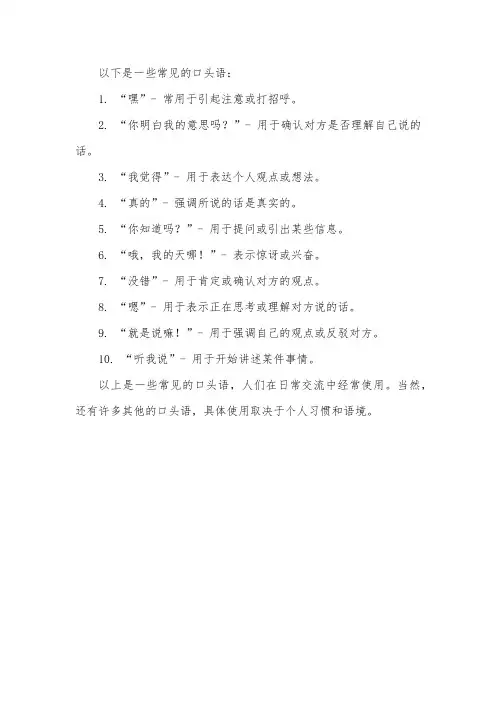
以下是一些常见的口头语:
1. “嘿”- 常用于引起注意或打招呼。
2. “你明白我的意思吗?”- 用于确认对方是否理解自己说的话。
3. “我觉得”- 用于表达个人观点或想法。
4. “真的”- 强调所说的话是真实的。
5. “你知道吗?”- 用于提问或引出某些信息。
6. “哦,我的天哪!”- 表示惊讶或兴奋。
7. “没错”- 用于肯定或确认对方的观点。
8. “嗯”- 用于表示正在思考或理解对方说的话。
9. “就是说嘛!”- 用于强调自己的观点或反驳对方。
10. “听我说”- 用于开始讲述某件事情。
以上是一些常见的口头语,人们在日常交流中经常使用。
当然,还有许多其他的口头语,具体使用取决于个人习惯和语境。
口语中的常用表达
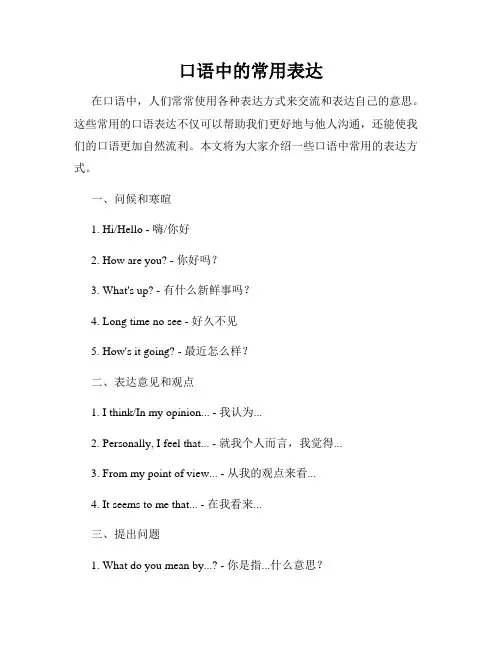
口语中的常用表达在口语中,人们常常使用各种表达方式来交流和表达自己的意思。
这些常用的口语表达不仅可以帮助我们更好地与他人沟通,还能使我们的口语更加自然流利。
本文将为大家介绍一些口语中常用的表达方式。
一、问候和寒暄1. Hi/Hello - 嗨/你好2. How are you? - 你好吗?3. What's up? - 有什么新鲜事吗?4. Long time no see - 好久不见5. How's it going? - 最近怎么样?二、表达意见和观点1. I think/In my opinion... - 我认为...2. Personally, I feel that... - 就我个人而言,我觉得...3. From my point of view... - 从我的观点来看...4. It seems to me that... - 在我看来...三、提出问题1. What do you mean by...? - 你是指...什么意思?2. Could you please explain...? - 你能解释一下...吗?3. Do you understand...? - 你理解...吗?4. Can you give me an example of...? - 你能给我一个...的例子吗?四、请求帮助和提供帮助1. Could you do me a favor? - 你能帮我一个忙吗?2. Can you help me with...? - 你能帮我处理...吗?3. If you need any assistance, feel free to ask. - 如果你需要任何帮助,请随时告诉我。
五、表示同意和不同意1. I agree with you. - 我同意你的观点。
2. I disagree. - 我不同意。
3. That's a good point. - 这是个好观点。
口语书面语词举例
口语书面语词举例 Document serial number【KK89K-LLS98YT-SS8CB-SSUT-SST108】口语书面语词举例??剥bāo—剥皮儿?bō—剥削薄?báo—纸很薄?bó—薄弱?淡薄?单薄?尖嘴薄舌? 差?chà—差不多?差不离?差点儿?chā—差别?偏差?阴差阳错?一念之差?澄?dèng—把水澄清了?chéng—澄清?逮?dǎi—逮老鼠?逮坏蛋?dài—逮捕?给?gěi—给东西?给钱?jǐ—给予?供给?自给自足? 貉?háo—貉子?貉绒?hé—丘之貉虹?jiàn—虹出来了?hóng—彩虹?虹吸?嚼?jiáo—味同嚼蜡?咬文嚼字?jué—咀嚼?过屠门而大嚼壳?ké—贝壳儿?花生壳?脑壳?qiào—地壳?甲壳?躯壳?壳面勒?lēi—把马勒住?lè—勒索?勒令?悬崖勒马馏?liù—馏馒头?liú—蒸馏?干馏露?lòu—露马脚?露相?露一手?lù—暴露?露骨?抛头露面?藏头露尾?绿?lǜ—绿叶?绿油油?lù—绿林?鸭绿江落?lào—落枕?落色?luò—涨落?落魄?着落?落花生? là—丢三落四?落在后边蔓?wàn—瓜蔓?压蔓?màn—蔓延?不蔓不支泌?mì—分泌?bì—泌阳(地名)疟?yào—发疟子?nüè—疟疾片?piān(部分)—唱片儿?影片儿?piàn—唱片?影片荨?xún—荨麻疹?qián—荨麻翘?qiào—翘尾巴?qiáo—翘首?翘楚?连翘色?shǎi—色子?掉色了?sè—色彩?色调?颜色?眼色塞?sāi(名物义)—活塞?瓶塞?(动作义)—把洞塞住?sè(动作义)—塞音?阻塞厦?shà—大厦?xià—厦门?安得广厦千万间杉?shā—杉木?杉篙?shān—紫杉?水杉?红杉葚?rèn—桑葚儿?shèēn—桑葚螫?zhē—被蜜蜂螫了…?shì—螫针熟?shóu—饭熟了?熟人儿?shú—熟悉?熟练?熟能生巧? 苔?tāi—舌苔?tái—苔藓削?xiāo—削铅笔?削球?切削?xuē—剥削?削减?瘦削血?xiě—流血了?鸡血?地上有血?xuè—血液?贫血?心血?呕心沥血钥?yào—钥匙?yuè—锁钥??。
口语表达中的常用短语和词汇
口语表达中的常用短语和词汇一、口语表达中的常用短语和词汇在日常生活中,我们经常需要进行口语交流。
无论是与家人朋友交谈,还是与同事合作或外出旅行,良好的口头表达能力都显得尤为重要。
而掌握一些常用的短语和词汇,不仅可以帮助我们更加流利地表达自己的意思,还能增强语言的准确性和地道性。
一、问候与交际用语1. Hello! / Hi!(你好!)- 用于打招呼或开始交谈。
2. How are you?(你好吗?)- 询问对方近况。
3. Nice to meet you!(很高兴认识你!)- 在初次见面时表示友善和愉快。
4. Can I help you with anything?(我能帮助你吗?)- 提供帮助或支持。
5. Thank you! / Thanks!(谢谢!)- 表示感激之情。
二、日常生活1. What's the weather like today?(今天天气怎么样?)- 询问当天的天气情况。
2. Do you have any plans this weekend?(周末有什么计划吗?)- 询问对方是否有安排。
3. Let's grab a bite to eat.(我们一起去吃点东西吧。
)- 邀请对方共进餐。
4. I'm sorry, but I can't make it.(很抱歉,我不能参加。
)- 表示无法参与某项活动或邀约。
5. Can you give me a hand with this?(你能帮我个忙吗?)- 请求对方的帮助。
三、工作和学习1. What's your occupation?(你从事什么职业?)- 询问对方的职业身份。
2. I'm a teacher / engineer / accountant, etc.(我是一名教师/工程师/会计等。
)- 自述职业身份。
3. How is work/school going?(工作/学校怎么样?)- 询问工作或学习情况。
英语日常对话中的常用表达
英语日常对话中的常用表达
在日常生活中,英语是一种被广泛应用的语言,我们经常需要运用英语进行各种对话交流。
掌握一些常用的表达方式可以让我们的对话更加流畅自然。
下面就让我们一起来看看英语日常对话中常用的表达吧。
打招呼与介绍
Hello!-你好!
Hithere!-嗨!
Nicetomeetyou.-很高兴见到你。
What’syourname?-你叫什么名字?
Mynameis…-我叫…
询问与回答
Howareyou?-你好吗?
I’mgood,thankyou.-我很好,谢谢。
Whereareyoufrom?-你来自哪里?
I’mfrom…-我来自…
表达喜爱与喜悦
Iloveit!-我喜欢!
That’sawesome!-太棒了!
I’msohappy!-我好开心!
请求帮助与礼貌用语
Couldyouhelpme,please?-你能帮帮我吗?
Thankyouverymuch!-非常感谢!
You’rewelcome.-不客气。
道别与祝福
Goodbye!-再见!
Takecare!-保重!
Haveaniceday!-祝你有美好的一天!
以上是一些英语日常对话中常用的表达,希望可以帮助你更好地与他人交流。
练习是提高口语的最好方法,多多和他人交流,你的英语一定会越来越流利!
掌握日常对话中的常用表达是提高英语口语交流能力的关键,多加练习,你一定可以取得进步!
这就是关于英语日常对话中常用表达的内容,希望对你有所帮助!。
英语口语中的常用交际用语
英语口语中的常用交际用语在日常英语交流中,我们常使用一些特定的交际用语来表达我们的意思、表达礼貌、或者与他人建立联系。
这些常用交际用语可以帮助我们更流利地表达自己,同时也有助于我们与他人更好地沟通。
以下是一些常见的英语口语中的常用交际用语。
问候与寒暄1. Hello! / Hi! - 你好!这是最常见的打招呼方式,可以在任何正式或非正式场合使用。
2. How are you? - 你好吗?这是询问对方近况的常用问候语,对方可以回答“Fine, thank you.”(很好,谢谢你)或者“Not bad.”(还不错)。
3. Good morning / afternoon / evening - 早上好 / 下午好 / 晚上好这些是根据时间来打招呼的常用用语。
4. Nice to meet you! - 很高兴认识你!当我们与新朋友见面时,可以用这句话来表示自己的高兴之情。
5. What's up? - 最近怎样?这是问候别人最近情况的非正式用语。
道别1. Goodbye! - 再见!这是最常见的告别方式,可以在任何场合使用。
2. See you later! - 再见,待会见!这是告别时表达再次见面意愿的常用短语。
3. Take care! - 保重!当别人离开时,可以用这句话表达对他的关心。
4. Have a nice day! - 祝你有个美好的一天!这是在白天结束时对别人的祝福。
感谢与道歉1. Thank you! - 谢谢!这是日常生活中最常用的表达感谢的短语。
2. Thanks a lot! - 非常感谢!这是更加强调感激之情的方式。
3. I'm sorry. - 对不起。
当我们犯了错误或冒犯了他人时,使用这个短语来道歉是常见的做法。
4. Excuse me. - 不好意思。
当我们需要打扰别人时,或者需要引起别人的注意时,可以用这个短语作为开场白。
提出请求与提议1. Can you help me, please? - 请你帮个忙好吗?这是请求帮助的一种委婉方式。