
人教版英语七年级下册Unit7 It’s raining!词汇教学
Unit7 It’s raining!
词汇教学精讲
词汇精讲
1.rain v. 下雨,降雨
n.雨水 (un 不可数)
adj. rainy 下雨的; 多雨的
短语:rain cats and dogs 下倾盆大雨
2.windy Wind n. 风
adj: windy 多风的
3.cloud n.云
Adj. Cloudy 多云的
4.snow n.雪 snowman雪人 make a snowman堆雪人
v.下雪
Adj: snowy 下雪的
5.Sun n. 太阳
Adj. Sunny 晴朗的
Tips: ①英语中,许多表天气的名词+y=相应的形容词。
Eg:
cloud(云) +y→cloudy 多云的 wind(风)+y→windy 多风的(晴朗的)
rain(雨) + y→rainy(下雨的) snow(雪) + y→snowy (下雪的)
sun (太阳) + n +y→sunny
②表示下雨,下雪时,可以用rain,snow的不同形式来表达
It is rainy/snowy in Beijing. (rainy/snowy是rain/snow的形容词形式,“下雨/雪的”)
= It is raining/snowing in Beijing. (rain/snow作动词) 北京在下雨/雪。
6.Weather n.天气(un)
询问天气状况:
How’s the weather ...?=What’s the weather like... ....天气怎样
--It’s +adj/ving
7.cook
V. 烹调 cook dinner / cook tomato and egg soup
N. 厨师
Tips:cook +er=cooker,是可数名词,厨具。
8.bad adj . 坏的 反义词:good 同义词: terrible
9. park n. 公园,停车场 at the park在公园
v.停车 No parking here! 这儿禁止停车。
10.message (cn)
N.消息,信息
take a message 捎个口信,传话 leave a message 留个口信 send a message 发送信息
11.him 他 宾格 he主格 his形代/名代 (tip: 介词,动词后人称代词用宾格)
12.could
modal v. 能可,以 (can的过去式---表示委婉语气)
13.back adv. 回来,回到原处
call sb. back 给某人回个电话:
Tips: 一些动词+back短语: be back (返回), come back (回来), go back (回去) ...
N.后背,后面
Adj.后面的 There is a picture on the back wall.
14. problem n.困难,难题
Tip:No problem 没问题,小事一桩
①用来回答感谢 不用谢;别客气;没什么
-Thank you very much. 非常感谢你。
-No problem. 没什么。
②用来回答道歉 没关系; 没什么
-I’m sorry to have kept you waiting. 对不起,让你久等了。
-No problem. 没关系。
③用来表示有能力做某事,没问题;不在话下
-Can you make soup? 你会做烫吗?
-No problem. 没问题。
区别:problem需要解决的问题,物理数学等习题;question指需要回答的问题...
15.right now 此刻马上----now (现在进行时)
Tip: right正确的,右边 on the right.
16.again adv. 再一次 over and over again 反复的,一次又一次
talk on the phone again又在打电话、
17. dry
Adj.形容词 干燥的 反义词 潮湿的wet
V. 使干燥,弄干,变干
Eg.Don’t cry! Dry your eyes. 别哭了!擦干眼泪。
The wet clothes will soon dry in the sun. 湿衣服在阳光下很快就会干。
18. cold&hot; warm&cool adj.
①cold 寒冷的,冷的; 反义词hot,炎热的;
It’s hot today. 今天天气炎热。
On a cold night, we stayed at home and watched TV.
②warm 暖和的, 反义词cool凉爽的,酷的
It’s warm in spring and cool in autumn. 春天天气暖和,秋天天气凉爽。
Wo, you look cool!
19.visit V./ n.参观,拜访,访问 visit sb.拜访某人visit sp.参观某地 visitor访问者,参观者
Canada n. 加拿大 Canadian adj 加拿大的,加拿大人的 n.加拿大人
Tip: 区别America n. 美国 American adj 美国的,美国人的 n.美国人
20.summer n.夏天
Tips:季节 season 春 spring 秋 autumn/fall 冬 winter
In+季节 在...季 summer holiday/vacation 暑假
21.sit
v.坐,主语是人; sit down 坐下 stand up起立 sitting
Seat n.座位
22.juice n. 果汁(un) drink/have(喝) orange juice 橙汁 black tea红茶 green tea 绿茶
23. Soon adv. 不久,很快 See you soon希望尽快见到你.see you then到时候见
24.Vacation n.假期 on (a) vacation 度假
In summer, we often go to the mountains on a vacation. 夏天我们经常去山里度假。
同义:vacation&holiday
25. hard
Adv.副词,努力地,辛苦地,常放在动词后面修饰动词。
study hard. 努力学习, work hard努力工作
Adj.形容词: ①困难的,艰难的,与difficult同义,与easy相反;
②硬的,牢固的 与soft相对;
③严的,严厉的 be hard on sb--be strict with sb
26.Europe n.欧洲 European adj. 欧洲的,欧洲人的 in Europe 在欧洲
Africa n.非洲 African adj. 非洲的,非洲人的
27.mountain n. 高山 climb a mountain 爬山 in the mountains 在山里
Tip:区别:hill 小山,丘陵
28.country n.
country 国,国家 pl复数--countries. China is a big country. 中国是一个大国。
country 农村,乡下=countryside, 前面常用定冠词the。 Country music 乡村音乐
Eg.My grandparents live in the country.
29.skate v.滑冰 go skating
30.Russian adj 俄罗斯的,俄罗斯人的,俄语 (America-American Africa-African)
Russia n. 俄罗斯
人教版七年级英语下册知识点总结总复习Unit7 It’s raining(共76张PPT)
教学重难点
1. 询问天气的情况的两种表达方式。 2.表示天气的词,名词与形容词的转化 3.take a message 4.形容词的用法。 5.work的用法。 6.just right for doing sth. 7.have a good time in doing sth. 8.tell sb to do sth.
—Can you make a kite? —No problem.
8.have a good/great time=have fun =enjoy oneself
(oneself要随主语的变化而变化) I'm having a good/great time. He enjoys himself in learning English.
5. buy bread to take home,
6. wear hats and sweaters,
7. play in the snow, 8. skate on a river,
9. have fun,
10. be relaxing here,
11. see you soon
课时重点回顾
- How’s the weather? - It’s raining./It’s cloudy./It’s sunny. - What are you doing? - I’m watching TV./I’m cooking. - What’s he doing? - He’s studying at his friend’s home. - What are they doing? - They’re playing basketball in the park. - How’s it going? - Great./Not bad./Terrible!
七年级英语下册Unit7It'sraining教案人教新目标版(2021-2022学年)

Unit 7 It'sraining.Section A1(1a—2d)一、教学目标:1。
语言知识目标:1) 能掌握以下单词: rain, windy,cloudy, sunny,snow, weather, cook, bad, park, message, take a message, could,back,problem能掌握以下句型:①—How’sthe weather inBeijing?—It's sunny.② —Can I take a message for him?—Yes。
Could you just tellhim to callmeback?—Sure,no problem.2) 能用所学的知识描述天气情况。
3)描述正在发生的动作。
2.情感态度价值观目标:教育学生善于观察天气,善于调整自己的情绪;了解世界各地的天气情况,增加世界观念。
知道大自然的力量是神奇而伟大的,我们应当好好学习,立志学好科学知识,为长大后探索神奇的大自然,打好基础.二、教学重难点1. 教学重点:1) The vocabulary and useful expressions.2) —How's the weather?-It's raining/windy。
3) —What are you doing?-I’m playing basketball.2.教学难点:运用目标语言来对天气进行问答,并且会问答其他人正在进行的活动。
三、教学过程Ⅰ。
Presentationﻬ1. (Show some pictures of the weather)Let Ss look atthe pictures and askthem howthe weather is。
Ss learn the new words and expressions with the help of thepictu re s。
人教七年级英语下册 Unit 7 It’s raining. 知识点复习

七年级下册Unit 7 It’s raining. 知识点复习一、重点单词默写下雨,雨水________________ 多风的________________多云的________________晴朗的________________下雪,雪________________天气________________做饭________________坏的_______________公园________________信息________________他(宾)________________能__________________回来__________________ 困难________________再一次________________干燥的________________寒冷的________________热的______________温暖的________________参观________________加拿大___________________夏天________________坐___________________果汁_____________________不久________________假期________________努力地,困难的____________欧洲________________高山________________国家________________滑冰________________下雪的________________冬天________________俄罗斯的________________雪人________________多雨的________________二、短语归纳做某事很开心_____________________给某人捎口信_____________________给某人回电话_____________________告诉某人(不要)做某事___________________ 叫某人(不要)做某事马上;立刻_____________________在水池边____________________在下雨的天气里给某人写信_____________________高兴/难过做某事_____________________ 听起来像__________________寒/暑假_____________________学会很多_____________________努力学习_____________________没问题在电话中交谈_____________________三、重点语法。
2020年春新人教版七年级英语下册Unit7-It39;s-raining-!-全单元课件

Language Points
How’s the weather? 天气怎么样? 1. 后可接时间、地点。如: How’s the weather today? 今天天气怎么样? How’s the weather in Sichuan? 四川天气怎么样? 2. 回答用“It’s + 天气”, 如:
(2) call sb. back 意为“给某人回电话”。 例如:I’ll call you back .
5. Sure , no problem . no problem 常用于表示同意或愉快地答应请求,意为 “没问题;小事一桩”,还可以用来回答感谢,意为 “不 用谢,别客气,没什么”。
Grammar Focus
Mary
How’s it going?
not bad
Eric great
what are you How’r?
1d. Listen again. Write the answers to “What are you doing?” and “ How’s the weather?”.
1b. Listen and write these city names In the boxes above.
Beijing Moscow Toronto Boston Shanghai
1c. Imagine you are in one of the places in 1a. Talk about the weather with your friend on the phone.
--How’s the weather today? --It’s cloudy.
人教版初中七年级英语下册第七单元Unit 7 教案含教学反思
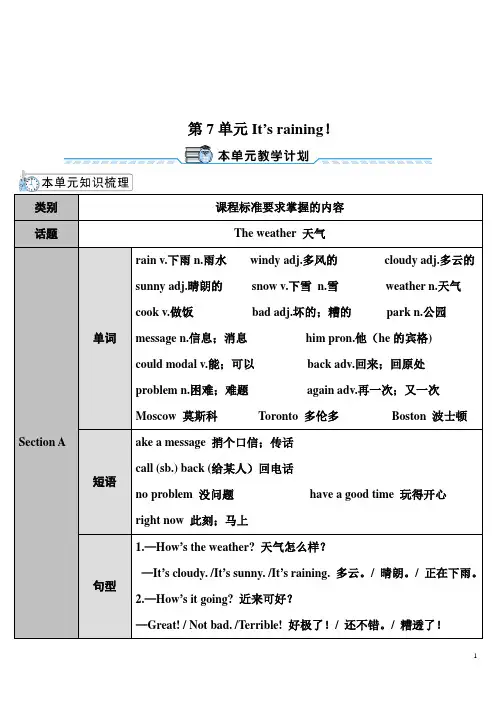
第7单元It’s raining!类别课程标准要求掌握的内容话题The weather 天气Section A 单词rain v.下雨n.雨水windy adj.多风的cloudy adj.多云的sunny adj.晴朗的snow v.下雪n.雪weather n.天气cook v.做饭bad adj.坏的;糟的park n.公园message n.信息;消息him pron.他(he的宾格)could modal v.能;可以back adv.回来;回原处problem n.困难;难题again adv.再一次;又一次Moscow 莫斯科Toronto 多伦多Boston 波士顿短语ake a message 捎个口信;传话call (sb.) back (给某人)回电话no problem 没问题have a good time 玩得开心right now 此刻;马上句型1.—How’s the weather? 天气怎么样?—It’s cloudy. /It’s sunny. /It’s raining. 多云。
/ 晴朗。
/ 正在下雨。
2.—How’s it going? 近来可好?—Great! / Not bad. /Terrible! 好极了!/ 还不错。
/ 糟透了!句型1. I’m having a great time visiting my aunt in Canada. 我在加拿大看望我的姑妈,并且玩得很开心。
2. My family and I are on a vacation in the mountains. 我和我的家人正在山里度假。
3. It’s hot in your country now, isn’t it ?你们的国家现在很热,对吗?4.The weather here is cool and cloudy, just right for walking.这儿的天气凉爽且多云,正适合散步。
七年级《go_for_it》Unit7_It’s_raining.教学设计与反思
教学设计与反思the sample answer for number 1. Correct the answers 2b.Check the answers 2b. 8.Homework根据听力2a2b ,写一篇Uncle Joe 一家的活动,文章开头给出:This is Uncle Joe ’s family. It ’s 6:00 pm. Uncle Joe is ------.这是检验学生对这堂听力课堂理解的延续巩固学习。
七、教学评价设计八、板书设计九.教学反思本节课中心话题是谈论天气,涉及两个主要的语言功能项目:一是运用How’s theweather? 及描述天气情况的形容词;二是继续运用现在进行时来描述人们的即时活动。
我在充分考虑了学生的语言基础,设计了操作性很强的语言活动,开始我主要是通过图片了然的解决描绘天气的生词,克服了学生记单词的心理障碍。
然后,我设计猜天气并和地点城市结合的游戏,活跃气氛,激发兴趣。
所以处理Section A 1b 的听力部分,学生不会有问题。
接着2a2b 的听力时围绕上一单元学过的的现在进行时,我是用听前-听中-听后的方法处理,不同层次的学生都有成功的体验。
同时创设了听力延续巩固练习,在整个教学设计和过程实施中做到了环环相扣,层层推进,课本教学内容和任务是非常好的完成了。
虽然经过我的精心设计,在循序渐进的呈现和练习中,学生由大量的语言输入和内化的机会,但是备课时考虑还是不够全面,活动设计还不够有效,教学方法还不够新颖灵活,学生知识的拓展延伸方面设计的不够好。
在教学路上,且行且思,且思且行。
我会在今后的教学路上,发扬优点,改进缺点,争做学生、家长、学校满意的人民教师。
Sunnyrainy/rainingcloudySnowy/snowingwindyHow ’ s the weather?=What ’s the weather like?is calling is cookingis watching TV Be +doing is playing computer games is talking on the phone。
人教版英语七年级下册unit7_It's_raining!语法精讲
rain
rain 做动词,意为“下雨”。 现在重庆在下雨。 _I_t’_s_r_a_in_i_n_g_i_n_C_h_o_n_g_q_i_n_g_n_o_w_._ rain 做名词,意为“雨_,__雨__水___ ”。
A spot of rain fell on her hand. 一滴雨落在她的手上。
weather
rainy
sunny
snowy
windy
cloudy
foggy
dry
humid = wet
What are the four seasons(季节)?
spring
summer
autumn/fall winter
warm
hot
cool
cold
cold cool warm hot
100℃
用所给单词的适当形式填空。 1. It’s a _s_u_n_n_y_ day today (sun). 2. The weather is bad now. It’s _w__in_d__y_
(wind). 3. Sounds like you _a_re__h_a_v_in__g_ (have) a
表示天气的形容词也可表示人的 态度和心态
—What’s/What are…doing? —…is/are v-ing.
1.询问天气与回答 —How’s the weather?
Review
—It’s raining/snowing/cloudy/sunny.
—What's the weather like (in…) ?
3. how 用来询问方式或手段。 你怎样去上学? _H__o_w_ do you go to school?
(完整版)人教版初中英语七年级下册Unit7SectionA教材全解
(完整版)⼈教版初中英语七年级下册Unit7SectionA教材全解⼈教版初中英语七年级下册Unit7SectionA教材全解Unit 7 It’s raining!.Unit 7 Section A教材全解1.raining下⾬【重点注释】rain在这⾥是动词,意为“下⾬”,raining是动词rain的现在分词(v.ing形式)。
例如:It often rains in summer.夏天经常下⾬。
It is raining outside.外⾯正在下⾬。
【拓展记忆】1)rain还可作名词,是不可数名词,意为“⾬;⾬⽔”。
例如:There is a lot of rain here in summer.这⼉夏天⾬⽔很多。
We have too much rain this summer.今年夏天⾬⽔太多了。
2)在表⽰“下⾬”时,可以⽤rain的不同形式来表达。
例如:⊙北京在下⾬——There is rain in Beijing.(rain作名词,表⽰“⾬”)=It is rainy in Beijing.(rain的形容词形式rainy表⽰“下⾬的”)=It is raining in Beijing.(rain的现在分词形式raining表⽰“下⾬”) ⊙明天将要下⾬——It will _____ tomorrow.It will be _____ tomorrow.There will be ____tomorrow.(第⼀空“rain”,will之后加动词原形;第⼆空“rainy”,be是系动词,之后加形容词;第三空“rain”,这⾥rain是名词,不可数名词,意为“有⾬”) 3)⽤heavy (heavily=hard)/light表⽰⾬的⼤/⼩。
例如:∵∵∵There will be a heavy rain tomorrow.明天会下⼤⾬。
It is raining heavily / hard here now。
初中英语_Unit 7 It's raining! Section A (1a教学设计学情分析教材分析课后反思
学情分析七年级的学生自我意识开始发展,他们有了一定的评价能力,也开始注意塑造自己的形象,希望得到老师和同学的好评。
本班学生有一部分英语基础较好,渴望展现自我,上课表现很积极,课堂参与度高。
但也有一小部分学生英语学习自信心不足,不愿、不敢表现。
两极分化现象初显。
效果分析本节课大部分同学能认真听讲,积极回答问题。
小组合作时能积极探究知识,合作互助完成任务。
大部分同学能够完成学习目标。
但部分学生学习主动性不强,上课漫不经心,不能积极参与活动与话题讨论。
部分同学听力能力较差,听力效果达成度不高,练习环节完成度不好,个别发音仍然存在问题。
部分同学目标语言应用能力不强,编对话和复述过程中存在语言错误。
附:学生课堂学习效果评价表学生课堂学习效果评价表注:1.本评价表针对学生课堂表现情况作评价2.本评价分为定性评价部分和定量评价部分。
3.定量评价部分总分为100分,最后取值为教师评、同学评和自评分数按比例取均值;4.定性评价部分分为“我这样评价自己”、“同伴眼里的我”和“老师的话”,都是针对被评者作概括性描述和建议,以帮助被评学生的改进与提高。
教材分析第七单元的中心话题是谈论天气。
本单元主要涉及两个语言功能项目:一是运用How’s the weather?及描述天气情况的形容词来谈论不同城市的天气状况;二是继续运用现在进行时态来描述人们的即时活动。
本节听说课通过介绍北京等五个不同城市的天气状况以及Linda 一家的活动,让同学们在不同场景中学会谈论天气,学会介绍他人的即时活动。
本部分的教学重点是how 引导的询问天气的特殊疑问句,描述天气状况的形容词,与天气相关的人们相应的即时活动。
难点是现在进行时中助动词be和动词-ing的正确使用。
涉及的文化背景知识主要有世界各地的气候差异,通过谈论天气来促进交际是本单元涉及的交际策略。
评测练习一:Make a weather forecast.评测练习二:Make a report.不识庐山真面目,只缘身在此山中——“一师一优课”课后反思美国学者波斯纳德有一句名言:“没有反思的经验是狭隘的经验,至多只能形成肤浅的知识”。
人教新目标版2013—2014年度下学期七年级英语教案Unit 7 It’s raining!
人教新目标版2013—2014年度下学期七年级英语教案主备人:备课时间:2014年月日成员:Unit 7 It’s raining!Period 1(Section A 1a, 1b, 1c)Teaching aims1、Words:rain,windy,cloudy,sunny,snow,weather,Moscow,Boston,how’s,bad,terrinle,pretty,cool, cold, humid, warm, hot2、Sentence structures: How’s it going? How’s the weather? What’s the weather like? Important pointsA new way of greetings and the description words about the weather.Difficult pointsHow’s the weather? It’s raining/windy/cloudy/sunn y/snowing/.How’s it going? Great! /Not bad! /Terrible! /Pretty good!Teaching proceduresStep1. Warming up1. Ask the Ss randomly: What’s the date today? What day is it today? How are you?2. Give a new expression which has the same meaning as How are y ou? : How’s it going? But the new one has more answers.Step2. Presentation1. Show 4 faces on the screen and ask Ss to describe each face using whatever words they can. Help Ss identify each person is feeling.2. Then show 4 words. Say the words and ask Ss to repeat each one. Ask Ss to match each remembered phrase with a face. Encourage them to spell the phrases by How do you spell it?3. Practice with the new structure by the whole class: Choose one to the front and the others guess the description words through his/her facial expressions.Step3. Practice and listening test1. Let one student ask me: How’s it going? I may answer like this: Terrible! Because it’s snowing and it’s so cold. Show a picture of snowing day and children are making a snowman and pretend to be very cold. Make Ss guess the words: the weather and snowing. Ask them: How’s the weather? Get them to answer like: It’s snowing/snowy. Go on with other kinds of weather: sunny, rainy, cloudy, windy.2. Play the tape and get Ss to write the city names in the boxes. Check the answers. Look at the 5 pictures in 1a. Encourage Ss to use the description words to describe the weather: ①Beijing—sunny and warm/hot ②Shanghai—cloudy and cool ③Boston—windy and cool ④Moscow—snowing and cold ⑤Toronto—raining and humid. Show an arrow to identify the degree of the 4 adjectives: cold, cool, warm and hot.4. Practice with the structures: How’s the weather? and What’s the weather like? with the 5 pictures The exact weather on that day should not be missed. Note: Talking about the weather is quite common in western countries as a daily greeting.Step4. Weather reportShow a weather map of China. Get Ss to make a weather report as a CCTV anchor. They may begin with asking the weather in each city, then make up a report about it.Step5. ChantShow an easy chant to reinforce the questions and words about the weather.Step6. Homework1. Copy the new words 4 times each.2. Summarize the usages of how in questions.3. Watch a weather report on TV and take down some notes about the weather forecast for tomorrow, and then write a report about it.教学后记:Period 2 (Section A 2a, 2b, 2c)Teaching aims:1. Learn the vocabulary words and useful expressions.2. Target languages:How’s the weather? It’s raining.What are you doing? I’m watching TV.What’s she doing? She is playing basketb all.3. Enable the students to talk about the weather and the activities that people are doing.4. Help the student learn how to talk about the weather and the activities that people are doing.Teaching procedures:Step 1. RevisionTalk about the students about the weather.Ask as many students the similar questions as possible and write the words about weather on the blackboard. Then ask the students to read them repeatedly.Step 2. Free talk and lead-inShow the following pictures. Talk with the students about the weather and the activities that people are doing. Say: Please look at the pictures and answer the following questions.Show or draw the pictures on the blackboard, and let the students practice more.Step 3. Listening (2a, 2b)1.Work on 2a.Let's see what Joe's families are doing. Point to the 4 pictures.2.Ask Ss tell each person is doing in each picture. More attentions shouldbe paid to the correct use of the Present Progressive Tense.3. Play the recording for the Ss to listen and number the pictures [1-4].4. Play the tape for Ss to check the answers.5. With the whole picture, get some Ss to tell the story of it.6.BrainstormingPlay the tape for another time. Then do a memory test.Ask Ss: What's Uncle Joe/Jeff/Mary/Aunt Sarah doing?What're Scott and Lucy doing?Is Jeff watching TV? etc.7.Let Ss match the names with the activities in 2b.Play the recording for the Ss to check the answers.Step 4. Pair work(2c)1.Look at the pictures and talk about the people in 2a with a partner.2.Ask a student the questions as a model:T: What's Uncle Joe doing?S1: He's playing basketball.3.Ss work in pairs. Ask and answer about the pictures.Step 5.Role-play1.Ask Ss to read the conversation and answer the questions:a.What's Steve doing?b.What's Rick's brother doing?Ss read the conversations and answer the questions. Then check the answers together.Step 6.GrammarAsk the students to read the sentences in the grammar box.Help the students sum up how to add-ing to verbs.Homework1. Ask the students to make a dialogue in pairs after class.2. Ask the students to do exercise 4 in workbook.教学后记:Period 3 (Section A 2d--3b)Teaching aims:1. Teach vocabulary words.2. Target languages:—How's the weather in Beijing? —It's sunny.—Can I take a message for him? —Yes. Could you just tell him to call me back?—Sure, no problem.3. Enable the students to talk about feelings about different things.4. Help the students learn how to talk about feelings about different things.Teaching procedures:Step 1. RevisionTalk about the weather and activities.Show the pictures.Give the students more changes to practice.Then check the answers.Step 2. Lead-inSay, Look at the picture. How’s the weather in the picture? Show the picture.Help the students express their feelings with the words: great, terrible, good, pretty, good, not bad Step 3. Warming- up and revision1.Have a dictation of the new words and expressions in period 1.2.Ask some pairs to role-play the conversation in 2d.Step 4.Grammar Focus.1.Ss fill in the blanks and check the answers themselves.2.Ss read the sentences and learn by themselves.Step 5.Practice1.Work on 3a. Fill in the blanks with the correct forms of the verbs in the box. Then practice the conversations with a partner.2. Ss read the conversations and fill in the blanks.3. Check the answers with the class.4. Ss practice the conversation in pairs.5. Ask some pairs role-play the conversation.Step 6.Practice1.Work on 3b.Yuan Y uan from CCTV is interviewing people in five different places. Fill in the chart below.2.Ss work in groups. Discuss the pictures and talk about the weather andwhat the people doing.Make a model for the Ss:—How's the weather in Picture a? —It's sunny.—What's the boy doing? —He's playing the guitar.3.Ss ask and answer about the pictures. Then fill in the blanks.4.Check the answers with the class.Step 7.Practice1.Every student draws a picture. On your pictures sb. is doing something in some kind of weather.2.Ask and answer about the picture.—How's the weather?—What's he/she doing?HomeworkAsk the students to do the following:1. Write something about the weather and make some sentences with the Presents Continuous Tense.2. Prepare the new words in Section B.教学后记:Period 4 (Section B 1a--1d)Teaching aims:1. Teach vocabulary words: dry, cold, hot, warm, visit, Canada, summer, sit, juice, soon, vacation, hard, Europe, mountains, country2. Target languages:—How's it going?—Not too bad. Are you studying hard or having fun?3. Enable the students to describe the weather and what people are doing.4. Help the students learn how to describe the weather and what people are doing.Teaching procedures:Step 1. Warming- up and revision1. Ask and answer about the weather.2. Ask and answer what sb. is doing.Step 2.Presentation1.Show some pictures on the big screen. Present the new words. dry, cold, hot, warm …2.Ss learn the new words and expressions and try to understand the expressions.3.Give Ss some time and try to remember the new words and expressions.Step 3.Matching1.Read the words in the box in 1a. Then look at the pictures. Match the words with the pictures.Ss match the words with the picture.2. Check the answers.Step 4. Pairwork1.Look at the pictures in 1a. Ask and answer questions about the weather in the pictures in 1a.Give an example to the Ss.T: How's the weather in the picture d?S1: It's dry.2.Now work in pairs. Ask and answer about questions about the weather in the pictures in 1a.3.Ask some pairs to ask and answer about the questions.Step 5.Listening work on 1c:1.Read the chart in 1c.2.Play the tape for the Ss to listen and write what Mary and Eric answerto "How's it going?".3.Play the recording twice. The first time Ss only listen. For the secondSs listen and write down the words in the blanks.Step 6.ListeningWork on 1d:1.Listen again. What does Eric answer to "What are you doing?" & "How's the weather?"2. Play the recording twice. The first time Ss only listen. For the secondSs listen and write down the words in the blanks.HomeworkAfter class, please make dialogues with your friend or classmates talking about the weather and the activities that you are doing. And do EX 5 and 6 in the workbook.教学后记:Period 5 (Section B 2a--Self-check)Teaching aims1. Teach vocabulary words: visit, Canada, summer, sit, juice, soon, vacation, hard, Europe, mountains, country2. Target languages: Are you studying hard or having fun? I'm having a great time in Europe.3. Ability: Learn about different activities in different weather4. Cultural awareness: Learn to love our nature and protect the environment. Make a donation if possible Important points:Use the words, expressions and sentence structures correctly.Difficult points:Use the expressions they learned to describe the weather in 4 seasons and people’s activitiesTeaching proceduresStep1. Warming- up and revision1.Ask and answer about the weather.2.Ask and answer what sb. is doing.Step 2.Presentation1.Show some pictures on the big screen. Present the new words. dry, cold, hot, warm …2.Ss learn the new words and expressions and try to understand the expressions.3.Give Ss some time and try to remember the new words and expressions.Step 3.Talking1.Look at the pictures in 2a. Talk about the pictures with a partner. How'sthe weather? What are the people doing? Make a model to the Ss.S1: How's the weather in picture a? S2: It's sunny and warm.S1: What's the girl doing? S2: She's sitting near the pool and drinking some juice.2.Ss work in pairs and talk about the pictures.3.Let some pairs ask and answer the pictures aloud.Step 4.Presentation1.Show some pictures on the big screen to present some of the new words in the postcards in 2b.2.Teach Ss the new words. Then let Ss read the new words after the teacher.Step 5. Reading1.Fast ReadingRead the postcards in 2b and math each postcard with the correct picture in 2a.Ss read the postcards quickly and match the postcard the correct picture.Then check the answers.2. Careful reading:Read the first postcard again and find the answers to these questions.Read the second postcard again and find the answers to these questions.① Where is Dave now?② What are Dave and his family doing there?③ Are they having a good time?Ss read the postcards and try to find the answers to the questions. Then check the answers with the class. Step 6. After Reading1.Read the postcards again and fill in the chart with the information from the postcards in 2b.Step 7.Writing1.Write a postcard to a friend. Tell your friend about your vacation and what you are doing.2.Let Ss read their postcard to the class.Step 8 HomeworkSummarize the key words and expressions in this unit.教学后记:。