
(151页)人教版九年级英语上册(全册)教案 汇总
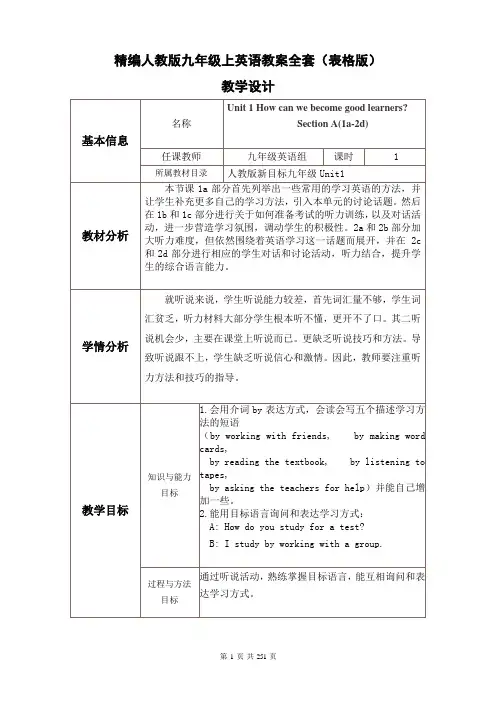
(151页)人教版九年级上册(全册)教案 汇总 Unit 1 How can we become good learners? Section A (1a-2d)
1.重点单词:textbook,conversation,aloud,pronunciation,sentence 2.重点短语:make word cards,work with friends,ask the teacher for help,listen to tapes,speaking skills,word by word,be patient 3.重点句式: How can we become good learners? —How do you study for a test? —I study by working with a group. What about reading aloud to practice pronunciation? It's too hard to understand spoken English. —Have you ever studied with a group? —Yes,I have.I've learned a lot that way. Try to guess a word's meaning by reading the sentences before and after it. You can become better by reading something you enjoy every day. The more you read,the faster you'll be. 1.重点短语和句型 2.How对方式进行提问及用by+doing回答
How对方式进行提问及用by+doing 回答 一、预习课本P1-2新单词并背诵,完成下面的汉译英. 1.课本____________ 2.交谈____________ 3.大声地____________ 4.发音(n.)____________ 5.句子____________ 6.有耐心的____________ 二、认真预习1a-2d找出下列短语和句型. 1.制作单词卡片________________________________________________________________________ 2.和朋友一起学习________________________________________________________________________ 3.向老师请教________________________________________________________________________ 4.听磁带________________________________________________________________________ 5.口语技能________________________________________________________________________ 6.逐词地________________________________________________________________________ 7.耐心点儿________________________________________________________________________ 8.我们怎样才能成为好的学习者? ________________________________________________________________________ 9.——你怎样为考试复习做准备? ——我通过和小组合作来学习. ________________________________________________________________________ ________________________________________________________________________ 10.大声朗读来练习发音怎么样呢? ________________________________________________________________________ 11.理解英语口语太难了. ________________________________________________________________________ 12.——你曾经和小组一起学习吗? ——是的,用那种方法我学到很多. ________________________________________________________________________ ________________________________________________________________________ 13.通过阅读一个单词前后的句子尽量来猜测它的意思. ________________________________________________________________________ 14.通过每天阅读一些你喜欢的东西,你能变得更好. ________________________________________________________________________ 15.你读得越多,就会读得越快. ________________________________________________________________________
Step 1 情景导入 (Show some pictures about ways to learn English)Teacher:Do you like English?How do you learn English?There are some good ways to learn English.Let's learn the ways to learn English like this:How do you study English?I learn English by listening to tapes. 环节说明:由图片入手,图文并茂,引起学生的学习兴趣. Step 2 完成教材1a-1c的任务 1.学生领读1a中的短语,教师纠正错误读音,学生识记短语后再添加其他的学习英语的方法并且熟悉by doing sth.的用法. (3分钟). 2.认真听录音,看看这些学生的学习方法,紧挨着名字写下图中的字母. (2分钟) 3.再听一遍录音,并跟读对话. (2分钟) 4.结对练习1c中的对话,并请一些学生表演出他们的对话. (3分钟) 5.模仿1c中的对话,结合1b的答案材料与同伴编练新对话,并邀请几组学生表演对话. (5分钟) 参考案例 A:How do you study for a test? B:I study by working with a group. 6.小结训练. (3分钟) (B)1.________ do you study for a test? A.What B.How C.When D.Where (D)2.He learns English by ________ English songs. A.listen B.listen to C.listening D.listening to (D)3.How do you study ________ an examination? A.to B.at C.with D.for (A)4.Do you often have meals ________ your parents? A.with B.for C.to D.at (B)5.—How do you study for a test? —I study by ________. A.ask the teacher for help B.asking the teacher for help C.ask the teacher to help D.asking the teacher to help 环节说明:听说结合,第一时间向学生传达了语言目标,通过结对对话练习和小结训练,使语言目标得以强化. Step 3 完成教材2a-2c的任务 1.在小组内认真读一读2a中的句子并交流句子的意思,为听力做好准备. (2分钟) 2.认真听录音,在你听到的问题前打勾. (2分钟) 3.再认真听一遍录音,从2b中把2a中的问题的答案找出来,把序号填写在2a表格Answers 栏目下,集体核对答案. (3分钟) 4.让学生利用2a, 2b中的信息仿照2c 的形式练习对话,并要求多组同学表演对话. (5分钟) 参考案例 A:Have you ever studied with a group? B:Yes.I have.I've learned a lot that way. 5.小结训练. (2分钟) 1.What about reading(read) aloud to practice pronunciation? 2.Listening to tapes improves my listening skills(skill). 3.Have you ever studied (study) with a group? 4.It's too hard for me to_learn (learn) English. 5.We should practice speaking (speak) English aloud every morning. 环节说明:通过听、说、读、写训练让学生掌握了询问方式的句型及答语,并且使学生的口语表达能力在这一环节得到提升. Step 4 完成教材2d的任务 1.学生自读对话,回答下面的问题. (5分钟) 1)Why is Jack nervous? 2)How should Jack read faster? 3)What's Annie's advice about understanding the words? 2.大声朗读2d中的对话,读熟后与同伴结对练习,分角色表演对话. (3分钟) 3.邀请三组同学来表演对话. (5分钟) 4.小结训练. (3分钟) 1.不要逐词地读,要读字群. Don't_read_word_by_word.Read_word_groups. 2.每天读一些你喜欢的东西你就能变得更好. You_can_become_better_by_reading_something_you_enjoy_every_day. 3.你读得越多,读得越快.
精编人教版九年级上英语教案全套(表格版)
精编人教版九年级上英语教案全套(表格版)教学设计教学设计教学设计Step41b(5minutes)Step5 Listening and speaking (13minutes) 1b What other things are difficult foryou? Make a list.1. I don’t know enough words to writewell.2.____________________________3.____________________________Step 2 Listening and speaking1c Paul finds it difficult to learnEnglish. Listen and complete .Answers:pronunciation,forgets,understand, writing1d Listen again. Complete thesolutions.Answers:Listening, write the newwords, join an English language club,pen pal1e Role-play conversations using theinformation in 1c and 1d.Make a list.Listen andcomplete .Listen againandcompletethesolutions.Role-playconversations为听力训练做铺垫。
课堂练习,检测他们对知识的掌握程度,训练学生的听力能力和听力技巧。
通过拓展练习教学设计Step6 Group work(7minutes) 状语从句even though 引导让步状语从句时,不能与but连用。
2e Do you think you are a goodlearner? What learning habits do youthink are useful? Discuss with yourgroup and share your ideas with theclass.A: I think another way to become asuccessful learner is by trying to thinkabout the same thing in different ways.B: I agree. I believe that…Discuss withyour groupand shareyour ideaswith theclass.通过小组活动,让学生各抒己见,也为下节课的写作做了准备。
人教版初中英语九年级全册教案整理

新目标英语九年级全册教案Unit 1 How do you study for a test?Section A 1a—2c【学习目标】知识目标:1、熟练掌握以下句型:(1)A: How do you study for a test?B: I study by working with a group?(2)A: Have you ever studied with a group ?B: Yes, I have. I’ve learned a lot that way.2、掌握“by doing”结构3、熟练掌握词汇:aloud, pronunciation, flashcard, vocabulary技能目标:能用how引导的特殊疑问句和by短语对学习方法进行讨论。
情感目标:能与别人交流学习方法,形成相互交流相互促进的学习氛围。
【课前准备】I、(1)你认为下面图片中的人或物哪些对你的英文学习有帮助,快把它们选出来吧。
(2)你能根据图片,结合课本1a和2a内容,用英文写一写学习英语的方法吗?(越多越好哦!)1、对照课前准备I的内容,在班里举办一个自由访谈,向你认为英语成绩优异的同学请教一下学习方法,或者把你的经验告诉其他同学。
并由老师帮助汇总。
2、在1a中选出你认为适合自己的学习方法。
并在1a中补充你采用的其他方法。
3、观察1a中三幅图片,他们都在做什么?用英语怎么说?1、听1b中孩子们谈论的学习英语的方法。
根据所听录音,将1b中的人名与1a图片中的字母匹配。
2、听两遍录音,完成下面的对话。
A: You did really well on the last English test, didn’t you, Mei?C: Yeah, I did OK.A: well, how did you study?C: By .A: Maybe I’ll try that. How did you study, Pierre?D: By . She was really happy I asked.A: That’s interesting., Antonio?E: I like to study by . But sometimes my mother thinks I’m listening to music. And then she gets mad.观察与思考:通过刚才的听力训练,请你来总结一下:向他人请教学习英语的方法应该用来提问。
初三上册英语教案人教版
【导语】学习是每个⼀个学⽣的职责,⽽学习的动⼒是靠⾃⼰的梦想,也可以这样说没有⾃⼰的梦想就是对⾃⼰的⼀种不责任的表现,也就和⼈失⾛⾁没啥两样,只是改变命运,同时知识也不是也不是随意的摘取。
要通过⾃⼰的努⼒,要把我⾃⼰⽣命的钥匙。
以下是为您整理的《初三上册英语教案⼈教版》,供⼤家学习参考。
Unit 1Self-check and Reading学习⽬标1.通过学习短⽂,掌握如何处理我们在学习、⽣活中遇到的问题和挑战。
2.掌握下列知识点:■重点词汇:soft,unless,solve,regard,influence,friendship,lose,development■重点短语:①look up ②write down ③make up ④deal with⑤regard as ⑥be angry with ⑦go by ⑧as a second language■重点句型:①If you don't know how to spell new words,look them up in a dictionary.②As young adults,it is our duty to try our best to deal with each challenge in our education with the help of our teachers.预习导学Ⅰ.预习单词,完成下列各词。
1.unfair(反义词)2.friend(形容词3.easy(副词)4.important(反义词5.agreement(反义词Ⅱ.预习Reading部分,回答下列问题。
6.How do we deal with our problems合作研讨⼀、重点单词与短语1.unless conj.如果不;除⾮例如:l won't go to the party unless I am invited.除⾮我受到邀请,否则我不会去参加晚会的。
最新九年级英语全册(人教版)配套教学教案 (全册)

全新修订版教学设计(教案全)九年级英语全册老师的必备资料家长的帮教助手学生的课堂再现人教版目录Unit 1How can we become good learners (003)Unit 2I think that mooncakes are delicious! (013)Unit 3 Could you please tell me where the restrooms are? (023)Unit 4I used to be afraid of the dark (031)Unit 5What are the shirts made of? (042)Unit 6When was it invented? ....................... (054)Unit 7Teenagers should be allowed to choose their own clothes (064)Unit 8It must belong to Carla (074)Unit 9I like music that I can dance to (083)Unit 10You're supposed to shake hands....... (093)Unit 11Sad movies make me cry (102)Unit 12Life is full of the unexpected..... . (122)Unit 13We are trying to save the earth! (156)Unit 14I remember meeting all of you in Grade 7 (172)Unit 1How can we become good learners?第一课时Section A(1a-2d)I. Target Navigation【目标导航】◆Key words and phrases:textbook,conversation,aloud,pronunciation,sentence,patient,by+v.ing◆Key sentences:(1)How do you study for a test?I study by working with a group.(2)Have you ever studied with a group?Yes,I have. I've learned a lot that way.(3)It's too hard to understand spoken English.◆Skills:能够熟练地谈论怎样学习的话题,以及回答自己的学习方式。
人教版九年级上册英语教案

人教版九年级上册英语教案一、教材信息- 教材名称:人教版九年级上册英语- 出版社:人民教育出版社二、教学目标1. 培养学生对英语研究的兴趣和自信心。
2. 提高学生的听、说、读、写能力。
3. 培养学生良好的研究惯和合作意识。
三、教学内容1. Unit 1: Meeting New People- 课时安排:2课时- 教学目标:- 研究并掌握有关介绍自己和他人的英语表达方式。
- 锻炼学生的听力和口语能力。
- 教学重点:- 学会用英语自我介绍。
- 学会询问他人的个人信息。
- 教学步骤:1. 导入新课:通过图片和问题引导学生讨论与主题相关的话题。
2. 呈现新词汇和句型:通过多种方式介绍课文中的生词和句型,帮助学生理解并记忆。
3. 听力训练:播放录音,让学生根据听到的内容填写相关信息。
4. 口语练:通过小组活动、角色扮演等形式,让学生运用所学内容进行口语练。
5. 小结与作业布置:对本课所学内容进行总结,并布置相应的作业。
2. Unit 2: Making a Difference- 课时安排:2课时- 教学目标:- 研究掌握有关环保行动和社会公益活动的英语表达方式。
- 培养学生对环境保护和公益事业的意识和责任感。
- 教学重点:- 学会用英语表达对环境保护的看法和建议。
- 学会描述社会公益活动并表达参与的意愿。
- 教学步骤:1. 导入新课:通过图片和问题引导学生讨论与主题相关的话题。
2. 呈现新词汇和句型:通过多种方式介绍课文中的生词和句型,帮助学生理解并记忆。
3. 阅读训练:让学生阅读课文,并回答相关问题。
4. 口语练:通过小组活动、角色扮演等形式,让学生运用所学内容进行口语练。
5. 小结与作业布置:对本课所学内容进行总结,并布置相应的作业。
(以下教学内容省略)四、教学评价1. 学生听说读写能力的提升情况。
2. 学生对课程内容的理解和掌握程度。
3. 学生合作意识和参与度。
4. 学生课后作业完成情况。
五、教学反思与改进通过对教学过程和效果的评估,及时反思并改进教学方法与策略,不断提升教学质量。
初中初三九年级人教版上册英语全册教案下载

初中初三九年级人教版上册英语全册教案下载Unit 1 How do you study for a test?Page 2, 1a, 1b, 1c课时: Period 1教学目的: Talk about how to study.Learn the use of “by doing something”重点难点: Useful expressions-How do you study …? I study by doing …教学工具: courseware教学步骤:Step 1. Self-introductionThe new term has come. Ask the students to introduce them selves to the others and the teacher. Then ask what they did in t he summer holiday. If possible, ask how they did that.Help the students use the construction “I …by doing…”.Ex plain “by”.Step 2. DiscussionHave the students say what they think of English.Then tell each other how they study for an English test. See the phrases shown in the courseware, which is similar to 1a. Rem ind them to use “by doing…”Step 3. 1a. Checking the ways you studyAsk students to finish the task. They can add something els e.Step 4. 1b.ListeningListen to the listening stuff of 1b, which is recorded in the co urseware (convenient to be repeated). Finish the task.Then the teacher asks, ”How did Mei/ Pierre / Antonio study?” Have some students give the answers, i.e. repeat the senten ces by using “by doing”Step 5. 1c. Making dialoguesWork in pairs or groups. Discuss first. Then make a short dia logue.Have the students share their work.Step 6. Writing.See the courseware. Fill in the blanks. Write down the answe rs on a piece of paper. Ask students to read their work.课时: Period 2教学内容: Page 3, 2a, 2b, 2c and the grammar focus.教学目的: Talk about how to learn English.Consolidate the use of “by doing something”重点难点: Useful expressions-Do you study …by doing…? Y es /No... (reason).教学工具: courseware教学步骤:Step 1. RevisionMake a dialogue between the teacher and some students. A sk whether they like English, then tell the reason. Ask how they l earn English.Step 2. 2a. ListeningSee the courseware. Explain any difficult points. Listen to th e stuff, and check the answers.Have students repeat some main sentences, ready to practic e dialogues.Step 3. 2b.ListeningFinish the task.Step 4. 2c.Doing a pairworkGive students some time to talk about the contents of 1a an d 1b.See the courseware. Some patterns will help, such as “Do y ou.../ What about.../ Have you ever.../ How do you…?” and the possible answers.Share their dialogues.Step 5. Make a conversation.Ask students to tell the others their own experience about s tudying English by working in pairs or groups. Then make a con versation respectively.They can also use indirect speech, such as “... says she learn s ... by ...”etc.Step 6. SummaryPoint out the main contents learnt these two days.英语(九年级)教学设计(3)课时: Period 3教学内容: Page 4, 3a, 3b,教学目的: Practice reading.Learn useful expressions.Practice writing.重点难点: v + ing phrase used as a subjectfind / think + O + OC教学工具: courseware教学步骤:Step 1. Make a statement.Firstly the teacher asks a student a question and the student answers. Ask several.Then have many more students make a statement one by o ne to introduce how he / she learns English.Step 2. 3a. ReadingFirstly, read to the tape aloud. Pay attention to the pronunci ation and the intonation.Read again, underline the useful expressions.Read once more. Fill in the chart. Check the answers.Step 3. Learn the useful expressions.1. Ask students to say the useful expressions they have und erlined.2. Add if the students miss some.3. Learn some grammar:Ask a student to tell us how many sentences, which include v-ing phrase as a subject, are in the text. Point out the constructi ons. Explain why they are used.Teach the structure ”find / think + O + OC” and other gra mmar.Step 4. 3b. PairworkGive the students a little time to prepare a role play.Ask some to share their work with the whole class.Step 5. ConsolidationIn Chinese, teacher says some important phrases from the t ext. Have the students tell us the English ones as quickly as poss ible.Unit 2 I used to be afraid of the dark.The First PeriodTeaching Contents: Section A 1a,1b,1c,2a,2b,2cStep I Organization of class1.Greeting2.Warming upStep II Presentation1.Words CompetitionShow the class many words of appearance and personality. Get them to put the words in the right place.2.Guess: Who is the boy?Show the class some information about Harry Potter:He is a boy. He is not tall. He has curly hair. He is easygoing. He is very smart. He can see strange things and so on.3.Show two photos of the teacher — five years ago/ now. Ask the students some questions: What did I look like five years ago? What do I look like now?4.Introduce the new conversations in Unit 2.I used to be fat. I am thin now.I used to have long hair. I have short hair now.I used to play basketball. I play ping-pong now.Step lIl Teaching Tasks1.Task One (Pairwork): Listening to the tape(1) Show the students two pictures and say something about the people in the picture.(2) Listen to the tape. Then fill in the blanks in lb,2a,2b.2.Task Two (Groupwork): Describing different persons(1) Show the students a set of pictures, such as a movie star,a sportsman, a teacher.(2) Get the students to discuss in groups and take notes, such as: Jacky Chan used to have big eyes, but now he has small eyes.(3) Ask two or three groups to present their answers.(4) Which group does best?3.Task Three (Team work): Survey(1) Ask the students to bring two photos of themselves to class.(2) Get the students to talk about the changes of their classmates and write down the key words in the form.(3) Let the team leader present their survey results.(4) Who has changed most in your team?(5) Which is the best team?Step IV SummaryStep V Assign homeworkWrite a composition about your classmate before and now.The Second PeriodTeaching Contents: Section A 3a,3b,4Step I Organization of class1.Greetings2.Singing an English songStep II Revision1.Revise the conversations that the students learned in the first period. Ask them to talk about some pictures.2.Check the homework. Talk about what one person used to be like and she/ he is like now.Step IIl Presentation1.Show the class a picture of a big dog,then introduce the new conversations in 3a:I used to be afraid of big dogs./I’m still afraid of big dogs.2.Ask the students some questions like this:What did you use to be afraid of?/Are you still afraid of...?Step IV Teaching Tasks1.Task One (Pairwork):Match the pictures with the phrases.(1) Show the students six pictures about the phrases in 3a.(2) Ask the students to talk about the pictures in pairs and match them.2.Task Two:Put checks in the first two columns.(1) Show the students the first two columns about “I”, thenget them to put checks.(2) Ask a group of students to read out their answers like this:I used to be afraid of... / I’m still afraid of...3.Task Three(Pairwork):Put checks in the last two columns.(1) Show the students the last two columns about “My Partner”.(2) Get the students to practice the dialogs in 3b.(3) Put checks in the columns.(4) Ask several pairs to present their answers.(5) Choose the best pair.4.Task Four(Groupwork): A survey(1) Show the students a form about the activities.(2) Get the students to fill in the blanks about “I”.(3) Get the students to ask their classmates and fill in the blanks about “My classmate”.(4) Ask the students to ask questions like this:What did you use to eat?/ What do you eat now?(5) Let two or three groups present their results.(6) Which is the best group?5.Task Five (Teamwork): How has Zhongshan(中山)changed?(1) Show the class several pictures of Zhongshan city — Past and Now.(2) Get the students to talk about the pictures and write down the key words on the paper.(3) Ask two or three team leaders to present their opinions.Step V SummaryStep V IAssign homeworkGet the students to write a composition about“Zhongshan has changed a lot!”The Third PeriodTeaching Contents: Section B la, lb, 2a, 2b, 2c, 3aStep I Organization of classWarming upStep II Checking up the homework1.Ask two students to read out their compositions (Zhongshan has changed a lot!).2.Get students to discuss the compositions.Step III Presentation1.Show the class four pictures in la.2.Ask students to describe what is happening in each picture:A girl is exercising in gym class.A girl is painting a picture.A boy is singing.A boy is looking at some insects.3.Ask students to check the things they liked to do when they were very young.Step IV Teaching Tasks1.Task One (Pairwork): I used to like to...(1) Point out the lines under the picture in lb.(2) Ask students to write down different things that they used to like to do.(3) Get students to discuss the answers in pairs, then ask some students to read out their sentences.2.Task Two: Listening practice (2a, 2b)(1) Ask students to listen to a dialog between a boy and a girl.(2) Ask students to check the sentences on the list that they hear on the recording.(3) Check the answers in 2a.(4) Play the recording again. Ask students to fill in the blanks with the words they hear.(5) Correct the answers in 2b.3.Task Three (Pairwork): Making up dialogs(1) Teach students the conversation in 2c.(2) Say some sentences using Did you...?and the answers Yes,I did./ No, I didn't.(3) Ask students to make similar dialogs in pairs.(4) Call on different pairs to read out their conversations to the class.4.Task Four (Groupwork): A debate(1) Show students a survey that the teacher did before the class.(2) Get them to discuss their hairstyles in the past and now like this:I used to have ... hair, but now I have ... hair.(3) A debate──Should students choose their own hairstyle? Why or why not?5.Task Five: Reading Practice(1) Get students to read the story in 3a.(2) Ask students to complete the chart about Rose Tang then and now.(3) Check the answers.Step V SummaryStep VI Assign homework1.Ask students to Complete the letter in 3b (How I've changed!).2.Get students to talk to their parents and fill in the chart in 4a.The Fourth PeriodTeaching Contents: Section B 3b, 3c, 4a, 4b, Self Check.Teaching Procedures:Step I Organization of classStep II Checking up the homework1.Ask some students to read out the letter (How I've changed!).2.Get students to discuss their answers and choose the best one.Step lII Teaching Tasks1.Task One (Pairwork)Ask students to finish 4a before the class-Talk to their parents and fill in the chart in 4a.2.Task Two (Groupwork)(1) Ask students to talk about the contents in 4a with their classmates.(2) Choose two groups to present their answers.3.Task Three (Teamwork): How has Yu Mei changed!(1) Get students to talk about the pictures in Self Check 2.(2) Ask students to use the drills in Unit 2 to describe the pictures.(3) Ask students to write down a composition about Yu Mei on the paper.(4) Ask two or three of them to read out their compositions in class.(5) Choose the best one.4.Task Four (Teamwork): A survey──How has our life changed?(1) Show students some information in Unit 2.(2) Ask students to talk about how their life has changed since primary school and fill in the blanks in the survey form.(3) Ask the team leaders to present their survey results.(4) Choose the best team.5.Task Five: A composition about the changes in our life(1) Get students to write a composition on the paper.(2) Ask students to exchange their compositions and correct them.(3) Show the class one or two good compositions.Step IV SummaryStep V Assign homeworkFinish Part One of Self Check.The Fifth PeriodReading—E-mail EnglishStep I Organization of class1.Ask the whole class some questions:What subjects do you study at school?What subject do you like best? Why?2.Talk about the usage and importance of English.Step II Introducing E-mail EnglishWhat does e-mail English mean? What is it used for?Step III Teaching Tasks1.Task One (Pairwork)(1) Ask students to talk about the words in Part 1.(2) Ask students to fill in the chart with their partners and try to think of some more.(3) Check their answers.2.Task Two: Matching(1) Get the students to read the whole article as quickly asthey can.(2) Try to finish the exercise in Part 2—Match each paragraph with its main idea.(3) Check the answers.3.Task Three: Deep Comprehension(1) Tell the students to read the article more carefully again.(2) Try to finish the exercise in Part 3—Match the words and expressions with their meanings.(3) Try to finish the exercise in Part 4—Find words or phrases for 1-5.(4) Check their answers.4.Task Four (Pairwork)(1) Ask the students to finish Part 5 in pairs.(2) Write a message to their partner using the e-mail English in this reading or other e-mail words.(3) Let some students read out their e-mails.(4) Choose the best one.Step IV SummaryStep V Assign homeworkWrite a reply to your partner, using the e-mail English as much as possibleUnit 3 Teenagers should be allowed to choose their own clothes.I. Learning objectives 教学目标SkillFocus Talk about what you are allowed to do.Learn to talk about “agree” and “disagree”.Talk about the rules around the students.Learn to make rules or change rules reasonably.LanguageFocus功能句式 Talk about what you are allowed to do (P18)I think teenagers should be allowed to drive.Students should not be allowed to have part-time job.Talk about “agree” and “disagree” (P19)I think students should be …I disagree. They talk …I agree.Do you think …?No, I don’t.Talk about the rules (P20-22)We have a lot of rules …So do we.My friends and I goy to talk about the rules …What school rules do you think should be changed?词汇1. 重点词汇license, silly, study, present, member, sleepy, reply, possibly, drop, final, count, owner, sky, catch, interview, noise, wind, neighbor, director, smell, finger, lift, stone2. 认读词汇pierce, earring, concentrate, design, opportunity, volunteer, local, mess, newsletter, obey, achieve, realistic, taught, Kathy3. 词组get in the way, care about, instead of, stay up, concentrate on, at present, old people’s homestay up, be strict with, the other day, learn from, at present, be good for, English-English Dictionary语法should + be allowed to do …StrategyFocus 1. Reflecting2. transforming informationCultureFocus What rules do they have at school/home?What school or other rules do you think should be followed /changed?II. Teaching materials analyzing and rearranging教材分析和重组1. 教材分析本单元以Teenagers should be allowed to choose their own clothes 为话题,共设计了四个部分的内容:Section A该部分有4个模块:第一模块围绕What should teenagers be allowed to do? 这一话题展开思维(1a)、听力(1b)、口语(1c) 训练;第二模块围绕“agrees”and “disagrees”进行听力(2a-2b)、口语(2c) 训练,并就所学语言结构进行总结(Grammar Focus);第三模块就“about following the rules”这一话题展开阅读训练(3a)和角色表演训练(3b) ; 第四模块继续就上一话题以小组活动形式展开讨论。
人教版九年级英语上册全册教案
1.2.预习课本,找出重点短语和句式。
(见学案中3.Step 1GreetingT: Welcome to our class. I believe we will have agood year.Step 2T: English is widely used all over the world. But it's noteasy to learn English well for us. Because we have no chances to speak English with foreign people. But where there is a will, there is a way. If we keep on speaking andusing it, we can learn it well.Questions:T: Can you tell me how you learn English?Ss:_______________________________1. I learn English by listening to the tapes.2. I learn English by reading aloud.…环节说明:通过和学生互动导入新课,引出新课的中心句—How do you study for a test? —By doing sth.。
Step 3完成教材1a~2d1.通过实物,练习句式—How do you study for a test?—I study by ___________.参考案例T: How do you study for a test?Ss: I study for a test __________.(1)by reading aloud/listening to tapes(2)by asking the teacher for help(3)by getting the main ideas(4)by going over exercise books2.听1b录音,并完成1b3.小组练习,让学生借助1a中的信息使用新知识练习4.听2a5.再听录音,让学生跟读并使2b中答句与2a中问题6.小组练习,让学生结合2a、2b中的信息编对话,练习新句型—Have you ever studied with a group? —Yes,I have, I've learned a lot that way.7.两人一组,读2d的对话,然后让2~3对学生表演对8.教师根据学生情况如:The more you read, the faster you will be.(解析:the+比较级+主+谓,the+比较级+主+谓)Step 4()1.—___do you study for a test?—I study by working with a group.A.WhatB.HowC.WhyD.Who( )2.—How do you study Chinese so well?—___reading plenty of books.A.ToB.OfC.AtD.By答案:1.B 2.DStep 51. I study English by ___(make) the word cards.2. What about ___(get) the main ideas?3.顺便说一下,必须9___ the way, must I come back ___9:00 a.m.?4.___too hard for me ___ English well in a year.答案:1.making 2.getting 3.By,by4.It's,to learn本课时以问答形式与学生互动来导入新课,引出课时的中心—How do you study for a test?—By doing sth.。
2024年人教版九年级英语全一册全册完整课件
2024年人教版九年级英语全一册全册完整课件一、教学内容Chapter 1: Education and LifeChapter 2: Cultures and CustomsChapter 3: Safety and HealthChapter 4: Environment and EnergyChapter 5: Technology and Future二、教学目标1. 掌握全册教材的基本词汇和语法,提高英语听说读写综合能力。
2. 了解不同国家的教育、文化、安全、健康、环境和科技等方面的知识,拓宽国际视野。
3. 培养学生的思辨能力和跨文化交际能力。
三、教学难点与重点1. 教学难点:词汇的准确运用,语法结构的理解,长难句的翻译。
2. 教学重点:培养学生的语言实际运用能力,提高学生的文化素养。
四、教具与学具准备1. 教具:多媒体教学设备、PPT课件、黑板、粉笔。
2. 学具:教材、笔记本、文具。
五、教学过程1. 导入:通过呈现与本节课相关的实践情景,激发学生的学习兴趣。
2. 新课内容:讲解教材章节内容,结合实际例题,引导学生掌握知识点。
3. 随堂练习:设计有针对性的练习题,巩固所学知识。
4. 小组讨论:组织学生进行小组讨论,培养学生的合作意识和解决问题的能力。
6. 课后作业:布置与本节课相关的作业,巩固所学知识。
六、板书设计1. 用彩色粉笔书写,突出重点。
2. 知识点:用不同颜色的粉笔,分门别类地展示。
3. 例题:用红色粉笔标注关键信息,方便学生理解。
七、作业设计1. 作业题目:Write a short passage about the education system in your country.Translate the following sentences into English:1) 我们应该尊重不同的文化。
2) 健康的生活方式对我们很重要。
3) 保护环境是每个人的责任。
Fill in the blanks with the correct form of the verb.Answer the following questions about the text.2. 答案:见附件。
【教育学习文章】人教版九年级英语上册全册表格式教案
人教版九年级英语上册全册表格式教案本资料为woRD文档,请点击下载地址下载全文下载地址学科English课型fresh年级9课题Unit1Howdoyoustudyforatest?/5教学媒体Ataperecorder教学目标知识技能.keywords:vocabulary,flashcard2.TargetLanguage;Howdoyoustudyforatest?Istudyby…….过程方法Accordingtodesigningsometasks,trainstudents’listeningskill.情感态度maybeyoufindEnglishfrustratingsometimes.Butremember nottogiveitup.Asweknow,wherethereisawill,thereisaway教学重点.keywords:vocabulary,flashcard2.TargetLanguageHowdoyoustudyforatest?Istudyby…….3.structureverb+bywithgerund.教学难点verb+bywithgerund教学内容及教师活动学生活动设计意图Step1:warm-up.Greetings.2.AsksomestudentsabouttheirsummerholidayTeachershowstheothersandteachestheword “flashcard”tothestudents.Step2:RevisionReadandtranslatesomewordstheyhavelearned.Step2.PresentationnguageStudyTeacherwritesthepatternontheblackboard:--HowdoyoustudyforanEnglishtest?--Istudyforatestby+V.-ingmakealistoftheiranswersontheblackboard.Teachercante achthe“vocabulary”and“pronunciation”attherighttime.II.1a.checktheanswers,afterchecking,readthewaystothe studentsandaskstudentstoputuptheirhandstoshowwhicht hingstheychecked.countthenumbers.2.AskstudentstowritedownotherwaystheystudyforanEngl ishtest.Thenasksometoreadtheirwaystotheclass.III.1b.Playthetape.2.checktheanswerswiththestudents.3.Readthesampleanswertotheclassandaskstudentstosayt heothertwo.Step3consolidationandextension.Readtheinstructionsandtheconversationtotheclas s,andthenaskstudentstomakesimilarconversations.2.Asksomepairstopresenttheirconversations.3.Smallcompetition:groupinfour,makesentencesusingst ructure.4.makeasurvey:onestudentinterviewotherstudentsusing thestructuresShowtheresults.Step4SummaryAnswerthequestionsandtalkabouttheirholidays.Reviewthenewword..Studentscantelltheirwaysfreelywiththepattern.)2.Studentsmakeconversationsbasedonthepattern.(V.+by +V.-ingDoexercisein1awritesomegoodwayswhattheyuse.Studentslistenandwritethelettersforeachone.makesimilarconversationbyoneself.workinpairstopresenttheirconversations.workingroups.Interview.通过师生对于假期的对话,在轻松的氛围中为本课的学习掀开了序幕。
九年级英语上册全册教案
九年级英语上册全册教案第一章:Unit 11.1 教学目标掌握常用单词:gap, skirt, blouse, pr, jeans, T-shirt, schoolbag, uniform。
学会使用一般现在时描述经常性动作或状态。
学会使用there be句型描述某地有某物。
1.2 教学内容单词讲解与练习。
一般现在时的讲解与练习。
there be句型的讲解与练习。
1.3 教学步骤1. 导入:通过图片引导学生复习常用单词。
2. 新课:讲解一般现在时和there be句型。
3. 练习:完成课本练习题。
第二章:Unit 22.1 教学目标掌握常用单词:family, father, mother, brother, sister, ba, friend。
学会使用一般现在时描述家庭成员和朋友的特征。
2.2 教学内容单词讲解与练习。
一般现在时的讲解与练习。
2.3 教学步骤2. 新课:讲解一般现在时和家庭成员的描述。
3. 练习:完成课本练习题。
第三章:Unit 33.1 教学目标掌握常用单词:like, dislike, favortie, food, restaurant, meal。
学会使用一般现在时描述喜好。
3.2 教学内容单词讲解与练习。
一般现在时的讲解与练习。
3.3 教学步骤1. 导入:通过图片引导学生复习常用单词。
3. 练习:完成课本练习题。
第四章:Unit 44.1 教学目标掌握常用单词:subject, like, dislike, Monday, Tuesday, Wednesday, Thursday, Friday。
学会使用一般现在时描述学科喜好。
4.2 教学内容单词讲解与练习。
一般现在时的讲解与练习。
4.3 教学步骤3. 练习:完成课本练习题。
第五章:Unit 55.1 教学目标掌握常用单词:am, is, are, watch, TV, puter, read, book。
学会使用一般现在时描述日常活动。