
广东省佛山市第十四中学七年级英语上册 Module 5 Unit 1 I love history.课件 (新版)外研版
Module 5 Unit 1 I love history(解析版)
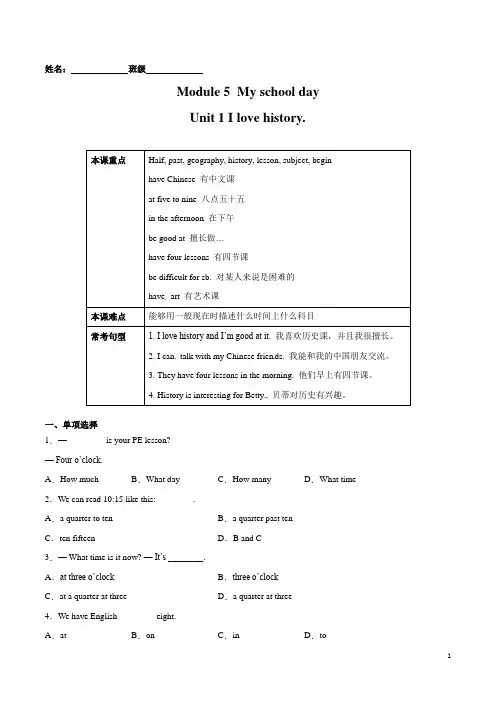
姓名:班级Module 5 My school dayUnit 1 I love history.本课重点Half, past, geography, history, lesson, subject, beginhave Chinese 有中文课at five to nine 八点五十五in the afternoon 在下午be good at 擅长做…have four lessons 有四节课be difficult for sb. 对某人来说是困难的have art 有艺术课本课难点能够用一般现在时描述什么时间上什么科目常考句型 1. I love history and I’m good at it. 我喜欢历史课,并且我很擅长。
2. I can talk with my Chinese frien ds. 我能和我的中国朋友交流。
3. They have four lessons in the morning. 他们早上有四节课。
4. History is interesting for Betty.贝蒂对历史有兴趣。
一、单项选择1.— ________ is your PE lesson?—Four o’clock.A.How much B.What day C.How many D.What time2.We can read 10:15 like this: ________.A.a quarter to ten B.a quarter past tenC.ten fifteen D.B and C3.— What time is it now? —It’s ________.A.at three o’clock B.three o’clockC.at a quarter at three D.a quarter at three4.We have English ________ eight.A.at B.on C.in D.to5.Music and art ________ my favourite lessons.A.is B.are C.have D.be二、用所给单词的正确形式填空6.Anna enjoys ________(learn)about new things, so she reads newspapers every day. 7.My mother is a junior high school teacher and she ________(teach)maths. 8.The child is five years old and he can brush his ________(tooth).9.There ________(be)an apple and three glasses of water on the table.10.I’ll remember ________(tell)him about the thing.11.I like _____________(talk)with my friends in my free time.12.We usually have four ______________(lesson)in the morning on weekdays. 13.My father____________(love)me and I love him a lot too.14.My brother is really good at ___________(swim).15.English and maths are Tony's favourite_____________(subject).三、句型转换16.We have a break. We talk to our friends.(合并为一句)We have a break ________ ________ ________ our friends.17.I have art this afternoon.(改为否定句)I ________ ________ ________ this afternoon.18.I like healthy food.(改为一般疑问句)________ ________ ________ healthy food?19.Their science lesson is at nine o’clock.(对画线部分提问)________ ________ their science lesson?20.She does the housework every day.(改为否定句)She ________ ________ the housework every day.21.Liu Ming cleans the room every week.(改为一般疑问句)________ Liu Ming ________ the room every week?22.We have maths this afternoon.(改为否定句)We ________ ________ maths this afternoon.23.Sally is thirteen years old.(对画线部分提问)________ ________ is Sally?24.Jerry can play basketball very well.(改为一般疑问句)________ Jerry ________ basketball very well?25.My favourite subject is Chinese.(对画线部分提问)________ ________ favourite subject?四、完型填空I am Tim. I am a(n) 26 in a middle school. This is my school day. I usually 27 at half past six. At seven o'clock,I have breakfast with my 28 .After that,they go to work and I go to(a) 29 .Classes begin at eight. We have four 30 in the morning. I like 31 classes very much and my English is good. I have 32 at school at twelve. After school I don't go home but 33 on the playground with my classmates. I get home at five thirty and have supper at 34 o'clock. I do my homework at eight. After that I watch TV for twenty minutes. I 35 at ten. It is a busy day.26.A.teacher B.student C.doctor D.postman27.A.get up B.stand up C.look up D.stay up28.A.students B.friends C.parents D.cousins29.A.school B.shop C.park D.hospital30.A.meals B.classes C.apples D.jobs31.A.English B.maths C.music D.art32.A.breakfast B.lunch C.supper D.dinner33.A.wash hands B.read a book C.play games D.play the piano34.A.six B.nine C.eleven D.twelve35.A.go shopping B.go swimming C.go to bed D.go to work参考答案1.D【详解】句意:——你的体育课几点?——4点。
外研版英语七年级上册Module 5 全部课件

Listen and repeat.
T:Betty, what are our lessons on Monday? B:We have Chinese at eight o’clock and science at five to nine.
At twenty past ten we have IT. Then we have maths. Do you like maths, Tony? T:Yes, I do, but it’s difficult! I like the lessons on Monday afternoon: English and art. What lessons do we have on Friday? B:We have English, Chinese, PE and Geography. T:And in the afternoon? Do we have maths? B:No, we don’t. We have art and history, but we don’t have maths. I love history and I’m good at it. It’s my favourite subject because it’s very interesting. T:My favourite subject is Chinese. I can talk with my Chinese friends.
art Chinese English history maths
I/They/We like
science
I/They/We don’t like
What time is your art lesson?
at eight o’clock. at half past eleven.
外研版英语七年级上册:Module 5 Unit 1 I love history.课件(5)
语文
12
9
3
6
历史
12
9
3
6
英语
12
9
3
6
化学
12
9
3
6
挑战你的听力
What subject does Betty like best? History.
Name Subject
Tony
Time
Betty
Do you like math, Tony? 托尼,你喜欢数学吗?
I love history and I'm good at it. It's my favourite subject because it's very interesting. 我喜欢历史并且学的很好。我很喜 欢这个学科因为它比较有趣。
2. Do you have science _____ Monday?
A. at
B. on
C. in
3. He doesn’t have Chinese _____ the
morning.
A. at
B. on
C. in
4. ____ Tom have maths today?
A. Does
B. Is
What time is it?
1
2.
It’s _t_w_e_l_v_e o’clock. It’s _h__al_f_p_a_s_t_s_ix__.
3.
4.
It’s _e_l_e_v_e_n o’clock. It’s _h_a_l_f_p_a_s_t _o_n_e.
Match the pictures with the
What day is it today? 2. It’s ten o’clock now. (就划线部分提问)
外研版英语七年级上册:Module 5 Unit 1 I love history.课件(共25张P

plants(植物) and so on .
science
3. We can draw beautiful pictures in
this class!
art
4品. I)nofthLius
lesson, Xun.
we
learn
works(作
Chinese
5. It takes us into a world full of 1,2,3 and X,Y,Z…
My school day.
It’s twenty to
ten.
差
Let's tell the time.
It’s eight o’cloc
12
8:00
9
3
6
It’s ten to nine.
12
8:50
9
3
6
It’s five t 9:55
6
It’s ten past one
12
9
3 1:10
6
It’s 2 o'clock.
1. Lessons begin at eight. 2. They have four lessons in the morning.
3. Maths is difficult for BTeotntyy.
4. They have art on Monday. 5. History is interesting for Betty.
Let's listen and answer.
1. What is Betty's favourite subject? History
2. What is Tony 's favourite subject? Chinese
七年级英语上册外研版课件:Module 5 My school day Unit1
课文理解
Tony loves Chinese 3. _b_e_c_a_u_s_e__ he can talk with his Chinese friends. And in the afternoon ,they don’t have maths,but 4. _a_r_t _____and history. History is Betty’s favorite and she’s good at it. She thinks it’s very 5. _in_t_e_r_e_s_ti_n_g.
What time is Chinese lesson on Monday?
At 1. _e_ig_h__t_/8__o_’_c_l_o.ck
What time is science At 2. _fi_v_e__to__n_i_n_e_/_8.:55
lesson on Monday?Байду номын сангаас
课文理解
What does Tony think of 3. _D_i_f_fi_c_u_l_t ____. maths? What is Betty’s favorite4. _H_i_s_t_o_r_y_____. subject? How many lessons do 5. _S_i_x_/__6______. they have on Friday?
课堂导学
B. 分钟数超过30时,用“分钟数+to+钟点数” 表达,表示“差几分就到几点”。其中“分钟数 =60-原分钟数”,“钟点数”为下一个钟点数。如: 9:50—ten to ten 2:58—two to three
课堂导学
注意: ①分钟数是15时(一刻钟),少用fifteen, 多用a quarter; ②分钟数是30时(半小时),一般用逆读法“half past + 钟点数”。 如:10:15—a quarter past ten 7:30—half past seven
广东佛山市第十四中学七英语上册ModuleMyschooldayUnitIlovehistory教案(新)外研

七年级英语上册 Module 5 My school day Unit 1 I love history教案一、学习目标:1. 重点单词:half, past, o’clock, to, art, geography, history, IT, maths, (Am E math ), PE ( physical education ), lesson, then, like, difficult, love, subject, because, interesting, talk, begin, when, weekday, house, start, work, break, evening, watch, do, homework, bed, sleep, park, busy, wash, face, minute2. 重点短语:go to school,get up, have breakfast, have lunch, go home, have dinner, go to bed, go to sleep3.重点句子:1) I love history.2) It’s twelve o’clock .3) We have Chinese at eight o’clock.4) We don’t have maths.5) —Do you like maths?—Yes, I do.6) In the evening, I watch TV and have dinner with my family.7) I get up at half past seven in the morning and have breakfast.8) I drink cola or water.二、重点及难点:1.时间地表达方式.2.用在时间前地介词(at , in , on)地用法.3.一般现在时地陈述句形式(主语为主语为I, they, we, you).4.and 连接地两个简单句.三、教学设计:Unit 1 I love history.ⅠTeaching modelListening and speakingⅡTeaching methodInteractive a pproachⅢTeaching aims1. To understand time expressions and identify school subjects.2. To understand conversations about “a school day”.3. To process information o f time and school subjects in the listening.4. To talk about one’s lessons with given information.ⅣTeaching ObjectivesKey vocabulary: half, past, o’clock, art, geography, history, IT, maths, (AM E math ), PE ( physical education ), lesson, then, difficult, love,subject, because, interesting, talk, begin, whenKey structures: It’s six o’clock.It’s half past six.ⅤTeaching aidsTape recorder, OHP, video, a clockⅥTeaching StepsStep 1 Warming-up1. Show some pictures to explain time expressions.2. Listen and repeat the time.3. Ask and answer. What time is it?1.__________2.__________3.__________4.__________4. Call back the answer from the whole class and check the answer.Keys:1. It’s twelve o’clock2. It’s half past six3. It’s eleven o’clock4. It’s half past one5. Practice. Ask and answer. What time is it?Step 2 Practice1. Show some pictures of the subjects.2. Introduce the new words.3. Match the pictures with the words from the box.4. Call back the answer from the whole class and check the answer.Answers:1. art2. Chinese3. English4. history5. maths6. IT7. geography8. PE 5. Read the words.Step 3 Listen and read.1. Ask the students to read the conversation silently.2. Play the recording and ask the students to listen and read the conversation.3. Read the conversation.4. Act it out.Step 4 Read t he dialogue Check (√) the true sentences.1. Read the dialogue again.2. Ask the students to choose the correct answers.1) Lessons begin at eight.2) They have four lessons in the morning.3) Maths is difficult for Betty.4) They have art on Monday.5) History is interesting for Betty.6) Tony’s favourite lesson is art.3) Ask the students to check with a partner.4. Play the recording again .Check the answers:Answers:1. √2. √3. ╳4. √5. √6. ╳Step 5 Listen and repeat.1. Play the recording once without stopping.2. Play the recording again and stop at the end of each line. Ask the whole class to repeat.3. Play the recording again and stop at the end of each line. Ask individual students to repeat.4. Ask the students to practice the sounds in pairs.Step 6 Answer the questions about you.1. Ask the students t o work alone and to answer the questions.2. Ask them to check their answers in pairs.Step 7 Work in pairs.Talk about your lesson s.1. Go through the language in the substitution table with the class.2. Pair them to ask and answer.I have / We have …I don’t have / We don’t have …I like / I don’t like …art, chemistry, Chinese, English, history, maths, science …3. Circulate and monitor their production.Step 8 Important and difficult points.1.时间Asking the time and responses(1)询问时间地表达法:What time is it?/What's the time?(2)时间地表达法:①整点: It's +基数词(one, two, …)+o'clock.e.g. It's twelve o'clock. 现在12点整.②几点过几分: It's +分+past+小时(基数词)(基数词)e.g. It's twenty past five. 现在5:20.③几点差几分: It's+分+to+小时(基数词)(基数词)e.g. It's twenty to six. 现在5:40./现在6点差20.注意:A、介词to, past前地分钟通常在30之内,但几点半,通常用介词past.e.g. It's half past six. 现在6:30.B、时间地表达有一种简单地方法:即直接用小时+分钟(基数词)(基数词)e.g. It's eight twenty –five 现在8:25.Step 9 Do exercises:A、用英语写出下列时间6:00 _______________ 8:00 _______________6:30 _______________ 7:45 _______________8:01 _______________ 1:15 _______________2:30 _______________ 3:45 _______________7:20 _______________ 9:40 _______________8:15 _______________ 5:10 _______________6:35 _______________ 9:55 _______________Answers:6:00 six o’clock 8:00 eight o’clock6:30 six thirty 7:45 seven forty-five8:01 one past eight 1:15 a quarter past one2:30 half past two 3:45 a quarter to four7:20 twenty past seven 9:40 twenty toten8:15 a quarter past eight 5:10 ten past five6:35 twenty-five to seven 9:55 five to tenB.单词拼写:1. It’s ten ___________ (钟)now .2. I like ___________ (数学), What about you, Tony?3. I am goo d at ___________ (地理).4. W e don’t have ___________ (历史) o n Friday afternoon.5.IT is my favourite ___________ (科目) because it’s ve ry interesting.6. At twenty ___________ (过) ten we have English.7. We have two _________ (课) in the afternoon.8. We have ___________ (语文) at n ine o’clock in the morning.Keys:1. o’clock 2. maths 3. geography 4. history 5. subject6. past7. lessons8. ChineseC、翻译下列句子:1.我们11:00上美术课.______________________________________________________2. 他们9:10上历史课.______________________________________________________3. 我经常和我地朋友谈话.______________________________________________________4. 我周六、日不去学校.______________________________________________________5. 星期五我们不上地理课.______________________________________________________Answers:1. We have art lesson at eleven o’clock.2. We have histor y lesson at ten past nine.3. I often talk to my friends.4. I don’t go to school on Saturday or Sunday.5. We don’t have geography lesson on Friday.Step 10 Homework。
七年级英语上册(外研版2024)新教材解读ppt课件
starting out在于激活,reflection在于回顾反思。板块 小学到初中英语学习的过渡,另外还包括10个学
与板块之间构成一个学习“大循环”,即从activate激 习模块(Module)和两个复习模块(Revision
Topic Self-introduction New school life
Hobbies Family Festival Animals Plants
Weather Dates Sports
单元 Starter Module 1
新旧教材单元语法对比
旧教材 语法
单元
26个字母的读音;问候语
Starter
新教材单元结构说明
外研版初中英语教材分为三 个年级,每年级均分为上、 下两册,按新课标要求,体 现三级内容。整套教材内容 具备体系性、延伸性、接续 性。本套教材各册由 6 个学 习单元及附录组成,各册具 体结构如图所示。
新教材单元结构说明
外研版初中英语教材共包含 36 个学习单元,每个单元由五个板块构 成,分别为:背景激活(Starting out)、主题理解(Understandingideas)、思 维拓展(Developing ideas)、主题实践(Presentingideas)、自我评价 (Reflection)学习单元覆盖了新课标三级对主题、语篇、语言知识、文化 知识、语言技能和学习策略所要求的所有课程内容。同时,单元内的学 习过程分为“理解一发展一实践”三个环节,各环节及其子环节之间密 切关联、相互衔接,共同构成学生课程学习的完整学习链和发展进程。 学习单元具体结构如下图所示。
外研版七年级英语上册(课件):Module 5
Unit 1 I love history.
第一课时 Getting ready & vocabulary
课前导学
核心单词
1. ________ n. 一半 half past 2. ________ prep. 晚于,过(几点) 3. ________ o'clock adv. ……点钟 4. geography ________ n. 地理 5. ________ lesson n. (一节)课 6. difficult ________ adj. 困难的,难懂的 7. ________ because conj. 因为 8.interesting ________ adj. 有趣的 9. ________ v. 谈论,说话 talk 10. ________ adv. 什么时候,何时 when
常用句型精讲 句型“What's the time?”的用法 【教材例句】What's the time? 现在几点了?(教材第
26页)
【用法】句型“What's the time?”用来询问当前的时间,
等于“What time is it?”。答语:It's+时间.
【举例】—What time is it now? 现在几点了?
【应用】 ( A )1. Daming is talking ________ Lingling. A. with B. on C. in D. of ( A )2. They are talking ________ the festivals
in America.
A. about B. to C. with D. /
易混词 (组) 辨析
2019年外研版七年级英语上册课件:Module 5 Unit 1 I love history(共48张PPT)
Unit 1 I love history.
例 (2017重庆江津区五校期末联考)His brother TV every day. A.watch;on B.watches;in C.watches;on D.watch;in
sports
解析 句意:他的弟弟每天在电视上看体育节目。主语是his brother,故 要用第三人称单数形式watches,先排除A和D;on TV意为“在电视上”, 故答案为C。 答案 C
意为“感兴趣的”,常用来修饰人。be/become interested in意为“对 ……感兴趣”
Unit 1 I love history.
巧记 We are interested in the interesting book.我们对那本有趣的书感 兴趣。
例 (2018上海川沙中学南校自主调研)用所给词的适当形式填空
Unit 1 I love history.
知识点四 行为动词的一般现在时的一般疑问句 教材原文 Do you like maths,Tony?托尼,你喜欢数学吗? 本句是行为动词的一般现在时的一般疑问句,结构是“Do/Does+主语+ do...?”。当主语是第三人称单数时,要用does。如: Does she like listening to music?她喜欢听音乐吗? 拓展 该一般疑问句有两种答语形式,肯定答语是“Yes,主语+do/ does.”,否定答语是“No,主语+don't/doesn't.”。如: —Does she like English?她喜欢英语吗? —Yes,she does.是的,她喜欢。 注意
Unit 1 I love history.
七年级英语上册 Module 5 Unit 1 I love history教学设计 (新版)外研版
七年级英语上册 Module 5 Unit 1 I love history教学设计(新版)外研版一. 教材分析《七年级英语上册 Module 5 Unit 1 I love history》的主要内容是关于学生们介绍自己喜欢的学科和历史人物。
通过本节课的学习,学生能够掌握一般现在时的表达方式,运用所学的词汇和句型来介绍自己和他人。
本节课的教学内容与学生的日常生活紧密相连,有利于激发学生的学习兴趣和积极性。
二. 学情分析七年级的学生已经具备了一定的英语基础,能够听懂并运用一些基本的英语句子进行交流。
但是,学生的英语水平参差不齐,部分学生对一般现在时的掌握还不够熟练。
因此,在教学过程中,教师需要关注学生的个体差异,合理安排教学内容,提高学生的学习兴趣和自信心。
三. 教学目标1.知识目标:–学生能够掌握一般现在时的表达方式。
–学生能够运用所学的词汇和句型来介绍自己和他人。
2.能力目标:–学生能够在课堂上用英语进行简单的交流和讨论。
–学生能够通过听、说、读、写的训练,提高自己的英语表达能力。
3.情感目标:–学生能够激发对英语学习的兴趣,增强学习的自信心。
–学生能够培养尊重和理解不同文化和历史的意识。
四. 教学重难点1.教学重点:–学生能够掌握一般现在时的表达方式。
–学生能够运用所学的词汇和句型来介绍自己和他人。
2.教学难点:–学生对一般现在时的理解和运用。
–学生对英语语法的掌握,如主谓一致、时态等。
五. 教学方法1.任务型教学法:通过设定各种真实的任务,让学生在完成任务的过程中学习英语,提高学生的学习兴趣和积极性。
2.情境教学法:通过设定各种真实的情境,让学生在情境中学习英语,提高学生的学习效果。
3.小组合作学习:通过小组合作完成任务,培养学生的团队合作能力和沟通能力。
六. 教学准备1.教师准备:–教师需要提前准备教学课件和教学素材。
–教师需要熟悉教材内容,了解学生的学习情况。
2.学生准备:–学生需要提前预习教材内容,了解本节课的学习内容。