
五年级英语下册 Module 4 Unit 2(2)课件 外研版(一起)
最新五年级下册外研英语Module 4课件 Unit 2-2
B: Is it in summer? A: Yes, it is./No ,it isn’t. B: Is it in June? A: Yes,it is./No,it isn’t.
What can you do in summer? I can __g_o__s_w_i_m_m__i_n_g__.
A: What can you do in spring?
B: I can fly a kite.
can fly kites
We can go swimming
We can have a picnic
We can go skiing
阴 It’s cloudy
雨 It’s rainy
晴 It’s sunny
Lingling’s favourite season is autumn. Lingling can play with the leaves.
What is Sam’s favourite season? What can Sam do in winter? What can Sam wear?
Amy’s favourite season is spring. Amy can see ducks in the river.
What is Daming’s favourite season? What can Daming do in summer? What can Daming wear?
• What’s the weather like in spring/summer/autumn/winter?
What’s the weather like in ... ?
Module4Unit2I'mgoingtobeeleven(教案)外研版(一起)英语五年级上册

Module 4 Unit 2I’m going to be eleven【学习目标】1. 能够听说读写单词Sunday,Saturday.2. 巩固月份的英语表达。
3. 掌握句型I’m going to be eleven. 并能进行替换练习。
4. 学会邀请卡的写作。
【学习重难点】1. 本课的教学重点是重点单词、句子的听、说、读、写。
2. 本课的教学难点是邀请卡的写作。
【知识探究】一、导学:1. Warm up(1)Listen a song “You know up to June.” (9册Module 4 Unit 2)(Listen and do the actions.)(2)Free talk.用“What’s the date?”“What day is today?”“What are you going to do?”等问句做自由对话,通过对话,进一步复习巩固月份日期的说法。
二、知识构建:1. S1: What are you going to do?T: I’m going to Amy’s birthday party. Look it’s an invitation to her birthday party.通过对话,导出本单元要讲授的课文。
出示Amy的生日邀请卡,听录音,回答问题:How old is Amy going to?(Amy is going to be 11.)2. 学生认真听录音,回答问题。
Where are we going to go?When are we going to go?3. 教师播放CD-ROM,学生认真听教师讲解。
4. Listen and repeat. 老师再放录音(CD-ROM),请学生逐句跟读,模仿录音中的发音。
5. Write an invitation.根据学生复述的课文,请学生们仿照Amy的生日聚会邀请卡一起完成活动用书上的练习。
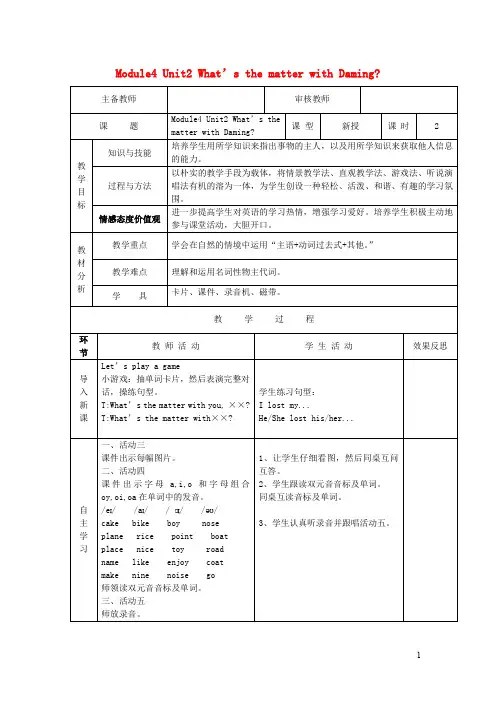
外研版五年级英语上册Module4Unit2What’sthematterwithDaming(第2课时)教案
5. his / isn’t / pen / this
_______________________________________
6. pencil / is / whose / this
_______________________________________
2. green / yours / is / T-shirt / this
_______________________________________
3. is / Xiaoping’s / this / coat
_______________________________________
4. this / hers / dress / red / is
释
难
解
疑
填空
1.This book is __mine__(my ).
2.___She__( she ) can play football.
3._Her_( she ) shirt is white.
4.Is this hat _yours__( your ) ?
No, __mine_( I ) is over there.
教学难点
理解和运用名词性物主代词。
学具
卡片、课件、录音机、磁带。
教学过程
环节
教师活动
学生活动
效果反思
导
入
新
课
Let’s play a game
小游戏:抽单词卡片,然后表演完整对话,操练句型。
T:What’s the matter with you,××?
Module 4 Unit 2(课件)-五年级英语下学期同步精品课堂(外研版三起)
Let’s learn
information
(名词)信息
useful information 有用的信息 We need more information.
我们需要更多信息。
Let’s learn
We are going to do a science project about animals. This is a guide for us to get information from the school library.We can find information from books and CDs. We can find information from films and ebooks as well. There are lots of different ways to find information on this topic.
project
项目,课题。
Pay attention
We are going to do a science project about animals. 我们打算做一个关于动物的科学项目。
句型“主语 +be going to+ 动词原形( + 其他)” 用来表达“某人打算做某事”。时态为一般将来时。 I am going to have an art lesson tomorrow.
Let's go to the library. There's a lot to enjoy. Maps, photos and newspapers. You can have a great day!
Say and guess
No, you can use it with a computer.
(三起点)外研版五年级英语上册《Module2_Unit2_名师课件》

kilo千克 kilos (复数)
a kilo of meat two kilos of meat
Practice
Practice
Role play
Practice
Role play
三人一组,表演对话。 观看他人表演,按键打分!
Good C
朗读有感情, 语音语调正确 地道。
Presentation
三人一组表演对话。
Did Amy eat all the chocolate?
How much juice did she drink?
She drank it all.
Yes, she ate it all.
Presentation
Let’s watch.
(单击图片可播放动画)
Now write and act.
补充完下列对话,并根据活动六的图片进行对话表演。
What did you buy at the
supermarket?
I bought some bananas and rice.
How much rice did you buy?
I bought two kilos .
外研版(三起点)五年级上册
Module 2
Unit 2 How much cheese did you buy?
Warm-up Let’s chant.
Review
Amy went to the supermarket.
How many apples did Amy buy? She bought __f_o_u_r __ apples.
Summary
询问数量: How many+可数名词: 例子:How many birds did you buy?
外研版英语(三起)五年级上册Module 4 Unit 2 What's the matter with Daming 课件
Look! There is a cap.
Oh, it's my cap!
Role play.
What’s the matter with you?
I lost…
What’s the matter with you?
I lost…
What’s the matter with you?
I lost…
英语中的称呼问题
Mr和Doctor都是称呼,翻译为中文就是先 生,医生(博士)。也就是说Doctor是可以代 替Mr,所以不能说Mr Doctor,这是重复。在 英语国家Doctor是社会地位比较高的,因此, 很多人有Doctor学历的人,博士以上学历或者 医生,会希望被称呼为Doctor而不是Mr。
Make funny sentences.
Amy Sam
fly eat
bag pen yesterday
Lingling Daming ride meet T-shirt book last week
Sam
eat book last week
Ha ha...
Sam ate his book last week.
A. with B. on C. about ( A ) 3. There is a bag________ the school bus.
A. on B. to C. for
二、选择合适的单词并用其正确的形式填空。
find, eat, be, lose, make 1. Where did you___l_os_e___ your pen? 2. Here___a_r_e___ the things for you. 3. I___fo_u_n_d__ my book in the desk. 4. My sister can't___m_a_k_e__ kites at all. 5. Sam___a_t_e___ lots of chocolate yesterday.
外研版小学英语五年级下册《Module 4 Unit 2 My favourite season is spring.》精品教案(一起点)
新标准英语(一年级起点)第十册Module 4 Unit 2 My favourite season is spring. (阅读课)教学目标:1、知识技能目标:学生能够听、说、读、写单词spring, summer, autumn, winter, season;能够认读、表达和运用重点句My favourite season is .... It’s . (I)can …. ;能够运用所学词汇、句子表达或描写出自己喜欢的季节及原因;能够正确朗读语篇、获取语篇的信息,在阅读的基础上进行仿写。
2、过程方法目标:学生通过给单词分类的热身活动,对前置知识进行复习巩固,如colour, weather and activities等,为本课进一步谈论季节话题奠定一定的语言基础;学生通过看短文的课件,整体感知文本,并找出文中What are their favourite seasons?提高学生抓主要信息的能力;通过回答“Why do they like these seasons?”这一问题,学生自主细读短文,采用划关键词的方法,找出答案,完成表格,提高学生整理、分析信息的能力;通过猜季节的游戏活动,初步培养学生的阅读能力,并对我国不同地方不同季节的特色有所了解;学生在谈论最喜欢的季节中继续巩固本课的重点句型,结合自身感受和经历进行初步的仿说,再到仿写,提高学生的语言运用能力及写作能力。
3、其他目标:学生通过独立阅读、同伴阅读,提高自主探究、合作学习的能力;通过谈论喜欢的季节及原因,提高学生实际运用语言的能力;通过品读短文,感受四季之美,培养学生热爱生活,热爱大自然,积极乐观的生活情感态度。
教学内容:本课是第四模块第二单元,按照教材设计意图和高年级段阅读教学的建议,本课主要是学习有关季节的短文,在正确朗读、回答问题、理解短文的基础上培养学生的阅读能力和初步的仿说、仿写能力。
学情分析:学生在二年级已经学习过有关季节的知识,能够熟练说出季节词汇spring, summer, autumn, winter, it’s warm/ hot/ cool/ cold. We can wear T-shirts.;学生喜欢谈论季节话题,并对不同季节中的人们的衣着变化有一定的感受和经历,这样就为本课学习谈论并初步表达出自己喜欢的季节、天气、自然景物特征及其原因奠定了良好的语言和心理基础。
新外研版五年级英语下册Module 4 Unit 2 课件2.ppt
17、一个人如果不到最高峰,他就没有片刻的安宁,他也就不会感到生命的恬静和光荣。2020/12/192020/12/192020/12/192020/12/19
谢谢观看
。2020年12月19日星期六2020/12/192020/12/192020/12/19
THE END 15、会当凌绝顶,一览众山小。2020年12月2020/12/192020/12/192020/12/1912/19/2020
16、如果一个人不知道他要驶向哪头,那么任何风都不是顺风。2020/12/192020/12/19December 19, 2020
express.
--- We can find information from books and CDs. 我们可以在书中 和光盘里发现信息。
1. Look, Listen and Say !
I want a Chinese book. Where can I find it?
They are all here. They're e-books.
Let's go to library. There are a lot to enjoy. Maps, photos and newspapers. You can have a great day!
5. Say and Guess! You can find it in the library.
Module 4
Unit 2 We can find information from books
and CDs.
§To learn the basic meaning of some
words and phrases. §To learn how to play the games. §To use the typical sentences to
外研版(一起)六年级英语上册《Module4Unit2》教案设计
外研版(一起)六年级英语上册《Module 4 Unit 2》教案设计一、教学目标1. 知识与技能:(1)学生能够理解并运用一般过去时态描述过去发生的事情。
(2)学生能够听懂、会说、会读本课的生词和重点句子。
(3)学生能够通过阅读课文,理解课文大意,提高阅读能力。
2. 过程与方法:(1)通过图片、视频等教学资源,激发学生的学习兴趣,提高学生的观察能力和思维能力。
(2)通过小组合作、角色扮演等活动,培养学生的合作意识和口语表达能力。
3. 情感态度与价值观:(1)培养学生对英语学习的兴趣和自信心。
(2)培养学生积极向上的生活态度,学会珍惜时光。
二、教学内容1. 词汇:yesterday, last week, weekend, visited, took, photos, went, park, lake等。
2. 句型:What did you do yesterday? I visited3. 语法:一般过去时态的运用。
4. 课文:《Module 4 Unit 2》的内容及相关练习。
三、教学重点与难点1. 教学重点:(1)掌握一般过去时态的用法。
(2)运用本课的词汇和句型描述过去发生的事情。
2. 教学难点:(1)正确运用一般过去时态。
(2)理解课文中的细节信息。
四、教具与学具准备1. 教具:PPT、图片、视频、录音机等。
2. 学具:课本、练习册、文具等。
五、教学过程1. 导入(1)播放一首关于过去的英文歌曲,让学生初步感知一般过去时态。
(2)展示一些过去的照片,引导学生用英语描述照片中的情景。
2. 新课展示(1)教师呈现本课的词汇和句型,引导学生跟读并模仿。
(2)通过图片、视频等教学资源,帮助学生理解课文内容。
(3)讲解一般过去时态的用法,并进行相关练习。
3. 小组活动(1)学生分组,每组根据课文内容编写一个小对话,要求运用本课的词汇和句型。
(2)学生进行角色扮演,展示自己的对话。
4. 课堂小结(2)学生分享自己的学习心得和收获。
外研版(三起)-英语-五年级下册--Module4 Unit 1教材同步讲解
1. let's引起的祈使句。
2.特殊疑问句的用法。
3.倒装句的用法。
能力目标
1.了解如何在图书馆借书。
2.能够询问和寻找相关的信息。
文化目标
了解未来的图书馆。
Unit l:Let's make a home library.
(第一单元:让我们建一个家庭图书馆o)
(教材20~22页)
1.Look,listen and say.看一看,听一听,说一说。(教材第20页)
Lingling:OK.玲玲:好的。
Amy:What are these big books? They're埃米:这些大书是什么?它们很重。
Lingling: They're dictionaries. We can put them here
玲玲:它们是字典。我们可以把它们放在这里。
Amy: These are the library cards for the children
Sam:No, they aren't These books are about art
萨姆:木,它们不是。这些书是关于美术的。
Lingling:What? Oh, they're in the wrong place.
玲玲:什么?噢,它们在错误的地方。
Juhn:Where are the books about animals?关于动物的书在哪里?
A.book B.CDs C CD
3. There are many books in our new__________
·A. library B.book C.librarys
4.-Let's go to the park.