
湘少版六年级英语上册复习资料
湘少版小学英语六年级复习知识点

湘少版小学英语六年级复习知识点文稿归稿存档编号:[KKUY-KKIO69-OTM243-OLUI129-G00I-FDQS58-湘少版(湖南少年儿童出版社出版)小学英语教材知识点,使用湘教版小学英语教材六年级(de)老师应该用得着,这些知识点还是很全面(de),希望对您有所帮助.1.字母:(大小)辨认、书写顺序;元音字母:A a , Ee, Ii, Oo, Uu2. 数字:1~999(de)基数词和序数词(de)运用,如计算、购物、时间、日期等.句型:①What's your number②What’s the time③How many pens are there④How old are you⑤How much is it⑥How tall are you⑦How heavy are you⑧What time do you get up⑨When's your birthday⑩What time did you see him3. 颜色:单词:red, pink, yellow, brown, blue, purple, orange, black, white, green.句型:①What colour is it②What’s your favourite colour4. 时间:年、季节、月、星期、日、时刻:Season( spring, summer, autumn, winter)Month: January, February, March, April, May, June, July, August, September, October, November, December.Week:Sunday, Monday, Tuesday, Wednesday, Thursday, Friday, Saturday.Day:1st May (the first of May), May 2nd ( May the second)句型:见话题2.5. 食品与饮料:人对食品与饮料(de)喜好;东西方食品.句型:①I like biscuits.②I’d like a cold drink.③Would you like some buns④Do you want some rice⑤This isn’t my food.6. 服装:服装(de)颜色:人对服装(de)喜好;某人(de)穿戴;所属关系;位置等.句型:①I like the green T-shirt.②Where’s my new cap③Who’s shirt is this④Is this your hat7.物品:名词(de)单、复数;特点、颜色、所属关系;存在(de)位置(in, on, under, beside, behind, in front of, above, near, inside, outside).玩具(toy car, doll, )文具(desk, book, bag ,pen, pencil, pencil-box, ruler, pencil sharpener,)句型:①What’s this②What colour is it③Whose is this④This is my brother’s painting.⑤I have a puppet.⑥There's a car near the hospital.⑦Was it in the wardrobe⑧Is there a book on the desk⑨That's not mine.8.动物和植物:cat, dog, duck, fish, sheep, bird, panda, monkey, rabbit, hen , cock, chick, tiger, lion, pig, cow , mouse (mice), elephant, ladybird, puppy, tree, flower, rose,9. 建筑与场所:factory, hospital, park, house, library, museum, office, farm, post office, bank, police station, railway station, bookstore, school, classroom, skating rink, café, house(ba throom, living-room, sitting-room, bedroom,kitchen),garden…10. 身体:head, hair, eye, nose, ear, mouth, neck, hand, finger, foot(feet) ,toe…外貌: fat, thin, tall, short, old, young, two big blue eyes, long hair, short hair, black hair. 句型:①This is my nose.②Touch your head.③Raise your arm.11. 个人情况:姓名、年龄、地址、特点与爱好.句型:①I'm twelve years old.②My hobby is reading.③I like music.④I'm interested in space.⑤My name is Peter.⑥I'm tall and thin.⑦Do you have any hobbies12. 家庭、亲属和朋友:姓名、年龄、地址、职业、特点与爱好、与你(de)关系family, grandfather(grandpa/granddad), grandmother(grandma/grand mum), father, mother, brother, sister, uncle, aunt, cousin, friend.句型:①Who's heHe's my father.②He's a doctor③He likes playing games.④My father helps me.⑤Is he a soldier⑥What’s he13. 学校:学校建筑和学校生活.school, classroom, library, playground, Chinese, maths , English, music, computer, PE, art, science,句型:①When do you go to school②What time do you have English14. 情绪和身体状态:happy, sad, tired, angry, shy, sorry, well, sick,句型:①I'm sick.②I'm happy.③We are sorry.④ I feel sad.15. 社交礼仪:礼貌用语;询问与应答.句型:问候①Hello./ Hi.②Good morning/afternoon/evening.③How are you ④How do you do⑤Glad to meet you./ Nice to meet you.介绍①My name is…②I’m a pupil.③I’m 12.④This is our teacher, Miss Chen.⑤He is from Japan.道别①Goodbye./Bye.②See you.③Good night.道谢①Thank you./Thanks.②You’re welcome.道歉①Sorry.②I’m sorry.③Excuse me.请求①Can I have a puppy ②Can I borrow a pencil ③Yes, please.④Of course.祝愿①Happy birthday.②Merry Christmas.提供帮助①Can I help you ②What can I do for you ③What’s the matter寻求帮助和建议①What can I do用餐①Do you want some soup ②Would you like some rice ③I'd like a cold drink.购物①Which one do you want ②Can I look at it ③I want a red one, please.④It's too expensive.⑤Have you got enough money⑥How much is it16.国家与国庆日:China, Japan, America (the USA), English( the UK), Australia, Russia, Canada, Singapore, India, France,句型:①When’s your country’s National Day②I come from China.17.天气与气候特征:hot, cold, cool, warm, sun, sunny, rain ,heavy rain, rainy, wind, strong wind,windy, snow , heavy snow, cloud, cloudy, …句型:①What's the weather like②It’s a cold day.③Spring is warm and nice.④Tomorrow will be rainy.⑤I like a sunny day.18. 节日:节日(de)特点;节日(de)活动.New Year's Day, Spring Festival, Children's Day, Mid-autumn Festival, Teachers' Day , National Day, Christmas Day, Dragon Boat Festival.19. 正在发生(de)事情:现在进行(de)动作和发生(de)事.句型:①Are you making a kite②Peter is writing.③What's Anne doing④Where are you going⑤What are they doing⑥Is he running20.日常生活:日常生活、工作、学习(de)活动.句型:①I come to school by bus.②Your homework is good.③What time do you get up④She always get up early.21. 计划与打算:计划和将要进行(de)动作be going to do …句型:①I’m/You’re /He’s/She’s /We’re/They’re (not) going to swim.②Are you going to swim③Is he/she going to visit Anne④What are you going to do⑤What is he going to do⑥When are they going to swim⑦Tomorrow will be rainy.⑧ I'll stay at home.22. 能力和可能:能做某事或可能进行某事.句型:①Can you read and write in English②Can I have a puppy③What can you do④She can run fast.23. 过去发生(de)事情或过去(de)打算:过去式.句型:①Where were you②Who was first③Was it in the wardrobe④Benny took my ball.⑤Where did you go⑥What did you do⑦I came by plane.⑧Anne wanted to skate.24. 对事物(de)比较:比较级和最高级.句型:①My singing is louder than yours.②I’m taller than you.③There more shops in Picture One.④Some stories are more interesting than others.⑤The most interesting stories.⑥Who is fatter25.提醒与告示:①What does that sign mean②Draw a cat on the roof.③Don't put your feet on the seat.④No speaking.⑤Do not go in.26.擅长和喜欢(de)事情:①I'm/ You're/ He's good at drawing.②I like playing basketball.。
湘少版六年级上册英语复习资料112自己
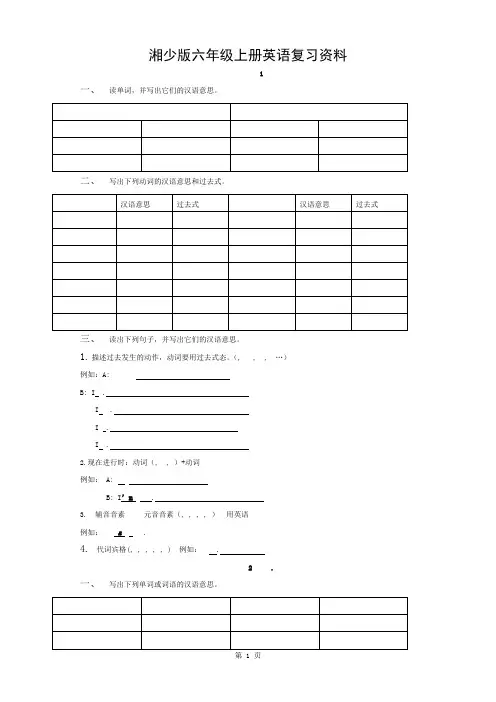
湘少版六年级上册英语复习资料1一、读单词,并写出它们的汉语意思。
二、写出下列动词的汉语意思和过去式。
三、读出下列句子,并写出它们的汉语意思。
1.描述过去发生的动作,动词要用过去式态。
(, , , …)例如:A:B: I .I .I .I .2.现在进行时:动词(, , )+动词例如: A:B: I’m .3. 辅音音素元音音素(, , , , )用英语例如: a .4.代词宾格(, , , , , ) 例如:.2 .一、写出下列单词或词语的汉语意思。
二、写出下列动词的第三人称单数形式。
三、读出下列句子,并写出它们的汉语意思。
在一般现在时中,当主语为第三人称单数时,动词要用第三人称单数形式。
1. a .2.天,时,月,季,年, 6:30 .3 I .一、写出下列单词或短语的汉语意思。
二、读出下列句子并写出它们的汉语意思。
1.动词原形A:B: .a .2.I a .3. I a .4.’s . a .5.’s a .6. a .8. ’s + 动词原形’s .1-3 复习试题一、单项选择()1. I a .A. B. C.()2. I a .A. B. C.()3. I . A. a B. C. ()4. . A. I B. C. ()5. 7:00. A. B. C.()6. 5:00 . A. B. C. ()7. I . A. B. C.()8. .A. B. C.()9. .A. B. C.()10 .A. B. C.()11. I’m . ’s . A. B. C. 二.连词成句。
1. I (.)2. (.)3. ()4. a (.)5. I (.)6. 7:00 .4 .一.写出下列单词或短语的汉语意思。
二.写出下列句子的汉语意思。
1. ( / ) 有,表存在2.’s a .3.A:B: I .4.A: aB: ’s 50 .5. + 动词I .I .8. I’d a a .5 .一.写出下列单词或短语的汉语意思。
湘少版本小学六年级的上册的英语总结复习重点.doc

WORD格式小学英语六年级(上)复习资料Unit 1 What did you do during the holidays?●词汇 :holiday 假期 during 在 ... 期间learn words and 学习单词和句playsentences 子gameslearn 学习写practise 练习听力writing 作listening你在假期都做些什么?speak 说玩游戏●语法 : 一般过去时:表示过去某个时间里发生的动作或状态过去时判断标志:句子中有表示过去的时间。
yesterday 昨天 yesterday morning昨天早上the day before yesterda last night前天昨晚last week 上周last month 上个last justyear 去年now刚才月two days ago 两天前 in 等, .1990+ 动词过去.构成:主语式动词过去式的变化规则:1. 直接加ed : work—worked look—looked2.以不发音 e 结尾的单词,直接加d:live lived hope---hoped---use--- used3. 以辅音字母+y结尾y 为 i加的,变ed:study—studied carry—carriedworry—worried+ed: stop — stopped 4. 以重读闭音节结尾且末尾只有一个辅音字母的,双写最后的辅音字母 plan — planned; 重读闭音节体现形式为辅- 元 - 辅结构,例如nod,n为辅音,o为元音,d为辅音。
5. 以 ic结尾的动词,要ic变成再加ed,如→ picnicked,把ick picnic traffic→ trafficked6.不规则变化的动词过去式:have- am/is- was are- ge--- g ot fe ---felt go---went drink----- had -- -- were t say--- said el do/does---did drank eat--ate broughbring---- tthink- thought bought caught taugh--- buy---- catch---- teach---- twear-- wore cut---- cut swept sleep —----slept see-- sweep sawsitbecome-- read-- ----- became -- read - sat●语言结构:What did you do during the holidays?专业资料整理WORD格式I read many books.I wrote a little storybook.◆乘坐某种交通工具“ by+交通工具的名称” 如:乘火车by train乘公共汽车by bus但是,有一个特殊,步行on footUnit 2 Katie always gets up early.凯蒂总是很早起床。
新湘少版六年级上册英语复习资料

新湘少版六年级上册英语复习资料Unit1 What did you do during the holidays?假期你做什么了?单词:learn words and sentences 学习单词和句子playgames 玩游戏learn writing 学习写作practise listening 练习听力句型:what did you do during the holidays?假期你做了什么?I read many books.我看了许多书。
语法:动词过去式的变化规则一、规则动词的过去式变化规则①一般情况动词词尾直接加-ed。
如:work—worked play—played②以不发音的-e结尾的动词,动词词尾加-d。
如:live—lived taste—tasted③以辅音字母+y结尾的动词,把y变为i,再加-ed。
如:study—studied cry—cried④以一个辅音字母结尾的,重读闭音节动词(即Vivi常说的辅元辅结构)双写词尾辅音字母,再加-ed.如:stop—stopped clap—clapped二、不规则变化动词没有变化规律,需要童鞋们好好识记。
如:go—went make—madeget—got buy—boughtlearn—learnt do—didtake—took have—hadread—read speak—spoketeach—taught say—saidUnit2 Katie always gets up early凯蒂总是很早起床词汇:(频度副词:always总是、often常常、sometimes有时、never从不)get up 起床return home 回家take a walk 去散步do her homework 做她的家庭作业have breakfast/lunch/dinner吃早/ 中/ 晚餐play chess 下象棋wave goodbye 挥手再见read a newspaper 读报纸be late for school 上学迟到句型:Peter always gets up at 7:00 a.m。
新湘少版六年级上册英语复习资料

学习必备欢迎下载六年级上册句型汇总Unit 1★动词过去式变化规律:1. 一般情况下,直接在动词词尾加ed. 如:talk—talked 说listen—listened听play—played玩climb—climbed爬visit---visited 参观,访问,拜访2. 以不发音的e结尾,在动词词尾加 d. 如:practise—practised练习3. 以辅音字母加y结尾的动词,变y为i再加ed. 如:study —studied学习,研究4. 以一个辅音字母结尾的重读闭音节词,双写最后一个辅音字母,再加ed. 如:stop—stopped停止5. 不规则动词没有规律,需要特殊记。
如:do-did have—had go—went get---got run—ran learn—learnt / learned take—took read—read speak—spoke teach—taught think---thought buy---bought bring---brought stand—stood sit—sat say—said is, am—was are—were write--wrote drive---drove see---saw eat---ate★单词、短语during 在…期间holiday 假期learn words and sentences学习单词和句子play games玩游戏learn writing学习写作practice listening练习听力★句子时态:一般过去时,表示过去某个时间里发生的动作或存在的状态。
主要有动词的过去式来体现,其标志词是过去的时间。
如:yesterday昨天 last night昨晚 last week 上周 last year 去年等等。
1. What did you do during the holidays? 假期间你做了什么?--I read many books./ I learnt writing. / I wrote a little storybook in English./ I visited my grandparents.Unit 2★单词、短语wave goodbye挥手再见be late for school上学迟到read a newspaper读报纸get up起床play chess下棋take a walk散步have/has breakfast吃早餐return home回家★句子时态:一般现在时:表示经常,反复发生的动作或存在的状态。
湘少版英语六年级上册知识归纳【精校版】
湘少版英语六年级上册知识归纳【精校版】目标
本文档旨在为六年级上册的英语研究提供一个全面的知识归纳
总结,有助于学生复巩固已学知识。
内容
1. 单词词汇
- 列举六年级上册所学的所有重要单词,并加以分类和分类归
纳。
2. 语法知识
- 总结六年级上册所学的常用句型和语法规则,包括但不限于
动词时态、名词变复数、形容词比较级和最高级等。
3. 短文理解
- 总结六年级上册所阅读的短文,提炼出关键信息和主要意思,以便学生更好地理解和回答相关问题。
4. 句子翻译
- 提供一些六年级上册中的句子,并要求学生将其翻译成中文,以加强他们的语言运用能力。
5. 课文要点
- 汇总六年级上册每个课文的要点和重点内容,帮助学生回顾
课文内容和理解教学重点。
使用方法
本文档可以作为学生在复阶段的指导资料,学生可以根据自己
的研究计划,有针对性地选择相应的部分进行复。
根据自己的优势
和需要,可以选择按照单词、语法、短文理解、句子翻译或课文要
点的顺序进行研究。
同时,建议学生结合教材和其他参考资料进行
综合复。
总结
通过本文档,六年级上册的英语学习者将能够更好地回顾和巩固已学知识,并在复习阶段更加有针对性地进行学习。
希望本文档能够对学生的学习有所帮助,提高他们的英语水平。
湘少版六年级上册期末总复习资料及练习
2016湘少版六年级上英语期末复习Unit1 What did you do during the holidays?假期你做什么了?单词:learn words and sentences 学习单词和句子play games 玩游戏learn writing 学习写作practise listening 练习听力句型:what did you do during the holidays?假期你做了什么?I read many books.我看了许多书。
语法:动词过去式的变化规则一、规则动词的过去式变化规则①一般情况动词词尾直接加-ed。
如:work—worked play—played②以不发音的-e结尾的动词,动词词尾加-d。
如:live—lived taste—tasted③以辅音字母+y结尾的动词,把y变为i,再加-ed。
如:study—studied cry—cried④以一个辅音字母结尾的,重读闭音节动词(即Vivi常说的辅元辅结构)双写词尾辅音字母,再加-ed.如:stop—stopped clap—clapped二、不规则变化动词没有变化规律,需要童鞋们好好识记。
如:go—went make—made get—got buy—bought learn—learnt do—did take—took have—had read—read speak—spoke teach—taught say—saidUnit2 Katie always gets up early凯蒂总是很早起床词汇:〔频度副词:always总是、often常常、sometimes有时、never从不〕get up 起床return home 回家take a walk 去散步do her homework 做她的家庭作业have breakfast/lunch/dinner吃早/ 中/ 晚餐play chess 下象棋wave goodbye 挥手再见read a newspaper 读报纸be late for school 上学迟到句型:Peter always gets up at 7:00 a.m。
六年级上英语期末复习资料加油站_新湘少版
新湘少版六年级上册英语复习资料Unit 1★ 动词过去式变化规律:1.一般状况下,直接在动词词尾加ed. 如: talk — talked 说listen — listened 听play — played 玩climb — climbed 爬2.以不发音的 e 结尾,在动词词尾加 d. 如: practise — practised练习3.以辅音字母加y 结尾的动词,变y 为 i 再加 ed. 如: study — studied 学习 ,研究4.以一个辅音字母结尾的重读闭音节词,双写最后一个辅音字母,再加ed. 如: stop— stopped 停止5.不规则动词没有规律take — took read — read ,需要特别记。
如:do-didspeak— spoke teach— taughthave— had go—went learn — learntstand — stood sit — sat say— saidrun —ranis, am — was are—were write--wrote★ 单词、短语during 在时期holiday假期learn words and sentences学习单词和句子play games 玩游戏learn writing学习写作practice listening练习听力★ 句子时态:一般过去时,表示过去某个时间里发生的动作或存在的状态。
主要有动词的过去式来表现,其标记词是过去的时间。
如:yesterday 昨天 last night 昨晚 last week上周last year昨年等等。
1. What did you do during the holidays?假时期你做了什么?--I read many books./I learnt writing./ I wrote a little storybook in English./I visited my grandparents.Unit 2★ 单词、短语weekday 工作日after在以后before 在 ..以前always 老是,常常often 常常sometimes 有时 never 从不wave goodbye 招手再会be late for school 上学迟到read a newspaper读报纸play chess 下棋take a walk 漫步get up 起床 have/has breakfast 吃早饭return home 回家★ 句子时态:一般此刻时:表示常常,频频发生的动作或存在的状态。
新湘少版六年级英语上下册复习资料
六年级上册英语复习资料一、单词:after 在……之后always总是;经常bar条,棒bean 豆子blouse 女式短上衣bottle瓶子bring 带来call 打电话candy糖果Christmas 圣诞节centre中心clay 黏土;泥土clear 晴朗的colourful 彩色的concert 音乐会cough 咳嗽decorate装饰dress up 装扮;穿上盛装drop滴during 在……期间email 电子邮件enough足够的feel 感觉fever 发烧film 电影find out about 发现forecast 预报fresh 新鲜的fruit 水果greet 问候greeting 问候hall 大厅headache 头痛heavy 大量的holiday 假日idea 主意just只是;仅仅learn 学习light 轻柔的;灯lotus莲花medicine 药merry欢乐的mooncake 月饼nearby 附近的never 从不often 经常picnic 野餐plan 计划play 戏剧practice 练习present 礼物rain 雨;下雨receive 收到rest 休息return 返回Santa Claus圣诞老人save 节约search 查找seed种子send 发送should 应该slow 慢的sometimes 有时speak 说taste 尝than比theatre 剧院the Mid-Autumn Festival 中秋节type 类型wait 等待waste 浪费wave 挥手weak 弱的weekday平日well (身体)好的why 为什么world 世界二、句型:Unit 1. What did you do during the holidays?假期中你做了什么?---What did you do during the holidays?假期中你做了什么?---I learnt writing. 我学习写作。
新湘少版六年级上册英语复习资料
六年级上册句型汇总Unit 1★动词过去式变化规律:1. 一般情况下,直接在动词词尾加ed. 如:talk-talked说listen—listened听play—played玩climb-climbed爬visit-—-visited 参观,访问,拜访2. 以不发音的e结尾,在动词词尾加d。
如:practise—practised练习3. 以辅音字母加y结尾的动词,变y为i再加ed. 如:study —studied学习,研究4. 以一个辅音字母结尾的重读闭音节词,双写最后一个辅音字母,再加ed. 如:stop—stopped停止5. 不规则动词没有规律,需要特殊记.如:do-did have—had go—went get—-—got run—ranlearn-learnt / learned take—took read—read speak—spoke teach—taught think—-—thought buy-—-bought bring—--brought stand—stood sit—sat say—saidis,am—was are—were write—-wrote drive---drove see—--saw eat——-ate★单词、短语during 在…期间holiday 假期learn words and sentences学习单词和句子play games玩游戏learn writing学习写作practice listening练习听力★句子时态:一般过去时,表示过去某个时间里发生的动作或存在的状态。
主要有动词的过去式来体现,其标志词是过去的时间。
如:yesterday昨天 last night昨晚 last week 上周 last year 去年等等。
1. What did you do during the holidays? 假期间你做了什么?—-I read many books。