
2014年6月英语四级真题及答案
2014年6月英语四级真题及答案(word版) Part I Writing (30 minutes)
Directions: For this part, you are allowed 30 minutes to write a short essay on the following topic. You should write at least 120 words but no more than 180 words.
Suppose a foreign friend of yours is coming to visit your hometown, what is the most interesting place you would like to take him/her to see and why?
注意:此部分试题请在答题卡1上作答。 Part II Listening Comprehension (30 minutes) Section A Directions: In this section, you will hear 8 short conversations and 2 long conversations. At the end of each conversation, one or more questions will be asked about what was said. Both the conversation and the questions will be spoken only once. After each question there will be a pause. During the pause, you must read the four choices marked A), B), C) and D), and decide which is the best answer. Then mark the corresponding letter on Answer Sheet 1 with a single line through the centre.
注意:此部分试题请在答题卡1上作答。 1. A) See a doctor about her strained shoulder. B) Use a ladder to help her reach the tea. C) Replace the cupboard with a new one. D) Place the tea on a lower shelf next time. 2. A) At Mary Johnson’s. C) In an exhibition hall. B) At a painter’s studio. D) Outside an art gallery. 3. A) The teacher evaluated lacks teaching experience. B) She does not quite agree with what the man said. C) The man had better talk with the students himself. D) New students usually cannot offer a fair evaluation. 4. A) He helped Doris build up the furniture. B) Doris helped him arrange the furniture. C) Doris fixed up some of the bookshelves. D) He was good at assembling bookshelves. 5. A) He doesn’t get on with the others. C) He has been taken for a fool. B) He doesn’t feel at ease in the firm. D) He has found a better position. 6. A) They should finish the work as soon as possible. B) He will continue to work in the garden himself. C) He is tired of doing gardening on weekends. D) They can hire a gardener to do the work. 7. A) The man has to get rid of the used furniture. B) The man’s apartment is ready for rent. C) The furniture is covered with lots of dust. D) The furniture the man bought is inexpensive. 8. A) The man will give the mechanic a call. B) The woman is waiting for a call. C) The woman is doing some repairs. D) The man knows the mechanic very well. Questions 9 to 11 are based on the conversation you have just heard. 9. A) She had a job interview to attend. B) She was busy finishing her project. C) She had to attend an important meeting. D) She was in the middle of writing an essay. 10. A) Accompany her roommate to the classroom. B) Hand in her roommate’s application form. C) Submit her roommate’s assignment. D) Help her roommate with her report. 11. A) Where Dr. Ellis’s office is located. C) Directions to the classroom building. B) When Dr. Ellis leaves his office. D) Dr. Ellis’s schedule for the afternoon. Questions 12 to 15 are based on the conversation you have just heard. 12. A) He finds it rather stressful. C) He can handle it quite well. B) He is thinking of quitting it. D) He has to work extra hours. 13. A) The 6:00 one. C) The 7:00 one. B) The 6:30 one. D) The 7:30 one. 14. A) It is an awful waste of time. B) He finds it rather unbearable. C) The time on the train is enjoyable. D) It is something difficult to get used to. 15. A) Reading newspapers. C) Listening to the daily news. B) Chatting with friends. D) Planning the day’s work. Section B Directions: In this section, you will hear 3 short passages. At the end of each passage, you will hear some questions. Both the passage and the questions will be spoken only once. After you hear a question, you must choose the best answer from the four choices marked A), B), C) and D). Then mark the corresponding letter on Answer Sheet 1 with a single line through the centre.
注意:此部分试题请在答题卡1上作答。 Passage One Questions 16 to 18 are based on the conversation you have just heard. 16. A) Ignore small details while reading. B) Read at least several chapters at one sitting. C) Develop a habit of reading critically. D) Get key information by reading just once or twice. 17. A) Choose one’s own system of marking. B) Underline the key words and phrases. C) Make as few marks as possible. D) Highlight details in a red color. 18. A) By reading the textbooks carefully again. B) By reviewing only the marked parts. C) By focusing on the notes in the margins. D) By comparing notes with their classmates. Passage Two Questions 19 to 21 are based on the conversation you have just heard. 19. A) The sleep a person needs varies from day to day. B) The amount of sleep for each person is similar. C) One can get by with a couple of hours of sleep. D) Everybody needs some sleep for survival. 20. A) It is a made-up story. C) It is a rare exception. B) It is beyond cure. D) It is due to an accident.
2014年6月大学英语四级(CET-4)考试答案解析(第一套)
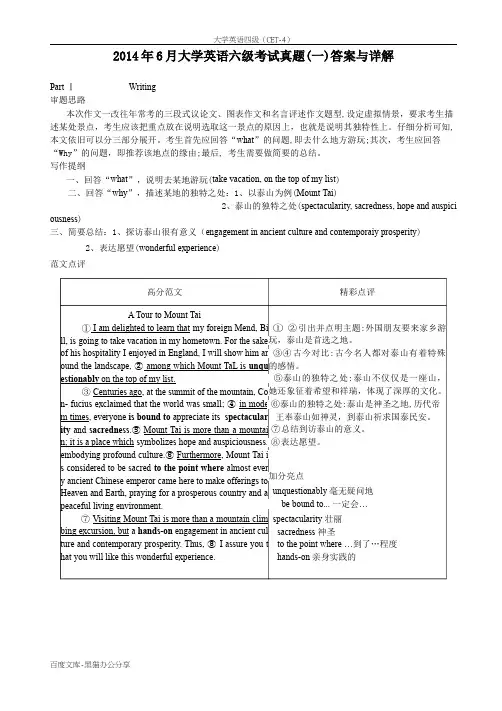
2014年6月大学英语六级考试真题(一)答案与详解Part Ⅰ Writing审题思路本次作文一改往年常考的三段式议论文、图表作文和名言评述作文题型,设定虚拟情景,要求考生描述某处景点,考生应该把重点放在说明选取这一景点的原因上,也就是说明其独特性上。
仔细分析可知,本文依旧可以分三部分展开。
考生首先应回答“what”的问题,即去什么地方游玩;其次,考生应回答“Why”的问题,即推荐该地点的缘由;最后, 考生需要做简要的总结。
写作提纲一、回答“what”,说明去某地游玩(take vacation, on the top of my list)二、回答“why”,描述某地的独特之处:1、以泰山为例(Mount Tai)2、泰山的独特之处(spectacularity, sacredness, hope and auspici ousness)三、简要总结:1、探访泰山很有意义(engagement in ancient culture and contemporaiy prosperity)2、表达愿望(wonderful experience)范文点评全文翻译泰山之旅欣闻我的外国朋友比尔要来我的家乡度假。
由于我在英国曾受到比尔的热情款待,我将带他四处看看家乡的风景。
在所有风景中,泰山无疑是首选之地。
几个世纪前,孔子登上泰山之巅,发出登泰山而小天下之感叹;在现代,每个人必定会去欣赏泰山的壮丽和神圣。
泰山不仅仅是一座山,她还象征着希望与祥瑞,体现了深厚的文化。
此外,泰山被看作是如此神圣,以至于几乎每位古代帝王都会到这里祭祀天地,祈求国家昌盛、国泰民安。
登泰山不仅是一次登山远足,还是一次亲身体验古代文化和现代繁荣的旅行。
因此,我向你保证你一定会喜欢这次美妙的旅行的。
PartⅡ Listening ComprehensionSection A1.W: I can’t seem to reach the tea at the back of the cupboard.M: Oh. Why don’t you use the ladder? You might strain your shoulder.Q: What does the man suggest the woman do?1. A)See a doctor about her strained shoulder. C)Replace the cupboard with a new one.B) Use a ladder to help her reach the tea.D)Place the tea on a lower shelf next time.【预测】四个选项都是动词短语,由此可推断该题会对建议或计划进行提问。
2014年6月大学英语四级考试真题答案详解

112
答案详解
7. W: You’ve already furnished your apartment? M: I found some used furniture that was dirt cheap. Q: W h a t d o w e l e a r n f r o m t h e conversation? 8. W: Has the mechanic called the bus repairers? M: Not yet. I’ll let you know when he calls. Q: W h a t d o w e l e a r n f r o m t h e conversation? Now you’ll hear the two long conversations. Conversation One M: Hello. Matt Ellis speaking. W: Hello, Dr. Ellis, my name’s Pan Johnson. My roommate, Janet Holmes, wanted me to call you. M: Janet Holmes? Oh, that’s right. She’s in my Shakespearean English class. Has anything happened to her? W: Nothing, it’s just that she submitted a job application yesterday and the company asked her in for an interview today. She’s afraid she won’t be able to attend your class this afternoon though. I’m calling to see whether it would be OK if I gave you her essay. Janet said it’s due today. M: Certainly, that would be fine. Uh, you can either drop it off at my class or bring it to my office. W: Would it be all right to come by your office around 4:00? I’m afraid I can’t come any earlier because I have three classes this afternoon. M: Uh, I won’t be here when you come. I’m supposed to be at a meeting from
2014年6月英语四级真题答案【修改版】
Part Ⅰ WritingThe First Place I Will Show in My Hometown —the Central AvenueMy hometown is Harbin. The most interesting place which I would like to take my foreign friends to is the Central Avenue, if they come to my hometown. The reasons for this can be illustrated as below.To begin with, as the symbol of Harbin, the Central Avenue not only has a long history, but also a famous food palace. There are a variety of delicious foods for you to choose. Just take the ice-cream brick of Ma Dieer as an example. Many of tourists to the Central Avenue sing their praises for the ice-cream brick of Ma Dieer. In addition, the brilliant historic culture of the Central Avenue can widen people ’s vision and enhance their knowledge, which lays a solid foundation for the understanding of this fabulous city —Harbin.I believe my foreign friends will enjoy themselves in the Central Avenue. Not only can they appreciate the wonderful landscape of Harbin but also taste authentic northeast food. No better place can be chosen than the Central Avenue!Part Ⅱ Listening Comprehension1-5: BDDCD6-10: ADBAC11-15: ACBCA16-20: DABDC20-25: BCDAB26.identical27.approach28.back and forth29.opposite30.indicates31.referring to32.parallel to33.reserved34.at the right angle35.embarrassingPart III Reading ComprehensionSection A36.melted37.line 东南大学学生会Students' Union of Southeast University2014年6月英语四级真题答案(1)止于至善38.contributing39.ranging40.dramatic41.impact42.appealing43.average44.maintain45.recentlySection B46. C Physical books will surely become much rarer in the marketplace….47.N Books —especially books the average…48.J Nor did TV kill radio…49.H Sometimes a new technology doesn’t…50. A Amazon, by far the largest…51.L Sometimes old technology lingers for…52. B Does this spell the doom of the ….53. F One technology r eplaces another only…54. C Physical books will surely become much rather…55.M Then there is the fireplace…Section C56.B The humanities and STEM subjects should be given equal importance.57.D Their chances of getting a good job.58.A They benefit students in their future life.59.D Those who have received a well-rounded education.60.C Prepare themselves for different job options.61.A It sounds very attractive.62.D They cause serious damage to the environment.63.C It wants to keep its own environment intact.64.B It improves economic efficiency.65.A To justify America's dependence on oil imports.Part IV TranslationIn order to promote equality in education, China has invested 36 billion Yuan to improve educational facilities in rural areas and strengthen rural compulsory education in Midwest areas. These funds are used to improve teaching facilities, and purchase books, benefiting more than 160,000 primary and secondary schools. Funds are used to purchase musical instrument and painting tools as well. Now children in rural and mountainous areas can have music and painting lessons as children from coastal cities do. Some students who has transferred to city schools to receive a better education are now moving back to their local rural schools. 东南大学学生会Students' Union of Southeast University止于至善。
2014年6月大学英语四级考试真题(第3套)含参考答案
2014年6月大学英语四级考试真题(第3套)Part I Writing (30 minutes) Directions: For this part, you are allowed 30 minutes to write a short essay on the following topic.You should write at least 120 words but no more than 180 words.Suppose a foreign friend of yours is coming to visit China, what is the first place youwould like to take him/her to see and why?Part II Listening Comprehension (30 minutes) Section ADirections: In this section, you will hear 8 short conversations and 2 long conversations. At the end of each conversation, one or more questions will be asked about what was said.Both the conversation and the questions will be spoken only once. After each questionthere will be a pause. During the pause, you must read the four choices marked A), B),C) and D), and decide which is the best answer. Then mark the corresponding letter onAnswer Sheet 1 with a single line through the centre.1.A) He has proved to be a better reader than the woman.B) He has difficulty understanding the book.C)He cannot get access to the assigned book.D) He cannot finish his assignment before the deadline.2. A)She will drive the man to the supermarket.B)The man should buy a car of his own..C)The man needn’t go shopping every week.D) She can pick the man up at the grocery store.3. A) Get more food and drinks. C)Tidy up the place.B) Ask his friend to come over. D) Hold a party.4. A) The talks can be held any day except this Friday.B) He could change his schedule to meet John Smith.C) The first-round talks should start as soon as possible.D) The woman should contact John Smith first.5. A) He understands the woman’s feelings.B) He has gone through a similar experience.C)The woman should have gone on the field trip.D)The teacher is just following the regulations.6. A) She will meet the man halfway. B) She will ask David to talk less.C) She is sorry the man will not come. D) She has to invite David to the party.7. A) Few students understand Prof.Johnson’s lectures.B) Few students meet Prof.Johnson’s requirements.C)Many students find Prof.Johnson’s lectures boring.D)Many students have dropped Prof.Johnson’s class.8. A) Check their computer files. C)Study a computer program.B)Make some computations. D) Assemble a computer.Questions 9 to 12 are based on the conversation you have just heard.9. A) It allows him to make a lot of friends. C)It enables him to apply theory to practice.B) It requires him to work long hours. D)It helps him understand people better.10. A) It is intellectually challenging.B) It requires him to do washing-up all the time.C) It exposes him to oily smoke all day long.D) It demands physical endurance and patience.11. A) In a hospital. C)At a laundry.B)At a coffee shop. D) In a hotel.12. A) Getting along well with colleagues. C) Planning everything in advance.B) Paying attention to every detail. D) Knowing the needs of customers. Questions 13 to 15 are based on the conversation you have just heard.13. A) The pocket money British children get. C) The things British children spend money on.B) The annual inflation rate in Britain. D) The rising cost of raising a child in Britain.14. A) It enables children to live better. C)It often rises higher than inflation.B)It goes down during economic recession. D)It has gone up 25% in the past decade.15.A)Save up for their future education. C)Buy their own shoes and socks.B) Pay for small personal things. D) Make donations when necessary.Section BDirections: In this section, you will hear 3 short passages. At the end of each passage, you will hear some questions. Both the passage and the questions will be spoken only once.After you hear a question, you must choose the best answer from the four choicesmarked A), B), C) and D). Then mark the corresponding letter on Answer Sheet 1 witha single line through the centre.Passage OneQuestions 16 to 19 are based on the conversation you have just heard.16. A) District managers. C) Sales directors.B) Regular customers. D)Senior clerks.17. A) The support provided by the regular clients .B) The initiative shown by the sales representatives.C)The urgency of implementing the company’s plans.D)The important part played by district managers.18. A)Some of them were political-minded. C)One third of them were senior managers.B)Fifty percent of then were female. D)Most of them were rather conservative.19. A) He used too many quotations. C)He did not keep to the point.B) He was not gender sensitive. D)He spent too much time on details.. Passage TwoQuestions 20 to 22 are based on the conversation you have just heard.20.A)State your problem to the head waiter. C)Ask to see the manager politely but firmly.B)Demand a discount on the dishes ordered. D)Ask the name of the person waiting onyou.21.A)Your problem may not be understood correctly.B)You don’t know if you are complaining at the right time.C)Your complaint may not reach the person in charge.D)You can’t tell how the person on the line is reacting.22.A)Demand a prompt response. C)Send it by express mail.B)Provide all the details. D)Stick to the point.Passage ThreeQuestions 23 to 25 are based on the passage you have just heard.23.A)Fashion designer. C)City planner.B)Architect. D)Engineer.24.A)Do some volunteer work. C)Work flexible hours.B)Get a well-paid part-time job. D)Go back to her previous post.25. A)Few baby-sitters can be considered trustworthy.B)It will add to family’s financial burden.C)A baby-sitter is no replacement for a mother.D)The children won’t get along with a baby-sitter.Section CDirections: In this section, you will hear a passage three times. When the passage is read for the first time, you should listen carefully for its general ideal. When the passage is readfor the second time, you are required to fill the blanks with the exact words you havejust heard. Finally, when the passage is read for the third time, you should check whatyou have written.Almost every child, on the first day he sets foot in a school building, is smarter, more _26_, less afraid of what he doesn’t know, better at finding and _27_, more confident, resourceful(机敏的), persistent and _28_ than he will ever be again in his schooling—or, unless he is very unusual and very lucky, for the rest of his life. Already, by paying close attention to and _29_ the world and people around him, and without any school-type formal instruction, he has done a task far more difficult, complicated and _30_ than anything he will be asked to do in school, or than any of his teachers has done for years. He has solved the _31_ of language. He has discovered it—babies don’t even know that language exists—and he has found out how it works learnt to use it _32_. He has done it by exploring, by experimenting, by developing his own model of the grammar of language, by _33_ and seeing whether it works by gradually changing it and _34_ it until it work. And while he has been doing this, he has been learning other things as well, including many of the _35_ that the schools think only they can teach him, and many that are more complicated than the ones they do try to teach him.Part III Reading Comprehension (40 minutes) Section ADirections:In this section, there is a passage with ten blanks. You are required to select one word for each blank from a list of choices given in a word bank following the passage. Readthe passage through carefully before making your choices. Each choice in the bank isidentified by a letter. Please mark the corresponding letter for each item on AnswerSheet 2 with a single line through the centre. You may not use any of the words in thebank more than once.Questions 36 to 45 are based on the following passage.The fact is, the world has been finding less oil than it has been using for more than twenty years now. Not only has demand been _36_, but the oil we have been finding is coming from places that are _37_ to reach. At the same time, more of this newly _38_ oil is of the type that requires a greater investment to _39_. And because demand for this precious resource will grow, according to some, by over 40 percent by 2025, fueling the world’s economic _40_ will take a lot more energy from every possible source.The energy industry needs to get more from existing fields while continuing to search for new _41_. Automakers must continue to improve fuel efficiency and perfect hybrid(混合动力的)vehicles. Technological improvements are needed so that wind, solar and hydrogen can be more _42_ parts of the energy equation. Governments need to formulate energy policies that promote _43_ and environmentally sound development. Consumers must be willing to pay for some of these solutions, while practicing conservation efforts of their own.Inaction is not an _44_. S o let’s work together to balance this equation. We are taking someSection BDirections:In this section, you are going to read a passage with ten statements attached to it.Each statement contains information given in one of the paragraphs. Identify theparagraph from which the information is derived. You may choose a paragraph morethan once. Each paragraph is marked with a letter. Answer the questions by markingthe corresponding letter on Answer Sheet 2.I Cry, Therefore I AmA)In 2008, at a German zoo, a gorilla(大猩猩)named Gana gave birth to a male infant, whodied after three months. Photographs of Gana, looking stricken and inconsolable(伤心欲绝的), attracted crowds to the zoo. Sad as the scene was, the humans, not Gana, were the only ones crying. The notion that animals can weep has no scientific basis. Years of observations by the biologists Dian Fossey, who observed gorillas, and Jane Goodall, who worked with chimpanzees(黑猩猩), could not prove that animals cry tears from emotion.B)It’s true that many animals shed tears, especially in response to pain. Tears pro tect the eye bykeeping it moist, but crying as an expression of feeling is unique to humans and has played an essential role in human evolution and the development of human cultures.C)Within two days an infant can imitate sad and happy faces. If an infant does not cry out, it isunlikely to get the attention it needs to survive. Around 3-4 months, the relationshipbetween the human infant and its environment takes on a more organized communicative role, and tearful crying begins to serve interpersonal purposes; the search for comfort and pacification(抚慰). As we get older, crying becomes a tool of social interaction: grief and joy, shame and pride, fear and manipulation.D)Tears are as universal as laughter, and grief is more complex than joy. But although we all cry,we do so in different ways. Women cry more frequently and intensely than men, especially when exposed to emotional events. Like crying, depression is, around the world, more commonly seen in women than in men. One explanation might be that women, who despite decades of advances still suffer from economic inequality, discrimination(歧视)and even violence, might have more to cry about. Men not only cry for shorter periods than women, but they also are less inclined to explain their tears, usually shed them more quietly, and tend more frequently to apologize when they cry openly. Men, like women, report crying at the death of a loved one and in response to a moving religious experience. They are more likely than women to cry when their core identities—as providers and protectors, as fathers fighters —are questioned.E)People who score on personality tests as more sympathetic cry more than those who aremore rigid or have more self-control. Frequency of crying varies widely: some shed tears at any novel or movie, others only a handful of times in their lives. Crying in response to stress and conflict in the home, or after emotional trauma(创伤), lasts much longer than tears induced by everyday sadness—which in turn last longer than tears of delight and joy.F)Sadness is our primary association with crying, but the fact is that people report feelinghappier after crying. Surveys estimate that 85% of women and 73% of men report feeling better after shedding tears. Surprisingly, crying is more commonly associated with minor forms of depression than with major depression involving suicidal thoughts.G)People widely report that crying relieves tension, restores emotional balance and provides“catharsis,” a washing out of bad feelings. The term “catharsis” has religious implications of removing evil and sin; it’s no surprise that religious ceremonies ar e, around the world, one of the main settings for the release of tears.H)Crying is a nearly universal sign of grief, though some mourners report that, despite genuinesorrow, they cannot shed tears—sometimes even for years after their loved one has gone.Unlike today, when the privacy of grief is more respected, the public or ceremonial shedding of tears, at the graveside of a spouse or the funeral of a king or queen, was once considered socially or even politically essential.I)Crying has also served other social purposes. Rousseau wrote in his Confessions that while heconsidered tears the most powerful expression of love, he also just liked to cry over nothing. J)The association of tears with art has ancient roots. The classic Greek tragedies of the fifth century B.C. were primarily celebrations of gods. Tragedies, like poetry and music, were staged religious events. Even then it was recognized that crying in response to drama brought pleasure.K)I have argued that there are neurobiological(神经生物方面的)associations linking the arts and mood disorders. When I lecture on crying, I ask my audience to let me know, by a show of hands, which art forms most move them to tears. About 80% say music, followed closely by novels (74%), but then the figures fall sharply, to 43%, for poetry, and 10-22% for paintings, sculpture and architecture.L)The physical act of crying is mainly one of breathing in air, which is why we choke up when we weep. This suggests to language scientists that emotional crying evolved before language, perhaps explaining why tears communicate states of mind and feelings that are often so difficult to express in words. Of course, from an evolutionary perspective, recognition of emotion (usually through facial gesture) was essential for survival.M)The earliest humans arrived several million years ago, but only 150,000 to 200,000 years ago, did cultures, languages, religion, and the arts arise. Along the way, tears became more than a biological necessity to lubricate (润滑) the eye and developed into a sign of intense emotion and a signal of social bonding. The development of self-consciousness and the notion of individual identity, or ego; storytelling about the origins of the world, the creation of humanity and life after death; and the abil ity to feel others’ sadness—all were critical parts of the neurobiological changes that made us human.N)More recently, we’ve learned from neuroscience that certain brain circuits(回路)are activated(激活), rapidly and unconsciously, when we see another in emotional distress. In short, our brain evolved circuits to allow us to experience sympathy, which in turn made civilization, and an ethics based on sympathy, possible. So the next time you reach a tissue box, or sob on a friend’s shoulder, or shed tears at the movies, stop and reflect on why we cry and what it means to cry. Because ultimately, while we love to cry, we also cry to love.46. Nowadays people respect the privacy of grief more than in the past.47. Infants cry to attract attention for survival.48. There is no scientific evidence as yet that animal can shed tears from emotion.49. Tears can perform certain communicative function which words cannot.50. Our ability to experience sympathy is essential to the development of civilization.51. People are more inclined to cry when suffering minor forms of depression.52. Sometimes people cannot cry despite genuine grief.53. In humans’ long history,tears have developed an essential role in social relationships.54. Men are less likely to give reason for their tears.55. Crying has long been associated with art.Section CDirections: There are 2 passages in this section. Each passage is followed by some questions or unfinished statements. For each of them there are four choices marked A), B), C) andD). You should decide on the best choice and mark the corresponding letter onAnswer Sheet 2 with a single line through the centre.Passage OneQuestions 56 to 60 are based on the following passage.Hospitals, hoping to curb medical error, have invested heavily to put computers, smart phones and other devices into the hands of medical staff for instant access to patient data, drug information and case studies.But like many cures, this solution has come with an unintended side effect: doctors and nurses can be focused on the screen and not the patient, even during moments of critical care. A poll showed that half of medical technicians had admitted texting during a procedure.This phenomenon has set of an intensifying in discussion at hospitals and medical schoolsabout a problem perhaps best described as “distracted doctoring”. In response, some hospitals have begun limiting the use of electronic devices in critical settings, while schools have studied reminding medical students to focus on patients instead of devices.“You justify carrying the devices around the hospital to do medical records, but you can surf the Internet or do Facebook, and sometimes Facebook is more tempt ing,” said doctor Peter Papadakos at the university of Rochester Medical Center.“My gut feeling(本能的感觉)is lives are in danger,” said doctor Dr. Papadakos. “we’re not educating people about the problem, and it's getting worse.”A survey of 439 medical technicians found that 55 percent of the technicians who monitor bypass machines acknowledged that they had talked on cellphones during heart surgery. Half said they had texted while in surgery. The study concluded, “Such distractions have the potential to be disastrous”.Medical professionals have always faced interruptions from cellphones, and multitasking is simply a fact of life for many medical jobs. What has changed, say doctors, especially younger ones, is that they face increasing pressure to interrupt with their devices.The pressure stems from a mantra(信条)of modern medicine that patient care must be “data driven,” and informed by the latest, instantly accessible information. By many accounts, the technology has helped reduce medical error by providing instant access to patient data all prescription details.Dr. Peter Camel, president of the American Medical Association, said technology “offers great potential in health care,” but he added that doctor's first priority should be with the patient.56. Why do hospitals equip with their staff with computers, smart phones and other devices?A) To reduce medical error. C) To facilitate administration.B) To cope with emergencies. D) To simplify medical procedures.57. What does the author refer to by “distracted doctoring”?A) The disservice done by modern devices to doctors, nurses, as well as patients.B) The tendency of medical institutions encouraging the use of modern devices.C) The problem of devices preventing doctors from focusing on their working.D) The phenomenon of medical staff attending to personal affairs while working.58. What does Dr. Peter Papadakos worry about?A) Medical students are not adequately trained to use modern technology.B) Doctors’ interaction with their devices may endanger patients’ lives.C) Doctors are relying too heavily on modern electronic technology.D) Pressures on the medical profession may become overwhelming.59. Why do doctors feel increasing pressure to use modern devices?A) Patients trust doctors who use modern technology.B) Use of modern devices adds to hospitals’ revenues.C) Data is given too much importance in patient care.D) Patients’ data has to be revised from time to time.60. What is Peter Carmel’s advice to doctors?A) They follow closely the advances in medical science.B) They focus their attention on the patient’s condition.C) They observe hospital rules and regulations.D) They make the best use of modern devices.Passage TwoQuestions 61 to 65 are based on the following passage.I have closely watched my generation, known as The Millennials, for 29 years now. Joel Stein wrote an extensive piece on Millennials and he remains rather optimistic about our potential.I hesitate to share his optimism because of a paradox(矛盾的现象)we seem to exhibit, namely, that there are more avenues for us to entertain ourselves than ever before, yet we are more bored than ever before.Entertainment has never been more varied. We have more cable channels, television shows, and movies than ever before. Internet providers allow instant viewing of almost any movie or television program ever created. Social drinking and partying are also widely available for Millennials. Every generation develops these habits at a certain age, but Millennials seem to be extending this phase of life as they postpone marriage.Some of this is undoubtedly due to The Great Recession. Millennials are having a difficult time finding jobs; only 47 percent of 16-to-24-year-olds are employed, the smallest share since government started recording data in 1948.But do Millennials respond to these economic troubles by doing whatever it takes to make ends meet? Hardly. In fact, of the four generations Pew Research has data for, the Millennial generation does not cite work ethic(勤奋工作)as distinctive of itself. Millennials want to save the world, but they sit and wait for that world-changing opportunity to be handed to them. Instead of working 2-3 jobs, launching a business, or doing what it takes to succeed, they retreat. Millennials may be the first generation to have a lower standard of living than their parents, but with this response to adversity(逆境), perhaps deservingly so.Much ink has been spilled in management books discussing how to get the most out of these youths in the workplace. Largely, they come to the same conclusion: Millennials are entitled, over-confident, and expect too much too quickly. We should not be surprised. Today’s young adults were raised by parents who made sure to boost their self-esteem at every turn, telling them they could achieve whatever they set their minds to, and handing out prizes for sixth place.61. What does the author of the passage think of Millennials?A) They show little interest in entertainment.B) They are not confident about their ability.C) They enjoy an easy life due to high technology.D) They may not have bright prospects for success.62. How do Millennials feel about their life?A) They can hardly do anything about it. C) It is not as good as their paren ts’.B) There is little in it to get excited about. D) It is full of opportunities for success.63. In what way are Millennials different from previous generations according to the PewResearch?A) They spend less time socializing. C) They do not value hard work.B) They are indifferent to others. D) They are more independent.64. What should Millennials do according to the author?A) Remain optimistic in face of diversity. C) Make full use of new opportunities.B) Start a business as early as possible. D) Take action to change their situation.65. Why are Millennials over-confident about themselves?A) They have been spoiled by their parents. C) They are misguided by management books.B) They can always get whatever they expect. D) They think they are young and energetic.Part IV Translation (30 minutes) Directions: For this part, you are allowed 30 minutes to translate a passage from Chinese into English. You should write your answer on Answer Sheet 2.为了促进教育公平,中国已投入360亿元,用于改善农村地区教育设施和加强中西部地区农村义务教育(compulsory education)。
2014年6月英语四级真题及答案第一套
Section ADirections: In this section, you will hear 8 short conversations and 2 long conversations. At the end of each conversation, one or more questionswill be asked about what was said. Both the conversation and thequestions will be spoken only once. After each question there will bea pause. During the pause, you must read the four choices marked A),B), C) and D), and decide which is the best answer. Then mark thecorresponding letter on Answer Sheet 1 with a single line throughthe centre.1.A) See a doctor about her trained shoulder. B) Use a ladder to help her reachthe tea.C). Replace the cupboard with a new one. D) Place the tea on a lower shelfnext time.2.A) At Mary Johnson’s. B)At a painter’s studio.C)In an exhibition hall. D)Outside an art gallery.3.A)The teacher evaluated lacks teaching experience.B)She does not quite agree with what the man said.C)The man had better talk with the students himself.D)New students usually cannot offer a fair evaluation.4.A)He helped Doris build up the furniture. B)Doris helped him arrange thefurniture.C)Doris fixed up some of the bookshelves. D)He was good at assemblingbookshelves.5.A)He doesn’t get on with the others. B)He doesn’t feel at ease in thefirm.C)He has been taken for fool. D)He has found a better position.6.A)They should finish the work as soon as possible.B)He will continue to work in the garden himself.C)He is tired of doing gardening on weekends.D)They can hire a gardener to do the work.7.A)The man has to get rid of the used furniture.B)The man’s apartment is ready for rent.C)The furniture is covered of lot’s of dust.D)The furniture the man bought is inexpensive.8.A)The man will give the mechanic a call. B)The woman is waiting for a call.C)The woman is doing some repairs. D)The man knows the mechanic very well. Questions 9 to 11 are based on the conversation you have just heard.9.A)She had a job interview to attend. B)She was busy finishing her project.C)She had to attend an important meeting. D)She was in the middle of Writingan essay.10.A)Accompany her roommate to the classroom.B).Hand in her roommate’s application formC)Submit her roommate’s assignment.D)Help her roommate with her report.11.A)Where Dr.Elli’s office is located. B)When Dr.Ellis leaves his office.C)Directions to the classroom building. D)Dr.Ellis’s schedule for the afternoon.Questions 12 to 15 are based on the conversation you have just heard.12.A)He finds it rather stressful. B)He is thinking of quitting it.C)He can handle it quite well. D)He has to work extra hours.13.A)The 6:00 one. B)The 6:30 one.C)The 7:00 one. D)The 7:30 one.14.A)It is an awful waste of time. B)He finds it rather unbearable.C)The time on the train is enjoyable. D)It is something difficult to getused to.15.A)Reading newspapers. B)Chatting with friends.C).Listening to the daily news. D).Planning the day’s work.Section BDirections: In this section, you will hear 3 short passages. At the end of each passage, you will hear some questions. Both the passage and thequestions will be spoken only once. After you hear a question, you mustchoose the best answer from the four choices marked A), B), C) and D).Then mark the corresponding letter on Answer Sheet 1 with a singleline through the centre.Passage OneQuestions 16 to 18 are based on the passage you have just heard.16.A)Ignore small details while reading.B)Read at least several chapters at one sitting.C)Develop a habit of reading critically.D)Get key information by reading just once or twice.17.A)Choose one’s own system of marking.B)Underline the key words and phrases.C)Make as few marks as possible.D)Highlight details in a red color.18.A)By reading the textbooks carefully again.B)By reviewing only the marked parts.C)By focusing on the notes in the margins.D)By comparing notes with their classmates.Passage TwoQuestions 19 to 21 are based on the passage you have just heard.19.A)The sleep a person needs varies from day to day.B)The amount of sleep for each person is similar.C)One can get by with a couple of hours of sleep.D)Everybody needs some sleep survival.20.A)It is a made-up story. B)It is beyond cure.C)It is rare exception. D)It is due to an accident.21.A)His extraordinary physical condition.B)His mother’s injury just before his birth.C)The unique surroundings of his living place.D)The rest he got from sitting in a rocking chair.Passage ThreeQuestions 22 to 25 are based on the passage you have just heard.22.A)She invested in stocks and shares on Wall Street.B)She learned to write for financial newspapers.C).She developed a strong interest in finance.D)She tenderly looked after her sick mother.23.A)She made a wise investment in real estate.B)She sold her restaurant with a substantial profit.C)She got 7.5 million dollars from her ex-husband.D)She inherited a big investment in real estate.24.A)She was extremely mean with her money.B)She was dishonest in business dealings.C)She frequently ill-treated her employees.D)She abused animals including her pet dog.25.A)She made a big fortune from wise investment.B)She built a hospital with her mother’s money.C)She made huge donations to charities.D)She carried on her family’s tradition.Directions: In this section, you will hear a passage three times. When the passage is read for the first time, you should listen carefully for its generalidea. When the passage is read for the second time, you are requiredto fill in the blanks with the exact words you have just heard. Finally,when the passage is read for the third time, you should check what youhave written.Among the kinds of social gestures most significant for second –language teachers are those which are 26 in form but different in meaning in the two cultures. For example, a Colombian who wants someone to 27 him often signals with a hand movement in which all the fingers of one hand, cupped, point downward as they move rapidly 28 .Speakers of English have a similar gesture means goodbye or go away,Directions: In this section, there is a passage with ten blanks. You are required to select one word for each blank from a list of choices given in a wordbank following the passage. Read the passage through carefully beforemaking your choices. Each choice in the bank is identified by a letter.Please mark the corresponding letter for each item on Answer Sheet2 with a single line through the centre. You may not use any of thewords in the bank more than once.Questions 36 to 45 are based on the following passage.Global warming is a trend toward warmer conditions around the world. Part of warming is natural; we have experienced a 20,000-year-long warming as the last ice age ended and the ice 36 away. However, we have already reached temperatures that are in 37 with other minimum-ice periods, so continued warming is likely not natural. We are 38 to a predicted worldwide increase in temperatures 39 between 1C and 6C over the next 100 years. The warming will be more 40 in some areas, less in others, and some places may even cool off. Likewise, the 41 of this warming will be very different depending on where you are—coastal areas must worry about rising sea levels, while Siberia and northern Canada may become more habitable (宜居的) and 42 for humans than these areas are now.The fact remains, however, that it will likely get warmer, on 43 , everywhere. Scientists are in general agreement that the warmer conditions we have been experiencing are at least in part the result of a human-induced global warming trend. Some scientists 44 that the changes we are seeing fall within the range of random(无规律的) variation—some years are cold, others warm, and we have just had an unremarkable string of warm years 45 --but that is becoming an increasingly rare interpretation in the face of continued and increasing warm conditions.Section BDirections: In this section, you are going to read a passage with ten statements attached to it. Each statement contains information given in one of theparagraphs. Identify the paragraph from which the information isderived. You may choose a paragraph more than once. Each paragraph ismarked with a letter. Answer the questions by marking the correspondingletter on Answer Sheet 2.The End Of The Book?A)Amazon, by far the largest booksellers in the country, reported on May 19 thatis now selling more books in its electronic Kindle format than in the old paper-and-ink format . That is remarkable, considering that the Kindle has only been around for four years. E-books now account for 14 percent of all book sales in this country and are increasing far faster than overall book sales. E-book sales are up 146 percent over last year, while hardback sales increased 6 percent and paperbacks decreased 8 percent.B)Dose this spell the doom of the physical book? Certainly not immediately, andperhaps not at all. What it does mean is that the book business will go througha transformation in the next decade or some profound than any it has been sinceGutenberg introduced printing from moveable type in the 1450s.C)Physical books will surely become much rarer in the marketplace. Mass marketpaperbacks, which have been declining for years anyway, will probably disappear, as will hardbacks for mysteries, thrillers, “romance fiction,”etc. Such books, which only rarely end up in permanent collections, either private or public, will probably only be available as e-books within a few years. Hardback and trade paperbacks for “serious” nonfiction and fiction will surely last longer.Perhaps it will become the mark of an author to reckon with that he or she is still published in hard copy.D)As for children’s books, who knows? Children’s books are like dog food in thatthe purchasers are not the consumers, so the market ( and the marking ) is inherently strange.E)For clues to the book’s future, let’s look at some examples of technologicalchange and see what happened to the old technology.F)One technology replaces another only because the new technology is better,chapter, or both. The greater the difference, the sooner and more thoroughly the new technology replaces the old. Printing with moveable type on paper dramatically reduced the cost of producing a book compared with the old-fashioned ones handwritten on vellum, which comes from sheepskin. A Bible—to be sure, a long book—required vellum made from 300 sheepskins and countless man-hours of labor. Before printing arrived, a Bible cost more thana middle-class house. Three were perhaps 50,000 books in all of Europe in 1450.By 1500 there were 10 million.G)But while printing quickly caused the handwritten book to die out, handwritinglingered on (继续存在) well into the 16th century. Very special books are still occasionally produced on vellum, but they are one-of-a-kind show pieces.H)Sometimes a new technology doesn’t drive the old one out, but only parts ofit while forcing the rest to evolve. The movies were widely predicted to drive live theater out of the marketplace, but they didn’t, because theater turned out to have qualities movies could not reproduce. Equally, TV was supposed to replace movies but, again, did not.I)Movies did, however, fatally impact some parts of live theater. And while TVdidn’t kill movies, it did kill second-rate pictures, shorts, and cartoons. J)Nor did TV kill radio. Comedy and drama shows (“ Jack Benny,”) “Amos and Andy,”“The Shadow”) all migrated to television. But because you can’t drivea car and watch television at the same time, rush hour become radio’s primetime, while music, talk, and news radio greatly enlarged their audiences. Radio is today a very different business than in the late 1940s and a much larger one. K)Sometimes old technology lingers for centuries because of its symbolic power.Mounted cavalry (骑兵) replaced the chariot (二轮战车) on the battlefield around 1000 BC. But chariots maintained their place in parades and triumphs right up until the end of Roman Empire 1,500 years later. The sword hasn’t had a military function for hundred years, but is still part of an officer’s full-dress uniform, precisely because a sword always symbolized “an officer and a gentleman.”L)Sometimes new technology is a little cranky (不稳定的) at first. Television repairman was a common occupation in the 1950s, for instance. And so the old technology remains as a backup. Steamships captured the North Atlantic passengers business from sail in the 1840s because of its much greater speed.But steamships didn’t lose their sails until the 1880s, because early marine engines had a nasty habit of breaking down. Until ships became large enough (and engines small enough ) to mount two engines side by side, they needed to keep sails. ( The high cost of steam and the lesser need for speed kept the majority of the world’s ocean freight moving by sail until the early years of the 20th century.)M)Then there is the fireplace. Central heating was percent in every upper- and middle-class home by the second half of the 19th century. But functioning fireplaces remain to this day a powerful selling point in a house or apartment.I suspect the reason is a deep-rooted love of fire. Fire was one of the earliestmajor technological advances for humankind, providing heat, protection, and cooked food (which is much easier to eat and digest). Human control of fire goes back far enough (over a million years) that evolution could have produced a genetic leaning towards fire as a central aspect of human life.N)Books—especially books the average person could afford—haven’t been around long enough to produce evolutionary change in humans. But they have a powerful hold on many people nonetheless, a hold extending far beyond their literary content. At their best, they are works of art an there is a tactile (触觉的) pleasure in books necessarily lost in e-book versions. The ability to quickly thumb through pages is also lost. And a room with books in it induces, at least in some, a feeling not dissimilar to that of a fire in the fire place on a cold winter’s night.O)For these reasons I think physical books will have a longer existence as a commercial product than some currently predict. Like swords, books have symbolic power. Like fireplace, they induce a sense of comfort and warmth. And, perhaps, similar to sails, they make a useful backup for when the lights go out.46.Authors still published in printed versions will be considered important ones.47.Some people are still in favor of printed books because of the sense of touch they can provide.48.The radio business has changed greatly and now attracts more listeners.49.Contrary to many people’s prediction of its death, the film industry survived.50.Remarkable changes have taken place in the book business.51.Old technology sometimes continues to exist because of its reliability.52.The increase of e-book sales will force the book business to make changes not seen for centuries.53.A new technology is unlikely to take the place of an old one without a clear advantage.54.Paperbacks of popular literature are more likely to be replaced by e-books.55.A house with a fireplace has a stronger appeal to buyers.Directions: There are 2 passages in this section. Each passage is followed by some questions or unfinished statements. For each of them there are fourchoices marked A), B), C) and D). You should decide on the best choiceand mark the corresponding letter on Answer Sheet 2 with a single linethrough the centre.Passage OneQuestions 56 to 60 are based on the following passage.The question of whether our government should promote science and technology or the liberal arts in higher education isn’t an either/or proposition (命题),although the current emphasis on preparing young Americans for STEM (science, technology, engineering, maths )-related fields can make it seem that way.The latest congressional report acknowledges the critical importance of technical training, but also asserts that the study of the humanities (人文学科) and social sciences must remain central components of America’s educational system at all levels. Both areas are critical to producing citizens who can participate effectively in our democratic society, become innovative (创新的) leaders, and benefit from the spiritual enrichment that reflection on the great ideas of mankind over time provides.Parents and students who have invested heavily in higher education worry about graduates’ job prospects as technological advances and changes in domestic and global markets transform professions in ways that reduce wages and cut jobs. Under these circumstances, it’s natural to look for what may appear to be the most “practical” way out of the problem:” Major in a subject designed to get you a job” seems the obvious answer to some, though this ignores the fact that many disciplines in the humanities characterized as “soft” often, in fact, lead to employment and success in the long run. Indeed, according to surveys, employers have expressed a preference for students who have received a broadly-based education that has taught them to write well, think critically, research creatively, and communicate easily.Moreover, students should be prepared not just for their first job, but for their 4th and 5th jobs, as there’s little reason to doubt that people entering the workforce today will be called upon to play many different roles over the course of their careers. The ones who will do the best in this new environment will be those whose educations have prepared them to be flexible. The ability to draw upon every available tool and insight—picked up from science, arts, and technology—to solve the problems of the future, and take advantage of the opportunities that present themselves, will be helpful to them and the United States.56.What does the latest congressional report suggest?A)STEM-related subjects help students find jobs in the information society.B)The humanities and STEM subjects should be given equal importance.C)The liberal arts in higher education help enrich students’ spiritual life.D)Higher education should be adjusted to the practical needs of society.57.What is the main concern of students when they choose a major?A)Their interest in relevant subjects. B)The academic value of the courses.C)The quality of education to receive. D)Their chances of getting a good job.58.What does the author say about the so-called soft subjects?A)They benefit students in their future life.B)They broaden students’ range of interests.C)They improve students’ communication skills.D)They are essential to students’ healthy growth.59.What kind of job applicants do employers look for?A)Those who have a strong sense of responsibility.B)Those who are good at solving practical problems.C)Those who are likely to become innovative leaders.D)Those who have received a well-rounded education.60.What advice does the author give to college students.A)Seize opportunities to tap their potential.B)Try to take a variety of practical courses.C)Prepare themselves for different job options.D)Adopt a flexible approach to solving problems.Passage TwoQuestions 61 to 65 are based on the following passage.Energy independence. It has a nice ring to it, doesn’t it? If you think so, you’re not alone, because energy independence has been the dream of American presidents for decades, and you never more so than in the past few years, when the most recent oil price shock has been partly responsible for kicking off the great recession.“Energy independence” and its rhetorical ( 修辞的 ) companion “energy security” are, however, slippery concepts that are rarely thought through. What is it we want independence from, exactly?Most people would probably say that they want to be independent from imported oil. But there are reasons that we buy all that oil from elsewhere.The first reason is that we need it to keep to our economy running. Yes, there is a trickle of biofuel (生物燃料) available,and more may become available,but most biofuels cause economic waste and environmental destruction.Second, Americans have basically decided that they don’t really want to produce all their own oil. They value the environmental quality they preserve over their oil imports from abroad, Vast areas of the United States are off-limits to oil exploration and production in the name of environmental impacts of domestic energy production in order to cut back impacts?Third, there are benefits to trade, It allows for economic efficiency, and when we buy things from places that have lower production costs than we do, we benefit. And although you don’t read about this much, the United States is also a large exporter of oil products, selling about 2 million barrels of petroleum products per day to about 90 countries.There is no question that the United States imports a great deal of energy and, in fact, relies on that steady flow to maintain its economy. When that flow is interrupted, we feel the pain in short supplies and higher prices. At the same time, we derive massive economic benefits when we buy most affordable energy on the world market and when we engage in energy trade around the world.61.What does the author say about energy independence for America?A)It sounds very attractive. B)It ensures national security.C)It will bring oil prices down. D)It has long been everyone’s dream.62.What does the author think of biofuels?A)They keep America’s economy running healthily.B)They prove to be a good alternative to petroleum.C)They do not provide a sustainable energy supply.D)They cause serious damage to the environment.63.Why does America rely heavily on oil imports?A)It wants to expand its storage of crude oil.B)Its own oil reserves are quickly running out.C)It wants to keep its own environment intact.D)Its own oil production falls short of demand.64.What does the author say about oil trade?A)It proves profitable to both sides.B)It improves economic efficiency.C)It makes for economic prosperity.D)It saves the cost of oil exploration.65.What is the author’s purpose in writing this passage?A)To justify America’s dependence on oil imports.B)To arouse America’s awareness of the energy crisis.C)To stress the importance of energy conservation.D)To explain the increase of international oil trade.Directions: For this part, you are allowed 30 minutes to translate a passage from Chinese into English. You should write your answer on Answer Sheet 2.为了促进教育公平,中国已投入360亿元。
2014年6月大学英语四级考试真题及答案(第1套)

2014年6月英语四级考试真题试卷(1)Part I Writing (30 minutes)Directions: For this part, you are allowed 30 minutes to write a short essay on the following question .You should write at least 120 words but no more than 180 words.Suppose a foreign friend of yours is coming to visit your hometown, what is the most interesting place you would like to take him/her to see and why?注意:此部分试题在答题卡1上_______________________________________________________________________________ _______________________________________________________________________________ _______________________________________________________________________________Part ⅡListening Comprehension (30 minutes)Section ADirections: In this section, you will hear 8 short conversations and 2 long conversations.At the end of each conversation, one or more questions will be asked about what was said.Both the conversation and the questions will be spoken only once.After each question there will be a pause.During the pause, you must read the four choices marked A, B, C and D, and decide which is the best answer.Then mark the corresponding letter on Answer Sheet 1 with a single line through the centre.注意:此部分试题请在答题卡1上作答.1. A) See a doctor about her strained shoulder.B) Use a ladder to help her reach the tea.C) Replace the cupboard with a new one.D) Place the tea on a lower shelf next time.2. A) At Mary Johnson's.B) At a painter's studio.C) In an exhibition hall.D) Outside an art gallery.3. A) The teacher evaluated lacks teaching experience.B) She does not quite agree with what the man said.C) The man had better talk with the students himself.D) New students usually cannot offer a fair evaluation.4. A) He helped Doris build up the furniture.B) Doris helped him arrange the furniture.C) Doris fixed up some of the bookshelves.D) He was good at assembling bookshelves.5. A) He doesn't get on with the others.B) He doesn't feel at ease in the firm.C) He has been taken for a fool.D) He has found a better position.6. A) They should finish the work as soon as possible.B) He will continue to work in the garden himself.C) He is tired of doing gardening on weekends.D) They can hire a gardener to do the work.7. A) The man has to get rid of the used furniture.B) The man's apartment is ready for rent.C) The furniture is covered with lots of dust.D) The furniture the man bought is inexpensive.8. A) The man will give the mechanic a call.B) The woman is waiting for a call.C) The woman is doing some repairs.D) The man knows the mechanic very well.Questions 9 to 11 are based on the conversation you have just heard.9. A) She had a job interview to attend.B) She was busy finishing her project.C) She had to attend an important meeting.D) She was in the middle of writing an essay.10. A) Accompany her roommate to the classroom.B) Hand in her roommate's application form.C) Submit her roommate's assignment.D) Help her roommate with her report.11. A) Where Dr. Ellis's office is located.B) When Dr. Ellis leaves his office.C) Directions to the classroom building.D) Dr. Ellis's schedule for the afternoon.Questions 12 to 15 are based on the conversation you have just heard.12. A) He finds it rather stressful.B) He is thinking of quitting it.C) He can handle it quite well.D) He has to work extra hours.13. A) The 6:00 one.B) The 6:30 one.C) The 7:00 one.D) The 7:30 one.14. A) It is an awful waste of time.B) He finds it rather unbearable.C) The time on the train is enjoyable.D) It is something difficult to get used to.15. A) Reading newspapers.B) Chatting with friends.C) Listening to the daily news.D) Planning the day's work.Section BDirections: In this section, you will hear 3 short passages.At the end of each passage, you will hear some questions.Both the passage and the questions will be spoken only once.After you hear a question, you must choose the best answer from the four choices marked A, B, Cand D.Then mark the corresponding letter on Answer Sheet 1 with a single line through the centre.注意:此部分试题请在答题卡1上作答.Passage OneQuestions 16 to 18 are based on the conversation you have just heard.16. A) Ignore small details while reading.B) Read at least several chapters at one sitting.C) Develop a habit of reading critically.D) Get key information by reading just once or twice.17. A) Choose one's own system of marking,B) Underline the key words and phrases.C) Make as few marks as possible.D) Highlight details in a red color.18. A) By reading the textbooks carefully again.B) By reviewing only the marked parts.C) By focusing on the notes in the margins.D) By comparing notes with their classmates.Passage TwoQuestions 19 to 21 are based on the passage you have just heard.19. A) The sleep a person needs varies from day to day.B) The amount of sleep for each person is similar.C) One can get by with a couple of hours of sleep.D) Everybody needs some sleep for survival.20. A) It is a made-up story.B) It is beyond cure.C) It is a rare exception.D) It is due to an accident.21. A) His extraordinary physical condition.B) His mother's injury just before his birth.C) The unique surroundings of his living place.D) The rest he got from sitting in a rocking chair.Passage ThreeQuestions 22 to 25 are based on the passage you have just heard.22. A) She invested in stocks and shares on Wall Street.B) She learned to write for financial newspapers.C) She developed a strong interest in finance.D) She tenderly looked after her sick mother.23. A) She made a wise investment in real estate.B) She sold her restaurant with a substantial profit.C) She got 7.5 million dollars from her ex-husband.D) She inherited a big fortune from her father.24. A) She was extremely mean with her money.B) She was dishonest in business dealings.C) She frequently ill-treated her employees.D) She abused animals including her pet dog.25. A) She made a big fortune from wise investment.B) She built a hospital with her mother's money.C) She made huge donations to charities.D) She carried on her family's tradition.Section CDirections: In this section, you will hear a passage three times.When the passage is read for the first time, you should listen carefully for its general idea.When the passage is read for the second time, you are required to fill in the blanks with the exact words you have just heard.Finally, when the passage is read for the third time, you should check what you have written.注意:此部分试题请在答题卡1上作答.Among the kinds of social gestures most significant for second-language teachers are those which are __26__ in form but different in meaning in the two cultures. For example, a Colombian who wants someone to __27__ him often signals with a hand movement in which all the fingers of one hand, cupped, point downward as they move rapidly __28__. Speakers of English have asimilar gesture though the hand may not be cupped and the fingers may be held more loosely, but for them the gesture means goodbye or go away, quite the __29__ of the Colombian gesture. Again, in Colombia, a speaker of English would have to know that when he __30__ height he must choose between different gestures depending on whether he is __31__ a human being or an animal. If he keeps the palm of the hand __32__ the floor, as he would in his own culture when making known the height of a child, for example, he will very likely be greeted by laughter; in Colombia this gesture is __33__ for the description of animals. In order to describe human beings he should keep the palm of his hand __34__ to the floor. Substitutions of one gesture for the other often create not only humorous but also __35__ moments. In both of the examples above, speakers from two different cultures have the same gesture, physically, but its meaning differs sharply.Part Ⅲ Reading Comprehension (40 minutes)Section ADirections: In this section, there is a passage with ten blanks.You are required to select one word for each blank from a list of choices given in a word bank following the passage.Read the passage through carefully before making your choices.Each choice in the bank is identified by a letter.Please mark the corresponding letter for each item on Answer Sheet 2 with a single line through the centre.You may not use any ,of the words in the bank more than once.Questions 36 to 45 are based on the following passage.Many Brazilians cannot read. In 2000, a quarter of those aged 15 and older were functionally illiterate (文盲). Many __36__ do not want to. Only one literate adult in three reads books. The __37__ Brazilian reads 1.8 non-academic books a year, less than half the figure in Europe and the United States. In a recent survey of reading habits, Brazilians came 27th out of 30 countries. Argentines, their neighbors, __38__ 18th.The government and businesses are all struggling in different ways to change this. On March 13 the government __39__ a National Plan for Books and Reading. This seeks to boost reading, by founding libraries and financing publishers among other things.One discouragement to reading is that books are __40__. Most books have small print-runs, pushing up their price.But Brazilians' indifference to books has deeper roots. Centuries of slavery meant the country's leaders long __41__ education. Primary schooling became universal only in the 1990s.All this means Brazil's book market has the biggest growth __42__ in the western world.But reading is a difficult habit to form. Brazilians bought fewer books in 2004, 89 million, including textbooks __43__ by the government, than they did in 1991. Last year the director of Brazil's national library __44__. He complained that he had half the librarians he needed and termites (白蚁) had eaten much of the __45__. That ought to be a cause for national shame.注意:此部分试题请在答题卡2上作答.A)average B)collection C)distributed D)exhibitionE)expensive F)launched G)named H)neglectedI)normal J)particularly K)potential L)quitM)ranked N)simply O)treasuredSection BDirections: In this section, you are going to read a passage with ten statements attached to it.Each statement contains information given in one of the paragraphs.Identify the paragraph from which the information is derived.You may choose a paragraph more than once.Each paragraph is marked with a letter.Answer the questions by marking the corresponding letter on Answer Sheet 2.The Touch-Screen GenerationA) On a chilly day last spring, a few dozen developers of children's apps (应用程序) for phones and tablets (平板电脑) gathered at an old beach resort in Monterey, California, to show off their games. The gathering was organized by Warren Buckleitner, a longtime reviewer of interactive children's media. Buckleitner spent the breaks testing whether his own remote-control helicopter could reach the hall's second story, while various children who had come with their parents looked up in awe (敬畏) and delight. But mostly they looked down, at the iPads and other tablets displayed around the hall like so many open boxes of candy. I walked around and talked with developers, and several quoted a famous saying of Maria Montessori's, "The hands are the instruments of man's intelligence."B) What, really, would Maria Montessori have made of this scene? The 30 or so children here were not down at the shore poking (戳) their fingers in the sand or running them along stones or picking seashells. Instead they were all inside, alone or in groups of two or three, their faces a few inches from a screen, their hands doing things Montessori surely did not imagine.C) In 2011, the American Academy of Pediatrics updated its policy on very young children and media. In 1999, the group had discouraged television viewing for children younger than 2, citing research on brain development that showed this age group's critical need for " direct interactions with parents and other significant care givers. " The updated report began by acknowledging that things had changed significantly since then. In 2006, 90% of parents said that their children younger than 2 consumed some form of electronic media. Nevertheless, die group took largely the same approach it did in 1999, uniformly discouraging passive media use, on any type of screen, for these kids. (For older children, the academy noted, "high-quality programs" could have "educational benefits.") The 2011 report, mentioned "smart cell phone" and "new screen" technologies, but did not address interactive apps. Nor did it bring up the possibility that has likely occurred to those 90% of American parents that some good might come from those little swiping (在电子产品上印) fingers.D) I had come to the developers' conference partly because I hoped that this particular set of parents, enthusiastic as they were about interactive media, might help me out of this problem, that they might offer some guiding principle for American parents who are clearly never going to meet the academy's ideals, and at some level do not want to. Perhaps this group would be able to express clearly some benefits of the new technology that, the more cautious doctors weren't ready to address.E) I fell into conversation with a woman who had helped develop Montessori Letter Sounds, an app that teaches preschoolers the Montessori methods of spelling. She was a former Montessori teacher and a mother of four. I myself have three children who are all fans of the touch screen. What games did her kids like to play, I asked, hoping for suggestions I could take home."They don't play all that much."Really? Why not?"Because I don't allow it. We have a rule of no screen time during the week, unless it's clearly educational."No screen time? None at all? That seems at the outer edge of restrictive, even by the standards of overcontrolling parents."On the weekends, they can play. I give them a limit of half an hour and then stop. Enough."F) Her answer so surprised me that I decided to ask some of the other developers who were also parents what their domestic ground rules for screen time were. One said only on airplanes and long car rides. Another said Wednesdays and weekends, for half an hour. The most permissive said half an hour a day, which was about my rule at home. At one point I sat with one of the biggest developers of e-book apps for kids, and his family. The small kid was starting to fuss in her high chair, so the mom stuck an iPad in front of her and played a short movie so everyone else could enjoy their lunch. When she saw me watching, she gave me the universal tense look of mothers who feel they are being judged. "At home," she assured me, "I only let her watch movies in Spanish."G) By their reactions, these parents made me understand the problem of our age; as technology becomes almost everywhere in our lives, American parents are becoming more, not less, distrustful of what it might be doing to their children. Technological ability has not, for parents, translated into comfort and ease. On the one hand, parents want their children to swim expertly in the digital stream that they will have to navigate (航行) all their lives; on the other hand, they fear that too much digital media, too early, will sink them. Parents end up treating tablets as precision surgical (外科的) instruments, devices that might perform miracles for their child's IQ and help him win some great robotics competition-but only if they are used just so. Otherwise, their child could end up one of those sad, pale creatures who can't make eye contact and has a girlfriend who lives only in the virtual world.H) Norman Rockwell, a 20th-century artist, never painted Boy Swiping Finger on Screen, and our own vision of a perfect childhood has never been adjusted to accommodate that now-common scene. Add to that our modern fear that every parenting decision may have lasting consequences-that every minute of enrichment lost or mindless entertainment indulged (放纵的) will add up to some permanent handicap (障碍) in the future-and you have deep guilt and confusion. To date, no body of research has proved that the iPad will make your preschooler smarter or teach her to speak Chinese, or alternatively that it will rust her nervous system-the device has been out for only three years, not much more than the time it takes some academics to find funding and gather research subjects. So what is a parent to do?注意:此部分试题请在答题卡2上作答。
2014年6月英语四级考试真题及答案(第1套)
2014年6月四级真题(第1套)Part IWriting(30minutes)minutes)Directions:For this part,.you are allowed30 minutes to write a short essay on the following question.You should w~te at least 120words but No more than180words.Suppose a foreign friend of yours is coming to visit your hometown,what is the most interestingplace you would like to take him/her to see and why?__________________________________________________________________________注意:此部分试题请在答题卡1上作答Part HListening Comprehension(30minutes)Section ADirecti6ns:In Sis section,you will hear8short conversations and2long conversations.At the end ofeach conversation,one or more questions will be asked about what was said.Both theconversation and the questions will be spoken only onee. After each question there well be apause.During the pause,you must rectd the four choices marked A),E),C)and D),anddecide which is the best answer.Then mark the eorresponding letter on Answer Sheet1with a sinate line thougk the centre.1.A.See a doctor about her strained shoulder,e a ladder to help her reach the tea.C.Replace the cupboard with a new one.D.Place the tea on lower sheLf next time.2.A.At Mary johuson's.B.At a painter's studio.C.In an exhibition hall.D.Outside an art gallery.3.A.The teacher evaluated lacks teaching experience.B.She doesnot quite agree with what the man said.C.The man had better talk with the students himself.D.New students usually canno offer a fair evaiuation4.A.He helped Doris build up the furniture.B.Doris helped him arrange the furniture.C.Doris fixed up some of the bookshelves.D.He was good at assembling bookshelves.5.A.He doesn't get on with the others.B.He doesn't feel at ease m the firm.C.He hasbeen taken for a fool.D.He has found a better position.6.A.They should finish the work as soon as possible.B.He will continue to work in the garden himself.C.He is tired of doing gardeulng on weekends.D.They can hire a gardener to do the work.7.A.The man has to get rid of the used furniture.B.The man's apartment is ready for rentC.The furniture is covered with lots of dust.D)The furniture the man bought is inexpensive.8.A.The man will give the mechaulc a call.B.The woman is waiting for a call.C.The woman is doing some repairs.D.The man KNows the mechanic very well.Questions9to11are based on the conversation you have just heard.9.A.Shehad a job interview to attend.B.She was busy finishing her project.C.She had to attend an important meeting.D.She was in the middle of writing an essay.10.A.Accompany her roommate to the classroom.B.Hand in her roommate's application form.C.Submit her roommate's assignment.D.Help her roommate with her report.11.A.Where Dr.Ellis's office is located.B.When Dr.Ellis'leaves his office.C.Directions to the classroom building.D.Dr.Ellis's schedule for the afternoon.Questions12to15are based on the conversation you have just heard.12.A.He finds it rather stressful.B.He is thinking of quitting it.C.He can handle it quite well.D.He has to work extra hours.13.A.The6:00one.B.The6:30one.C.The7:00one.D.The7:30one.14.A.It is an awful waste of time.B.He finds it rather unbearable.C.The time on the train is enjoyable.D.It is something difficult to get used m.15.A.Reading newspapers.B.Chatting with friends.C.Listening to the daily news.D.Planning the day's work.Section BDirections:In this section,you will hear3short passages.At the end of each passage,you will hearsome questions.Both the passage and the questions will be spoken only once.After youhear a question,you must choose the best answer from the four choices marked A),B),C)and D).Then mark the corresponding letter on Answer Sheet I with a single line throughthe centre.注意:此部分试题请在答题卡1上作答。
2014年6月英语四级听力真题及答案(2)
2014年6月英语四级听力真题及答案(2)2014年6月英语四级听力真题及答案M: Yes, I bumped into someone I know on the platform every day. Last week I came across a couple of old school friends and we spend the entire journey in the bar.W: It sounds like a good club. You never know. I may join it too.Questions 12 to 15 are based on the conversation you have just heard.12. What does the man say about his job?13. Which train does the man take to work every day?14. How does the man feel about commuting to work every day now?15. How does the man spend his time on the morning train?短文一Passage OneMost American college students need to be efficient readers. This is necessary because full-time students probably have to read several hundred pages every week. They dont have time to read a chapter three or four times. They need to extract as much information as possible from the first or second reading.An extraordinarily important study skill is knowing how to mark a book. Students mark the main ideas and important details with a pen or pencil, yellow or blue or orange. Some students mark new vocabulary in a different color. Most students write questions or short notes in the margins. Marking a book is a useful skill, but its important to do it right. First, read a chapter with one pen in your hand and others next to you on the desk. Second, read a whole paragraph before you mark anything. Dontmark too much. Usually you will mark about 10% of a passage. Third, decide on your own system for marking. For example, maybe you will mark main ideas in yellow, important details in blue and new words in orange. Maybe you will put question marks in the margin when you dont understand something and before an exam. Instead, you just need to review your marks and you can save a lot of time.16. What should American college students do to cope with their heavy reading assignments?17. What suggestion does the speaker give about marking a textbook?18. How should students prepare for an exam according to the speaker?短文二:Passage TwoThe thought of having no sleep for 24 hours or more isnt a pleasant one for most people. The amount of sleep that each person needs varies. In general, each of us needs about 8 hours of sleep each day to keep us healthy and happy. Some people, however, can get by with just a few hours of sleep at night.It doesnt matter when or how much a person sleeps. But everyone needs some rest to stay alive. Few doctors would have thought that there might be an exception to this. Sleep is, after all, a very basic need. But a man named Al Herpin turned out to be a real exception, for supposedly, he never slept!Al Herpin was 90 years old when doctors came to his home in New Jersy. They hoped to challenge the claim that he never slept. But they were surprised. Though they watched him every hour of the day, they never saw Herpin sleeping. He did not even own a bed. He never needed one.The closest that Herpin came to resting was to sit in a rocking chair and read a half dozen newspapers. His doctors were puzzled by the strange case of permanent sleeplessness. Herpin offered the only clue to his condition. He remembered some talk about his mother having been injured several days before he had been born. Herpin died at the age of 94, never, it seems, having slept at all.19. What is taken for granted by most people?20. What do doctors think of Al Herpins case?21. What could have accounted for Al Herpins sleeplessness?短文三:Passage ThreeHetty Green was a very spoiled, only child. She was born in Massachusetts USA in 1835. Her father was a millionaire businessman. Her mother was often ill, and so from the age of two her father took her with him to work and taught her about stocks and shares. At the age of six she started reading the daily financial newspapers and opened her own bank account. Her father died when she was 21 and she inherited 7.5 million dollars. She went to New York and invested on Wall Street. Hetty saved every penny, eating in the cheapest restaurants for 15 cents. She became one of the richest and most hated women in the world. At 33 she married Edward Green, a multi-millionaire, and had two children, Ned and Sylvia.Hetty’s meanness was well-known. She always argued about prices in shops. She walked to the local grocery store to buy broken biscuits which were much cheaper, and to get a free bone for her much loved dog. Once she lost a two-cent stamp and spent the night looking for it. She never bought clothes and always wore the same long, ragged black skirt. Worst of all, whenher son, Ned, fell and injured his knee, she refused to pay for a doctor and spent hours looking for free medical help. In the end Ned lost his leg. When she died in 1916 she left her children 100 million dollars. Her daughter built a hospital with her money.下载文档润稿写作咨询。
2014年6月大学英语四级考试真题及答案(第2套)
2014年6月大学英语四级考试真题及答案(第2套)2014年6月英语四级考试真题试卷(2)Part I Writing (30 minutes)Directions: For this part, you are allowed 30 minutes to write a short essay on the following question .You should write at least 120 words but no more than 180 words.Suppose a foreign friend of yours is coming to visit your campus, what is the most interesting place you would like to take him/her to see and why?注意:此部分试题在答题卡1上________________________________________________________________ ___________________________________________________________________________________ _______________________________________________________________________________ ___________Part ⅡListening Comprehension (30 minutes)Section ADirections: In this section, you will hear 8 short conversations and 2 long conversations.At the end ofeach conversation, one or more questions will be asked about what was said.Both theconversation and the questions will be spoken only once.After each question there will be apause.During the pause, you must read the four choices marked A, B, C and D, anddecide which is the best answer.Then mark the corresponding letter on Answer Sheet 1with a single line through the centre.注意:此部分试题请在答题卡1上作答.1. A) They came in five different colors.B) They were good value for money.C) They were a very good design.D) They were sold out very quickly.2. A) Ask her roommate not to speak loudly on the phone.B) Ask her roommate to make her phone calls outside.C) Go and find a quieter place to review her lessons.D) Report her problem to the dorm management.3. A) The washing machine is totally beyond repair.B) He will help Wendy prepare her annual report.C) Wendy should give priority to writing her report.D) The washing machine should be checked annually.4. A) The man fell down when removing the painting.B) The wall will be decorated with a new painting.C) The woman likes the painting on the wall.D) The painting is now being reframed.5. A) It must be missing.B) It was left in the room.C) The man took it to the market.D) She placed it on the dressing table.6. A) Go to a play.B) Meet Janet.C) Book some tickets.D) Have a get-together.7. A) One box of books is found missing.B) Some of the boxes arrived too late.C) Replacements have to be ordered.D) Some of the books are damaged.8. A) The man will pick up Professor Johnson at her office.B) The man did not expect his paper to be graded so soon.C) Professor Johnson has given the man a very high grade.D) Professor Johnson will talk to each student in her office.Questions 9 to 11 are based on the conversation you have just heard.9. A) To buy a present for his friend who is getting married.B) To find out the cost, for a complete set of cookware.C) To see what he could ask his friends to buy for him.D) To make inquiries about the price of an electric cooker.10. A) To teach him how to use the kitchen ware.B) To discuss cooking experiences with him.C) To tell him how to prepare delicious dishes.D) To recommend suitable kitchenware to him.11. A) There are so many different sorts of knives.B) Cooking devices are such practical presents.C) A mixer can save so much time in making cakes.D) Saucepans and frying pans are a must in the kitchen.Questions 12 to 15 are based on the conversation you have just heard.12. A) Some new problems in her work.B) Cooperation with an international bank.C) Her chance for promotion in the bank.D) Her intention to leave her present job.13. A) The World Bank.B) Bank of Washington.C) A US finance corporation.D) An investment bank in New York.14. A) Supervising financial transactions.B) Taking charge of public relations.C) Making loans to private companies in developing countries.D) Offering service to international companies in the United States.15. A) It is a first, major step to realizing the woman's dream.B) It is an honor for the woman and her present employer.C) It is a loss for her current company.D) It is really beyond his expectation.Section BDirections: In this section, you will hear 3 short passages.At the end of each passage, you will hearsome questions.Both the passage and the questions will be spoken only once.After youhear a question, you must choose the best answer from the four choices marked A, B, Cand D.Then mark the corresponding letter on Answer Sheet 1 with a single line throughthe centre.注意:此部分试题请在答题卡1上作答.Passage OneQuestions 16 to 18 are based on the conversation you have just heard.16. A) Carry out a thorough checkup.B) Try to keep the gas tank full.C) Keep extra gas in reserve.D) Fill up the water tank.17. A) Attempting to leave your car to seek help.B) Opening a window a bit to let in fresh air.C) Running the engine every now and then.D) Keeping the heater on for a long time.18. A) It exhausts you physically.B) It makes you fall asleep easily.C) It causes you to lose body heat.D) It consumes too much oxygen.Passage TwoQuestions 19 to 21 are based on the passage you have just heard.19. A) They are very generous in giving gifts.B) They refuse gifts when doing business.C) They regard gifts as a token of friendship.D) They give gifts only on special occasions.20. A) They enjoy giving gifts to other people.B) They spend a lot of time choosing gifts.C) They have to follow many specific rules.D) They pay attention to the quality of gifts.21. A) Gift-giving plays an important role in human relationships.B) We must be aware of cultural differences in giving gifts.C) We must learn how to give gifts before going abroad.D) Reading extensively makes one a better gift-giver.Passage ThreeQuestions 22 to 25 are based on the passage you have just heard.22. A) It reflects American people's view of French politics.B) It is first published in Washington and then in Paris.C) It explains American politics to the French public.D) It is popular among French government officials.23. A) Work on her column.B) Do housework at home.C) Entertain her guests.D) Go shopping downtown.24. A) To report to her newspaper.B) To refresh her French.C) To visit her parents.D) To meet her friends.25. A) She might be recalled to France.B) She might change her profession.C) She might close her Monday column.D) She might be assigned to a new post.Section CDirections: In this section, you will hear a passage three times.When the passage is read for the firsttime, you should listen carefully for its general idea.When the passage is read for thesecond time, you are required to fill in the blanks with the exact words you have justheard.Finally, when the passage is read for the third time, you should check what youhave written.注意:此部分试题请在答题卡1上作答.According to American law, if someone is accused of a crime, he is considered __26__ until the court proves the person is guilty.To arrest a person, the police have to be reasonably sure that a crime has been __27__. Thepolice must give the suspect the reasons why they are arresting him and tell him his rights under the law. Then the police take the suspect to the police station, where the name of the person and the __28__ against him art; formally listed.The next; step is for the suspect to go before a judge. The judge decides whether the suspect should be kept in jail or __29__. If the suspect has no previous criminal record and the judge feels that he will return to court __30__ run away, he can go free. Otherwise, the suspect must put up bail (保释金). At this time, too, the judge will __31__ a court lawyer to defend the suspect if he can't afford one.The suspect returns to court a week or two later. A lawyer from the district, attorney's office presents a case against the suspect. The attorney may present __32__ as well as witnesses. The judge then decides whether there is enough reason to __33__.The American justice system is very complex and sometimesoperates slowly. However, every step is __34__ to protect the rights of the people. These individual rights are the __35__ of the American government.Part Ⅲ Reading Comprehension (40 minutes)Section ADirections: In this section, there is a passage with ten blanks.You are required to select one word foreach blank from a list of choices given in a word bank following the passage.Read thepassage through carefully before making your choices.Each choice in the bank is identifiedby a letter.Please mark the corresponding letter for each item on Answer Sheet 2 with asingle line through the centre.You may not use any ,of the words in the bank more than once.Questions 36 to 45 are based on the following passage.Global warming is a trend toward warmer conditions around the world. Part of the warming is natural; we have experienced a 20,000-year-long warming as the last ice age ended and the ice __36__ away. However, we have already reached temperatures that are in __37__ with other minimum-ice periods, so continued warming is likely not natural. We are __38__ to a predicted worldwide increase in temperatures __39__ between and 6*C over the next, 100 years. The warming will be more __40__ in some areas, less in others, and some places may even cool off. Likewise, the __41__ of this warming will be very different depending on where you are-coastal areas must worry about rising sea levels, while Siberia and northern Canada may become more habitable (宜居的) and __42__ for humans than these areas are now.The fact remains, however, that it will likely get warmer, on __43__ , everywhere. Scientists are in general agreement that the warmer conditions we have been experiencing are at least in partthe result of a human-induced global warming trend. Some scientists __44__ that the changes we are seeing fall within the range of random (无规律的) variation-some years are cold, others warm, and we have just had an unremarkable string of warm years __45__ -but that is becoming an increasingly rare interpretation in the face of continued and increasing warm conditions.注意:此部分试题请在答题卡2上作答。
2014年6月英语四级真题及答案第三套
2014年6月英语四级真题及答案第三套Part I Writing ( 30 minutes)Directions: For this part, you are allowed 30 minutes to write a short essay on the following question.You should write at least 120 words but no more than 180 words. Suppose a foreign friend of yours is coming to visit China, what is the first place you would like totake him/her to see and why?_______________________________________________________________________________ _______________________________________________________________________________ _______________________________________________________________________________ 注意:此部分试题请在答题卡1上作答.Part II Listening Comprehension ( 30 minutes) Section ADirections: In this section, you will hear 8 short conversations and 2 long conversations.At the end ofeach conversation, one or more questions will be asked about what was said.Both theconversation and the questions will be spoken only once.After each question there will be apause.During the pause, you must read the four choices marked A, B, C and D, anddecide which is the best answer.Then mark the corresponding letter on Answer Sheet 1with a single line through the centre.注意:此部分试题请在答题卡1上作答.1.A.It was mainly meant for cancer patients.B.It might appeal more to viewers over 40.C.It was frequently interrupted by commercials.D.It could help people of all ages to avoid cancer.2.A.The man admires the woman's talent in writing.B.The woman took a lot of pictures at the contest.C.The woman is a photographer.D.The man is fond of traveling.3.A.The man placed the reading list on a desk.B.The man regrets being absent-minded.C.The woman saved the man some trouble.D.The woman emptied the waste paper basket.4.A.He has left the army recently.B.He quit teaching in June.C.He has taken over his brother's business.D.He opened a restaurant near the school.5.A.She read only part of the book.B.She is interested in reading novels.C.She seldom reads books from cover to cover.D.She was eager to know what the book was about.6.A.She called to say that her husband had been hospitalized.B.She was absent all week owing to sickness.C.She was seriously injured in a car accident.D.She had to be away from school to attend to her husband.7.A.The man lives two blocks away from the Smiths.B.The woman is not sure if she is on the right street.C.The Smiths' new house is not far from their old one.D.The speakers want to rent the Smiths' old house.8.A.The man couldn't find his car in the parking lot.B.The man had a hard time finding a parking space.C.The woman found they had got to the wrong spot.D.The woman was offended by the man's late arrival.Questions 9 to 12 are based on the conversation you have just heard.9.A.The hotel clerk couldn't find his reservation for that night.B.The hotel clerk tried to take advantage of his inexperience.C.The hotel clerk had put his reservation under another name.D.The hotel clerk insisted that he didn't make any reservation.10.A.A grand wedding was being held in the hotel.B.It was a busy season for holiday-makers.C.The hotel was undergoing major repairs.D.There was a conference going on in the city.11.A.It was free of charge on weekends.B.It was offered to frequent guests only.C.It had a 15% discount on weekdays.D.It was 10% cheaper than in other hotels.12.A.Demand compensation from the hotel.B.Find a cheaper room in another hotel.C.Ask for an additional discountplain to the hotel manager.Questions 13 to 15 are based on the conversation you have just heard.13.A.Secretary of Birmingham Medical School.B.Head of the Overseas Students Office.C.Assistant Director of the Admissions Office.D.An employee in the city council at Birmingham.14.A.A small number are from the Far East.B.A large majority are from Latin America.C.About fifteen percent are from Africa.D.Nearly fifty percent are foreigners.15.A.She will have more contact with students.B.She will be more involved in policy-making.C.It will be less demanding than her present job.D.It will bring her capability into fuller play.Section BDirections: In this section, you will hear 3 short passages.At the end of each passage, you will hearsome questions.Both the passage and the questions will be spoken only once.After youhear a question, you must choose the best answer from the four choices marked A, B, Cand D.Then mark the corresponding letter on Answer Sheet 1 with a single line throughthe centre.注意:此部分试题请在答题卡1上作答.Passage OneQuestions 16 to 18 are based on the passage you have just heard.16.A.Her parents immigrated to America.B.Her parents set up an ice-cream store.C.Her parents left Chicago to work on a farm.D.Her parents thrived in the urban environment.17.A.He was born with a limp.B.He taught English in Chicago.C.He worked to become an executive.D.He was crippled in a car accident.18.A.She was fascinated by American culture.B.She was very generous in offering help.C.She was highly devoted to her family.D.She was fond of living an isolated life.Passage TwoQuestions 19 to 22 are based on the passage you have just heard.19.A.He was seriously injured.B.He was wrongly diagnosed.C.He developed a strange disease.D.He suffered a nervous breakdown.20.A.He raced to the nursing home.B.He was able to talk again.C.He could tell red and blue apart.D.He could not recognize his wife.21.A.Two and a half months.B.Twenty-nine days.C.Fourteen hours.D.Several minutes.22.A.They released a video of his progress.B.They avoided appearing on television.C.They welcomed the publicity in the media.D.They declined to give details of his condition.Passage ThreeQuestions 23 to 25 are based on the passage you have just heard.23.A.For farmers to exchange their daily necessities.B.For people to share ideas and show farm “products.C.For officials to educate the farming community.D.For farmers to celebrate their harvests.24.A.By offering to do volunteer work at the fair.B.By bringing an animal rarely seen on nearby farms.C.By bringing a bag of grain in exchange for a ticket.D.By performing a special skill at the entrance.25.A.They help to increase the state governments' revenue.B.They contribute to the modernization of American farms.C.They remind Americans of the importance of agriculture.D.They provide a stage for people to give performances.Section CDirections: In this section, you will hear a passage three times.When the passage is read for the firsttime, you should listen carefully for its general idea.When the passage is read for thesecond time, you are required to fill in the blanks with the exact words you have justheard.Finally, when the passage is read for the third time, you should check what youhave written.注意:此部分试题请在答题卡1上作答.Students' pressure sometimes comes from their parents.Most parents are ( 26) __________, butsome of them aren't very helpful with the problems their sons and daughters have in( 27) __________college, and a few of them seem to go out of their way to add to their children'sdifficulties.For one thing, parents are often not ( 28) __________the kinds of problems their children face.They don't realize that the ( 29) __________is keener, that the required standards of work are higher, and that their children may not be prepared for the change.( 30) __________to seeing A's andB's on high school report cards,they may be upset when their children's first semester college gradesare below that level.At their kindest, they may ( 31) __________inquire why John or Mary isn't doing better, whether he or she is tryingas hard as he or she should, and so on.At their worst, theymay ( 32) __________to take their children out of college, or ( 33)__________funds.Sometimes parents regard their children as extensions of themselves and think it only right and natural that they determine what their children do with their lives. In their involvement and( 34)__________with their children, they forget that everyone is different and that each personmust develop in his or her own way. They forget that their children, who are now young( 35) __________, must be the ones responsible for what they do and what they are. Part Ⅲ Reading Comprehension ( 40 minutes) Section ADirections: In this section, there is a passage with ten blanks.You are required to select one word foreach blank from a list of choices given in a word bank following the passage.Read thepassage through carefully before making your choices.Each choice in the bank is identifiedby a letter.Please mark the corresponding letter for each item on Answer Sheet 2 with asingle line through the centre.You may not use any ,of the words in the bank more than once.Questions 36 to 45 are based on the following passage.Global warming is a trend toward warmer conditions around the world.Part of the warming isnatural; we have experienced a 20,000-year-long warming as the last ice age ended and the ice____36____away.However, we have already reached temperatures that are in____37____with other minimum-iceperiods, so continued warming is likely not natural.We are____38____to a predicted worldwide increase intemperatures____39____between 1℃ and 6℃ over the next 100 years.The warming will be more____40____insome areas, less in others, and some places may even cool off.Likewise, the____41____of this warming will be very different depending on where you are-coastal areas must worry about rising sea levels,while Siberia and northern Canada may become more habitable ( 益居的) and____42____for humans thanthese areas are now.The fact remains, however, that it will likely get warmer, on____43____, everywhere.Scientists are in general agreement that the warmer conditions we have been experiencing are at least in part the resultof a human-induced global warming trend.Some scientists_____44____that the changes we are seeing fallwithin the range of random ( 无规律的) variation--some years are cold, others warm, and we have just had an unremarkable string of warm years____45____but that is becoming an increasingly rareinterpretation in the face of continued and increasing warm conditions.注意:此部分试题请在答题卡2上作答.A.appealingB.averageC.contributingD.dramaticE.frequentlyF.impactG.lineH.maintainI.meltedJ.persistK.rangingL.recentlyM.resolvedN.sensibleO.shockSection BDirections: In this section, you are going to read a passage with ten statements attached to it.Eachstatement contains information given in one of the paragraphs.Identify the paragraph fromwhich the information is derived.You may choose a paragraph more than once.Eachparagraph is marked with a letter.Answer thequestions by marking the correspondingletter on Answer Sheet 2.The End of the Book?A.Amazon, by far the largest bookseller in the country, reported on May 19 that it is now selling morebooks in its electronic Kindle format than in the old paper-and-ink format.That is remarkable,considering that the Kindle has only been around for four years.E-books now account for 14 percentof all book sales in this country and are increasing far faster than overall book sales.E-book salesare up 146 percent over last year, while hardback sales increased 6 percent and paperbacksdecreased 8 percent.B.Does this spell the doom of the physical book? Certainly not immediately, and perhaps not at all.What it does mean is that the book business will go through a transformation in the next decade orso more profound than any it has seen since Gutenberg introduced printing from moveable type inthe 1450s.C.Physical books will surely become much rarer in the marketplace.Mass market paperbacks, whichhave been declining for years anyway, will probably disappear, as will hardbacks for mysteries,thrillers, “omance fiction,”etc.Such books, which only rarely end up in permanent collections,either private or public, will probably only be available as e-books within a few years.Hardback andtrade paperbacks for “serious” nonfiction and fiction will surely last longer.Perhaps it will becomethe mark of an author to reckon with that he or she is Still published in hard copy.D.As for children's books, who knows? Children's_ books are like dog food in that the purchasers arenot the consumers, so the market ( and the marketing) is inherently strange.E.For clues to the book's future, let's look at some examples of technological change and see whathappened to the old technology.F.One technology replaces another only because the new technology is better, cheaper, or both.Thegreater the difference, the sooner and more thoroughly the new technology replaces the old.Printingwith moveable type on paper dramatically reduced the cost of producing a book compared with theold-fashioned ones handwritten on vellum, which comes from sheepskin.A Bible--to be sure, a longbook--required vellum made from 300sheepskins and countless man-hours of labor.Before printingarrived, a Bible cost more than a middle-class house.There were perhaps 50,000 books in all ofEurope in 1450.By 1500 there were 10 million.G.But while printing quickly caused the handwritten book to die out, handwriting lingered on( 继续存在)well into the 16th century.Very special books are still occasionally produced on vellum, but they areone-of-a-kind show pieces.H.Sometimes a new technology doesn't drive the old one out, but only parts of it while forcing the restto evolve.The movies were widely predicted to drive live theater out of the marketplace, but theydidn't, because theater turned out to have qualities movies could not reproduce.Equally, TV wassupposed to replace movies but, again, did not.I.Movies did, however, fatally impact some parts of live theater.And while TV didn't kill movies, it didkill second-rate pictures, shorts, and cartoons.J.Nor did TV kill edy and drama shows ( “Jack Benny,” “Amos and Andy,” “The Shadow”)all migrated to television.But because you can't drive a car and watch television at the same time,rush hour became radio's prime time, while music, talk, and news radio greatly enlarged theiraudiences.Radio is today a very different business than in the late 1940s and a much larger one.K.Sometimes old technology lingers for centtmes because of its symbolic power.Mounted cavalry ( 骑兵)replaced the chariot ( 二轮战车) on the battlefield around 1000 BC.But chariots maintained theirplace in parades and triumphs right up until the end of the Roman Empire 1,500 years later.Thesword hasn't had a military function for a hundred years, but is still part of an officer's full-dressuniform, precisely because a sword always symbolized “an officer and a gentleman.”L.Sometimes new technology is a little cranky ( 不稳定的) at first.Television repairman was a commonoccupation in the 1950s, for instance.And so the old technology remains as a backup.Steamshipscaptured the North Atlantic passenger business from sail in the 1840s because of its much greaterspeed.But steamships didn't lose their sails until the 1880s, because early marine engines had anasty habit of breaking down.Until ships became large enough ( and engines small enough) to mounttwo enginesside by side, they needed to keep sails.( The high cost of steam and the lesser need forspeed kept the majority of the world's ocean freight moving by sail until the early years of the 20th century.)M.Then there is the fireplace.Central heating was present in upper- and middle-class home by thesecond half of the 19th century.But functioning fireplaces remain to this day a powerful selling pointin a house or apartment.I suspect the reason is a deep-rooted love of fire.Fire was one of theearliest major technological advances for humankind, providing heat, protection, and cooked food ( which is much easier to eat and digest).Human control of fire goes back far enough ( over a millionyears) that evolution could have produced a genetic leaning towards fire as a central aspect ofhuman life.N.Books--especially books the average person could afford--haven't been around long enough toproduce evolutionary change in humans.But they have a powerful hold on many people nonetheless,a hold extending far beyond their literary content.At their best, they are works of art and there is atactile ( 触觉的) pleasure in books necessarily lost in e-book versions.The ability to quickly thumbthrough pages is also lost.And a room with books in it induces, at least in some, a feeling notdissimilar to that of a fire in the fireplace on a cold winter's night.O.For these reasons I think physical books will have a longer existence as a commercial product thansome currently predict.Like swords, books have symbolic power.Like fireplaces, they induce a senseof comfort and warmth.And, perhaps, similar to sails, they make a useful backup for when the lightsgo out.注意:此部分试题请在答题卡2上作答.46.Authors still published in printed versions will be considered important ones.47.Some people are still in favor of printed books because of the sense of touch they can provide.48.The radio business has changed greatly and now attracts more listeners.49.Contrary to many people's prediction of itsdeath, the film industry survived.50.Remarkable changes have taken place in the book business.51.Old technology sometimes continues to exist because of its reliability.52.The increase of e-book sales will force the book business to make changes not seen.for centuries.53.A new technology is unlikely to take the place of an old one without a clear advantage.54.Paperbacks of popular literature are more likely to be replaced by e-books.55.A house with a fireplace has a stronger appeal to buyers.Section CDirections: There are 2 passages in this section.Each passage .is followed by some questions orunfinished statements.For each of them there are four choices marked A, B, Cand D.You should decide on the best choice and mark the corresponding letter on Answer Sheet 2with a single line through the centre.Passage OneQuestions 56 to 60 are based on the following passage.The question of whether our government should promote science and technology or the liberal artsin higher education isn't an either/or proposition ( 命题), although the current emphasis on preparingyoung Americans for STEM ( science, technology, engineering, maths) -related fields can make it seem thatway.The latest congressional report acknowledges the critical importance of technical training, but alsoasserts that the study of the humanities ( 人文科学) and social sciences must remain central componentsof America's educational system at all levels.Both areas are critical to producing citizens who canparticipate effectively in our democratic society, become innovative ( 创新的) leaders, and benefit fromthe spiritual enrichment that the reflection on the great ideas of mankind over time provides.Parents and students who have invested heavily in higher education worry about graduates' jobprospects as technological advances and changes in domestic and global markets transform professions inways that reduce wages and cut jobs.Under these circumstances, it's natural to look for what mayappear to be the most“practical” way out of the problem:“Major in a subject designed to get you ajob” seems the obvious answer to some, though this ignores the fact that many disciplines inthehumanities characterized as“soft” often, in fact, lead to employment and success in the long run.Indeed, according to surveys, employers have expressed a preference for students who have received abroadly-based education that has taught them to write well, think critically, research creatively, andcommunicate easily. Moreover, students should be prepared not just for their first job, but for their 4th and 5th jobs, asthere's little reason to doubt that people entering the workforce today will be called upon to play manydifferent roles over the course of their careers.The ones who will do the best in this new environmentwill be those whose educations have prepared them to be flexible.The ability to draw upon everyavailable tool and .insight--picked up from science, arts, and technology--to solve the problems of thefuture, and take advantage of the opportunities that present themselves, will be helpful to them and theUnited States.注意:此部分试题请在答题卡2上作答.56.What does the latest congressional report suggest?A.STEM-related subjects help students find jobs in the information society.B.The humanities and STEM subjects should be given equal importance.C.The liberal arts in higher education help enrich students' spiritual life.D.Higher education should be adjusted to the practical needs of society.57.What is the main concern of students when they choose a major?A.Their interest in relevant subjects.B.The academic value of the courses.C.The quality of education to receive.D.Their chances of getting a good job.58.What does the author say about the so-called soft subjects?A.They benefit students in their future life.B.They broaden students' range of interests.C.They improve students' communication skills.D.They are essential to students' healthy growth.59.What kind of job applicants do employers look for?A.Those who have a strong sense of responsibility.B.Those who are good at solving practical problems.C.Those who are likely to become innovative leaders.D.Those who have received a well-rounded education.60.What advice does the author give to college students?A.Seize opportunities to tap their potential.B.Try to take a variety of practical courses.C.Prepare themselves for different job .options.D.Adopt a flexible approach to solving problems.Passage TwoQuestions 61 to 65 are based on the following passage.Energy independence.It has a nice ring to it, doesn't it? If you think so, you're not alone, becauseenergy independence has been the dream of American presidents for decades, and never more so than inthe past few years, when the most recent oil price shock has been partly responsible for kicking off thegreat recession.“Energy independence” and its rhetorical( 修辞的) companion “energy security', are, however, slipperyconcepts that are rarely thought through.What is it we want independence from, exactly?Most people would probably say that they want tobe independent from imported oil.But there arereasons that we buy all that off from elsewhere.The first reason is that we need it to keep our economy running.Yes, there is a trickle ( 涓涓细流)of biofuel ( 生物燃料) available, and more may become available, but most biofueis cause economic wasteand environmental destruction.Second, Americans have basically decided that they don't really want to produce all their Own oil.They value the environmental quality they preserve, over their off imports from abroad.Vast areas of theUnited States are off-limits to off exploration and production in the name of environmental protection.Towhat extent are Americans really willing to endure the environmental impacts of domestic energyproduction in order to cut back imports?Third, there are benefits to trade.It allows for economic efficiency, and when we buy things fromplaces that have lower production costs than we do, we benefit.Andalthough you don't read about thismuch, the United States is also a large exporter of off products, selling about 2 million barrels ofpetroleum products per day to about 90 countries.There is no question that the United States imports a great deal of energy and, in fact, relies onthat steady flow to maintain its economy.When that flow is interrupted, we feel the pain in shortsupplies and higher prices.At the same time, we derive massive economic benefits when we buy themost affordable energy on the world market and when we engage in energy trade around the world.注意:此部分试题请在答题卡2上作答.61.What does the author say about energy independence for America?A.It sounds very attractive.B.It ensures national security.C.It will bring oil prices down.D.It has long been everyone's dream.62.What does the author think of biofuels?A.They keep America's economy running healthily.B.They prove to be a good alternative to petroleum.C.They do not provide a sustainable energy supply.D.They cause serious damage to the environment63.Why does America rely heavily on off imports?A.It wants to expand its storage of crude oil.B.Its own oil reserves are quickly running out.C.It wants to keep its own environment intact.D.Its own oil production falls short of demand.64.What does the author say about oil trade?A.It proves profitable to both sides.B.It improves economic efficiency.C.It makes for economic prosperity.D.It saves the cost of oil exploration.65.What is the author's purpose in writing the passage?A.To justify America's dependence on oil imports.B.To arouse Americans' awareness of the energy crisis.C.To stress the importance of energy conservation.D.To explain the increase of international oil trade.Part IVTranslation ( 30 minutes)Directions: For this part, you are allowed 30 minutes to translate a passage from Chinese into English.You should write your answer on Answer Sheet 2.为了促进教育公平,中国已投入360亿元,用于改善农村地区教育设旋和加强中西部地区农村义务教育( compulsory education).这些资金用于改善教学设施、购买书籍,使l6万多所中小学受益.资金还用于购置音乐和绘画器材.现在农村和山区的儿童可以与沿海城市的儿童一样上音乐和绘画课.一些为接受更好教育而转往城市上学的学生如今又回到了本地农村学校就读.注意:此部分试题请在答题卡2上作答.2014年6月四级真题答案详解( 第3套)Part IWritingThe Must-see City for a Visitor to China写作指南这是一篇介绍性说明文,要求向外国朋友介绍中国的著名景点.考生可以结合实际情况.客观描述自己认为最值得介绍的景点,重点在于陈述清楚该景点值得介绍的原因.第一段可以开篇点题,第二段描述该景点的特色,第三段总结全文.文章的结构可安排如下:第一段:言简意赅地引出想要介绍的景点.第二段:列举该景点值得介绍的原因.注意要描写的景点应该具有代表性或独特性.此外.该段落为主体部分.最好能列出两个或更多的原因予以说明.第三段:总结全文.注意,总结段尽量不要只对第一、二段进行简单复述,应换种表达,以使全文的表达富有多样性.范文与译文and stomach.To summarize,Beijing is a city that a visitor toChinashould not miss.不可错过的城市。