
高中英语必修第三册教案Unit 7 Art—Topic Talk-北师大版(2019)
新教材北师大版高中英语必修第三册全册精品教学课件(共620页)

2.The...are just amazing.They are all very...
那些……太棒了。 他们都很…… [仿写] 那些音乐家/歌手/演员/舞蹈演员/画家/乐队太棒了。 他们都很有才华/专业/出色/有创造力。 The _m__u_si_c_ia_n_s_/_si_n_g_e_r_s/_a_c_to_r_s_(_a_c_tr_e_s_se_s_)_/d_a_n_c_e_r_s/_p_a_in_t_e_rs_/_b_a_n_d_s__ are just amazing. They are all very _ta_l_e_n_te_d_/_p_ro_f_e_s_s_io_n_a_l_/f_a_n_ta_s_ti_c_/c_r_e_a_ti_v_e_____.
Section Ⅲ Lesson 2
Section Ⅴ The rest parts of the unit
Unit 8 Green Living
Section Ⅰ Topic talk Section Ⅳ Lesson 3
Section Ⅱ Lesson 1
Section Ⅲ Lesson 2
Section Ⅴ The rest parts of the unit
贝多芬是最著名的古典音乐作曲家。 3.As far as I’m concerned, music is the source of joys and inspiration in life.
就我个人而言,音乐是生活中快乐和灵感的源泉。
4.Moreover, listening to some soft music does relax your mood and give you a new start. 而且,听轻音乐的确能使你心情放松,给你一个新的开端。
新教材北师大版高中英语必修第三册Unit7 Art 精品教学课件
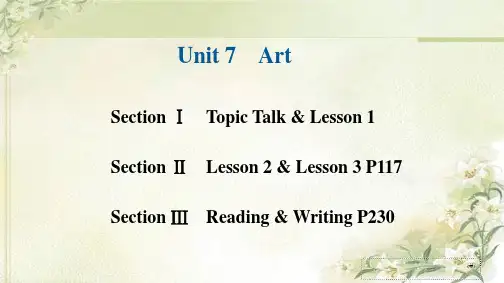
Unfortunately,Van Gogh's unique⑪ paintings weren't very popular and he only sold one painting in his lifetime.He also thought The Starry Night was a failure⑫.However,the fact remains that The Starry Night is now one of the world's most famous paintings.[2]
Ⅰ.语境填词 figure;exhibition;sight;masterpiece;atmosphere; visual;affect;striking;scream;component 1.We try and provide a very homely _a_tm__o_sp_h_e_r_e_. 2.More than seven million people have been _a_ff_e_c_te_d__ by drought.
[2]that 引导表语从句。 The Scream was painted by Edvard Munch in 1893.What makes it striking⑬ is that it shows a thin figure⑭ with an expression⑮ of fear—the figure's mouth is wide open and letting out a powerful scream ⑯.The figure covers his or her ears and looks directly at the viewer.This figure is set on a bridge above a dark,stormy⑰ sea,and against a burning⑱ orange-red⑲ sky.
Unit+7+Art+Lesson+3+A+Musical+Geni北师大版(2019)必修第三册+
Vienna was tense. Beethoven was afraid that the performance would be a disaster.
After all, what use is a conductor who could not hear his orchestra—even if he is
2. Where was Beethoven born?
A. In Germany.
B. In Canada. C. In France.
birthplace
3. What big challenge did Beethoven face?
A. He became deaf.
life challenge
score. n. 乐谱
当这位著名作曲家时隔12年再次走上舞台时,观众们毫不犹豫地报以热烈的掌声。剧院 的音乐总监迈克尔·乌姆劳夫(Michael Umlauf)加入了他的行列,两人一起负责管弦乐队。 在一个多小时的时间里,贝多芬在管弦乐队面前跳来跳去,在空中忘情地挥舞着双臂, 疯狂地翻动着乐谱。
Read and explore
Para 2
General information
Para 3-6
Performance of Symphony No. 9
Read and explore
back(后面的)+stage(舞台)=后台的
n. 剧场,戏院
3. Before the performance, the backstage atmosphere at a very famous theatre in
Activity 1.
1. What is Beethoven most famous for? A. His piano performances. n. 大型管弦乐队
Unit 7 Art 北师大2019版高中英语必修第三册
高中北师大2019版英语必修三Unit 7 ART【NOTES ON THE TEXTS】Topic TalkAll artists must be half-poet,half-craftsman.凡是艺术家都须有一半是诗人,一半是匠人。
------朱光潜《谈美》Lesson lIn his diary, Munch talked about what inspired him. “ I was walking down the road with two friends when the sun set; suddenly the sky turned as red as blood... I stood there shaking...”蒙克在他的日记中谈到了灵感的来源,“太阳落山时,我和两个朋友一起走在路上;天空突然变得像血一样红......我站在那里颤抖......”①set n. 集合,布景,装置,一套V. 树立,点燃a. 固定的,规定的set up 建立;装配;开业;树立set out 出发;开始;陈述(书面用词)set off v. 出发,引起,动身,;使爆炸;抵消;分开all set 准备就绪,都安排好了Eg:Then confirm your selection and you’re all set.最后再确认你的选择,就完成了。
He set off once more in spite of his friends’ attempts to dissuade him.他不顾朋友们的劝阻,再次启程远航。
In the chilly autumn wind, the soldiers set out with a mettlesome and handsome bearing.秋风飒飒中,战士们英姿勃发地出发了。
Police have set up a roadblock on the road to London.警察在通往伦敦地路上设置了路障。
北师大版(2023)必修第三册 Unit 7Art Topic Talk 词汇讲解课件 (共19张P
北师大版(2023)必修第三册Unit 7Art Topic Talk 词汇讲解课件(共19张PPT,内镶嵌音频)(共19张PPT)Unit 7 Art-Topic TalkLearning wordsⅠ. Knowing words1. opera n.2. band n.3. performance n.4. exhibition n.5. classical adj.6. jazz n.7. drama n.8. comedy n.9. calligraphy n.歌剧,歌剧艺术乐队,乐团表演,演出展出(会),展览古典的,传统的爵士乐戏剧喜剧片,喜剧节目书法English to ChineseⅠ. Knowing words10. performer n.11. talented adj.12. component n.13. costume n.14. shade n.15. atmosphere n.16. monthly adv.17. uplifting adj.表演者,演奏者,演员有才能的,有天资的组成部分戏装,化妆服(画)的阴影部分气氛,氛围每月地,每月一次地令人振奋的English to Chinese Ⅰ. Knowing words opera n.band n. performance n. exhibition n. classical adj.jazz n.drama n. comedy n. calligraphy n.1.歌剧,歌剧艺术2.乐队,乐团3.表演,演出4.展出(会),展览5.古典的,传统的6.爵士乐7.戏剧8.喜剧片,喜剧节目9.书法Chinese to EnglishⅠ. Knowing wordsperformer n.talented adj.component n.costume n.shade n.atmosphere n.monthly adv.uplifting adj.10.表演者,演奏者,演员11.有才能的,有天资的12.组成部分13.戏装,化妆服14.(画)的阴影部分15.气氛,氛围16.每月地,每月一次地17.令人振奋的Chinese to EnglishⅠ. Learning words1. opera n. 歌剧,歌剧艺术;歌剧院Eg. I quite like Beijing oprea with a long history.我非常喜欢京剧,它有着悠久的历史。
高中英语必修第三册课件Unit 7 Art Lesson 1 Masterpieces-北师大版(2019)
Questions: 1. What does the painting show? 2. What may have inspired the painter? 3. What did the artist think or say about the painting?
Painting The Starry Night
●
b 3 W h a t i s s t r a n g e i s t h a t a b o v e t h e h o u s e a n d t h e t r e e , w e s e e a d a y t i m e s k y f u l l o f b r i g h t n e s s a n d s o f t w h i t e c l o u d s .
Unit 7 Art Lesson 1 Masterpieces
ActivitWy 1hat do you see in the painting?
The Starry Night
by Van Gogh
ActivitWy 1hat do you see in the painting?
The Scream by Edvard Munch
A thin figure with an expression of fear.
His experience of Not mentioned in the walking with friends. text.
A beautiful house lit by lights from inside, surrounded by the
ActivitWy 1hat do you see in the painting?
高中英语外北师大版(2019)必修第三册-Unit 7 Art Lesson 2 Beijing O
Unit 7 ArtLesson 2 Beijing Opera【教学目标】Students will be able to1. read and talk about Beijing Opera2. listen for understanding3. recall information previously heard4. express and discuss emotions【教学重难点】1. talking about Beijing Opera2. expressing and discussing emotions【教学过程】1. Talk about Beijing Opera(1) Ask the students if they have watched Beijing Opera and what their experiences were. Write these examples on the board.(2) Discuss the questions as a class. Ensure that all students get a chance to answer the questions.(3) Instruct students to work independently and match the photos with the descriptions.(4) Discuss the answers as a class.2. Listen and tick.(1) Ask a volunteer student to read the four aspects. Explain any unknown terms.(2) Instruct students to tick the aspects that are mentioned as they listen to the radio programme.3. Listen again and answer questions.(1) Explain to students that they will listen to the radio programme once more, and this time to listen for details.(2) Preview the questions with the students.(3) Suggest that students underline or take notes as they listen.(4) Students work independently or in pairs to answer the questions in full sentences.(5) Check answers as a class. If needed, replay the radio programme and point out the different features of Beijing Opera.4. Listen again, take notes, and answer questions.(1) Read aloud the instruction and the Skill Builder. Then read each question. Explain any difficult words.(2) In pairs, students discuss the answers.(3) While the radio programme is playing, students check and complete their answers.(4) Discuss the answers as a class.5. Listen again. List key phrases and talk about whether you like Beijing Opera.(1) In pairs, students listen and take notes of the key phrases used by Dr. Liu to give reasons.(2) Review the answers as a class.(3) Create a class discussion on the students’ opinion of Beijing Opera. Each student needs to provide their opinion and support with logical reasoning.6. Introduce Beijing Opera.(1) Divide students into five groups. Each group discusses one of the topics in relation to Beijing Opera: the four roles, costumes and masks, sound and singing, history and interesting features.(2) Each group selects one person to be the scribe and write down notes for the group.(3) Each student in the group describes the chosen topic. The scribe can mind map this information.(4) Each group writes a few complete sentences about their topic on Beijing Opera using these descriptions.(5) A volunteer from the group reads this passage to the class, role playing that he or she is introducing Beijing Opera to a group of foreign students.(6) The class can ask questions about the topic and members from the group can help to answer the questions.7. Listen and answer.(1) Read the instruction and questions aloud to the students.(2) Play the dialogue.(3) In pairs, students answer the questions in full sentences.(4) If needed, play the dialogue a second time. Give the students time to complete the answers.(5) Discuss the answers as a class.8. Listen, imitate, and talk about emotions.(1) Read aloud the instruction and the Talk Builder box as a class. Explain any unknown terms.(2) Ask students to give a personal example of an emotion, either satisfaction, worry or regret.a. What do these emotions mean?b. Which are positive emotions and which are negative emotions?c. How can your facial features or tone of voice show these emotions?Students can use their dictionaries, if needed.(3) Tell students that they will listen to the dialogue for more detail.(4) As students listen to the dialogue, they need to identify the emotion for each sentence in the brackets.(5) Review the answers as a class.9. Pair Work: Act it out.(1) Explain to students that they will be watching a short local opera. Students need to take notes of the roles, costumes and masks, sound and singing, history and interesting features. Play only some parts of the prepared video, either from TV or from online resources.(2) Divide the class into pairs. Tell students that they will role play a dialogue between a Chinese student and a foreign student.(3) Student A is role playing a Chinese student, who understands the different elements of opera. Student B is role playing a foreign student, who does not understand opera and asks questions.(4) In pairs, students first write down five questions that a foreign student would ask about the opera; then students provide responses in a script format.(5) Students can practise their role play and perform it for the class.。
北师大版高中英语必修第3册 UNIT 7 SECTION A TOPIC TALK
11.At 54 years of age,he didn’t know that this would be his last symphony. 宾语从句 12.As he proudly signed his name at the bottom of the page,Beethoven tried to imagine how people would respond when they heard it for the first time. 宾语从句
视觉 精神疾病 发出尖叫声
重点句式
Others,however,find them calming. 然而,另一些人则觉得他们很平静。 重点语法 名词性从句
Ⅱ.阅读导学
A.阅读pp.8-9课文并填空
Painter
Painting
Vincent van Gogh
Edvard Munch René Magritte
Ⅲ.阅读下列句子,并注明画线部分的用法
1.Van Gogh painted what he saw from his window. 宾语从句 2.His unusual use of colour has led experts to think that Van Gogh’s mental illness may have affected his sense of sight. 宾语从句 3.He also thought The Starry Night was a failure. 宾语从句 4.However,the fact remains that The Starry Night is now one of the world’s most famous paintings. 同位语从句
2019-2020新教材北师大版高中英语必修第三册课件:UNIT 7 ART LESSON 1 MASTERPIECES
• (5) The police were _____ _____ _____ (在现场) within a few
minutes after the old man’s phone call
• 词汇五 failure n. [C]失败的人或事;[U]衰竭;失败;故障 • ◆教材原句 • He also thought The Starry Night was a failure. 他还认为《星空》是一幅失败的作品。 • ◆要点必记 • a power failure 停电;电力故障 • fail v. 失败;不及格;(健康、视力、记忆力) 衰退 • fail to do sth. 未能做某事 • fail in sth. 在某事中失败 • ◆误区警示 • failure 作“失败”讲时为抽象名词,是不可数名词;但作“失败的人或事”讲时,是
• (6)[2017·北京卷]If you don’t understand something,you may research,
study,and talk to other people until you
it
(弄明白).
figure out
• 词汇二 lead sb. to do sth. 引导某人做某事 • ◆教材原句
• His unusual use of colour has led experts to think that Van Gogh’s mental illness may have affected his sense of sight. 凡·高对色彩的运用很不寻常,专家们认为精神 疾病可能影响了他的视力。
out
• •
◆单句语法填空 (1) Have you
figures