
仁爱英语七年级下册unit7知识点
Unit 7 Topic 3 知识点总结
一、语法:一般过去式
1、概念:表示过去发生的动作、事件、情况,而现在已结束,也可以表示过去时间里经常性或
习惯性的动作,或主语过去的性格和能力。
2、常见的时间状语
①yesterday ,yesterday morning/afternoon/evening
②just now刚才in the past过去the day before yesterday前天
③ago短语:a moment ago, an hour ago, three weeks ago, two months ago, four years ago等
④in+时间点:in 2000,in 1995,in 1880
⑤last短语:last week上周/last year去年/last month上个月/last night昨天晚上
二、
是
三、
1、at the party在聚会上
2、recite a Chinese poem背汉语诗
3、perform magic tricks表演魔术
4、enjoy oneself=have a good time玩的愉快
5、miss the chair 坐空椅子
6、fall down摔倒
7、hurt yourself伤了你自己8、at once立刻
9、sth happened to sb某事发生在某人身上10、at that time在那时
11、come back home回家12、lie to sb向某人撒谎
13、tell sb the truth告诉某人真相14、go to the party with sb和某人一起去参加party
15、last night昨天晚上16、tell a lie to sb向某人说谎
17、make sb angry使某人生气18、lose the game输了比赛
19、buy lots of food and drinks for sb为某人买许多食物与饮料
20、each of us我们每一个人21、make the card by hand亲手制作卡片
22、a big birthday cake with 13 candles带13根蜡烛的大生日蛋糕
23、make a silent wish默默地许愿
24、blow the candles out in one breath一口气吹灭蜡烛25、it’s your turn 轮到你了
26、it’s one’s turn to do sth轮到某人做某事
27、enjoy doing sth=like doing sth喜欢做某事
四、重要句型
1、How was Kangkang’s birthday party? It was very nice.康康的生日party怎么样?它很不错。
2、Did you recite a Chinese poem? No, I didn’t.你背中文诗了吗?不,没有。
3、What did Sally do? She danced.萨利做了什么?她跳舞了。
4、He performed some magic tricks.他表演了一些魔术。
5、Did Kangkang enjoy himself? Certainly, he was very happy.
6、It’s one’s turn to do sth.轮到某人做某事。
7、I missed the chair and fell dowm.我坐空了椅子,摔倒了。
8、Did you hurt yourself? No, I didn’t.你伤了你自己吗?不,我没有。
9、Go and wash them at once.马上去洗它们。
10、What happened to him at the party?他在聚会上发生了什么事?
11、What time did you come back home last night?昨晚你们何时回来?
I came back home at ten.我10点回来的。
12、You were not at home at that time.你那时不在家。
13、How can you lie to me?你怎么能向我撒谎?
14、I didn’t play video games at all.我根本不会玩电子游戏。
15、Everyone had a good time, so we all forgot the time.每个人都玩的很开心,因此我们都忘
了时间。
16、Why didn’t you tell me the truth? I won’t do it again.为何你不告诉我真相?我不再那样做
了。
17、He told a lie to his father yesterday.他昨天向他父亲撒谎。
18、It made her father very happy.他使他父亲很高兴。
19、His parents bought lots of food and drinks for us.他父母为我们买了许多食物和饮料。
20、Kangkang made a silent wish, and then he blew the candles out in one breath.
康康默默地许了愿,然后一口气吹灭蜡烛。
五、本话题出现的动词过去式有:(要反复落实)
play forget bring perform have give enjoy tell sit recite go blow do come lose
sing think come dance make stop miss lie(撒谎)plan fall lie(位于)hear hurt get put wash like begin stand buy run
四、本话题有几个需要注意的知识点
1、What’s the matter with sb? = What happened to sb?某人怎么啦?
2、make sb/sth + 形容词“使----处于某种状态”
make me happy 让我高兴make me angry 让我生气
3、①lie(撒谎)过去式:lied 现在分词:lying
lie(动词)to sb 向某人说谎= tell a lie(名词)to sb
如:He told a lie to his father yesterday. = He lied to his father yesterday.
②lie“躺”,“位于”lay(过去式)lying(现在分词)
如:The boy is lying on the floor.那男孩正躺在地上。
He lay on the sofa last night.昨晚他躺在沙发上。
4、拓展:be angry with sb对某人很生气be angry at sth 对某事很生气
5、enjoy oneself = have a good time = have a wonderful time 玩的愉快
6、反身代词:I ----myself我自己we----ourselves我们自己
you-----yourself你自己you----yourselves你们自己
she----herself 她自己they----themselves他们自己
he-----himself 他自己it------itself它自己
7、each of“—中的每个人”做主语、谓语动词用单数,each可单独使用
如:Each is different. (不能不能用every)、Each of them/us is different.
every 后不跟of做主语,做主语时谓语动词用单数
Each of us has an English book.
Each of the girls _____(have) a pink bag.
8、well与good的区别:
①well只有当身体好时是形容词:I’m very well today.
Well是副词,修饰动词放句末:She can sing very well.
②good是形容词,常用来修饰名词或放系动词be后,表人或事物的质量、品行
如:Mr.Wang is a good teacher, and he teach very well.
9、happen的用法:
①happen动词(偶然)发生:What time did the accident happen?
②happen to sb(事件)发生在某人身上:I want to know what happened to Jane.
③What happened to sb/sth?某人或某物怎么了?。
(完整版)仁爱版七年级英语下册知识点总结
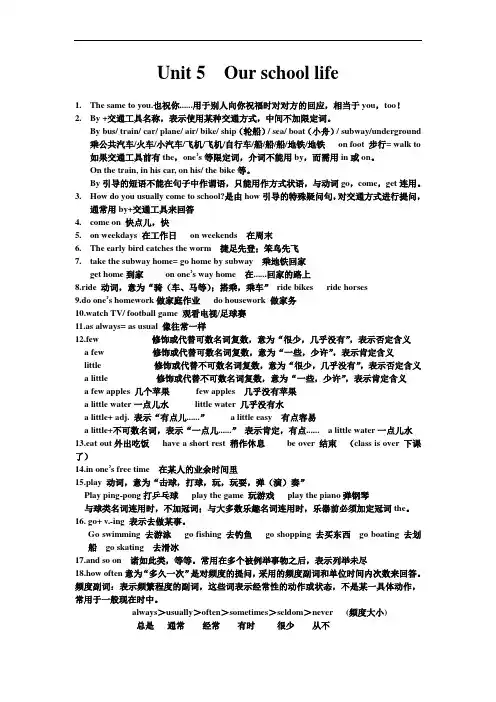
Unit 5 Our school life1.The same to you.也祝你......用于别人向你祝福时对对方的回应,相当于you,too!2.By +交通工具名称,表示使用某种交通方式,中间不加限定词。
By bus/ train/ car/ plane/ air/ bike/ ship(轮船)/ sea/ boat(小舟)/ subway/underground 乘公共汽车/火车/小汽车/飞机/飞机/自行车/船/船/船/地铁/地铁on foot 步行= walk to 如果交通工具前有the,one’s等限定词,介词不能用by,而需用in或on。
On the train, in his car, on his/ the bike等。
By引导的短语不能在句子中作谓语,只能用作方式状语,与动词go,come,get连用。
3.How do you usually come to school?是由how引导的特殊疑问句,对交通方式进行提问,通常用by+交通工具来回答e on 快点儿,快5.on weekdays 在工作日on weekends 在周末6.The early bird catches the worm 捷足先登;笨鸟先飞7.take the subway home= go home by subway 乘地铁回家get home到家on one’s way home 在......回家的路上8.ride 动词,意为“骑(车、马等);搭乘,乘车”ride bikes ride horses9.do one’s homework做家庭作业do housework 做家务10.watch TV/ football game 观看电视/足球赛11.as always= as usual 像往常一样12.few 修饰或代替可数名词复数,意为“很少,几乎没有”,表示否定含义a few 修饰或代替可数名词复数,意为“一些,少许”,表示肯定含义little 修饰或代替不可数名词复数,意为“很少,几乎没有”,表示否定含义a little 修饰或代替不可数名词复数,意为“一些,少许”,表示肯定含义a few apples 几个苹果few apples 几乎没有苹果a little water一点儿水little water 几乎没有水a little+ adj. 表示“有点儿......” a little easy 有点容易a little+不可数名词,表示“一点儿......”表示肯定,有点...... a little water一点儿水13.eat out外出吃饭have a short rest 稍作休息be over 结束(class is over 下课了)14.in one’s free time 在某人的业余时间里15.play 动词,意为“击球,打球,玩,玩耍,弹(演)奏”Play ping-pong打乒乓球play the game 玩游戏play the piano弹钢琴与球类名词连用时,不加冠词;与大多数乐趣名词连用时,乐器前必须加定冠词the。
最新仁爱英语七年级下册Unit 7单词表
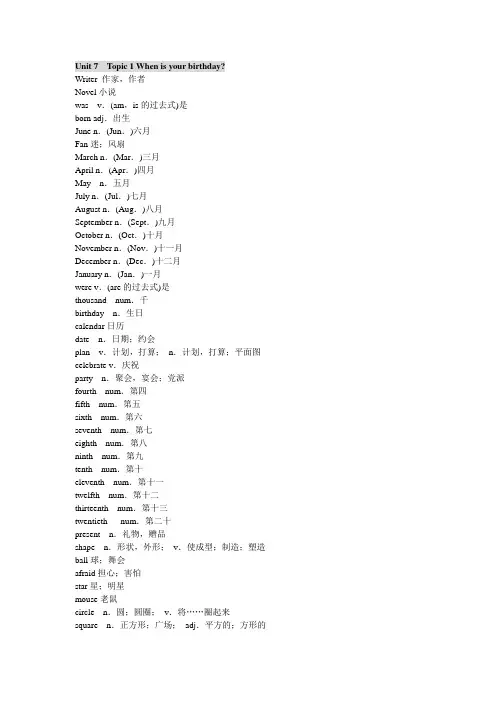
Unit 7 Topic 1 When is your birthday?Writer 作家,作者Novel小说was v.(am,is的过去式)是born adj.出生June n.(Jun.)六月Fan迷;风扇March n.(Mar.)三月April n.(Apr.)四月May n.五月July n.(Jul.)七月August n.(Aug.)八月September n.(Sept.)九月October n.(Oct.)十月November n.(Nov.)十一月December n.(Dec.)十二月January n.(Jan.)一月were v.(are的过去式)是thousand num.千birthday n.生日calendar日历date n.日期;约会plan v.计划,打算;n.计划,打算;平面图celebrate v.庆祝party n.聚会,宴会;党派fourth num.第四fifth num.第五sixth num.第六seventh num.第七eighth num.第八ninth num.第九tenth num.第十eleventh num.第十一twelfth num.第十二thirteenth num.第十三twentieth num.第二十present n.礼物,赠品shape n.形状,外形;v.使成型;制造;塑造ball球;舞会afraid担心;害怕star星;明星mouse老鼠circle n.圆;圆圈;v.将……圈起来square n.正方形;广场;adj.平方的;方形的triangle n.三角形rectangle n.长方形;矩形oval n.椭圆;adj.椭圆形的centimeter n.(cm)厘米Unit 7 Topic 2 Can you dance or draw?piano钢琴else别的,其他的disco n.迪斯科(一种舞曲)perform v.表演;履行;行动ballet n.芭蕾舞have a good time玩得高兴,过得愉快smart adj.聪明的,灵巧的;(人、服装等)时髦的,帅的count v.数,点数ago以前London n.伦敦age n.年龄;时代at the age of 在……岁时word n.单词,词;话Unit 7 Topic 3 We had a wonderful party.magic adj.有魔力的trick n.把戏,诡计enjoy v.喜欢;欣赏;享受……的乐趣himself pron他自己enjoy oneself 过得愉快kung fun n.功夫yesterday adv.&n.昨天ouch interj.(突然受痛时的叫声)哎哟fall (过去式fell)v.倒;落(下),降落;秋季autumn n.秋季myself我自己wash v.&n.洗(涤),冲洗at once立刻,马上washroom n.盥洗室forget忘记bring带来candle蜡烛wish愿望,希望blow吹,刮风blow out吹灭everyone每人,人人sunny adj.晴朗的,阳光充足的delicious adj.美味的,可口的musical adj.音乐的,配乐的funny adj.有趣的,滑稽可笑的。
七年级下册英语unit7仁爱版知识点

七年级下册英语unit7仁爱版知识点Unit 7主要介绍了购物和做家务的相关语言知识。
以下是本单元的重点知识:
一、购物语言
1.询问价格和折扣:
- How much is it?(这个多少钱?)
- Is it on sale?(打折吗?)
- What's the discount?(有多少折扣?)
2.询问购物需求:
- Can I help you?(需要帮忙吗?)
- What size/color do you need?(你需要什么尺码/颜色?)
- What do you want to buy?(你想买什么?)
3.支付和找零:
- How do you want to pay?(你想用什么方式支付?)- Here's your change.(这是找给您的钱)
二、家务语言
1. 做家务的动词:
- sweep(扫地)
- mop(拖地)
- vacuum(吸尘)
- wipe(擦拭)
- dust(擦灰尘)
- clean(清洁)
- wash(洗)
- iron(熨烫)
2. 做家务的时间:
- on weekends(在周末)
- in the morning(早上)
- after school/work(放学/下班后)
- before bedtime(睡觉前)
3. 表示强调的副词:
- really(真的)
- very(非常)
- extremely(极其)
以上是本单元的重点知识,掌握上述语言知识可以帮助你更好地与他人交流。
希望你能够认真学习,在日常生活中灵活运用。
仁爱版英语七年级下册Unit7Topic2知识点总结

仁爱版英语七年级下册Unit7Topic2知识点总结Unit 7 Topic 2: Knowledge Points Summary in Ren'ai English Textbook for 7th GradeIn the seventh grade English textbook of Ren'ai, Unit 7 Topic 2 focuses on various knowledge points related to the English language. This article will provide a comprehensive summary of the key concepts covered in this topic.1. Verb tenses:- Present Simple: Used to talk about habitual actions, general truths, and permanent situations.- Present Continuous: Used to talk about actions happening now or around the present time.- Past Simple: Used to talk about completed actions in the past.- Past Continuous: Used to talk about actions that were in progress at a specific time in the past.- Future (be going to): Used to talk about future plans and intentions.2. Adverbs of frequency:- Adverbs such as always, usually, often, sometimes, and never are used to express how often an action occurs.- They are usually placed before the main verb, except when the main verb is "to be." In that case, the adverb is placed after "be."3. Comparatives and superlatives:- Comparatives are used to compare two things, while superlatives are used to compare more than two things.- Comparatives are formed by adding "-er" to short adjectives or using "more" before long adjectives.- Superlatives are formed by adding "-est" to short adjectives or using "most" before long adjectives.4. Quantifiers:- Quantifiers are words or phrases used to specify the quantity or amount of something.- Some common quantifiers include much, many, a lot of, a few, a little, and some.- They can be used with countable and uncountable nouns, but the choice of quantifier depends on the noun.5. Modal verbs:- Modal verbs are auxiliary verbs that express ability, possibility, necessity, or permission.- Common modal verbs include can, could, may, might, must, should, and would.6. Question forms:- There are two types of questions: yes/no questions and information questions.- Yes/no questions are formed by inverting the subject and the helping verb.- Information questions are formed by placing the question word at the beginning of the sentence.7. Direct and indirect speech:- Direct speech is when we report someone's words exactly as they were spoken.- Indirect speech is when we report someone's words indirectly, without using their exact words.- When changing from direct to indirect speech, tenses, pronouns, and time references often need to be adjusted.8. Prepositions of time and place:- Prepositions such as on, at, and in are used to express time and place relationships.- "On" is used with specific days, "at" is used with specific times, and "in" is used with months, years, and longer periods.- Prepositions of place, such as "in," "on," and "at," indicate where something is located.This summary provides a brief overview of the key knowledge points covered in Unit 7 Topic 2 of the Ren'ai English textbook for seventh graders.By understanding and practicing these concepts, students can enhance their English language skills and improve their proficiency in communication.。
仁爱版初中英语七年级下册Unit7Topic3课文+单词+知识梳理

知识梳理:【重点短语】1. recite a poem 背诗2. Perform magic tricks 表演魔术3. Perform kungfu 表演功夫4. It's your turn. 现在轮到你了5. miss the chair 没坐到椅子6. poor Michael 可怜的迈克尔7. Did you hurt yourself? 你摔伤了吗?8. hurt oneself 伤着某人自己9. go and wash them at once 马上去洗一洗10. This way, please. 请走这边。
11. come back 回来12. come back home 回家来13. come back to school 回到学校14. play video games 玩电子游戏15. lie to sb = tell a lie to sb 对某人撒谎16. tell me the truth 跟我说实话17. each of us 我们每个人18. sit around 坐在...周围19. make a silent wish 默默许个心愿20. blow the candles out = blow out the candles 吹灭蜡烛21. in one breath 一口气22. have a big dinner 吃一次大餐【重点句型】1.Did Kangkang enjoy himself?康康玩得开心吗?2.It’s your turn.该你了。
3.What happened to Michael at the party?聚会上迈克发生什么事情了?4.What’s the matter ? 怎么啦?5.This way, please . 请往这边走。
6.We bought many presents for him.我们给他买了许多礼物。
仁爱版七年级英语下册Unit7TheBirthdayParty词汇精讲精练含答案

Unit 7 The Birthday Party词汇精讲精练词汇精讲1. writerwriter意为“作者,作家”,是由动词write后加-er构成。
【拓展】表示职业或身份的名词小结:(1) 以-ist结尾的有:pianist钢琴家 chemist化学家 violinist小提琴家physicist物理学家 scientist科学家(2) 以-er,-r或-or结尾的有:teacher教师 painter画家 singer歌唱家 visitor参观者actor演员 engineer工程师 inventor发明家 professor教授 reporter记者(3) 以-man结尾的有:postman邮递员 policeman警察 businessman商人 spaceman宇航员fisherman渔夫 dustman清洁工(4) 以-ian结尾的有:musician音乐家 politician政治家2. thousandthousand是数词,意为“千”,当表示具体的“几千”时,用“基数词+ thousand”,注意不加-s。
例如:There are six thousand students in the city. 这个城市有6000名学生。
【拓展】(1)thousands of 表示“数千,成千上万的”这时thousand后要加-s,且后面有介词of,但是不能与数词连用。
例如:There are thousands of people on the square. 在广场上有成千上万的人。
(2)表示数词的还有hundred“百”,million“百万”,billion“十亿”。
它们的用法和thousand一样,可以用来表示约数和确数。
3. plan(1) 作可数名词,意为“计划,方案”。
例如:What are your plans? 你的计划是什么?Make a plan for study, please. 请制定学习计划。
仁爱版英语七年级下册Unit7TheBirthdayParty全单元导学案附复习练习讲解
Topic 3 We had a wonderful party. ( 61 课时)Section B合作交流1. Kangkang had a birthday party last Saturday. At the party, Michael missed the chair and felldown.Now let 's listen to the tape and answer:① Did Michael hurt himself?Unit 7 The Birthday PartyTopic 3 We had a wonderful party.Section B60 课时)学习目标 1. 2. 3. 学习内容 继续学习行为动词的一般过去时 掌握有关责备和抱怨的句子 鼓励学生做一名诚实的孩子 1.生词和短语fall down wash washroom at once happen video game everyone tell the truth tell a lie time 2.句型 1.What 's the matter?I missed the chair and fell down. 2.Did yo u hurt yourself? Yes, I did. This way ,please.How can you lie to me?Why didn 'tyou tell me the truth 导学自主 stand up come back lie lie to angry have a good1. 2. 3. Translate the following phrases: fall down This way, please. ____ at that time ________ tell the truth ________ 给出下列动词的过去式: Fall__ Can_ Have Think hurt oneself ________ _______ come back lie to ______ tell a lie to sb. at once have a good time __ ___ make sb. angry miss_ come tell__ hurt__ play__ forget wash__ go___ make②Where did he want to go?2. Two students a group and act out 1a班级展示A、展示合作交流1B、展示合作交流23. 短文填空:At Kan gka ng ' birthday party, his frie nds played a game. Michael missed the chair and________ dow n. He couldntsta nd up. Did he hurt ______ ? No, he ______OK. Hishands got dirty. He had to wash them. He wan ted to go to the washroom. Kan gka ng____ him the way.C、Part 2 Listen and answe①Did Judy lie to her father?②Why did she come back late last night?质疑探究用所给动词的适当形式填空:1. Judy _____ (lie) to her father this mornin g. It ____ (make)her father very an gry.2. Michael ______ (fall)dow n but he ______ (not hurt) himself.3. Judy _____ (come) back late last ni ght. Her father ____ (th ink) she played video games.四、总结,生成新问题。
仁爱版英语七年级下册unit7重难点知识归纳总结
仁爱版英语七年级下册Unit 7 The Birthday Party Topic 1 When is your birthday?【重点单词】1.writer [ˈraɪtɚ] n. 作家,作者2.novel [ˈnɒvl] n. (长篇)小说3.was [wɒz] v. (am, is的过去式)是4.born [bɔ:n] v. 出生5.fan [fæn] n. 迷;风扇6.March [mɑ:tʃ] n. (mar.)三月7.April ['eɪprəl] n. (apr.)四月8.May [meɪ] n. 五月9.June [dʒu:n] n. (jun.)六月10.August [ˈɔ:gəst] n. (aug.)八月11.September [sepˈtembə(r)] n. (sept.)九月12.October [ɒkˈtəʊbə(r)] n. (oct.)十月13.November [nəʊˈvembə(r)] n. (nov.)十一月14.December [dɪˈsembə(r)] n. (dec.)十二月15.January [ˈdʒænjuəri] n. (jan.)一月16.were [wɜ:(r)] v. (are的过去式)是17.thousand [ˈθaʊznd] num. 千18.birthday [ˈbɜ:θdeɪ] n. 生日19.date [deɪt] n. 日期;约会20.calendar [ˈkælɪndə(r)] n. 日历21.plan [plæn] v. &n. 计划,打算22.celebrate ['selɪbreɪt] v. 庆祝23.party ['pɑ:tɪ] n. 聚会,宴会;党派24.fourth [fɔ:θ] num. 第四25.fifth [fɪfθ] num. 第五26.sixth [sɪksθ] num. 第六27.seventh ['sevnθ] num. 第七28.eighth [eɪtθ] num. 第八29.ninth [naɪnθ] num. 第九30.tenth [tenθ] num. 第十31.eleventh [ɪ'levnθ] num. 第十一32.twelfth [twelfθ] num. 第十二33.twentieth ['twentɪəθ] num. 第二十34.present ['preznt] n. 礼物35.shape [ʃeɪp] n. 形状v. 使成为……形状36.ball [bɔ:l] n. 球;舞会37.afraid [əˈfreɪd] adj. 担心;害怕38.star [stɑ:(r)] n. 星;明星39.mouse [maʊs] n. 老鼠40.square [skweə(r)] n. 正方形;广场;平方adj. 正方形的41.circle ['sɜ:kl] n. 圈,圆圈v. 圈出42.triangle ['traɪæŋɡl] n. 三角形43.rectangle [ˈrektæŋgl] n. 长方形;矩形44.oval ['əʊvl] n. 椭圆adj. 椭圆形的45.centimeter ['sentɪˌmi:tə] n. (cm)厘米46.Mrs. [ˈmɪsɪz] n. 太太,夫人47.cake [keɪk] n. 蛋糕【重点短语】1.be born 出生2.look at 看3.plan to do sth. 计划做某事4.have a birthday party 举办生日聚会5.the shape of ……的形状6.be like 像……7.how long 多长8.how wide 多宽e ... for ... 用……做……【重点句型】1.—When were you / was he/she born?你/他/她是什么时候出生的?—I/He/She was born on/in …我/他/她出生于……2.—Where were you / was he/she born?你/他/她在哪里出生的?—I/He/She was born in …我/他/她出生在……3.—When is your birthday?你的生日是什么时候?—May 13th.5月13号。
河南仁爱版中考英语课本教材基础过关 第5课时 七年级(下) Unit 7
12.five(num.)→ fifth (序数词)第五 13.nine(num.)→ ninth (序数词)第九 14.twelve(num.)→ twelfth (序数词)第十二 15.twenty(num.)→ twentieth (序数词)第二十
熟词生义 1.date(n.)日期; 约会 2.square (n.)正方形;广场; 平方 (adj.)→ 正方形的 3.fall(v.)跌倒;落下 →(n.) 秋季 → autumn (同义词) 4.shape(n.)形状 →(v.) 使成为……形状 5.circle(n.)圈,圆圈
ry. 5.He lost his balance and fell (fall) onto the ground. 6.Please remember to bring (bring) your books to school tomorrow. We'll have a reading class. 7.If you walk to the park, it will take you twenty minutes (minute). 8.My sister enjoys taking (take) photos, so she wants to buy a good camera. 9.We celebrated (celebrate) the Spring Festival with a party. 10.We sat in a circle (circle) and began to play games. 二、用方框内所给词的适当形式填空
核心精讲过关
知识点1 enjoy的用法
命题档案 1.(2016上海)—The Art Festival is coming. We're going to watch the play Twelfth Night.— D . A.Thats all right B.Never mind C.Youre welcome D.Enjoy your time 答案 D 考查情景交际。句意:——艺术节就要到了,我们打算去看《第十 二夜》的演出。——愿你玩得开心。由句意可知选D。
七年级英语笔记仁爱版 Unit7 复习
U7 T1-T3 复习1.am,is—was(过去式)2.are—were(过去式)3.I was 改为一般疑问句时要改为were you.I was born in 1997.(否) I wasn’t born in 1997. (一般疑问句) Were you born in 1997?Yes, I was. / No, I wasn’t.4.be born5.十二个月:January, February, March, April, May, June, July, August, September, October, Novermber, December6.in +月份/年代:in May, in 2010, in May, 2010 on+具体日期:on May 14, 2010on the morning/afternoon/evening of …:on the morning of May 14,20107.年代的写法与读法:1949年10月1日:October 1st, 1949 ( October first, nineteen forty-nine)/ 1st October, 1949 ( the first of October, nineteen forty-nine)2009年6月3日:June 3rd, 2009 ( June third, two thousand and nine)/ 3rd June, 2009 (the third of June , two thousand and nine)8.提问日期,用what…date1)It’s May 14, 2010 today.What’ s the date today?2)Yesterday was January 20th, 1999.What was the date yesterday?9.1)I was born in 1985.When were you born?2)They were born in Shanghai.Where were they born?3)She was born in London in 1998.When and where was she born?10.1)plan—planning—planned2)plan to doHe is planning to play ping-pong.(play)11.基数词—序数词one—first,two—second,three—third, five—fifth,eight—eighth,nine—ninth, twelve—twelfth,twenty—twentieth,twenty-one---twenty-first,hundred--hundredth12.what shape=what’s the shape ofMy box is a rectangel.What shape is your box?/What’s the shape of your box?13.just now=a moment ago14.度量表达法:主语+be+数词+量词+形容词(long/wide/tall/high/heavy…)The pencil-box is 24 centimetres long.15.提问长度How long提问宽度How wide提问高度How tall/high提问重量How heavyThe pencil-box is 24 centimetres long.How long is the pencil-box?16.a surprise for sb17.do some + --ingdo some cleaning/shopping/reading/washing18.dance to disco19.prerfom ballet20.have a good time=enjoy oneself21.so smart/clever22.count from one to one hundred23.climb the tree/hill24.play ping-pong25.be good at doing=do well in doing26.at the age of…=whenHe could play ping-pong at the age of four.=He could ping-pong when he was four.27.something肯定句,anything否、疑问句Nothing表示否定意思的陈述句There’s something in the bag.(否) There isn’t anything in the bag./There is nothing in the bag.(一般疑问句)Is there anything in the bag?28.recite a poem29.perform magic tricks30.enjoy doing31.反身代词:单数:myself,yourself,himself,herself,itself;复数:ourselves,yourselves,themselves32.perform Chinese kung fu33.fall down34.at once=right now/away35.This way,please.36.happen to sbWhat happened to you yesterday?37.stand upe back homecome back to China39.lie to sb=tell sb a lie=tell a lie to sb140.play video games41.everyone=everybody ,作主语,谓语用单数42.true(adj.)---truth(n.)43.tell sb the truth44.be angry45.make sb angry/happy46.each other47.each of us/them/the answers ,作主语时,谓语用单数。