
unit3 how do you get to school
新目标七年级下 Unit3 How do you get to school?
一、 Teaching material analysis. 1、 Status and function 第三单元以How do you get to school?为中心话题,围绕交通方式而展开,主要运用How long/How far 询问“去某地的交通方式、时间、距离。”简单描述路线。Section A 是基本语言内容的收集和学习,引导学生通过利用本课的语言素材看图说话、句型操练、实际描述,运用对话表演等方法是学生能够正确的使用表示交通方式的词组、句型,从而熟练的谈论乘坐不同的交通工具去上学。为进一步深入学习由“How long„” 和“How far„?”引导的句型作好铺垫。 Section B是承接Section A所学交通和距离类话题的延伸,进一步提高学生的听说读写综合能力。交通话题贴近学生的日常生活,因此较容易激发学生的学习兴趣。 2、Teaching aims
根据《英语课程标准》关于总目标的具体描述,结合本单元的教材内容,我按知识目标、语言技能、情感态度、文化意识四个方面将本单元的教学目标细化: ①Knowledge object: 单词:学习掌握本单元的重点词汇。 句型:—How do you get to school? —I take the …/ride …/ walk… —How does Mary get to school? —She takes the subway. —How long does it take? —It takes forty minutes. —How far is it from„ to„ —It's„ kilometers. 语法:乘坐交通工具的两种表达方式. ②Ability object:能够正确使用take和by表达乘坐交通工具。 ③Moral object:让学生感受到他们学习英语是为了在现实生活中进行交流,而不单纯是为了英语课和应付考试而学习,了解东西方国家出行方式的不同,以及不同的交通规则,教育学生注意交通安全, 加深对交通知识的了解。倡导自觉遵守交通法规及礼貌,构建和谐的人际关系。了解交通的发展,培养创新精神。 ④Cultural consciousness:了解中西方文化的差异,培养交流意识。 3、Teaching key points and difficult points
根据教学大纲的要求,及本课在教材中所处的地位和作用,确定如下教学的重、难点: 重点:1) 学会使用How/How far/ How long question。 2) 能够正确使用take和by表达乘坐交通工具 难点:目标语言在实际生活中的应用。
二、Analysis of students. 对于七年级下册的学生来说,他们在经过七年级一学期的英语学习后,已具有了一定的英语基础知识,同时也具备一些运用语言知识的能力。在这样的基础上,学生对于讨论跟他们生活息息相关的内容,一概很容易产生兴趣。但是,我们的学生,了解和使用的交通工具比较单一,因而联系实际来学习交通工具相对比较容易。
三、Teaching methods 1)、用幻灯片将本课所需要的录音、图片、文字、制成多媒体课件,使抽象的语言变得直观,为学生运用英语进行交际创设情景,实现师生互动,生生互动和人机互动的多向交流。 2)、通过合作学习,分组竞争的机制,来汇报展示自己实际的运用交通工具的方法和途径。在合作学习中,让学生互相取长补短,给予学生明确学习任务;让学生主动参与学习,达成目标。提高学习的效率。 3)、本堂课,本人将大量使用图片教学,以及有声的听力材料,以此培养学生的通过观察学习和通过记忆分析来学习的方法。另外开展小组学习,指导学生自学与合作学习相结合。鼓励指导学生参与课堂交际活动,在实践中,学习语言知识。
四、Learning methods 新制定的《英语课程标准》把“培养学生学习英语的兴趣,树立自信心,培养良好学习习惯和形成有效策略,发展自主学习和合作精神”放在了首位。依据课改的精神,我从以下几个方面对学生进行学法指导: 1、学习方法的指导:培养学生观察力,想象力,记忆力以及思维能力。用生动的课件调动学生的感官进行听说读写的训练。 2、学习积极性的调动 我在教学过程中创造一种开放的,和谐的,积极互动的语言氛围,把课堂变成有声有色的舞台,让学生在乐中学。 3、学习能力的培养 通过连贯的听说读写,游戏,竞赛等,培养学生的交际能力,发展他们的思维能力。 4、学习策略的指导 创建开放式,探究式的课堂,有意识渗透学习策略的训练。让学生观察课件画面,回答问题,让学生学会使用认知策略;让学生表演对话,实现交际策略;引导学生交际,主动练习和实践,是调控策略的体现。充分利用多媒体,录音等是资源策略。
Period1 Section A (1a-1c) Teaching aims: 1. Knowledge objectives: 1) 能掌握以下单词: train, bus, subway, ride, bike, get to, take the subway, ride a bike. 2) 能掌握以下句型: ① —How do you get to school? —I ride my bike. ② —How does Mary get to school? —She takes the subway. 2.Ability objectives: The students can Talk about how to get to places (谈论出行方式) take the bus /subway /train /taxi , ride a bike /walk . The student can use “ how question。 3.Moral objectives: 让学生感受到他们学习英语是为了在现实生活中进行交流,而不单纯是为了英语课和应付考试而学习,了解东西方国家出行方式的不同,以及不同的交通规则,教育学生注意交通安全, 加深对交通知识的了解。倡导自觉遵守交通法规及礼貌,构建和谐的人际关系。了解交通的发展,培养创新精神。 Teaching key points and difficult points 1. Teaching key points: 1) how引导的特殊疑问句. 2) 乘坐交通工具的表示方法. 2. Teaching difficult points: —How do you get to school? —I take the …/ride …/ walk… —How does Mary get to school? —She takes the subway. Teaching procedures: Step 1 Lead in Let’s play a guess game. I said something ,please guess what they are. (通过一个小游戏,调动课堂气氛,让学生集中精力准备上课) Step 2. Check Preview 1. Show some pictures of the transportation and ask students to read. If the students are wrong, correct the pronunciation. 2 Look at the picture of 1a. Match the words with the picture.1. (通过检查预习,了解学生对新知的预习情况) Step 3 Group learning each other Discuss with group members: If you are here, but your school is in Shanghai. How do you get to school? Ss: I take the bus /plane/ boat / ship / car / taxi I ride a bike / motorbike Step 4. Presentation 1. Teacher shows pictures on the big screen ,and show the sentences: —How do you get to...? —I take the… = I go to…by I ride the… =I go to…by I walk to…=I go to…on foot Ask some questions about how you get to…? (通过句型的操练让学生归纳总结出行方式,多媒体增加趣味性,加强直观性,效果事半功倍) 2. Show a picture about Part 1, on the screen. Point at girls or boys in the picture. Ask students to answer and write in the blanks. S1 : How does he / she go to school? S2 : He / She … … Step 5. Practice 1. Pair work: Ask students to make conversation . Ask and answer how students get to school in the picture. 2. Ask some pairs of students to present their conversations to the class. Make sure the Ss know what to do. Give them an example orally if possible. Read the names in the box. Then play the tape and check the answers. (让学生们通过对话和听力练习巩固新知) Step 6 Consolidation Ask students to do some exercises. 1. I take the train to school. = I get to school __________. 2. She takes the subway to school. (同义句) She _____ to school ___ _______. 3. Jenny rides the bike to school = Jenny gets to school ___ _____. 4.Mr. Wang walks to school. (同义句) Mr. Wang _____ to school ___ ____. (进行完听、说、读之后,让学生动笔练习。了解学生对本堂课的了解。) Step 7. Summary
Unit 3 How do you get to school_ 教案

单位名称
填写时间
学科
英语
年级/册
七年级下册
教材版本
人教版
课题名称
第三单元第一节Unit3 How do you get to school?(1a-1c)
难点名称
To talk about how to get to school.
难点分析
从知识角度分析为什么难
本节课要达到的目的就是让学生能够学会多种搭乘交通工具的表达方式。但是在这其中涉及到How引导的特殊疑问句,如果稍微不注意就用错单词,要去很好的掌握此句型需要对人称代词,助动词再次进行巩固。
从学生角度分析为什么难
因为学生之间存在差异性,基础好的学生很容易能够掌握所涉及到的知识点,对基础稍弱的学生需要层层递进地去教,同时给他们足够的时间去做相应的练习题。
难点教学方法
1.Through visual display to attract students' attention, lead students to actively participate in the classroom to achieve good results.
train(n )火车
subway(n.)地铁
bike(n.)自行车
walk(v.)步行
2.key phrases:
take the bus=by bus坐公共汽车
take the train=by train坐火车
take the subway=by subway坐地铁
ride the bike=by bike骑自行车
= I get to school by bike.
2.她怎样去学校?她是乘火车去学校?
Unit 3 How do you get to school_Section A 课件
2.--How does she get to school? --She usually takes the bus.
3.--How long does it take to get to school?
6.--Do they take the bus to school? --No, they don’t. They walk.
二、探究乐园。
1. How do/does + 某人 + __g_e_t _to__某__地__ ? 某人怎么去某地? how是疑问副词, 本句中用来提问 _出__行__方__式___ 等。 你叔叔通常怎样去香港? _H_o_w__d_o_e_s_y_o_u_r_u_n_c_l_e_g_e_t_t_o_H_o_n_g__K_o_n_g_?___
I ride my bike.
How does she get to school?
She usually takes the bus.
How long does it take to get to school? How far is it from your home to school? Does Jane walk to school?
How far is it from your home to school? It’s about …
How does … get to school? He/She …
How long does it take … to get from … home to school? It takes …
How far is it from … home to school? It’s about …
Unit 3 How do you get to school重点词语背诵(答案)

Unit 3How do you get to school?重点词语背诵(答案)Section A1.train n.火车2.bus n.公共汽车3.subway n.地铁4.ride v.骑n.旅程5.bike n.自行车6.sixty num.六十7.seventy num.七十8.eighty num.八十9.ninety num.九十10.hundred num.一百11.minute n.分钟12.far ad v.& adj.远;远的13.kilometer(=kilometre)n.千米;公里14.new adj.新的;刚出现的15.every adj.每一;每个16.by prep.(表示方式)乘(交通工具)17.drive v.开车18.car n.小汽车;轿车19.live v.居住;生活1.bus—buses(复数) 2.sixty—sixties(复数) 3.far—near(反义词) 4.live—living(现在分词) 5.drive—driving(现在分词)—driver(名词)司机1.take the train乘火车2.take the bus乘公共汽车3.take the subway乘地铁4.ride a bike/by bike骑自行车5.every day每天6.get to school到达学校7.one hundred and five一百零五8.how far多远9.how long多长时间10.have a good day度过愉快的一天1.——你如何去学校?——我骑自行车。
—How do you get to school?—I ride my bike.2.乘公共汽车需要大约20分钟。
The bus ride takes about 20 minutes.3.这是不错的锻炼。
It is good exercise.4.在学校度过愉快的一天。
Unit 3 How do you get to school听课反思

Unit 3 How do you get to school?听课反思星期三我听了一节七年级的英语课,这是一节阅读课,我把一些听课想法记录如下。
整节课分为: Before reading.---While reading---After reading---Conduction四个部分,这是李如的第二次比较正式的试课,与第一次相比,在课堂控制与教师教态方面进步了很多,更加自然大方,环节设计合理,思路清晰,教师语言简洁明了,指令较为清晰。
另把一些好的地方与小小的建议记录如下:一、Before reading1、好:老师用用索道图片引出rope way,把rope 和way分开,让学生更容易理解,在让学生理解ropeway 的意思的时候,老师提问参加拔河比赛时要用到的是什么,从而让学生理解Rope 是绳子的意思。
随后引出词组go on a rope way, 然后用四幅图片展示Go on a ropeway for…这个用法。
(建议:可以稍为加上一些身体语言把拔河表演出来,学生更容易理解,在板书时与学生可以有点交流)2、好:老师在教授afraid 的用法时,先给出句子让学生感受afraid 三个词组的用法,再让学生自己尝试总结。
最后教师再进行总结以及让学生进行造句。
3、好:老师用farm—farmer, 引出village—villager,这样一个类比是很好的引出方法。
4、好:教师给出三幅图片,提问学生:According to this three pictures, can you image what is the story about? 问题引领,让学生预测信息,然后让学生尝试用自己的语言说一下这篇故事的大概内容。
然后老师提出问题:why they go on a rope way to school? 让学生进入正式阅读。
总:在这一部分,教师呈现了阅读里面的重点单词和句型,并进行简单的操练,为接下来的while reading 做好准备与铺垫。
Unit 3 How do you get to school 达标测试卷(含答案)
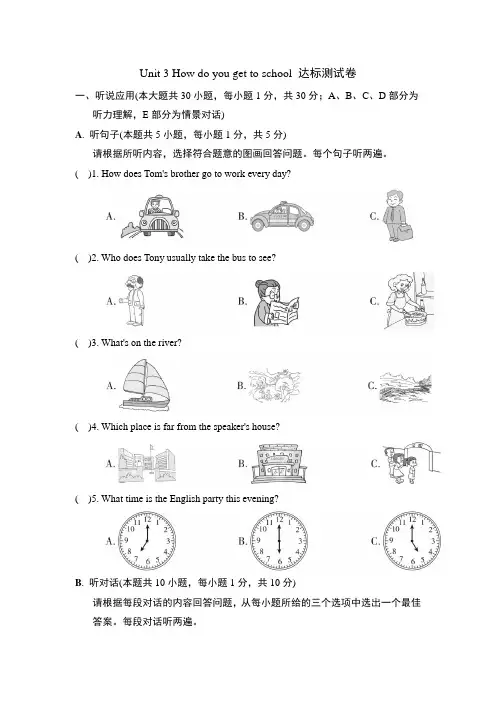
Unit 3 How do you get to school 达标测试卷一、听说应用(本大题共30小题,每小题1分,共30分;A、B、C、D部分为听力理解,E部分为情景对话)A. 听句子(本题共5小题,每小题1分,共5分)请根据所听内容,选择符合题意的图画回答问题。
每个句子听两遍。
()1. How does Tom's brother go to work every day?()2. Who does Tony usually take the bus to see?()3. What's on the river?()4. Which place is far from the speaker's house?()5. What time is the English party this evening?B. 听对话(本题共10小题,每小题1分,共10分)请根据每段对话的内容回答问题,从每小题所给的三个选项中选出一个最佳答案。
每段对话听两遍。
听第一段对话,回答第6小题。
()6. How does Liangliang sometimes get to school?A. He takes the bus.B. He walks.C. He rides a bike. 听第二段对话,回答第7小题。
()7. How far is it from Jim's home to his school?A. About 5 kilometers.B. About 12 kilometers.C. About 20 kilometers.听第三段对话,回答第8小题。
()8. Who thinks the train trip is fun?A. Jenny.B. Lewis.C. Lewis's mother. 听第四段对话,回答第9小题。
()9. How long does it take the girl to get to school by bus?A. About 20 minutes.B. About 30 minutes.C. About 40 minutes. 听第五段对话,回答第10小题。
新人教版七年级下册《unit 3 how do you get to school》单元测试卷
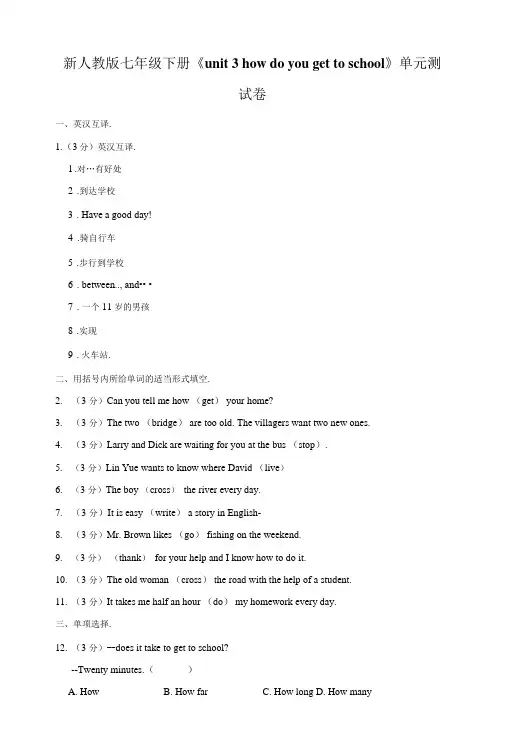
新人教版七年级下册《unit 3 how do you get to school》单元测试卷一、英汉互译.1.(3分)英汉互译.1.对…有好处2.到达学校3. Have a good day!4.骑自行车5.步行到学校6. between.., and•• •7. 一个11岁的男孩8.实现9.火车站.二、用括号内所给单词的适当形式填空.2.(3 分)Can you tell me how (get) your home?3.(3 分)The two (bridge) are too old. The villagers want two new ones.4.(3 分)Larry and Dick are waiting for you at the bus (stop).5.(3 分)Lin Yue wants to know where David (live)6.(3 分)The boy (cross)the river every day.7.(3 分)It is easy (write) a story in English-8.(3 分)Mr. Brown likes (go) fishing on the weekend.9.(3 分)(thank)for your help and I know how to do it.10.(3 分)The old woman (cross) the road with the help of a student.11.(3 分)It takes me half an hour (do) my homework every day.三、单项选择.12.(3 分)--does it take to get to school?--Twenty minutes.()A. HowB. How farC. How longD. How many13.(3 分)--is it from the radio station to your home?--It's about 5 kilometers.( A. How long B. How far C. How much D. How many14. (3 分)--How do you school?--I take the train.( ) A. getB. get toC• arriveD. arrive at15. (3 分)I walk to school every day. ?( )A. What about you doB. What do you C • How about youD • How do you16. (3 分)How do the students get to school Monday morning?( )-Yes, she does.( )18. (3 分)I never go to school by bus ; I walk to school20. (3 分)--How does your father go to work?a bus there every day.()21. (3 分)--How many Chinese players (运动员)were there in the 2012 London Olympics(奥运会)?--About.( )A. three hundred C • three hundred ofD • three hundreds of22. (3 分)--How do you get from the village?-- Ona ropeway.( ) A • to homeB • to schoolC. to hereD. the room23. (3 分)Nancy loves stories for children.()A. onB. inC. atD. for 17. (3 分)your teacher home?A. Do ; driveB. Does ; drive C- Do ; drivesD- Does ; drivesA. usually B • sometimes C. often D. every day19. (3 分)He has to take a boat to work.()A. getB. to getC. gotD. getsA. takesB• doesC. walksD. goesB. three hundredsA. writeB. writesC. to writeD. wrote24.(3 分)How long it to get to his home? ()A. do; takeB. do; takesC- does; take D. does; takes25.(3 分)Mr. Han has a son and he is happy.()A. 3 year oldB. 3 - year - oldC. 3 - years - oldD. 3 years old26.(3 分)What do you this new club?Ifs nice and big-()A. get toB. think ofC. live toD. go to27.(3 分)It usually takes about ten minutes to school-()A•by b汰e B. on a bike C. to ride D. ride四、句型转换.28.(3 分)He walks to school every day.(同义句替换)He goes to school every day.29.(3 分)2 takes about 20 minutes to go there by bus.(对画线部分提问)does it to go there by bus?30.(3 分)Its two kilometers from my home to school.(划线提问)it from home to school?31.(3 分)The boy often rides a bike to school.(对画线部分提问)Often a bike to school?32.(3 分)I need to see my friend.(对画线部分提问)do you need?五、补全对话.33.(3 分)A- How far is it from here?B.Turn left at the first crossing.C.Where is the bus stop?D・ Thank you very much.E. Can I take a bus there?A: Excuse me, sir. Where is the museum?B: Go along this street (1)The museum is next to the bank.A.(2) _______B: It's only about twenty minutes on foot.A: I see. (3)B: Yes, you can. The No.8 bus will take you there.A: (4) _______B.The bus stop? Oh, ifs over there. Look!The bus is coming.A: (5) .六、写作34. (3分)假如你的名字叫Tony, 12岁了,现在要给你的朋友Alice写封信告诉她你每天去学校的情况:包括几点起床,早饭吃什么,几点离开家去学校,如何去学校,你家与学校的距离以及你所花费的时间等.开头已给出.Dear Alice,How are you?新人教版七年级下册^unit 3 how do you get to school^单元测试卷参考答案与试题解析一、英汉互译.1.(3分)英汉互译.1.对…有好处好good for2.到达学校get to school3. Have a good day!祝你愉快4.骑自行车ride a bike5.步行到学校walk to school6. between.., and, •・在・••和•••之间7.一个11 岁的男孩an 11 - year - old boy8.实现come true9.火车站train station ・【分析】1.对…有好处be good for2.到达学校get to school3. Have a good day!祝你愉快4.骑自行车ride a bike5.步行到学校walk to school6. between.., and…在…和…之间7. 一个11 岁的男孩an 11 - year - old boy8.实现come true9.火车站train station.【解答】1.对…有好处be good for10到达学校get to school11Have a good day!祝你愉快12骑自行车ride a bike13步行到学校walk to school14between.., and…在…和…之间15一个11 岁的男孩an 11 - year - old boy16实现come true17火车站train station.【点评】解答翻译这类试题时,翻译既要忠实于原文,又要符合汉语和英语的语法规则和表达习惯,准确翻译.二、用括号内所给单词的适当形式填空.2.(3 分)Can you tell me how to get to (get) your home?【分析】你能告诉我怎样去你家吗?【解答】答案:to get to.根据Can you tell me how - - (get) your home,可知你能告诉我怎样去你家吗?how+to 引导的不定式短语,get to表示到达.故填to get to.【点评】本题考查用所给单词的适当形式填空,首先要根据语境明确句意,然后再根据相关语法对所给单词在形式上做出正确的变化.3.(3 分)The two bridges (bridge) are too old. The villagers want two new ones.【分析】这两座桥太老了,村民们想要两座新的.【解答】答案:bridges, bridge”桥,桥牌”是名词,变成复数直接加s,因是两个,应用知数bridges,由题干”这两座桥太老了,村民们想要两座新的.”可知,故应填bridges.【点评】本题考查名词的单、复数变化形式,做此类题时要牢记变化规则,从而填出正确答案.4.(3 分)Larry and Dick are waiting for you at the bus stop (stop).【分析】拉里和迪克在公共汽车站等你.【解答】答案:stop可以当名词,’车站,停止,逗留”. the bus stop”公共车站”,bus”公共汽车”是名词,可以来修饰名词,相当于形容词.由题干”拉里和迪克在公共汽车站等你”可知,故答案应该填stop.【点评】主要考查学生”识词、记词和用词”的能力.这类试题体现了“词不离句”的特点,要求学生注意单词在句子中的确切含义与正确形式,而不是孤立地死记硬背单词.5.(3 分)Lin Yue wants to know where David lives (live)【分析】林跃想知道大卫住在哪里.【解答】live”居住,生存”.是动词,where David…在句中是宾语从句,在句中应是自然语序,又因主句是用的一般现在时,从句就用它原来的时态,原来时态是一般现在时就用一般现在时.David主语是第三人称单数,所以live应该用第三人称单数形式lives.由题干”林跃想知道大卫住在哪里.”可知,故应填lives..【点评】本题考查了时态及宾语从句的语序,在做此类题时要注意变宾语从句的规则,从而填出正确答案.6.(3 分)The boy crosses (cross) the river every day.【分析】这男孩每天都穿过这条河.【解答】cross”横过,渡过",every day“每天",是时间状语,说明此句是一般现在时,又因主语the boy是第三人称的单数形式,后面动词用第三人称单数形式.根据动词变成第三人称单数形式变化规则,以s, ss, o, x, ch, sh等结尾的单词变成第三人称单数加es,由题干”这男孩每天都穿过这条河."可知,故答案应该填crosses.【点评】本题考查时态应用,做这类题抓住时间状语是关键,才能判断所用时态,从而填出正确答案.7.(3 分)It is easy to write (write) a story in English.【分析】用英语写一个故事是容易的.【解答】答案:to write. write”写作,书写",根据It' s+adj to do. ”做某事…样.这句型, 该句应该用不定式,由题干”用英语写一个故事是容易的”可知,故答案应该填to write.【点评】本题考查了固定短语,做此类题要注意平时多积累.8.(3 分)Mr. Brown likes going (go) fishing on the weekend.【分析】布朗先生喜欢周末去钓鱼.【解答】答案:going考查单词填空.句意:布朗先生喜欢周末去钓鱼.根据单词提示,可知like doing sth喜欢做某事.故答案为going.【点评】做这类题型,首先根据所给单词明确句子所要考查的单词或短语,再结合相关语法知识对单词或短语做出形式上的变化.9.(3 分) Thanks (thank) for your help and I know how to do it.【分析】谢谢你的帮助,我知道该怎么做.【解答】答案:Thanks考查单词填空.句意:谢谢你的帮助,我知道该怎么做.根据单词提示,可知Thanks for sb sth感谢某人做某事,故答案为Thanks.【点评】做这类题型,首先根据所给单词明确句子所要考查的单词或短语,再结合相关语法知识对单词或短语做出形式上的变化.10.(3 分)The old woman crossed (cross) the road with the help of a student.【分析】那位老妇人在一名学生的帮助下过马路.【解答】答案:crossed考查单词填空.句意:那位老妇人在一名学生的帮助下过马路.根据单词提示,可知句子是一般过去时,主语是The old woman单数,cross的过去式是crossed.故答案为crossed.【点评】做这类题型,首先根据所给单词明确句子所要考查的单词或短语,再结合相关语法知识对单词或短语做出形式上的变化.11.(3 分)It takes me half an hour to do (do) my homework every day.【分析】我每天花半小时做家庭作业.【解答】根据II takes me half an hour - - (do) my homework every day.可知句子考查It takes sb some time to do sth表示花费某人多长时间做某事.故填to do.【点评】做这类题型,首先根据所给汉语明确句子所要考查的单词或短语的拼写,再结合相关语法知识对单词或短语做出形式上的变化.三、单项选择.12.(3 分)--does it take to get to school?--Twenty minutes.( )A. HowB. How farC. How longD. How many【分析】- -到学校要多长时间?--二十分钟.【解答】答案:C.考查疑问词组.how怎么.how far多远.how long多久,对一段时间或长度提问.howmany多少,修饰可数名词复数.根据回答“二十分钟. 可知,对一段时间提问用疑问词组how long多长时间.选C.【点评】疑问词组通常用来构成疑问句,要根据回答的具体内容进行选择,注意一些固定搭配,分清疑问词的用法.13.(3 分)--is it from the radio station to your home?--It's about 5 kilometers.( )A. How longB. How farC. How muchD. How many【分析】- -从广播站到你家有多远?--大约5公里.【解答】答案:B.考查疑问词组.how long多久,对一段时间或长度提问.how far多远,对距离提问.how much多少钱.How man不搭配.结合回答”大约5公里.可知, 对距离提问用疑问词组how far.故选:Bo【点评】疑问词通常用来构成疑问句,要根据回答的具体内容进行选择,注意一些固定搭配,分清疑问词的用法.14.(3 分)--How do you school?--I take the train.( )A. getB. get toC. arriveD. arrive at【分析】你怎样去上学?乘火车.【解答】答案:B分析句子,结合选项,推测意思是你怎样去上学?乘火车.考查短语get to school,故选B到达.A得到,C到达,常与介词in和at搭配.故选:B.【点评】解答这类试题时,务必充分理解上下文的语境和前后文的逻辑关系,找到解题的依据,同时正确区分选项的细微差别,准确作答.15.(3 分)I walk to school every day. ?( )A. What about you doB. What do youC. How about youD. How do you【分析】我每天步行上学.你呢?【解答】答案:C考查情景对话.句意:我每天步行上学.你呢?问怎么样或怎样做,就用how about you.或what about you?结合本题应该是问问怎么样或怎样做.故选C.【点评】做这类题型,首先结合语境,再结合相关语法知识完成句子.16.(3 分)How do the students get to school Monday morning?( )A. onB. inC. atD. for【分析】星期一上午学生们是怎么到校的?【解答】答案:A.考查介词.on表示在具体某一天. in表示在一个具体范围.at在具体的几点.for为了…结合语境”星期一上午”.可知,具体某一天的上午,用介词on.选A.【点评】考查介词用法,这个知识点很广泛,有一些固定用法,需要日常积累,结合语境选择正确介词完成习题.17.(3 分)-your teacher home?-Yes, she does.( )A. Do; driveB. Does; driveC. Do; drivesD. Does; drives【分析】■你的老师开车回家吗?-是的,她开车回家。
英语人教新目标七年级下册Unit 3 How do you get to schoo
onwaflokot
take a bus take a car take a subway take a boat ride a bike walk
I
school.bike on foot
I
school. X
I
school
.
√
How do the Students in China Get to School?
in big cities:
eIats'ys easy for them to get to school.
Tbyhebyuscan get to school by bus.
takes about 30 minutes
bTyhseuybcwaanyget to school by subway. Somfeasrtudennts live far from the
body:
In big cities, Some students...(过度
句,连词,细节)
Ending:
As for me, I usually take the bus to school.It's
interesting. I like my trip to school.
Show your work,and let's make it better.
1.Write this article again.
2.Write an article about how your classmates get to school.
Different ways to get to school:
bryidebaikbeike
tbakye ba obaoatt
人教版七年级英语下册《Unit 3 How do you get to school单元教案
授课时间年月日第周星期第1课时教学内容Unit 3 How do you get to school? SectionA教学目标1. Words & phrases: get to , how far , bicycle , subway ,minute , mile , bus stop .2. Talk about how to get to places (谈论出行方式)take the bus /subway /train /taxi , ride a bike /walk .3. how引导的特殊疑问句,表示乘坐何种交通工具的方式..教学重点难点1. how /how far /how long 引导的特殊疑问句.2. 乘坐交通工具的表示方法.3. It takes /will take/took some time to do sth .教学辅导材料与手段Multimedia教学过程教学环节教师活动学生活动Step 1 Leading inAsk some Ss some questions :I usuallytake the motorbike to school? How about you? Step 2 Pre-task1. Write down how you get to school .2. Look at the picture .Write down how the studentsget to school.3. Make dialogues with the phrases .4. Groupwork: Divide the students into groups ofthree or four .Practice reading the dialogues. 5. Act out their dialogues .Page 19 , 1b .Listening1. Make sure the Ss know what ot do .Give them an Greet the classReview the things learntbefore.Answer the questions.Say something abou ttheir own experience.Learn the conversationsand the drills.example orally if possible .教学环节教师活动学生活动2. Read the names .3. Play the tape and check the answers .Correct the answers .Step 3 PairworkA: How do you get to school?B:I…A:How does he\she get to school?B:He\She…Step4 Group WorkMake a survey: How do the Ss get to school inyour group? Do a report.Step5HomeworkMake a survey: How your parents get to work..Look at the pictures.Look at the picturescarefully and answer thequestions.Read the conversationand do a pairwork withpartners.Do this part carefullyFinish the exercises andhomework carefully.板书设计Unit 3 How do you get to school?take the bus /subway /train /taxi , ride a bike /walk .A:How do you get to school?B:I…A:How does he\she get to school?B:He\She…教学反思授课时间年月日第周星期第2课时教学内容Unit 3 How do you get to school? SectionA 教学目标1.复习基数词及时间的表示方法.2.了解中外文化的差异.教学重点难点1.It takes /will take/took some time to do sth .2. Target language. The use of the drill.教学辅导材料与手段Multimedia教学过程教学环节教师活动学生活动Step 1 Leading in1. Greetings .2. Check the homework .Step 2 Pre –taskPage 20 , 2a.2b&2c .1. Revise the numbers .2. Teach the new word :minute .3. Play the tape for the students to finish Greet the classReview the things learntbefore.Revise the numbers .Listen to the recordingcarefully.2a&2c .Then play again and check theanswers ..4. Go over the dialogue in Page20 ,2d.Step 3 Pre-taskCheck the answer.教学环节教师活动学生活动Page 20 ,Grammar focus .1. Review the grammar box .Ask students to saythe statements and responses .2. Practice reading .Explain the usage of “take” in “take the train”and “take some time to do sth” .activityStep 4 PairworkMake a conversation about how you get toschool. Then practice in pairs.Step5 HomeworkRemember the Grammar Focus .Read the conversationand do a pairwork withpartners.Do this part carefullyFinish the exercises andhomework carefully.板书设计Unit 3 How do you get to school? Numbers: 32 40 41 50 60 70 80 90 100 Phrases:It takes /will take/took some time to do sth .教学反思授课时间年月日第周星期第3课时教学内容Unit 3 How do you get to school? SectionA教学目标1. 复习how far ,how long 引导的特殊疑问句.2. Reading practice.3. Writing practice.4.New words and phrases: town ill worry so much教学重点难点1. Key vocabulary, key phrases2. Target language. The use of the drill.教学辅导材料与手段Multimedia教学过程教学环节教师活动学生活动Step 1 Leading in1.Have Ss make sentences with “take to” .Explain the usage of “take” in “take the train”and “take some time to do sth” .Step 2 While-taskPage 21,3a .1. Pay attention to the speech bubbles .Read thequestions .2. Read the passage by the Ss. Find the answersto the questions and write the answers on thelines .Correct the answers .Step 3 Page 21, 3b .Greet the classReview the things learntbefore.Answer the questions.Say something abouttheir own experience.Learn the conversationsand the drills.教学环节教师活动学生活动1. Show Ss the example in the box .Two studentsread it to the class .2. Pairwork: Make your own conversations usingthe information in the left box.3. Ask some pairs to present the conversations tothe classStep 4 Post-taskPage 21 ,Part 4 .Groupwork.Divide the Ss into groups of three .In each group ,one is A,who look at Page 21.One is B,who look at Page 85,the other is C,who look at Page 86 .Fill in the blanks .The group who fill in the blanks first wins .Step 5 HomeworkWrite the sentences in Part 4 on the exercise books .Look at the pictures. Look at the pictures carefully and answer the questions.Read the conversation and do a pairwork with partners.Read this part carefullyFinish the exercises and homework carefully.板书设计Unit 3 How do you get to school?A:How far is it from your home to school?B:It’s…It takes/took sometime to do something.教学反思时间年月日第周星期第4课时教学内容Unit 3 How do you get to school?. SectionB教学目标1. vocabulary :bus stop bus station train station subwaystation .2. 能力目标:谈论上学的全过程。
初中英语《Unit3Howdoyougettoschool》单元教学设计以及思维导图1
Unit 3 How do you get to school适用年级七年级所需时间5课时主题单元学习概述本单元话题取材于七年级英语下学期第三单元:交通运输方式。
该话题与学生生活息息相关,他们有深刻的生活体验,易于接受,有话可说,乐于表达。
本单元以交通为话题、以谈论出行方式为功能,在具体语境中呈现了How、How far、How long 引导的特殊疑问句及回答,谈论如何到达目的地、行程多久及距离多远。
本单元包括33个生词和9个常用短语和固定搭配。
通过模仿对话、自编对话、阅读,学生将掌握不同交通方式的英语表达,了解不同地区的学生是采用何种交通方式去学校的,并能根据自己实际情况,合理安排行程,合理选用交通工具。
主题单元规划思维导图主题单元学习目标知识与技能:1.能听说读写围绕交通工具等的核心词汇。
2. 能正确使用各种人称来询问他人的出行方式,并作出正确地回答。
3.能在任务型活动中熟练运用how, how long, how far等引导的特殊疑问句询问出行方式、所花费时间和两地之间的距离。
过程与方法:1.通过谈论不同的上学出行方式,提高同学们的口语表达能力和交际能力。
2.在多媒体资源和网络资源的帮助下,锻炼听说读写能力。
3.使用阅读技巧阅读文章,提高阅读理解能力,培养寻找信息,概括主旨大意的能力。
4.能够写一篇电子邮件来介绍自己的出行方式。
情感态度与价值观:1.让学生了解东西方国家出行方式的区别,以及不同的交通规则,教育学生注意交通安全。
2.通过英美国家交通文化的学习,倡导自觉遵守交通法规及礼貌,构建和谐的人际关系。
对应课标1.能听懂有关出行话题的对话,提取重要信息和观点。
2.能熟练使用语言目标有效地询问信息和获得帮助。
3.能在活动中正确地使用语音、语调。
4.能在课文中找出有关信息,理解课文大意。
5.在交际中遇到困难时,能主动地向老师和同学寻求帮助。
6.能主动参与小组学习,并在小组活动中扮演一定的角色。
初中英语七年级下册 Unit3 How to get to school
课题
Unit 3 How do you get to school?
单元
第三单元
学科
英语
年级
七年级
学习
目标与核心素养
1. 1)能掌握以下单词:
train, bus, subway, ride, bike, sixty, seventy, eighty, ninety, hundred, far, minute, kilometer, new, every, every day
学生和老师进行简单的问候
Ss: Good morning, teacher.
T: Good morning, class
T: Look at the picture. What can you see? Do you like your school? I usually get to school by bike, but sometimes on foot. How do you get to school?
3. Summary
1---12: (记住每个单词)
13---19: -teen (thir-, f(twen-, thir-, for-, fif-, eigh-)
21---99:十位+个位
100---900: _______ hundred
101---999:____ hundred and个位
Ⅳ. 1b Listening
1. Make sure the Ss know what to do. Give them an example orally if possible.
2. Read the names in the box.