
外研版七年级下册英语module 10 a holiday journey 模块测试题 (及答案)
外研版七年级下册英语Module 10 A holiday journey模块测试题(二)Ⅰ. 单项选择(共10分,每小题1分)从各题后所给的四个选项中选择可以填入空白处的最佳答案。
( ) 1. They went to Shanghai during the winter holiday and everyone had ________ good time.A. theB. anC. aD. 不填( ) 2. He stayed ________ America ________ two weeks last year.A. in; forB. with; forC. in; atD. with; at( ) 3. —Where are you from?—________ are from England.A. TheyB. TheirC. OurD. We( ) 4. —It’s a little dark in the room.—Why not turn on the ________?A. tablesB. lightsC. booksD. doors( ) 5. —I heard you went to the concert on Saturday.—That’s right. It was really ________. I enjoyed it a lot.A. strangeB. wonderfulC. difficultD. lucky( ) 6. No one answered the phone. ________ what did you do?A. AgainB. AlsoC. SoD. Even( ) 7. —Why don’t you drive to the village?—Well, I ________ my car last week.A. soldB. tookC. sawD. found( ) 8. How ________ you win the match yesterday?A. doB. didC. areD. were( ) 9. —________ did you go last night?—To Jerry’s party.A. WhereB. WhyC. WhenD. How( ) 10. —We had a picnic on Sunday. ________!—Send some photos to me, please.A. Excuse meB. I’m not sureC. Let’s goD. It was greatⅡ. 完形填空(共10分,每小题1分)先通读下面的短文,掌握其大意,然后从A、B、C、D四个选项中选择可以填入空白处的最佳答案。
I like travelling. Last year I 11 myself during the May Day holiday. I went to Beijing with my parents.That was 12 first visit to Beijing. Everything was new to me. We went there 13 train on 1st May. There were too many people on it. It 14 us about three hours to get there. After lunch, we went to Tian’anmen Square and Wangfujing Dajie. At the square, we saw many people 15 the great ceremony (仪式). We did some 16 at Wangfujing Dajie and I bought some presents for my friends. And my parents bought me a 17 coat. I like blue best. We went to the Great Wall on 2nd May. It was 18 to stand on the Great Wall! I also tried lots of famous 19 in Beijing, such as Beijing duck. They were delicious. We 20 home on 3rd May.What a great tour!( ) 11. A. helped B. taught C. washed D. enjoyed( ) 12. A. my B. your C. her D. his( ) 13. A. in B. on C. at D. by( ) 14. A. spent B. saved C. took D. needed( ) 15. A. waiting for B. hearing from C. getting on D. picking up( ) 16. A. sightseeing B. shopping C. cooking D. swimming( ) 17. A. blue B. green C. red D. purple( ) 18. A. clear B. difficult C. exciting D. silly( ) 19. A. games B. foods C. phones D. jobs( ) 20. A. cleaned B. found C. left D. returnedⅢ. 情景交际(共10分,每小题2分)根据对话内容从方框中选择能填入空白处的最佳选项补全对话,其中有两项多余。
A: I went to Hawaii on holiday.B: (21) ________A: Sure, I love it. I want to live there.B: (22) ________A: The island (岛) is so green, and the water is so blue.B: (23) ________A: Yes. I went to the beach every day.B: How was the weather?A: (24) ________B: What did you do at night?A: At night I went out to eat. (25) ________B: People in Hawaii are lucky.Ⅳ. 阅读理解(共20分,每小题2分)AThere was a small river near Xue Yong’s town. It went through several villages. The water was clean and there were lots of fish in it.Women would like to wash clothes along the river. It was a good place for them to talk about interesting things in their daily (日常的) life. Xue Yong liked eating noodles. So his mum often asked questions about how to cook noodles with different vegetables when she washed clothes there.It was also a good place for children. They caught fish and played water games there. At that time, Xue Yong had a small black dog. Every time he caught fish in the river, the dog followed (跟着) him. A fish was a good present for its work.Now, Xue Yong lives in a city with his parents. He likes to tell his classmates about his town. They are interested in his town. Last Friday, Xue Yong and his parents watched a programme about some towns. Their town was one of them.根据材料内容选择最佳答案。
( ) 26. Women often ________ along the river near Xue Yong’s town.A. took walksB. collected litterC. did some washingD. did some cooking( ) 27. What did Xue Yong like eating?A. Noodles.B. Hamburgers.C. Rice.D. Fruit.( ) 28. Xue Yong’s ________ often followed him to the river.A. catB. pigC. duckD. dog( ) 29. Who does Xue Yong like to talk about his town with?A. His classmates.B. His grandparents.C. His cousins.D. His teachers.( ) 30. When did Xue Yong and his parents watch a programme about some towns?A. Last Tuesday.B. Last Friday.C. Last Saturday.D. Last Sunday.BI’m Li Ming. The holidays always make me happy. Last summer holiday, I went to Paris with my mother by plane. We went there to visit my uncle. He met us at the airport.My uncle took us to visit the Louvre Museum by underground. I saw a lot of famous things. I enjoyed many old pictures in it. The pictures were very creative (有创意的). We also visited the Eiffel Tower. It is the famous symbol (标志) of Paris. One evening, my uncle took us to eat good food and go shopping. My mother bought many clothes — some for her, and some for my sister.We stayed in Paris for about half a month. The trip gave me lots of fun. I will remember it.根据材料内容选择最佳答案。
外研版七年级英语下册Module 10 A holiday journey_Unit 2 This

1.修饰可数名词单数 (1)such +a/an +形容词+单数名词 Eg. She is such a beautiful girl. (2)so + 形容词 +a/an + 单数名词 Eg. She is so beautiful a girl.
2.修饰不可数名词或可数名词复数 只能用such + 形容词 + 不可数名词/可数名词复数 Eg. They sell such good fruit and vegetables. 特别提醒:
Read Part 2 、3 、4 and answer the questions
What did she see in the Louvre Museum? She saw the Mona Lisa.
Where did she go this morning?
When did they go to the Eiffel Tower?
2. I hadn't left home __ti_ll__ I was nineteen. 我直到19岁才离开家门。
Read the email and choose T or F.
1. Betty arrived in Paris two days ago. T
2. She took a tour in the city the day before
yesterday.
F
3. They took the Paris Underground today.
那个蛋糕简直是个艺术品!
5.such as 例如,要用在句子中,不能单独使用。 =for example 有逗号隔开。 如:Tourist like to visit historic places in China , such as Beijing and Xi’an.
新外研版七年级下Module 10主题阅读: A holiday journey
主题阅读:Module 10 A holiday journey(A)Many people like travelling. Travelling is one of the most popular activities during vacations. Modern traffic develops fast, so travelling to different places gets much easier than before.Staying healthy while travelling can make your trip happier. But do you know how to keep healthy during a trip? The following information may be useful to you.Before leaving★Wear comfortable shoes, a hat and sunglasses.★Take some necessary (必要的) medicines with you. You will need them when you get sick or have other problems.★If you do lots of sports like walking or climbing during your trip, you should do some exercises for weeks or months before you leave.While travelling★Be sure not to eat dirty food or bad fruit. ★Have enough time to take a rest during your trip.★Tap water is not safe, so drink bottled water. When you drink it, remember to clean the cover of the bottle. There may be something dirty on it, such as dust (灰尘).()1. Travelling to different places has become easier because ______.A. there are more planes to takeB. modern traffic develops fastC. there are fewer people travelling aroundD. there are more interesting places for travelling()2. You should ______ before you leave your home for a trip.A. get some medicinesB. clean the coverC. drink much waterD. wear warm clothes()3. You had better not ______ while you are having a trip.A. wear sunglassesB. be too tiredC. wear a hatD. take a rest()4. What does the underlined word “cover” mean in Chinese? A. 底部B. 盖子C. 覆盖D. 封面()5. What's the main idea of the passage?A. It is about the things we need to do before travel ling.B. It is about the things we should do while travelling.C. It is about how to keep healthy during a trip.D. It is about some interesting places for travelling.(B)An English traveller found himself in Norway with only enough money to buy the ticket for his journey back home. As he knew that it would take him only two days to get to England, he decided that he could easily spend the time without food. So he bought a ticket and got on the ship. The man closed his ears to the sound of the lunch bell. When dinnertime came, he didn’t go to dining room, saying that he was not feeling very well.The next morning he still didn’t have breakfast and at lunchtime he again stayed in his room. But at dinnertime, he was so hungry that he went to the dining room and ate everything the waiter put in front of him. He got ready for the quarrel.“Bring me the bill,” he said. “The bill, sir?” said the waiter in surprise. “There isn't any bill. On our ship meals are included (包括) in the money for the ticket,” said the waiter.()1. The story happened_______.A. in EnglandB. on a ship from Norway to EnglandC. in NorwayD. on a ship from England to Norway()2. Why didn’t the traveller go to the dining room first?A. Because he had no money.B. Because he didn’t feel very well.C. Because he di dn’t want to eat anything.D. Because he didn’t hear the sound of the bell.()3. The traveller went to the dinning room to eat something because_______.A. his friend had given him some moneyB. the waiter had asked him to change his mindC. he learned that there was no bill on the shipD. he was too hungry()4. How many meals did the traveller have on the ship? A. Only one.B. Two. C. Three. D. None.。
外研社版最新七年级英语下册Module10Aholidayjourney语法篇试题附答案

第 1 页 共 18 页奋斗令我们的生活充满生机,责任让我们的生命充满意义,常遇困境说明你在进步,常有压力,说明你有目标。
给自己定目标,一年,两年,五年,也许你出生不如别人好,通过努力,往往可以改变%的命运。
破罐子破摔只能和懦Module 10____________________________________________________________________________________________________________________________________________________________一般过去时(4)一般过去时的特殊疑问句用法第 2 页 共 18 页奋斗令我们的生活充满生机,责任让我们的生命充满意义,常遇困境说明你在进步,常有压力,说明你有目标。
给自己定目标,一年,两年,五年,也许你出生不如别人好,通过努力,往往可以改变%的命运。
破罐子破摔只能和懦在前两个模块中我们主要学习了一般过去时的判定,一般过去时的肯定、否定、一般疑问句及其回答。
本单元主要学习一般过去特殊疑问句的用法。
我们看下面的例句:--When did he die?--He died in 1900.--How long did the rain last?--It lasted four hours.--Why did he come back late?--Because he wanted to finished the work.综上,我们发现一般过去时的特殊疑问句的用法与一般现在时的特殊疑问句在结构上没有太大的差异,只是使用的助动词不同而已。
单项选择1.--__________did you go there?--Two years ago.A.WhenB.WhereC.WhyD.How答案:A解析:考查一般过去时特殊疑问句的用法,根据回答“两年前”故答案是A。
外研版七年级下册英语M10 Unit 1 What did you do

8.—AllofusenjoylivinginQingdao______.D —I’mgladtohearthat.
A. alotofB. lotsof
【C点. a拨lot】so句fD意. a:lot——我们所有人都非常喜欢生活在青 岛。——我很高兴听到这个消息。enjoysth. alot很喜欢 某事; alotof=lotsof许多,后接名词; alot很,非常,修 饰动词或动词短语,表程度。结合句意,故选D。
C. HowwIawsyenouttrotQriupa?nzhou B. Did you stay there long?
D. Let’sgwotihthemreythfaismsuilmylmasetrw. C. How was your trip?
E. Howdiedeyko. ugetthere?
G. WhatplacesofintereFs.tdDididyoyuoviusivt?isit any
famous places?
G. What places of interest
Jack:___A_._W19hatdoyouthinkoftheAfo.oWdthearted?o you think of Mina:WeBv.iDsitidedyKouasityauyatnhTereemlopng? the food there?
therwGe.llW-khnaotwpnlapclaescoefsi.nterestDdid. yLoeutv’sisigt?o there this summer.
E. How did you get there?
F. Did you visit any
famous places?
G. What places of interest
七级英语下册Module10AholidayjourneyUnit3Languageinuse课后练习(新版)外研版
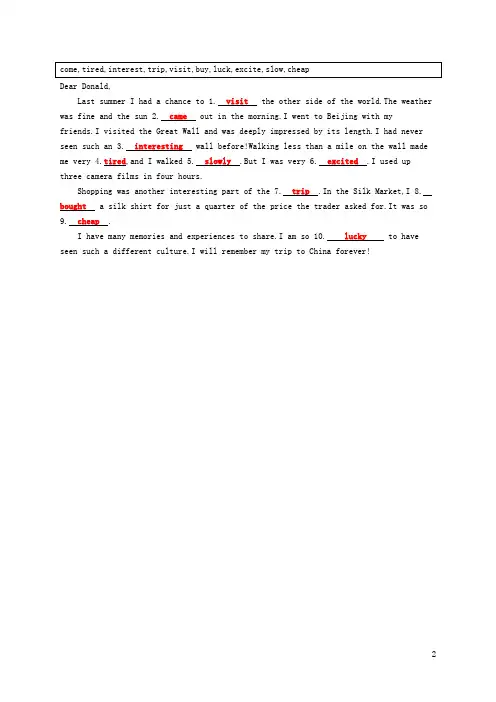
Unit 3Language in useⅠ.从括号中选词填空。
1.—How long will they study in this school?—For(In/For)half a year.2.Just a minute.I’ll start the topic right now(just now/right now).3.The yellow leaves are beautiful.Let’s take photos of(of/for)them.4.Sam opened the door and found(found/finds)a lovely dog outside.5.—Where(Where/How)did you go on holiday?—I went to Dalian.Ⅱ.用括号内所给单词的适当形式填空。
1.He spent half an hour finishing(finish)his homework yesterday.2.Let’s do some shopping(shop)this evening.3.We visited(visit)the Eiffel Tower last week.We were all very tired.4.They saw many interesting(interest)things during their trip.5.Tony and Daming had a really(real)good time near the sea last summer.6.They’re in the same school but different classes(class).Ⅰ.单项选择。
1.—C will you stay in Beijing?—For about 2 weeks.A.How manyB.How muchC.How longD.How soon2.Where did you go B?A.on the holidayB.on holidayC.on holidaysD.on the holidays3.You can go to the small island(岛)A.A.by boatB.on boatC.by the boatD.by a boat4.导学号62434110—When did they C this city?—Two days ago.A.arriveB.getC.get toD.arrivedⅡ.用方框中所给单词的适当形式完成短文。
浙江省嘉兴市七年级英语下册词法语法手册Module10Aholidayjourney复习素材新版外研版
Module 10 A holiday journey语法精选1. so 那么;因此;如此(1)so作副词,意为“那么(尤指用于引出新话题);这么,那么(用于强调质量、感觉或数量)”。
如:①Don’t be so w orried. 别这么担心。
②So what did you do in Los Angeles?那么你在洛杉矶做了什么?so作副词还意为“(指刚说过的事物)这样;如此”。
如:—Is he coming? 他来吗?—I hope so. 我希望如此。
(2)so作连词,意为“所以;因此”。
如:I like travellin g, so I like holidays.我喜欢旅游,所以我喜欢假期。
2. excite, excited与exciting(1)excite是动词,意为“使……激动”;excited是形容词,意为“激动的;兴奋的”,修饰人。
如:The woman is so excited when she sees her lost boy.当她看到她丢失的孩子时,那个女人是如此激动。
(2)exciting是形容词,意为“令人激动的;令人兴奋的”,修饰物。
如:The news is exciting.那个消息是令人激动的。
句法精析1. Guess what?你猜怎么着?用于向对方讲述一件自己认为会让对方感到惊讶的事情之前,字面意思是让对方猜,但通常是紧接着说出想说的事情。
如:—You look so excited!你看起来很兴奋!—Guess what? I won a computer.你猜怎么着?我赢了一台电脑。
2. I hope y ou like it. 我希望你喜欢它。
hope意为“希望”,它有许多种用法。
(1)hope用作及物动词,意为“期望;希望”,后面可接不定式或宾语从句。
如:Tom hopes to hear from you soon.=Tom hopes he can hear from you soon.汤姆希望尽快收到你的来信。
外研版七年级英语下册模块10答案部分
Module10 A Holiday journeyUnit 1 What did you do?基础练I. 词汇1. 太平洋的2. 那么(尤指用于引出新话题);这么;那么(用于强调质量、感觉或数量)3. 猜;猜测4. 激动的;兴奋的5. 哇;噢6. 到达7. 放松8. 举世闻名的Ⅱ.短语1. 度假2.购物3.买礼物4. 观光5. 玩的高兴Ⅲ.基本句型及交际用语1. Where are ; going2. spent 3 hours to do3.took;to do4.stayed at home with mum5. first; guess what6. spent two daysⅣ.根据句意及首字母提示补全单词1.stayed2. met3.alked4. astronaut5.medecineⅤ.单项选择1.B 在度假的过程中。
2.A 过去时go的动词went +doing3.A meet的过去式met。
4.C 什么事情花掉多长时间用take。
5.A 当人做主语时花费时间用spend 。
6.A 问时间长短用how long7.A a lot 相当多的意思。
Ⅵ.用所给词的适当形式填空。
1. ate2. sent3. wrote4. sat5. bought6. spent7. left8. made语法句型练Ⅰ.根据汉语提示完成句子1. did; go to school; was ill2. go to work3.become4. wanted to be5. started talking aboutⅡ.按照要求转换句型1. arrive in2. can’t ; can3. go across4.Where did5.Where didUnit 2 He decided to be an actor.基础练I.词汇1. spend2. hope3. clock4. tomorrow5. grant6.relax7.emailⅡ.短语1. two years ago2. at the airport3. by plane4. takea taxi 5. the next day 6. listen to a concert 7. send emailsⅢ.基本句型及交际用语1. met; at2.were ;so; began3. took a taxi to4. such as5. hoped to go6.waited till Ⅳ.根据所给的首字母,写出所缺的单词,使句子意思完整、语法正确1. Middle2. end3. date4. third5.flag6.ranⅤ.单项选择1.C shop的动名词形式是shopping。
配套K12七年级英语下册 Module 10 A holiday journey(语法篇)试题 (新
Module 10______________________________________________________________________________ ______________________________________________________________________________一般过去时(4)一般过去时的特殊疑问句用法在前两个模块中我们主要学习了一般过去时的判定,一般过去时的肯定、否定、一般疑问句及其回答。
本单元主要学习一般过去特殊疑问句的用法。
我们看下面的例句:--When did he die?--He died in 1900.--How long did the rain last?--It lasted four hours.--Why did he come back late?--Because he wanted to finished the work.综上,我们发现一般过去时的特殊疑问句的用法与一般现在时的特殊疑问句在结构上没有太大的差异,只是使用的助动词不同而已。
单项选择1.--__________did you go there?--Two years ago.A.WhenB.WhereC.WhyD.How答案:A解析:考查一般过去时特殊疑问句的用法,根据回答“两年前”故答案是A。
2.--__________did it take to get there?--About nine hours.A.How farB.How oftenC.How longD.How many 答案:C解析:考查一般过去时特殊疑问句的用法,根据回答“9个小时”是时间段故选C。
3.--__________did you buy?--Two bags.A.WhenB.WhereC.WhyD.What答案:D解析:根据句子回答可知是买了什么,故选D。
初中英语外研版七年级下册《Module 10》单元测试题 1
Modules 10单元测试题Written test part (共80分)Ⅰ. 单项选择(共10分,每小题1分)从各题后所给的四个选项中选择可以填入空白处的最佳答案。
( )1. The work will take me half ________ day, but if you help me, it will only take ________ hour.A. an; aB. a; anC. an; anD. a; a( )2. Some people like to swim in the ocean ________ Santa Monica.A. inB. toC. aboutD. at( )3. —Why do you like the food?—It's cheap ________ delicious.A. andB. orC. soD. because( )4. It's dark. Why not turn on the ________?A. doorB. lightC. TVD. machine( )5. —What are these in the photos?—They are old ________. People often watched films there in the past.A. palacesB. museumsC. theatresD. halls( )6. I met the great man that day and took a photo with him. I felt ________ at that time.A. sorryB. badC. excitedD. healthy( )7. —Do you know about the woman?—Sure. She is a ________ singer, so all of us know her.A. beautifulB. carefulC. strangeD. world-famous( )8. The manager was happy because his workers ________ ten new cars in the morning.A. washedB. soldC. broughtD. drove( )9. —Have a good holiday.—________.A. Thank youB. Be carefulC. You are welcomeD. That's bad( )10. —________?—To Shanghai.A. What did he doB. Where did he goC. When did he goD. How did he goⅡ. 完形填空(共10分,每小题1分)先通读下面的短文,掌握其大意,然后从A、B、C、D四个选项中选择可以填入空白处的最佳答案。
外研版七下英语 Module 10 A holiday journey Unit 1
took
us
an
hour
①Then our friends met us and drove us to their home. 然后我们的朋友去接我们,并开车带我们去了他们家。(教材P60)②I met Snow White and Mickey Mouse!我遇到了白雪公主和米老鼠!(教材P60)
excited与exciting
excited
激动的;兴奋的
属于-ed形容词,常用来表示人的主观感受,在句中多作表语。
exciting
令人激动的;使人兴奋的
属于-ing形容词,常用来表示事物自身具备的特征,可作定语或表语。
语境串记We felt very excited when we heard the exciting news. 听到这个令人兴奋的消息时我们感到非常激动。
How
long
It takes/took (sb.) some time to do... 做……花费(某人)多长时间。 该句型中,It是形式主语,真正的主语是动词不定式(短语)。It takes (me) 15 minutes to get to school every day. 每天到学校要花费(我)15分钟。It took them five days to finish the task. 完成这项任务花费了他们五天时间。
meet v. 迎接;遇见(其过去式为met) (1)[动词]迎接 (①句义项)My best friend met me at the airport yesterday. 昨天我最好的朋友到机场接我了。