
APchemistry exam
AP chemistry考试题Choose one of the following for questions 1–4.(A) There is no change in the voltage.(B) The voltage becomes zero.(C) The voltage increases.(D) The voltage decreases, but stays positive.(E) The voltage becomes negative.The following reaction takes place in a voltaic cell.Zn(s) + Cu2+(1 M) → Cu(s) + Zn2+(1 M)The cell has a voltage that is measured and foundto be +1.10 V.1. What happens to the voltage when a saturatedZnSO4 solution is added to the zinc compartmentof the cell?2. What happens to the cell voltage when thecopper electrode is made smaller?3. What happens to the cell voltage when thesalt bridge is filled with deionized water insteadof 1 M KNO3?4. What happens to the cell voltage after the cell hasoperated for 10 minutes?Questions 5–8 refer to the following aqueoussolutions. All concentrations are 1 M.(A) H2C2O4(oxalic acid) and KHC2O4(potas-sium hydrogen oxalate)(B) KNO3 (potassium nitrate) and HNO3(nitric acid)(C) NH3 (ammonia) and NH4NO3 (ammoniumnitrate)(D) C2H5NH2(ethylamine) and KOH (potas-sium hydroxide)(E) CH3NH2(methylamine) and HC2H3O2(acetic acid)5. The most acidic solution (lowest pH)6. The solution with a pH nearest 77. A buffer with a pH> 78. A buffer with a pH< 79. An atom of 23892U undergoes radioactive decay by α emission. What is the product nuclide?(A) 23090 Th(B) 23490Th(C) 23092 U(D) 23091Pa(E) 230238 Pu10 . The specific rate constant, k , for radioactive beryllium-11 is 0.049 s−1. What mass of a 0.500 mg sample of beryllium-11 remains after 28 seconds?(A) 0.250 mg(B) 0.125 mg(C) 0.0625 mg(D) 0.375 mg(E) 0.500 mg11. H2PO4−+ H2O ↔ H3O++ HPO42−Which species, in the above equilibrium, behaveas bases?I. HPO42−III. H2O(A) I only(B) I and II(C) II and III(D) I and III(E) III only12. A sample of silver is to be purified by electrorefining.This will separate the silver from an impurityof gold. The impure silver is made into an electrode.Which of the following is the best way toset up the electrolytic cell?(A) an impure silver cathode and an inert anode(B) an impure silver cathode and a pure gold anode(C) a pure silver cathode with an impure silveranode(D) a pure gold cathode with an impure silver anode(E) an impure silver cathode with a pure silveranode13. Cycloalkanes are hydrocarbons with the general formula C n H2n. If a 0.500 g sample of any alkene is combusted in excess oxygen, how many moles of water will form?(A) 0.50(B) 0.072(C) 0.036(D) 1.0(E) 0.01814. The purpose of striking a match against the side of a box to light the match is(A) to supply the free energy for the reaction(B) to supply the activation energy for the reaction(C) to supply the heat of reaction(D) to supply the kinetic energy for the reaction(E) to catalyze the reaction15. When the concentration of H+ (aq) is doubled for the reaction H2O2 (aq) + 2 Fe2+ (aq) + 2 H+(aq) → 2Fe3+(aq) + 2H2O(g), there is no change in the reaction rate. This indicates(A) the H+ is a spectator ion(B) the rate-determining step does not involve H+(C) the reaction mechanism does not involve H+(D) the H+ is a catalyst(E) the rate law is first order with respect to H+16. H2O2(aq) + KIO4(aq) → KIO3(aq) + O2(g) +H2O(l)Choose the true statement from the following list.(A) The iodine oxidation state is reduced from+8 to +6.(B) This is not an oxidation–reduction reaction.(C) H2O2 behaves as a reducing agent.(D) Hydrogen is reduced from +2 to +1.(E) H2O2 behaves as an oxidizing agent.17. Which of the following lists the types of radiation in the correct order of increasing penetrating power?(A) α, γ, β(B) β, α, γ(C) α, β, γ(D) β, γ, α(E) γ, β, α18. C(s)+ H2O(g) ↔CO(g) + H2O(g) endothermicAn equilibrium mixture of the reactants is placedin a sealed container at 150°C. The amount ofthe products may be increased by which of the following changes?I. raising the temperature of the containerII. increasing the volume of the containerIII. adding 1 mol of C(s) to the container(A) II only(B) I and II(C) I only(D) II and III(E) III only19. When a basic solution of KMnO4 is added to anSnCl2 solution, a brown precipitate ofMnO2forms and Sn4+remains in solution. When thesame basic solution of KMnO4 is added to anNaF solution, no reaction occurs. Which of thesubstances involved in these reactions serves asthe best reducing agent?(A) SnCl2(B) KMnO4(C) NaF(D) MnO2(E) Sn4+20. CH4(g)+ CO2(g)↔2CO(g)+ 2H2(g)A 1.00-L flask is filled with 0.30 mol of CH4and0.40 mol of CO2, and allowed to come to equilibrium. At equilibrium, there are 0.20 mol ofCO in the flask. What is the value of K c, the equilibrium constant, for the reaction?(A) 1.2(B) 0.027(C) 0.30(D) 0.060(E) 3.021. Which of the following compounds is optically active?(A) CH3CHClCH2CH2CH3(B) CH3CH=CHCH2CH3(C) CH3CH2CHClCH2CH3(D) CH3CH2CH2CH2OH(E) CH3CH2CH2CH2CH322. All of the following may serve as reducing agents,EXCEPT:(A) Mg(B) Cs(C) Fe2+(D) MnO4−(E) Br−23. If 75% of a sample of pure 31H decays in 24.6 years, what is the half-life of 31H?(A) 24.6 yr(B) 18.4 yr(C) 12.3 yr(D) 6.15 yr(E) 3.07 yr24. The steps below represent a proposed mechanism for the catalyzed oxidation of CO by O3. Step 1: NO2(g) + CO(g) → NO(g) + CO2(g)Step 2: NO(g) + O3(g) → NO2(g) + O2(g)What are the overall products of the catalyzed reaction?(A) CO2 and O2(B) NO and CO2(C) NO2 and O2(D) NO and O2(E) NO2 and CO225. H2C3H2O4+ 2H2O ↔ 2 H3O++ C3H2O42−As shown above, malonic acid is a diprotic acid.The successive equilibrium constants are1.5×10−3(K a1) and2.0× 10−6(K a2). What is the equilibrium constant for the above reaction?(A) 1.0 × 10⁻¹⁴(B) 2.0 × 10⁻⁶(C) 4.0 × 10⁻¹²(D) 3.0 × 10⁻⁹(E) 1.5 × 10−326. How many grams of mercury could be producedby electrolyzing a 1.0 M Hg(NO3)2 solution witha current of 2.00 A for 3.00 h?(A) 22.4 g(B) 201 g(C) 11.2 g(D) 44.8 g(E) 6.00 g27.The organic compound shown above would be classified as(B) an ether(C) an alcohol(D) an aldehyde(E) a ketone22What is the rate law for this reaction?(A) Rate = k[CO](B) Rate = k[CO]2[Cl2](C) Rate = k[Cl2](D) Rate = k[CO][Cl2]2(E) Rate = k[CO][Cl2]29. MnO4−(aq) + H+(aq) + C2O42−(aq) → Mn2+(aq)+ H2O(l) + CO2(g)What is the coefficient of H+when the abovereaction is balanced?(A) 16(B) 2(C) 8(D) 5(E) 3230. The equilibrium constant for the hydrolysis ofC2O42−is best represented by which of the following?(A) K = [OH−][C2O42−]/[HC2O4−](B) K = [H3O+][C2O42−]/[HC2O4−](C) K = [HC2O4−][OH−]/[C2O42−](D) K = [C2O42−]/[HC2O4−][OH−](E) K = [C2O42−]/[HC2O4−][H3O+]31. The slow rate of a particular chemical reaction might be attributed to which of the following?(A) a low activation energy(B) a high activation energy(C) the presence of a catalyst(D) the temperature is high(E) the concentration of the reactants are high32. Co2+ + 2 e−→ Co E° = −0.28 VCd2+ + 2 e−→ Cd E° = −0.40 VGiven the above standard reduction potentials,estimate the approximate value of the equilibriumconstant for the following reaction:Cd +Co2+→Cd2++Co(B) 10−2(C) 104(D) 1016(E) 10233. The mechanism below has been proposed for the reaction of CHCl3 with Cl2.Step 1: Cl2(g) ↔ 2Cl (g) fastStep 2: Cl(g) + CHCl3(g) → CCl3(g) + HCl(g) slowStep 3: CCl3(g) + Cl(g) → CCl4(g) fastWhich of the following rate laws is consistent with this mechanism?(A) Rate= k[Cl2](B) Rate= k[CHCl3][Cl2](C) Rate= k[CHCl3](D) Rate= k[CHCl3]/[Cl2](E) Rate= k[CHCl3][Cl2]1/234. The formation of 23090Th from 23492U occurs by:(A) electron capture(B) α decay(C) β decay(D) positron decay(E) γ decay35. The reaction (CH3)3CBr(aq) + H2O(l) → (CH3)3COH(aq) + HBr(aq) follows the rate law: Rate = k[(CH3)3CBr]. What will be the effect of decreasing the concentration of (CH3)3CBr?(A) The rate of the reaction will increase.(B) More HBr will form.(C) The rate of the reaction will decrease.(D) The reaction will shift to the left.(E) The equilibrium constant will increase.36. A carboxylic acid may be represented as:(A) ROH(B) RCHO(C) R-O-R’(D) RCOOH(E) RCOOR’37.S2O32− + OH−→ SO42− + H2O + e−After the above half-reaction is balanced, whichof the following are the respective coefficients ofOH−and SO42−in the balanced half-reaction?(A) 8 and 3(B) 6 and 2(C) 10 and 2(D) 5 and 2(E) 5 and 138. NO2(g) ↔2NO(g) + O2(g)The above materials were sealed in a flask andallowed to come to equilibrium at a certain temperature. A small quantity of O2(g) was added tothe flask, and the mixture allowed to return toequilibrium at the same temperature. Which ofthe following has increased over its original equilibrium value?(A) the quantity of NO2(g) present(B) the quantity of NO(g) present(C) the equilibrium constant, K(D) the rate of the reaction(E) the partial pressure of NO(g)39. The energy difference between the reactants and the transition state is(A) the free energy(B) the heat of reaction(C) the activation energy(D) the kinetic energy(E) the reaction energy40. C2H4(g) + 3O2(g) ↔ 2 CO2(g) + 2H2O(g)An equal number of moles of each of the reactants are sealed in a container and allowed tocome to the equilibrium shown above. At equilibrium which of the following must be true?I. [CO2] must equal [H2O]II. [O2] must be less than [C2H4]III. [CO2] must be greater than [C2H4](A) II and III(B) I only(C) III only(D) II only(E) I and IIYou have 20 minutes to do the following questions. You may use a calculator and the tables at the back of the book.The alkane hexane, C6H14, has a molecular mass of 86.17 g/mol.a. Like all hydrocarbons, hexane will burn. Write a balanced chemical equation for the complete combustion of hexane. This reaction produces gaseous carbon dioxide and water.b. The complete combustion of 10.0 g of hexane produces 487 kJ. What is the molar heat of combustion (ΔH) of hexane?c. Determine the pressure exerted by the carbon dioxide formed when 5.00 g of hexane are combusted. Assume the carbon dioxide is dry and stored in a 20.0-L container at 27°C.d. Under identical conditions, hexane vapor diffuses at one-half the rate of the vapor of another compound. What is the molar mass of the other compound?e. Hexane, like most alkanes, may exist in different isomeric forms. The structural formula of one of these isomers is pictured below. Draw the structural formula of any two other isomers of hexane. Make sure all carbon atoms and hydrogen atoms are shown.Free-Response Questions 2Answer the following question in 15 minutes. You may not use a calculator. You may usethe tables at the back of the book.The above galvanic cell is constructed with a cobalt electrode in a 1.0 M Co(NO3)2solution in the left compartment, and a silver electrode in a 1.0 M AgNO3solution in the rightcompartment. The salt bridge contains a KNO3solution. The cell voltage is positive.a.What is the balanced net ionic equation for the reaction, and what is the cell potential?b. Which electrode is the anode? Justify your answer.c.CouldKCl be substituted for the KNO3in the salt bridge? Justify your answer.d.If some solid Co(NO3)2is added to the cobalt compartment, what will happen to thevoltage? Justify your answer.e.If the cell is allowed to operate until equilibrium is established, what will the potentialbe? Justify your answer.You have 15 minutes for this question. You may use a calculator and the tables at the backof the book.2ClO2(aq)+2OH−(aq)→ClO3−(aq)+ClO2−(aq)+ H2O(l)A series of experiments were conducted to study the above reaction. The initial concentrations and rates are reported in the table below.a.i. Determine the order of the reaction with respect to each reactant. Make sure youexplain yourreasoning.ii. Give the rate law for the reaction.b. Determine the value of the rate constant, making sure the units are included.c.Calculate the initial rate of disappearance of ClO2in experiment 1.d.The following has been proposed as a mechanism for this reaction.Step 1: ClO2+ ClO2→Cl2O4Step 2: Cl2O4+ OH−→ClO3−+ HClO2Step 3: HClO2+ OH−→ClO2−+ H2OWhich step is the rate-determining step? Show that this mechanism is consistent withboth the rate law for the reaction and with the overall stoichiometry.AP Chemistry 考试题 Answer sheet Class: Chinese name : Free-Response Questions 1 Free-Response Questions 2Free-Response Questions 3。
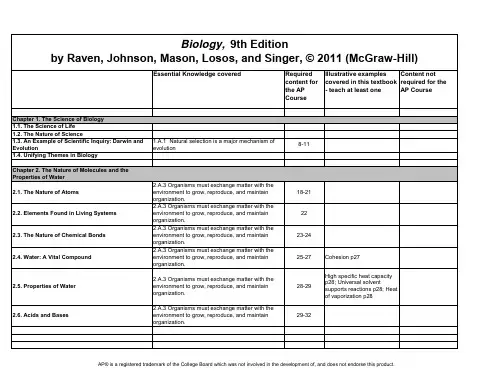
AP化学 Chemistry 教材 书 Raven Biology Correlation
38-40
41-43
44-52
53-58
4.1. Cell Theory
59-62
4.2. Prokaryotic Cells
2.B.3 Eukaryotic cells maintain internal membranes that partition the cell into specialized regions; 4.A.2: The structure and function of subcellular components, and their interactions, provide essential cellular processes; 4.B.2: Cooperative interactions within organisms promote efficiency in the use of energy and matter.
Biology, 9th Edition by Raven, Johnson, Mason, Losos, and Singer, © 2011 (McGraw-Hill)
Essential Knowledge covered Required content for the AP Course Illustrative examples Content not covered in this textbook required for the - teach at least one AP Course
2.A.3 Organisms must exchange matter with the environment to grow, reproduce, and maintain organization. 2.A.3 Organisms must exchange matter with the environment to grow, reproduce, and maintain organization. 2.A.3 Organisms must exchange matter with the environment to grow, reproduce, and maintain organization. 2.A.3 Organisms must exchange matter with the environment to grow, reproduce, and maintain organization. 2.A.3 Organisms must exchange matter with the environment to grow, reproduce, and maintain organization. 2.A.3 Organisms must exchange matter with the environment to grow, reproduce, and maintain organization.
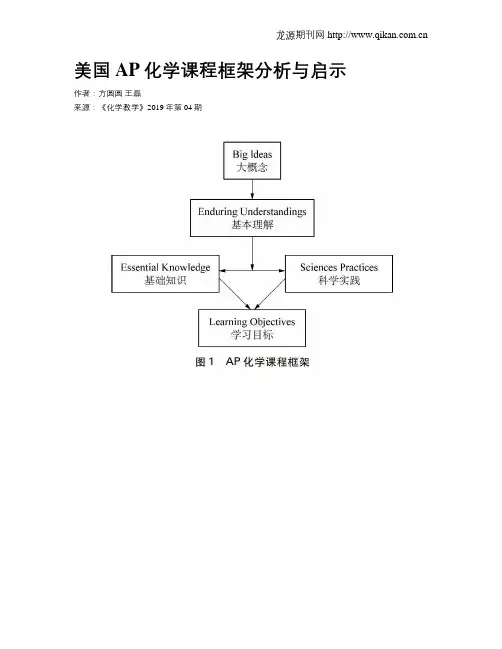
美国AP化学课程框架分析与启示
美国AP化学课程框架分析与启示作者:方圆圆王磊来源:《化学教学》2019年第04期摘要: AP 化学课程是国外化学“大学先修课程”的典型代表。
对其新修订的课程与考试说明进行分析后发现,其围绕六个大概念组织课程框架,强调基础知识和科学实践的统整,关注高阶化学学科能力的发展,特别是结合美国《K12科学教育框架》的对比分析能看到其清晰的进阶脉络。
其设计方案对我国普通高中选修课程和CAP等相关大学先修课程的课程设计和教学有一定的参考价值。
关键词:大学先修课程; AP化学课程; 课程改革文章编号: 10056629(2019)4009305中图分类号: G633.8文献标识码: B21世纪是人才、物资和信息交流空前密切的时代,随着我国经济、社会的发展以及教育国际化的进程,美国“大学先修课程”(Advanced Placement course,以下简称AP课程)已经以多种形式走进我国。
本文聚焦于AP课程中的化学课程,介绍并分析AP化学课程的整体框架与核心要点,以期为我国普通高中选修课程和CAP等相关大学先修课程的课程设计和教学提供参考。
1 AP课程概述美国AP课程是由美国大学理事会(The College Board)主持开发的面向具有潜力、追求卓越、期望发展其个性和兴趣的高中生设置的大学先修课程[1]。
其课程和考试由大学教师及资深AP教师组成的委员会设计,以确保其准确反映课程对高中学生达到大学(一般为大学一年级)水平的期望。
学生在高中选修AP课程,并通过统一的AP考试后,能在申请大学时获得优势,并可抵扣大学学分,有利于学生从中学教育过渡到大学教育并获得学业成功。
该课程由福特基金会在1951年启动,1955年由美国大学理事会接手管理。
经过半个多世纪的不断发展和完善,如今AP课程已形成包括英语、数学、物理、化学等23个学科领域,38门科目在内的课程体系,并设置了与之配套的考试评价系统。
据不完全统计,在美国约25000所公、私立高中里,已经有60%的高中开设了AP课程,包括哈佛大学、耶鲁大学等著名高等学府在内的22个国家的3388所大学承认AP课程学分。
新加坡留学特殊名词缩写

22 个科目,37 门课程。美国和加拿大 90%的学院和大学都是接受 AP 考试成绩的,而且,学生在 大学可以用 AP 成绩换取三到六个学分。 (ASEAN) The Association of Southeast Asian Nations——东南亚国家联盟(这里称为亚细安) (A*STAR) Agency for Science, Technology and Research——科学技术研究机构(新加坡) (AYE) Ayer Rayal Expressway 阿逸拉惹快速公路
(BPGHS) Bukit Panjang Government High School——武吉班让政府中学
(Cedar) Cedar Girls' Secondary School——四德女中 (CGS) Cresent Grils' School——克信女中 (CHS) Catholic High School ——公教中学
(NCHS) Nan Chiau High School ——南侨中学 (NHHS) Nan Hua High School—— 南华中学 (NYGH) Nanyang Girls’ High School——南洋女校
(RGS) Raffles Girls' School——莱佛士女校
(SCGS) Singapore Chinese Girls' School —— 新加坡女子中学 (SCSS) Swiss Cottage Secondary School —— 瑞士村中学 (SJI) St. Joseph's Institution —— 圣尤瑟夫学院 (SNGS) CHIJ St. Nicholas Girls' School——圣尼各拉女中
什么是AP课程和AP考试 AP考试所有考试科目一览.doc
什么是AP课程和AP考试 AP考试所有考试科目一览同学们对AP课程产生的一些常见问题包括:什么是AP课程和AP考试?我应该修几门AP课程?我可以不上AP课程就参加AP考试吗?它们值得参加吗?等等等等。
接下来,我将回答大家所有这些问题,并帮助比较AP课程的优缺点,以便同学们做出决定。
什么是AP课程?大学预修(AP)课程旨在通过更具挑战性的课程,让高中生为大学更高水平的学业和期望做好准备。
AP课程被认为是大学水平的课程。
如果AP考试分数足够高,考生可以获得一定的大学学分。
AP评分为1-5分,其中5分是最高分,表示“非常优秀”,1则表示“不推荐”。
通常,只要有3分及以上就可以获得大学学分。
什么是AP考试?AP考试每年五月举行。
共有38项考试,它们都有以下共同特点:1、每项考试时长都是2-3小时。
2、对于错误的答案或未回答的问题,不会进行扣分。
3、第一部分是多项选择题。
4、第二部分由自由回答的问题组成,这些问题可以用文章、口头(会话)或问题解决方案的形式来回答。
谁能上AP课程?这取决于学校的政策。
在某些情况下,学生必须在某一特定科目上有一定的GPA或成绩才能参加AP课程。
应该上几节AP课程?请记住申请大学时,招生人员不仅要看你的总体GPA,还要看学生所修课程的难易程度。
因此,参加AP课程不仅有助于提高平均绩点(因为它们通常是加权的),而且还能表明作为申请人的你富有挑战性。
有很多科目提供AP考试,从数学和科学到心理学再到外语(完整的列表在文章最后),尽管不是所有的高中都会提供以下所有课程。
我建议同学们选择的AP课程最好与自己大学想要修学的专业有关。
如果一个学生想要继续医学预科学习,他们的成绩单上最好有科学AP课程的成绩。
没有必要参加高中提供的每一门AP课程。
相反,只把你的注意力集中在你想要学习的领域。
相对于修超级多的AP课程只获得了很低的分数,修少几门AP课程并获得高分,是更可取的。
我必须和我申请的大学分享我的分数吗?学生可以从他们想要申请的大学名单中保留一个或多个AP分数。
ap化学的算分
ap化学的算分
AP化学考试的算分方式主要包括选择题和非选择题的计分,以及实验室实践的计分。
选择题部分,通常包括多项选择题和解答题,占据了总分的60-75%。
每个多项选择题有4个选项,每题1分,总分为50分。
解答题也是选择题的一部分,根据回答的正确性和完整性来评分。
这部分的得分主要基于得分点和扣分点,得分点是指考生回答正确的部分,而扣分点是指回答错误的部分。
如果答案完全错误,会扣除相应的分数;如果答案不完全正确,但证明了一定的化学知识,可能会得到部分分数。
非选择题部分,主要考察实验技巧和思维能力,占据了剩余的25-40%的分数。
这部分包括解答题和计算题,要求考生展示对化学概念的理解和运用知识的能力。
对于解答题,考试官会根据学生的回答给予相应的分数,主要考察学生对于化学过程和原理的理解,以及推理和解释的能力。
对于计算题,考试官会根据学生的计算过程和答案的准确性给予分数。
实验室实践部分是通过实验室报告的形式进行评分,主要考察学生在实验操作和数据处理等方面的能力。
实验室报告通常包括背景知
识、实验目的、实验步骤、实验结果和数据处理等内容。
考试官会根据实验报告的完整性、准确性和逻辑性给予相应的分数。
需要注意的是,AP化学考试的算分方式可能会因考试机构和场次的不同而有所差异,具体评分标准和算分方式应以官方公布的信息为准。
AP化学真题2000
2000 Advanced Placement Program®Free-Response QuestionsThe materials included in these files are intended for use by AP® teachers for course and exam preparation in the classroom; permission for any other use must be sought from the Advanced Placement Program. Teachers may reproduce them, in whole or in part, in limited quantities, for face-to-face teaching purposes but may not mass distribute the materials, electronically or otherwise. These materials and any copies made of them may not be resold, and the copyright notices must be retained as they appear here. This permission does not apply to any third-partycopyrights contained herein.These materials were produced by Educational Testing Service (ETS), which develops and administers the examinations of the Advanced Placement Program for the College Board. The College Board and Educational Testing Service (ETS) are dedicated to the principle of equal opportunity, and theirprograms, services, and employment policies are guided by that principle.The College Board is a national nonprofit membership association dedicated to preparing, inspiring, and connecting students to college and opportunity.Founded in 1900, the association is composed of more than 3,800 schools, colleges, universities, and other educational organizations. Each year, the College Board serves over three million students and their parents, 22,000 high schools, and 5,000 colleges, through major programs and services in college admission, guidance, assessment, financial aid, enrollment, and teaching and learning. Among its best-known programs are the SAT®, the PSAT/NMSQT®, the Advanced Placement Program® (AP®), and Pacesetter®. The College Board is committed to the principles of equity and excellence, and thatcommitment is embodied in all of its programs, services, activities, and concerns.Copyright © 2000 by College Entrance Examination Board and Educational Testing Service. All rights reserved. College Board, Advanced Placement Program, AP, and the acorn logo are registered trademarks of the College Entrance Examination Board.INFORMATION IN THE TABLE BELOW AND IN THE TABLES ON PAGES 3-5 MAY BE USEFUL IN ANSWERING THE QUESTIONS IN THIS SECTION OF THE EXAMINATION.D O N O T DE T A C HF R O M B O O K .P E R I O D I C T A B L E O F T H E E L E M E N T S1311193785.4755132.9187(223)412203887.6256137.3388226.02213988.9157138.9189227.03224091.2272178.49234192.9173180.95244295.9474183.852543(98)75186.212644101.176190.22745102.9177192.22846106.4278195.082947107.8779196.973048112.4180200.595133149114.8281204.386143250118.7182207.27153351121.7583208.988163452127.6084(209)9173553126.9185(210)10183654131.2986(222)HL i N aK R b C s F rB eM gC a S r B a R aS c Y *L a A cT iZ rH fVN bT aC rM oWM nT cR e F eR uO sC oR hI rN iP dP tC uA gA uZ nC dH g110(269)111(272)112(277)§§§BA lG aI nT lCS iG eS nP bNPA sS bB iOSS eT eP oFC lB rIA tN eA rK rX eR nH e104(261)105(262)106(263)107(262)108(265)109(266)R f D bS g B h H s M t21.00796.94122.9939.109.01224.3040.0844.9647.9050.9452.0054.93855.8558.9358.6963.5565.3910.81126.9869.7212.01128.0972.5914.00730.97474.9216.0032.0678.9619.0035.45379.9020.17939.94883.804.0026585960616263646566676869707190919293949596979899100101102C eP rN d P mS mE uG dT bD yH oE rT mY bL uT h P a UN p P uA mC mB kC fE sF mM dN oL r103140.12140.91144.24(145)150.4151.97157.25158.93162.50164.93167.26168.93173.04174.97232.04231.04238.03237.05(244)(243)(247)(247)(251)(252)(257)(258)(259)(260)*L a n t h a n i d e S e r i e s†A c t i n i d e S e r i e s †§N o t y e t n a m e dSTANDARD REDUCTION POTENTIALS IN AQUEOUS SOLUTION AT 25°CHalf-reactionE °()V Li Cs Li Cs K K Rb Rb Ba Ba Sr 2Sr Ca 2Ca Na Na Mg 2Mg(Be 2Be Al 3Al Mn 2Mn +-+-+-+-+-+-+-+-+-+-+-+-+ -+ -+ -+ -+ -+ -+ -+ -+ -+ -+ -+ -e e e e e e e e e e e e s s s s s s s s s s s s ().().().().().().().().).().().()30529229229222902892872712371701662222232118076074000034028025014013200022323222222.().().().44.41().40().).().().().().()Zn 2Zn Cr 3Cr Fe 2Fe Cr Cr Cd 2Cd Tl Tl Co 2Co(Ni 2Ni Sn 2Sn Pb 2Pb H 2H S H 2++-+-+-+-++-+-+-+--+-+-+ -+ -+ -+ -+ -+ -+ -+ -+ -+ -+ +e e e e e e e e e e e s s s s s s s s s g s +-+-++-++-+---+-++-+-+-+-+--+ + + + + + + + + + + + +2H S 0.14Sn 2Sn Cu Cu Cu 2Cu Cu Cu I 2 I Fe Fe Hg 2 Hg(Ag Ag(Hg 2Hg( Hg 2Hg Br 2 Br O e e e e e e e e e e e e g s s s l s l l g 242222322222222201501503405220530772079080085209221074()..().().()..).).)..().() H 4 H O(Cl Cl Au Au Co Co +---+-+-++ + + + e e e e l g s 212322136315018222332).().()..ADVANCED PLACEMENT CHEMISTRY EQUATIONS AND CONSTANTSP V T n D m =======pressure volume temperaturenumber of moles density mass velocityu u KE r i K K Q I q tE K rms f b ==============root-mean-square speed kinetic energy rate of effusion molar massosmotic pressure van ’t Hoff factormolal freezing-point depression constant molal boiling-point elevation constant reaction quotient current (amperes)charge (coulombs)time (seconds)standard reduction potential equilibrium constantM p o Gas constant, J mol K L atm mol K volt coulomb mol K Boltzmann ’s constant,J K for H O K kg mol for H O K kg mol STP C and atmFaraday ’s constant,coulombs per moleof electronsR k K K f b ====×===−−−−−−−−−−=8310082183113810186051200001000965001111112312121........,o ᏲCHEMISTRY—SECTION II(Total time—90 minutes)Part ATime—40 minutesYOU MAY USE YOUR CALCULATOR FOR PART A.CLEARLY SHOW THE METHOD USED AND STEPS INVOLVED IN ARRIVING AT YOUR ANSWERS. It is to your advantage to do this, because you may earn partial credit if you do and you will receive little or no credit if you do not. Attention should be paid to significant figures. Be sure to write all your answers to the questions on the lined pages following each question in this booklet.Answer Question 1 below. The Section II score weighting for this question is 20 percent.2 H2S(g) →← 2 H2(g) + S2(g)1.When heated, hydrogen sulfide gas decomposes according to the equation above. A 3.40 g sample of H2S(g) isintroduced into an evacuated rigid 1.25 L container. The sealed container is heated to 483 K, and 3.72 × 10⁻² mol of S2(g) is present at equilibrium.(a)Write the expression for the equilibrium constant, K c , for the decomposition reaction represented above.(b)Calculate the equilibrium concentration, in mol L-1, of the following gases in the container at 483 K.(i)H2(g)(ii)H2S(g)(c)Calculate the value of the equilibrium constant, K c , for the decomposition reaction at 483 K.(d)Calculate the partial pressure of S2(g) in the container at equilibrium at 483 K.S2(g) →← H2S(g) at 483 K, calculate the value of the equilibrium constant, K c .(e)For the reaction H2(g) + 12Copyright © 2000 College Entrance Examination Board and Educational Testing Service. All rights reserved.Answer EITHER Question 2 below OR Question 3 printed on page 8. Only one of these two questions will be graded. If you start both questions, be sure to cross out the question you do not want graded. The Section II score weighting for the question you choose is 20 percent.2.Answer the following questions that relate to electrochemical reactions.(a)Under standard conditions at 25°C, Zn(s) reacts with Co2+(aq) to produce Co(s).(i)Write the balanced equation for the oxidation half reaction.(ii)Write the balanced net-ionic equation for the overall reaction.(iii)Calculate the standard potential, E°, for the overall reaction at 25°C.(b)At 25°C, H2O2decomposes according to the following equation.2 H2O2(aq) → 2 H2O(l) + O2(g) E° = 0.55 V(i)Determine the value of the standard free energy change, ∆G°, for the reaction at 25°C.(ii)Determine the value of the equilibrium constant, K eq , for the reaction at 25°C.(iii)The standard reduction potential, E°, for the half reaction O2(g) + 4 H+(aq) + 4 e−→ 2 H2O(l) has a value of 1.23 V. Using this information in addition to the information given above, determine the valueof the standard reduction potential, E°, for the half reaction below.O2(g) + 2 H+(aq) + 2 e-→ H2O2(aq)(c)In an electrolytic cell, Cu(s) is produced by the electrolysis of CuSO4(aq). Calculate the maximum mass ofCu(s) that can be deposited by a direct current of 100. amperes passed through 5.00 L of 2.00 M CuSO4(aq) for a period of 1.00 hour.Copyright © 2000 College Entrance Examination Board and Educational Testing Service. All rights reserved.3.Answer the following questions about BeC2O4(s) and its hydrate.(a)Calculate the mass percent of carbon in the hydrated form of the solid that has the formula BeC2O4ؒ3 H2O(b)When heated to 220. C, BeC2O4ؒ3 H2O(s) dehydrates completely as represented below.BeC2O4ؒ3 H2O(s) BeC2O4(s) + 3 H2O(g)If 3.21 g of BeC2O4ؒ3 H2O(s) is heated to 220. C, calculate(i)the mass of BeC2O4(s) formed, and,(ii)the volume of the H2O(g) released, measured at 220. C and 735 mm Hg.(c)A 0.345 g sample of anhydrous BeC2O4 , which contains an inert impurity, was dissolved in sufficient waterto produce 100. mL of solution. A 20.0 mL portion of the solution was titrated with KMnO4(aq). Thebalanced equation for the reaction that occurred is as follows.16 H+(aq) + 2 MnO4-(aq) + 5 C2O42-(aq) → 2 Mn2+(aq) + 10 CO2(g) + 8 H2O(l).The volume of 0.0150 M KMnO4(aq) required to reach the equivalence point was 17.80 mL.(i)Identify the reducing agent in the titration reaction.(ii)For the titration at the equivalence point, calculate the number of moles of each of the following that reacted.•MnO4-(aq)•C2O42-(aq)(iii)Calculate the total number of moles of C2O42-(aq) that were present in the 100. mL of prepared solution.(iv)Calculate the mass percent of BeC2O4(s) in the impure 0.345 g sample.Copyright © 2000 College Entrance Examination Board and Educational Testing Service. All rights reserved.CHEMISTRYPart BTime—50 minutesNO CALCULATORS MAY BE USED FOR PART B.Answer Question 4 below. The Section II score weighting for this question is 15 percent.4.Write the formulas to show the reactants and the products for any FIVE of the laboratory situations describedbelow. Answers to more than five choices will not be graded. In all cases, a reaction occurs. Assume that solu-tions are aqueous unless otherwise indicated. Represent substances in solution as ions if the substances are extensively ionized. Omit formulas for any ions or molecules that are unchanged by the reaction. You need not balance the equations.Example: A strip of magnesium is added to a solution of silver nitrate.(a)A small piece of calcium metal is added to hot distilled water.(b)Butanol is burned in air.(c)Excess concentrated ammonia solution is added to a solution of nickel(II) sulfate.(d)A solution of copper(II) chloride is added to a solution of sodium sulfide.(e)A solution of tin(II) nitrate is added to a solution of silver nitrate.(f)Excess hydrobromic acid solution is added to a solution of potassium hydrogen carbonate.(g)Powdered strontium oxide is added to distilled water.(h)Carbon monoxide gas is passed over hot iron(III) oxide.Copyright © 2000 College Entrance Examination Board and Educational Testing Service. All rights reserved.Copyright © 2000 College Entrance Examination Board and Educational Testing Service. All rights reserved.Your responses to the rest of the questions in this part of the examination will be graded on the basis of the accuracy and relevance of the information cited. Explanations should be clear and well organized. Examples and equations may be included in your responses where appropriate. Specific answers are preferable to broad, diffuse responses.Answer BOTH Question 5 below AND Question 6 printed on page 11. Both of these questions will be graded. The Section II score weighting for these questions is 30 percent (15 percent each).5.The molar mass of an unknown solid, which is nonvolatile and a nonelectrolyte, is to be determined by the freezing-point depression method. The pure solvent used in the experiment freezes at 10°C and has a known molal freezing-point depression constant, K f . Assume that the following materials are also available.test tubesstirrer pipetthermometer balance beakerstopwatchgraph paperhot-water bathice(a)Using the two sets of axes provided below, sketch cooling curves for (i) the pure solvent and for (ii) thesolution as each is cooled from 20°C to 0.0°C.(b)Information from these graphs may be used to determine the molar mass of the unknown solid.(i)Describe the measurements that must be made to determine the molar mass of the unknown solid by this method.(ii)Show the setup(s) for the calculation(s) that must be performed to determine the molar mass of theunknown solid from the experimental data.(iii)Explain how the difference(s) between the two graphs in part (a) can be used to obtain informationneeded to calculate the molar mass of the unknown solid.(c)Suppose that during the experiment a significant but unknown amount of solvent evaporates from the testtube. What effect would this have on the calculated value of the molar mass of the solid (i.e., too large, too small, or no effect)? Justify your answer.(d)Show the setup for the calculation of the percentage error in a student ’s result if the student obtains a valueof 126 g mol −1 for the molar mass of the solid when the actual value is 120. g mol −1.O3(g) + NO(g) → O2(g) + NO2(g)6.Consider the reaction represented above.(a)Referring to the data in the table below, calculate the standard enthalpy change, ∆H , for the reaction at25°C. Be sure to show your work.O3(g)NO(g)NO2(g)Standard enthalpy offormation, D Hfo, at 25°C(kJ mol-1)14390.33(b)Make a qualitative prediction about the magnitude of the standard entropy change, ∆S°, for the reaction at25°C. Justify your answer.(c)On the basis of your answers to parts (a) and (b), predict the sign of the standard free-energy change, ∆G°,for the reaction at 25°C. Explain your reasoning.(d)Use the information in the table below to write the rate-law expression for the reaction, and explain how youobtained your answer.Experiment Number Initial [O3](mol L−1)Initial [NO](mol L−1)Initial Rate ofFormation of NO2(mol L−1 s−1)10.00100.0010x20.00100.00202x30.00200.00102x40.00200.00204x(e)The following three-step mechanism is proposed for the reaction. Identify the step that must be the slowestin order for this mechanism to be consistent with the rate-law expression derived in part (d). Explain.Step I:O3 + NO → O + NO3Step II:O + O3→ 2 O2Step III:NO3 + NO → 2 NO2Copyright © 2000 College Entrance Examination Board and Educational Testing Service. All rights reserved.Answer EITHER Question 7 below OR Question 8 printed on page 13. Only one of these two questions will be graded. If you start both questions, be sure to cross out the question you do not want graded. The Section II score weighting for the question you choose is 15 percent.7.Answer the following questions about the element selenium, Se (atomic number 34).(a)Samples of natural selenium contain six stable isotopes. In terms of atomic structure, explain what theseisotopes have in common, and how they differ.(b)Write the complete electron configuration (e.g., 1s2 2s2. . . etc.) for a selenium atom in the ground state.Indicate the number of unpaired electrons in the ground-state atom, and explain your reasoning.(c)In terms of atomic structure, explain why the first ionization energy of selenium is(i)less than that of bromine (atomic number 35), and(ii)greater than that of tellurium (atomic number 52).(d)Selenium reacts with fluorine to form SeF4. Draw the complete Lewis electron-dot structure for SeF4andsketch the molecular structure. Indicate whether the molecule is polar or nonpolar, and justify your answer.Copyright © 2000 College Entrance Examination Board and Educational Testing Service. All rights reserved.Copyright © 2000 College Entrance Examination Board and Educational Testing Service. All rights reserved.8.A volume of 30.0 mL of 0.10 M NH 3(aq )is titrated with 0.20 M HCl(aq ). The value of the base-dissociation constant, K b , forNH 3 in water is 1.8 10-5 at 25 C.(a)Write the net-ionic equation for the reaction of NH 3(aq ) with HCl(aq ).(b)Using the axes provided below, sketch the titration curve that results when a total of 40.0 mL of0.20 M HCl(aq ) is added dropwise to the 30.0 mL volume of 0.10 M NH 3(aq).(c)From the table below, select the most appropriate indicator for the titration. Justify your choice.Indicator p K a Methyl Red 5.5Bromothymol Blue 7.1Phenolphthalein8.7(d)If equal volumes of 0.10 M NH 3(aq ) and 0.10 M NH 4Cl(aq ) are mixed, is the resulting solution acidic,neutral, or basic? Explain.END OF EXAMINATION。
九上英语书外研版单词表
九上英语书外研版单词表Module 1man-made/mæn'meid/adj.人造的natural/'nætʃərel/adj.大自然的wonder/wʌndə/n.奇观;奇迹discussion /di'skaʃn/n.讨论;商讨eastern/i:stən/adj.在东边的;来自东边的though /ðəu/conj.虽然;但是loud /laud/adj.(声音)响亮的wow/wau/int.呀;哇(用于表示惊讶或赞叹) opinion/ə'pinjen/n.看法;主张in one's opinion按某人的意见;据某人看来more than超过electricity /rlek'triseti/n.电millions of大量的;无数的below/bi'ləu/prep.在下面;在……以下shine/ʃain/v.(shone /ʃdn/,shone;shined,shined)照耀sign/sain/n.迹象;标志;招牌silent /'sailənt/adj.寂静的silver/'silvə/adj.银灰色的;银制的sky/skai/n.天:天空grey/grei/adj.灰色的;(天气)阴沉的go through穿过求beside /bi'said/prep.在……旁边;在……附近reply /riplai/v.回答;答复clear/kliə/v.(烟雾等)开始消失fall away突然向下倾斜stream/stri:m/n.小河;小溪nearly /'niəli/adv.几乎;差不多on top of在……上面;盖住canyon /kenjən/n.峡谷remain/ri'mein/v.逗留;留下*by /bai/prep.在……旁边;靠近Module 2found /faund/v.创立;创建since then从那以后flag/fleg/n.旗;旗帜until /ən'til/prep.直到……为止conj.直到……为止off/ɔf/adv.不上课;休息;不工作all kinds of各种各样的vacation /və'keiʃn/n.假期;假日take a vacation去度假*season/'si:zn/n.度假旺季;节期*kid /kid/n.小孩have fun玩得高兴;有乐趣band /bænd/n.乐队UK/ju:'kei/英国as soon as一……就……fourth/fɔ:θ/num.第四sixth /si ksθ/num.第六seventh /'sevnθ/num.第七eighth /eitθ/num.第八ninth/nai nθ/num.第九tenth/tenθ/num.第十twelfth /twelfθ/num.第十二twentieth /'twentiəθ/num.第二十among/əmʌŋ/prep.在……之中speech/spi:tʃ/n.演说;讲演pioneer/paiə'niə/n.开拓者;先驱者grow/grəu/v.种植,栽培(植物)corn/kɔ:n/n.谷物;玉米following/fɔləuiŋ/adj.接着的;接下来的lay /lei/v.(laid /leid/,laid)摆放(餐桌)lay the table摆放餐桌over/əuvə/adj.完了的;结束的dish/diʃ/n.盘;碟parade /pa'reid/n.(庆祝)游行ourselves /auə'selvz/pron.我们自己Module 3including/in'klu:diŋ/prep.包含;包括medal/'medl/n.奖牌;奖章attend /ə'tend/v.上(学);出席,参加(事件或活动) abroad/ə'brɔd/adv.在国外;到国外once again再一次doctor /'dɔktə/n.博士degree /di'gri:/n.课程;学位whatever/wɔt'evə/pron.无论什么;不管什么give up放弃(努力)amazing/ə'meiziŋ/adj.惊人的;极好的will/wil/n.意志;决心victory/'viktəri/n.成功;胜利simply /'simpli/adv.实在;的确Canadian/kə'neidian/adj.加拿大的;加拿大人的sick/sik/adj.(感觉)不适的,生病的soldier/'səuldʒə/n.军人;士兵treat/tri:t/v.医治;治疗war/wɔ:/n.战争wound /wu:nd/n.伤;伤口die for为……而死wounded /wu:ndid/adj.受伤的realise /riəlaiz/v.了解;意识到dying/daiŋ/adj.垂死的;即将死亡的care/keə/n.照顾;照料take care of照顾;护理tool/tu:l/n.工具;器械invention/in'venʃən/n.发明;发明物at that time那时候on one's own独自一人useful /ju:sfl/adj.有用的;有益的rest/rest/v.休息;睡眠himself /him'self;im'self/pron.他自己manage /'mænidʒ/v.做成;(尤指)设法完成operation/ɔpə'reiʃn/n.手术continue/kən'tinju:/v.(使)继续die of死于……Canada/'kænədə/加拿大Module 4platform/plætfɔ:m/n.(供上下火车用的)月台;站台meeting /'mi:tiŋ/n.会议;集会miss/mis/v.未出席;未出现shut/ʃʌt/v.(shut,shut)关上;合上lock /lok/v.锁;锁住simple/'simpl/adj.简单的;容易的anybody /eni,bɔdi/pron.任何人*clock/klɔk/n.钟;时钟ring/riŋ/v.(rang/ræŋ/,rung/raŋ/)鸣响;发出铃声passenger/pæsindʒə/n.乘客;旅客address /ə'dres/n.地址text/tekst/n.文本;正文text message短信couple /kʌpl/n.一对;两个a couple of两个actually /'ektʃuəli/adv.事实上manage /'menidʒ/v.管理;支配unhappy /an'hepi/adj.不高兴的turn off关掉;关闭(设备)order/'ɔ:də/n.命令;指示be worried about担心business /biznəs/n.工作on business出差sofa/'səufə/n.(长)沙发snack/snæk/n.点心;小吃midnight/'midnait/n.午夜;子夜wake up醒;醒来hand in提交;上交empty /'empti/adj.空的unable/an'erbl/adj.不能做某事的all day long整天burn/bə:n/v.(burned/bə:nd/,burned;burnt /bə:nt/,burnt)(使)烧焦;(使)烤糊cup/kʌp/n.杯子;一杯饮料task/ta:sk/n.任务;工作Module 5upstairs /ap'steəz/adj.位于楼上的adv.往楼上;在楼上exhibition/eksi'biʃn/n.展览;展览会rule/ru:l/n.规则;法则against the rules违反规定in trouble遇上麻烦;处于困境tail/tell/n.尾;尾巴rope /rəup/n.粗绳;绳索entry /'entri/n.进入权;进入许可No entry.禁止人内。
AP化学试题
(A) 206 83 Bi (B) 210 83 Bi
(D) 208 82 Pb (E) 210 81 ቤተ መጻሕፍቲ ባይዱb
(C) 206 82 Pb
18. A 0.1-molar solution of which of the following ions is orange? (A) Fe(H2O)42+ (B) Cu(NH3)42+ (C) Zn(OH)42¯ (D) Zn(NH3)42+ (E) Cr2O72¯
13. .....Mg(s) + .....NO3¯(aq) +.....H+(aq) →......Mg2+(aq) + ....NH4+(aq) + ....H2O(l) When the skeleton equation above is balanced and all coefficients reduced to their lowest whole-number terms. What is the coefficient for H+ ? (A) 4 (B) 6
Use the following answers for questions 5-8. (A) CO32¯ (B) Cr2O72¯ (C) NH4+ (D) Ba2+ (E) Al3+ Assume that you have an "unknown" aqueous solution consisting of a salt that contains one of the ions listed above. Which ions must be absent on the basis of each of the following observations of the "unknown" solution? 5. The solution is colorless. 6. The solution gives no apparent reaction with dilute hydrochloric acid. 7. No odor can be detected when a sample of the solution is added drop by drop to a warm solution of sodium hydroxide. 8. No precipitate is formed when a dilute solution of H2SO4 is added to a sample of the solution.
美国AP化学与中国高考化学试题对比分析——电化学部分
本科毕业论文美国AP化学与中国高考化学中关于电化学的试题对比分析学生姓名:***指导教师:***所在学院:化学学院所学专业:化学(师范)中国·长春2014 年 5 月摘要美国大学大学理事会(The College Board)推出的“大学预修课程课程(Advanced Placement)考试,是针对高中生开设的具有大学水平的课程和考试,其成绩已经成为美国大学录取学生的重要依据。
为促使我国高中化学教育更具有国际化,而作为先进化学教育大国的美国对我们无疑有莫大的启示。
本文通过对美国AP化学试题与中国普通高等学校招生全国统一考试(新课标全国卷1)试题中关于电化学考点内容和考试试题的对比,以期为我国化学新课程学业水平考试、高中教育以及高考改革提供参考。
考评可以促进高中化学教学的提升,这正是我国教育改革目前所需要的。
关键词:AP化学高考化学电化学试题对比分析ABSTRACTThe College Board launched The "Advanced Placement exam, is for high school students of university level courses and exams, its performance has become The important basis of admission to The university students in The United States. To promote The high school chemistry education in our country has more internationalization, as The United States Advanced chemical education power undoubtedly has great enlightenment to us. This article through to The AP chemistry questions with China unified national examination of recruit students of common colleges and universities (new standard national volume 1) tests of electrochemical test content and The comparison of exam questions, in order to chemistry new curriculum in our country academic level exam, high school education, and to provide The reference for The College entrance examination reform. Assessment can promote The ascension of high school chemistry teaching, this is our country education reform is needed.Keyword AP chemistry ;The college entrance examination chemistry; The electrochemical;Test analysis目录摘要 (Ⅰ)ABSTRACT (Ⅱ)1 AP化学简介 (1)2 国内研究现状 (2)3 电化学考点内容的对比分析 (3)3.1 广度和深度的对比分析 (3)4试题考察形式的对比分析 (4)5 试题广度和深度的对比分析 (4)5.1 选择题部分的对比分析 (7)5.1.1 广度的对比分析 (7)5.1.2深度的对比分析 (7)5.2 大题部分的对比分析 (8)5.2.1广度的对比分析 (8)5.2.2深度的对比分析 (8)6 结论 (8)参考文献 (10)致谢 (11)美国AP化学与中国高考化学中关于电化学的试题对比分析我国从2001年至今,中学化学新课程从设计到实施已经将近十余年,取得的进展和经验是显著而丰富的。
Course Syllabus
Course Syllabus 2010 Spring, Language Center National Chung Cheng UniversityCourse # 課程編號1903206-01Instructor任課教授Hsiao-jung Kuo郭曉蓉Course Title科目名稱English News Reading Intermediate(I)進階英文時事閱讀(二)Semester上課期間2010 Spring(February 22, 2010~June 28, 2010)Class Hours上課時間16:10~18:00 ThuClassroom 上課地點Room 225, Language Center, Library & Information Building 2F 語言中心225教室Credit Hours學分數2 credits (自由選修)Phone 05-2720411 ext. 16712E-mail deptclc@.twWeb Page 課程網頁.tw (中正大學語言中心網頁).tw/ (中正大學Ecourse 課程平台)Office Room 225, Language CenterOffice Hours諮詢時段Thu. 10:00~12:00A. Course Level/建議修課程度1. 英語程度相當通過GEPT中高級初試者 1. GEPT High-Intermediate-- First Stage(Listening and Reading )2. 英語程度相當TOEIC「藍色」證書成績者 2. TOEIC Certificate(Blue Certificate)/stat1.htm(多益測驗成績與證書顏色參照)3. 具有以上程度者,仍會在第一堂課進行能力檢測,以更明確評估是否適合修課。
未通過該檢測標準者,得不予加簽。
3. An English placement test will be held on thefirst day of the class to make sure the English proficiency level is appropriate for the course.備註:進階課程選課系統開放符合先修條件且「通過」校外英檢者同學選修,「未通過」校外英檢,如欲選修進階課程者,需於1/8~1/11至語言中心提出「課程上修申請」,審核通過且順利排隊遞補進入教室者,將以「課程加簽」方式,協助同學進行課程加選。