
12月大学英语六级考试真题及答案(3)
12月大学英语六级考试真题及答案(3)20. A) Most of them are specially made for his shop.B) All of them are manufactured in his own plant.C) The kitchenware in his shop is of unique design.D) About half of them are unavailable on the market.21. A) They specialise in one product only. C) They run chain stores in central London.B) They have outlets throughout Britain. D) They sell by mail order only.Questions 22 to 25 are based on the conversation you have just heard.22. A) It publishes magazines. C) It runs sales promotion campaigns.B) It sponsors trade fairs. D) It is engaged in product design.23. A) The ad specifications had not been given in detail.B) The woman's company made last-minute changes.C) The woman's company failed to make payments in time.D) Organising the promotion was really time-consuming.24. A) Extend the campaign to next year. C) Run another four-week campaign.B) Cut the fee by half for this year. D) Give her a 10 percent discount.25. A) Stop negotiating for the time being. C) Reflect on their respective mistakesB) Calm down and make peace. D) Improve their promotion plans.Section BDirections: In this section, you will hear 3 short passages. At the end of each passage, you willhear some questions. Both thepassage and the questions will be spoken only once. After you hear a question, you must choose the best answer from the four choices marked A), B), C) and D). Then mark the corresponding letter on Answer Sheet 2 with a single line through the centre.注意:此部分试题请在答题卡2上作答。
Passage OneQuestions 26 to 29 are based on the passage you have just heard.26. A) They look spotlessly clean throughout their lives.B) They are looked after by animal-care organizations.C) They sacrifice their lives for the benefit of humans.D) They are labeled pet animals by the researchers.27. A) They may affect the results of experiments.B) They may behave abnormally.C) They may breed out of control.D) They may cause damage to the environment.28. A) When they become escapees. C) When they get too old.B) When they are no longer useful. D) When they become ill.29. A) While launching animal protection campaigns, they were trapping kitchen mice.B) While holding a burial ceremony for a pet mouse, they were killing pest mice.C) While advocating freedom for animals, they kept their pet mouse in a cage.D) While calling for animal rights, they allowed their kids to keep pet animals.Passage TwoQuestions 30 to 32 are based on the passage you have just heard.30. A) They take it for granted. C) They contribute most to it.B) They are crazy about it. D) They often find fault with it.31. A) Heat and light. C) Historical continuity.B) Economic prosperity. D) Tidal restlessness.32. A) They find the city alien to them.B) They are adventurers from all over the world.C) They lack knowledge of the culture of the city.D) They have difficulty surviving.Passage ThreeQuestions 33 to 35 are based on the passage you have just heard.33. A) A political debate. C) A documentary.B) A football game. D) A murder mystery.34. A) It enhances family relationships. C) It helps broaden one’s horizons.B) It is a sheer waste of time. D) It is unhealthy for the viewers.35. A) He watches TV programs only selectively.B) He can't resist the temptation of TV either.C) He doesn't like watching sports programs.D) He is not a man who can keep his promise.Section CDirections: In this section, you will hear a passage three times. When the passage is read for the first time, you should listen carefully for its general idea. When the passage is read for the second time, you are required to fill in the blanks numbered from 36 to 43 with the exact words you have just heard. For blanks numbered from 44 to 46 you are required to fill in the missing information. For these blanks, you can either use the exact words you have just heard or write down the main points in your own words. Finally, when the passage is read for the third time, youshould check what you have written.注意:此部分试题请在答题卡2上作答。
In the past, one of the biggest disadvantages of machines has been their inability to work on a micro-scale. For example, doctors did not have devices allowing them to go inside the human body to (36) _____ health problems or to perform (37) _____ surgery. Repair crews did not have a way of (38) _____ broken pipes located deep within a high-rise (39) _____ building. However, that's about to change. Advances in computers and biophysics have started a microminiature (超微) (40) _____that allows scientists to envision –and in some cases actually build –microscopic machines. These devices promise to (41)_____ change the way we live and work.Micromachines already are making an impact. At Case Western Reserve University in Cleveland,Ohio, research scientists have designed a 4-inch silicon chip that holds 700 tiny (42) _____motors. At Lucas NovaSensor in Fremont, California, scientists have perfected the world's firstmicroscopic blood-pressure sensor. Threaded through a person's blood (43) _____, the sensor can provide blood pressure readings at the valve of the heart itself.(44)____________________________________________________________________ __. Auto manufacturers, for example, are trying to use tiny devices_______________________________________________________(45)____________________________________________________________ _______________. Some futurists envision nanotechnology (纳米技术) also being used to explore the deep sea in small submarines, or even to launch finger-sized rockets packed with microminiature instruments.There is an explosion of new ideas and applications. So, (46) _________________________________________________________________________________________.Part IV Reading Comprehension (Reading in Depth) (25 minutes)。
2018年12月大学英语六级第三套真题及答案

2018年12月大学英语六级考试真题及参考答案Part I Writing (30 minutes)For this part,you are allowed 30 minutes to write an essay on how to balance academic study and extracurricular activities. You should write at least 150 words but no more than 200 words。
Part ⅢReading Comprehension (40 minutes)Section ADirections: In this section, there is a passage with ten blanks. You are required to select one word for each blank from a list of choices given in a word bank following the passage. Read the passage through carefully before making your choices. Each choice in the bank is identified by a letter. Please mark the corresponding letter for each item on Answer Sheet 2 with a single line through the centre. You may not use any of the words in the bank more than once.Questions 26 to 35 are based on the following passage.In what’s probably the craziest headline I’ve ever written, I’ve reported that 26 in livestock protection are happening with scientists painting eyes on the butts of cows. The experiment is based upon the idea that farmers who’re protecting their herd from lions would shoot and kill lions in an effort to protect their livestock. While this makes a lot of sense, it results in many lion deaths that 27 would have been unnecessary. Researchers in Australia have been 28 and testing a method of trickery to make lions think they are being watched by the painted eyes on cow butts.This idea is based on the principle that lions and other 29 are far less likely to attack when they feel they are being watched. As conservation areas become smaller, lions are increasingly coming into contact with human populations, which are expanding to the 30 of these protected areas.Efforts like painting eyes on cow butts may seem crazy at first, but they could make actual headway in the fight for conservation. “If the method works, it could provide farmers in Botswana-and 31 —with a low-cost, sustainable tool to protect their livestock, and a way to keep lions safe from being killed.”Lions are 32 ambush(埋伏)hunters, so when they feel their prey has 33 them, they usually giveup on the hunt. Researchers are 34 testing their idea on a select herd of cattle. They have painted half of the cows with eyes and left the other half as normal. Through satellite tracking of both the herd and the lions in the area, they will be able to 35 if their psychological trickery will work to help keep farmers from shooting lions.Section BDirections: In this section, you are going to read a passage with ten statements attached to it. Each statement contains information given in one of the paragraphs. Identify the paragraph from which the information is derived. You may choose a paragraph more than once. Each paragraph is marked with a letter. Answer the questions by marking the corresponding letter on Answer Sheet 2.Resilience Is About How You Recharge, Not How You Endure[A] As constant travelers and parents of a 2-year-old, we sometimes fantasize about how much work we can do when one of us gets on a plane, undistracted by phones, friends, or movies. We race to get all our ground work done: packing, going through security, doing a last-minute work call, calling each other, then boarding the plane. Then, when we try to have that amazing work session in flight, we get nothing done. Even worse, after refreshing our email or reading the samestudies over and over, we are too exhausted when we land to soldier on with(继续处理)theemails that have inevitably still piled up.[B] why should flying deplete us? We’re just sitting there doing nothing. Why can’t we betougher, more resilient(有复原力的)and determined in our work so we can accomplish all ofthe goals we set for ourselves? Based on our current research, we have come to realize that the problem is not our hectic schedule or the plane travel itself; the problem comes from a misconception of what it means to be resilient, and the resulting impact of overworking.[C] We often take a m ilitaristic, “tough” approach to resilience and determination like a Marine pulling himself through the mud, a boxer going one more round, or a football player picking himself up off the ground for one more play. We believe that the longer we tough it out, the tougher we are, and therefore the more successful we will be. However, this entire conception is scientifically inaccurate.[D] The very lack of a recovery period is dramatically holding back our collective ability to be resilient and successful. Research has found that there is a direct correlation between lack of recovery and increased incidence of health and safety problems. And lack of recovery —whetherby disrupting sleep with thoughts of work or having continuous cognitive arousal by watching our phones —is costing our companies $62 billion a year in lost productivity.[E] And just because work stops, it doesn’t mean we are recovering. We “stop” work sometimes at 5pm, but then we spend the night wrestling with solutions to work problems, talking about our work over dinner, and falling asleep thinking about how much work we’ll do tomorrow. In a study just released, researchers from Norway found that 7.8% of Norwegians have become workaholics(工作狂). The scientists cite a definition “workaholism”as “be ing overly concerned aboutwork, driven by an uncontrollable work motivation, and investing so much time and effort in work that it impairs other important life areas.”[F] We believe that the number of people who fit that definition includes the majoriy of American workers, which prompted us to begin a study of workaholism in the U.S. Our study will use a large corporate dataset from a major medical company to examine how technology extends our working hours and thus interferes with necessary cognitive recovery, resulting in huge health care costs and turnover costs for employers.[G] The misconception of resilience is often bred from an early age. Parents trying to teach their children resilience might celebrate a high school student staying up until 3am to finish a science fair project. What a distortion of resilience! A resilient child is a well-rested one. When an exhausted student goes to school, he risks hurting everyone on the road with his impaired driving; he doesn’t have the cognitive resources to do well on his English test; he has lower self-control with his friends; and at home, he is moody with his parents. Overwork and exhaustion are the opposite of resilience and the bad habits we acquire when we’re young only magnify when we hit the workforce.[H] As Jim Loehr and Tony Schwartz have written, if you have too much time in the performance zone, you need more time in the recovery zone, otherwise you risk burnout. Gathering your resources to “try hard” requires burning energy in order to overcome your currently low arousal level. It also worsens exhaustion. Thus the more imbalanced we become due to overworking, the more value there is in activities the allow us to return to a state of balance. The value of a recovery period rises in proportion to the amount of work required of us.[I] So how do we recover and build resilience? Most people assume that if you stop doing a task like answering emails or writhing a paper, your brain will naturally recover, so that when you start again later in the day or the next morning, you’ll have your energy back. But surely everyone reading this has had times when you lie in bed for hours, unable to fall asleep because your brains is thinking about work. If you lie in bed for eight hours, you may have rested, but you can still feel exhausted the next day. That’s because rest and recovery are not the same thing.[J] If you’re trying to build resilience at work, you need adequate internal and external recovery periods. As researchers Zijlstra, Cropley and Rydstedt write in their 2014 paper: “Internal recovery refers to the shorter periods of relaxation that take place within the frames of the work day or the work setting in the form of short scheduled or unscheduled breaks, by shifting attention or changing to other work tasks when the mental or physical resources required for the initial task are temporarily depleted or exhausted. External recovery refers to actions that take place outside of work—e.g. in the free time between the work days, and during weekends, holidays or vacations.” If after work you lie around on your bed and get irritated by political commentary on your phone or get stressed thinking about decisions about how to renovate your home, your brain has not received a break from high mental arousal states. Our brains need a rest as much as our bodies do.[K] If you really want to build resilience, you can start by strategically stopping. Give yourself the resources to be tough by creating internal and external recovery periods. Amy Blankson describes how to strategically stop during the day by using technology to control overworking. She suggests downloading the Instant or Moment apps to see how many times you turn on your phone each day. You can also use apps like Offtime or Unplugged to create tech free zones by strategically scheduling automatic airplane modes. The average person turns on their phone 150 times every day. If every distraction took only 1 minute, that would account for 2.5 hours a day.[L] In addition, you can take a cognitive break every 90 minutes to charge your batteries. Try to not have lunch at your desk, but instead spend time outside or with your friends—not talking about work. Take all of your paid time off, which not only gives you recovery periods, but raises your productivity and likelihood of promotion.[M] As for us, we’ve started using our plane time as a work-free zone, and thus time to dip into the recovery phase. The results have been fantastic. We are usually tired already by the time we get on a plane, and the crowded space and unstable internet connection make work more challenging. Now, instead of swimming upstream, we relax, sleep, watch movies, or listen to music. And when we get off the plane, instead of being depleted, we feel recovered and ready to return to the performance zone.36. It has been found that inadequate recovery often leads to poor health and accidents.37. Mental relaxation is much needed, just as physical relaxation is.38. Adequate rest not only helps one recover, but also increases one’s work efficiency.39. The author always has a hectic time before taking a flight.40. Recovery may not take place even if one seems to have stopped working.41. It is advised that technology be used to prevent people from overworking.42. Contrary to popular belief, rest does not equal recovery.43. The author has come to see that his problem results from a misunderstanding of the meaning of resilience.44. People’s distorted view about resilience may have developed from their upbringing.45. People tend to think the more determined they are, the greater their success will be.Section CDirections: There are 2 passages in this section.Each passage is followed by some questions or unfinished statements.For each of them there are four choices marked A), B), C)and D). You should decide on the best choice and mark the corresponding letter on Answer Sheet 2 with a single line through the centre.Passage OneQuestions 46 to 50 are based on the following passage.Children with attention problems in early childhood were 40% less likely to graduate from high school, says a new study from Duke University.The study included 386 kindergarteners from schools in the Fast Track Project, a multi-site clinical trial in the U.S. that in 1991 began tracking how children developed across their lives.With this study, researchers examined early academic attention and socio-emotional skills and how each contributed to academic success into young adulthood.They found that early attention skills were the most consistent predictor of academic success, and that likability by peers also had a modest effect on academic performance.By fifth grade, children with early attention difficulties had lower grades and reading achievement scores than their peers. As fifth-graders, children with early attention problems obtained average reading scores at least 3% lower than their contemporaries’ and grades at least 8% lower than those of their peers. This was after controlling for IQ, socio-economic status and academic skills at school entry.Although these may not seem like large effects, the impact of early attention problems continued throughout the children’s academic careers. Lower reading achievement scores and grades in fifth grade contributed to reduced grades in middle school and thereby contributed to a 40% lower high school graduation rate.“The children we identified as having attention difficulties were not diagnosed with attention deficit hyperactivity disorder(注意力缺乏多动症)(ADHD), although some may have hadthe disorder. Our findings suggest that even more modest attention difficulties can increase the risk of negative academic outcomes,” said David Rabiner, an associate dean of Duke’s Trinity College of Arts & Sciences, whose research has focused on ADHD and interventions to improve academic performance in children with attention difficulties.Social acceptance by peers in early childhood also predicted grades in fifth grade, Children not as liked by their first-grade peers had slightly lower grades in fifth grade, while those with higher social acceptance had higher grades.“This study shows the importance of so-called ‘non-cognitive’ or soft skills in contributing to children’s positive peer relationships, which, in turn, contribute to their academic successs,” said Kenneth Dodge, director of the Duke Center for Child and Family Policy.The results highlight the need to develop effective early interventions to help those with attention problems stay on track academically and for educators to encourage positive peer relationships, the researchers said.“We’re learning that student success requires a more comprehensive approach, one that incorporates not only academic skills but also social, self-regulatory and attention skills,” Dodge said. “If we neglect any of these areas, the child’s development lag s. If we attend to these areas, a child’s success may reinforce itself with positive feedback loops.”46. What is the focus of the new study from Duke University?A) The contributor to children’s early attention.B) The predictors of children’s academic success.C) The factors that affect children’s emotional well-being.D) The determinants of children’s development of social skills.47. How did the researchers ensure that their findings are valid?A) By attaching equal importance to all possible variables examined.B) By collecting as many typical samples as were necessary.C) By preventing them from being affected by factors not under study.D) By focusing on the family background of children being studied.48. What do we learn from the findings of the Duke study?A) Modest students are generally more attentive than their contemporaries.B) There are more children with attention difficulties than previously thought.C) Attention deficit hyperactivity disorder accounts for most academic failures.D) Children’s academic performance may suffer from even slight inattention.49. What does the Duke study find about children better accepted by peers?A) They do better academically.B) They are easy to get on with.C) They are teachers’ favorites.D) They care less about grades.50. What can we conclude from the Duke study?A) Children’s success is related to their learning environment.B) School curriculum should cover a greater variety of subjects.C) Social skills are playing a key role in children’s development.D) An all-round approach should be adopted in school education.Passage TwoQuestions 51 to 55 are based on the following passage.On Jan. 9,2007, Steve Jobs formally announced Apple’s “revolutionary mobile phone”— a device that combined the functionality of an iPod, phone and Internet communication into a single unit, navigated by touch.It was a huge milestone in the development of smartphones, which are now owned by a majority of American adults and are increasingly common across the globe.As smartphones have multiplied, so have questions about their impact on how we live and how we work. Often the advantages of convenient, mobile technology are both obvious and taken for granted, leaving more subtle topics for concerned discussion: Are smartphones disturbing children’s sleep? Is an inability to get away from work having a negative impact on health? And what are the implications for privacy?But today, on the 10th anniversary of the iPhone, let’s take a moment to consider a less obvious advantage: the pot ential for smartphone technology to revolutionize behavioral science. That’s because, for the first time in human history, a large proportion of the species is in continuous contact with technology that can record key features of an individual’s behavior a nd environment.Researchers have already begun to use smartphones in social scientific research, either to query people regularly as they engage in their normal live or to record activity using the device’s built-in sensors. These studies are confirming, c hallenging and extending what’s been found using more traditional approaches, in which people report how they behaved in real life or participate in relatively short and artificial laboratory-based tasks.Such studies are just first steps. As more data are collected and methods for analysis improve, researchers will be in a better position to identify how different experiences, behaviors and environments relate to each other and evolve over time, with the potential to improve people’s productivity and wellbeing in a variety of domains. Beyond revealing population-wide patterns, the right combination of data and analysis can also help individuals identify unique characteristics of their own behavior, including conditions that could indicate the need for some form of intervention—such as an unusual increase in behaviors that signal a period of depression.Smartphone-based data collection comes at an appropriate time in the evolution of psychological science. Today, the field is in transition, moving away from a focus on laboratory studies with undergraduate participants towards more complex, real-world situations studied with more diverse groups of people. Smartphones offer new tools for achieving these ambitions, providing rich data about everyday behaviors in a variety of contexts.So here’s another way in which smartphones might transform the way we live and work: by offering insights into human psychology and behavior and, thus, supporting smarter social science.51.What does the author say about the negative impact of smartphones?A)It has been overshadowed by the positive impact.B)It has more often than not been taken for granted.C)It is not so obvious but has caused some concern.D)It is subtle but should by no means be overstated.52.What is considered a less obvious advantage of smartphone technology?A)It systematically records real human interactions.B)It helps people benefit from technological advances.C)It brings people into closer contact with each other.D)It greatly improves research on human behavior.53.What characterizes traditional psychological research?A)It is based on huge amounts of carefully collected data.B)It relies on lab observations and participants’ reports.C)It makes use of the questionnaire method.D)It is often expensive and time-consuming.54.How will future psychological studies benefit individuals?A)By helping them pin down their unusual behaviors.B)By helping them maintain a positive state of mind.C)By helping them live their lives in a unique way.D)By helping them cope with abnormal situations.55.What do we learn about current psychological studies?A)They are going through a period of painful transition.B)They are increasingly focused on real-life situations.C)They are conducted in a more rigorous manner.D)They are mainly targeted towards undergraduates.Part ⅣTranslation (30 minutes)Directions: For this part, you are allowed 30 minutes to translate a passage from Chinese into English.You should write your answer on Answer Sheet 2.近年来,中国政府近一步加大体育馆建设投资,以更好地满足人们快速增长的健身需求。
12月英语六级真题及答案「完整版」(3)

12月英语六级真题及答案「完整版」(3)2017年12月英语六级真题及答案「完整版」Section AHis future subjects have not always treated the Prince of Wales with the respect one XXXX expect. They laughed aloud in 1986 when the heir to the British(36)_____ told a TV reporter that he talked to his plants at his country house, Highgrove, to stimulate their growth. The Prince was being humorous- “My sense of humor will get me into trouble one day”, he said to his aids(随从)-but listening to Charles Windsor can indeed prove stimulating. The royal(37)_____ has been promoting radical ideas for most of his adult life. Some of his(38)_____, which once sounded a bit weird, were simply ahead of their time. Now, finally, the world seems to be catching up with him.Take his views on farming. Prince Charles’ Duchy Home Farm went(39)_____ back in 1986. When most shoppers cared only about the low price tag on suspiciously blemish-free(无瑕疵的) vegetables and(40)_____ large chickens piled high in supermarkets.His warnings on climate change proved farsighted,too.Charles began(41)_____ action in warming in 1990 and says he has been worried about the(42)_____ of man on the environment same be was a teenger.Although he was gradually gained international(43)_____ as one of the world's lending conservationists,many British people still think of him as an(34)_____ person who talks to plants.This year,as it happens,South Korean scientists proved that plants really do(45)_____ to round.So Charles was ahead of the game there,too.A.conformB.eccentricC.environmentalistD.expeditionsE.impactF.notionsanicH.originallyI.recognitionJ.respondK.subordinateL.suppressingM.throneN.unnaturallyO.urgingSection BDirections: In this section,you are going to read a passage with ten statements attached to it. Each statement contains information given in one of the paragraphs. Identify the paragraph from which the information is derived. You may choose a paragraph more than once. Each paragraph is marked with a letter. Answer the questions by marking the corresponding letter on Answer Sheet 2. High School Sports Aren’t Killing AcademicsA)In this month’s Atlantic cover article, “The Case Against High-School Sports,” Amanda Ripley argues that school-sponsored sports programs should be seriously cut. She writes that, unlike most countries that outperform the United States on international assessments, American schools put too much of an emphasis on athletics, “ Sports are embedded in Americanschools in a way the y are not almost anywhere else,” she writes, “Yet this difference hardly ever comes up in domestic debates about America’s international mediocrity(平庸)in education.”B)American student-athletes reap many benefits from participating in sports, but the costs to the schools could outweigh their benefits, she argues, In particular, Ripley contends that sports crowd out the academic missions of schools: America should learn from South Korea and Finland and every other country at the top level of international test scores, all of whom emphasize athletics far less in school. ”Even in eighth grade, American kids spend more than twice the time Korean kids spend playing sports,” she writes, citing a 2010 study published in the Journal of Advanced Academics.C)It might well be true that sports are far more rooted in American high schools than in other countries. But our reading of international test scores finds no support for the argument against school athletics. Indeed, our own research and that of others lead us to make the opposite case. School-sponsored sports appear to provide benefits that seem to increase, not detract(减少)from, academic success.D)Ripley indulges a popular obsession(痴迷)with international test score comparisons, which show wide and frightening gaps between the United States and other countries. She ignores, however, the fact that states vary at least as much in test scores as do developed countries. A 2011 report from Harvard University shows that Massachusetts produces math scores comparable to South Korea and Finland, while Mississippi scores are closer to Trinidad and T obago. Ripley’s thesis about sports falls apart in light of this fact. Schools in Massachusetts provide sports programs while schools in Finland do not. Schoolsin Mississippi may love football while in Tobago interscholastic sports are nowhere near as prominent. Sports cannot explain these similarities in performance. They can’t explain international differences either.E)If it is true that sports undermine the academic mission of American schools, we would expect to see a negative relationship between the commitment to athletics and academic achievement. However, the University of Arkansas’s Daniel Bowen and Jay Greene actually find the opposite. They examine this relationship by a nalyzing schools’ sports winning percentages as well as student-athletic participation rates compared to graduation rates and standardized test score achievement over a five-year period for all public high schools in Ohio. Controlling for student poverty levels, demographics(人口统计状况), and district financial resources, both measures of a school’s commitment to athletics are significantly and positively related to lower dropout rates as well as higher test scores.F)On-the-field success and high participation in sports is not random-it requires focus and dedication to athletics. One might think this would lead schools obsessed with winning to deemphasize academics. Bowen and Greene’s results contradict that argument. A likely explanation for this seemingly counterintuitive(与直觉相反的)result is that success in sports programs actually facilitates or reflects greater social capital within a school’s community.G)Ripley cites the writings of renowned sociologist James Coleman, whose research in education was groundbreaking. Coleman in his early work held athletics in contempt, arguing that they crowded out schools’ academic missions. Ripley quotes his 1961 study, The Adolescent Society, where Colemanwrites, “Altogether, the trophy(奖品)case would suggest to the innocent visitor that he was entering an athletic club, not an educational institution.”H)However, in later research Coleman would show how the success of schools is highly dependent on what he termed social capital, “the social networks, and the relationships bet ween adults and children that are of value for the child’s growing up.”I)According to a 2013 evaluation conducted by the Crime Lab at the University of Chicago, a program called Becoming a Man-Sports Edition creates lasting improvements in the boys’ study habits and grade point averages. During the first year of the program, students were founds to be less likely to transfer schools or be engaged in violent crime. A year after the program, participants were less likely to have had an encounter with the juvenile justice system.J)If school-sponsored sports were completely eliminated tomorrow, many American students would still have opportunities to participate in organized athletics elsewhere, much like they do in countries such as Finland, Germany, and South Korea. The same is not certain when it comes to students from more disadvantaged backgrounds. In an overview of the research on non-school based after-school programs, researchers find that disadvantaged children participate in these programs at significantly lower rates. They find that low-income students have less access due to challenges with regard to transportation, non-nominal fees, and off-campus safety. Therefore, reducing or eliminating these opportunities would most likely deprive disadvantaged students of the benefits from athletic participation, not least of which is the opportunity to interact with positive role models outside of regular school hours.K)Another unfounded criticism that Ripley makes is bringing up the stereotype that athletic XX are typically lousy(蹩脚的)classroom teachers. “American principals, unlike the XX XX of principals around the world, make many hiring decisions with their sports teams in mind, which does not always end well for students,” she writes. Educators who seek em ployment at schools primarily for the purpose of coaching are likely to shirk(推卸)teaching responsibilities, the argument goes. Moreover, even in the cases where the employee is a teacher first and athletic coach second, the additional responsibilities that come with coaching likely comes at the expense of time otherwise spent on planning, grading, and communicating with parents and guardians.L)The data, however, do not seem to confirm this stereotype. In the most rigorous study on the classroom results of high school coaches, the University of Arkansas’s Anna Egalite finds that athletic coaches in Florida mostly tend to perform just as well as their non-coaching counterparts, with respect to raising student test scores. We do not doubt that teachers who also coach face serious tradeoffs that likely come at the expense of time they could dedicate to their academic obligations. However, as with sporting events, athletic coaches gain additional opportunities for communicating and serving as mentors(导师)that potentially help students succeed and make up for the costs of coaching commitments.M)If schools allow student-athletes to regularly miss out on instructional time for the sake of traveling to athletic competitions, that’s bad. However, such issues would be b etter addressed by changing school and state policies with regard to the scheduling of sporting events as opposed to total elimination.If the empirical evidence points to anything, it points towards school sponsored sports providing assets that are well worth the costs.N)Despite negative stereotypes about sports culture and Ripley’s presumption that academics and athletics are at odds with one another, we believe that the greater body of evidence shows that school-sponsored sports programs appear to benefit students. Successes on the playing field can carry over to the classroom and vice versa(反之亦然). More importantly, finding ways to increase school communities’ social capital is imperative to the success of the school as whole, not just the athletes.46.Stunets from low-income families have less access to off-campus sports programs.47.Amanda Ripley argues that America should learn from other countries that rank high in international tests and lay less emphasis on athletics.48.According to the author,Amanda Ripley fails to note that stunents'performance in exams varies from state to state.49.Amanda Ripley thinks that athletic coaches are poor at classroom instruction.50.James Coleman's later resrarch make an argument for a school's social capital.51.Reaearchers find that there is a ppsitive relationship between a school's commitment to athletics and academic achievements.52.Aa rigorous study finds that athletic coaches also do well in raising students'test scores.53.According to an evaluation,spograms contribute to students's academic preformance and character building.54.Amanda Ripley believes the emphasis on school sports shuold be brought up when trying to understand why Aamerican students are mediocre.55.James Coleman suggests in his earlier writings that school athletics would undermine a school's image.Section CDirections: There are 2 passages in this section. Each passage is followed by some questions or unfinished statements. For each of them there are four choices marked A, B, C and D. . You should decide on the best choice and mark the corresponding letter on Answer Sheet 2 with a single line through the centre.Passage oneIt is easy to miss amid the day-to-day headlines of global economic recession, but there is a less conspicuous kind of social upheaval(剧变)underway that is fast altering both the face of the planet and the way human beings live. That change is the rapid acceleration of urbanization. In 2008, for the first time in human history, more than half the world’s population was livi ng in towns and cities. And as a recently published paper shows, the process of urbanization will only accelerate in the decades to come—with an enormous impact on biodiversity and potentially on climate change.As Karen Seto, the led author of the paper, points out, the wave of urbanization isn’t just about the migration of people into urban environments, but about the environments themselves becoming bigger to accommodate all those people. The rapid expansion of urban areas will have a huge impact on biodiversity hotspots and on carbon emissions in those urban areas.Humans are the ultimate invasive species—when the moveinto new territory, the often displace the wildlife that was already living there. And as land is cleared for those new cities—especially in the dense tropical forests—carbon will be released into the atmosphere as well. It’s true that as people in developing nations move from the countryside to the city, the shift may reduce the pressure on land, which could in turn be good for the environment. This is especially so in desperately poor countries, where residents in the countryside slash and burn forests each growing season to clear space for farming. But the real difference is that in developing nations, the move from rural areas to cities often leads to an accompanying increase in income — and that increase leads to an increase in the consumption of food and energy, which in turn causes a rise in carbon emissions. Getting enough to eat and enjoying the safety and comfort of living fully on the grid is certainly a good thing — but it does carry an environmental price.The urbanization wave can’t be stopped —and it shouldn’t be. But Seto’s paper does underscore the importance of managing that transition. If we do it the right way, we can redu ce urbanization’s impact on the environment. “There’s an enormous opportunity here, and a lot of pressure and responsibility to think about how we urbanize,” says Seto. “One thing that’s clear is that we can’t build cities the way we have over the last couple of hundred years. The scale of this transition won’t allow that.” We’re headed towards an urban planet no matter what, but whether it becomes heaven or hell is up to us.56. What issue does the author try to draw people’s attention to?A. The shrinking biodiversity worldwide.B. The rapid increase of world population.C. The ongoing global economic recession.D. The impact of accelerating urbanization.57. In what sense are humans the ultimate invasive species?A. They are much greedier than other species.B. They are a unique species born to conquer.C. They force other species out of their territories.D. They have an urge to expand their living space.下载文档。
2020年12月英语六级真题第3套
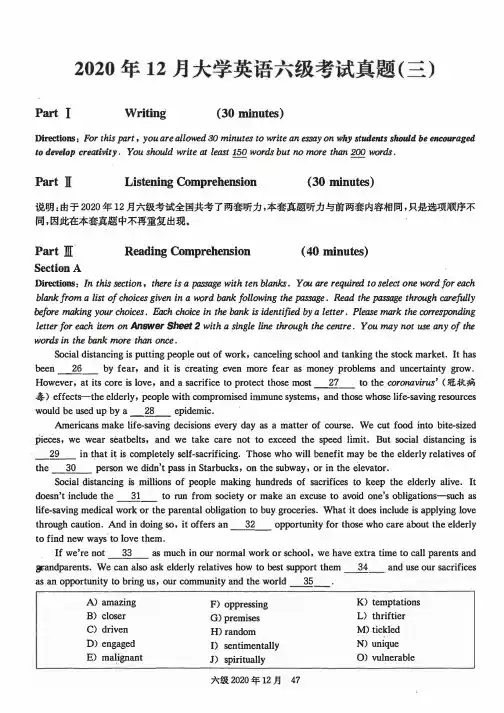
letter for each item on Answer Sheet 2 with a single line through the centre. You may not use any of the
words in the bank more than once.
Social distancing is putting people out of work, canceling school and tanking the stock market. It has
new horizons. What are they thinking while they throw their caps in the air? What is it with this thin sheet of paper that makes it so precious? It’s not only the proof of acquired knowledge but plays into the reputation game of where you were trained. Being a graduate from Harvard Law School carries that extra glamour, doesn’t it? Yet take a closer look, and the diploma is the perfect ending to the modem tragedy of education. B) Why? Because universities and curricula are designed along the three unities of French classical tragedy: time, action, and place. Students meet at the university campus (unity of place) for classes (unity of action) during their 20s (unity of time). This classical model has traditionally produced prestigious universities, but it is now challenged by the digitalisation of society—which allows everybody who is connected to the internet to access learning—and by the need to acquire skills in step with a fast-changing world. Universities must realise that learning in your 20s won’t be enough. If technological diffusion and implementation develop faster, workers will have to constantly refresh their skills. C) The university model needs to evolve. It must equip students with the right skills and knowledge to compete in a world ‘where value will be derived largely from human interaction and the ability to invent and interpret things that machines cannot’, as the English futurist Richard Watson puts it. By teaching foundational knowledge and up-to-date skills, universities will provide students with the future-proof skills of lifelong learning, not just get them ‘job-ready’. D) Some universities already play a critical role in lifelong learning as they want to keep the value of their diplomas. This new role comes with a huge set of challenges, and needs largely to be invented. One way to start this transformation process could be to go beyond the ‘ five-year diploma model ’ to adapt curricula to lifelong learning. We call this model the lifelong passport. E) The Bachelor’s degree could be your passport to lifelong learning. For the first few years, students would ‘learn to learn’ and get endowed with reasoning skills that remain with them for the rest of their lives. For instance, physics allows you to observe and rationalise the world, but also to integrate observations into models and, sometimes, models into theories or laws that can be used to make predictions. Mathematics is the language used to formulate the laws of physics or economy, and to make rigorous computations that turn into predictions. These two disciplines naturally form the foundational pillars of education in technical universities. F) Recent advances in computational methods and data science push us into rethinking science and engineering. Computers increasingly become principal actors in leveraging data to formulate questions, which requires radically new ways of reasoning. Therefore, a new discipline blending computer science, programming, statistics and machine learning should be added to the traditional foundational topics of mathematics and physics. These three pillars would allow you to keep learning complex technical subjects all your life because numeracy (#•$-) is the foundation upon which everything else is eventually built. G) According to this new model, the Master of Science (MSc) would become the first stamp in the lifelong learning journey. The MSc curriculum should prepare students for their professional career by allowing them to focus on acquiring practical skills through projects. H) Those projects are then interwoven with fast-paced technical modules (^&) learned ‘on-the-fly’ and
2017年12月大学英语六级考试真题附答案解析(三套全)
2017 年12 月英语六级考试真题及答案(第一套)考试采取“多题多卷”模式,试题顺序不统一,请依据试题进行核对Part I Writing (30 minutes)Directions: for this part, you are allowed 30 minutes to write an essay commenting onthe saying " Respect others, and you will be respected. " you can cite examples toilustrate your views. you should write at least 150 words but no more than 200Part IIListening comprehension(30miutes)Section aDirections: in this section, you will hear two long conversations at the end of each comversation you will hear four questions. both the comversation and the questions will be spoken only once. afier you hear a question, you must choose the best answer from the four choices marked a, b) cand d). then mark the corresponding letter on answer Sheet i with a single line through the centre.Questions1 to 4 are based on the conversation you have just heard1. a)they reward businesses that eliminate food wastb) they prohibit the sale of foods that have gone stalec) they facilitate the donation of unsold foods to the needyd) they forbid businesses to produce more foods than needed2. a)it imposed penalties on businesses that waste foodb) it passed a law aiming to stop overproductionC)it voted gainst food import from outside europe d) it prohibited the promotion of bulk food sales.3. a) it has warmed its people against possible food shortage.b) it has penalized businesses that keep overproducing foodsc) it has started a nationwide campaign against food waste.d) it has banned supermarkets from dumping edible foods.4 .a)the confusion over food expiration labels.b) the surplus resulting from overproductionc) americans' habit of buying food in bulkd) a lack of regulation on food consumptionQuestions 5 to 8 are based on the conversation you have just heard.5. a) it has started a week-long promotion campaign.b) it has just launched its annual anniversary salesc) it offers regular weekend sales all the year roundd) it specializes in the sale of ladies designer dresses6. a)price reductions for its frequent customers.b) coupons for customers with bulk purchases.c) free delivery of purchases for senior customers.d) price adjustments within seven days of purchase.7. a)mail a gift card to her.b) allow her to buy on credic) credit it to her accountd) give her some coupons.8. a) refunding for goods returnedb) free installing of appliances.c) prolonged goods warranty.d) complimentary tailoringSection bDirections: in this section, you will hear two passages. at the end of each passage, you will hear Iree or four questions. both the passage and the questions will be spoken only once After you hear a question, you must choose the best answer from the four choices marked a, b, cand d). then mark the corresponding letter on answer Sheet 1 with a single line through the centre.Questions 9 to 11 are based on the passage you have just heard9. a)they are thin, tall, and unlike real human beings.b) they have more than twenty different hair texturesc) they have twenty-four different body shapes in totald) they represent people from virtually all walks of life.10. a)they do not reflect young girls aspirationsb) they are not sold together with the originalc) their flat feet do not appeal to adolescentsd) their body shapes have not changed much11. a)in toy storesb) in shopping malls.c) on the internetd) at barbie shopsQuestions 12 to 15 are based on the passage you have just heard.12. a )moveable metal type began to be used in printingb) chinese printing technology was first introducec) the earliest known book was publishedd) metal type was imported from korea13. a) it had more than a hundred printing presses.b) it was the biggest printer in the 16th century.c) it helped the german people become literate.d) it produced some 20 million volumes in total14. a)it pushed handwritten books out of circulation.b) it boosted the circulation of popular works.c) it made writing a very profitable career.d) it provided readers with more choices.15. a) it accelerated the extinction of the latin language.b) it standardized the publication of grammar books.c) turned translation into a welcome profession.d) it promoted the growth of national languagesSection cDirections: in this section, you will hear three recordings of lectures or talks followed by three or four questions. the recordings will be played only once. after you hear a question,you must choose the best answer from the four choices marked a, b, c and d)Then mark the corresponding letter on answer sheet 1 with a single line through centre.Questions 16 to 18 are based on the recording you have just heard.16. a) they get bored after working for a period of time.b) they spend an average of one year finding a job.c) they become stuck in the same job for decades.d) they choose a job without thinking it through.17. a)see if there will be chances for promotion.b) find out what job choices are available.c) watch a film about ways of job hunting.d) decide which job is most attractive to you.18. a)the qualifications you have.b) the pay you are going to get.c) the culture of your target company.d) the work environment you will be in.19. a) it is as important as christmas for african-americans.b) it is a cultural festival founded for african-americans.c) it is an ancient festival celebrated by african-americans.d) it is a religious festival celebrated by african-americans20. a)to urge african-americans to do more for society.b) to call on african-americans to worship their godsc) to help african-americans to realize their goals.d) to remind african-americans of their sufferings.21. a)faith in self-determinationb) the first fruits of the harvestc) unity and cooperative economics d creative work and achievement.22. a)they recite a principleb) they take a solemn oathc) they drink wine from the unity cupd) they call out their ancestors' names.Questions 23 to 25 are based on the recording you have just heard23. a) it is one of the world's most healthy diets.b) it contains large amounts of dairy products.c) it began to impact the world in recent years.d) it consists mainly of various kinds of seafood.4. a) it involved 13, 000 researchers from asia, europe and america.b) it was conducted in seven mid-eastern countries in the 1950sc) it is regarded as one of the greatest researches of its kind.d) it has drawn the attention of medical doctors the world over.25. a) they care much about their health.b) they eat foods with little fat.c)they use little oil in cookingd) they have lower mortality ratesPart III Reading Comprehension(40 minutes)Section ADirections: In this section, there is a passage with ten blanks. You are required to select one word for each blank from a list of choices given in a word bank following the passage. Read the passage through carefully before making your choices. Each choice in the bank is identified by a letter. Please mark the corresponding letter for each item on Answer Sheet 2 with a single line through the centre. You may not use any of the words in the bank more than once.In the past 12 months,Nigeria has suffered from a shrinking economy, a slidingcurre ncy, and a proIon ged fuel shortage. Now, Africa ' s largest in facing a food crisis asmajor tomato fields have bee n destroyed by an in sect,lead ing to a n ati on wide shortage and escalating prices.The in sect, Tutaabsoluta, has destroyed 80% of farms in Kaduna, Nigeria's largesttomato produc ing state, leadi ng the gover nment there to declare a state of26 .The in sect, also known as the tomato leaf miner, devastates crops by 27 onfruits and diggi ng into and moving through stalks .It 28 in credibly quickly,breeding up to 12 generations per year if conditions are favorable. it is believed tohave 29 in South America in the early 1900s, and later spread to Europe before cross ing over to sub-Sahara n Africa.In Nigeria, where tomatoes are a staple of local diets,the in sect's effects aredevastat ing. Retail prices for a 30 of tomatoes at local markets have rise n from $0. 50to $2.50. Farmers are report ing steep losses and a new $20 milli on tomato-paste factory has 31 producti on due to the shortages.Given the moth's ability also to attack crops like pepper and potatoes, AuduOgbeh, Nigeria's minister of agriculture, has warned that the pest may"create seriousproblems for food 32 "in the coun try.Ogbeh says experts are in vestigati ng how tocon trol the pest ' s damage and preve nt its spread, which has gone largely 33 un tilnow.Despite being the continen t's sec on d-largest producer of tomatoes, Nigeria is 34 on $1 billi on worth of tomato-paste imports every year.as around 75% of thelocal harvest goes to waste tha nks to a lack of proper storage facilities. A further 35 inlocal supplies is yet ano ther un welcome setback to the in dustry.A)dependent I ) originatedB) Embark ing J) reducti onC) emerge nc K) reproducesD) feedi ng L ) securityE) grazes M ) terrorF) halted N) uncheckedG) han dful O ) uncheckedH) multitudeSectio n BDirections: In this secti on, you are going to read a passage with ten stateme nts attached to it. Each statement contains information given in one of the paragraphs. Identify the paragraph from which the information is derived. You may choose a paragraph more than once. Each paragraph is marked with a letter. Answer the questio ns by marking the corresp onding letter on An swer Sheet 2.who's really addicting you to Technology?A. "Nearly everyone i know is addicted in some measure to the internet, "wrote tony Schwartz in The New York Times. it's a common complaint these days. A steady stream of similar headlines accuse the net and its offspring apps, social media sites and online games of addicting us to distractionB. There's little doubt that nearly everyone who comes in contact with the net has difficulty concentration than it takes to post a status update. as one person ironically put it in the comments section of Schwartz'sonline article, "As I was reading this very excellent article.I stopped at least half a dozen times to cheek my email.C. There's something different about this technology: it is both invasive and persuasive.but who's at fault for its overuse ?To find solutions, it's important to understand whatwe ' re dealing with.There are four parties conspiring to keep you connected the tech,your boss, your friends and you.D. The technologies themselves and their makers, are the easiest suspects to blame for our diminishing attention spans. Nicholas Carr,author of The Shallows :what the internet is doing Our brains, wrote, The net is designed to be an interruption system, a machine geared to dividing attention.E. Online services like Facebook, twitter and the like, are called out ofmanipula-tion--making ,products so good that people can't stop using them. afterstudying these products for several years, I wrote a book about how they do it. I learnedit all starts with the business model. since these services rely on advertising revenue, The more frequentlyyou use money they make.It teams of people focused on engineering their services to be as engaging as possible. these products aren't habit-forming by chance; it's by design.' s no wminpdaenr itehseseemcpoloy they have an incentive to keep us hooked.F. However, as good as these services are, there are simple steps we can take to keepthem at bay.For example, we can change how often we receive the distracting notifications that trigger our urge to check.According to adam marchick, ceo of mobile marketing company kahuna, less than 15 percentof smartphone users ever bother to adjust their notification setlings--meaning the remaining 85 percent of us default to the app makers' every preset trigger.Google and Apple have made it far too difficult to adjust these settings so it's up to us to take steps ensure we set these triggers to suit our own needs, not the needs of the app makers.G.While companies like Facebook harvest attention to generate revenue fromadvertisers, other technologies have no such agenda. take email, for example. this system couldn't care less how often you use it. Yet t o many, email is the mosthabit-forming medium of all.We check email at all hours of the day--we're obsessed, butwhy? Because that's what the boss wants.For almost all white-collar jobs, A slowResponse to a message could hurt not only your reputation but also your livelihood.H. Your friends are also responsible.Think about this familiar scene.People gathered around a table,enjoying food and each others company. there's laughter and a bit of kidding. Then, during an interval in the conversation, someone takes out their phone to check who knows what.Barely anyone notices and no one says a thing.I. Now imagine the same dinner,but instead of checking their phone, the person belches(打嗝)-loudly.Everyone notices. unless the meal takes place in a beer house, this is considered bad manners. The impolite act violates the basic rules of etiquette. one has to wonder why don ' t we apply the same social norms to checking phones during meals,meetings and conversations as we do to other antisocial behaviors somehow, we accept it and say nothingwhen someone offends.J. The reality is taking one's phone out at the wrong time is worse than belching because, unlike other minoroffense, checking tech is contagious. once one person looks at their phone,other people feel compelled to dothe same, starting a chain reaction. the more people are on their phones, the fewer people are talking untilfinally you are the only one left not reading email or checking twitter. from a societal perspective, phonechecking is less like belching in public and more like another bad habit. our phones are like cigarettes-something to do when were bored or when our fingers need something to toy with seeing others enjoy asmoke,or sneak a quick glance, is too tempting to resist and soon everyone is doing it.K. The technology, your boss, and your friends, all influence how often you find yourself using (or overusing )these gadgets. but there's still someone who deserves scrutiny--the person holding the phone. L. I have a confession. even though i study habit-forming technology for a living, disconnecting is not easyfor me.I'm online far more than I'd like like Schwartz and so many others, I often find myself distracted andoff tack.I wanted to know why so i began self-monitoring to try to understand my behavior. that's when idiscovered an uncomfortable truth. i use technology as an escape. when I'm doing something I'd rather notdo, or when I'm someplace I'd rather not attention was often a good thing, like when passing time on publictransportation, but frequently my tech use was not so benign.when i faced difficult work, like thinking through an article idea or editing the same draft for the hundredthtime, for example, a more sinister screen would draw me in. i could easily escape discomfort.temporarlly.byanswering email or browsing ing the web under the pretense of so-called"research. "though I desperatelywanted to lay blame elsewhere, i finally had to admit that my bad habits had less to do with new-age.technology and more to do with old-fashioned procrastination( 拖延 )M. it's easy to blame technology for being so distracting, but distraction is nothing new.Aristotle and Socrates dehated nature of “ akrasia--our”tendency to do things agninstour interests. If we're honest with ourselves, tech is just another way to occupy our time and minds,if we weren ' t on our deWviec'es.d likely do similarly unproductive.N. personal technology is indeed more engaging than ever, and there's no doubt companies are engineeringtheir products and services to be more compelling and attractive but would want it any other way theintended result of making something better is that people use it more. that's not necessarily a problem, that'sprogress.O. These improvements don't mean we shouldn't attempt to control our use of technology. In order to makesure it doesn't control us, we should come to terms withthe fact that it's more than the technology itself that workplace culture, social norns ands responsible for our habits. ou individual behaviors all play a part to put technology in its place, we must be conscious notonly of how technology is changing, but also of how it is changing us.36.Online services are so designed that the more they are used, the more profit they generate.37. The author admits using technology as an escape from the task at hand.38. Checking phones at dinners is now accepted as normal but not belching39. To make proper use of technology, we should not only increase our awareness of how it is changing butalso how it is impacting us.40. Most of us find it hard to focus on our immediate tasks because of internet distractions41. when one person starts checking their phone, the others will follow suit.42. T he great majority of smartphone users don' t take the trouble to adjust their settings to suit their ownpurposes.43. T he internet is regarded by some as designed to distract our attention.44. The author attributes his tech addiction chiefly to his habit of putting off doing what he should45. W hite-collar workers check email round the clock because it is required by their employersSection BDirections: In this section, you are going to read a passage with ten statements attached to it. Eachstatement contains information given in one of the paragraphs. Identify the paragraph from which theinformation is derived. You may choose a paragraph more than once. Each paragraph is marked with a letter. Answer the questions by marking the corresponding letter on Answer Sheet 2.who's really addicting you to Technology?A. "Nearly everyone i know is addicted in some measure to the internet, "wrote tony Schwartz in The New York Times. it's a common complaint these days. A steady stream of similar headlines accuse the net and its offspring apps, social media sites and online games of addicting us to distractionB. There's little doubt that nearly everyone who comes in contact with the net has difficulty concentration than it takes to post a status update. as one person ironically put it in the comments section of Schwartz's online article, "As I was reading this very excellent article.I stopped at least half a dozen times to cheek my email.C. There's something different about this technology: it is both invasive and persuasive. but who's at fault for its overuse ?To find solutions, it's important to understand whatwe ' re dealing with.There are four parties conspiring to keep you connected the tech, your boss, your friends and you.D. The technologies themselves and their makers, are the easiest suspects to blame for our diminishing attention spans. Nicholas Carr,author of The Shallows :what theinternet is doing Our brains, wrote, The net is designed to be an interruption system, a machine geared to dividing attention.E. Online services like Facebook, twitter and the like, are called out of manipula-tion--making ,products so good that people can't stop using them.after studying these products for several years, I wrote a book about how they do it. I learned it all starts with the business model. since these services rely on advertising revenue, The more frequently you use money they make.It ' s no winder these companies employ teams of people focused on engineering their services to be as engaging as possible.these products aren't habit-forming by chance; it's by design. they have an incentive to keep us hooked.F. However, as good as these services are, there are simple steps we can take to keep them at bay.For example, we can change how often we receive the distracting notifications that trigger our urge tocheck.According to adam marchick, ceo of mobile marketing company kahuna, less than 15 percent of smartphone users ever bother to adjust their notification setlings--meaning the remaining 85 percent of us default to the app makers' every preset trigger.Google and Apple have made it far too difficult to adjust these settings so it's up to us to take steps ensure we set these triggers to suit our own needs, not the needs of the app makers.G.While companies like Facebook harvest attention to generate revenue from advertisers, other technologies have no such agenda. take email, for example. this system couldn't care less how often you use it. Yet t o many, email is the mosthabit-forming medium of all.We check email at all hours of the day--we're obsessed, butwhy? Because that's what the boss wants.For almost all white-collar jobs, A slowResponse to a message could hurt not only your reputation but also your livelihood.H. Your friends are also responsible.Think about this familiar scene.People gathered around a table, enjoying food and each others company. there's laughter and a bit of kidding. Then, during an interval in the conversation, someone takes out their phone to check who knows what.Barely anyone notices and no one says a thing.I. Now imagine the same dinner,but instead of checking their phone, the personbelches(打嗝)-loudly.Everyone notices. unless the meal takes place in a beer house, this is considered bad manners. The impolite act violates the basic rules of etiquette. one hasto wonder why don ' t we apply the sameciasol norms to checking phones during meals,meetings and conversations as we do to other antisocial behaviors somehow, we accept it and say nothing when someone offends.J. The reality is taking one's phone out at the wrong time is worse than belching because, unlike other minor offense, checking tech is contagious. once one person looks at their phone,other people feel compelled to do the same, starting a chain reaction. the more people are on their phones, the fewer people are talking until finally you are the only one left not reading email or checking twitter. from a societal perspective, phone checking is less like belching in public and more like another bad habit. our phones are like cigarettes-something to do when were bored or when our fingers need something to toy with seeing others enjoy a smoke,or sneak a quick glance, is too tempting to resist and soon everyone is doing it.K. The technology, your boss, and your friends, all influence how often you find yourself using (or overusing )these gadgets. but there's still someone who deserves scrutiny--the person holding the phone. L. I have a confession. even though i study habit-forming technology for a living, disconnecting is not easy for me.I'm online far more than I'd like like Schwartz and so many others, I often find myself distracted and off tack.I wanted to know why so i began self-monitoring to try to understand my behavior. that's when i discovered an uncomfortable truth. i use technology as an escape. when I'm doing something I'd rathernot do, or when I'm someplace I'd rather not attention was often a good thing, like whenpassing time on public transportation, but frequently my tech use was not so benign. when i faced difficult work, like thinking through an article idea or editing the same draft for the hundredth time, for example, a more sinister screen would draw me in. i could easily escape discomfort.temporarlly.by answering email orbrowsing ing the web under the pretense of so-called"research. "though I desperately wanted to lay blame elsewhere, i finally had to admit that my bad habits had less to do with new-age.technology and more to do with old-fashioned procrastination(拖延)M. it's easy to blame technology for being so distracting, but distraction is nothing new.Aristotle and Socrates dehated nature of “ akrasia--our”tendency to do things agninstour interests. If we're honest with ourselves, tech is just another way to occupy our time and minds,if we weren ' t on our deWviec'es.d likely do similarly unproductive.N. personal technology is indeed more engaging than ever, and there's no doubt companies are engineering their products and services to be more compelling and attractive but would want it any other way the intended result of making something better is that people use it more. that's not necessarily a problem, that's progress.O. These improvements don't mean we shouldn't attempt to control our use of technology. In order to make sure it doesn't control us, we should come to terms with the fact that it's more than the te chnology itself that ' s responsible for our habits. ourworkplace culture, social norns and individual behaviors all play a part to put technologyin its place, we must be conscious not only of how technology is changing, but also of how it is changing us.36.Online services are so designed that the more they are used, the more profit they generate.37. The author admits using technology as an escape from the task at hand.38. Checking phones at dinners is now accepted as normal but not belching39. To make proper use of technology, we should not only increase our awareness of how it is changing but also how it is impacting us.40. Most of us find it hard to focus on our immediate tasks because of distractions41. when one person starts checking their phone, the others will follow suit.42. T he great majority of smartphone users don' t take the trouble to adjust their settings to suit their own purposes.43. T he internet is regarded by some as designed to distract our attention.44. The author attributes his tech addiction chiefly to his habit of putting off doing what he should45. W hite-collar workers check email round the clock because it is required employers Part IVTranslation (30 minutes)Directions: for this part, you are allowed 30 minutes to translate a passage from chinese into English. you should write your answer on answer sheet 2. internet by their太湖是中国东部的一个淡水湖,占地面积2250 平方公里,是中国第三大淡水湖,仅次于鄱阳和洞庭。
2022年12月英语六级真题及参考答案完整版

2022年12月英语六级真题及参考答案完整版Conversation 01.M:Welcome to the Book Club. Today's guest is Susan Lane, the author of a new book on personal finances that has already sold half a million copies. Hi, Susan. Your book is extremely successful. Why do you think that is?W:I think that's because of my message, which is making happiness a priority over money. So many of us in my generation have spent decades trying to earn more money just to consume more, but it made us more miserable.M:You yourself were once caught in that cycle, working for two decades as an executive and earning a high salary, but still accumulating debt.W: I most certainly was. I earned million. But by the time I quit my job four years ago to become a writer, I owed over $30,000.M: So how did you escape that pattern and what would you advise other people to do? W: The first change isn't what we value. We need to emphasize things that actually make us happy, like relationships, the environment, or even our hobbies. Once we make the right things our priority . Our goals will change and so will our financial behavior.M:How does that translate into practical action? Can you give our audience examples of what you're talking about? On an everyday basis?W: The major areas for action are usually housing, food, and transportation. So people might share a home with friends instead of living on their own. Bring lunch from home instead of going to restaurants and use public transport instead of owning a car.M: Those sound like major sacrifices. I could never share my home. I need my own space,W: But they aren't sacrifices. When people change their values, their desires change. So in the example of housing, if we value relationships, sharing a home isn't depriving ourselves of space. But giving us an opportunity to spend more time with our loved ones.M: Indeed it is.Q1. What message does the woman convey in her book?Q2. What do we learn about the woman before she became a writer?Q3. What does the woman say about one's financial behavior?Q4. What does the man say about sharing a home?Conversation 02.W: Thank you for inviting me to the gallery, Christopher. I haven't visited here since your predecessor's retirement function.M: Would you like to see the newest additions to our collection First? Catherine. W: Are those the landscapes? By Danielle Gregory? I absolutely adore her work. M: This first piece was a gift to the gallery from the artist herself, and it's quite exquisite.W:I love how she depicts the barren landscape. The colors compliment each other perfectly.M: You can sense the desolation in the picture. This piece was inspired by Gregory's recent trek in the Goy Desert.W: And how did you obtain her other piece over here?M: It was purchased at auction by an anonymous collector who lent it to the gallery for display.This composition is one of her most acclaimed paintings.W: It must have cost that collector a small fortune to purchase this.M: Obviously, I can't disclose the exact amount he paid, but it was substantial. W: There's so much detail in this painting. I feel like I can really immerse myself in the scene. I particularly like the symmetry created by the reflection of the mountain in the lake.M: This particular piece was the one that was nominated for a gateway award. I was lucky enough to attend the award ceremony as Gregory's guest.W: So you know her personally, I assume she's an eccentric artist.M:Quite the opposite. In fact, she's not at all eccentric. I would say she's one of the most easygoing and intelligent people I know.W: I'd love to be able to meet her. There are so many questions I'd like to ask. What a coincidence.M: I'm meeting her for dinner tonight. Would you like to come along?W: I'd love to. thank you.Q5. What do we learn about one of the newest additions to the gallery's collection? Q6. What does the man say about one of the most acclaimed paintings by Daniel Gregory? Q7. Why does the woman say she can feel immersed in the scene in the painting?Q8. How does the man describe Danielle Gregory?Passage 01.Forgiveness is the release of resentment or anger. Forgiveness doesn't mean reconciliation. We don't have to return to the same relationship, nor do we have to accept the same harmful behaviors from an offender. Forgiveness is vitally important for the mental health of certain victims. It propels people forward rather than keeping them emotionally engaged in an injustice or trauma. Carrying the hurt or anger of an offense leads the body to release stress chemicals. Eliminating the perpetual flow of those chemicals may also explain why forgiveness provides physical health benefits. There are scenarios in which forgiveness is not the best course. Sometimes a victim becomes more empowered when they give themselves permission not to forgive. Forgiveness can be challenging . This is especially true when the offending party offers an insincere apology, or maybe they haven't offered anything at all. However, it's often the healthiest path forward. It's important to cultivate forgiveness by developing compassion for the offender. Reflect on whether the act was due to malicious intent or whether it was caused by challenging circumstances in the offender's life. What about forgiving ourselves? We sometimes need to take responsibility for mistakes, but intense guilt and shame aren't a desirable outcomein the long run, forgiving yourself may seem like an ambiguous process. You can begin by acknowledging that you are at fault. Take responsibility for the hurt you caused. Then reflect on why the event, draw the lessons you learned and try to avoid committing a similar offense in the future.Q09. What does the passage say about forgiveness?Q10. When is forgiveness especially challenging?Q11. What should one do in order to forgive the offender?Passage 02The Glasgow Subway first opened in 1896 as a cable hauled system. It is generally recognized as the world's third underground railway after London and Budapest. In its long history, it has never been expanded, remaining as a single loop line with a mere 15 stations. At its peak, it served the shipyard workers on the south side of the city.In the 1960s, there was a decline in the ship building industry, and the popularity of private transport grew. As a result, the subway saw a rapid decline in ridership. It ran with little further change until 1977 when its new operators closed it for major modernization investment. carriages were replaced, Ventilation was improved. And the main depot was also renovated and fitted with connecting tracks to replace the outdated crane transfer mechanism. The subway in its present form reopened for operation in April, 1980. Since its relaunch, the subway has seen a revival in its fortunes. It serves as a viable alternative to other forms of transport, and has gone a long way to alleviate traffic jams in the city center.In 1996, the system reached an important milestone 100 years. To commemorate this special event, the color scheme of the train carriages was updated. recently, High tech systems such as smart card ticketing machines and smart gates are used across all subway stations. The SMART card provides more convenient travel and passengers simply top up their cards and tap them to get in and out the subway. Since its launch, the technology has been adopted by more than 100,000 subway customers.Q12. What does the passage say about the Glasgow subway in the 1960s?Q13. Why was the Glasgow subway closed in 1977?Q14. Why does the Glasgow subway remain important today?Q15. What does the passage say about all subway stations in Glasgow nowadays?Lecture 1If you visit the Great Smoky Mountains National Park, Chances are: you will remember the roadside or campground bears. Above all else, theirs are the most popular animals in a number of our national parks and these mountains where the population of bears runs into the hundreds. Opportunities to observe these large wild animals are plentiful during the summer. Since national parks are wildlife sanctuaries where no disturbance of the native animals is allowed, years of protection have servedto break down the wild bear's fear of humans. Now instead of depending on their own resources for a living, many bears, patrol park roads and campgrounds, they give the garbage cans a frequent, going over an occasional offer of food from a park visitor and illegal and dangerous practice makes beggars of them. Bears are very often hungry, and since they will feed on almost any kind of plant or animal, garbage is quite acceptable. Feeding them however represents misguided kindness because the bears come to expect such generosity from everyone, and consequently, trouble could lie ahead.Park rules prohibit the feeding of bears. Violators are arrested. Every year, Doctors who have offices near the park treat a number of cases of bear bites and bear scratches. Some of the accidents have come about in strange ways. One man was in the process of feeding two small cubs when the mother bear appeared and insisted upon having some of the food shoving the big bear aside with one hand.The man continued feeding the cubs when suddenly he was struck a fierce blow in the face. A bear prompted by the food that a lady kept offering to him entered the car where the generous person was sitting. Her efforts to push the bear out of the car resulted in injuries. A man required medical attention after he applied a lighted cigarette to a bear's noses.Another man tried to boost a bear into the front seat of his car so that he might take a picture of a bear sitting beside his wife who was behind the wheel. Because bears prefer roads and campgrounds. The possibility of a hiker meeting up with a bear along park trails is small, but there's always that chance for a bear seems to know if you are carrying a lunch or a candy bar, he may even insist on taking it.Question 16 to 18 are based on the recording you have just heard.Question 16 what does the speaker say about the bears in National Parks now? question 17 what does the speaker say about visitors feeding bears in national parks? Question 18 what is the speaker's advice to people who carry some food while hiking on a park trail?Lecture 02Why do we form opinions or attitudes about someone or something without really knowing much about them? Just hearing something good or bad about a person, a place or thing can influence our opinions positively or negatively. But letting the opinions of another person determine what our opinions will be is dangerous. Forming opinions about someone or something before really knowing them well is called prejudice. Pre means before, and Judice refers to judgment, hence prejudice means to judge before having adequate knowledge, we can be prejudiced toward or against someone or something. In either case, we are only allowing ourselves to see half of the picture. Very few people or things in this world are all good or all bad. Prejudiced attitudes are usually based on myths, half truths or incorrect information, and they're dangerous because they can keep us from learning the truth about someone or something. People form prejudices against others for many reasons,differences in their race, religion, gender, or occupation. prejudices keep people apart. They keep us from really knowing and understanding each other. We should feel proud of who we are and the group of people we represent. If feelings of pride begin to turn to feelings of superiority, when we think that our group or our beliefs are better than those around us, however, then we begin to develop prejudiced attitudes that can be harmful. For example, the prejudiced attitudes of one group may keep another group from attending certain schools, from living in any neighborhood they want or from getting a job or a promotion. Extreme feelings of prejudice have caused the deaths of innocent people. We are responsible for our own thoughts and opinions. When we let someone else tell us what to think about someone or something, we are giving up some control of our own. Before you form an attitude or opinion, find out for yourself about the person or the thing in question. Sometimes we don't realize that we hold prejudiced attitudes toward or against someone or something. We need to carefully examine our lives and our fears and to ask ourselves whether our attitudes come from our personal knowledge and experience, or from rumors and fear of the unknown. The good news about prejudice is that we are not born with it. Prejudiced attitudes and opinions develop over time, but with education and knowledge, we can replace our prejudices with cooperation and understanding.Q19. Why does the speaker say about prejudice?Q20. Why does the speaker say prejudiced attitudes are dangerous?Q21. When does the speaker say we begin to develop prejudiced attitudes?Lecture 03When I started high school, it was a shock. I had spent eight years fighting my way to be the most popular kid in the Catholic school student body.I had been a big, tough eighth grader, and suddenly I was a lowly ninth grader, bullied by the big, tough 12th grade seniors who ran the high school.I realized then that it's nice to strive for something. But that you also have to enjoy the moment you're in and be happy where you are.Rock and Roll had always been an important part of my life. I remember my friends and I used to drive around until the late hours of the nights listening to the Music of Rock and Roll Legends.During those teenage years, I built friendships that I thought would last a lifetime.Most people that age think the same thing, but people drift apart. Jobs, families, and tragedies separate people from those lasting friendships. The tragedy that separated me from my friends forever was the Vietnam War.A year after I graduated from high school, I left for Vietnam.I came back burned out and tired, as though I had lived 10 lifetimes in the short span of 14 months.The 14 months I was in the war. I couldn't relate to the friends I had had in high school. They still seemed childish, concerned with childish things that weren't important to me. I was still trying to cope with the death, destruction, and evil I had seen in Vietnam.I felt like we had done terrible things to innocent people there, and in turn, I had seen terrible things done to my friends. I withdrew from my friends and started college.Then I quit collage and took many different jobs. I spent a lot of my time and money on alcohol and other drugs. Finally, in an effort to get my life going in the right direction again, I sold everything and took what little money I had and bought myself an airplane ticket to Israel.I went there to study history while studying at High Five University, I met my wife, who was also an American student. I now teach in a high school back in America. I look at my students and see them struggling with many of the very things I struggled with many years ago.As a teacher, I try to help them over the rough spots as best I can.Q22. How did the speaker feel when he started high school?Q23. What did the speaker once think of teenage friendships?Q24. What do we learn about the speaker when he returned from the Vietnam War?Q25. What does the speaker try to do as a teacher?写作部分(共3套)更多样、有效的学习方式Learn in diverse and effective waysWith the application of information technology in education, college students can now learn in more diverse and effective ways. Benefited from this, students' learning efficiency and learning effect has been improved.First of all, studying through the online courses offered by the university is the most common way for college students to study nowadays. Online education gets rid of the traditional offline teaching mode, so that students are no longer restricted by time and place. Even thousands of miles away, through the Internet, students can learn knowledge anytime and anywhere, which greatly saves time. Secondly, through the Internet, many college students can achieve unprecedented interaction, feedback and communication with teachers, classmates and friends. The learning scope and communication objects are also expanded with the application of informationtechnology in education, which is more convenient and efficient than the traditional learning methods. Finally, college students can learn what they are interested in through a variety of online platforms, which cover a broader and more cutting-edge range of knowledge than what is taught in school.We college students should actively adapt to and effectively make use of the more diversified and effective learning styles. Only in this way can we quickly grow into the talents needed by the society.辩证思维In an era of information explosion, it is vitally important to develop the ability to think critically and make rational choices. There are two sides to everything, dialectical thinking is of great importance for students because it is helpful in the process of learning and students can benefit from it in the professional life as well.To begin with, students can benefit from the ability to think critically In the study. There is an old Chinese saying that it is better not to believe in books at all, rather than to believe in them implicitly. This proverb indicates that through dialectical thinking students can discern the true from the false to make rational judgments in their learning . Second, dialectical thinking will help us have a more reasonable perception of different aspects and factors in the work. When we analyze everything around us in a more holistic way, we are more likely to be driven by favorable factors and have a greater chance of success in the workplace.To sum up, in the age of information explosion, we must apply dialectical thinking and make rational choices to write a colorful book of life.加强培养大学生的团队精神Just as the saying goes, “many hands make light job” . In modern society, it’s beyond all doubt that the team spirit is a key factor contributing to success, therefore, it is deemed essential to place a increasingly high value on cultivating college students' team spirit.In my view, there are a couple of reasons for the necessity of strengthening teamwork. To begin with, teamwork provides each student a chance to communicate with others. By discussing as a team member, they are able to be aware of their disadvantages that are hardly be discovered by themselves, and their horizons, to some extent, will be broadened in the meantime. In addition, to cultivate the college students'team spirit is conducive to saving their time and energy so that they are available to other activities in campus. Last but not least, college students will enter society one day, hence they should equip themselves with the competence of working together.In a word, one thing for certain is to increase the importance of cultivating the college students' team spirit is what we should do in the future.听力部分来源参考:有道考神、对啊、星火英语、网络综合。
2020大学英语六级考试12月真题-写作部分3套及范文

2020大学英语六级考试真题写作部分3套及范文第一套WritingDirections: For this part, you are allowed 30 minutes to write an essay on why students should be encouraged to develop effective communication skills. You should write at least 150 words but no more than 200 words.范文:Living in an age when competition is becoming increasingly severe, students are generally encouraged to develop effec-tive communication skills. These skills include both the management of body language and facial expressions while stu-dents are talking and the pace and emphasis of the speech flow.The reasons why students should be encouraged to develop effective communication skills mainly lie in the following three respects. First of all, as a student, effective communication skills make our thoughts and ideas more easily understood by those around us and our talent would be morelikely to been seen by others. Moreover, effective communication skills give us the ability to fulfill tasks more efficiently and solve problems more effectively. Last but not least,knowing the secrets of effectively delivering what we would like to express helps us make more friends.To conclude, developing effective communication skills can not only render us outstanding easily but also lead us to success undoubtedly. With these skills, we will definitely become the one we have been dreaming to be.第二套WritingDirections: For this part, you are allowed 30 minutes to write an essay on why students should be encouraged to develop the ability to meet challenges. You should write at least 150 words but no more than 200 words.范文:Living in a world where challenges exist everywhere, stu-dents are generally encouraged to develop the ability to meet diverse challenges. Cultivating this ability is no easy task, but once you own it, you will be more likely to achieve success.The reasons why students should be encouraged to develop the ability to meet challenges mainly lie in the following three respects. First of all, as a student, the ability to meet challenges can give them a stronger inner mind, which is very indispensable for the growth of contemporary young-sters. Moreover, the ability, to meet challenges can make students better prepared for their future career. Last but not least, this ability can undoubtedly enhancestudents'efficiency to solve problems in their real lives.To conclude, developing the ability to meet challenges can not only render us outstanding easily but also lead us to success eventually. With this ability, we will definitely become the one we have been dreaming to be.第三套WritingDirections: For this part, you are allowed 30 minutes to write an essay on why students should be encouraged to develop creativity. You should write at least 150 words but no more than 200 words.范文:Living in a time when science and technology has already been highly developed, students are gradually used to ac-cepting largenumbers of structured and experience-based knowledge. By contrast, creativity seems relatively more precious because it is a quality so rare that most people would ignore its existence.The reasons why students should be encouraged to develop creativity mainly lie in the following three respects. First of all, the ability to be creative can give them a more splendid inner. mind, which is very indispensable for the growth of contemporary youngsters. Moreover, creativity can stimu-late students' ”imagination, which people attach great im-portance to in the process of invention. Last but not least,this ability can undoubtedly enhance students ”efficiency to solve problems in their real lives.In my point of view, developing creativity can not only render us outstanding easily but also lead us to success eventually. With this ability, we will definitely become the one we have been dreaming to be.。
12月大学英语六级考试真题(第3套)
12月大学英语六级考试真题(第3套)2015年12月大学英语六级考试真题(第3套)很多考生都会在真题中探索出考试出题者的'规律,下面是店铺精心为大家整理的2015年12月大学英语六级考试真题(第3套),希望对大家有帮助,更多内容请关注应届毕业生网!Part I Writing(30 minutes)Directions:For this part, you are allowed 30 minutes to write a short essay based on the picturebelow.You should focus on the harm caused by misleading information online.You arerequired to write at least 150 words but no more than 200 words.Part Ⅱ Listening Comprehension (30 minutes)Section ADirections: In this section, you will hear 8 short conversations and 2 long conversations.At the endof each conversation, one or more questions will be asked about what was said.Both theconversation and the questions will be spoken only once.After each question there will bea pause.During the pause, you must read the four choices marked A), B), C.and D),and decide which is the best answer.Then mark the corresponding letter on AnswerSheet I with a single line through the centre.1.A.She has completely recovered.B.She went into shock after an operation.C.She is still in a critical condition.D.She is getting much better.2.A.Ordering a breakfast.B.Booking a hotel room.C.Buying a train ticket.D.Fixing a compartment.3.A.Most borrowers never returned the books to her.B.The man is the only one who brought her book back.C.She never expected anyone to return the books to her.D.Most of the books she lent out came back without jackets.4.A.She left her work early to get some bargains last Saturday.B.She attended the supermarket's grand opening ceremony.C.She drove a full hour before finding a parking space.D.She failed to get into the supermarket last Saturday.5.A.He is bothered by the pain in his neck.B.He cannot do his report without a computer.C.He cannot afford to have a coffee break.D.He feels sorry to have missed the report.6.A.Only top art students can show their works in the gallery.B.The gallery space is big enough for the man's paintings.C.The woman would like to help with the exhibition layout.D.The man is uncertain how his art works will be received.7.A.The woman needs a temporary replacement for her assistant.B.The man works in the same department as the woman does.C.The woman will have to stay in hospital for a few days.D.The man is capable of dealing with difficult people.8.A.It was better than the previous one.B.It distorted the mayor's speech.C.It exaggerated the city's economic problems.D.It reflected the opinions of most economists.Questions 9 to 12 are based on the conversation you have just heard.9.A.To inform him of a problem they face.B.To request him to purchase control desks.C.To discuss the content of a project report.D.To ask him to flX the dictating machine.10.A.They quote the best price in the market.B.They manufacture and sell office furniture.C.They cannot deliver the steel sheets on time.D.They cannot produce the steel sheets needed.11.A.By marking down the trait price.B.By accepting the penalty clauses.C.By allowing more time for delivery.D.By promising better after-sales service.12.A.Give the customer a ten percent discount.B.Claim compensation from the steel suppliers.C.Ask the Buying Department to change suppliers.D.Cancel the contract with the customer.Questions 13 to 15 are based on the conversation you have just heard.13.A.Stockbroker.B.Physicist.C.Mathematician.D.Economist.14.A.Improve computer programming.B.Explain certain natural phenomena.C.Predict global population growth.D.Promote national financial health.15.A.Their different educational backgrounds.B.Changing attitudes toward nature.C.Chaos theory and its applications.D.The current global economic crisis.Section BDirections : In this section, you will hear 3 short passages.At the end of each passage, you will hearsome questions.Both the passage and the questions will be spoken only once.Afteryouhear a question, you must choose the best answer from the four choices marked A), B),C.and D ).Then mark the corresponding letter on Answer Sheet 1 with a single linethrough the centre.Passage OneQuestions 16 to 18 are based on the passage you have just heard.16.A.They lay great emphasis on hard work.B.They name 150 star engineers each year.C.They require high academic degrees.D.They have people with a very high IQ.17.A.Long years of job training.B.High emotional intelligence.C.Distinctive academic qualifications.D.Devotion to the advance of science.18.A.Good interpersonal relationships.B.Rich working experience.C.Sophisticated equipment.D.High motivation.Passage TwoQuestions 19 to 21 are based on the passage you have just heard.19.A.A diary.B.A fairy tale.C.A history textbook.D.A biography.20.A.He was a sports fan.B.He loved adventures.C.He disliked school.D.He liked hair-raising stories.21.A.Encourage people to undertake adventures.B.Publicize his colorful and unique life stories.C.Raise people's environmental awareness.D.Attract people to America's national parks.Passage ThreeQuestions 22 to 25 are based on the passage you have just heard.22.A.The first infected victim.B.A coastal village in Africa.C.The doctor who lust identified it.D.A river running through the Congo.23.A.They exhibit similar symptoms.B.They can be treated with the same drug.C.They have almost the same mortality rate.D.They have both disappeared for good.24.A.By inhaling air polluted with the virus.B.By contacting contaminated body fluids.C.By drinking water from the Congo River.D.By eating food grown in Sudan and Zalre.25.A.More strains will evolve from the Ebola virus.B.Scientists will eventually fred cures for Ebola.C.Another Ebola epidemic may erupt sooner or later.D.Once infected, one will become immune to Ebola.Section CDirections: In this section, you will hear a passage three times.When the passage is read for theirst time, you should listen carefully for its general idea.When the passage is read forthe second time, you are required to fill in the blanks with the exact words you have justheard.Finally, when the passage is read for the third time, you should check what youhave written.The ideal companion machine would not only look, feel, and sound friendly but would also beprogrammed to behave in an agreeable manner.Those 26 that make interaction with other peopleenjoyable would be simulated as closely as possible, and the machine would 27 charming,stimulating, and easygoing.Its informal conversational style would make interaction comfortable, andyet the machine would remain slightly 28 and therefore interesting.In its first encounter it might besomewhat hesitant and unassuming, but as it came to know the user it would progress to a more29 and intimate style.The machine would not be a passive 30 but would add its ownsuggestions, information, and opinions; it would sometimes 31 developing or changing the topicand would have a personality of its own.The machine would convey presence: We have all seen how a computer's use of personal namesoften 32 people and leads them to treat the machine as if it were almost human.Such features areeasily written into the software.By introducing 33 forcefulness and humor, the machine could bepresented as a vivid and unique character.Friendships are not made in a day, and the computer would be more acceptable as a friend if it34 the gradual changes that occur when one person is getting to know another.At an 35 timeit might also express the kind of affection that stimulates attachment and intimacy.Part m Reading Comprehension (40 minutes)Section ADirections: In this section, there is a passage with ten blanks.You are required to select one wordfor each blank from a list of choices given in a word bank following the passage.Read thepassage through carefully before making your choices. Each choice in the bank isidentified by a letter.Please mark thecorresponding letter for each item on AnswerSheet 2 with a single line through the centre.You may not use any of the words in thebank more than once.Questions 36 to 45 are based on the following passage.As it is, sleep is so undervalued that getting by on fewer hours has become a badge of honor.Plus, we live in a culture that 36 to the late-nighter, from 24-hour grocery stores to onlineshopping sites that never close.It's no surprise, then, that more than half of American adults don't getthe 7 to 9 hours of shut-eye every night as 37 by sleep experts.Whether or not we can catch up on sleep--on the weekend, say--is a hotly 38 topic amongsleep researchers.The latest evidence suggests that while it isn't 39, it might help.When Liu, theUCLA sleep researcher and professor of medicine, brought 40 sleep-restricted people into the labfor a weekend of sleep during which they logged about 10 hours per night, they showed 41 in theability of insulin (胰岛素) to process blood sugar.That suggests that catch-up sleep may undo somebut not all of the damage that sleep 42 causes, which is encouraging, given how many adults don'tget the hours they need each night.Still, Liu isn't 43 to endorse the habit of sleeping less andmaking up for it later.Sleeping pills, while helpful for some, are not 44 an effective remedy either."A sleeping pillwill 45 one area of the brain, but there's never going to be a perfect sleeping pill, because youcouldn't really replicate (复制 ) the different chemicals moving in and out of different parts of the brainto go through the different stages of sleep," says Dr.Nancy Collop, director of the Emory UniversitySleep Center.A.alternativelyB.catersC.chronicallyD.debatedE.deprivationF.idealG.improvementsH.necessarilyI.negotiatedJ.pierceK.presumptionL.readyM.recommendedN.surpassesO.targetSection BDirections: In this section, you are going to read a passage with ten statements attached to it.Eachstatement contains information given in one of the paragraphs.Identify the paragraphfrom which the information is derived.You may choose a paragraph more than once.Each paragraph is marked with a letter. Answer the questions by marking thecorresponding letter on Answer Sheet 2.Climate change may be real, but it's still not easy being green How do we convince our inner caveman to be greener? We ask some outstanding social scientists.[A] The road to climate hell is paved with our good intentions.Politicians may tackle polluters whilescientists do battle with carbon emissions.But the most pervasive problem is less obvious: ourown behaviour.We get distracted before we can turn down the heating.We break our promise notto fly afterhearing about a neighbour's trip to India.Ultimately, we can't be bothered to changeour attitude.Fortunately for the planet, social science and behavioural economics may be able todo that for us.[B] Despite mournful polar beats and charts showing carbon emissions soaring, most people find ithard to believe that global warming will affect them personally.Recent polls by the Pew ResearchCentre in Washington, DC, found that 75-80 per cent of participants regarded climate change as animportant issue.But respondents ranked it last on a list of priorities.[C] This inconsistency largely stems from a feeling of powerlessness."When we can't actually removethe source of our fear, we tend to adapt psychologically by adopting a range of defencemechanisms," says Tom Crompton, change strategist for the environmental organisation WorldWide Fund for Nature.[ D] Part of the fault lies with our inner caveman.Evolution has programmed humans to pay mostattention to issues that will have an immediate impact."We worry most about now because if wedon't survive for the next minute, we're not going to be around in ten years' time," says ProfessorElke Weber of the Centre for Research on Environmental Decisions at Columbia University in NewYork.If the Thames were lapping around Big Ben, Londoners would face up to the problem ofemissions pretty quickly.But in practice, our brain discounts the risks--and benefits--associatedwith issues that lie some way ahead.[E] Matthew Rushworth, of the Department of Experimental Psychology at the University of Oxford,sees this in his lab every day."One of the ways in which all agents seem to make decisions is thatthey assign a lower weighting to outcomes that are going to be further away in the future," hesays."This is a very sensible way for an animal to make decisions in the wild and would havebeen very helpful for humans for thousands of years."[F] Not any longer.By the time we wake up to the threat posed by climate change, it could well betoo late.And ff we're not going to make rational decisions about the future, others may have tohelp us to do so.[G] Few political libraries are without a copy of Nudge: Improving Decisions About Health, Wealthand Happiness, by Richard Thaler and Cass Sunstein.They argue that governments shouldpersuade us into making better decisions--such as saving more in our pension plans--by changingthe default options.Professor Weber believes that environmental policy can make use of similartactics.If, for example, building codes included green construction guidelines, most developerswould be too lazy to challenge them.[H] Defaults are certainly part of the solution.But social scientists are most concerned about craftingmessages that exploit our group mentality (,~, ~ )."We need to understand what motivatespeople, what it is that allows them to make change," says Professor Neil Adger, of the TyndallCentre for Climate Change Research in Norwich."It is actually about what their peers think ofthem, what their social norms are, what is seen as desirable in society." In other words, ourinner caveman is continually looking over his shoulder to see what the rest of the tribe are up to.[ I ] The passive attitude we have to climate change as individuals can be altered by counting us in--and measuring us against--our peer group."Social norms are primitive and elemental," says Dr.Robert Cialdini, author of Influence: The Psychology of Persuasion."Birds flock together, fishschool together, cattle herd together...just perceiving norms is enough to cause people to adjusttheir behaviour in the direction of thecrowd."[J] These norms can take us beyond good intentions.Cialdini conducted a study in San Diego inwhich coat hangers bearing messages about saving energy were hung on people's doors.Some ofthe messages mentioned the environment, some financial savings, others social responsibility.Butit was the ones that mentioned the actions of neighbours that drove down power use.[K] Other studies show that simply providing the facility for people to compare their energy use withthe local average is enough to cause them to modify their behaviour.The Conservatives plan toadopt this strategy by making utility companies print the average local electricity and gas usage onpeople's bills.[L] Social science can also teach politicians how to avoid our collective capacity for serf-destructivebehaviour.Environmental campaigns that tell us how many people drive SUVs unwittingly (不经意的) imply that this behaviour is widespread and thus permissible.Cialdini recommends somecareful framing of the message."Instead of normalising the undesirable behaviour, the messageneeds to marginalise it, for example, by stating that if even one person buys yet another SUV, itreduces our ability to be energy-independent."[M] Tapping into how we already see ourselves is crucial.The most successful environmental strategywill marry the green message to our own sense of identity.Take your average trade unionmember, chances are they will be politically motivated and be used to collective action--muchlike Erica Gregory.A retired member of the Public and Commercial Services Union, she is settingup one of 1,i00 action groups with the support of ClimateSolidarity, a two-year environmentalcampaign aimed at trade unionists.[N] Erica is proof that a great-grandmother can help to lead the revolution if you get the psychologyright--in this case, by matching her enthusiasm for the environment with a fondness for organisinggroups."I think it's a terrific idea," she says of the campaign."The union backing it makesmembers think there must be something in it." She is expecting up to 20 people at the firstmeeting she has called, at her local pub in the Cornish village of Polperro.[O] Nick Perks, project director for Climate Solidarity, believes this sort of activity is where the futureof environmental action lies. "Using existing civil society structures or networks is a moreeffective way of creating change.., and obviously trade unions are one of the biggest civil societynetworks in the UK," he says. The " Love Food, Hate Waste" campaign entered into acollaboration last year with another such network--the Women's Institute.Londoner Rachel Taylorjoined the campaign with the aim of making new friends.A year on, the meetings have madelasting changes to what she throws away in her kitchen."It's always more of an incentive if you'redoing it with other people," she says."It motivates you more if you know that you've got toprovide feedback to a group."[P]The power of such simple psychology in fighting climate change is attracting attention across thepolitical establishment.In the US, the House of Representatives Science Committee has approveda bill allocating $10 million a year to studying energy-related behaviour.In the UK, new studiesare in development and social scientists are regularly spotted in British government offices.Withthe help of psychologists, there is fresh hope that wemight go green after all.46.When people find they are powerless to change a situation, they tend to live with it.47.To be effective, environmental messages should be carefully framed.48.It is the government's responsibility to persuade people into making environment-friendly decisions.49.Politicians are beginning to realise the importance of enlisting psychologists' help in fighting climatechange.50.To find effective solutions to climate change, it is necessary to understand what motivates people tomake change.51.In their evolution, humans have learned to pay attention to the most urgent issues instead of long-term concerns.52.One study shows that our neighbours' actions are influential in changing our behaviour.53.Despite clear signs of global warming, it is not easy for most people to believe climate change willaffect their own lives.54.We should take our future into consideration in making decisions concerning climate change beforeit is too late.55.Existing social networks can be more effective in creating change in people's behaviour.Section CDirections: There are 2 passages in this section.Each passage is followed by some questions orunfinished statements.For each of them there are four choices marked A), B), C.andD ).You should decide on the best choice and mark the corresponding letter on AnswerSheet 2 with a single line through the centre.Passage OneQuestions 56 to 60 are based on the following passage.More than a decade ago, cognitive scientists John Bransford and Daniel Schwartz, both then atVanderbilt University, foundthat what distinguished young adults from children was not the ability toretain facts or apply prior knowledge to a new situation but a quality they called "preparation for futurelearning." The researchers asked fifth graders and college students to create a recovery plan to protectbald eagles from extinction. Shockingly, the two groups came up with plans of similar quality(although the college students had better spelling skills ). From the standpoint of a traditionaleducator, this outcome indicated that schooling had failed to help students think about ecosystems andextinction, major scientific ideas.The researchers decided to go deeper, however.They asked both groups to generate questionsabout important issues needed to create recovery plans.On this task, they found large differences.College students focused on critical issues of interdependence between eagles and their hab/tats (栖息地).Fifth graders tended to focus on features of individual eagles ( "How big are they?" and "What dothey eat?" ).The college students had cultivated the ability to ask questions, the cornerstone of criticalthinking.They had learned how to learn.Museums and other institutions of informal learning may be better suited to teach this skill thanelementary and secondary schools.At the Exploratorium in San Francisco, we recently studied howlearning to ask good questions can affect the quality of people's scientific inquiry.We found that whenwe taught participants to ask "What if?" and "How can?" questions that nobody present would knowthe answer to and that would spark exploration, they engaged in better inquiry at the next exhibit--asking more questions, performing more experiments and making better interpretations of their results.Specifically, their questions became more comprehensiveat the new exhibit.Rather than merely askingabout something they wanted to try, they tended to include both cause and effect in their question.Asking juicy questions appears to be a transferable skill for deepening collaborative inquiry into thescience content found in exhibits.This type of learning is not confined to museums or institutional rmal learningenvironments tolerate failure better than schools.Perhaps many teachers have too little time to allowstudents to form and pursue their own questions and too much ground to cover in the curriculum.Butpeople must acquire this skill somewhere.Our society depends on them being able to make criticaldecisions about their own medical treatment, say, or what we must do about global energy needs anddemands.For that, we have a robust informal learning system that gives no grades, takes all comers,and is available even on holidays and weekends.56.What is traditional educators' interpretation of the research outcome mentioned in the firstparagraph ?A.Students are not able to apply prior knowledge to new problems.B.College students are no better than fifth graders in memorizing facts.cation has not paid enough attention to major environmental issues.cation has failed to lead students to think about major scientific ideas.57.In what way are college students different from children?A.They have learned to think critically.B.They are concerned about social issues.C.They are curious about specific features.D.They have learned to work independently.58.What is the benefit of asking questions with no ready answers?A.It arouses students' interest in things around them.B.It cultivates students' ability to make scientific inquiries.C.It trains students' ability to design scientific experiments.D.It helps students realize not every question has an answer.59.What is said to be the advantage of informal learning?A.It allows for failures.B.It is entertaining.C.It charges no tuition.D.It meets practical needs.60.What does the author seem to encourage educators to do at the end of the passage?A.Train students to think about global issues.B.Design more interactive classroom activities.C.Make full use of informal learning resources.D.Include collaborative inquiry in the curriculum.Passage TwoQuestions 61 to 65 are based on the following passage."There's an old saying in the space world: amateurs talk about technology, professionals talkabout insurance." In an interview last year with The Economist, George Whitesides, chief executive ofspace-tourism fu'm Virgin Galactic, was placing his company in the latter category.But insurance willbe cold comfort following the failure on October 31st of VSS Enterprise, resulting in the death of onepilot and the severe injury to another.On top of the tragic loss of life, the accident in California will cast a long shadow over the future ofspace tourism, even before it has properly begun.The notion of space tourism took hold in 2001 with a $ 20 million flight aboard a Russianspacecraft by Dennis Tito, a millionaire engineer with an adventurous streak.Just haft a dozen holiday-makers have reached orbit since then, for similarly astronomical price tags. But more recently,companies have begun to plan more affordable "suborbital" flights--briefer ventures just to the edge ofspace's vast darkness.Virgin Galactic had, prior to this week's accident, seemed closest to startingregular flights.The company has already taken deposits from around 800 would-be space tourists,including Stephen Hawking.After being dogged by technical delays for years, Sir Richard Branson, Virgin Galactic's founder,had recently suggested that a SpaceShipTwo craft would carry its first paying customers as soon asFebruary 2015. That now seems an impossible timeline. In July, a sister craft of the crashedspaceplane was reported to be about half-finished.The other half will have to walt, as authorities ofAmerica's Federal Aviation Administration (FAA.and National Transportation Safety Board work out:what went wrong.In the meantime, the entire space tourism industry will be on tenterhooks (坐立不安).The 2004Commercial Space Launch Amendments Act, intended to encourage private space vehicles andservices, prohibits the transportation secretary (and thereby the FAA.from regulating the design oroperation of private spacecraft, unless they have resulted in a serious or fatal injury to crew or.passengers.That means that the FAA could suspend Virgin Galactic's licence to fly.It could also insiston checking private manned spacecraft as thoroughly as it does commercial aircraft.While that may:make suborbital travel safer, it would add significant cost and complexity to an emerging industry thathasuntil now operated largely as the playground of billionaires and dreamy engineers.How Virgin Galactic, regulators and the public respond to this most recent tragedy will determinewhether and how soon private space travel can transcend that playground.There is no doubt thatspaceflight entails risks, and to pioneer a new mode of travel is to face those risks, and to reduce them.with the benefit of hard-won experience.61.What is said about the failure of VSS Enterprise?A.It may lead to the bankruptcy of Virgin Galactic.B.It has a strong negative impact on space tourism.C.It may discourage rich people from space travel.D.It has aroused public attention to safety issues.62.What do we learn about the space-tourism firm Virgin Galactic?A.It has just built a craft for commercial flights.B.It has sent half a dozen passengers into space.C.It was about ready to start regular business.D.It is the first to launch "suborbital" flights.63.What is the purpose of the 2004 Commercial Space Launch Amendments Act?A.To ensure space travel safety.B.To limit the FAA's functions.C.To legalize private space explorations.D.To promote the space tourism industry.64.What might the FAA do after the recent accident in California?A.Impose more rigid safety standards.B.Stop certifying new space-tourist agencies.C.Amend its 2004 Commercial Space Launch Amendments Act.。
2017年12月英语六级真题答案及解析(卷三)
2017年12月大学英语六级考试真题答案与详解(第3套)Part I Writing审题思路:“帮助他人”是我们日常生活中非常熟悉的话题。
本文是一篇语句点评类作文,要求我们针对所给引言“帮助他人,你在困难的时候就能获得帮助”给出自己的观点。
首先,考试需要从引言出发,解释内涵,进而将重点放在阐述帮助他人,你在困难的时候就能获得帮助的重要性上,在阐述论点时,既可以分条阐述帮助他人的重要性,也可以采用例证法,使论点鲜活易懂。
高分范文:Be Generous with Your HelpWhen it comes to the topic of help,we are frequently told that,“Help others,and you will be helped when you are in need.”Simple as the saying is,it implies the importance of helping others in need.What I learn from the remark,in short words,is that helping others is helping yourself.Examples can easily be found to make this point clearer.The story of the ant and the dove is a case in point.An ant slipped into the river when drinking along the river.A dove heard his cries for help and threw him a leaf,which helped the ant float back to the bank.After a few days,a hunter was raising his gun to the dove as the was building her nest.Seeing this,the ant ran quickly to bite the hunter’s leg.The dove heard the hunter’s scream and flew away.All in all,this example indicates that when we offer our help to others,we are leaving a way open for the future. Helping others is a virtue,and we should take some measures to carry forward this virtue and do others a favor.Only in this way can we build a loving and harmonious society.全文翻译:不要吝啬你的帮助提到“帮助”这一话题,我们经常被告知,“帮助他人,你在困难的时候就能获得帮助。
2017年12月大学英语六级真题及答案解析(全三套)
2017年12月大学英语六级真题及答案解析(全三套)六级听力第一套:Section AConversation 1M: And now, for the lighter side of the news, Europe is setting an example for the rest of the world when it comes to food waste.W: That’s right John. This week the Italian government pass legislation that aims to dramatically reduce the amount of food wasted in the country. New laws have been put into place that would make it easier for farms and supermarkets to donate unsold foods to those who are in need.M: Yes. And in addition to this, businesses would now be rewarded for successful efforts to cut food waste.W: Italy is not the only country to focus on reducing food waste. Just earlier this year, the European Parliament voted in favor of legislation that would stop grocery giants from unfair trading practices that result in overproduction, thus creating waste.M: In France, the government has banned supermarkets from throwing away edible foods and imposed harsh penalties on businesses that fail to comply with the regulations.W: While there is still much progress to be made, other countries could learn a thing or two from the example set by France and Italy. In the United States, up to forty percent of all food goes uneaten. Despite the fact that one in seven American households lacks regular access to good food, one major cause of this problem is the confusion over food expiration labels, which are currently not regulated by the government.M: All this could change soon. This wave of new laws in Europe will definitely put more pressure on law makers to reduce food waste here. We turn now to a spokesperson fromHarvard University’s Food Law and Policy Clinic for more on the story. And now, let’s welcome Prof. Edward Becker to speak to us.Q1: What does the woman say about the new laws in Italy?Q2: What did the European Parliament do reduce food waste?Q3: What has the French government done recently?Q4: What is the major cause of food waste in the United States?Q1. C) They facilitate the donation of unsold foods to the needy.Q2. B) It passed a law aiming to stop overproduction.Q3. D) It has banned supermarkets from dumping edible foods.Q4. A) The confusion over food expiration labels.Conversation 2M: Thank you for calling Saks Fifth Avenue department store. How can I be of assistance to you today?W: Hello. I was in your store this past weekend and bought a few items. Yesterday, my friend told me that the annual anniversary sales had begun. It turned out she bought the same sweater as I did but for a much lower price.M: Yes. Our anniversary sale started on Monday. We do offer price adjustments within seven days of purchase to ensure our customer satisfaction. You said you did the purchase here this past weekend?W: Yes. I was shopping in your store last Sunday afternoon.M: That would definitely fall within the price adjustment window. Do you have an account with us? We can credit your account directly with the difference if you wish. Otherwise we can send a gift card by mail if you prefer.W: Crediting my account would be wonderful. Thank you. Now that you mention there's a sale going on, I do remember a dress I quite like when I was in the shop on Sunday. Is it on offer as well?M: Yes, ma'am. All the new arrivals are 15-20% off. In addition to the sale, we're running a promotion for complimentary tailoring if you need it.W: That's a good news. The dress really caught my eye but I did have some concerns about the length. How long will the alterations take?M: Our tailoring department guarantees alterations to be completed within five working days. If you like I can set one aside for you. If you're able to come this afternoon, you can give your name to the sale manager and they will be able to assist you.Q5. What do we learn about Saks department store?Q6. What does the man say Saks department store offers?Q7. What does the woman want the store to do to address the price difference?Q8. What is the service Saks department store offers in addition to the promotional sale?Q5. B) It has just launched its annual anniversary sales.Q6. D) Price adjustments within seven days of purchase.Q7. C) Credit it to her account.Q8. D) Complimentary tailoring.Section BPassage 1Barbie dolls have a particular look to them. They’re thin, tall, long-legged and virtually unlike any real human being. Although over the years Barbie has had more than 180 different careers-including football coach, sign language teacher, ambassador, president and astronaut–her body shape hasn’t changed much.Last year Mattel, the company that makes Barbie dolls, added some Barbies to its line that have different skin tones and hair textures. There are now Barbies with one of seven skin tones, 22 eye colours and 24 hair styles to choose from. Last year Mattel also gave Barbie a flat foot, rather than forcing her to be “in heels” all the time like the original Barbie is.Now they are introducing new Barbies with three slightly different body shapes while the original, tall and thin Barbies will continue to be sold.In a statement on its website, the company says it wants Barbies to look more like real people, and to give girls everywhere infinitely more ways to spark their imagination and play out their stories.Although many people say the new Barbies are a step in the right direction, some people say they don’t go far enough. They say that the new body shapes could be even more different from the original, tall, thin Barbies.Sales of Barbie dolls have been falling “every year since 2012,” according to CBC News.The toys aren’t in stores yet but they will be sold online at the Barbie website, starting this week, for $9.99.Q9. What do we know about the original Barbie dolls?Q10. Why do some people feel unsatisfied with the new Barbie dolls?Q11. Where will the new Barbie dolls be sold first?Q9. A. They are thin, tall, and unlike real human beings.Q10. D. Their body shapes have not changed much.Q11. C. On the Internet.Passage 2The earliest printed book we know today appeared in China in the year 868, and metal type was in use in Korea at the beginning of the fifteenth century, but it was in Germany around the year 1450 that a printing press using movable metal type was invented.Capitalism turned printing from an invention into an industry. Right from the start, book printing and publishing were organized on capitalist lines. 'The biggest sixteenth- century printer, Plantin of Antwerp, had twenty-four printing presses and employed more than a hundred workers. Only a small fraction of the population was literate, but the production of books grew at an extraordinary speed. By 1500 some twenty million volumes had already been printed.The immediate effect of printing was to increase the circulation of works that were already popular in the handwritten form, while less popular works went out of circulation. Publishers were interested only in books that would sell fairly quickly in sufficient numbers to cover the costs of production and make a profit. Thus, while printing enormously increased access to books by making cheap, high-volume production possible, it also reduced choice.The great cultural impact of printing was that it facilitated the growth of national languages. Most early books were printed in Latin, but the market for Latin was limited, and in its pursuit of larger markets the book trade soon produced translations into the national languages emerging at the time. Printing indeed played a key role in standardizing and stabilizing these languages by fixing them in print, and producing dictionaries and grammar books.Q12. What happened in Germany around the year of 1450?Q13. What does the speaker say about the printer, Plantin of Antwerp?Q14. What was the immediate effect of printing?Q15. What was the great cultural impact of printing?Q12. A) Movable metal type began to be used in printing.Q13. B) It was the biggest printer in the 16th century.Q14. B) It boosted the circulation of popular works.Q15. D) It promoted the growth of national languages.Section CRecording OneYou dream about being a movie star. You live in a big house in Hollywood, go to the Oscars every year, and win. You will be rich and famous. Wait a minute. You also hate having your photos taken and you are very shy. So how could you ever become a movie star? Choosing a right career can be hard. Many people graduate from school or college not knowing what they want to do with their lives and get a job without really thinking about it. For some, things work out fine. But others often find themselves stuck in a job they hate. Your work ing life lasts in average 40 years, so it’s important to find a job you like and feel enthusiastic about.Luckily, there are many ways you can get help to do this. The Australian website WWW. Careers online. com, compares choosing a career with going to the movies. Before you see a movie, you find out what films are showing. The site suggests you should do the same with your career. Find out what jobs are available and what your options are. Next, decide which movie you like best. If you are not a romanti c person, you won’t want to see a love story. In other words, with your career, you should decide which job will suit your personality. Finally, decide how to get movie tickets and find out where the theater is before you go. With your career, you need to find information about where you can work and how to get a job in that profession.So, how do you start? Begin by asking yourself some questions, certain life experiences. Have you travelled overseas? Do you have any extra certificates at your degree? Such as the first aid license, for example. Your physical state and build can also affect which jobs you can do. A person, for example, who is allergic to cats will probably never become ananimal doctor. Flight attendants, firefighters and police officers have to be over a certain height and be physically fit. Your personality matters too. Are you outgoing or shy? If you like working alone, a job that requires lots of team work might not suit you.Choosing a career can take time and a lot of thought. However, when you know you can look forward to working in your dream job, you will be glad you thought it through.16. What does the speaker say about many college graduates?17. What does the Australia website suggest you do first to find a suitable job?18. What should you think about when you look for the right job according to the Australian website?16.D) They choose a job without thinking it through.17.B) Find out what job choices are available.18.A) The qualifications you have.Recording 2Kwanzaa is a cultural festival, during which African-American celebrate and reflect upon their rich heritage as the products of the two worlds. It begins December 26th and last for seven days. Kwanzaa was founded in 1966 by Dr. Karenga, a college professor and African-American leader, who believed that a special holiday could help African Americans meet their goals of building strong families, learning about their history and creating a sense of unity. After conducting extensive research in which he studied the festivals of many African groups of people, he decided that the new holiday should be a harvest or first fruit’s celebration. In cooperating ideas from many different harvest traditions. Kwanzaa is a … word meaning the first fruits of the harvest. The eas t African language of … was chosen as an official language of Kwanzaa. Because it is a non-tribal language spoken by a large portion of the African population. Also its pronunciation is easy. Kwanzaa is based on seven principles which are unity, self-determination, collective work and responsibility, cooperative economics, purpose, creativity and faith. One principal is highlighted each day of the holiday. In preparation for the celebration, a astroy matters placed on the table. Along with the candle holder was seven candles. One black, three red and three green. The black candle represents the African-American people. The red is for their struggles, and the green represents their hopes for their future. Other itemsplaced on our table are a variety of fruit is of comes gifts and communal unity cup for pouring and sharing drinks. Each day of Kwanzaa usually before the evening meal,family and friends gather around the table and someone lights the candle beginning with the black. After that,candles are lit alternatively from left to right. While the candles is being lit, a principal is recited then each person present takes turn to speak about the importance that the principle has to himself or herself. Next, the ceremony focuses on remembering those who've died. A selected person pours water or juice from the unity cup into a bowl. That person then drinks from the cup and raises it high saying “her thanmbi”,which means that let’s all pour together. All repeat “her thanmbi” seven times and each person drinks from the cup . Then they and names of African American leaders and heroes a cold out to and everyone reflects upon the great things these people did. The ceremony is followed by a meal, and then singing and perhaps listening to African music19.What does the speaker say about Kwanzaa?20. For what purpose did Doctor Karenga create the special holiday?21. What does the word Kwanzaa mean?22. What do people do while each candle is being let at the Kwanzaa celebration?19. B)It is a cultural festival founded for African-Americans.20. C)To help African-Americans to realize their goals.21. B)The fruits of the harvest.22. A)They recite a principle.Recording 3The Mediterranean diet is based upon the eating patterns of traditional cultures in the Mediterranean region. Several noted nutritionists in research projects have concluded that this diet is one of the most healthful in the world in terms of preventing such illnesses as heart disease and cancer and increasing life expectancy. The countries that have inspired Mediterranean diet all surround the Mediterranean Sea. These cultures have eating habits that developed over thousands of years. In Europe, parts of Italy, Greece, Portugal, Spain and southern France adhere to principles of the Mediterranean diet as to the morocco, Indonesia, and North Africa. Parts of the Balkan region and turkey follow the diet as well as middle eastern countries like Lebanon and Syria, the Mediterranean region is warm and sunny and produces large supplies of fresh fruits and vegetables almost a year round that the people eat many times a day. Wine, bread, all of oil and nuts are other staples ofthe region. In the Mediterranean sea has historically yielded abundant quantities of fish. International interest in therapeutic qualities of Mediterranean diet began back in the late nineteen fifties. When medical researchers started to link the currency of heart disease with diet, Doctor Ansol Keths performed the epidemiological analysis of diets around the world. In titled of the seven countries study, it is considered one of the greatest studies of its kind ever performed. In it, Keths gathered data on heart disease in its potential causes from nearly thirty thousand men in Greece, Italy, Croatia, Serbia, Japan, Finland, the Netherlands and the United States. The study was conducted over period of decades. It concluded that the Mediterranean people in the study enjoyed some significant health advantages. The Mediterranean groups have lower mortality rates in all age brackets in form of all causes particularly from heart disease. The study also showed that the Mediterranean diet is as high as or higher in fat than other diets, obtaining up to forty percent of all its calories from fat. It has however, different patterns of fat intake. Mediterranean cooking, in its smaller amounts of saturated fat and higher amount of unsaturated fat, mostly in form of all of oil. Saturated fats are fats are found principally in meat and dairy products, although some nuts in vegetable oils also contain them. Saturated fats are used by the body to make cholesterol in high levels of cholesterol has since been directly related to heart disease.23. What has research concluded about the Mediterranean diet?24. What do we learn about the seven countries study?25. What do we learn about the Mediterranean people from the seven countries study?23. D) It is one of the world’s most healthy diets.24. A) It is regarded as one of the greatest researches of its kind.25. B) They have lower mortality rates.六级听力第二套:1.A) Say a few words to thank the speaker.2.D) He joined the local history societ when young.3.B) She had a good knowledge of the town's history.4.C) He made an embarrassing remark.5. B) What their rivals are doing.6. D) Their potentials has been underestimated.7. C) She had not seen it yet.8. D) Exporting their motorbikes to Indonesia.9. B) It makes claims in conflict with the exising research.10. C) They run a higher risk of gaining weight.11. D) Go to bed earlier.12. A) All the acting nominees are white.13. D) Only 3.4 percent of film directors are female.14. C) Females color over 40.15. B) They are most underrepresented across TV and film.16. C) One that covers their debts and burial expenses.17. D) Add more insurance on the breadwinner.18. A) When their children grow up and leave home.19.D)They may not always be negative.20.A) Biased sources of information.21.B) They may have a negative impact on people they apply to.22.C) A positive stereotype may help one achieve better results.23. B) Quit taking the medicine immediately.24. D) It may increase the effect of certain drugs.25. A)Tell their children to treat medicine with respect.六级阅读第一套选词填空帕劳群岛的捕鱼业The Pacific island nation of Palau has become home to the sixth largest marine sanctuary in the world.26. I) permit27. O) territory28. F) exclusive29. C) commercial30. D) communities31. E) essential32. G) independent33. M) sponsor34. J) secure35. N) stocks匹配题Who's really addicting you to technology?36. [E] Online services are so designed that the more they are used, the more profit they generate.37. [L] The author admits using technology as an escape from the task at hand.38. [I] Checking phones at dinners is now accepted as normal but not belching.39. [O] To make proper use of technology, we should not only increase our awareness of how it is changing but also how it is impacting us.40. [B] Most of us find it hard to focus on our immediate tasks because of Internet distractions.41. [J] When one person starts checking their phone, the others will follow suit.42. [F] The great majority of smartphone users don’t take the trouble to adjust thei r settings to suit their own purposes.43. [D]The Internet is regarded by some as designed to distract our attention.44. [L] The author attributes his tech addiction chiefly to his habit of putting off doing what he should do right away.45. [G] White-collar workers check email round the clock because it is required by their employers.仔细阅读Passage One46. A) He used a strangely potent ingredient in a food supplement.47. C) Many were shipped to Europe in the late 19th century for medicinal use.48. A) Cocaine had become notorious.49. D) It has remained virtually unchanged since its creation.50. A) The evolution of Coca-cola.Passage Two51. C) There was a clear divide between large and small cities.52. D) They have changed America's landscape.53. D) looked deserted in the evenings54. C) Modernized housing and improved infrastructure.55. D) Better job opportunities.六级阅读第二套选词填空第二套:尼日利亚西红柿减产In the past 12 months, Nigeria has suffered from a shrinking economy, a sliding currency, and a prolonged fuel shortage.26. C) emergency27. D) feeding28. K) reproduces29. I) originated30. G) handful31. F) halted32. L) security33. N) unchecked34. A) dependent35. J) reduction匹配题It is a movement building steady momentum: a call to make research data, software code and experimental methods publicly available and transparent.[M] 36. Astronomer David Hogg doesn’t think scooping is as serious a problem as generally thought.[G] 37. Some researchers are hesitant to make their data public for fear that others might publish something similar before them.[D] 38. Some psychology journals have offered incentives to encourage authors to share their data.[A] 39. There is a growing demand in the science community that research data be open to the public.[P] 40. Sharing data offers early-career researchers the chance to build a certain level of reputation.[L] 41. Data sharing enables scientists to publish each step of their research work, thus leading to more citations.[B] 42. Scientists hold different opinions about the extent and timing of data sharing.[O] 43. Potential problems related to data sharing should be made known to and discussed by all participants at the beginning of a joint research project.[I] 44. Sharing data and handling data-related issues can be time-consuming.[F] 45. Junior researchers may have no say when it comes to sharing data.仔细阅读Passage One46. A) Whether robots can reach better decisions47. D) They did not take moral issues into consideration.48. C) They perform duties in their owners' best interest.49. A) Abstract concepts are hard to program.50. C) Robots can have trouble making decisions in complex scenarios. Passage Two51. D) The rapid technological progress in a very short period of time.52. B) The popularization of smart homes.53. B) Gain automatic control of their businesses.54. A) How to turn it to profitable use.55. A) It is feasible with a connection to the internet.六级阅读第三套选词填空26. O) sparking27. L) powered28. H) implemented29. D) eliminate30. G) hopeful31. A) acceptance32. J) installed33. B) currently34. K) noticeable35. F) futile匹配题36. E37. B38. I39. C40. D41. J42. F43. A44. L45. G仔细阅读Passage 146. A) It is simply uninhabitable for most animals.47. C) stay away from predators.48. B) they can survive well in salty water49. A) They can take refuges in the less salty waters.50. D) The disruption of Lake Natron’s ecosystem.Passage 2 城市规划用地51. A) They were divided into residential and business areas.52. B) They have seen a rise in property prices.53. D) look deserted in the evenings54. C) More comfortable life and greater upward mobility55. B) More chances for promotion翻译:青海湖青海湖位于海拔3205米、青海省省会西宁以西约100公里处。
2013年12月英语六级真题及答案解析(3套)
2013年12月大学英语六级考试真题〔第1套〕Part IWriting (30 minutes)〔请于正式开考后半小时完成该局部,之后将进展听力考试〕Directions:For this part, you are allowed 30 minutes to write an essay on happiness by referring to the saying“Happiness is not the absence of problems, but the ability to deal with them.〞You can cite examples to illustrate your point and then explain how you can develop your ability to deal with problems and be happy. You should write at least 150 words but no more than 200 words.Part IIListening Comprehension (30 minutes)Section ADirections:In this section, you will hear 8 short conversations and 2 long conversations. At theend of each conversation, one or more questions will be asked about what was said. Both the conversation and the questions will be spoken only once. After each question there will be a pause. During the pause, you must read the four choices marked A), B), C) and D), and decide which is the best answer. Then mark the corresponding letter on Answer Sheet 1 with a single line through the centre.注意:此局部试题请在答题卡1 上作答。