
人教版PEP小学英语五年级下册知识点汇总(最新)
人教版小学五年级英语下册知识点汇总(完整版)
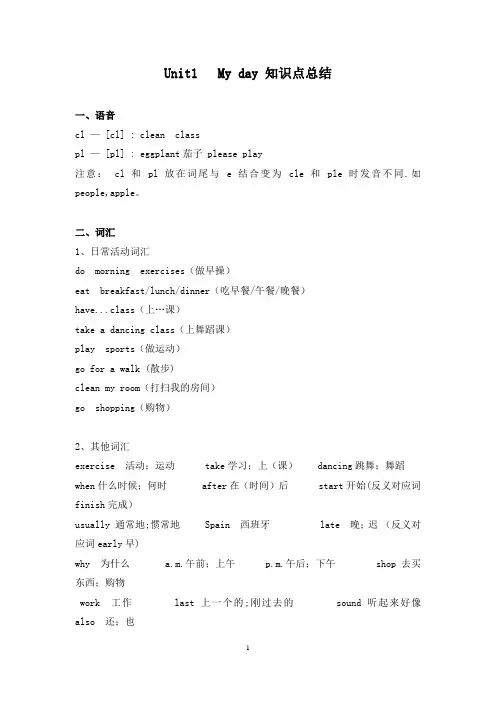
Unit1 My day 知识点总结一、语音cl — [cl] : clean classpl — [pl] : eggplant茄子 please play注意:cl 和 pl 放在词尾与 e 结合变为cle 和 ple 时发音不同.如people,apple。
二、词汇1、日常活动词汇do morning exercises(做早操)eat breakfast/lunch/dinner(吃早餐/午餐/晚餐)have...class(上…课)take a dancing class(上舞蹈课)play sports(做运动)go for a walk (散步)clean my room(打扫我的房间)go shopping(购物)2、其他词汇exercise 活动;运动 take学习;上(课)dancing跳舞;舞蹈when什么时候;何时 after在(时间)后 start开始(反义对应词finish完成)usually 通常地;惯常地 Spain 西班牙 late 晚;迟(反义对应词early早)why 为什么 a.m.午前;上午 p.m.午后;下午 shop去买东西;购物work 工作 last上一个的;刚过去的 sound听起来好像also 还;也busy 忙的need 需要play 戏剧剧本 letter 信Live 居住island 岛always 总是;一直 cave 山洞;洞穴go swimming 去游泳win 获胜。
三、句型以及语法知识点1、询问别人什么时候做某事某种活动的when特殊疑问句型,使用时间短语回答。
When do you do morning exercises? 你何时做早操?I do morning exercises at 7:00.我七点钟做早操。
When do you finish class in the morning? 你们上午的课到什么时候结束?We finish class at 1 o’clock.我们一点钟结束上午的课。
小学英语人教版PEP五年级下册1-6单元知识点总结
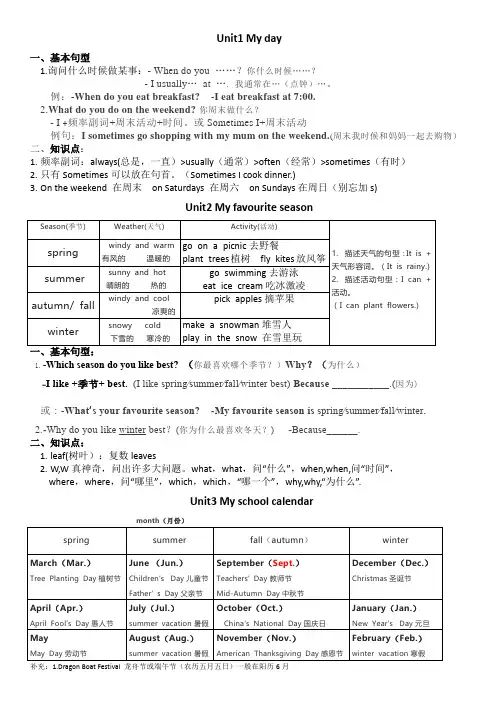
Unit1 My day一、基本句型1.询问什么时候做某事:- When do you ……?你什么时候……?- I usually…at …. 我通常在…(点钟)…。
例:-When do you eat breakfast?-I eat breakfast at 7:00.2.What do you do on the weekend?你周末做什么?- I +频率副词+周末活动+时间。
或Sometimes I+周末活动例句:I sometimes go shopping with my mum on the weekend.(周末我时候和妈妈一起去购物)二、知识点:1.频率副词:always(总是,一直)>usually(通常)>often(经常)>sometimes(有时)2.只有Sometimes可以放在句首。
(Sometimes I cook dinner.)3.On the weekend 在周末on Saturdays 在周六on Sundays在周日(别忘加s)Unit2 My favourite season1.-Which season do you like best? (你最喜欢哪个季节?)Why?(为什么)-I like +季节+ best.(I like spring∕summer∕fall∕winter best) Because ___________.(因为)或:-What‘s your favourite season? -My favourite season is spring∕summer∕fall∕winter.2.-Why do you like winter best?(你为什么最喜欢冬天?) -Because______.二、知识点:1.leaf(树叶):复数leaves2.W,W真神奇,问出许多大问题。
what,what,问“什么”,when,when,问“时间”,where,where,问“哪里”,which,which,“哪一个”,why,why,“为什么”.Unit3 My school calendar补充:1.Dragon Boat Festival 龙舟节或端午节(农历五月五日)一般在阳历6月2.月份首字母大写。
人教PEP版五年级下册知识点归纳

人教PEP版五年级下册知识点归纳要提高小学英语教学效果,我觉得解读小学英语新课标是必须放在首位的。
在这里整理了英语相关知识,快乐看看吧!人教PEP版五班级下册知识点归纳第一单元一、重点词汇eat breakfast吃早餐have...class 上课play sports 进行体育运动exercise 活动,运动do morning exercises做早操eat dinner吃晚饭clean my room 打扫我的房间go for a walk 散步go shopping 去购物take学习,上(课)dancing 舞蹈take a dancing class 上舞蹈课a.m.上午p.m.下午usually 通常地二、其他日常活动get up起床eat lunch吃午饭go to bed 上床睡觉wash my face洗脸wash my clothes 洗我的衣服watch TV看电视play ping-pong打乒乓球play the pipa弹琵琶go swimming 去游泳go running去跑步do homework 做作业do kungfu练武术play football踢足球play basketball打篮球三、语音cl [cl] :clean clock class cleverpl[pl] :plate eggplant please play注意:cl 和pl 放在词尾与e 结合变为cle 和ple 时发音不同。
四、频度副词always总是,一直(100%) usually通常(80%) often 常常(60%) sometimes有时(30%)五、疑问词why 为什么when 什么时候六、重点句型1、询问别人什么时候做某事的句型及回答。
句型结构:问:When do you+动词短语原形+其他?(你/你们什么时候做某事?) 答:I/we(+频度副词)+动词短语原形+at+具体时间. (我/我们通常在几点做某事。
新人教版PEP 【小学五年级英语下册】 单元知识点 归纳总结

新人教版PEP 【小学五年级英语下册】单元知识点归纳总结Unit 1 My DayIn this unit。
we learn some core vocabulary words。
phrases。
and XXX.Core Vocabulary:1.Verbs: take (studying)。
go to (class)2.Nouns: dancing。
exercise。
sports3.Phrases: do morning exercises。
eat breakfast。
play sports。
eat dinner。
go for a walk。
go shopping。
clean my room。
take a dancing class。
have a classXXX Vocabulary:1.Verbs: start。
shop。
work。
need。
live。
win。
sound2.Nouns: Spain。
play。
letter。
island。
cave3.ns: after4.XXX: when。
XXX。
a.m。
p.m。
why。
last。
also。
busy5.nal Vocabulary: frequency adverbs (always。
usually。
sometimes)Phrases:watch TV。
eat lunch。
go to bed。
go swimming。
go home。
go to schoolCore Sentence Structure:When do you do morning exercises?" "At 7 o'clock."XXX phrase is "good job" to praise XXX.Which season do you like best。
I like winter best。
This sentence means "which one do you like the most" and "like。
PEP人教版小学英语五年级下册单元知识梳理总结(全套)

Unit 1知识梳理【重点单词】1.exercise 活动;运动2.take 学习;上(课)3.dancing 跳舞;舞蹈4.when 什么时候;何时5.after 在(时间)后6.start 开始ually 通常地;惯常地te 晚;迟9.a.m. 午前;上午10.p.m. 午后;下午11.why 为什么12.busy 忙的13.always 总是;一直【重点词组】1.eat breakfast 吃早饭2.have … class 上……课3.play sports 进行体育运动4.do morning exercises 做早操5.eat dinner 吃晚饭6.clean my room 打扫我的房间7.go for a walk 散步8.go shopping 去买东西;购物9.take a dancing class 上舞蹈课【重点句子】1.I get up at 5 o’clock.我五点钟起床。
2.That sounds like a lot of fun.听起来很有趣。
3.I usually wash my clothes.我通常洗我的衣服。
4.Sometimes I cook dinner.有时候我做晚饭。
5.I often go shopping.我经常去购物。
【重点对话】1.—When do you finish class in the morning? 你们上午的课到几点结束? —We finish class at 1 o’clock.我们一点钟结束上午的课。
2.—When do you eat dinner? 你几点钟吃晚饭?—At 6:00 p.m.下午六点钟。
3.—What do you do on the weekend ? 你周末做什么?—I often watch TV and play ping-pong with my father.我经常看电视,也常和我爸爸一起打乒乓球。
【口袋书】人教版PEP五年级下册英语 基础知识汇总
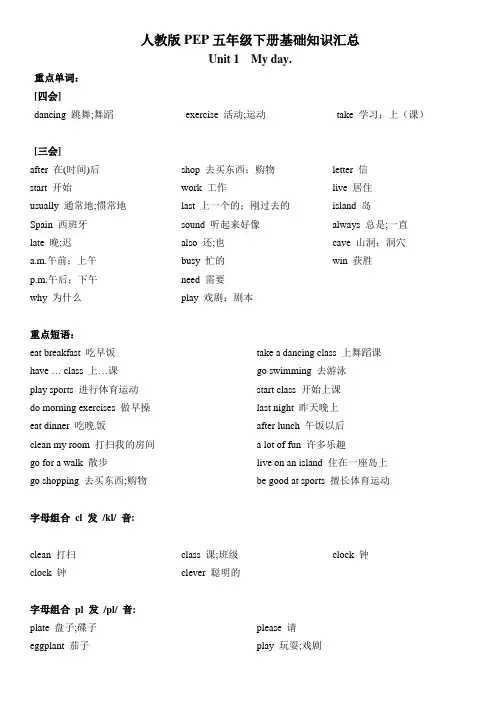
人教版PEP五年级下册基础知识汇总Unit 1 My day.重点单词:[四会]dancing 跳舞;舞蹈exercise 活动;运动take 学习;上(课)[三会]after 在(时间)后start 开始usually 通常地;惯常地Spain 西班牙late 晚;迟a.m.午前;上午p.m.午后;下午why 为什么shop 去买东西;购物work 工作last 上一个的;刚过去的sound 听起来好像also 还;也busy 忙的need 需要play 戏剧;剧本letter 信live 居住island 岛always 总是;一直cave 山洞;洞穴win 获胜重点短语:eat breakfast 吃早饭have … class 上…课play sports 进行体育运动do morning exercises 做早操eat dinner 吃晚饭clean my room 打扫我的房间go for a walk 散步go shopping 去买东西;购物take a dancing class 上舞蹈课go swimming 去游泳start class 开始上课last night 昨天晚上after lunch 午饭以后a lot of fun 许多乐趣live on an island 住在一座岛上be good at sports 擅长体育运动字母组合cl 发/kl/ 音:clean 打扫clock 钟class 课;班级clever 聪明的clock 钟字母组合pl 发/pl/ 音:plate 盘子;碟子eggplant 茄子please 请play 玩耍;戏剧重点句型:1.询问别人什么时候做某事的问句及回答:-- When do/does + 主语+ 动词(短语)原形(+ 其他)?-- 主语(+ 频度副词)+ 动词(短语)原形/ 第三人稀单数形式+ at + 具体时间/ At + 具体时间.-- When do you get up? 你什么时候起床?-- I get up at 5 o'clock. 我5点起床。
人教版PEP小学英语五年级下册知识点汇总(最新)
人教版PEP小学英语五年级下册知识点汇总(最新)Unit One: This Is My DayBasic Vocabulary:Activities: get up。
do morning exercises。
have English class。
play sports。
play the piano。
climb mountains。
go shopping。
go hiking。
visit grandparents。
eat breakfast。
eat dinner.Basic XXX Structures:1.Asking about daily routines:When do you。
(你什么时候。
)XXX I。
(我通常在。
(点钟)。
(做什么事)。
有时。
)XXX: When do you go to school。
(你每天几点去上学?)I usually go to school at 7:00.Sometimes I go to school at7:10.2.Asking about XXX:What do you do on the weekend。
(你周末做什么?)XXX I。
(我通常/经常。
有时。
)XXX: What do you do on the weekend?I often play XXX I go shopping with my mom.3.Introducing one's own habits:Every weekend。
I go hiking。
(我每个周末远足。
)Every day。
I do my homework at 8:00 in the evening。
(我每天晚上8点做作业。
)4.Asking XXX:What do you do。
(你是干什么的?)Time:morning。
afternoon。
evening。
noon。
at night。
6:00.on Sunday。
人教版PEP小学英语五年级下册知识点汇总(最新)
人教版PEP小学英语五年级下册知识点汇总Unit One This Is My Day【基本词汇】:Activities(活动) Time(时间)频率词get up 起床do morning exercises 晨练 have English class上英语课 play sports 进行体育活动 play the piano 弹钢琴climb mountains 爬山go shopping 购物go hiking 去远足visit grandparents 看望外/祖父母eat breakfast 吃早饭eat dinner 吃晚饭morning 早上in the afternoon下午evening 晚上noon 中午at night 夜晚6:00 具体时间on Sunday 在星期天when 什么时候always总是usually通常often经常sometimes有时seldom很少never从不注:表格拉长排版乱的话把手机横过来就OK啦【基本句型】:1. 询问生活规律:---- When do you ……?你什么时候……?---- I usually… at …Sometimes I….我通常在…(点钟)…(做什么事)。
有时…E.g. --- When do you go to school ? 你每天几点去上学?--- I usually go to school at 7:00. Sometimes I go to school at 7:10.2. 询问生活习惯:--- What do you do on the weekend? 你周末做什么?--- I usually / often ….. Sometimes I …..E.g. --- What do you do on the week?--- I often play football. Sometimes I go shopping with my mom.3. 介绍自己的生活习惯:Every weekend I go hiking. 我每个周末远足。
人教版PEP五年级下册英语知识点复习总结
人教版PEP五年级下册英语知识点复习总结When do you usually do certain things。
For example。
"When do you get up?" or "When do you have breakfast?" XXX structure "When do you + verb (phrase) + other?" When asking about a third person。
the verb "do" should be changed to "does" and the answer should reflect the third person singular subject。
For example。
"When does he get up?" "He gets up at 6:00am."To ask about someone's weekend plans。
you can use the sentence structure "What do you do on the weekend?" and followup with specific days or activities。
For example。
"What do youdo on Saturdays?" To talk about a regular activity on a specific day。
you can use the sentence structure "I + adverb of frequency + verb (phrase) + with someone + on [day of the week]."The verb "play" can be used in different contexts。
新人教版PEP五年级英语下册各单元知识点总结
新人教版PEP五年级英语下册各单元知识点总结Unit 1: Our Classroom- Classroom objects and their names- Sentences to describe classroom objects and their locationsUnit 2: Our Clothes- Clothing items and their names- Describing clothing using colors and patterns- How to ask and answer questions about what someone is wearingUnit 3: I Love Sports- Sports vocabulary and their names- Describing sports using adjectives (e.g., fun, exciting, tiring)- Expressing preferences for certain sportsUnit 4: My Birthday Party- Vocabulary related to birthdays and celebrations- Describing activities at a birthday party- Expressing likes and dislikes about different party elementsUnit 5: At the Farm- Vocabulary related to farm animals and their names- Describing farm animals using adjectives (e.g., big, small, noisy) - Describing activities at a farm (e.g., feeding animals, milking cows)Unit 6: A Fun Day Out- Vocabulary related to amusement park rides and activities- Describing activities and experiences at an amusement park- Expressing likes and dislikes about different rides and activitiesUnit 7: A Friendly Letter- Vocabulary related to writing a letter (e.g., greeting, closing, signature)- Structure of a friendly letter- Writing a letter to a friend, describing personal experiences or activitiesUnit 8: Our Pets- Vocabulary related to pets and their names- Describing pets using adjectives (e.g., cute, friendly, playful)- Talking about responsibilities and caring for petsUnit 9: Our Earth- Vocabulary related to the environment and nature- Describing different natural elements (e.g., mountains, rivers, plants)- Expressing concerns and suggesting actions to protect the environmentUnit 10: Fun with Art- Vocabulary related to art and artistic activities- Describing different art forms (e.g., drawing, painting, sculpting) - Talking about personal preferences for different art activitiesUnit 11: Let's Travel- Vocabulary related to travel and transportation- Describing different modes of transportation (e.g., car, train, airplane)- Talking about travel experiences and preferences for different destinationsUnit 12: Healthy Habits- Vocabulary related to health and healthy habits- Describing different healthy habits (e.g., exercise, balanced diet, enough sleep)- Talking about personal choices and habits for a healthy lifestyle。