
人教版英语九年级Unit10单元检测
九年级Unit10单元检测二、单项填空()26.Tomorrow is Labor Day. He ________ his uncle.A.dropped by B.drop by C.drops by D.will drop by ()27.The film is worth ________.A.see B.seeing C.seen D.sees()28.Sanya is famous ________ its beautiful beaches.A.of B.as C.for D.from()29.David felt very happy.________,it was his first time to have a party in our class for him.A.At l east B.After all C.At once D.At all()30.We must keep them from ________ to know our plans.A.got B.getting C.to get D.gets()31.Could you tell me how to ________ at the table?A.take B.behave C.put D.smell()32.We can ask him for some advice at any time ______ during his holidays.A.except B.except for C.but D.so ()33.—We are going on a school trip tomorrow. —________.A.Excuse me B.I'm sorry to hear that C.You're welcome D.Have a good time()34.Jack ________ dislike the weather in Beijing in spring, because there is so much wind and sand.But now he ________ it.A.is used to; used to B.used to; is used to C.was used to; is used to D.used to; uses to()35.President Xi Jinping calls on Chinese people to ________ all the food each meal.A.eat up B.use up C.pick up D.cut up()36.—The food looked bad, but it ________ OK. —So we can't judge a man by his appearance.A.is tasted B.tasted C.was tasted D.taste()37.—Come and join us, Ben! —I'm afraid I can't.I'm too busy now.If I ________ time, I woul d certainly go. A.had B.will have C.have had D.have()38.A direct order like “Daisy, pass me the book” sounds rude.We'd better say: “________”A.Daisy, coul d you please pass me the book? B.Daisy, I wonder if can you pass me the book.C.Daisy, give me the book! D.Daisy, I wonder you can pass me the book.()39. I spent $5 ________ this book. A.in B.to buy C.buying D.buy()40.—Shall we go for a picnic tomorrow? —Well, it all ________ the weather.A.bel ongs to B.happens to C.d epends on D.concentrate on()41.Our plane is ________ in a few minutes.Please be seated and keep your safe belt fastened.A.turning off B.putting off C.taking off D.getting off()42.—Do you know why he didn't ________ a word when he ________ to? —Because he was too nervous. A.speak; speaks B.say; was spoken C.say; spoke D.speak; is spoken()43.—You l ook sad. What has happened? —Everyone ________ us to win the match, but we lost.A.expects B.expected C.hopes D.hoped()44. You are ________ to write quickly when we have a meeting.A.suggested B.supported C.taught D.supposed()45.By the time I locked the d oor, I realized I ________ my keys at home.A.had repaired B.had changed C.had forgotten D.had left中考在线1.It’s very kind ____ them to pick me up at the railway station and drive me home. A.for B.to C.of D.with2. Usually people in Japan and Korea _____ when they meet for the first time.A. are supposed to kissB.are supposed to bowC. supposed to kissD.supposed to bow3. Mrs Green _____ go to hospital,but now she is in good health.A. has toB.needs toed toD.ought to4.All the clerks went home _____ Mr Wang for he had to finish his work. A .except B.besides C.without5. .[2013·咸宁] —Coul d you give me some________ on how to learn English________?—Sure. Practice makes perfect. A.advice; good B.suggestions; good C.advice; well D.suggestion; well1. Do you like the music__________ (call) Yesterday Once More?2. Helen made a plan__________ (visit) the Great Wall this Sunday.3. I'm sorry to let you keep ___________(wait) for us so l ong.基础知识练习---Ⅰ单项选择1._____ the weather was cold,Wei Ganggang jumped into it to save others.A. AlthoughB. WhenC. IfD. Because2. They are friendly to me.So I’m made _____ at home. A.feel B.to feel C.feeling D.felt3. ---All the clerks went home ___ Mr Wang.Why? ---Because he had to finish his work.A.exceptB.besidesC.withoutD.beside4. .He can carry the heavy box. He's strong, _____.A.at all B.at last C.after all D.all al ong5. [2013·莱芜] —It's too hot today.—Yes. Why don't you________ your jacket?A.put on B.put up C.take off D.take after6.[2013·内江] The plane to Chengdu________ just now. You have to wait until tomorrow.A.took off B.took after C.took out D.took away7.[2013·重庆] I'll go to visit my aunt in England ________the summer holidays start.A.while B.since C.until D.as soon as8.It is polite________ a gift when you visit somebody for the first time.A.take B.taking C.to take D.took9.【2013 山东青岛】14. — You look sad. What has happened? —Everyone ______ us to win the match, but we lost.A. ExpectsB. expectedC. hopesD. Hoped10.I often drop ________ my uncl e’s home. A. By B. over C. in D. In11.We always _______ our friends’ homes without ______ plans.A. drop by; makeB. drop by; makingC. visit; makeD. visit; to makeII. 用括号中所给单词的适当形式填空1.He is used to ________ (shop) on Sundays.2.His sister learned English by ________ (she).3.Our plan is sure to _____________ (success).4.The old man has been ________ (die) for a year.5.Are you used to __________(stay)with us in China?6.We can park the car here while __________(go) shopping.7.We couldn't stop__________(laugh) when hearing the joke.综合能力提升I.单项选择1. In China, stud ents ______ greet the teachers when classes begin.A.are supposed toB.are suppose toC.supposed toD.suppose to2. The plane will ________ from Beijing Capital Airport and land in London.A. take onB. take offC. take outD. take away3.The peaceful music in the CD made the stud ents relaxed. A. feel B. feels C. felt4. —Peter has changed a lot, hasn’t he? —Yes. He used to the guitar, but now he is more in playing soccer.A. plays; interestedB. play; interestedC. play; interestingD. playing; interest5. — Coul d we see each other at 9 o’clock tomorrow morning?—Sorry, let’s make it ______ time.A.other’sB. the otherC. anotherD. other6.—Oh, dear! Who’s broken my glasses? —______ he ______ I. It was your cat.A. Both; andB.Not only; but alsoC. Either; orD. Neither; nor7. I think _____ not difficult _____ English every morning.A. that; keep reading B.it’s; keep reading C. that; to keep reading D.it; to keep reading8. In France, it’s ______ to say you are full. A.rude B.polit e C.nice D.friendly9. You can’t expect ________ a foreign language well in several months.A. to learnB. learningC. learntD. to be learnt10. —Will you come to the dinner party? —I won’t come unless Jenny ________.A. will be invitedB. can be invitedC. invitedD. is invited11.The room _____ I live _____ is very large. A. which, / B. that, / C. which, in D. where, in12. This is the d octor _____ saved the baby’s life. A. who B. whom C. whose D. which13. The film reminded him ____ what he had seen in American. A. to B. in C. of D. for14. Not only I but also Tom and Jack _____ interested in English because it _____ useful.A. is, isB. is, areC. are, isD. are, are。
(人教版)初中英语九年级 Unit 10单元测试卷(附答案)03
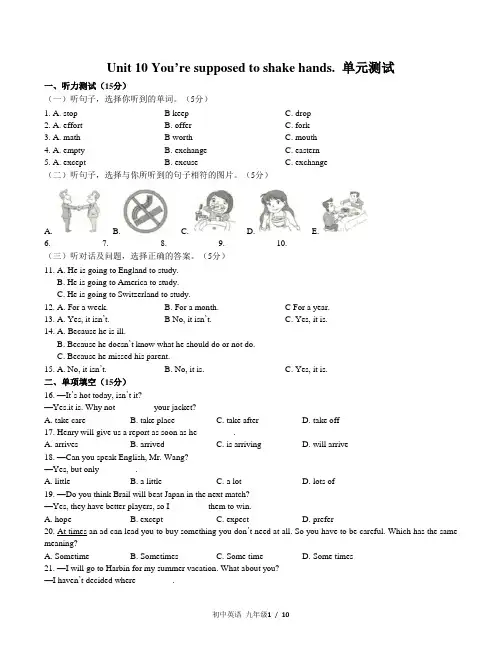
Unit 10 You’re supposed to shake hands. 单元测试一、听力测试(15分)(一)听句子,选择你听到的单词。
(5分)1. A. stop B keep C. drop2. A. effort B. offer C. fork3. A. math B worth C. mouth4. A. empty B. exchange C. eastern5. A. except B. excuse C. exchange(二)听句子,选择与你所听到的句子相符的图片。
(5分)A. B. C. D. E.6.________7.________8.________9.________ 10.________(三)听对话及问题,选择正确的答案。
(5分)11. A. He is going to England to study.B. He is going to America to study.C. He is going to Switzerland to study.12. A. For a week. B. For a month. C For a year.13. A. Yes, it isn’t. B No, it isn’t. C. Yes, it is.14. A. Because he is ill.B. Because he doesn’t know what he should do or not do.C. Because he missed his parent.15. A. No, it isn’t. B. No, it is. C. Yes, it is.二、单项填空(15分)16. —It’s hot today, isn’t it?—Yes.it is. Why not ________ your jacket?A. take careB. take placeC. take afterD. take off17. Henry will give us a report as soon as he ________.A. arrivesB. arrivedC. is arrivingD. will arrive18. —Can you speak English, Mr. Wang?—Yes, but only ________.A. littleB. a littleC. a lotD. lots of19. —Do you think Brail will beat Japan in the next match?—Yes, they have better players, so I ________ them to win.A. hopeB. exceptC. expectD. prefer20. At times an ad can lead you to buy something you don’t need at all. So you have to be careful. Which has the same meaning?A. SometimeB. SometimesC. Some timeD. Some times21. —I will go to Harbin for my summer vacation. What about you?—I haven’t decided where ________.A. goB. wentC. goingD. to go.22. He used to ________ in a small village, but now he has been used to ________ in a big city.A. live; livingB. live; liveC. living; livingD. living; live23. As we all know, it’s not polite to keep others ________ for a long time.A. waitB. waitedC. to waitD. waiting24. —Why are you s0 excited?—Peter invited me ________ on a trip to Yuntai Mountain.A. to goB. goC. goingD. went25. —Have you seen the TV play My Ugly Mother?—Yes, it’s well worth ________. It’s ________ moving that I’ve seen it twice.A. seeing; tooB. seeing; soC. to see; enoughD. to see; too三、完形填空(15分)Around the world, people have different ideas about what good manners are.When you go to restaurants in different parts of the world, it’s 26 to know the right and wrong things to do. For example, in China it’s OK to 27 a lot of noises in a restaurant. In fact, if a restaurant isn’t noisy and 28 , you may think there is something wrong with it. However, in many western countries, restaurants are 29 places. If a table is too loud, other people who are eating there might even 30 to the owner of the restaurant.Paying the bill is also different from country to country. In China, one person usually pays for 31 . In western countries, one person pays if he or she is entertaining clients(宴请宾客), but 32 friends eat together, they usually share the cost. This is called doing Dutch(均摊费用). Also, when westerners pay the bill they usually leave some money for the 33 .This is called “Leaving a tip”. Leaving a tip is thought to be polite. In the U. S, it’s 34 to leave tips of 10%, 15%, or 20% of the bill, which is decided by how good the service is. Good waiters can make a lot of money!The food people eat is different in the world, but you can 35 the same kind of food in many countries. Chinese and Italian food, for example, are popular all over the world.26. A. popular B. difficult C. nice D. easy27. A. cause B. keep C. hear D. make28. A. lively B. friendly C. lucky D. happy29. A. noisy B. quiet C. busy D. clean30. A. shout. B. explain C. complain D. speak31. A. everybody B. nobody C. somebody D. none32. A. until B. when C. unless D. since33. A. gate keeper B. seller C. waiter D. visitor34. A. terrible B. common C. serious D. usually35. A. invent B. discover C. prefer D. find四、阅读理解(20分)ATable manners are how to behave when you eat a meal. They include how to handle knives, forks and spoons and how to eat in n polite manner. To behave well abroad, you are to know some table manners.EATING MANNERSJapan:It is “perfectly”okay to slurp(出声地吃)when you eat noodles. Unlike making big noises, slurping slightly is not rude. Japanese also say it tastes better if you slurp.Russia: Your wrists should be placed on the edge of the table while eating, fork in left hand, and knife in the right. It is not good manners to rest them on your lap. Keep your elbows off the table.Leave some food on your plate to show that the host has given you enough to eat.France:Never discuss money or religion over dinner. What is different from the manners in Russia is that finishing everything on your plate is considered good manners.Mexico:Whenever you catch the eye of someone who’s eating, even a stranger, it’s good manners to say “provecho”, which means enjoy. In Mexico, dining is more than a meal. It’s a social occasion—lunches are seldom quick and suppers can last for hours. Where you sit matters in the country. Before you get seated, look for place cards, or wait until the host seats you. And you must say “enjoy your meal” before you leave the table.DRINKING MANNERSAmerica: If you empty a bottle into someone’s glass, it obliges that person to buy the next bottle.It’s polite to put the last drops into your own glass.Australia: In a pub it’s usual to buy a round of drinks for everyone in your group. When it’s your turn, say “I’s my round”. When it’s their round, they will buy it for you, Don’t leave before you’ve bought a round.Japan: Don’t fill your own glass of alcohol. Instead, you should pour for others and wait for them to do it for you.36. When you are at table in Mexico, you should ________.A. keep silent if you catch the eye of n strangerB. eat as quickly a8 you can to save your timeC. wish others happy with eating before leaving the tableD. seat yourself anywhere before the host tell you to37. When you are drinking in America, you should ________.A. put the last drops into your own glassB. put the last drops into other’s glassC. pour for others and wait for them to do it for youD. leave before you’ve bought a round38. According to the pasage.it is good manners to ________.A. keep quiet when eating noodles in JapanB. leave some food on your plate in FranceC. put the fork in the right hand in RussiaD. take turns to treat each other in Australia39. Which of the following can be the best title of the passage?A. Eating mannersB. Drinking mannersC. Table mannersD. Country manners40. The writer tells us the table manners in many countries in order to ________.A. attract us to these countries to enjoy foreign foodB. help us behave in a polite manner in different countriesC. teach us how to handle knives, forks and spoonsD. make us able to express thanks to different hosts.BFor the British, the home is a private place in which he or she goes to hide away from the troubles of life. It is very seldom that one would be invited to a British person’s home. It is rude to knock on a person’s door if you are not invited. If you are invited, don’t ask to see more than the downstairs that your British host invites you into. Never ask how much the house or any of the items in it cost.To the American, most of them want their home to be a place where they can entertain(款待)and share their lives with their friends. They may be delighted to give you a full tour of their houses. They may also be pleased when you show your interest and pleasure in their houses.Both British and American people will engage in quite a bit of chat and a drink or two before the meal is served. After the first mouthful, you should say how delicious the food is and ask something about it. Remember, never eat with your mouth open and make very little noise while eating. It would be nice of you to help your host in anyway. Maybe offer to pour some drinks or clear up after the meal.41. British people ________ invite friends to their home.A. oftenB. alwaysC. seldomD. never42. If your British friend invites you to his home, you can ________.A. see anything you likeB. ask how much his house isC. ask the cost of any of the items in itD. only see the downstairs that you are invited into43. When you show your interest and pleasure in American people’s houses, they may be ________.A. angryB. happyC. sadD. worried44. What does the underlined “engage in” mean in Chinese?A.陷入B.参与C.回避D.限制45. What’s the main idea of the passage?A. Some manners on visiting British and American people’s homes.B. Different table manners between British and American people.C. Different ideas about the home between British and American people.D. Different ideas about how to get along well with neighbors between British and American people.五、补全对话(5分)根据对话内容,从方框中选择适当的句子填入空白处,使对话完整。
人教版新目标英语九年级(全一册)Unit 10《You’re supposed to shake hands》单元测试题及答案(含答案)
Unit 10 You’re supposed shake hands附参考答案一、单项填空(共15小题,计15分)( ) 1. I eating with spoons.A. used toB. are supposed toC. didn’t use toD. wasn’t used to ( ) 2. While in the country, I made friends with Jim.A. workingB. to workC. worksD. work( ) 3. I ask you to sit down , not to sit down .A. at table, at the tableB. at table, at tableC. at the table, at the tableD. on table, on the table( ) 4. The girl was nervous before she arrived here.A. a bit ofB. a bitC. a fewD. a little of( ) 5. —Is ready for dinner?—No, the table hasn’t been set yet.A. anythingB. everythingC. somethingD. nothing( ) 6. You shake hands when you meet someone for the first time in China.A. would like toB. are supposed toC. want toD. will( ) 7. The train will arrive Shenyang 9:34.A. at, atB. at, inC. in, inD. in, at( ) 8. She was a woman.A. forty year oldB. forty years oldC. forty-years-oldD. forty-year-old( ) 9. He found very difficult to drive a car.A. himB. it isC. itD. that( ) 10. Her idea sounds from ours, we should think it over.A. the sameB. differenceC. differentlyD. different( ) 11. I kept phone calls to my friend but nobody answered.A. to makeB. makeC. madeD. making( ) 12. In 1992, I went to Beijing the first time.A. inB. atC. onD. for( ) 13. Of the three men, one is a worker, two are teachers.A. the othersB. the otherC. othersD. other( ) 14. Spending time with family and friends very important to useA. areB. isC. wereD. being( ) 15. We never eat anything without hands first.A. to washB. washingC. washD. washed二、完形填空(共10小题,计10分)There was a boy named Ben, who was not doing well in school. Boys in his class laughed at him because he seemed so 16 .His mother 17 that she would, herself, have to help her son do better in school .She told him to go to the library to read a 18 a weak and write a report about it for her.One day, in Ben’s 19 , the teacher held up a rock and asked if anyone knew it. Ben put up his hand and the teacher let him 20 .”Why did Ben raise his hand?”his classmates wondered.” He 21 said anything; what could he possibly want to say?”Well, Ben not only 22 the rock; he said a lot about it. He even knew 23 the teacher had found it. The teacher and the students were 24 . Ben had learned all this from doing one of his work reports.Ben later went on to the 25 of his class. When he finished high school, he went to Yale University and at last become one of the best doctors in the United States.( ) 16.A.clever B. hard C. slow D. quick( ) 17.A.asked B. decided C. forgot D. heard( ) 18.A.notice B. message C. office D. lab( ) 20.A.think B. leave C. sing D. speak( ) 21.A.always B. even C. quickly D. never( ) 22.A. found B. played C. knew D. threw( ) 23.A.whether B. when C. where D. why( ) 24.A.afraid B. surprised C. worried D. unhappy ( ) 25.A.top B. end C. back D. last三、阅读理解(共15小题,计24分)AKnowing table manners is very important. Do you know ho to sit at table properly?Don’t put your chair too far away from the table, nor too close, so as to sit up straight at table.Never place your elbows(胳膊肘)on the table.Don’t put your arm in front of or around your plate.Don’t place your hands under the table.While you’re eating, don’t put your elbows in front of the table of the person sitting next to you.Don’t stretch your legs or move your knees back and forth(反复地).A lady isn’t allowed to comb her hair at table.A gentleman shouldn’t shave his beard at table.Never put the napkin under your chin(下巴). And don’t lay it in front of your chest, either. Its main purpose is to wipe your mouth and hands, but not to be used as a piece of dish cloth.Good table manners make life more enjoyable!Never put the napkin under your chin(下巴). And don’t lay it in front of your chest, either. Its main purpose is to wipe your mouth and hands, but not to be used as a piece of dish cloth.Good table manners make life more enjoyable!( ) 26. You should put your chair _________ when you are at table.A. far away from the tableB. under the tableC. neither too far nor too closeD. very close to the table( ) 27. _________ is impolite at table according to the passage.A. Placing elbows on the tableB. Sitting up straightC. Wiping hands with the napkinD. Placing hands on the table( ) 28. What does the underlined word “shave” mean in Chinese?A.抓挠B.触摸C.刮D.看( ) 29. Which is the best title for the passage?A. What should we do in the restaurant?B. How to behave properly at table?C. The rules for behavior in the restaurant.D. Good manners are important.( ) 30. If you want to go to li ly and Brain’s party, you should call them at _________.A.342-5691B.342-7859C.342-4625D.342-7896 ( ) 31. Mike Green has to sell his washing machine because _________.A. he wants to buy a new oneB. it is out of styleC. it wastes too much waterD. he will go broad( ) 32. Where should you go if you want to read books?A. 15 South RoadB. 56 Park RoadC. 15 North RoadD. 216 Zhongshan Road( ) 33. How long does Smith’s Book Club open a day?A. 8 hoursB.10 hoursC. 12 hoursD. 14 hoursCSocial customs and ways of behaving change. Things that were considered impolite many years ago are now acceptable. Just a few years ago, it was considered to be impolite behavior for a man to smoke on the street. No man who thought of himself as being a gentleman would make a fool of himself by smoking when a lady was in the room.Customs also differ from country to country. Does a man walk on the left or the right of a woman in your country? Or doesn’t matter? What about table manners?The Americans and British not only speak the same language but also share a large number of social customs. For example, in both America and England people shake hands when they meet each other for the first time. Also, most Englishmen will open a door for women or offer their seats to women, and so will most American. Promptness(准时)is important both in England and in America. That is, the dinner guest either arrives close to the time that has been made or calls up to explain his delay(耽误).The important thing to remember about social customs in not to do anything that might make other people feel uncomfortable-especially if they are your guests. There is an old story about a man who gave a very formal dinner party. When the food was served, one of the guests started to eat his peas with a knife. The other guests were amused or greatly surprised, but the host calmly picked up his knife and began eating in the same way. It would have been bad manners to make his guest feel foolish or uncomfortable.( ) 34. The underlined phrase “make a fool of himself” in the first paragraph means .A. make himself strongB. make himself richC. make himself comfortableD. cause himself to seem like a fool ( ) 35. According to the passage, the American and the British .A. don’t speak the same languageB. don’t have social customs in commonC. do share a lot of social customsD. do have the exactly same social customs( ) 36. If a dinner invitation is for six o’clock, the guest is supposed to arrive at six.A. nearly or a minute or two later thanB. a quarter pastC. a quarter toD. much later than( ) 37. The last example in the passage shows_________.A. the correct way to use a knife at tableB. that it’s good manners not to make your guest feel foolish or uncomfortableC. that social customs and ways of behaving change too fastD. that different countries have different customsDLetter ADear Rose,I like your programs very much. I’m now writing to ask you something about American social customs(社交习惯). My American friends want me to join them in their dinner party. I am very happy and have decided to go , but I’m a little worried about it , too. The social customs in my country are very different from here, so I’m afraid of making mistakes.Should I bring a present, such as sweets or flowers? Should I arrive on time or a little late?At the dinner table, how can I know which fork(叉子)or knife to use? How can I let the family know that I’m thankful for their kindness?Wang LinLetter BDear Wang Lin,It’s a good idea to bring a small present when you go to a dinner par ty. Flowers are always nice, or you may bring a bottle of wine(葡萄酒)if you know that your friends drink it .You sh ould arrive on time or five to ten minutes late. Don’t get there early. If you’re going to be more than fifteen minutes late, you should call and tell them.Try to be free at the dinner table. If you don’t know about choosing the right fork or knife, just watch the other people, and follow them. If you still have no idea of what to do, ask the person next to you.If you like the food, say so. Of course, you’ll thank them for the meal and for their kindness. It’s also a good idea to send a thank-you card the day after.Rose( ) 36. Wang Lin wants to .A. make friends with RoseB. know some social customs for a dinner partyC. make her friends happyD. give her friends a surprise.( ) 37. Rose is possibly .A. a good housewifeB. a TV hostess(女主持人)C. a member of the dinner partyD. a friend of Wang Lin’s( ) 39. Which of the following is NOT proper(适当的)for joining in a dinner party?A. Get there 15 minutes earlier.B. Make yourself at homeC. Follow others to use forks and knives.D. Thank your friends for the meal.四、单词拼写(共5小题,计5分)41. I’ve just had lunch, so I am f__________ now.42. People of Western countries use k__________ and forks to eat.43. Our chemistry teacher often does e__________ in class to explain some theories.44. —W__________ is this book? Do you know?—Let me see. It must be John’s.45. I often make some m__________ while reading.五、综合填空(共10小题,计10分)The Chinese New Year is the most important holiday for the Chinese People. For the Chinese, New Year comes with the first day of the First Moon, (46) b________ January 21 and February 19. People get (47) r________ for the holiday for fifteen days.Finally, at midnight it is the first day of the First Moon. People close the shops and the streets are (48) e________. Everyone locks the doors and stays at (49) h________.It is an important time for the family. The (50) y________ people bow to the older people. The Chinese call this Ke Tou. This (51) m________ “to touch the ground with the forehead”. Then the young people (52) w________ the older people a happy New Year. The older people give children gifts of (53) m________ in red envelopes. The family then goes to sleep.In the morning, people dress in their best (54) c_______. Some people stay at home, others go out to pay a New Year call. They are very (55) p________ and do not use bad words. It’s the most important day of the year.六、阅读表达(共5小题,计10分)The main difference between China and Western countries on the dinner table is the tableware (餐具), but that’s just a small difference. In quite good restaurant, you can always ask for a pair of knife and fork, if you find the chopsticks are not helpful enough.The real difference is whether people share food on the same plate. In the West, you have your own plate of food ,while in China the dishes are placed in the middle of table and everyonemeat and vegetable dishes. Soup is then served, followed by rice, noodles or dumplings. Perhaps what surprises Western visitors most is that Chinese hosts like to put food into the plates of their gue sts. In formal dinners, there are always. “Public” chopsticks and spoons, but some hosts may use their own chopsticks. This is a sign of politeness. It is always polite to eat the food.People in China tend to order more food than they could eat. They will think it embarrassing if all the food is eaten.(一)根据短文内容简要回答问题56. What’s the real difference between Chinese and Western table manners?______________________________________________________________________57. What may make Western guests feel surprised when they have dinner in a Chinese family?______________________________________________________________________(二)将短文中划线的句子译成汉语.58.______________________________________________________________________59.______________________________________________________________________(三)请给短文拟一个适当的标题.60.______________________________________________________________________七、完成句子(共4小题,计6分。
人教版英语九年级全册 Unit 10 单元测试题(有答案)
人教新目标英语九年级全册Unit 10 单元测试题一.单项选择。
(每小题1分,共15分)1.It’s bad for your eyes _____computer games too much.A. playsB. to playC. playD. to playing2.There is _____ milk at home, We have to buy some this afternoon.A. a littleB. littleC. a fewD. few3.Don’t waste water, Water is very important and no one can live it.A. withoutB. withC. exceptD. but4.On weekends, I have nothing to do but ________ TV.A. to watchB. watchingC. watchD. watched5.We need fifteen more people _____our team to do the job.A butB exceptC as wellD besides6.---Did you go to the movie with Lucy? --- No , I _____A .didn’t inviteB wasn’t invitedC hadn’t invitedD wasn’t inviting7.---I don’t know ______next. – You could ask your teacher for help.A how to doB what to doC . why to doD when to do8.I have ____the English club for three terms.A. joined B been in C taken part in D become a member of9. The big bowl ____wine warm in the old days.A was used for keepingB is used by keepingC was used by keepingD is used to keep10. My grandfather ___ me stories when I was young .A .was used to tellB .is used to tellingC .used to tellD .used to telling11. ____ expensive trousers!A. WhatB.What aC.HowD. What an12.--- Would you like to go there with me?--- Yes, I shall go unless I ____ too busy.A. won’t beB. will beC. am notD. am13.Because of the bad weather, we ________the meeting.A. put offB. took offC.cut offD. clean off14. ---Whose letter is that?——The letter ______in Chinese is to Li Lei.A. writesB. is writtenC. writtenD. writing15. My mother’s birthday is coming. I’m thinking about ____________.A. what present shall I get herB. how I can give her a surpriseC. where we had a big mealD. whether should I plan a party for her or not.二.完形填空。
人教版九年级英语上册Unit 10 培优检测卷含答案
人教版九年级英语上册Unit 10 培优检测卷第一部分选择题(共50分)一、阅读理解(共20小题,每小题2分;满分40分)第一节阅读下面语言材料,从每题所给的A、B、C、D四个选项中选出最佳选项。
A1. Adam didn't buy drinks for his friends because ____.A. he had no moneyB. his friends refused himC. they didn't finish theirsD. they didn't need any more2. To show they like the lecture, the students ____ in Germany.A. stand upB. clap their handsC. knock on the desksD. put their hands on the desks3. How might Zoe feel when she heard her friend's explanation?A. Surprised.B. Happy.C. Angry.D. Bored.4. In which part of a magazine can we probably read this passage?A. Education.B. Health.C. Customs.D. Science.BIn the eyes of many foreigners, Chinese are the best hosts and the worst guests in the world. They're not really bad guests, but because the guest-host relationship in China is much different from that in some western countries, it appears that they are not nice guests. And western guests sometimes look rude (粗鲁的) in the eyes of Chinese guests.In China,hosts try their best to make guests feel at home. Whenever I enter a Chinese person's home, there is always fruit on the table for me, and someone is quick to bring me a cup of tea or water. In the west, acting according to the host's way of doing things is usual behavior for a guest.My wife's mother, a very kind elderly Chinese lady, doesn't smoke. When I see some of her guests smoking in her house, as a non-smoker, I feel unhappy. Usually I want to stop them directly, but I must realize that in China, to be a good host, she must not do that. In most North American homes, if you are a guest, and the hosts are not smokers, you should not smoke in their house. At the very least, you could ask,“Is it OK if I smoke?” But, don't be surprised if they say, “No, you can't smoke. ” In our culture, if you smoke in their home, you are a bad guest, but if they don't allow you to smoke in their house, they are not a rude host.Guests in China also have special habits. Some western people may not adapt__to these habits very soon. Thankfully my wife is Chinese, so whenever we visit a Chinese family she tells me to buy them a gift. However, giving a gift to a host is notalways necessary in my country. So, if you invite international guests to your home, don't be too surprised if they don't bring you a gift.In China, you probably won't need to change the guest-host relationship very much because you will probably only be the host, and Chinese are naturally very good hosts. If western hosts invite you to their house, try not to be too surprised if their style of treating you is not what you have expected.5. When a western guest visits a Chinese family, he often ____.A. buys some fruitB. gets a warm welcomeC. wants some giftsD. takes a cup of coffee6. If the writer's guests want to smoke in his house, what will he probably say?A. It's OK if you smoke here.B. Let's smoke together.C. Sorry, you can't smoke here.D. Smoking is a bad habit.7. The underlined words“adapt to”in the fourth paragraph probably mean“____”.A. think back toB. get used toC. look forward toD. keep close to8. What is the main idea of this passage?A. Foreigners should learn from Chinese.B. Hosts must do things in the guest's way.C. Western hosts are always nice to guests.D. People should understand cultural differences.CWhether you have foreign friends or a foreign teacher, you might find one day they invite you to their house. What should you expect? How should you behave? Follow these tips, and you'll behave well.Before you go, ask what kind of visit this is. If you are invited for an activity like watching TV or playing a game, then you won't be expected to bring anything with you. If you're invited for dinner, ask if there is something you can bring, like a drink, some snacks or a dessert.When you arrive, your host will usually offer you a drink. Don't just say: “I'll have a Coke. ” Ask what they have now, and then make your choice. This way youwon't ask for something they don't have, which will save everyone from embarrassment(尴尬).When you're invited to someone's house for a meal, offer to help your hosts prepare food or set the table. If they decline(谢绝)your help before the meal, make sure you offer to clean up afterwards.Remember that while some people appreciate a guest's help, others would prefer that you just relax and enjoy yourself.When the meal is ready, it's polite to try everything on offer.When you leave, thank your hosts for inviting you. If you can, invite them next time!9. What should you bring if your foreign friend asks you to play games with her?A. Drinks.B. Desserts.C. Snacks.D. Nothing.10. What can we learn about having drinks when visiting a family?A. Every home has prepared Coke for guests.B. Don't ask for a certain drink directly.C. Bring your own drinks to be a good guest.D. It is rude to have drinks in the host's house.11. What does the underlined word “afterwards” exactly refer to?A. After the meal.B. After arriving at the house.C. Before the meal.D. In the kitchen.12. What does the passage mainly talk about?A. How to make friends with foreigners.B. What gift we can buy for our foreign friends.C. How to behave well when invited to a foreigner's house.D. What we can drink and eat at the party.DWe can't remember clearly when we started to take our phones to a dinner table. It's very common especially when we eat out. Once a dish comes, instead of lifting our chopsticks, we hold up our phones and take a photo. Later, we post the photosonto Weibo or WeChat, waiting to be “liked”. In the following moments, we check our phones from time to time during the meal, to see whether we get “liked” or not. We just cannot leave our phones for even a meal.Does that sound familiar to you? Do you do that often? If not, how do you feel if others do so while dining with you?A recent study suggests that spending time taking photos of food makes the food less pleasant. To test this, some researchers did an experiment. Some people were asked to take photos before they could enjoy food. As a result, it showed that the more photos they took, __▲__. So, why not stop taking photos and just enjoy the food in front of you?Besides the scientific result, there are also some other bad influences of taking photos of food before meals. After posting the photos onto the Internet, one will not be able to control hi mself or herself and check the phone again and again. “Does everyone like my photos? Do the ones I care like them? I do hope so!” It seems that your phone secretly calls your name all the time, even when you are with real people.Then how about not taking photos of food when you go out to dine with someone next time? Let the food be delicious as it is and share your life with people around you. Just put your phone aside, and you'll see how wonderful the meal will be.13. What happens a lot at the dinner table nowadays?A. People talk about their Weibo or WeChat.B. People learn from each other how to cook dishes.C. People enjoy taking photos with friends or family.D. People take photos of food and post them before eating.14. Which of the following c an be put in the “__▲__” in Paragraph 3?A. the less cheerful they becameB. the more “liked” they got on Weibo or WeChatC. the more interest they had in the foodD. the less delicious the food seemed to be15. What does the fourth paragraph mainly talk about?A. The reasons for checking your mobiles.B. The ways of posting the photos onto the Internet.C. The tips for making others like your photos on the Internet.D. Some other bad influences of taking photos of food before meals.16. What can we learn from the passage?A. Take photos of food in order to have a wonderful life.B. Take photos of delicious food and share them with others.C. Remember to have dinner with our family and friends at home.D. Enjoy the life with people around us instead of taking photos of food.第二节阅读短文,从方框内所给的选项中选出可以填入空白处的最佳选项,其中有一个多余的选项。
人教版九年级英语Unit 10单元测试卷及答案
人教版九年级英语Unit 10单元测试卷第一部分(听力共30分)I.听对话,选答案(共15小题,计20分)第一节:听下面10段对话,每段对话后有一个问题,读两遍。
请根据每段对话的内容和后面的问题,从所给的三个选项中选出最恰当的一项。
(共10小题,计10分)( ) 1. A. I am full. B. It was delicious. C. I don’t want to eat more.( ) 2. A. At about 6:30. B. At about 7:00. C. At about 7:30.( ) 3. A. Being on time. B. Greeting others C. Buying some presents.( ) 4. A. To eat with his chopsticks. B. To put his chopsticks on the table.C. To stick his chopsticks into his food.( ) 5. A. Korea. B. Japan. C. Brazil.( ) 6. A. India. B. America. C. Brazil.( ) 7. A. At 8:50. B. At 9:00. C. At 9:10.( ) 8. A. some snacks. B. Some books C. Some flowers( ) 9. A. What to take to her friend’s party. B. How to behave at the dinner table.C. What to wear at her friend’s party.( )10. A. They are supposed to kiss. B. They are supposed to bow.C. They are supposed to shake hands.第二节:听下面两段对话,每段对话后有几道小题,请根据每段对话的内容和后面的问题,从所给的三个选项中选出最恰当的一项。
(人教版)初中英语九年级 Unit 10单元测试03-答案
Unit 10 You're supposed to shake hands. 单元测试答案解析一、(一)【答案】1.С 2.А 3.В 4.А 5.A(二)【答案】6.E 7.D 8.C 9.A 10.B(三)【答案】11.C 12.В13.С14.В15.А听力录音原文:(一)听句子,选择你所听到的单词。
1. We often just drop by our friends’ homes if we have time.2. I make an effort to be on time when I meet my friends.3. It is worth the trouble if you want to understand another culture.4. It’s impolite to use your chopsticks to hit an empty bowl.5. You’re not supposed to cat anything with your hands except bread.(二)听句子,选择与你所听到的句子相符的图片.6. It’s impolite to reach across the table or in front of someone.7. It’s polite to be quiet when drinking soup or eating food.8. After the meal Jenny is brushing her teeth in the bathroom.9. You are supposed to shake hands when you meet someone for the first time.10. Smoking is not allowed in public place in China.(三)听对话及问题,选择正确的答案。
【初中英语】人教版九年级全一册Unit 10 单元过关测试卷 (练习题)
人教版九年级全一册Unit 10 单元过关测试卷(739)1.Th is(交换) s tud e n t h a s s tu d ied in o ur s c ho o l fo r on e ye a r.2.A s a s tu de n t,we sh o u ld(珍视)time a nd s tud y h a r d.3.J im is a go od bo y.H e (表现) we ll a t s c ho o l.4.Th e re is no th ing in th e bo ttle.It's(空的).5.Th e mo vie is ve r y i n te r e s ting.It is wo rth(se e).6.Ch ina is on e o f the(ea s t)co un tr ie s.7.I a m c o mf o r ta b le(ta lk)with h e r fo r s h e is s o n ic e.8.H e is (ex pe c t) to d o we ll in th e te s t.9.Lis te n in g to mu s ic ma k e s me f e e l (re la x).10.假如你叫张峰,你的笔友P a u l要来中国学习一段时间。
在到中国之前,他想了解中国的风俗习惯,请你给他写封信,讲述一些中国的风俗习惯,告诉他不要紧张。
内容提示:1.可以从见面问好、餐桌礼仪等方面介绍。
2.词数:90词左右。
3.文章开头和结尾已经给出,不计入总词数。
参考词汇:s h ake h an d s握手;tab le ma n n e r s餐桌礼仪;s tic k…in to…把……插进……里D ea r P a u l,I a m g la d to kn o w th atI a m lo o k in g fo r wa rd to s ee in g yo u in Ch ina.You r s,Zh a n g Fe n g11.Do n't b e a f r a id., n o o ne r ec o gn iz ed(认出)yo u.()A.A f te r a llB.In a llC.A bo ve a llD.Fir s t o f a ll12.It is p o lite a g if t wh en yo u vis it s o me b o d y f o r th e f ir s t time.()A.tak eB.tak in gC.to ta keD.to o k13.—Yo u'd b e tte r h u r ry.We'll b e la te f o r th e p la n e.—D o n't wo r r y.T h e p la n e will in two h ou r s.()A.tak e o u tB.tak e a wa yC.tak e o ffD.tak e a f te r14.T he f ilm is s o wond e r f u l th a t it is wo r th f o r e ve r yo n e in C h ina.()A.se eB.to s e eC.se e ingD.se e s15.P eo p le in d iff e re nt c o un tr ie s h a ve d iff e re n t wa ys o f do in g th ing s.S o me th in gis in on e c o un tr y,b u t it ma y b e qu ite imp o lite in an o th e r.In B r ita in,yo u mu s tn't lif t yo u r b o wl to yo u r wh e n yo u a re ha vin g so me liq u id(液体)f o o d.B u t it's in C h in a.And in J a p an yo u e ve n ne e d n't wo r r y a b o u tma k in g wh ile yo u a r e h a vin g it.It s h o ws tha t yo u'r e e n jo yin g it.B u t pe op le in B r ita in th ink it is ba d ma nn e r s.If yo u a r e a vis ito r in Mo n go lia,wh a t ma n n e rs d o th e y wis h to h a ve?Th e y wis h yo u to h a ve a lo u d “bu r p(打嗝)”yo u f in is h ea tin g.B u rp in g s ho ws tha t yo u lik e th e fo od.In B r ita in,yo u s h ould tr y n o t to yo u r h a nd s on th e ta b le wh en yo u'r e h a ving a me a l.B u t in A ra b(阿拉伯)co u n tr ies yo u mu s t b e ve r y c a r e f u l with yo u rh a nd s.You ea t with yo u r le ft h a nd.A ra b s c o ns id e r(认为) itve r y ma nn e r s ea tin g with le f t ha n d s.So whe n yo u ar e i n o t h e r c o u n t r i e s,yo u c a n a sk the na tive p e op le to he lp yo u o r ju s t ca r ef u lly a n d f o llo wth e m.A s a sa yin g g o e s,“Wh e n in R o me,d o a s th e Ro ma n s do.”(1)A.b a d e f u lC.po liteD.re la xe d(2)A.mo u thB.no s eC.e ye sD.e a r s(3)A.sa meB.d iff e re n tC.imp o r ta n tD.n e ce s s a r y(4)A.fa c e sB.de c is ion sC.mis ta k e sD.n o is e(5)A.th e mB.h imC.yo uD.h e r(6)A.a f te rB.be f o reC.un tilD.s in c e(7)A.g iveB.pu tC.br in gD.c a r r y(8)A.n e ed n'tB.mu s tn'tC.sh o u ld n'tD.c a n't(9)A.g o odB.s tr an geC.luc k yD.b a d(10)A.lis tenB.doC.wa tc hD.h a pp en16.G o in g to a f r ien d's h o u se is ve r y e x c itin g.Yo u ma y s p e n d time with a f r ien d a nd g e t to s e e wh e re he o r s he live s.S o r e me mb e r to be po lite.W h en to a r r iveT h e f ir s t th in g to r e memb e r is th a t wh e n a f r ie n d in vite s yo u o ve r,yo u n e e d to a r r ive o n time.If yo u r f r ie n d te lls yo u to c o me a r o un d 3:00 p.m.,th a t me a n s yo u c an tu r n up a little la te a f te r3:00 p.m.B u t u s u a lly it is a go od th ing to a rr ive a t th e r ig h t time.W h a t to b r in g?O f ten it is a lso n ic e to b r ing so me th in g to yo u r f r ie n d's h o u s e.T h is co u ld b e a b ox o f c h o co la te s fo r yo u two to s h a re,o r ma yb e a mo vie th a t yo u c a n wa tc h to ge th e r.Yo u c a n a ls o b r in g so me f lo we r s. A little g if t is a n ice wa y to s ho w yo u r f r ie nd th a t yo u a r e e x c ited to b e a t h is o r h e r h ou s e.W h en yo u vis it yo u r f r ie n d's h o u se,yo u ma y a ls o me e t h is or he r p a re n ts.Yo u sh ou ld te ll th e m wh o yo u a r e a n d the y ma y te ll yo u t h e ir n a me s.As a ch ild,I we n t to vis it my f r ie n d P au l.I c a lled h is p a re n ts b y th e ir f ir s t n a me s J o hn an d Ma r y.B u t no w I kn o w it is mo r e po lite to c a ll th e m M r.a nd M r s.S mith.Th is will s h ow th e m mo r e r e sp e c t(尊重)an d th en the y ma y te ll yo u to c a ll th e m b y th e ir f ir s t n a me s.A n o th e r wa y to s h o w r e s p ec t is to c a ll the m M a da m o r S ir.It is a c o o l th in g to vis it a f r ie nd's h o u s e.Be po lite to yo u r f r ie n d a nd yo u r f r ie n d'sp a r en ts,an d th e y will in vite yo u a ga in.(1)If yo u r f r ie n d a s k s yo u to g e t to h is h o u se a r o un d 4:30 p.m.,it is po lite to a r r ivea t .()A.4:00 p.m.B.4:35 p.m.C.5:30 p.m.D.6:00 p.m.(2)W he n yo u go to yo u r f r ie nd's h o u s e,yo u ca n b r ing.()A.a bo x o f ch oc o la te sB.so me f lo we r sC.a mo vieD.a ll o f th e a b o ve(3)W h ic h o f the f o llowin g ca n we ch o os e fo r th e b lan k(空白)in th e pa s s ag e?()A.W ha t to d oB.W h a t to ea tC.H o w to g r e e tD.Ho w to vis it(4)Th e p a s s ag e ma in ly te lls u s.()A.wh e n to a r r ive a t our f r ie n d's h o us eB.ho w to g r ee t ou r f r ie n d's p a r e n tsC.wha t to b r ing to o u r f r ie n dD.h o w to be a g oo d vis ito r(5)Th e p a s s ag e ma y b e.()A.a n a r tic le in a ma g az in eB.a le tte r f ro m a c h ild to pa r e n tsC.a TV ad ve r tis e me n tD.a T V ne ws r ep o r t17.You kn o w g if t g ivin g p la ys a ve r y imp o r ta n t r o le in tod a y's s o c ie ty.No w le t's s e e wh a t's h a p p en e d in some c o u n tr ie s.A us t r a liaA u s tra lia is k n o wn f o r its f r ie nd lin e s s, in f o rma lit y a n d lac k o f e tiqu e tte.A t a tr a de s h ow, T-s h ir ts, tie s, o r a p in ma y b e s u itab le s o u venir s.An yth in g mo r e th a n th e se typ e s o f g if ts c o u ld c au s e e mb a r r a s sme n t.Gre e c eT h e mo s t c o mmo n f o rm o f s h o wing ap p r ec ia tio n in G r e ec e is p r ob a b ly a n e ve n ing'se n te r ta in me n t.If yo u a r e in vite d to a G r ee k h o me, f lo we rs o r a c a k e fo r th e ho s te s s is a f itg if t.Ge r ma n yA We s t Virg in ia e x ec utive(主管), vis itin g Ge r ma n y f o r th e f ir s t time,wa s in vite d to th e h o me o f h is la rg e s t cu sto me r.He d ec id ed to b r ing h is h o s tes s a bo u qu e t o f f lo we r s.He s e le c ted a d oz en r ed ro s e s.Oh! A te r r ib le mis ta k e! Flo we r s a r e of te n tak e n to a h o s te s s o f a d inn e r p a r ty a t h e r h o me, b u t th e re a r e th r e e tab o o s(禁忌) to re me mb e r: ①R e d ro s es s ig n if y a r o ma n tic in ter e s t.②A n e ve n(偶数的) n u mb e r o f f lo wer s s ta nd fo r ba d lu ck, as d o e s th e nu mb e r th ir tee n.③A lwa ys u n wr ap th e f lo we r s b e f o re p re s e n ting the m.T h is We s t Virg in ian wa s ma k in g wh a t a mo u n ted to a p a s s a t h is c u s tome r's wif e.I t a lyW h en yo u a r e in vite d to a p e r so n's h o me fo r d in n e r, it mig h t be n ice to b r in g f lo we r s o r a b o x o f c h oc o la tes fo r yo u r h os te s s.An d in Ita l y n e ve r s e nd c h r ys a n th e mu ms(菊花), s in ce th e y s u g g e s t d e a th.(1)Yo u c a n g ive a t a tr ad e sh o w in A u str a lia.()A.c h r ys a n th e mu msB.a p inC.ca k esD.f lo we r s(2)Th e mo s t co mmo n f o r m o f s ho win g a pp re c ia tio n in G re e ce is.()A.a do z en r os e sB.a T-s h ir t a nd a tieC.a c ak eD.a n e ve n in g's e n te r tain me n t(3)S ix tee n f lo we r s mea n in G e r ma n y.()A.d e a thB.ba d lu ckC.go od luc kD.h a pp in es s(4)In Ita l y,c h r ys a n th emu ms me a n.()A.h a pp in es sB.luc kC.de a thD.lo ve(5)Fr o m th e p as s a ge, we c an le a rn tha t .()A.b e au tif u l r os e s s ta nd f o r “lo ve”in Ita l yB.d iff e re n t c o un tr ie s h a ve d iff e r en t cu ltu r eC.the nu mb e r“13” is a lu ck y n u mb e r in G e rma n yD.c h r ys a n th e mu ms a r e a s u itab le g if t in Ita ly18.O ur ne w f o re ig n s tu d en ts a r e go in g to a rr ive ve r y s o o n,a n d h e r e a r e so me wa ys toc o mmu n ic a te with them p o lite l y.H o w c lo se d o yo u s ta nd whe n yo u ta lk to a f rie n d?Yo u c an s tan d c lo s e to p e op le in the M id d le E a s t bu t d on't s ta n d too c lo s e to No r th A me r ic a n s! G ive th e m mo r e p e r s o na l s p a ce.D o yo u k n o w h o w to to u ch pe o p le co r r e c tly?Ch in e se g ir ls o f ten wa lk a r m in a r m with th e ir f r ie nd s.S o u th A me r ic a n s s o me time s h o ld yo u r a r m wh e n the y ta lk to yo u,so yo u c a n't mo ve a w a y! B u t in B r ita in ma n y p e o p le d o n't lik e o th e r p eo p le to to u c h the m a t a ll.D o yo u loo k a t pe o p le wh e n yo u ta lk In s ome p la c es,it isn't p o lite to loo k a t pe o p le wh e n yo u ta lk,bu t in o th e r co un tr ie s it is n't p o lite to lo o k s o me wh e r e e lse.In B r ita in a n d th e US,p e op le u s u a lly lo o k a t e a ch oth e r whe n th e y ta lk.A nd h o w d o yo u s a y g oo d b ye Th a t's e a s y,wa ve(挥手) to sa y g oo d b ye.Bu t b e c a re f u l! In G r e ec e,it's n o t a t a ll p o lite!In fa c t,it's ve r y r u d e!(1)Fr o m th e p as s a ge,we sh o u ld g ive mo r e p e r so n a l s p ace.()A.p e op le in th e M idd le Ea s tB.pe op le in N o r th A me r ic aC.pe op le in So u th A me r ic aD.p e op le in So u th C h in a(2)Th e u n de r lin ed wo rd“tou c h”me a n s “”in C h in e s e.()A.触碰B.打击C.感动D.震撼(3)We c an't wa ve to s a y g o o d b ye in.()A.A me r ic aB.J a p anC.B r ita inD.G re e ce(4)Ho w ma n y wa ys a r e g ive n to co mmu n ic a te with f o re ig n s tu de nts p o lite ly?()A.Two.B.T h re e.C.Fo u r.D.Five.(5)W ha t's th e b e s t title o f th e p a s sa g e()A.S a yin g Go od b yeB.Tou c h in g P eo p leC.Lo o k ing a t P eo p leD.C o mmu n ic a ting P o lite l y19.Tr a ve ling to a ll co rn e r s o f th e wo r ld g e ts ea s ie r a nd e a s ie r.We live in a g lob a l villa g e,b u t th is d oe s n't me a n th a t we a ll b eh a ve in th e s a me wa y.H o w s ho u ld we b e ha ve wh en we me e t s o me o n e fo r the f ir s t time An A me r ic a n s h ake s yo u r h a nd f ir mly wh ile lo ok ing a t yo u s tra ig h t in th e e ye.In T ha ilan d,p eo p le g re e t e ac h o th e r b y p r e s s in g b o th h a nd s to g e th e r a t th e c h e s t.M a n y c o un tr ie s h a ve ru le s a bo u t wh a t yo u s ho u ld an d s ho u ldn't we a r.In M u s lim co un tr ies,wo me n s h ou ld we a r lon g b lo u se s an d s k ir ts.In Ko r e a,yo u s ho u ld ta k e o ff yo u r s hoe s wh e n e n te r in g a ho u se.Re me mb e r to p lace th e m n ea tly to g e th e r wh e r e yo u c a me in.[[p p]] In Sp a in,ma ny p e o p le e a t a ligh t b r ea k f a s t an d a la te d in n e r.In Me x ico,lu nc h is th e time to r e lax,an d ma n y p e o p le pr e f e r n o t to d is cu s s b u s in e s s a s the y e a t.In B r ita in,it's n o t u nu s ua l to h a ve a b u s ine s s me e ting o ve r b r ea k f a s t.多余)M a nn e r s a r e imp o r tant in e ve r y c o u n tr y,b u t p e op le h a ve d iff e re n t 1.ab ou t th e irma n n e r s.W ha t is goo d in o ne co un tr y ma y n o t b e2.in a no the r.C h ine s e p eo p le a r e 3.to k no w th e f a c t th a t an E n g lish ma n doe s n't s to p to ta lk a nds h a ke h a nd s with h is f rie n d in th e s tr ee t.T he y ju s t s a y “He llo” 4.e ac h o the r a nd th e n p a s s b y.E ng lis h pe o p le th in k 5.we Ch in e se e nd o u r vis its to f r ie n ds all o f a s u dd en.T he y u s u a lly b e g in to 6. tha t th e y wa n t to go 15 o r 20 min u te s b e fo re th e y le a ve th e ir 7.h o us e.An d th e y d o th is twic e o r th re e8.with in 20 min u te s.It is i mp o r ta n t 9.pe o p le to un de r s ta nd eac h o th e r.He r e is a 10., “W h en in Ro me,d o as the R o ma n s d o.”(1)(2)(3)(4)(5)(6)(7)(8)(9)(10)21.It's p o lite to (敲) o n th e d o o r b e fo r e e n te r ing a r oo m.22.You we re he r e a t 8 a.m.,b u t yo u d idn't.()A.su pp o s e c o min gB.su p po s ed to c o meC.su p po s ed to c o min gD.su pp o s ed co min g23.D on't b e a f r a id a nd ju s t be a b ou t the in te r vie w.()A.se r io usB.wo rr ie dC.in te r e s tedD.re la xe d24.We o f te n o u r f r ie n d s' h o me s with o ut th e m f ir s t.()A.d r op b y; c a llB.dr o p b y; c a llin gC.dr o p a t; ca llD.d r op a t; ca llin g25.A f te r s e ve r a l we e ks,th e y he r e with th e ir n e igh bo r s.()A.u s ed to live e d to livin gC.we re us e d to liveD.g o t u s e d to livin g26.It's r u d e to po in t o the r s with yo u r ch o p s tick s.()A.a tB.toC.withD.o n27.—Wh a t a go o d yo u've g ive n me! T h a n k s a lo t.—M y p le a s u re.()A.in f o r ma tio nB.ne wsC.su g ge s tio nD.a d vic e28.H e is a ve r y u n f r ie n d ly ma n,s o f e w p eo p le a t h is pa r ty la s t S un d a y.()A.sh o wed u pB.sh o wed o ffC.sh o wed inD.o n sh o w29.—Will yo u p le a se g ive th is me s s a ge to H e len?—Su r e.I'l l g ive it t o h e r sh e a r r ive s h e r e.()A.u n tilB.a lth o ug hC.be f o reD.a s so o n a s30.T he b o y we n t h is wa y h is mo th er s o th a t h is mo th e r c ou ld b u y h im a ne w b ik e.()A.o n;h e lp in gB.ou t;to he lpC.ou t o f;to h e lpD.in;he lp ing31.We a ll k no w tha t le a r n ing a f o r e ig n la n gu a g e r eq u ir e s time a nd.()A.e ff o r tB.pr id eC.pr a is eD.c o u ra g e32.—Wh y d id yo u a ll g o s wimmin g Tom?—Be c au s e h e wa s ill a t h o me.()A.withB.be s ide sC.be s ideD.e x ce p t参考答案1.【答案】:exchange2.【答案】:value3.【答案】:behaves4.【答案】:empty5.【答案】:seeing6.【答案】:eastern7.【答案】:talking8.【答案】:expected9.【答案】:relaxed10.【答案】:One possible version:Dear Paul,I am glad to know that you are coming to China.Chinese people are very friendly,so you don't have to worry about the customs.In China,when you meet someone for the first time,you are supposed to shake hands.It's important for you to know some table manners.You are supposed to use chopsticks instead of knives and forks.You are not supposed to start eating first if there are older people at the table.It's rude to stick your chopsticks into your food.If guests have no food on their plate,it's polite of the host to put food on their plate.People in China and America behave differently at the dinner table.There are many different table manners here.I will tell you more when you come to China.I am looking forward to seeing you in China.Yours,Zhang Feng 11.【答案】:A13.【答案】:C14.【答案】:C15(1)【答案】C(2)【答案】A(3)【答案】B(4)【答案】D(5)【答案】C(6)【答案】A(7)【答案】B(8)【答案】B(9)【答案】D(10)【答案】C16(1)【答案】B(2)【答案】D(3)【答案】C(4)【答案】D(5)【答案】A17(1)【答案】B(2)【答案】D(3)【答案】B(4)【答案】C(5)【答案】B 18(2)【答案】A(3)【答案】D(4)【答案】C(5)【答案】D19.【答案】:①pressing;②long;③Korea;④breakfast;⑤business20(1)【答案】ideas(2)【答案】welcomed(3)【答案】surprised(4)【答案】to(5)【答案】that(6)【答案】show(7)【答案】friends'(8)【答案】times(9)【答案】for(10)【答案】saying21.【答案】:knock22.【答案】:B23.【答案】:D24.【答案】:B25.【答案】:D26.【答案】:A27.【答案】:C【解析】:考查名词的数。
最新人教版九年级英语全册Unit10单元综合提优测评卷及答案(精品试卷)
新目标9年级上提优训练——Unit 10 You’re supposed to shake hands.综合提优测评卷(时间:90分钟满分:100分)听力部分(20分)第一节:听句子,选择可以回答该句的正确答语。
(每个句子听一遍)1. A. Yes, please. B. No, excuse. C. Walk along the road and turn right.2. A. Take the escalator to the third floor.B. There is a post office next to the drugstore.C. Sure. Here's the money.3. A. Sure. It's across from the restroom.B.Yes, I could.C. Yes, there is a bookstore on River Road.4. A. Sorry, you can't. B. No. 2 Gate. C.Turn left.5.A.Yes, you're right.B. Don't worry. Come with me.C. You are a silly man. Why not ask others for help?第二节:听五段对话及五个问题,选择正确答案。
(对话及问题听两遍)6.A.Table manners. B. An interesting meeting. C. Aninteresting book.7. A. What he should be sure of.B. If Switzerland is a beautiful place.C. How to be polite in Switzerland.8. A. I am full. B. It was delicious. C. I don't want to eat any more.9.A.Go there earlier. B. Go there a little late. C.Go there on time.10. A. Talk with the woman.B.Trouble the woman.C. Ask the woman to return the book.听一段对话,选择正确答案。
(人教版)初中英语九年级 Unit 10单元测试01(含答案)
Unit 10 You’re supposed to shake hands. 单元测试第一卷听力部分(15分)Ⅰ.听句子,选择与所听句子相符合的图片(5分)1.A B C2.A B C3.A B C4.A B C5.A B C Ⅱ.听两段较长对话,选择最佳答案(5分)6. A. At 8:00. B. At 8:10. C. At 7:50.7. A. To bow. B. To kiss. C. To shake hands.8. A. Different opinions about time in different countries.B. People in Colombia like to be on time.C. People in Switzerland are relaxed about time.9. A. Visiting a factory. B. Giving a talk. C. Having a holiday.10. A. Lucy’s. B. Lily’s. C. Linda’s.Ⅲ.所短文,完成表格信息。
每空一词(5分)第二卷笔试部分(85分)Ⅳ.单项选择(10分)16.—Do you often ________ your friends’ homes on your way home?—Yes, we do.A. drop byB. visit toC. come atD. come over17. Don’t point ________ anyone _________ your chopsticks. It’s not polite.A. at; byB. at; withC. to; byD. to; with18.—All the workers went home yesterday ________ Mr White. Why?—Because he was on duty.A. besideB. besidesC. exceptD. but19. The restaurant owner ________ his way to see if all his guests are well satisfied.A. gets outB. goes outC. get out ofD. goes out of20.—The basket is ________ Will you please help me fill it with apples?—My pleasure.A. emptyB. StrangeC. brokenD. full21.—You’ve given us a wonderful Chinese dinner, Mrs Wang.—________.A. Oh, I’m afraid I didn’t cook very wellB. I’m glad you enjoyed itC. Come again when you are freeD. It’s not necessary for you to say so22. After ________ for a while, the whole building fell down.A. bowingB. bendingC. wipingD. shaking23. If you get into trouble, you can ________ your teacher ________ help.A. turn; toB. ask; forC. help; withD. look; for24. He ________ eat much junk food, but now he ________ eating lots of vegetables and fruit.A. used to; used toB. was used to; used toC. used to; is used toD. is used to; used to25.—I’ve put on ten pounds.—You should ________ to take more exercise every day.A. make sure ofB. make a plan forC. make a suggestionD. make an effortⅤ.完形填空(10分)What is rude and what is polite is different in different countries. Some things that many Chinese people do can be considered rude or not 26 in western countries. Here is some advice on what not to say or do. Let’s 27 .In business settings, one should never 28 a foreigner a cigarette. Smoking kills. Don’t kill anyone. That is true, and it smells very bad. Please don’t smoke!29 get angry at someone for going Dutch(各自付款) and 30 the bill when you eat out. In the west, it shows equal(平等的) respect. Try going Dutch. It is cheaper, and it shows equality. When eating dinner in Norway and the United States, it is polite to 31 everything on your plate to show that you enjoy the food.32 in some countries, it is polite to leave some of the food on your plate.Don’t use bad 33 at work. Even though some famous people use them, bad words are a sign of a bad education. Bad words should be used 34 or not at all.If you have to spit, clear your nose or clean your ears and do it in the bathroom where no one can 35 you. Don’t be a RUDE person at your office or in public.26. A. polite B. important C. particular D. pleased27. A. have a rest B. have a look C. have a try D. have a talk28. A. pick B. sell C. offer D. point29. A. Always B. Never C. Sometimes D. Often30. A. pay B. keep C. share D. take31. A. leave off B. take away C. put off D. eat up32. A. And B. But C. So D. Because33. A. words B. sentences C. passages D. texts34. A. as much as possible B. as little as possible C. as often as possible D. as soon as possible35. A. stop B. prevent C. see D. hurtⅥ.阅读理解(30分)ADinner customs are different around the world. If you are a guest in Ghana(加纳), this information will help you a lot.In Ghana, dinner is usually from four in the afternoon to six in the evening. But there are no strict rules about time. Whenever a guest arrives, a family offers food. When you go to a home, the person who receives guests takes you to the living room first. At this time everyone welcomes you. Then you go to the dining room. There you wash your hands in a bowl of water. All the food is on the table.In Ghana you usually eat with your fingers. You eat from the same dish as everyone else. But you eat from one side of the dish only. It is not polite to get food from the other side of the dish. After dinner, you wash your hands again in a bowl of water.Most meals in Ghana have a dish called fufu. People in Ghana make fufu from the powder(粉末) of some plants. Sometimes they cut the fufu with a saw(锯子) because it is very hard. You must chew fufu well, or you may get sick. You eat fufu with the fingers of your right hand only.36. From the passage we know that in Ghana ________.A. the rules for dinner time are not strictB. dinner is always at six in the eveningC. a family offers food only at four in the afternoonD. people usually invite their guests to dinner late in the evening37. If you are a dinner guest in Ghana, the host always takes you to ________.A. the dining room firstB. the living room. FirstC. the kitchen firstD. the garden first38. People in Ghana usually eat ________.A. from two sides of a dishB. from the other side of the dishC. with their fingersD. with their spoons39. In fact, most meals in Ghana ________.A. are cooked with the powder of some plantsB. have a dish called fufuC. are too hard to eatD. are very soft40. When you eat fufu, you’d better ________.A. cut it with a saw.B. use your right hand onlyC. chew it well.D. all of the aboveBSocial customs and ways, of behaving change all the time. Things that were considered impolite many years ago are now acceptable. Just a few years ago, it was considered to be impolite behavior for a man to smoke on the street. No. man who thought of himself as being a gentleman would make a fool of himself by smoking when a lady was in the room. .Customs also differ from country to country. Does a man walk on the left or the right of a woman in your country? Or that doesn’t matter? What about table manners?The Americans and British people not only speak the same language but also share a large number of socialcustoms. For example, in both America and England, people shake hands when they meet each other for the first time. Also most Englishmen will open a door for a woman or offer their seats to women, and so will most Americans. Promptness(准时) is important both in England and in America. That is, the dinner guest either arrives close to the time that has been made or calls up to explain his delay(耽误).The important thing to remember about social customs is not to do anything that might make other people feel uncomfortable—especially if they are your guests. There is an old story about a man who gave a very formal dinner party. When the food was served, one of the guests started to eat his peas with a knife. The other guests were amused or greatly surprised, but the host calmly picked up his knife and began eating in the same way. It would have been bad manners to make his guest feel foolish or uncomfortable.41. The underlined phrase “make a fool of himself” in the first paragraph means ________.A. make himself strongB. make himself richC. make himself comfortableD. make himself look like a fool42. According to the passage, the American people and the British people ________.A. don’t speak the same languageB. don’t have social customs in commonC. do share a lot of social customsD. do have the exactly same social customs43. If a dinner invitation is for six o’clock in England, th e guest is supposed to arrive ________ six.A. nearly or a minute or two later thanB. at a quarter pastC. at half pastD. much later than44. The last example in the passage shows ________.A. the correct way to use a knife at tableB. that it is good manners not to make your guest feel foolish or uncomfortableC. that social customs and ways of behaving change too fastD. that different-countries have different customs45. What’s the best title of the passage?A. Different CustomsB. Social CustomsC. Customs are Changing FastD. Different Countries, Different CustomsCIf you spend some time in an English-speaking country you might hear the term “etiquette”. It means normal and polite social behavior. This may seem like a difficult word at first, but it can be very useful to understand.Etiquette is not the same in every culture or in every situation. For example, standing very close to the person you are talking with is quite common in some Asian countries. However, if you do this in Europe, some people might feel uncomfortable. Even in China, we all know that etiquette is not the same in all situations. Perhaps we think that talking loudly in our own homes is fine, but there are other places where talking loudly is not allowed. For example, most people would agree that talking loudly in a library, a museum or a movie theater is impolite. Even if you are with your friends, it is better to keep your voice down in public places.If we see someone breaking the rules of etiquette, we may politely give them some suggestions. One of the politest ways is to ask someone, Would you mind doing this or Would you mind not doing that? People don’t usually like to be criticized, so we have to be careful how we do this.Although rules of etiquette can often be different, some rules are the same almost everywhere in the world! For example, dropping litter is almost never allowed. If you see someone you know doing this, you can ask him, Would you mind picking it up?46. What does the word “etiquette” mean?(根据短文内容回答问题)____________________________________________________________________________________________ 47. Find out the key sentence of Paragraph 2.(找出第二段的中心句)____________________________________________________________________________________________ 48. If your friend talks loudly in the library, what would you say to him/her?(根据你对短文的理解,写出一个委婉的建议)____________________________________________________________________________________________ 49.请将最后一段中的画线句子译成汉语。
人教版九年级英语Unit10 单元检测题(无答案)
人教版九年级英语Unit10 单元检测题一、根据句意及汉语或首字母提示完成单词。
(共5题,共5分)1.All my classmates went to climb mountains ______(除了) Tom because his leg was broken.2.The little girl _______(亲吻) her mum good bye before her mother goes to work.3.Linda went into her boss’s room with out _______ on the door, which made her boss mad.4.Shanghai, one of the _______ (东方的)seaside cities, played an important role in the Belt and Road Initiatives (一带一路).5.The boy stopped writing words on the b_______ when the teacher came in.二、根据句意, 选择方框中的单词并用其适当形式填空。
(共1题,共5分)1. Listening to light music can make me feel _____________.2. There are four _____________ in a year. They are all wonderful, but I like spring best.3. I don't know how to learn English. Can you give me some _____________?4. You can say “Hello” or bow to him to _____________ him.5. The bag is _____________. It is easy for you to take it there.三、单项选择题(共10题,共10分)( )1.It's raining outside. ______ your overcoat, Jim. Don't catch a cold.A. Try onB. Put downC. Take offD. Put on( )2.The TV set sells for ¥5, 000, it is much more than its real ______.A. moneyB. priceC. valueD. cost( ) 3.My friends always go somewhere famous ______ the holiday begins. A. even though B. so C. so that D. as soon as( )4.—Have you read the book Gone with the Wind?— No. Is it an interesting book?— Yes. It is very famous in the world and really worth_______.A. to be readB. readingC. to readD. read( )5.The show was so moving that it made everyone ____ again and again.A. cryB. criedC. cryingD. to cry( )6.James looks forward to ______ the letter from his pen pal as soon as possible. A. receives B. receive C. receiving D. received( )7.In France you ______ put bread on the table. It is impolite to put it on the plate.A. shouldn'tB. are supposed toC. would like toD. will( )8.—What a good ______ you've given me!Thanks a lot.—You are welcome. I hope it can help you.A. adviceB. informationC. suggestionD. news( )9.—Mom, shall we______ to see uncle Smith on our way home?—Good idea.A. look forB. drop byC. wait forD. pass by( )10.—It is a pity that I missed the NBA on TV last night.—Never mind.______, you can watch it on the Internet.A. Don't mention itB. You are welcomeC. That's rightD. It's no big deal四、完形填空(共10题,共10分)The word “blog” is a short way of 1 web log(网络日志). A “blogger” is a person whowrites a blog on the Internet. 2 can start a blog, and they can write about anything they like.There are a lot of blogs on the Internet today. They give information, news and ideas to many people 3 read them. And they give people a place 4 their ideas and talk about other people's ideas. If you want to open a blog, the first step is to link(链接) to the website. Then you can surf the Internet, find interesting articles and write comments about each one. This is called an online diary of links. Also there are personal diaries. The writers talk about their lives and 5 there. Sometimes these blogs can be very personal.Blogs are growing very fast. Compared 6 other websites, blogs are special in many ways. Most 7, they are updated(更新) more often. Many blogs are updated every day, and some are updated several times a day. Also, there are many special websites for blogs, so you don't need to be a computer expert(专家) to start 8 blog.Many people think that as blogs become more common, news reporting will depend 9 on TVs or radios, and more on people posting news to the Internet. They think that then the news will be less like a lesson, but more like a conversation, which anyone can 10.( )1.A talking B speaking C saying D spelling( )2.A No one B Who C Someone D Anyone( )3.A anyone B which C who D whoever( )4.A writing B to write C to read D reading( )5.A feels B feel C feelings D feeling( )6.A to B with C on D at( )7.A important B importantly C lucky D luckily( )8.A your own B my own C own your D her own ( )9.A more B less C little D fewer( )10.A attend in B join C join in D attend五、阅读理解(共4题,共8分)An American friend has invited you to visit his family. You've never been to an American's home before, and you are not sure what to do. Don't worry! When you're the guest, you should just make yourself at home.The question of whether or not to bring a gift often gives guests a headache. In American culture, it's not a must to do thing to bring a present. Of course, some people do bring some small gifts like flowers, candies or—if the family has small children—toys. If you choose not to bring a gift, don't worry. No one will even notice.American hospitality (好客) begins at home. Most Americans agree that good home cooking beats restaurant food any day. When invited for a meal, you might ask, “Can I bring anything?” If it's not a potluck, where everyone brings a dish, the host will possibly answer, “No, just yourself.” For most informal dinners, you can just wear comfortable clothes. Remember to arrive on time, or call to tell your hosts that you may be late.During the dinner conversation, it's polite to say the food is nice. After dinner, you can help clear the table or wash the dishes. But since you are the guest, your hosts may not let you. Instead, they may invite everyone to move to the living room to drink some tea or coffee. If the hosts are not smokers, you shouldn't smoke in their house. And, above all, don't go around looking at the house if you are not invited. After about an hour of chat, it's time to say goodbye. You don't want to wear out your welcome.( )1.In American culture, it's NOT OK to ______.A bring no gifts when visiting an American friendB smoke in a non-smoker's houseC bring some toys to the host's kidsD help clear the table or wash the dishes( )2.If you are invited to a potluck, you should bring ______.A just yourselfB some flowersC some candiesD a dish( )3. ______ may wear out your welcome.A Helping wash the dishesB Saying goodbye after about an hour of chatC Drinking tea after dinnerD Going around looking at the house without permission( )4.The passage mainly talks about ______.A How to behave at the dinner table in AmericaB How to invite an American friend to dinnerC How to act properly when invited by an AmericanD How to make oneself at home at a party六、书面表达(共1题,共20分)假如你是李明, 你的美国朋友Mark即将来中国旅游。