
人教七年级英语下册Unit 10 单元整合与拔高
Unit 10 I'd like some noodles.
单元整合与拔高
真题真练
一、语法整合真题练
1. I'd like some ____C____ and ________. 【2019•百色】
A. banana; tomato
B. bananas; tomato
C. bananas; tomatoes D. banana; tomatoes
—I'd like three ____D____.
【2018•铜仁】
A. bottles of waters
B. bottle of waters
C. bottle of water
D. bottles of water
【点拨】用语法判定法。句意为“——你想喝 点什么?——我想来三瓶水”。bottle是可数 名词,用复数,water是不可数名词,故选D。
C. any; any
D. any; some
【点拨】some一般用在肯定句或者表示委婉请 求的疑问句中;any用在否定句和疑问句中。 本题第一句为否定句,故第一空用any。第二 句为肯定句,故第二空用some。故选D。
真题真练
8. —Is dinner ready?
—Not ___C___.
A. already
the homeless? ____A____ 【A点. $拨10】, 0数00字. 计算题。根据“TBh.e$p2r0iz,e0w00a.s $20, C0F.0lo$0r6(i51d3,a00. ,”0可00.0知0,yu他an们) a获nd得t的ick奖Det.金s$t是1o3O200r, 0l0a00n00d美.o,元,
put up举起,张贴;set up建立;cut up切碎。 根据语境可知选D。
真题真练
7. We haven't got ____D____ meat for dinner. Let's buy
________ chicken.
【2019•天津】
A. some: some
B. some; any
挑战自我
_____W__el_c_o_m__e_t_o_o_u_r__r_e_st_a_u_r_a_n_t_. _T_h_e_r_e__a_re__th__re_e_ _s_p_e_c_ia_l_s_i_n__o_u_r_r_e_s_ta_u__ra_n__t._T__h_e__fi_r_st__o_n_e__is__eg_g_s_ _w_i_t_h__to_m__a_t_o_e_s.__It_'_s_a__l_it_t_le__s_w_e_e_t_. _I_t'_s__1_0_y_u__a_n_. _T_h_e__s_e_c_o_n_d__o_n_e_i_s__b_e_ef__w_i_t_h_p__o_ta_t_o_e_s_. _I_t'_s_v_e_r_y_ _h_o_t_. _I_t_'s__2_2__y_u_a_n_.__T_h_e__t_h_ir_d__d_i_s_h__is__v_e_g_e_t_a_b_le_ _s_a_la_d_._I_t_'s__1_5_y_u_a_n_.__________________________
பைடு நூலகம்
B. just
【2018•武威】 C. yet D. ever
【点拨】句意为“——晚饭准备好了吗?—— 还没有”。not yet尚未、还没有。其他选项 already已经,just刚刚,ever曾经,都不符合 句意。故选C。
真题真练
9. Here is a banana. Please ____C____. We'll make a
banana milkshake.
【2018•绥化】
A. cut them up
B. cut up it
C. cut it up
【点拨】句意为“这是一个香蕉,请把它切碎, 我们将做个香蕉奶昔”。a banana用it代替, 排除A项,cut up为“动词+副词”,it应该放 在中间,故选C。
原汁原味
1. What does Jared Winters do? ____A____ 【A点. A拨n】ei推gh理th判-g断rad题er。. 由第二段中B“.JAarteedacWheinr.ters
is one of the app's makers. ”可知,Jared Winters
C是.开A发co这m款pu软ter件p的rog团ra队m成m员er.之一,D.而A本n 文en开gin头ee提r.
【点拨】句意为“——如果这个星期天天气晴 朗,我们将去野餐。——听起来不错”。主句 是一般将来时,if引导的条件状语从句要用一 般现在时,故选B。
真题真练
3. —Would you like more dumplings, Harry?
—____C____ I'm full.
【2018•云南】
A. Yes, please.
而下文提到“And they gave out half of them to the homeless. ”他们把一半捐给了无家可归的人。由 此计算得出,捐款数量是10000美元。
挑战自我
本单元以“描述餐厅的广告或海报”为话题, 请用课本所学词汇写一篇30~50词的餐厅广告或海 报。语篇类型不限。
到“Paul Winters and the other four eighthgraders from Capital Day School”,由此判断, Jared Winters是八年级学生。
原汁原味
2. How much did Paul give away their prize money to
真题真练
5. —Would you like something to drink?
—Yes, ____D____ please.
【2018•梧州】
A. some meat
B. some cakes
C. some dumplings
D. some coffee
【点拨】用语法判定法。 根据问句Would you like something to drink?可知,答语中横线上 的词应当是表示饮品的名词。故选D。
【点拨】句意为“我想要一些香蕉和西红柿”。 some一些,后面接可数名词的时候要用其复数 形式。故选C。
真题真练
2. —We will go for a picnic if it ____B____ this Sunday.
—Sounds great.
【2019•湘西】
A. won't rain B. is sunny C. will be sunny
真题真练
二、高频考点真题练
6. To feed her little son, Mrs. Smith has to ____D____
the vegetables and meat.
【2019 •本溪】
【A点. m拨a】ke句up意为“为了喂养她B幼. p小u的t u儿p 子,史
C密. 斯se夫t u人p 必须切碎蔬菜和肉”D.。cumt aukpe up编造;
B. No way.
C. No, thanks.
D. All right.
【点拨】用情景交际法。句意为“——你想再 来点饺子吗,哈里? ——不,谢谢,我饱 了”。根据答语中我饱了,可以判断回答者不 需要饺子了,但也要表示感谢。故选C。
真题真练
4. —What would you like to drink?
人教版七年级下教学课件:Unit 10

2. If he or she blows out all the candles in one go, the wish will come true. 如果他(她)一口气把 蜡烛全部吹灭的话,许的愿望便会成真。
1)in one go 相当于汉语中的“同一次;一次性 地”,其中的介词还可用at,即at one go。例如: You can’t do the work all at one go. 你不可能一 次把工作都干完。
I’d like a cup of black tea with milk, please. 请给我来杯加奶的红茶。 I want some hot tea, Mom. 妈妈,我想喝些 热茶。 What do you want to eat today, children?孩 子们,今天你们想吃些什么? What would you like to order, sir? 先生,您 想点些什么?
adj. 特别的;特殊的 5. would modal v. (表示意愿)愿意 6. yet adv. (常用于否定句或疑问句)
还;仍然
Hale Waihona Puke 7. large adj. 大号的;大的 8. order n. & v. 点菜;命令 9. size n. 大小;尺码 10. bowl n. 碗 11. meat n. (可食用的)肉 12. dumpling n. 饺子
13. fish n. 鱼;鱼肉 14. pancake n. 烙饼;薄饼 15. world n. 世界 16. answer n. 答案 v. 回答 17. different adj. 不同的 18. cake n. 蛋糕
19. candle n. 蜡烛 20. age n. 年龄 21. blow v. 吹 22. if conj. 如果 23. will v. 将要;会 24. the UK n. 英国
_人教版英语七年级下册 Unit 10 ---12重难点精讲
Unit10 I’d like some noodles语法:名词的分类名词 n. 表示人或事物的名称。
分为:专有名词与普通名词.1)专有名词:个别的人,事物,地点等专有的名称。
如:人名、地名、商标名等。
专有名词的首字母要大写。
2)普通名词:又分为可数名词,不可数名词,既可数又不可数的名词。
可数名词:能以数目来计算(可以分成个体)。
特征:可数名词有单数形式与复数形式,少数可数名词的复数形式是不规则变化(如:man-men,sheep-sheep)。
不可数名词:不能以数目来计算(不可以分成个体)。
特征:一般没有复数形式。
既可数又不可数的名词:(如water, ice-cream等)详情见后文分析。
语法:可数名词的分类可数名词分为“个体名词”(表示某类人或事物中的个体,如worker, farmer, desk, factory等)和“集体名词/集合名词”(表示作为一个整体来看的一群人或一些事物,如people,family 等)。
语法:不可数名词的分类不可数名词分为“物质名词”(表示无法分为个体的物质,如meat, rice, water, milk, orange(橙汁)等)和“抽象名词”(表示动作、状态、情况、品质等抽象概念,如love, work, time, health, friendship 等)。
补充:关于可数名词前的常见修饰语1)可数名词单数表示泛指时,前面要用不定冠词a/an,表示特指时,前面要用定冠词the;2)可数名词前可用具体的数词来表示具体的数量。
不可数名词前不行。
e.g. one apple, two apples.3)现阶段只能修饰可数名词的有:many, a few, few, these, those。
3)现阶段既可以修饰可数又可以修饰不可数的有: this, that, some, any, a lot of, lots of, all 等。
语法:可数名词单复数的变化规则一、规则变化1)一般情况下,直接在名词词尾加-s.e.g. apple—apples2)以s, ss, x, ch, sh结尾的名词,在词尾加-es.e.g. box—boxes boss—bosses watch—watches wash—washes class—classes bus—buses fox—foxesdish—dishes3)以“辅音字母+y结尾”的名词,改y为i加-es.e.g. family—families comedy—comedies city—cities strawberry—strawberries4)以“元音字母+y结尾”的名词,直接加-s .e.g. boy—boys day—days key—keys5)以o结尾的名词,无生命的直接加-s;有生命的加-es.e.g. photo—photos potato—potatoes zoo—zoos tomato—tomatoes hero—heros(英雄)6)以f或 fe结尾的名词,先将f或fe改为v,再加-es. knife—knives(小刀) leaf—leaves(树叶)half—halves(一半的人或事物) wife—wives(老婆)wolf—wolves(狼)二、不规则变化(几种典型的类型,所给例子并非全部)1)男女(a变e)man—men woman—women2)鹅足牙(oo变ee)goose—geese foot—feet tooth—teeth3)老鼠虱子mouse—mice louse—lice4)孩子child—children5)单复同型的情况说明:有一种不规则变化称作“单复同型”。
Unit 10 复习提升课件 英语七年级下册大单元教学(人教版)
an apple tree five apple trees carrot dumplings=dumplings with carrots 一位男老师 a man teacher 两位男老师 two men teachers 三位女音乐家 three women musicians
08 所有的这些生日食品可能是不同的,但是它们的意义是相同的。
All of these birthday foods _m__a_y____ __b_e_____ _d_iff_e_r_e_n_t _, but the ideas are _t_h_e_____ _s_a_m_e____.
09 在中国,人们认为红色会给他们带来好运。
02 —I’d like _b_e_e_f ____ n_o_o_d_l_e_s__, please.
03 ——你想要多大碗的?
——我想要中碗的。 —_W__h_a_t___si_z_e______ would you like? —I’d like _a_______ _m_e_d_i_u_m__ __b_o_w__l __, please.
_y_o_u_r____Hale Waihona Puke _b_ir_t_h_d_a_y_.
06 他们绝不会切断面条,因为长长的面条象征长寿。
They never ___c_u_t ___ ___u_p____ the noodles because the long noodles are ___a_____ __s_y_m__b_o_l _____o_f __ long life.
③ 我的妈妈想要我努力学习。 My mother_w__a_n_ts__m_e__to_____study hard. = My mother_w_o_u_l_d__li_k_e_m__e_t_o__study hard.
初中英语人教版七年级下册第10单元
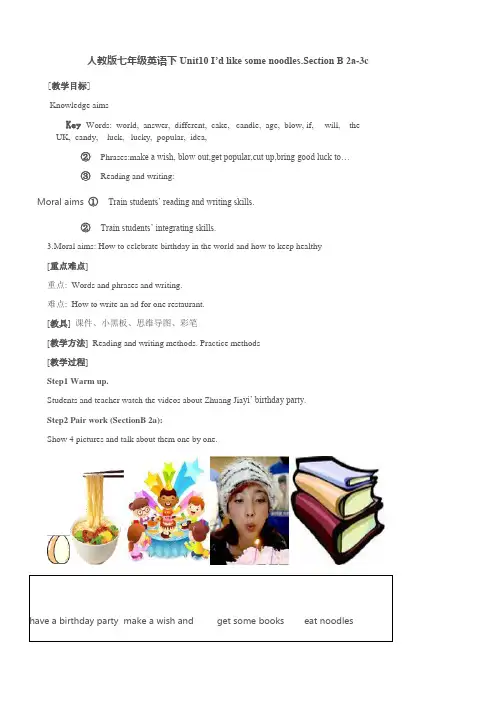
人教版七年级英语下Unit10 I’d like some noodles.Section B 2a-3c [教学目标]Knowledge aimsKey Words: world, answer, different, cake, candle, age, blow, if, will, the UK, candy, luck, lucky, popular, idea,②Phrases:ma ke a wish, blow out,get popular,cut up,bring good luck to…③Reading and writing:Moral aims ①Train students’ reading and writing skills.②Train students’ integrating skills.3.Moral aims: How to celebrate birthday in the world and how to keep healthy[重点难点]重点: Words and phrases and writing.难点: How to write an ad for one restaurant.[教具] 课件、小黑板、思维导图、彩笔[教学方法] Reading and writing methods. Practice methods[教学过程]Step1 Warm up.Students and teacher watch the videos about Zhuang Jia yi’ birthday party.Step2 Pair work (SectionB 2a):Show 4 pictures and talk about them one by one.1. People in different countries eat _________foods on their birthday, but the ideas are the _________.They bring__________ _________ to the birthday person.2. Find three foods:_________ _________and _________.3. Find two countries: _________ and _________.Task2: Careful reading (分段阅读,把握重点)1. Ask students to read silently Paragraph2 and Paragraph3Let students read and do by themselves1)Complete the chart.1. Let students read the article again and find out importances and difficulties, and then underline and write downthem in their notebook. At the same time, read Tongbu P108 Notes on the text and IV. Special difficulties. Such as:cakes with candles make a wish blow out in one go come trueget popular cut up2. Teacher tries to lead students to guess the meanings according to the text or use the dictionary to help.3. Students talk in groups and help each other.4. At the same time, teacher walks around and helps to deal with any problems that students offer.Step5 Let students look at the mind map and retell the article.Step6 Do some exercises: Tongbu P109 Exercise I.Step7 3a.1. Let students look at the picture and the topic, then guess what the main idea is.2. Fill in the blanks in the ad with the words in the box by themselves.3. Check the answers together.4. Talk in small groups and focus on how to write an ad. Pay attention to the title, the beginning ,the content andthe ending.Step8 Homework:A: (For lower level students)1. Read 2b we have learned in this class fluently.2. Preview Unit11.B: (For higher level students)1. Retell 2b we learned in this class.2. Preview Unit11.。
人教版pep英语七年级下册 Unit 10 单元分析

使用了很多礼貌用语,如would you
麻婆豆腐。
like ..., I’d like ..., May I...
教学内容 语篇类型
What
Period 1 对话 (接上页)
补充视频:
一个加拿大人分别在 四个不同的快餐店 (披萨店、汉堡店、 三明治店、甜甜圈店) 的点餐经历。
Why
How
这一个非常真实的语料,它采用街 头实拍的形式记录了加拿大人在餐 厅的日常点餐经历。因为这个视频 是专门为英语学习者拍摄的,所以 它的用语非常丰富并且简洁地道。 视频中使用了四种点餐的句型:I’d like to order ... / I’ll have ... / Could I have ... / Could I get ...,当然这四个 句型的使用场合也有不同,要注意 区分。视频中服务员和顾客的对话 都是在真实的场景下发生的,和课 文的对话既有不同又有类似,能够 很好地帮助学生学习点餐用语、丰 富学生的语言表达。
教学内容 语篇类型
Period 3
对话
What
Why
客人打电话给饺子馆 1.学会如何点外卖
订餐。客人说明了自 2.通过语篇让学生意
己要点的食物和分量, 识到“点外卖”在年
餐馆记录了客人的地 轻人中是一种越来越
址和电话。
普遍的生活方式,由
此鼓励思考他们是如
何看待这种生活方式
的。
How
该对话发生的场景仍然是在中餐馆。虽 然现实中用外卖软件点餐占比较高,但 是该对话仍然会在现实生活中发生,比 较真实。该对话是对Section A语言的综 合运用,它既有询问点餐的用语也有询 问分量的用语。除此之外,该对话还有 一些外卖订餐用语,如:I want to order some food please. / What’s your address? / What’s your telephone number?
人教版七年级下册英语unit 10单元课件ppt(知识点超全)
1.May I take your order?请问您可以点餐了吗?
-23-
order作名词:点菜
take one's order点菜
I want to order the beef noodles.我想点牛肉面。
order作名词:命令,指示
She takes orders only from his father.他只听从他父亲的吩咐。
-26-
Would +主语+ like. . . ? ......想要......吗? 句型的答语:
肯定:Yes, please. /OK. /All right. ;
否定:No, thanks.
如需用一些, 用some而不用any。
Would you like some fruit? 你想来点水果。
-1-
Unit 10 I'd like some noodles.
-2-
A: What would you like? B: I’d like some…
oranges
apples
Fruits
-3-
A: What would you like?
B: I’d like some…
bananas
strawberries
-12-
Noodle house
specials
What kind of noodles are they?
-13-
What size bowl of noodles would he/she like? He/She’d like a…bowl of noodles.
small
medium
large
人教新目标英语七年级下册第10单元复习(共14张PPT)
chicken and cabbage noodles.
Fill in the blanks.
A: Can I__h__e_lp___ you? B: I’d like some noodles,_p__le_a_s_e___ .
A:What kind of noodles__w__o_u_l_d__you like? B:What kind of noodles do you___h_a_v_e___?
• And what size of dessert would you like?
Smallm, _e_d_i_u_m__, or large? We also have
ora_n__g_e_j_u_ic_e and _g_r_ee_n__t_e_a___ .
修饰名词的词
1.只能修饰可数名词复数的词 数词,many,several,a few,few,a (large)number of, 如:two apples两个苹果,several books几本书
3.clean (干净的) <形容词> dirty (脏的)/ (打扫) <动词>
4.beef and tomato noodles (牛肉西红柿面)
5.chicken and cabbage noodles (鸡肉白菜面)
6.potato and mutton noodles (土豆羊肉面)
7.What kind of….would you like ? (你想要哪种……?)
7. If you are lost in the forest, what _(C__)_ you do?
A. would like B. like
Unit 10 单元整体教学设计 七年级英语下册(人教版)
在日常话题中运 用点餐的句型, 学会得体有礼貌 的在餐厅提问和 表达自己的需求
1.掌握询问和描述
本文段采用服务员 食物的词汇和句型
和顾客对话的形式,2. 可以在日常生活
轻松愉快,易于理 中点餐
解和掌握
3. 加强口语练习,
输出目标语言
26
第二课时SectionA 2d-3c课例展示
问题导入,理解文意
How 数名词和不可数名词
8
单元目标概览
语言知识
可以掌握食物相关的可数和不可 数名词 掌握what 引导的特殊疑问句
思维品质
学会分类归纳可数名词和不可数 名词 可以根据所听或所读内容整理表 格信息 能将所学的食物名称进行分类
语言能力
能够熟练运用目标语言对对方的需求 进行提问
可以书面输出广告性质的文体,为餐 厅做介绍
和语言表达通过这些听说活动学生学会在相应
的语境中,运用核心句型和重点词汇进行初步
的口头语言输出。
学习层次 学习理解
18
统筹课时安排
课时类型 教材板块
语篇内容
语法课
2d是两个学生在中餐厅里点餐,在语境当中加
强了对于目标语言的应用,语法部分梳理了S
A所学的语言结构主要包括would,不定代词
some和any以及可数不可数名词的用法。3a的
听前训练 储备词组
听力训练 细节挖掘
听后检测 加强效果
30
第四课时SectionB 2a-2c课例展示
what 语篇内容
单元主题:人与社会(食物)
why
how
语篇意义
内容结构、文本类 型、文本风格
教学目标
技能与策略学习要 点
介绍了中国和英国在生 日时不同的饮食习惯。
人教版七年级英语下册Unit 10 第十单元教学课件PPT
1b Listen and check (√) the noodles that the
person orders.
____ Special 1 ____ Special 2 ____ Special 3
What would
I’m not sure yet. Are
youa辨nli析yk形ea?n容y词与,so意m为e “一些”
What kind of noodles would you like? I ’d like ___m_u_t_t_o_n_a_n__d_p_o_t_a_t_o_ noodles.
What size would you like? I ’d like _m_e_d_i_u_m__ bowl.
Let’s read & answer the questions
Waitress: Sure. What sizesiwzeo大u小ld;y尺ou码l;ikweh?at size常用
来询问物体的尺寸、大小。
Sally: Large, please.
with作介词,意为“同;跟;和……一起”
Tom: We’d also like gongbao chicken and some mapo tofu with rice.
Waitress: Yes, _t_h_e_r_e_a_r_e_ some tomatoes. Boy: OK, I’d like the _b_e_e_f_n_o_o_d_l_e_s , please.
1c Practice the conversation in 1a with your
partner. Then make your own conversations.
人教版初中七年级英语下册第十单元Unit10教案含教学反思
⼈教版初中七年级英语下册第⼗单元Unit10教案含教学反思第10单元I’d like some noodles.类别课程标准要求掌握的内容话题Food⾷物Section A 单词noodle n.⾯条beef n.⽜⾁potato n.⼟⾖;马铃薯would modal v.(表⽰意愿)愿意yet adv.还;仍然large adj.⼤号的;⼤的order n.& v.点菜;命令size n.⼤⼩;尺码bowl n.碗meat n.(可⾷⽤的)⾁special n.特⾊菜;特价品adj.特别的;特殊的cabbage n.卷⼼菜;洋⽩菜mutton n.⽺⾁tofu n.⾖腐短语would like愿意;喜欢take one’s order 点菜what size多⼤(尺⼨)one (large)bowl of…⼀(⼤)碗……what kind of哪⼀种……句型1.—What would you like? 您想要点什么?—I’d like some noodles. 我想要些⾯条。
2. Are there any vegetables in the beef noodles?⽜⾁⾯⾥有蔬菜吗?3. We’d also like gongbao chicken and some mapo tofu with rice.句型1. The number of candles is the person’s age.蜡烛的数量是过⽣⽇的⼈的年龄。
2. If he or she blows out all the candles in one go,the wish will come true. 如果他/她⼀⼝⽓吹灭所有的蜡烛,许的愿望便会成真。
3. They never cut up the noodles because the long noodles are a symbol of long life. 他们从不切碎⾯条,因为长长的⾯条是长寿的象征。